For more cartoons, visit thedailysnooze.com.
Category: Life
How do people remember?
There is no stipulated time in life when we start “forgetting.” We all forget. As we increase our knowledge, so also we begin to forget: an item here, an occurrence there, a dangling thread that goes nowhere. Sometimes retrieval is simple: a particular smell, sight, sound or touch may jog the memory and most of what we have forgotten comes flooding back and we recall so much. Sometimes, it is not, and the memories fail to come.
Spending time with old (i.e. longtime) friends, one often takes a walk down memory lane. Soon, we are recreating an entire evening, for example, of an event that happened some 25 years ago and pictures flood in helter-skelter – we cannot wait to recall this or that person, how we looked and felt, what we ate or where it all took place.
There is much nostalgia that we recall with wistful and loving good feelings. When we think about a close chum who was special, we remember our times together; when we open a drawer and our eyes spot a long-forgotten photo or trinket lodged at the back, we relive a past moment.
Not everything is pleasant to remember or rehash, of course. Sometimes in the remembering, we re-feel the pain of long ago, and the sadness that often accompanied the ache. Even though time has passed and healed so many wounds, there are some memories that time does not allow us the forgetting.
Remembering is not heartbreaking per se; it is simply that we are looking through the other end of the telescope. The past is not as sharp or as large as the present and, in that moment of reflection, it appears so far away.

How do we remember? A touch on the arm, a particular look in someone’s eyes, a suit or a dress found in the closet.
When we start on a journey into the past, we are often off and running, breathlessly gulping down gobs of stuff that hasn’t crossed our mind in ages. We wonder how So-and-so is. Is she still around? How many kids did she and her “no-goodnik” husband end up having? Well, he was a character of the first waters, that’s for sure!
At another time, we might think to ourselves, I remember that handsome guy who used to come to the club; for the life of me I can’t recall his name … but I remember he was a damn good dancer and I loved being held and gently beguiled around the floor. Wonder if my friend in Australia would remember him? There was something about him having more than a drop or two of royal blood – from his father’s side, because his mother must have been Jewish … and, horror of horrors, we heard he was a bastard! (We didn’t use words like “illegitimate” back in those days where I came from.) Somehow, my friends and I didn’t seem to mind.
I could go on. One mental image leads to another so swiftly and a part of one’s life is relived in sizzling rapidity. We sometimes stop to examine a nugget, turning it this way and that, enjoying the feelings, the movements, the music. Not only do we not miss a beat, but we recall the tiniest details sometimes: faces, antics, what we ate, even the weather. Remember how it rained that night? I had to throw away my shoes! And so it goes. Or so it goes for us on such journeys in time.
Is this traveling safe? Of course it is! However, we are not meant to sit and brood for too long on the past. A dip here and there into something is quantum sufficit, and we do our best not to dwell unduly.
Is it time well spent? Should we be doing something more worthwhile? Somehow I get the feeling that we all need to connect with the past; with our pasts. It is like connecting the dots of our personal history and, in that way, somehow legitimizing who we are; not only who we are today but who we were then. Hence, these rememberings are very special, very important.
You can find your genetic makeup but that won’t tell you about your grandfather’s first suit, or how fast he outgrew it! Or how nerdy he felt wearing it for his bar mitzvah.
How much do you, dear reader, know about your parents’ rememberings? What do you know about your grandparents’ memories? Do you have a sense of who you are in that way? You can find your genetic makeup but that won’t tell you about your grandfather’s first suit, or how fast he outgrew it! Or how nerdy he felt wearing it for his bar mitzvah.
Events usually are recorded and can be recalled. However, it is being able to sit down comfortably next to your parent or grandparent and “chew the fat,” so to speak, that is truly meaningful. The plum in the pudding is the rare offering of a safta’s or a bubbe’s feelings, a saba’s or a zayde’s memory, and the contemplation today about how it was in the yesterdays of their lives. When a parent or a grandparent begins, “Oy, I must tell you,” it is in that moment that you start to get a sense, a brief glimpse, not so much of how it must have been, but rather how it felt.
Engaging in this sort of companionship is a win-win situation. A safta, for example, feels tremendously good, almost like she’s making you a meal, feeding you once again. It is that sense of giving, sharing, depositing for safekeeping. And, really, it is so much less exhausting and stressful compared to making another batch of komish broit, another bowl of matzah ball soup; never mind the washing up after! And you feel strengthened and joyful receiving the precious gift of a part of your heritage, which is unique to you and your family. It’s a little bit of your history, as well as a piece or two of the fabric of the community in which you live.
It is never too soon to have this type of interaction. It is sometimes too late – I never had the good fortune to know my grandparents, who came from Baghdad in Iraq and Persia (Iran today). My mother died when I was 12. My knowledge of my forebears would fill less than a page. This is my tragedy. Researching the history of these Jewish communities is akin to a starving person scratching for food from a parched earth: too much desert with nary a signpost to sustenance.
So, how do we remember? You can look through a box of photographs but if no one is there to tell you at whom or what you are looking, or if you didn’t experience those moments yourself with your loved ones, you might as well add the pictures to your recycling pile and take them to the curb. As an elder, I say to you: we need to be remembered – not just for our health and happiness, but for your sake as well!
Seemah C. Berson, born in Calcutta, India, in 1931, has lived in Vancouver since 1954. Married to Harold, with four sons and various grandchildren, baruch Hashem, she and Harold are longtime members of the Peretz Centre for Secular Jewish Culture. Author of I Have a Story to Tell You (Wilfred Laurier University Press, 2010), comprising the personal recollections of Jewish immigrants to Canada between 1900-1930, subsequently working in the Canadian garment industries, she is a freelance writer and occasional dabbler in art, children’s poems and stories.
Researching family history is deeply rewarding
The author’s grandfather, Solomon/Zalman (later, Bernard), is at top right.
I have been researching my family history for some years now. Usually, over the winter break, when life slows down to a dull roar and I can spend time at the computer. I pore over JewishGen for hours, entering names of people and places into search engines. The same searches over and over, hoping that databases will have been updated; that something in my mind will click; that I will finally reach the right person; that the right person will still be alive – that someone will be able to tell me what happened to the women in that photo. The photo from Vienna. The photo of the family that could have been. That should have been. These four brothers and two sisters. The brothers who escaped. The women who did not, and perished. Where? How? The women whose stories have never been told. Or maybe they were told to someone in the United States, Argentina, Scotland or Mexico – but not to me.
In recent months, I have started to ask new questions. These new questions are concerned, as ever, with the people in the photo. But they are also about my own motivation. Why do I feel compelled to keep searching? Why do some people live by the adage that it’s all water under the bridge, while others steadfastly paddle upstream? Would it not be easier to drift with the currents of time, away from our family’s past and just meander, uncomplaining, toward the future?
People used to tell me that true self-knowledge only comes to us when we have children of our own and are challenged daily, hourly, to face ourselves. We find out if we have truly stuck to the resolutions of childhood. You know, the resolution that we’d do things differently, be more engaged, more sensitive, empathic, less busy, more patient – that we’d truly remember what it was like to be a child.
Sure enough, since my first searches brought me in touch with my many cousins, I have had children of my own. I watch our older child leaving behind his early childhood, becoming more and more aware of our small family unit. I hear his wistful questions during each year’s big festivals and explain that our family is scattered across the world. I set up Skype for him to speak to relatives on other continents. His curiosity, persistence and intellect are bound to lead to more searching questions, questions about who we are and where we came from. And since he is already attached to his Jewish roots in our household of mixed traditions, I know that I’ll need to get my story straight soon enough. I know this because it is already beginning. Perhaps this is why I search, I wonder? So I can look him in the eye and know that I don’t have to fudge it?
But then I realize that my motivation comes from a more complex place than one where i’s are dotted and t’s are crossed. It’s not just about information; it’s about education.
There is certainly no education quite like motherhood. Children are such dogged teachers. Their curriculum may seem haphazard at times, their lesson planning a little sketchy, but when I take a step back – a really big step back – I find that what they are teaching me has as much to do with my ancestors as the two little chaps asking me to help them finish a puzzle, reassemble a broken toy or read a particularly difficult word.
Researching one’s family history is a gesture as deeply spiritually maternal as the act of raising one’s own children. Yes, there is a visceral desire shared by all humans to know where we come from and who we are, but there is an added layer of compassion, of love, of nurturing that comes when the people we love are gone.
Researching one’s family history is a gesture as deeply spiritually maternal as the act of raising one’s own children. Yes, there is a visceral desire shared by all humans to know where we come from and who we are, but there is an added layer of compassion, of love, of nurturing that comes when the people we love are gone. And not only are they gone, they left us too soon and in a manner so horrific that time and again, the adjective I hear from survivors’ children and grandchildren is “secretive.” So often, people simply don’t want to talk. They don’t want to share their stories because that would mean choosing to relive the horror, to tell tales that are replayed in dreams over and over again. The ones that wake them up at night and destroy the possibility of sleep for hours to come.
Those of us who grew up in the safety of this part of the world, we who are too young to have been witnesses to these crimes against humanity, we are aware of our good fortune. We know how lucky we are to have grown up in peacetime and, yet, we can feel somehow diminished by our lack of suffering. At the same time, and as we become parents ourselves, we dream of extending our parental love back through time to embrace and soothe the wounds inflicted on our forebears. We recall those who died in infancy or childhood. Having expanded our capacity for love, our fluency in that subtle language, we want to communicate absolute safety to that vulnerable child, the terrified adult unable to keep her children safe. We are challenged by the desire to reach out to our tormented and murdered ancestors, adults and children alike, to lift them out far beyond the atrocities and into the warmth of our own homes, our present, a safe and comfortable existence that they never knew.
And yet, unable to do so, we do what we can. We learn their names and we express our empathy and our sorrow by inscribing them and their stories in Word documents late at night while our children sleep, so that tomorrow, when they wake up, their parents can let them know, as they do every single day, that they are loved, that their world is safe and that, as small as it is, the human heart embraces the whole wide world.
Shula Klinger is an author-illustrator in North Vancouver, B.C. Her young adult novel, The Kingdom of Strange, was published in 2008 by Marshall Cavendish.
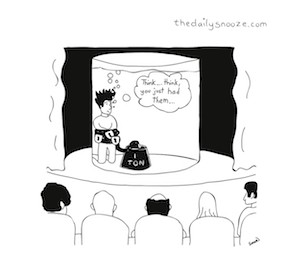
This week’s cartoon … Feb 14/14
For more cartoons, visit thedailysnooze.com.
Mystery photo … Feb. 7/14
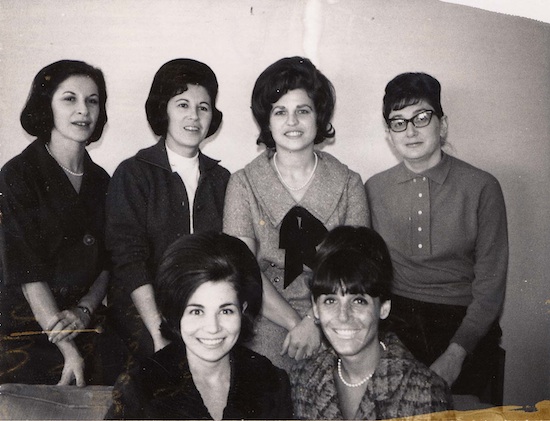
Pioneer Women group, Vancouver, B.C., 1960. (JWB fonds, JMABC L12600)
If you know someone in this photo, please help the JI fill the gaps of its predecessor’s (the Jewish Western Bulletin’s) collection at the Jewish Museum and Archives of B.C. by contacting [email protected].
This week’s cartoon … Jan. 24/14
For more cartoons, visit thedailysnooze.com.
This week’s cartoon … Jan. 17, 2014
For more cartoons, visit thedailysnooze.com.
Mystery photo … Jan. 10/14
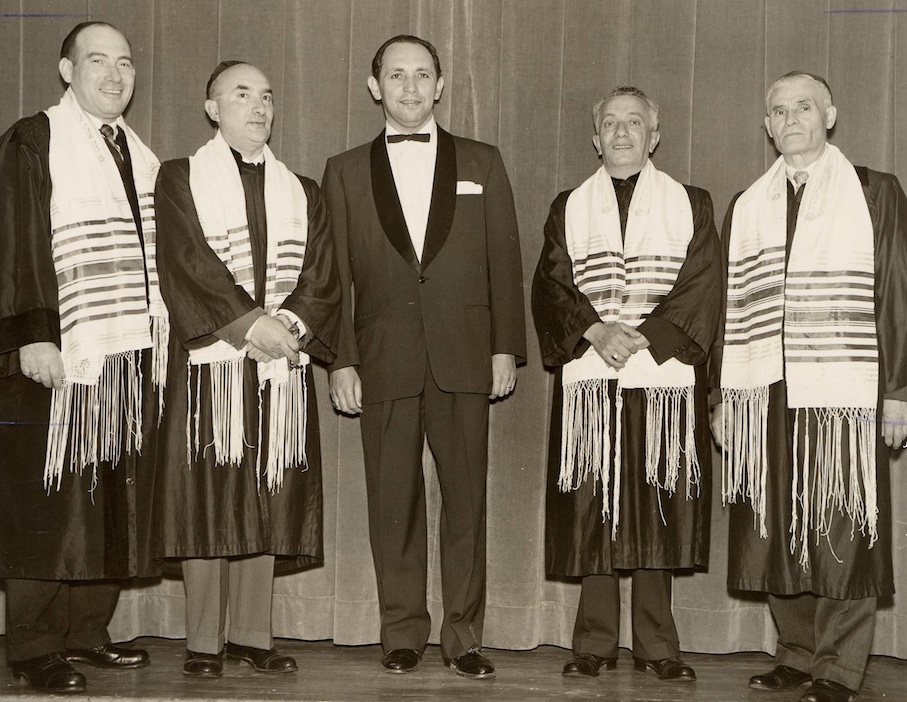
State of Israel Bonds parlor meeting, men’s group, Vancouver, B.C., 1964. (JWB fonds, JMABC L.14507 )
If you know someone in this photo, please help the JI fill the gaps of its predecessor’s (the Jewish Western Bulletin’s) collection at the Jewish Museum and Archives of B.C. by contacting [email protected].
This week’s cartoon … Jan. 10, 2014
For more cartoons, visit thedailysnooze.com.
Complexities of human sexuality
Some people still act as if same-sex attraction were a crime or, at least, an abomination and ought, therefore, not be tolerated. Russia, for example, recently announced that it will not permit any of its orphaned children to be adopted by people living in jurisdictions recognizing homophilic marriages, thereby ensuring that they will not end up in any of the more liberal democracies, including Canada. Perhaps this is based on the supposition that homosexual adoptive parents will somehow transmit their sexual preference to their charges, although there is no evidence that such attraction is a learned behavior, nor, indeed, that it is inherited. And, in either case, why should it be anathematized? It evidently does not harm consenting adults and becomes a crime only if we insist that it is.
For as long as there has been human heterosexuality, there has also been homosexuality. Overwhelming psychological and historical evidence demonstrates that same-sex attraction has been a consistent feature of human society, going back at least to the earliest days of antiquity, and that it harms no one who does not, somehow, insist on being “harmed.” The only people who may suffer are homosexuals themselves who, if they live in a bigoted environment, often have to conceal their sexuality or face expressions of disapproval, including imprisonment and violence, especially if they are men; female homosexuality seems more widely accepted.
There is no mention of homosexuality in the Christian Testament. The Jewish Testament, while decrying homosexuality between men, makes no mention of sexual attraction between women, which certainly existed.
God’s destruction of Sodom was allegedly a consequence of what is described as its “depravity,” (Genesis 13:10) interpreted as sodomy, a word still appearing in some criminal codes and defined as “the unnatural sex acts between two men.” (This became the basis for a criminal indictment in the notorious 1896 trial of Oscar Wilde, which my 1929 edition of Encyclopedia Britannica describes as “moral obliquity.) But Sodom was more likely destroyed because it was notoriously inhospitable to strangers, its sole survivor being Lot, the city’s only cordial resident. (And his wife, who shortly thereafter turns into a pillar of salt because she disobeyed God’s order by looking backward at the doomed city. As a side note, while Lot exhibited remarkable concern for his male guests, that evidently did not extend to his daughters, whom he offered to the mob.)
Leviticus is more explicit. In 18:22, it states: “Thou shalt not lie with mankind as with womankind; it is an abomination.” This inveighing against homosexuality was likely occasioned not by presumed morality, but rather as a consequence of a far more important remonstrance, viz., “Be fruitful and multiply” (Genesis 1:28), a demographic imperative necessitated by competition among various peoples, some of them more numerous than the Israelites, in the Fertile Crescent of Canaan. The “sin” of Onan (Genesis 38:9), for example, has been interpreted as not being simply that he cast his semen on the ground in coitus interruptus with Tamar, his widowed former sister-in-law, but that he subverted God’s command to “be fruitful and multiply.”
Much effort has gone into uncovering the underlying causes/motivation(s) for homosexuality. Theories have ranged widely, yet none has adequately explained same-sex attraction in spite of its apparent inevitability among persons of both genders, its long history, and its observed appearance in non-human species.
Much effort has gone into uncovering the underlying causes/motivation(s) for homosexuality. Theories have ranged widely, yet none has adequately explained same-sex attraction in spite of its apparent inevitability among persons of both genders, its long history, and its observed appearance in non-human species. Moreover, there may not be a single cause, but rather a constellation, perhaps including social, hormonal, genetic and environmental factors and, furthermore, one ought not assume that explanations for male homosexuality, no matter how cogent, can be extended to female homosexuality (lesbianism). To place this in perspective, the causes of heterosexuality, while it is evidently the norm and can result in progeny, are also not clear, although convention, conditioning and an impulse toward parenthood must be counted prominently among them.
In our current more-accepting environment, many homosexuals have “come out of the closet.” But we may never know the full extent of homosexuality because in disapproving social-cultural environments, even its self-acknowledgement may be difficult. Indeed, in many jurisdictions, homosexual behavior is still criminal, although its practitioners are rarely indicted. Far more common is that suspected homosexuals, especially men, have been the targets of blackmail, violence and murder. Even when the public is more tolerant, there is no uniform level of acceptance, so often homosexual relations are still clandestine for fear of the reaction of relatives, employers, fellow workers and others, including heterosexual spouses. “Coming out” by formerly “closet homosexuals” is still a life-changing and challenging experience. Consequently, public homosexual behavior still is dependent on local acceptability. What is permitted, for example, in Vancouver or Tel Aviv, may precipitate expressions of disapproval elsewhere.
It is estimated that exclusively homosexual men constitute about five percent of the male population, with approximately twice that number being occasionally homosexual. From an anatomic, physiologic, genetic or endocrine point of view, homosexuality offers no reliable markers. It is neither entirely genetic nor developmental in origin. The level of gender-related hormone production in most homosexuals does not differ significantly from that of heterosexuals and, ordinarily, male and female homosexuals, in their usual behavior and appearance, can be indistinguishable from their heterosexual peers or, on the contrary, they may, in the case of males, become “queens,” or of females, “butch.” Indeed, who has not speculated on what life might have been like, had he or she been of the opposite gender? (Interestingly, all human fetuses start out with external genitalia apparently female. While there are no proven instances of parthenogenesis – the development without spermatozoa of a complete embryo – among people, it can occur in other mammals.)
To offer additional revealing commentary on the idiosyncrasies of human sexual behavior, approximately 270 days after every nighttime power outage lasting a few hours, there is almost invariably a small but significant blip in the number of babies born in the affected area.
To offer additional revealing commentary on the idiosyncrasies of human sexual behavior, approximately 270 days after every nighttime power outage lasting a few hours, there is almost invariably a small but significant blip in the number of babies born in the affected area. Evidently, when it comes to TV versus sex, the data suggest that the former is frequently preferred.
However, our culture, if not obsessed with sex, is obviously mindful of it. Advertisers certainly have discovered that sex sells. “Sexy” has now become an adjective that defines anything from form-fitting or revealing clothes to a more permissive tax bill. It usually implores us to be more attractive (“sexy”) by the profligate and indiscriminate purchase and use of a great variety of products. In any case, any mention or hint of sex, almost without fail, attracts attention.
Sexual intimacy plays a prominent role in the way men and women relate to one another and, to be complete, the way women relate to women and men to men. The desire for sexual intimacy can arise from many sources – the release of sexual tension (a large factor in adolescence and youth), an expression of love, reassurance of one’s sexual attraction and capability and, since we live in a largely competitive society, to keep up with the purported national average. People being as variegated as they are, there are any number of other conceivable reasons and their combinations. So, while the heterosexual form of sexual intimacy is predominant (and the only one that can now give rise to progeny), finding the reasons can be difficult because, as is the case in uncovering the motivation for any human activity, although the final common pathway can be an objective behavior, the impulses for it are never in the singular, and may be arcane, derivative and complex.
It is clear that traditional Judaism does not approve of homosexuality, although congregations, individual Jews and rabbis may have a more accepting and realistic approach. Yet, the Talmud has the virtue of candor, suggesting, for example, frequencies, according to profession, of (heterosexual) intercourse, something quite unimaginable in Christian commentary, especially when one considers the Catholic priestly vow of chastity and that the preeminent female in Christianity is considered a virgin, even after the birth of Jesus’ younger sibling(s).
When it comes to all (non-coerced) sexual behavior, former prime minister Pierre Trudeau cogently declared that “the state has no place in the bedrooms of the nation.” It’s a sensible sentiment also expressed, in pithier form and broader terms, by Jimmy Durante, a popular madcap comedian of the 1930s and ’40s, known affectionately as “The Schnozz” because of his prominent proboscis: “Leave da peepul,” he vigorously intoned, “da hell alone!”
Eugene Kaellis has a doctorate in biochemical endocrinology. He is the author of several publications, including Making Jews, on the theme of the current basic problem of Diaspora Jewry, which is available from lulu.com.