Ballet BC creates with Salant

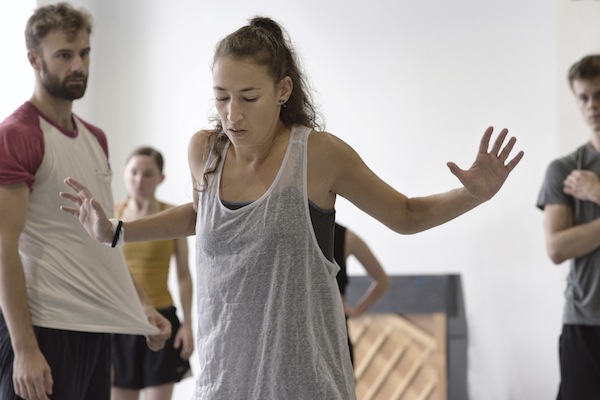
Israeli choreographer Adi Salant will be at the Ballet BC première of her work Feb. 28-March 2 at Queen Elizabeth Theatre. (photo © Michael Slobodian)

“I could not let it go on without being there to see the outcome,” Adi Salant told the Independent in a phone interview from Israel about the new work she is creating with Ballet BC. The piece will have its première Feb. 28-March 2 at Queen Elizabeth Theatre.

Salant was in Vancouver last August to work with the company and she was scheduled to return here earlier this week to help prepare for the performances.

“The [creative] process was split into two periods,” she explained, “and I was there for three weeks [in the summer], building the major part of the piece. Now I’m coming, it’s more the last adjustments, refining, rethinking, being open to the suggestions that will happen, but most of it is ready and they are working on it now, preparing it for my arrival. I’m very excited to meet them and meet the piece again because it’s been awhile.”

Salant knows Ballet BC artistic director Emily Molnar from the world of dance in general, but the two really connected just over two years ago, when Salant was invited to be one of the choreographers taking part in the inaugural Creative Gesture, a residency program led by Molnar and program head Stephen Laks at the Banff Centre. For the program, Salant had to create a short piece for the young dancers, who attended the residency from several countries, “to see how it is to work professionally.”

“I really enjoyed the energy there and the way I worked with the dancers. And she [Molnar] believed in me and gave me the opportunity to come and work with her company.”

Creating something in two time periods is interesting, said Salant. “It gives you time to reflect and to visit it with videos, or in my mind or afterthoughts of what happened. Even though I’m not there [in Vancouver], it’s like I stayed with the dancers. I got to know them.”

The limited amount of time made the work more intense, she said, “because both the dancers and I know, OK, we have now three weeks. There’s engagement and we’re just going for it.”

The piece involves many dancers. “I knew I wanted a feeling of a big group,” said Salant. “I think there will be 17 people, if I’m not mistaken. I fell in love with all of them and we want to use everybody…. I enjoyed so much and appreciated so much the energy and open hearts, and diving in with me to the unknown.”

In considering the piece about to be performed, as well as her previous works, Salant said, “I am just so fascinated by life – the everyday kind of life and the demands of life and the struggles. Some people, they create from what they dream about; I’m more about what I’m experiencing every day, so that’s the energy [of the new piece]. It’s about how, in life, you can plan and plan, but you can meet someone … if it’s a job interview or, for our profession, if it’s an audition, so he chooses, yes you are in, no you are out, and how [that concept] applies to the rest of your life. Or where you’re born … if you’re born into this kind of society or this kind of place, it’s also affecting you…. You can aim, but, in the end, we divide: you go there, you go there, you yes, you no, you up, you stay there, you down.”

Salant has been dancing since she was a young girl. “I started to dance in Bat-Dor dance group in Tel Aviv when I was 6…. When I graduated high school, I went for an audition … and, lucky for me, I was the one that got the yes.”

After two years at Batsheva Dance Company, she was invited to join the main company, with which she danced for five years. “Then I left, but I stayed in a very close relationship professionally with Ohad Naharin [then-artistic director of Batsheva], staging his works all over the world … and setting his repertoire for different companies – this is actually where I met Stephen, who I mentioned before. He was dancing in Les Grands Ballets Canadiens. It’s very nice and very exciting for me to look back and to realize, on this journey, I have met so many people.”

Members of her generation of dancers are now leading companies, choreographing and teaching, she said. “It’s really nice to see, and I enjoy very good and close relationships with my colleagues and we continue to share our passion in that way.”

Salant returned to Batsheva in 2009, but, she said, “this time, Ohad invited me as the co-artistic director.” She held that position until October 2017, when she struck out on her own.

“It’s part of my journey – all the tools that I collected until now and the experiences, and having actually more time now that I’m not directing a very busy company and dealing with the schedule of the company,” she said. “Now I have my schedule, and [am] owning my time in a way. I put the focus on choreographing and teaching workshops around the globe.”

Salant said she has created a motto of sorts for work, “Adi – Life is Moving,” “because I really enjoy meeting with people and, [while] it’s true that I’m coming to teach dance to them, I really connect it to life, and their life and how their emotions and, again, like I said about my work, this piece, it’s the same when I’m teaching or when I’m working now with the dancers of Ballet BC. Yes, I’m giving them the movements but I’m all the time connecting it to life, to the everyday behaviour. That’s what I’m aiming for.”

Salant teaches in various places around the world. This April, for example, she will be in Los Angeles for a week. “It’s called the Gypsy Project…. It’s the second time that I am involved there,” she said. “I’m looking forward to go, and to share and to learn and to deepen my knowledge and understanding.”

Salant reiterated her appreciation for Molnar. “As I said, I left my job as the co-artistic director and it’s, of course, a demanding job and you’re recognized with this position and with this place…. When I left and wanted to now continue to choreograph, because I did choreograph before, but I put it on hold because it was too intensive with the company life and, of course, I have three kids, something had to wait … Emily really was the first to open her door and believe fully. It’s not something that you see so often, that you feel that someone believes in you and takes a chance and appreciates who you are, knows your strengths and believes in your strength, no matter your title.”

Salant has enjoyed working with Ballet BC. “I had an amazing meeting with the dancers,” she said. “They inspired me and moved me a lot, so I really can’t wait to come back on Monday [Feb. 11], even though I miss my family. I have to leave three kids behind, and that’s the hardest part, but I’m happy that we can share again our time together and bring it on stage and to the audience what we did.”

Salant and her husband, Jesper Thirup Hansen, have two daughters, 10 and 8, and a 5-and-a-half-year-old son. Thirup Hansen is a physiotherapist. “I met him in Batsheva, he was a dancer, he is Danish,” said Salant. “Actually, they joined me in the summer in Vancouver; the whole family came. They had such a great time. I came to their place from work, and they told me all the fabulous things they did that day.”

For tickets to Ballet BC’s Program 2, visit balletbc.com.

Comedy for youth sport

Comedian Jacob Samuel headlines A Night of Shticks & Giggles Feb. 21 at the Rothstein Theatre. (photo from JCCGV)

In just one week, I will be standing on stage at one of the most exciting events I have ever been a part of. On Feb. 21, some of the funniest stand-up comedians in Vancouver will join me in the Jewish Community Centre of Greater Vancouver’s Rothstein Theatre, using laughter to raise money for JCC youth sports scholarships.

A Night of Shticks & Giggles is co-produced by the JCC and Rise of the Comics. Headlined by 2017 Yuk Off champion Jacob Samuel – It’s good to finally see a successful Jewish comedian, right!? – it will also feature a performance from Larke Miller, who I remember watching on The Late Late Show with Craig Ferguson, as well as several other local comedic stars.

While the show will be one of those guaranteed good times for the audience, for me, it also represents a unique opportunity to combine two of my great passions.

Passion #1: As the delegation head for the JCC Maccabi Games – an athletics and arts program that provides Jewish teens the opportunity to travel and experience an Olympic-style international event – I have the responsibility and honour of raising scholarship funds to enable as many teens as possible the chance to participate in this life-changing event.

Passion #2: As a stand-up comic still in his rookie season, I get to meet, learn from and share the stage with some of the city’s top comics. Not to mention the opportunity to stand and perform my craft in front of an audience of 200+ in the Rothstein. (Gulp!)

As a producer of the show, the fact that I will be performing my own original set kind of makes me like that kid who got to start on the soccer team because my dad happened to be the head coach. Except, in this case, I also run the soccer team, picked my dad to be the coach and, oh boy, he’s putting me in!

While I might not end up being the funniest comic of the night, I can promise A Night of Shticks & Giggles will deliver the funny in spades.

Among his many local appearances, Samuel has performed on the Rothstein stage before, when the Jewish Independent team held their JI Chai Celebration in December 2017. He followed that up with his Yuk Off championship win, and his career has taken off since.

Harris Anderson, Joey Commisso and Randee Neumeyer have all inspired me with their irreverent, clever and sharp takes on life, as well.

Another one of the comics, Ed Konyha, used to run the award-winning open mic Stand-up and Deliver, the show in which I finally found the courage to perform my very first set as a stand-up comic.

Finally, Scotty Aceman, emcee for the night and producer of Rise of the Comics, has worked with me on a few shows now (this being the largest by far!) and is a huge inspiration for anyone thinking of quitting their day jobs and following their passion – no matter how little money it makes them. Aceman had a career in the cellphone business before giving it all up to bring comedy to Vancouver’s masses. Today, Rise of the Comics showcases Vancouver’s incredible comedy scene, producing and selling out regular live shows while featuring these local talents on their YouTube channel. His latest venture, Rise After Dark, offers people the chance to bring stand-up comedy right into their living room or private event.

Shticks & Giggles is a well-supported community event with a powerhouse of partnerships including the Chutzpah! Festival; Axis, the Jewish Federation of Greater Vancouver’s young adult initiative; and, of course, the Jewish Independent.

Tickets for A Night of Shticks & Giggles are $20 and can be bought online at ticketpeak.com/jccgv. Doors open at 7:30 p.m. on Feb. 21, with the show set to begin at 8 p.m.

Kyle Berger is coordinator, sports department, Jewish Community Centre of Greater Vancouver, and co-producer of A Night of Shticks & Giggles.

Welcome to Cabaret!

Dylan Floyde as Cliff Bradshaw and Erin Palm as Sally Bowles in Cabaret, presented by Studio 58. (photo by David Cooper)

“I honestly couldn’t think of a more important show to do right now, with such a divided political climate. The past is as important as ever, we must not let it fade. We need stories like these,” Erin Palm told the Jewish Independent about Cabaret, which opened at Studio 58 (Langara College) last week and runs until Feb. 24.

The musical is set in Berlin in 1929, as the Nazis begin their ascent to power in Germany. Palm plays the role of Kit Kat Klub headliner Sally Bowles, the British singer with whom American writer Cliff Bradshaw falls in love.

“Sally is such a complex character. I’d say the most important thing as an actor is honouring her, and acknowledging that she and the other characters in Cabaret are based on the real experiences of Christopher Isherwood, back in Weimar Berlin,” said Palm. “The biggest challenge for me is to know her apathy. It’s painful and tragic.

“I have, hopefully, given her autonomy throughout her journey. I am not a fan of judging the characters I play so, to combat that, I focus on how she is brave, independent and whimsical. She uses humour and imagination as a tool to get through her own challenges and I think that’s where the fun comes in. Really, she’s searching for freedom, and I love playing with that as an actor.”

Palm is in her third and final year at Studio 58. “I became a student the summer after I finished playing Fruma Sarah in Fiddler on the Roof with RCMT [Royal City Musical Theatre] and traveling to Toronto to do the National Voice Intensive. It was a big decision to go back to school, but I know the legacy of Studio 58 is that it turns out fine actors. I wanted to give myself the best opportunity to grow and gain new tools.”

Fellow Jewish community member Josh Epstein makes his directing debut with this production. A multiple-award-winning actor and filmmaker, he was a student at Studio 58, where he played the role of Joey in Pal Joey. “I also met my creative partner, Kyle Rideout, while there and we named our company Motion 58 in honour of Studio 58,” said Epstein. (He and Rideout recently sold a feature film pitch to Paramount with the Transformers producers, di Bonaventura Pictures, said Epstein, “and we have a variety of film and TV projects at various stages of development.”)

About returning to Studio 58 for Cabaret, Epstein said, “I’ve been talking to Kathryn Shaw [Studio 58 artistic director] for a couple of years about returning to direct something, as I now felt ready, and Cabaret was my first and only choice.”

Epstein said he has a few favourite scenes, ones “that bring tears to my eyes, but none more than a late scene between Herr Schultz and Fraulein Schneider, the older couple that has sweetly fallen in love. None of the characters truly knows what’s coming. Herr Schultz still sees himself as a German and firmly believes he won’t lose anything. It’s heartbreaking.”

Another returning Jewish community member for this production is lighting designer Itai Erdal.

“Studio 58 is one of my favourite places to work,” he told the Independent. “I keep coming back because I love the staff and I love the energy of the young students and because I’ve done some of my best work there. I find it to be a great working environment, which often allows for some real magic to happen.”

Erdal is enjoying lighting Cabaret, which has much darkness in it story-wise, as well as being set in a nightclub.

“Lighting musicals is always tricky but it’s really wonderful to light a musical like Cabaret, just because of that darkness you refer to,” he said. “So many musicals are very lighthearted and it is so refreshing to do a musical about something that matters so much. It’s also some of the best music ever written for theatre, so it’s a joy to light these iconic songs and support these brilliant young actors as they tackle those songs.”

Given that Cabaret is such a well-known musical, Epstein said, “I’m definitely encouraging the team to tell the story that’s written, first and foremost, but any staging or performance that’s been done before, I’m not that interested in repeating. We’re creating something that is unique to Studio 58, their intimate space, and it will be aggressive, fun and stimulating.

“I’m very excited for the fresh performances of Sally and the Emcee in our production,” he added. “I think we’ve found a Sally (Erin Palm) that doesn’t feel sorry for herself, that has strength and power and makes active decisions rather than accepting her lot in life. Our Emcee is female and, after watching how Paige Fraser has done it so far, I would never want it any other way. For one, she dances and sings better than most of the men who have played the role before onstage.

“We’ve also played with the musical numbers,” he said. “‘Mein Herr’ is gonna rip the roof off the theatre and I think we’ve reinvented the pineapple song [‘It Couldn’t Please Me More’].”

Epstein recommends that audience members arrive early. “There’s a burlesque show you won’t want to miss,” he said.

The production’s promotional material, which advises that the show is suitable for ages 16+, comes with the warning, “Possible nudity, probable vulgarity and other behaviour your momma won’t approve of!”

For tickets, visit langara.ca/studio-58/current-season.

Matchmaker embraces farce

Ric Reid and Nicola Lipman co-star in The Matchmaker, which is at the Stanley until Feb. 24. (photo by David Cooper)

If you are an aficionado of the absurd, an enthusiast of the exaggerated, a supporter of slapstick and an overall buffoonery buff, then set a date to see The Matchmaker.

Thornton Wilder’s work has taken over the Stanley Theatre with all the intensity and madness a play can muster and keeps farce fans delighted from opening curtain to final applause.

Matchmaker, which was first staged in 1955, is the retelling of Wilder’s original farce The Merchant of Yonkers and was a precursor to Hello Dolly!, one of the most popular Broadway plays of all time. It was made into a movie in 1969 starring Barbra Streisand in the title role of Dolly Levi.

Levi – played by Nicola Lipman in the Arts Club production – is the thread in the play that winds its way through four relationships of star-crossed lovers and would-be elopers. She’s a woman who “arranges things,” but is generally bored with life. The forceful matchmaker goes to Yonkers under the pretence of finding a wife for the crotchety Scrooge-like storeowner Horace Vandergelder (Ric Reid). Her real motive, however, is to snatch Vandergelder for herself.

Along the way, Levi tries to cement the relationships of Vandergelder’s niece, Ermengarde, and struggling artist Ambrose Kemper; milliner Irene Molloy and Vandergelder’s chief clerk, Cornelius Hackl; and Molloy’s assistant Minnie Fay and store clerk Barnaby Tucker. Quite a bit of work for one day, but Levi is ready to put in the effort if it will get her what she wants. She even goes so far as to make up an extensive story that she tells Vandergelder about a fictional 19-year-old potential spouse, just to keep him from marrying anyone else. And she tells Molloy that Hackl is a millionaire known in the best levels of society in order to ensure Molloy loses interest in Vandergelder. And that’s all just in the first act!

The second act brings all the characters together at the home of Flora Van Huysen, a friend of Ermengarde’s late mother, who Vandergelder hopes will keep Ermengarde and Kemper apart. But, it turns out the over-the-top opera-singing spinster is a romantic at heart and, despite a series of confused identities, manages to bring all the relevant couples together.

Now, it’s understood that a farce is comprised of ludicrous situations, improbable plot lines, absurd characters, exaggerated fashion and just about anything that falls under the categories of irony, satire and bad wit. Even so, I expect there to be some consistency within a person’s character, some personality traits that remain the same despite the nonsense of any given situation. I found that missing (or misdirected) in Molloy, one of the key characters, and an original love interest of Vandergelder.

Molloy is a hat-maker who admits to never having adventure in her life, and being very limited in her socializing. Yet, when she finally goes out to a restaurant, she acts like she goes out on the town every night, ordering the best food, telling people what to do, convincing the two clerks to sing in order to get a date.

Also, Molloy and Hackl supposedly fall in love at first sight. The feelings are clearly evident from Hackl’s actions, but it’s hard to get any sense of interest from Molloy.

It makes sense that Hackl, whose experience with women is so minimal, basically falls in love with the first one he meets and laments the fact that he has so little knowledge about the opposite sex.

“I’ll bet you could know a woman 100 years and never really know if she likes you or not,” he says, presenting an observation that many would say holds true.

Now, just in case you were wondering if this level of farce is your cup of tea, here are a couple of examples of the humour you’ll see. When Minnie Fay kisses store clerk Barnaby Tucker, he goes all “aw, shucks” and falls down. There’s a knee-slapper!

In another scene, they need some help from a cabbie, so they ask him, “Do you want to earn $5?” The cabman replies, “I don’t know; I’ve never tried.” (Cue the ba-dum-tshh post-groaner sound effect.)

If you enjoy these types of laughs, then Matchmaker should be right up your alley.

In a final note, kudos go out to set and costume designer Drew Facey for absolutely gorgeous visuals, and composer and sound designer (Jewish community member) Mishelle Cuttler for a score that complements the frenetic action on stage.

The Matchmaker runs at the Stanley Industrial Alliance Stage until Feb. 24. For tickets, visit artsclub.com.

Baila Lazarus is a Vancouver-based writer and principal media strategist at bailalazarus.com.

Girls funny, open and smart

Girls Gotta Eat co-hosts Rayna Greenberg, left, and Ashley Hesseltine have created careers they love. (photo from JFL NorthWest)

To say it’s a podcast about dating and relationships doesn’t begin to describe Girls Gotta Eat. Co-creators and co-hosts Rayna Greenberg and Ashley Hesseltine invite their guests to talk about pretty much anything, and pretty much as explicitly as they’d like. Recent topics include creating successful online businesses, avoiding toxic partners, managing depression, the health benefits of masturbation, and having sex with famous people – and that was on just one show.

Girls Gotta Eat celebrates its first anniversary this month, and Greenberg and Hesseltine will be in Vancouver for that milestone. The pair has two soldout performances at JFL NorthWest, which runs Feb. 14-23 (jflnorthwest.com). They were scheduled to do just one show initially, and the demand would have sold out a third, no doubt, and probably even a fourth. On Instagram, Girls Gotta Eat has garnered more than 69,900 followers in less than a year. (By the time you’re reading this article, that number will likely be more than 71,000, as the account gained 300-plus new followers in the space of two days last week.)

In addition to Girls Gotta Eat, Greenberg and Hesseltine each have other ventures on various platforms, including websites, Twitter and Facebook, but Instagram is where their celebrity status is most remarkable. At press time, Greenberg’s One Hungry Jew had more than 350,000 followers on Instagram; Hesseltine’s Bros Being Basic, more than 915,000, and her Fashion Dads, another 186,000. It is no wonder that a good chunk of time on the Girls Gotta Eat podcast is spent promoting advertisers’ products, mainly cosmetics and fashion. These women have worked hard to secure an enviable target market – their 30-something peers who have money to spend.

While Girls Gotta Eat generally focuses on one topic or guest, Greenberg and Hesseltine try to cover a range of topics and have different guests for the live version, as well as make the show an interactive experience for the audience.

“We typically try to have a guest that has already been on the podcast,” Greenberg told the Independent in a recent phone interview from Los Angeles, where she and Hesseltine were performing.

“It’s rare,” she said, “that we go to a new city and invite somebody we’ve never had on the show. Just because our audience is so invested in the show and they love it, it’s so exciting for them to be able to also see another person that was on the show.”

The weekly podcast now averages well over an hour. In its first several months, it was about 45 minutes, the approximate length of a commute to work, said Greenberg.

“As we had more and more guests, the show just became really fun. We want guests to feel like they can cover a range of topics and we don’t want to truncate the show, something that’s great,” she explained. “We don’t want to hold ourselves to 45 minutes if it’s great content, so it’s just gotten a little longer. There was no day where we woke up and said, let’s do an hour-and-a-half. So, it just depends on the guests; some episodes are going to be 45, some are going to be an hour-and-a-half, we’ll see when the guests come in.”

For Greenberg, the podcast was a huge departure from what she had been doing before.

“I’ve worked in restaurants, I went to culinary school and then I really worked in tech startups for a long time,” she said.

The Girls Gotta Eat podcast was Hesseltine’s idea initially.

“She is a comedian herself and she really wanted to do a show about dating and relationships, and wanted to find somebody that would be open and honest about their own lives and also could be funny,” said Greenberg. “She and I met on a press trip because we both have very large Instagram influencer accounts, and we just really hit it off. We had a great time with each other, we became friends over the course of a few months, and then she asked me if I’d be interested in doing this.”

As soon as the idea came up, said Greenberg, “I decided, and she decided with me, that it wasn’t going to be a hobby or a side project, this could be what we do. So, we focused on it as a business: we built a website, we had professional photos taken, we devised a way to market this. From Day 1, there was definitely a strategy of let’s make this a business, let’s expand it.”

Greenberg had already monetized her food blog, One Hungry Jew, by doing ads for brands. “For example, a company like American Express will come to me if they’re looking to attract a younger audience that has money and they’ll say, OK, we want to create a campaign that is designed to encourage people to use our AmEx Travel and they’ll give me an idea of what they’re looking for and, obviously, a budget, a price, and it can be something like, hey, we want to encourage people to sign locally, so go to a restaurant, take a photo of yourself at the restaurant, write a caption, and they pay me for something like that. It’s clearly an ad, it says ad. That’s how, personally, I make money through social media.”

One Hungry Jew started “as a silly hobby,” said Greenberg. “I would never purposely have named a business One Hungry Jew…. I’ve always enjoyed food, I’d always worked in food, and I was in the tech startup world and I didn’t have much of a creative outlet, so I started taking photos of food with my cellphone. It’s something I always spent money on anyways, it’s what I enjoyed, and I just put them on Instagram because I wanted somewhere to put the photos. It’s just as simple as that.

“There weren’t a lot of food blogs back then…. I was one of the earlier people that started posting continuously. I had really good content, and it was really ‘right place, right time.’ It was certainly a time in the world where marketing and PR were shifting heavily to social media…. And I started getting invited to all these places for free, for a free meal in exchange for a photo.”

Working at Amazon at the time, Greenberg said she was splitting her focus between her job and the social media account. “I was obviously doing a bad job of both of them and I had to make a decision, so I chose. I left my job two-and-a-half years ago to pursue this full time and I worked really hard. I reached out to every single PR and advertising agency in the United States. I introduced myself, I said this is what I do, this is what makes me unique, I’d love to find time to meet. So, just like the podcast, I tried to make it into a business as opposed to a silly hobby.”

While not religious, Greenberg said, “I am exactly who I am because I was brought up in a Jewish family, I was brought up in a big Jewish community. A lot of my social activities as a child revolved around that, so I had a really nice upbringing because I was brought up in this Jewish community.”

Though her parents divorced when she was 4 years old, she said, “I have an incredibly supportive family from both sides.”

She could always talk about sex with her parents, and said her mom is a psychologist, so “we’ve always explored my feelings.”

“My mom bought me a book about puberty when I was like 11,” said Greenberg. “She wanted me to understand my body and what was happening.”

Nonetheless, she admitted to being a little nervous when she and Hesseltine started the podcast, as the pair does talk openly about their sex lives.

“It was a real struggle and a real choice that I wrestled with, how much do I talk about myself and how open am I going to be? And we both, Ashley and I, made the decision that, if we’re going to put ourselves in a public light, then we have to be honest and open about things in our life, and we both really are. And I think that’s what makes our show really good, is that people really feel like they know us, they really feel like they understand our pitfalls and our successes.”

Over the course of the year, Greenberg and Hesseltine have interviewed a wide variety of people. “We’ve had the founder of Hinge, which is a dating app, on the show; we’ve had a sex therapist; we’ve had a psychotherapist; we’ve had matchmakers; we’ve had comedians, actors and artists and all these different people. And everybody brings such a different, unique view of their own life and other people’s lives, and I feel so lucky to have amassed this huge knowledge of dating and what other people go through,” said Greenberg.

The podcast, she said, has “helped me be more calm and not so emotional, not take everything personally all the time. It’s helped me to realize that people are people and they make mistakes…. And I think that lots of people are looking for love and, just because you’re not the person they fall in love with, it’s not insulting, it’s not personal.

“It’s helped me to relax a little bit and be happy with my own life and realize that I should do other things besides focus on dating, which is funny because I do a show about dating. But, the advice I always give girls is focus on your job, focus on hobbies and friends and family and all these other things that bring so much joy your life, and that can be really fulfilling. And love will come and dating will come. And, if you’re a more whole person, it allows you to let in love in a really beautiful way.”

Kindler in JFL’s lineup

Andy Kindler (photo ©Maljan)

Actor, writer and comedian Andy Kindler is one of several Jewish community members on the Just for Laughs NorthWest roster for Vancouver. He’ll host The Alternative Show at Yuk Yuk’s Feb. 21-23.

Kindler spoke with the Independent from Montreal, while on a shoot for the dark comedy feature film The Fiddling Horse, in which he co-stars as Barry Bitterman.

“I’m a bitter ex-jockey and it’s perfect for me,” said Kindler. “I’m five, five-and-a-half, so I almost look like an ex-jockey, I’m not too tall, and it’s just fun.”

Kindler has a ton of acting credits, including Bob’s Burgers, I’m Dying Up Here and Portlandia, as well as Everybody Loves Raymond, Maron and But I’m Chris Jericho! But standup came first, he said, “although I did acting in college and in summer camp – I played Elwood P. Dowd, the lead in Harvey, when I was 12. But, any acting that was filmed to be seen by others, that happened after standup. Standup, if you’re doing it right, is a good rehearsal for acting; it is just being yourself.”

Before standup, Kindler was a musician. It was his pursuit of a music career that took him to Los Angeles “many, many, many years ago,” but he “couldn’t make a living.”

“I was in my 20s,” he said. “I was very insecure, I kind of hated myself, like many kids that age, unless you have a tremendous amount of confidence. So, I just happened to stumble into standup comedy. A friend of mine – we were working at the same stereo store together – he said, you’re funny, let’s try it, so I actually was in a duo for a couple years and that was really a good way to start.”

Kindler played guitar. “I played classical violin when I was a kid, but I didn’t play very well … and I still took it for another 12 years, even hating it, because I had issues…. I started playing guitar in high school, which was the greatest. When I grew up, people wanted to be the Beatles. We didn’t want to be necessarily [comedian] Shecky Greene. Now I want to be Shecky Greene but, back then, all my heroes were musicians, except for Richard Pryor. But, I didn’t know much about comedy.”

While he learned to do comedy in Los Angeles, he said he wouldn’t recommend that people follow his example, “because it’s kind of a frightening thing. But I lived in L.A., so the only way I wouldn’t have been able to not start in L.A., I would have had to have moved out of town.

“I put my name in the hat, did all the open mic things, and that’s how I started and it just, I don’t want to say, took off, but I’ve been making a living since ’87.”

Despite his long career, Kindler has spoken in interviews about only recently becoming comfortable with doing standup.

“A lot of people, they see comedians and they say, how can you do it? Well, when you start comedy – unless you’re a person who really has no fear – you’re scared for a long time because you can be funny off-stage, but you still can’t do it under pressure or it’s not necessarily that you can produce it at anytime. That’s where the technique comes in,” he explained. “The technique basically for standup comes from doing it over and over and over again, until you either hate it or it becomes something you love. So, I felt like, after 10 years, oh, I’m really good at this but I wasn’t…. There are still nights I don’t feel comfortable, but it gets better.”

Kindler faces challenges that most comedians don’t: he has attention deficit hyperactivity disorder and obsessive compulsive disorder. When he was younger and just starting out, he said, “At that time, you didn’t hear a lot about OCD and so I thought I was losing my mind, because I never got help until a couple of years ago for it…. And when I was first starting comedy, it was like a whole year where I would say to myself onstage, I am holding the mic in my right hand, I am gesturing to the crowd with my left hand, I am walking two steps – I couldn’t get out of my head and I didn’t even know I was officially OCD.”

While knowing that he has OCD and ADHD hasn’t changed his act, which he describes as “so stream of consciousness,” it has helped him in other ways. “I feel better about myself now,” he said. “I’m more calm.” And he has learned ways of coping, he said, recommending the book Delivered from Distraction. “I don’t make any money on the sales of the book,” he said, “but they give you tools for dealing with OCD.”

Kindler has been to Vancouver often, including with JFL’s The Alternative Show.

The Alternative Show started in Montreal at that festival,” explained Kindler, “and it started in the late ’90s when you actually needed to have a show called The Alternative Show. A lot of people probably don’t remember there was a big comedy boom, comedy got very generic and everybody was like, what’s the deal with this thing? It started to be very homogenized and so there was kind of a movement in L.A. and New York in the mid to late ’90s, or even earlier, for the core of alternative comedy. And now, the good news is, that comedy is better than it ever was, everybody is doing interesting things. So, I don’t really need to have a show because almost the whole festival you could call alternative, but one thing I do like to do is have people working on new stuff and hopefully taking chances, so it’s not like them doing their honed five minutes.”

Generally, Kindler brings five or six comedians onstage during the night. “It’s usually a combination of two things: other people in the festival and local people,” he said.

Kindler has been coming up to Canada in one form or another since the late 1980s. He worked Yuk Yuk’s in the west, he said. “So, I know a lot of the comedians and the comedians in Canada are hilarious. I think Canada has the best comedians per capita in the world. What I’m doing in my act, which is commenting culture, all Canadians do that naturally because you’re next to American culture, but you can comment on it and feel separate from it.”

Being Jewish is a large part of Kindler’s routine. While he sometimes thinks that, in his act, he’ll just do a few Jewish jokes and move on to other material, he said, “I just can’t stop it because I feel so Jewish. It’s so much a part of me. I used to make a joke about how Jewish people are funny even when they’re not trying to be funny. Like, when the Whitney Houston song ‘How Will I Know?’ came out, I was with this Jewish friend of mine, and she’s singing, ‘How will I know?’ and my friend yells at the radio, ‘You’ll know, Whitney, you’ll know. Believe me, you’ll know.’

“And this is just how all Jews are, even when they’re not trying to be funny. So, I feel very, very Jewish, but it also could be a member of any oppressed group that responds to being oppressed with humour and self-deprecation. I love to make fun of the fact that I’m Jewish.”

While he doesn’t have any topics that he won’t talk about in his act, Kindler does shy away from certain words and thinks about whether his material is unnecessarily offensive.

“I get very angry when comics say they never apologize, because everybody makes mistakes,” he said, giving the example of having used, early in his career, a joke that referenced the Holocaust. Two audience members approached him afterward, upset because they felt he was “gratuitously making fun of the Holocaust, and I decided that I wasn’t in that particular case, but also decided it’s important for comics to think about what they’re saying because, when you’re onstage, you can say something in the moment and then you have the right to not want to say it later. There’s no specific red lines, but I do think about why I’m doing the joke and whether it’s worth doing it and who’s the subject of the joke.”

Kindler said being a comic is a “kind of a miracle, or a magic thing” and “like a dream come true because I really, really, really love standup and a lot of people get sick of it after awhile. I just haven’t. That doesn’t mean I don’t get sick of it temporarily, but it’s still the thing I most love doing, it’s the thing I feel most natural about doing and it’s just I feel it is a dream come true.”

The Alternative Show is at Yuk Yuk’s Feb. 21, 10 p.m.; and Feb. 22 and 23, 11 p.m. For tickets and the full JFL NorthWest lineup, visit jflnorthwest.com.

A royal panto at Metro

Katherine Matlashewski plays Mopsy in Metro Theatre’s musical panto King Arthur’s Court. (photo by Tracy-Lynn Chernaske)

While Katherine Matlashewski has numerous acting, singing and choreographing credits on her resumé, the musical panto King Arthur’s Court, which opens tonight (Dec. 14) at Metro Theatre, will be her first pantomime.

“Unlike a traditional play, there is a lot of improv and audience participation,” she explained about a panto. “This can be a challenge because, as an actor, you never know what is going to happen.”

But it’s also part of the fun. “In any show,” she said, “everyone brings something unique to the table. In this wonderful cast [of 28], there is such a wide range in age and skill level.”

In contrast, King Arthur’s Court marks fellow Jewish community member Heather Webster’s third panto. Webster has been stage-managing at Metro for about five years now, but her connection to Metro – and pantos – goes further back.

“My first theatre experience came from my grandmother, Shirley Rose,” Webster told the Independent. “She took me to the Metro Theatre when I was 12 for my first panto. From there, I got into working backstage and learning stage craft in high school at Kitsilano from Julie Bond. In Grade 11, I began volunteering at the Metro Theatre, and have been ever since.”

Webster, who used to work as an on-call tech for the Rothstein Theatre at the Jewish Community Centre of Greater Vancouver, does stage-managing in her off-time. Her full-time job is with Purolator.

Matlashewski teaches at Arts Umbrella. “I love having the opportunity to share my love of visual and performing arts,” she said. “I believe it is so important for kids to have a creative outlet as part of their education.”

In addition, Matlashewski owns a small business, Sweetheart’s Baking, which can be found on Instagram and Facebook. “Like theatre,” she said, “my passion for baking started at a young age. This keeps me extremely busy when I am not in a show.”

At age 2, her mother enrolled her in her first dance class at Arts Umbrella. “In the years to follow,” Matlashewski said, “I continued my training in dance while also exploring theatre and visual arts. My love of musical theatre began at a very young age. Since then, I have not looked back. I feel extremely blessed to have had multiple opportunities to train with so many professionals in the industry. I am grateful to have taken part in programs such as the Arts Club’s Musical Theatre Intensive and the Pre-Professional Musical Theatre Troupe at Arts Umbrella.”

Among Matlashewski’s teachers and colleagues in the Jewish community have been Erika Babins, Perry Ehrlich and Wendy Bross Stuart, to name only a few.

“As a result,” said Matlashewski, who comes from a small family, “I have had many wonderful opportunities to connect with others in the community, create a positive support network, and learn more about my culture. I feel so blessed to be a part of such a warm and welcoming community.”

Matlashewski has also worked with the director of King Arthur’s Court before.

“Last year,” she said, “I worked with Chris Adams (our director) on RCMT’s [Royal City Musical Theatre’s] concert production of Into the Woods. He encouraged me to take part in this production.”

Adams was most recently featured in the Independentfor directing and co-producing Sweeney Todd: The Demon Barber of FleetStreet (jewishindependent.ca/experience-sweeneys-revenge). While this isMatlashewski’s first show with Metro, this will be Adams’ seventh show andthird panto with the theatre.

“I remember sitting in the audience, as a little kid, booing the demon and cheering the good fairy and then rushing to the stage after the show, just to get autographs from the cast,” he recalls on Metro’s website. “From that childhood time,” he says, “panto has kept a warm place in my heart.”

King Arthur’s Court will feature a demon and a fairy, too, along with a dragon and, of course, Arthur and the Knights of the Round Table. Chivalry and chicanery will run aplenty, and the audience will be encouraged to cheer and jeer.

Matlashewski plays Mopsy, the court jester. “My role requires me to do lots of singing, dancing and goofing around onstage,” she said. “I also talk directly to the audience at certain times.”

And, behind the scenes, Webster will be managing the chaos. For her, she said, “The best part is when I get to hear the kids talk to the actors during the meet-and-greets, and hearing their favourite parts of the show.”

For more information about and tickets to KingArthur’s Court, visit metrotheatre.com/currentshow. It runs until Jan. 5.

The Enemy: a fight for truth

Jenn Griffin and Paul Herbert in Firehall Arts Centre’s production, The Enemy, which runs to Dec. 1. (photo by Pedro Meza)

A doctor in a small B.C. town discovers that the main tourist draw, the springs, are polluted. As she tries to raise the alarm, she runs into harsh resistance – after all, the town’s economic well-being is completely dependent on the tourism the springs, spa and waterpark attract. Among other things, her findings are discredited, the truth is characterized as “fake news,” and she ends up regarded as a pariah instead of a saviour.

This very current-day scenario is actually based on Henrik Ibsen’s 1882 play An Enemy of the People, the themes of which are as relevant as ever. Firehall Arts Centre artistic producer Donna Spencer has adapted Ibsen’s drama, not only bringing the spa to British Columbia, but making the character of Dr. Stockman a woman in her version, called The Enemy, which runs at the Firehall until Dec. 1.

Spencer, who also directs the production, said in a press release, “Recently, we witnessed a decision south of the border that many of that country’s constituents did not support for good reasons. But the majority of those who had the power to vote supported the choice, angering thousands and potentially impacting hard-earned freedoms and rights. With the Firehall’s presentation of The Enemy, I have adapted Henrik Ibsen’s drama – which asks the question, is the majority always right? – and applied it to a contemporary issue not unlike the one faced by Ibsen’s version of Dr. Stockman. In this contemporary context of The Enemy, the role of Dr. Stockman is written as a female and illustrates the challenges that women face when confronting and disputing the ‘powers-that-be’ or, as some would say, ‘the old boys’ club.’”

photo - Michael Scholar Jr
Michael Scholar Jr. (photo from Firehall)

Jenn Griffin plays the role of Dr. Stockman in The Enemy. Jewish community member Michael Scholar Jr., is also part of the cast.

“I play the role of David Horseman (after Captain Horster in the Ibsen), who is a pilot who charters flights to remote fishing and hunting locations across B.C.,” Scholar told the Jewish Independent. “He’s someone who used to work for oil companies, but is now his own boss, trying to keep a low profile, and stay out of political frays. David is a friend of Dr. Stockman, who tries to help her when she is censored and vilified. Throughout the story, we find the otherwise complacent David find his political voice, when he sees a restriction on freedoms of expression come to his small town.”

The Enemy explores the role of the media, the mob mentality, political extremism, corruption, elitism, the environment.

“Theatre is a very powerful medium,” said Scholar, who is also the founding artistic producer of November Theatre. “The way in which ideas are communicated in theatre are through emotion, images and even moral ambiguities. There have been scientific studies done on what happens to theatre audiences when they experience a play live, showing that, when a play is effective, the mirror neurons are firing on all cylinders, creating an emotional, engaging experience that can lead to feelings of empathy and, therefore, understanding.

“The poetic form of theatre, with its use of imagery and physicality, allow for abstract thought and even an awakening of the mind and spirit that is unlike any other form,” he explained. “The ancient Greeks presented dramas to allow their people to wrestle with moral issues communally. It was an important form of public discourse. And The Enemy and other socially conscious theatre are carrying on that tradition.”

Scholar said he is excited to be working with Spencer.

“I’ve known Donna for years, and am thrilled to be working with her and this amazing cast,” he said. “Some great friends of mine are in this show, like my old U of A school chum Daniel Arnold, Green Lake cast mate Donna Soares, and clown extraordinaire Peter Anderson. And I’m getting to know some other incredible talents, like Sharon Crandall, who I saw at Bard [on the Beach] this summer; Paul Herbert, who I’ve seen act since living in Edmonton; Agnes Tong, who was great in Les Belles Soeurs; Braiden Houle, who just did Kill Me Now at the Firehall; and our leading lady, Jenn Griffin, who I know as a playwright and is doing incredible work as Dr. Stockman.”

One of the many intriguing aspects of the play – both Ibsen’s original and Spencer’s adaptation – is how the hero, Dr. Stockman, is portrayed. The doctor is not a sympathetic character, in ways that liberals and progressives especially should note. Dr. Stockman considers herself superior to her critics and those who believe them. A recent article in the New York Times – about why Ibsen’s play is seeing so many remounts in the United States these days – compares some of Stockman’s language to that of Hillary Clinton’s “basket of deplorables” statement, “or other comments that people – perhaps audience members themselves – have made that imply that those they disagree with are inferior.”

There is an excellent article in a 2010 issue of Public Health Ethics that can be found online. In it, Terrance McConnell uses Ibsen’s play to examine the competing responsibilities of a physician: to their own ideals, to their family, to their fellow citizens and to public health.

“One message of the play is that those with vested interests will try to silence the idealist,” writes McConnell.

“A second message in the play concerns how the idealist is portrayed by others,” he adds, giving examples of how Dr. Stockman’s opponents succeed in branding the doctor as crazy.

“In this age of divisive rhetoric,” said Scholar, “this play wrestles with the concept of speaking truth to power even at great personal cost. Ibsen’s story is sadly still relevant today, and Donna’s adaptation puts it in the here and now. I think this production will elicit much discussion, and I look forward to being a part of that.”

The Enemy runs at various times Tuesdays through Sundays at the Firehall Arts Centre, with post-show talkbacks Nov. 22 and 29. Tickets start at $20 and can be purchased from firehallartscentre.ca or 604-689-0926.

Women at centre stage

Gili Roskies co-stars in Red Birds, which opens Nov. 2. (photo from Gili Roskies)

Jewish community member Gili Roskies co-stars in the world première of Red Birds, written by Aaron Bushkowsky. Presented by Solo Collective Theatre and Western Gold Theatre, the play opens Nov. 2.

Described as a “bittersweet comedy,” Red Birds centres around “three generations of dirt-poor women whose lives are thrown into chaos when a birth mother is revealed. She is both incredibly wealthy and ready to marry a charming gold-digger.”

“I play Ashley in Red Birds,” Roskies told the Independent. “She is Carol’s daughter and helps her mother navigate through difficult decisions and new relationships. Despite being the youngest character in the play and dealing with her own hardships (that most 30-year-old women experience), she is the voice of reason in the play.

“I love the female relationships in this story,” Roskies said, “and, also, I’m more and more appreciative of seeing and starring in shows that have more women on stage than men. It’s rare and shouldn’t be. This show deals with a woman diving into some sort of unknown and the support the other women in her life provide her with. That is timeless.”

According to the production’s promotional material, Red Birds is a sister piece to Bushkowsky’s The Big Blue Bird, which had “a workshop reading by Western Gold more than 12 years ago. The Big Blue Bird looked at the sad but poignant relationship between three generations of men: a grandfather, father and son. It was subsequently nominated for a Jessie Richardson Award for outstanding original script.”

Red Birds will be Roskies’ first show with Western Gold Theatre, but her third with Solo Collective Theatre.

“I’ve been fortunate enough to work with Solo Collective on two other occasions. I was in a really fun musical called Cool Beans that was written by Anton Lipovetsky and directed by Rachel Peake in 2013. That show, I think, will always remain high on my favourites list. It was so hip and new. The music was catchy and fun, the story was relatable and relevant.

“I also was in Dressing for a Wedding, written by Aaron Bushkowsky and directed by Sarah Rodgers, in 2015. In both cases, I had the chance to assist in the creation of a new show, which is always an exciting process.

“I find Solo Collective really supports its playwrights, giving them time and space to better their pieces,” she said about what keeps her coming back to the troupe. “It’s an ensemble environment, which I consider myself lucky to get to be a part of. Aaron was my writing teacher at Studio 58 and has (thankfully) continued to allow me opportunities to learn about theatre-making.”

This summer, Roskies starred as Girl in Arts Club Theatre’s Once, which “was a blast,” she said.

Roskies was also in what she called “an incredible new show this past year called Glory. Tracey Power masterfully wrote and choreographed an important show about the Preston Rivulettes, a women’s hockey team from the 1930s. Steve Charles created the most intricate music for our insane hockey games/dances. James MacDonald directed a real winning show. It’s a must-see and will be on next year at the Richmond Gateway Theatre April 4-13. We were welcomed and loved debuting the show in Kamloops and performing in Calgary. We have a tour in the summer through B.C. and Ontario. Though I sadly won’t be able to be a part of this remount, I highly suggest going.”

As for future roles, she said she doesn’t have anything big coming up. “At least not to my knowledge!” she qualified. “‘I audition all the time,’ as my character Ashley states so aptly. I’ve been happy tinkering around with some music-making lately, that might take up some of my focus this year. Hard to say.”

Directed by Scott Bellis, Red Birds also stars Anna Hagan, Christina Jastrzembska, Gerry Mackay and France Perras. The set is by Stephanie Wong, lighting by John Webber, sound design by Ben Elliott, and costumes and props by Alaia Hamer.

Red Birds is at PAL Studio Theatre, 581 Cardero St., Nov. 2-18, with shows Tuesday to Saturday. Tickets ($27/$32) are available from redbirds.brownpapertickets.com or 604-363-5734.

Like a Fly in Amber première

Judith Chertkow-Levy, left, and Karen Kelm co-star in the musical Like a Fly in Amber, which will be at Sheraton Vancouver Wall Centre Hotel Oct. 19. (photo by Victor Dezso Foto)

The Canadian Association on Gerontology Annual Scientific and Educational Meeting (ASEM) is the highlight of the year for those of us who work, conduct research or have an interest in the field of aging,” said Dr. Gloria Gutman, event co-chair. And, as far as she is aware, “this is the first time in the 47 years that the Canadian Association on Gerontology has been organizing ASEMs that it has included a social or cultural event quite like Like a Fly in Amber. When the organizing committee became aware of it, they got excited. It’s just so topical, given population aging; professional, funny and poignant.

“In today’s world,” she added, “many of us, especially women, can expect to be caregivers of frail elderly parents and/or, if we married partners older than ourselves, of a spouse whose physical and/or mental capabilities may become compromised. It’s the new norm.”

Like a Fly in Amber is a two-person musical about aging written by Karen Kelm, and co-starring Kelm and Judith Chertkow-Levy. It sees its Vancouver première at the CAG meeting on Oct. 19. Both the show and the conference are open to the public.

Among other things, Gutman is past president of CAG and professor and director emerita of the department of gerontology and Gerontology Research Centre at Simon Fraser University.

The ASEM, she said, is “where we learn about and present new ideas on how to improve the quality of life of our elderly population. While other organizations may be concerned with a particular age-related disease, CAG is a multidisciplinary organization that is concerned with the health and well-being of the whole person in the context in which they are living.”

Since CAG is a national organization, said Gutman, “the ASEM is held in different parts of the country as a way to build capacity as well as take advantage of what the different venues have to offer in the way of natural beauty, unique scientific and educational offerings, and culture.”

The conference program includes national and international keynote speakers, she said, noting that, this year, there are two from the United Kingdom, one from the United States and one from Vancouver. Preconference events, she explained, allow for more detailed study of particular topics, such as Reducing Seniors’ Social Isolation Through Collective Impact, which is funded in part by the Government of Canada’s New Horizons for Seniors Program. More than 600 abstracts “have been accepted for presentation within the eight streams of the scientific program which correspond to CAG’s professional membership: behavioural sciences; biological sciences; clinical practice; health sciences; humanities; policy and programs; social sciences; teaching and learning in gerontology.”

Like a Fly in Amber was part of the 2016 Toronto Fringe Festival. “The play revolves around Iris’s writing of a eulogy for her mother while sitting in the attic of the house in which she grew up,” wrote Dr. Carol Herbert, former dean of the school of medicine and dentistry at Western University who now lives in Vancouver, in a review of that production for the Jewish Independent. “She struggles to evoke memories of the person her mother was and to put her personhood into words. The resulting tribute is beautiful.” (See jewishindependent.ca/moving-musical.)

According to the synopsis, Iris returns to the family home the night before her mother’s funeral and “discovers that fiercely independent Grace may have hastened her own demise – accidentally, through stubborn, irrational decisions. Iris reviews the final chapter of their relationship, to make sense of Grace’s kooky self-sufficiency, and find closure.”

Kelm plays Iris, while Chertkow-Levy plays Grace. The two performers met doing Fiddler on the Roof at Theatre Under the Stars in 1975.

photo - Karen Kelm
Karen Kelm (photo by Victor Dezso Foto)

“Over 40 years later,” Kelm told the Independent, “we are both enjoying being back onstage together – although I don’t think either of us could have imagined back when she portrayed Tzeitel and I was in the ensemble that she would play my mother one day!”

The two have been close friends since Fiddler. “She would join my family for Jewish holidays and Shabbat dinners and I would sing with her on Christmas Eve at her family gathering,” said Chertkow-Levy. “Although we moved to Toronto and shared an apartment and both pursued music careers, we did not have the opportunity to perform together until 2016. Karen is a gifted songwriter and, when she proposed the idea of doing this show in Toronto, I was thrilled to participate even though I was in San Diego and she was in Victoria.”

In preparation for the 2016 Fringe shows, Chertkow-Levy – who is one of Herbert and Gutman’s sisters – came to Vancouver around Passover for a few days of rehearsal. “Karen joined us for seder at my sister Carol’s home and, at the urging of my sisters, we sang a few bars of one of the songs. The theme of aging resonated with my sister Gloria professionally and with all of us emotionally and she had the idea of doing it sometime at a future convention. The seed of that idea grew and, as this CAG convention was being planned, Gloria felt the show was a good fit.”

photo - Judith Chertkow-Levy
Judith Chertkow-Levy (photo by Victor Dezso Foto)

While Kelm and Chertkow-Levy haven’t publicly performed the show since its debut in Toronto, they have continued to work with the material and improve it, said Kelm. “For example, the songs are mostly the same but, in the previous production, we performed to recorded tracks. In this production, we will perform with a live pianist.

“The script for the Fringe production emerged from swapping anecdotes with friends about their mothers,” she explained. “I knew Judy and Gloria’s mother (she ladled a lot of chicken soup down my throat over the years) and we laughed till we cried, remembering some of her best moments and priceless sayings. Judy also knows my mother, who, by the way, tells me it’s OK to poke a bit of fun at seniors because ‘we old folks are funny.’ Whew – she may come to the show this time. But, essentially, the first version of the show aimed to present a series of vignettes with songs attached.

“Of course, some of my mother’s idiosyncrasies show up in the script, but my experience performing for seniors in independent living facilities has taught me that many of the things we thought were unique to our moms are absolutely universal. So, after our first production, I took to heart some of the insightful observations of a couple of reviewers and began to write a more compelling script. The result is tighter, clearer dialogue and stronger dramatic structure surrounding the songs, now beautifully supported by a new score.

“I have always had a clear picture of Grace (the mother) because she is such a wonderful composite character, representing many mother figures whom I loved,” said Kelm. “Iris (the daughter) gave me more trouble, both as a writer and a performer, because, at first, I didn’t want to get too autobiographical. In this version of the script, Iris much more closely represents me than Grace does my mother.”

“As Grace,” said Chertkow-Levy, “I find myself drawing on the memories of wonderful mothers in my life who are no longer with us: my mother and grandmother and Karen’s wonderful Grandma Matthews and Aunt Peggy. And, I picture Karen’s mother and my mother-in-law who are modern ‘little old ladies’ who have embraced technology and surf the Net and are only old by virtue of their age in years. All are and were strong, resilient women who loved life and took aging with a grain of salt – accepted it but didn’t give in to it. I feel honoured to be able to draw on them as inspiration and keep them with me in memory. I hope that my portrayal lives up to that memory.”

Tickets for Like a Fly in Amber can be purchased from cag2018.eventbrite.ca. The price is $40 for the show only and $65 for the show plus flatbread and a beverage. It plays Oct. 19, 7 p.m., in the Grand Ballroom at Sheraton Vancouver Wall Centre Hotel, 1088 Burrard St. For details about the CAG meeting, visit cag2018.ca. There are one-day as well as student and senior reduced registration fees available.