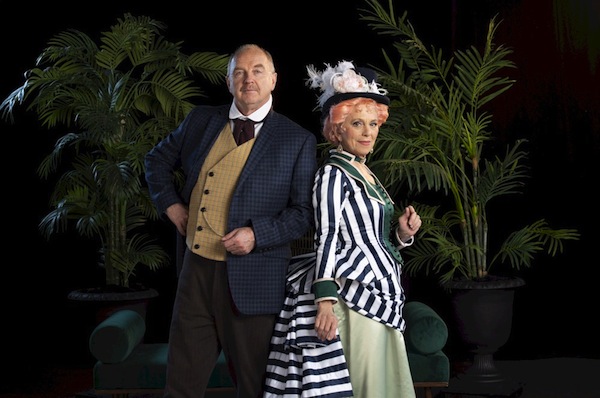
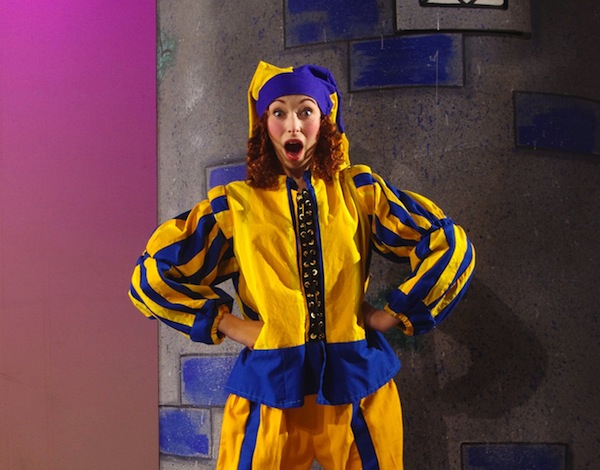
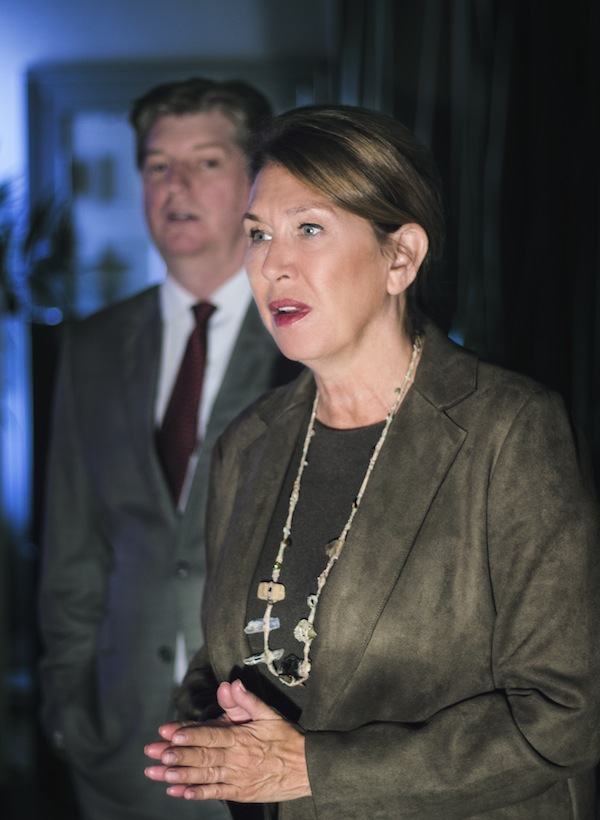
Vancouver Opera’s production of The Merry Widow opens Oct. 20. (photo by John Grigaitis)
“I am thrilled that The Merry Widow will open our 58th season,” Kim Gaynor told the Independent. “The Merry Widow has only been produced twice before in the history of Vancouver Opera. We have a terrific cast, and director Kelly Robinson also directed our smash-hit Evita in 2016.”
Gaynor, a member of the Jewish community, is general director of Vancouver Opera.
“Franz Lehár, the composer of The Merry Widow, always used Jewish librettists for his operas – in this case, Viktor Léon and Leo Stein – although he was Roman Catholic,” she noted. “The cultural milieu in early 20th-century Vienna was made up of a significant Jewish contingent. And Lehár’s wife, Sophie (née Paschkis), was Jewish before her conversion to Catholicism upon marriage, which was a common practice at the time in the case of a ‘mixed’ marriage.”
Lehár’s The Merry Widow (Die Lustige Witwe), a comedic operetta, is set in Paris at the turn of the last century. In the Vancouver Opera production, soprano Lucia Cesaroni will be making her role debut with the VO as the wealthy widow, Hanna Glawari, who tries to win the heart of Count Danilo, played by tenor John Cudia.
In the past year, notes the show’s promotional material, Cesaroni “also debuted with acclaim in both soprano roles of La Bohème, as Mimi with Pacific Opera Victoria and Musetta with l’Opéra de Montreal.” She last performed with the VO in West Side Story in 2011.
Cudia has performed in two recent VO productions: as Cassio in Verdi’s Otello (2017) and Juan Peron in Evita (2016). Among his credits, he is the first and only actor to have performed both as the Phantom in Phantom of the Opera and Jean Valjean in Les Misérables on Broadway.
The VO production of The Merry Widow plays Oct. 20, 25 and 27, 7:30 p.m., and Oct. 28, 2 p.m., at Queen Elizabeth Theatre. Tickets range in price from $50 to $175 and are available from the VO at 604-683-0222 or vancouveropera.ca.
Colleen Winton as Mrs. Lovett and Warren Kimmel as Sweeney Todd in Snapshots Collective’s production of Sweeney Todd: The Demon Barber of Fleet Street, which runs Oct. 10-31. (photo by Nicol Spinola)
“To seek revenge may lead to hell, but everyone does it, if seldom as well as Sweeney,” said Stephen Aberle, quoting from the finale of Sweeney Todd: The Demon Barber of Fleet Street. Aberle plays Judge Turpin in the Snapshots Collective production of the musical, which will take place at Mrs. Lovett’s Pie Shop, or at least a facsimile of it, at 348 Water St., in Gastown, Oct. 10-31. Most shows are already sold out.
“Part of the power of the piece,” explained Aberle, whose character sets Sweeney on his murderous path, “is that we can identify with all of the characters, see their strengths and their flaws, and observe how much we share with them. That’s what makes it troubling, that irresistible doubt: would I do anything differently?”
Let’s hope most people would, as Sweeney Todd slits quite a few throats in his barber’s chair – providing the main ingredient for Mrs. Lovett’s pies – before getting to the object of his revenge, Judge Turpin, who abused Sweeney’s wife and exiled Sweeney for a crime Sweeney didn’t commit.
“When we decided on doing Sweeney Todd,” director Chris Adams and choreographer Nicol Spinola told the Independent in an email interview, “we knew we wanted Warren Kimmel as Sweeney, so we approached him first to see if he would be interested in playing the title character. He was on board almost immediately and we started moving forward to cast the rest of the show. We next approached Colleen Winton for the role of Mrs. Lovett and held auditions for the rest of the cast. We weren’t shy in letting auditioning actors know that our show was going to be different and that seemed to excite them. We were thrilled with the turnout and were able to cast the show exactly how we saw it.”
And the intimate audience – theatre capacity is about 56 – will be right in the midst of it all.
“The show is staged around the entire venue with some seats being directly in the action,” said Adams and Spinola, who are also co-producers of the show, with Ron Stuart, Wendy Bross Stuart and Kat Palmer. “There will be interactive moments between the actors and the audience, although there is no audience participation required. Sometimes the action will take place right in front of you and other times the action will be across the room.”
Kimmel looks absolutely terrifying in the production’s 44-second teaser.
“It’s always more fun, interesting, to play dark or evil characters than good ones and, for the most part, I am cast as good guys rather than bad guys so this is fun from that point of view,” said Kimmel of playing the title character in the musical, composed by Stephen Sondheim, with book by Hugh Wheeler. “Also, Sweeney Todd is probably one of the most challenging pieces in the musical canon to perform, so that makes it a stimulating and scary experience as well, which is, I suppose, fun in a twisted fashion.”
“I think this is a tremendously important story for our time,” said Aberle, “a time when the power structures that reinforce men’s privilege and women’s presumed subservience (as well as racialized, class-based and other power imbalances) are being challenged by some; desperately defended by others. We read about Judge Turpin analogues just about every day in the news. I think it’s particularly important for those of us who possess power to check in with a story like this and consider our own exercise of that power. To what extent am I being a self-serving brute in this situation? Are there ways I might reduce that extent? The play, it seems to me, asks questions like those pretty insistently.”
About how he has chosen to portray Judge Turpin, Aberle said, “I’m looking for him the way I generally look for a character: by trying to figure out what he wants in the context of the given circumstances. That context, for a judge in mid-19th-century England, was power, privilege and prestige.
“One of the things that makes Judge Turpin interesting, to me, is that he’s not merely a psychopath or even a simple, spoiled narcissist: he tries to do ‘the right thing’ according to social convention and struggles with his desires (though more because of deeply ingrained inner shame than because he really understands his own power to harm, or empathizes with his victims). There are some questions about the man that I’m interested in exploring. What was his blue-sky vision of the perfect outcome when he set this engine of vengeance rolling, 15 years before the play begins? Why, especially given the power of his urges, has he gone through life so far without marrying? Why did he adopt a year-old infant as his ward? There are several plausible answers – and plausible combinations of multiple answers – for each of these, and I’m enjoying playing with them.”
Echoing Kimmel’s assessment of the music, Aberle added, “And, really, let’s face it. This is Sondheim at just about his Sondheimiest. If I can sing the material more or less in time and on pitch, I’ll be pretty happy.”
“The music plays a central role in telling this story,” Bross Stuart, the show’s musical director, told the Independent, “and there is no one more brilliant than Stephen Sondheim to do this for us. Central to the core of this music is the Gregorian chant, ‘Dies Irae’ (‘Day of Wrath,’ ‘Day of Judgment’) theme, heard throughout this work. We hear fragments of this musical motif hidden everywhere. Extended, shortened, pulled out of shape, but it’s there. We know it is the underpinning of Sweeney Todd’s motivation. It helps us understand Mr. Todd’s state of mind; and how revenge morphs into mental illness. When we are in the asylum, in Act 2, some of the ‘patients’ sing a demented version of ‘Dies Irae.’
“Another example is Sondheim’s use of a repeated note for more than 100 bars. Why does he do this? It is Mr. Todd’s obsession with murdering Judge Turpin. Even while the men are having a seemingly ‘friendly’ conversation, Todd is thinking along more sinister lines.”
“Sweeney Todd, as far as we can tell, is a normal man with a wife he adores and a new young daughter,” said Kimmel. “Without spoiling the plot altogether, life deals him a hand that most would find impossible to survive, let alone overcome, and so we have a perfect vehicle to allow us to ask what we would do in his position and, if we are honest with ourselves and had the courage to follow through, we could easily imagine doing the same things he does.”
Warren Kimmel looks terrifying in the production’s promotional material. (photo by Nicol Spinola)
But, he added, “In the end, I think it is a very moral story and the final destination is morally inevitable – although we feel for him and want to see him get his revenge, and although he and Mrs. Lovett almost get away with what they have done, it cannot be…. The world is set to rights at the end of the piece.
“You could say that this is just a Victorian melodrama, a deliciously dark tale underlining all the Christian moral virtue of the period,” he continued. “However, like all great drama, I think the rules of the game are timeless – first dramatized in Greek times or even biblical times. You cannot fool God; you cannot escape the price that must be paid for transgressing His rules. There is a fashion now to believe that we have moved past these religious moral strictures and that religion has less to offer a modern society but, in the end, this is a morality tale that resonates with very deep archetypal themes. No matter how justified it may seem, revenge will lead nowhere good.
“From a performance point of view, it is always a gift to be able to play someone truly morally compromised and, in a broader sense, I think that is what the theatre is really for: to allow us to watch this story and go through all that life is able to throw at us, to imagine, to understand and even to justify truly extraordinary behaviour, and yet to laugh and cry and cringe and know that, at the end, the moral compass of the world is back on true north.”
An emotional connection to the show is one of the reasons that the Stuarts wanted to be involved in this production. “We saw the original Broadway production in New York City in 1979, with Angela Lansbury and Len Cariou,” said Ron Stuart. “It was brilliant and riveting and unique in the genre – like West Side Story was 20 years before or Showboat before that.
“Our co-producers had the concept of an immersive version of the show at a Gastown venue around Halloween, and we thought it was an interesting way to present the work.”
In addition to funding, he said, “with projects of this scale, we are also very hands-on. Our director, choreographer, music director and assistant director are also producers. We readily share our contacts in a variety of specialities, such as costumes, set design, lighting, instrument rental, legal issues, marketing, etc. Moreover, we are a collective under Equity rules, so we all have ‘skin in the game.’”
This is Palmer’s first experience as a producer. “It has been nice to learn from professionals who have been through this journey from beginning to end,” she told the Independent.
Knowing that they wanted this show to be immersive, the venue not only had to work from a mechanical perspective, “but add to the experience,” said Palmer, who is also in the ensemble.
“It’s been a fun challenge,” she said, “to be switching between my assistant stage managing hat and my performer hat – ‘this prop will need to be pre-set here, oh no, this is the lyric, this person has a quick change.’”
Palmer described the show as being very difficult technically, “there is not just Stage Left and Stage Right to worry about, there is a whole building.”
This is part of the attraction for Bross Stuart.
“We, the musicians, are very close to the audience and to the actors,” she explained. “Communication, page-turning, singing as you play – could be problematic. And the action is very immediate and very gripping. Very exciting!”
“My favourite number in the show,” said Palmer, “has to be our opening number, ‘The Ballad of Sweeney Todd.’ Our amazing choreographer, Nicol Spinola, has created something so eerie, unique and unsettling. It immediately brings the audience right into this dark and thrilling world of 1840s London. Not only does it sound fantastic to have our entire cast of 17 singing Sondheim’s challenging music, but it also sets the mood for the entire show. I get chills performing it and I am very confident the audience will have never experienced anything like it before.”
For more information and tickets to Sweeney Todd, visit sweeneytoddthemusical.ca. And plan to have dinner at the venue before the show – pies, of course.
“Our pies come fresh each day from the Pie Hole located on Fraser Street in Vancouver,” said Adams and Spinola. “We are offering a traditional steak-and-stout meat pie, an aromatic Moroccan chickpea vegetarian pie and a delicious Thai coconut curry vegan pie. Pies can be added on when you are purchasing your tickets.”
Ghazal Azarbad, as Siobhan, a special-ed teacher, and Daniel Doheny, as Christopher, who has Asperger’s, often work in tandem in The Curious Incident of the Dog in the Night-Time. (photo by David Cooper)
Left, right, left, right. Follow the red line. Left, right, left, right. Through the tunnel. Up the stairs. Left, right, left, right. Take the A-Levels, get an A star, become a mathematical genius. Left, right, left, right….
Such are the thought processes of Christopher Boone, a 15-year-old with Asperger syndrome, who is the central character in The Curious Incident of the Dog in the Night-Time.
Asperger’s is a developmental disorder on the autism spectrum characterized by repetitive, single-minded actions, inappropriate social interaction and highly focused interests. In Christopher’s case, those interests involve solving a mystery about a neighbour’s dog that was killed with a pitchfork; writing a story about how he solves the crime; and doing his A-Levels math exams because he wants to be a mathematical genius.
The story he writes becomes a play within the play performed by the staff at the special school he attends. The audience is taken on this journey by his special-education teacher reading from the text he wrote; by Christopher narrating events in the robotic fashion that is often symptomatic of Asperger’s; and by the actual events interwoven through the show in present-day and flashbacks.
The pace is frenetic, even mind-numbing at times, and works as a metaphor for Christopher’s view of the world – where things we take for granted don’t make sense to him and he has to create his own processes and order for self-protection.
Christopher can describe and explain a black hole to the smallest scientific detail, but cannot understand that he shouldn’t call his classmates “stupid.”
He can quote statistics at random – “You are most likely to be killed by a family member on Christmas day” – but doesn’t like yellow food.
Similar to the character in the TV program The Good Doctor, an autistic surgeon with savant syndrome, Christopher is a genius in his realm of specialty – mathematics – but must do things his way, which is constantly putting him at odds with the rest of world.
Protecting him from this outside harm is his father, with whom he lives in Swindon, England. As patient as his father tries to be, the challenge of dealing with Christopher’s proclivity to be single-minded, as exhibited in his investigation of the dog’s death, drives his father to rage, eventually leading to a physical altercation in which Christopher is hit. Nonetheless, Christopher cannot let go of this obsession. “Sometimes, you have to ignore what people tell you to do,” he says, which is characteristic of someone with Asperger’s.
One day, Christopher finds out that his father has lied to him about what happened to his mother. Up until this point, his father was one of the few people Christopher could trust, even to just touch him or hold him. When this trust is broken, Christopher sets out on what, for him, is a terrifying and difficult journey.
In one of the more dazzling, complicated and mezmerizing scenes of the play, Christopher must make his way through the complexity of the train stations, dancing in and around the other travelers, while avoiding touching them, and then figuring out the timing of how one actually steps onto the train car from the platform, which he’s never done.
He eventually finds what he’s looking for, but the result is not what had hoped for. He ends up returning to Swindon to take his A-Level maths, in an effort to get an A-star rating, and to try and rebuild the relationship with his father.
While local rising star Daniel Doheny is stellar in this challenging performance, and Todd Thomson is compelling as the tormented father, what really makes the play brilliant is the creative team. The direction, movement, blocking, timing, set design and lighting are remarkable. Jewish community member Itai Erdal was the lighting designer of the production. And particular mention must go to a simple but highly effective prop that lifts and drops part of the stage, turning it into a train platform for one scene, then lowering it to form the seat on the train in another.
As a caution, the actors bring everything to bear in this performance, so be prepared for very loud yelling, moaning and frenetic action – often by multiple actors at once, as the chorus works to amplify Christopher’s feelings and racing mind – as well as some swearing. A “relaxed” special performance runs Sept. 30 that includes lower sound levels, lights and projections that are more subdued, and a relaxation station in the lobby equipped with a live feed so audience members can take a break from being inside the theatre without missing what’s happening on stage.
Though this play can be troublesome, chaotic and even exhausting to watch, it is one of my favourites of the past year and I highly recommend it.
The Curious Incident runs until Oct. 7 at the Stanley Industrial Alliance Stage (artsclub.com).
Baila Lazarusis a Vancouver-based writer and principal media strategist at bailalazarus.com.
Alexa Mardon is part of the creative team of Never Still, which is at the Firehall Sept. 26-29. (photo by Ben Didier)
It is fitting that Firehall Arts Centre is launching its 36th (double chai) season with a new work by Jewish community member Vanessa Goodman, artistic director of Action at a Distance Dance Society.
Never Still is described as “a highly physically piece that dives into the distinctions and overlap between three different systems of circulation: global water cycles, communication technology and fluids within the body.”
“The initial ideas for Never Still really began to emerge in 2013, when I made two separate works inspired by similar themes. Both dealt with our relationship to water, either in our environment or our bodies,” Goodman told the Independent. “On a very basic level, we are all between 50% to 70% water, depending on our age, and the earth’s surface is covered by roughly 70% water. There is some nice symmetry and, the deeper I dug into these themes, the more they revealed. Social, political, personal, environmental – no matter where I went with these themes, it checked all the boxes of what inspires my work.
“For me, it was just a matter of time before I began to focus on these ideas as a full-length. But it wasn’t until 2015, when I met Scott Morgan (Loscil) through Small Stage, where we first collaborated together, that I could imagine this work growing into what it is today. Each project requires the right collaborators to bring it to life.”
Goodman’s research began in 2016 during a creative residency in New Brunswick hosted by Connection Dance Works. “Loscil and I also made Floating Upstream that same year, a shorter piece that explored these ideas and worked out some staging concepts,” said Goodman. “In 2017, I continued the research through a local choreographic residency at EDAM.
“I always knew I wanted this to be a group piece and, in the spring of last year, I finally had the whole performing team together: Shion Skye Carter, Stéphanie Cyr, Bynh Ho, Alexa Mardon and Lexi Vadja. The work would also not be complete without my longtime collaborator, lighting designer James Proudfoot, who is a master of painting space with light.”
Sound and projection design for Never Still is by Loscil, with costumes by Lloyd clothing. EDAM’s Peter Bingham is listed as the piece’s creative mentor.
While the work has evolved since conception, Goodman said, “There’s not necessarily one element I can point to that’s different. When I began working on this piece, it was just me alone in the studio imagining all the elements, so being able to work with five incredible dance artists, lighting, sound and projections definitely pushes everything forward quite rapidly.
“It is always exciting how a work takes shape in each unique venue, too. Ideas that you may have thought would work sometimes don’t and other new elements reveal themselves, so it’s important to stay flexible. The work is constantly evolving, even through the final performances. That is one of the many exciting parts of live art: it is constantly being transformed by those who inhabit it.”
This idea ties in perfectly with the themes explored in Never Still.
“On a molecular level, liquid water is never truly still, which acts as a beautiful metaphor for dance. It offers myriad avenues to explore anatomically and thematically,” said Goodman.
About Never Still, she said, “I feel like it’s very easy in a developed urban setting to take water for granted and overlook its true value, so, if anything, parsing so many different aspects of water with this piece has helped me appreciate it that much more.”
The work also considers the “inherent conflict or dichotomy of water.” By way of explanation, Goodman said, “The most obvious textural example is water’s often-violent reaction to shifts in temperature, from the crack of ice to the vapour rising from a roiling boil. On a larger scale, the effects of flooding and drought, which, on one hand, represent polar opposites, often share conflict and devastation.”
Echoing these concepts, Firehall artistic producer Donna Spencer said in the release for Never Still, “We are living in an increasingly polarized culture. And it is our role as artistic creators to encourage audiences to consider, through what they are seeing on stage, how inextricably linked we all are in finding our way through these challenging times.”
Firehall’s programming this season, she added, “is about choices – the ones we make, the ones we think we should make but don’t, and the influences around us that colour that decision-making. Live performance allows us to experience a unique and powerful collective sharing of emotions and information that resonates through our day-to-day lives long after we have left the theatre, and indeed may influence the choices we make in the future.”
Never Still runs Sept. 26-29, 8 p.m., at the Firehall, with a talkback after the Sept. 27 show. For tickets (from $20), visit firehallartscentre.ca.
Naomi Vogt performs in Big Sister, written by her real-life sister, Deborah Vogt. (photo from Fringe)
The Vancouver Fringe Festival has started and there are (at least) a few shows that readers should try to fit in around the High Holidays. Jewish community members Deborah and Naomi Vogt, David Rodwin and Gemma Wilcox are presenting very personal works that examine issues with which we all deal, such as self-esteem, family relationships, finding and losing love, and the search for meaning. And they do it with humour and energy.
Local playwright Deborah Vogt and her sister, actor Naomi Vogt, “are still making tweaks” to Big Sister (Revue Stage), Deborah Vogt told the Independent. “However, I’m not sure if there will ever be a ‘final version,’ given that the script is a reflection of our ongoing conversation as sisters attempting to learn more about each other. Additionally, Naomi loves to ad lib and so the play will be slightly different every evening depending on who is in the audience. However, the dream would be to take it to other Fringe festivals, especially Edinburgh (the world’s largest Fringe Festival – and my personal dream). There is something very special, however, about premièring this show in the city that we grew up in and the community that we know and love.”
The idea for the show came up last summer at the Edinburgh Fringe. “Over there, I saw so many beautiful, personal solo shows that tread the line between monologue and standup. I thought, ‘I would love to do this, but I can’t act. Who do I know that could perform a solo show that I could write?’ The answer was obvious: my sister. We spent two weeks traveling together shortly after the Fringe, where we brainstormed ideas for shows in between hikes and wine bars. We abandoned most of those ideas when we realized the only story we could honestly tell was that of our relationship as sisters, and specifically how our relationship has changed over the last few years in the wake of Naomi’s 75-pound weight loss.”
Camp Miriam makes an appearance in Big Sister, said Vogt, “because my sister Naomi went there for a few summers as a preteen and our mother went there for many, many years when she was younger…. The show focuses on Naomi’s weight loss, and talks about what being a fat kid at camp was like. Naomi loved Camp Miriam, but we also acknowledge that no camp experience is easy if you don’t look like the other children.”
Naomi Vogt performs the whole play. “For the most part,” said her sister, “she is playing herself, but the version of herself that I have written through my perspective. And, on occasion, she plays me as well. I just have to sit in the audience every night and hear the ways she’s manipulating my words. Part of the joy of the show is the various power dynamics at play – as a playwright, I have shaped Naomi’s personal story but, as an actor, she is able to change my words at any moment.”
There were many challenges to writing Big Sister, said Vogt. “First of all, it was difficult trying to find the balance between Naomi as my real human sister and Naomi as a character. We wanted this show to be entirely truthful, while still presenting a piece of theatre. And this show touches on painful aspects of both of our lives (in a funny way, of course), so trying to write that without overstepping my place or lying to the audience about what actually happened (two sides to every story, right?) was difficult to manoeuvre.”
In a nutshell, the show is about weight loss. “It touches on how being heavy can affect all aspects of life, and particularly sibling dynamics,” said Vogt. “Both of us have lost weight … but Naomi’s journey was far more significant than mine. Through telling her story of weight loss, we’ve learned a lot about each other, our childhoods and the community we live in.”
* * *
David Rodwin shares his sometimes-heartbreaking dating experiences in F* Tinder. (photo by Julia Farr)
“F* Tinder is 100% autobiographical,” said David Rodwin. “Only the names have been changed. But I only have 75 minutes to talk about dating 120 different women over two years, so there’s a lot I have to leave out. But every story I tell, I do so as accurately as I can recall – with a theatrical flourish.”
F* Tinder: a love story (Performance Works) began as a book, when a friend who was writing his first book challenged Rodwin to do the same.
“I’d moved to San Francisco after my last serious relationship ended in L.A. and, over a year and a half on Tinder and other apps, I’d experienced some bizarre and noteworthy experiences in the lawless dating wilds of the Bay Area,” he said. “So, I had an unorganized collection of short stories I’d been developing…. Around that time, I met the one woman I truly fell in love with. That inspired me to write like crazy. But (spoiler alert), when she dumped me, I got writer’s block for the first time in my life.
“Though I wasn’t able to continue sitting alone at my desk typing out these tales, I couldn’t stop telling them to friends and in storytelling shows like The Moth, which I’ve done for years. Finally, it became clear that, rather than just a bunch of short anecdotes, this was a full evening of stories with its own narrative integrity…. And though I’d written half the book, I threw out everything and started over because I find that writing with my mouth creates a more natural, humorous and vibrant live performance than when I type something, memorize it and recite it.
“It’s a thrilling and terrifying process for me each night, not knowing quite how it’s going to go and I hope it creates a more visceral, authentic and deeply intimate experience. And it’s a technique I inherited from my mentor Spalding Gray. But it’s meant that the show has changed a lot over time. The first version was 60 minutes long, then it grew to 90 minutes. Now, it’s 75 minutes. But there have been multiple versions of each one…. I’m also able to adjust certain sections to fit specific audiences. I’ve even added a curling joke for my Canadian audiences, making fun of Americans’ inability to understand the sport.”
Rodwin continues to work on the book F* Tinder and, later this year, he said, “I’ll begin directing a web series of F* Tinder set in San Francisco, and also a feature film of my previous show set in Los Angeles, called Total Novice. That one has an even edgier narrative than F* Tinder, if you can believe. Let’s just say I was a ‘nice Jewish boy’ who went to Princeton and I was a very late bloomer who became fearless (and occasionally stupid) in my pursuit of things that I considered off limits when I was younger.”
F* Tinder includes Jewish elements, said Rodwin, “because they directly affected how I look at relationships.”
In the show, he shares how, on one Shabbat, while chanting prayers he’d said for 30 years, he stopped midway through the V’ahavta, “when I said, ‘And thou shalt teach them diligently unto thy children.’ It suddenly hit me that I didn’t have children, and I couldn’t fulfil this prayer in a literal way. I always thought eventually I would. But, at 45, when I read that, I fell silent, contemplating how I’d lived my romantic life in such a way that I was childless. And what it meant for me. And what I should be doing with the woman I was in love with. And it directed my next choice in how that relationship went.”
Rodwin shared another touching, and Jewish, element of his show.
“The woman I fell in love with told me she could tell I was falling for her and I shouldn’t do that because she’d already decided we weren’t going to work out in the long term, and she didn’t want to hurt me. So, she told me to build a wall around my heart, or she wouldn’t see me again…. I agreed to do so because I was afraid if I told her the truth, that I was already hopelessly in love, I’d never see her again. Now, I’m not a biblical scholar, but the next morning a piece of Torah came to my mind, out of the blue, while she lay sleeping next to me. Deuteronomy 30:6 – I’d studied it eight years earlier with Rabbi [Sharon] Brous and I didn’t understand it, so it stuck in my mind. The phrase, ‘You must circumcise your heart … so that you may live,’ baffled me. But, that morning, it suddenly made sense to me, and I decided I had to circumcise my heart and careen it against the wall around her heart until I either broke through or I broke. And people can come see the show, to discover the surprising ending.”
* * *
In Magical Mystery Detour, Gemma Wilcox explores the detours that happen in life and how we can find and trust our own centre. (photo from Fringe)
There are many twists and turns in Magical Mystery Detour (Studio 1398) by Gemma Wilcox. Set in the United Kingdom in 2012, the action is prompted “by a letter from her dead mother, [and] the protagonist, Sandra, and her dog, Solar, take an unexpected car journey from London to Land’s End, Cornwall, at a pivotal and sensitive time in her life.”
Created in the summer of 2012, Magical Mystery Detour premièred at the Boulder, Colo., Fringe Festival that year.
“It is a semi-autobiographical piece, heavily based on aspects of my life at that time,” Wilcox told the Independent. “I wrote this show very shortly after the death of my mother and the ending of a very significant love relationship with a man I thought I would marry and have children with. It was inspired by the tender and vulnerable process of dealing with and letting go of my mother’s death, the getting over and releasing this powerful love relationship, as well as some of my magical journeys through the sacred, beautiful landscape in the southwest of the U.K.
“The show reflects some of the themes I was fascinated by and exploring at that time in my life,” she continued, “such as learning how to trust and surrender to the detours that happen in life, when we think our life is going in a certain direction, but then it dramatically changes. I was also interested in exploring how we can find and trust our own centre when those we love are not there anymore, and when we feel lost or that life is too chaotic or not going the direction we want it to.”
Wilcox was born and raised in London, and moved to the United States in 2001. She has been based in Boulder since 2004. “I moved to the U.S. to explore yoga and embodiment practices, was in the Shakespeare Company in Austin, Tex., for a couple years, and found my theatrical/creative family in Boulder, as well as touring across the U.S. and Canadian Fringe festival circuit every summer for the past 11 years,” she said.
Magical Mystery Detour is one of a handful of shows that Wilcox and director Elizabeth Baron have worked on together. In creating it, said Wilcox, Baron was incredible, advising “me on how to stay both open and vulnerable as a performer, whilst also staying protected and safe and able to show the many shades and subtleties of a character.”
Wilcox writes comedy-dramas. “I find that it is highly important to balance the ‘light’ material with the ‘darker’ material, humour with seriousness – for me as a performer, and also for the audiences,” she said. “It is easier to receive and digest more poignant or shadowy material when juxtaposed in appropriate moments with humour and lightness. Humour is a huge aspect of my work – humour that comes from identifiable and sometimes embarrassing situations or honest admissions.”
For the full Fringe lineup, visit vancouverfringe.com. The festival runs to Sept. 16.
Left to right are Jennifer Lines, Quelemia Sparrow and Marci T. House, who form part of the cast of Lysistrata. (photo by David Cooper)
At Bard on the Beach this summer, there is an eclectic mix of plays. There is Macbeth, set in its proper period, which runs in repertory on the BMO Stage with a Beatlemania version of As You Like It. On the more intimate Howard Family Stage, there is an experimental gender-role reversal take on little-known Timon of Athens and Lysistrata, a somewhat X-rated farcical romp through an ancient Greek tale, with a contemporary twist.
For Lysistrata, University of Victoria professor Jennifer Wise (Canadian Jewish Playwriting Competition winner) collaborated with director Lois Anderson to adapt Aristophanes’ 411 BCE comedic protest play about a group of Athenian and Spartan women who, tired of their husbands’ endless war-mongering, reluctantly decide to withhold sex until the men vow to give up fighting and stay at home with their families. You can probably guess what ultimately happens. But, to get there, the audience is led through a Monty Python meets Saturday Night Live series of misadventures replete with double entendres, an interesting use of plastic pool noodles and plenty of rollicking action.
The play’s backstory is Bard’s scheduled production of an all-female Hamlet that morphs into a dramatis interruptus as the company decides, at the last minute and with profuse apologies to the audience and artistic director Christopher Gaze, to stage Lysistrata this one night only to protest the pending rezoning of Vanier Park to make way for a shipping terminal. This leads to a lot of backing-and-forthing through ancient Greece and modern-day Vancouver interspersed with the ever-sublime Colleen Wheeler, as Hamlet, trying to get her “to be or not to be” soliloquy in, despite the change in plans, as she hauls “poor Yorick’s skull” around the set.
This is truly an ensemble cast and every member shines, but special mention must be made of Luisa Jojic’s role as the eponymous ring leader, Jennifer Lines as Mother Earth and Quelemia Sparrow’s poignant performance as an indigenous actor.
Mention must also be made of the two male artists (Sebastien Archibald and Joel D. Montgrand) who, as uniformed police officers, “stop” the performance to arrest one of the actors – who has defaced the rezoning signs and plastered graffiti all over the crab sculpture in front of the Planetarium – for public mischief. It all seems very real and is very funny, especially since one of the cops plays Wheeler’s husband, Ross.
In addition to Wise, other Jewish community members play prominent roles in the production. Mishelle Cutler makes her Bard debut as music director and one-woman orchestra. She uses 1930s Weimar cabaret-style music for the contemporary scenes, and opera and choral works for the more classic Greek theatre bits. Choreographer Tara Cheyenne Friedenberg takes that music and provides novel dance moves, especially for the quirky geriatric men versus women Athenian reel.
In keeping with the environmental theme of the night, the costumes and accessories are simple, to give credence to the improvised nature of the show. Head gear is made of hand bags, recycled water bottles and paper toilet rolls, a Starbucks cup does double duty as a wine chalice, costumes made from curtain rods and drapes (à la Carol Burnett’s iconic Gone With the Wind outfit) mix in with the actors’ own street clothes.
Ultimately, this mélange of Shakespeare, Greek theatre and contemporary activism should resonate with all of us, as we grapple with the reality of development in this city and its impact on our heritage and our way of life. While this show is a lot of fun, it may not be suitable for children under the age of 13.
* * *
Sometimes, you have to take risks with Shakespeare and director Meg Roe certainly does so with this adaptation of Timon of Athens. She admits in her notes that it is a “difficult play” and that it may not have been written solely by the Bard. It is the tale of a wealthy Athenian who wines and dines his friends and showers them with expensive gifts until he gets into financial difficulty. When he approaches those friends for help, they refuse. This sends him into a rage and, ultimately, to his death.
In the original version, the cast is predominantly male. In this adaptation, it is 2018, the set is a high-end condo in Vancouver and the cast is reminiscent of the Real Housewives women – uber wealthy, stiletto-heeled and shallow, constantly on their pinging/chirping phones.
Wheeler is sublime in her role as Timon and her manic meltdown into madness alone is worth the price of a ticket. She literally destroys the set. You have to give kudos to the stage crew, who have to rebuild the set for every performance, and to the costumers, who have to replace her white pantsuit every show. The set is stylish and sleek and the couture frocks divine. But, in the end, the basic takeaway is that money can’t buy you friends.
* * *
This summer’s Macbeth is the way Shakespeare intended it to be – in its proper Elizabethan period, with a stark set and eerie smoke and lighting effects. Perfect for a tale of greed, lust for power and revenge.
Early in the play, Macbeth (Ben Carlson) encounters three witches (the ones with the famous brew that includes the “liver of a blaspheming Jew”) who predict that he will be king of Scotland. Once Lady Macbeth (Moya O’Connell) hears of this, she sets out to convince her husband to murder King Duncan when the king visits their castle so that he, Macbeth, can reign. And so begins their downward spiral towards murder, death, destruction and madness.
Carlson and O’Connell are the crème de la crème of Canadian acting and exude an intense chemistry as the plotting Scots. Special mention must be made of Andrew Wheeler as a gruff Macduff and Craig Erickson as a ghostly Banquo.
* * *
Bard’s As You Like It is the must-see show of the summer. It is definitely a crowd-pleaser. And you will want to see it over and over again. Director Daryl Cloran has taken out half the Shakespearean text and inserted 25 of the Beatles’ top hits where appropriate in this tale of four pairs of young lovers (and the obstacles in their paths) so that, when one of the pairs, Rosalind (Lindsey Angell) and Orlando (Nadeem Phillip), locks eyes the for the first time, he breaks out in, “She loves you, ya, ya, ya.” Every situation easily morphs into a Beatles’ moment through songs like “Help,” “I Want to Hold Your Hand,” “Eight Days a Week” and so forth. The 1960s setting is split between urban Vancouver and the Okanagan, where various characters are exiled by the new duke on the block. There, in the wilderness, the four love stories unfold.
In addition, there is a pre-show display of Wildcat Wrestling, a psychedelic VW van parked on stage, a terrific four-piece band led by musical director Ben Elliott who does double duty as love-struck Silvius and is one half of a memorable and raunchy pas de deux with Jojic as Phoebe the shepherdess. That girl can belt out a song.
The standouts are the protagonists Angell and Phillip – they both sing and dance up a storm – Kayvon Khoshkam, who is simply terrific as the wrestling master of ceremonies and then later as the court fool, Touchstone, and Ben Carlson who, as the stereotypical beatnik, intellectual elitist, gives the audience a new take on the “all the world’s a stage” speech.
This is a fast-paced, fun night of music, song and dance that will have you humming these tunes all the way back home. Even old Will himself is probably rocking in his grave over Stratford-upon-Avon way.
* * *
Bard on the Beach runs to Sept. 22. For tickets to any of the shows and more information, go to bardonthebeach.org or call the box office at 604-739-0559.
Tova Kornfeldis a Vancouver freelance writer and lawyer.
Dalia Levy, left, and Ariel Martz-Oberlander (photos from Vines Art Festival)
“Good art is accountable to the community, raises up voices rarely heard and is vital to repairing our world.” This is a quote from Jewish community member Ariel Martz-Oberlander’s bio. It is little surprise that she was the associate producer for Vines Art Festival last year and is once again one of the artists this year.
Martz-Oberlander will be joined at Vines by several fellow Jewish community members: interdisciplinary artist Barbara Adler, textile artist Dalia Levy and performer and storyteller Naomi Steinberg, as well All Bodies Dance, of which Naomi Brand is a co-founder and facilitator. The multidisciplinary eco-arts festival features more than 70 performing and visual artists at parks throughout Vancouver.
According to its mission statement, Vines “is a free public event that creates platforms for local artists and performers to create with and on the land, steering their creative impulses toward work that focuses on the environment – whether a deep love of nature, sustainability or climate justice.”
“Everything I create is in relation to the land I find myself on and the times I was born into,” Martz-Oberlander told the Independent. “I create from a place of wanting to live in good relation to the land and those who have been protecting it since the beginning. I also create with the hope of telling the stories we need to bring about tikkun olam, the stories that have been buried or hidden as we struggled to survive by assimilation. Telling my stories is part of my larger work of decolonizing theatre and performance – making space for other silenced stories, and dismantling and rethinking the ways we tell stories in the first place.”
About the specific work that she will present at the festival, Martz-Oberlander, who divides her time between theatre and community organizing, said, “My piece, entitled on behalf of my body, explores living in the body after sexual trauma and touches on the intersectionality of sexual violence, PTSD, dissociation and separation from the self. The piece is also an exploration of how the settler body can live in Turtle Island, as approached through the story of my Ashkenazi diasporic and refugee ancestry.
“I am making this piece because I struggle with my place on this land, having no homeland of my own, but still being an uninvited guest. My people have been wandering for 2,000 years, and now I find myself here – my body a site of so many struggles, politicized without my permission by the forces of antisemitism, racism, nationalism, Western medicine, patriarchy and rape culture. How do I walk back into my body after being forced from it in so many ways? What does recovery mean when I’m not sure what was there before or whether I can get back there. Was there a before?
“This is the journey I invite you to go on with me – it’s going to be a wild ride.”
Levy will be presenting Connective [T]issue at Vines.
“Inspired by women’s Arpilleras [brightly coloured patchwork images] of [Augusto] Pinochet’s Chile, this knit/sewn/embroidered piece protests the Pacific garbage patch and extractive economies, like bitumen on our coast,” Levy explained. “As the same criminal mentality of supremacy exhibited under a dictatorship disappears our earth and our humanity, the piece simultaneously contrasts the powerful sources of life embedded into all of us. Representative of the underground connective channels that create the webs of mycelium our entire planetary eco-system grows from, the netting gives further conceptual insights of life woven into all DNA. With women’s traditional textile knowledge as a means to subvert and survive, the piece protests the private and normalized plunder blanketing earth and the interwoven convergence of issues in an era of global crisis.”
Connective [T]issue builds off her performance art installation at the festival last year, which was called Knit Piece, she said. “I used natural red dye from local berries to cover myself in the blood of the earth and proceeded to knit a giant umbilical cord drawing fundamental connections between humans and Mother Earth. The umbilical cord was then attached to knit anatomical hearts, and left in the park as a ‘yarnbomb’ installation. You can see a photo of one of the hearts here: permacultureartisan.com.
“Knit Piece and this year’s piece will be accompanied by a relevant sound art soundtrack to encourage further reflection,” she added.
About her work in general and how it relates to the environmental justice focus of the festival or connects to Judaism or Jewish culture, Levy said, “My work is very much focused on using the traditions of my Jewish foremothers to highlight the massive injustices of today. By reconnecting with these folk traditions that women used to pass down through generations, I am able to find a voice for myself beyond the domestic craft sphere while keeping these ingenious skills alive. My work is in protest of the extractive, discard culture embodied in consumer culture, as every inch of my work has been hand-stitched by myself from upcycled and found materials headed for the landfill. The environmental themes I work with relate directly to Vines as a vehicle for system change and awareness-raising about the destruction to our sacred planet.
“My Jewish ancestors that escaped Eastern Europe stitched their way across an ocean, escaping dictatorships that were extremely antisemitic, and began working as tailors and settling in Winnipeg’s Jewish community,” she continued. “My work is, therefore, informed by this family history that literally survived the pogroms because of our ability to stitch and make and adapt. I feel strongly that our future rests in this spirit of humble handmade [things] that is full of sustainable, ‘slow’ knowledge adaptable to climate change and a post-carbon economy.”
Vines Art Festival is an all-ages event and, while it runs from Aug. 8 to 19 in various Vancouver parks, the main program takes place Aug. 18, 1-7:30 p.m., at Trout Lake Park. All of the festival presentations are free. For the schedule, visit vinesartfestival.com.
Andrew Cownden and Paige Fraser in Theatre Under the Stars’ production of 42nd Street. (photo by Lindsay Elliott Photography)
The gasp of surprise and awe came from the row behind. “The glass slippers,” whispered the gown-clad girl, maybe 7 or 8 years old, when Cinderella received her infamous footwear from Fairy Godmother in Theatre Under the Stars’ production of Rodgers & Hammerstein’s Cinderella on opening night.
Directed by Sarah Rodgers, this social justice-infused version of the tale (with book by Douglas Carter Beane) seemed to resonate with the younger audience members, even though it was understated. The pace was on the slower side, the music beautiful but not that memorable and the costumes by Christina Sinosich were a mixed bag of styles but all earthy in tone, with no flash or brilliant pops of colour. Cinderella sported a pale blue and white dress in her harsh life with her stepmom and two mean stepsisters (though one turns out to be pretty nice) and a mainly white ball gown, with some silver and blue accents. Prince Topher’s outfits were basically brown or black, with the exception of white formal wear, though they also had some fancy detail work.
The cast performed admirably, especially Mallory James as the heroine, Ella. Tré Cotten seemed a little less sure in his role as Topher, but was suitably dashing and princely, wanting more than a beautiful woman for his wife and wanting to be more than just a ruling figurehead. The revolutionary Jean-Michel, played by Daniel Curalli, and the not-so-evil stepsister Gabrielle, played by Vanessa Merenda, add interesting elements to the play for those who’ve only seen the less substantive (story- and character-wise) romantic version. And the ensemble, in which Jewish community member Lyrie Murad sees her TUTS debut, does a fine job.
Alternating with Cinderella on the Malkin Bowl stage is 42nd Street, which, despite its Depression-era story, costumes and set, is an uplifting, energetic and fun production.
The role of Broadway producer Julian Marsh seems to have been written for Andrew Cownden, and Paige Fraser – making a very strong TUTS debut – is perfect as Broadway ingénue Peggy Sawyer. While the entire cast and ensemble is great, Colin Humphrey as choreographer/dance leader Andy Lee is fantastic, cigarette hanging out of his mouth for much of the show, even when putting the chorus through its paces. And, ironically, Janet Gigliotti as fading star Dorothy Brock is probably the brightest light of this show.
The direction by Robert McQueen, the choreography by Shelley Stewart Hunt, the musical direction (and acting) of Christopher King, the set by Brian Ball, the costumes by Sinosich, etc., etc., all come together neatly in this production.
For tickets to both Cinderella and 42nd Street, visit tuts.ca.
Lyrie Murad is part of the ensemble in Rodgers & Hammerstein’s Cinderella, which opens July 11 at the Malkin Bowl. (photo from Theatre Under the Stars)
Lyrie Murad makes her Theatre Under the Stars debut this summer in Rodgers & Hammerstein’s Cinderella, which opens July 11.
“I’m both excited and nervous to be performing in front of 1,000 people every night,” Murad told the Independent. “I mean, that’s a lot of people! It’s great, because Cinderella is such a magical show, with such an empowering message, but it can be a lot of pressure to deliver the beloved tale. Despite this, I believe that our director, Sarah Rodgers, has done an incredible job in creating a show that will appeal to both young kids and adults, and that everyone will enjoy the love and magic the story entails.
“I am also so excited,” she said, “to be doing this show every other night with this company because everyone is so kind, funny and beyond talented, which makes the show so fun to do. I was nervous going into the rehearsal room, being the youngest in the ensemble, because I was going to be working with people up to 10 years older than me. But everyone was so welcoming, and I’ve learned a lot from all of them.”
Murad was born in Portland, Ore., but has lived in Metro Vancouver since she was 3 years old.
“My parents were both born and raised in Israel, so Israeli culture was a big part of my life growing up,” she said about her background. “My whole extended family lives in Israel, and it is extremely important to my parents to keep in contact with them, as well with the country, so they make sure we visit Israel at least once a year. I speak Hebrew fluently, which allows me to communicate with my family, as well as many people in Vancouver’s Israeli community.”
Murad went to elementary school at Vancouver Talmud Torah until Grade 6, then moved to McMath Secondary School, a late French immersion public school in Richmond. “I love learning languages, so choosing French was a no-brainer and a welcome addition to English and Hebrew,” she said.
While the family is not religious, “we observe the major holidays and traditions with various friends throughout the year,” she said. “Having gone to VTT, I have stayed very connected with the Jewish community through the friends I have from there. I’ve always felt OK with leaving VTT because I knew I could still stay connected to my roots by going to Camp Miriam, a Jewish social justice-based summer camp on Gabriola Island that has taught me a lot about different aspects of Judaism. I take pride in my Jewish identity, and I’m so happy that Vancouver has such a welcoming and inclusive community.”
Murad has been taking voice lessons and competing in local music festivals since she was 8 years old, and has been taking piano and music theory lessons since the age of 10. She has been dancing since she was 10, as well.
“I only started thinking about acting much later, so the lessons came recently,” she said. “I just finished my third year in the drama department at my school, and I’ve been taking private acting lessons for two years now. I have had the amazing opportunities and experience to perform with the Vancouver Opera in their productions of Tosca in 2013 and Hansel and Gretel in 2016.
“It’s always been hard for me to choose between classical voice and musical theatre,” she said, “so I’m very grateful for having done both opera and musical theatre performances to get a feel for each style.
“I am also so grateful to have been chosen to represent local festivals at the B.C. Performing Arts Provincial Music Festival four years in a row, where I am so honoured to have received first place in the Junior Classical Voice category, the Junior Musical Theatre category, the Junior Vocal Variety category and runner-up in the Intermediate Musical Theatre category.”
In addition to all of the performing arts activities, “when I was little, my parents also signed me up for karate at the JCC,” she added. “I just received my black belt in karate and became the first female black belt in the JCC karate club.”
She has always loved singing.
“My mom loves to tell the story of how I begged to be put into singing lessons because I thought it was so cool that your body is the instrument. I was also put into dance lessons at an early age, so I’ve been very involved in the performing arts world. But the first time I really knew I wanted to be on stage was at my first vocal competition, where I sang ‘Tomorrow’ from Annie. I was really nervous beforehand but, once I started singing, I enjoyed it so much that I didn’t want to leave the stage. I remember bowing for much longer than I should have. Once I started getting obsessed with listening to as many cast albums and different Broadway singers as I could, there was no turning back.”
Her sisters – Arielle is two-and-a-half years older and Omer is three years younger than Murad – are also very musical. “Arielle plays guitar and piano and Omer sings and plays piano, as well. We often put on shows in our house or just jam at the piano or with the guitar. They recently bought me a recording microphone for my birthday, so it’s been really fun playing around with that, as well.
“Omer also dances, so we dance together, too, whether it be at the studio or at home. Although my parents are not as theatrical as my sisters and I, they have come to appreciate the industry by either listening to musical theatre soundtracks on repeat in the car or taking us to New York to watch the actual Broadway productions.”
About the production she is in, Murad said, “Being in the ensemble of Cinderella is actually really hard work. In addition to being in all the major dance numbers, which are exhausting, we are used in all the scene transitions as well, so there isn’t a lot of time to sit in the dressing room. I have four different costumes and, though they are all gorgeous, my favourite is my ball gown. My favourite dance that we do is the ball sequence, because we get to waltz and get lifted a lot, in the beautiful ball gowns. It is also such a pleasure to sing Rodgers and Hammerstein’s music, which is so beautiful and elegant, even if we’re just oohing and ahhing!”
Having just finished Grade 10 at McMath Secondary, Murad plans on completing her high school education there. “I really want to continue my music education post-secondary and somehow keep theatre in my life,” she said.
While she doesn’t have any specific projects currently in the works, she said, “I am looking for any opportunities to be onstage. In the meantime, I will be participating in the Arts Club’s musical theatre summer intensive and continuing my training and education throughout the year.”
Encouraging JI readers to “come witness the magic in Cinderella,” Murad shared one of her favourite quotes from the show: “Impossible things are happening every day!”
Rodgers & Hammerstein’s Cinderella and 42nd Street run on alternating evenings until Aug. 18 at Stanley Park’s Malkin Bowl. For tickets ($30-$49), visit tuts.ca or call 604-631-2877.
Gili Roskies and Adrian Glynn McMorran in Once at Granville Island Stage. (photo by Emily Cooper)
Walking into the Arts Club Theatre’s Granville Island Stage and seeing a bar set up on stage is usually not a big deal. But when it turns out that the bar is a working bar for theatre-goers, well, that is a nice twist.
Not only can you go up on stage to buy your drink, the cast of the play (musicians all) hang out and mingle and eventually start playing instruments as patrons stand about chatting. Then, as audience members make their way to their seats, just a few movements on stage get the set ready for the first scene.
Once is set in Dublin’s music scene and opens with the male lead, known only as “Guy” (Adrian Glynn McMorran), singing and playing guitar despondently in a bar. “Girl” (Jewish community member Gili Roskies) admires his singing and starts up a conversation about his songs. He explains that he wrote them for a girlfriend who left him and moved to New York, and now he’s giving up his music and devoting his time to working as a vacuum salesman. Girl convinces him to fix a vacuum she has and, as payment, she’ll play piano for him. They end up at a music store where the two sing the breakout hit “Falling Slowly.” Girl, a Czech immigrant, cannot afford her own piano, so the music storeowner lets her use his.
After that, Girl insinuates herself into Guy’s life. She bugs him to go after his former girlfriend and win her back with his songs, she signs him up for an open-mic night and she even makes an appointment with a banker on Guy’s behalf to get a loan to book a recording studio. (Though broke, with no collateral, Guy gets the loan by playing a song for the banker. Ahhh, if only that happened in real life.)
As to be expected, the two fall for each other, but keep things platonic, as Girl is actually married and might reconcile with her estranged husband; and, eventually, Guy sees the possibility of getting back with his girlfriend, too.
Despite the romantic settings and interactions between the two main characters, I was never fully engrossed in this play. I didn’t find the chemistry between Guy and Girl to be that captivating and I think I got somewhat annoyed by the mixed messages and constant back-and-forth of emotions demonstrated by Girl for Guy. Guy’s feelings for her were clear; Girl was all over the map.
There are also several long, convoluted stories that seem only to end in lame jokes, and some odd dance routines whose choreography I just didn’t get. In this case, as with many productions, I found the backstory more interesting.
Once is based on a 2007 Irish film in the musical drama genre. The sleeper hit was made for only $150,000 US and grossed more than $23 million US. Part of its success was no doubt due to winning audience awards at both the Sundance and Dublin film festivals, the Independent Spirit Award for best foreign film in 2007 and an Academy Award for best original song, “Falling Slowly,” in 2008. The soundtrack was nominated for a Grammy.
The musical did even better, winning eight of 11 Tony nominations on Broadway in 2012, including best musical, as well as a host of other awards for productions around the world.
“Falling Slowly” was written, composed and performed by the film’s co-stars, Glen Hansard and Markéta Irglová, specifically for the film and recorded by Hansard’s band, the Frames. Many of the other songs in the production were provided by Hansard and Irglová and gave them material to perform together in the years following the film’s release. The film’s director, John Carney, called Hansard and Irglová his Bogart and Bacall.
Unfortunately, that chemistry is nowhere to be found on stage at the Arts Club. Thankfully, their performance of “Falling Slowly” does justice to the original, and is one of the highlights of the play, as is an a cappella version of the song “Gold,” sung by the entire cast. The voices and musicianship are all of high quality and there is definitely sweetness in this play, but once was enough for me to see it.
Once runs until July 29 at the Arts Club Granville Island Stage. For tickets, visit artsclub.com.
Baila Lazarusis a Vancouver-based writer and principal media strategist at bailalazarus.com.