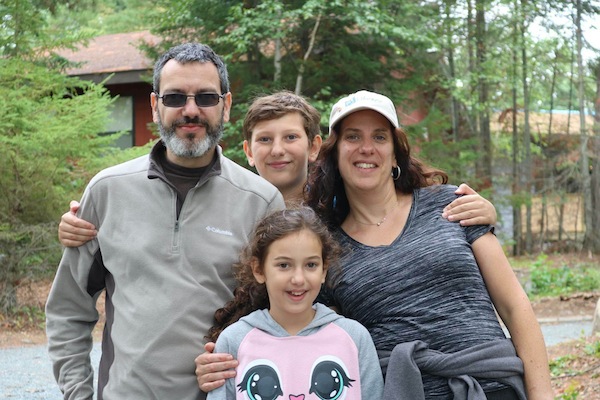
Silver family wedding

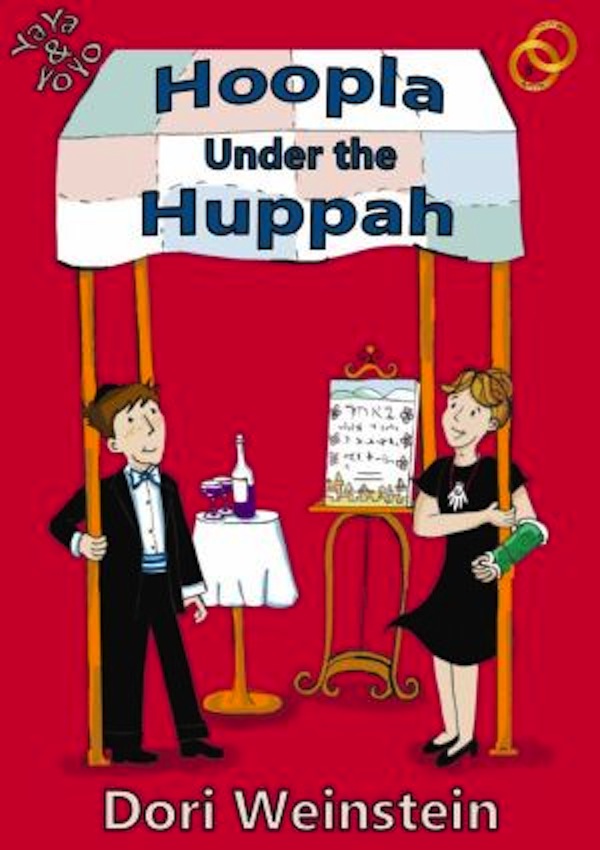
Hoopla Under the Huppah by Dori Weinstein (Five Flames Press, 2017) is the third instalment of the YaYa and YoYo series, which includes Sliding into the New Year, about Rosh Hashanah, and Shaking in the Shack, about Sukkot.

Targeted to 9-to-11-year-olds, Hoopla Under the Huppah features 11-year-old twins YaYa (Yael/Ellie) and YoYo (Yoel/Joel) Silver. Their Aunt Rachel is getting married to soon-to-be Uncle David, and they have been asked to participate. As the plans develop, YaYa and YoYo learn all of the rituals and traditions of a Jewish wedding. However, as the weeks pass, there are all kinds of good and bad adventures that the twins and their 13-year-old older brother, Jeremy, experience. As the ketubah, painted by the kids’ mother, the wedding ceremony and more evolve, YaYa worries about “the Evil Eye” and that she might be bringing bad luck to everything she touches.

Hoopla Under the Huppah offers opportunities for parents to discuss various Jewish traditions with their kids, while enjoying the humour of the Silver family. As an adult, I really enjoyed this book.

Weinstein grew up in New York, taught in public and Jewish schools and now lives in Minneapolis, Minn., with her husband and children, where she teaches preschool Hebrew.

Sybil Kaplan is a journalist, lecturer, book reviewer and food writer in Jerusalem. She created and leads the weekly English-language Shuk Walks in Machane Yehuda, she has compiled and edited nine kosher cookbooks, and is the author of Witness to History: Ten Years as a Woman Journalist in Israel.

Meet new or favourite writers

The Cherie Smith JCC Jewish Book Festival starts this Saturday night (Feb. 9) with Joshua Cohen, author of Moving Kings and ATTENTION: Dispatches from a Land of Distraction. It continues for five literary-filled days at the Jewish Community Centre of Greater Vancouver, and here’s a sampling of books you might want to add to your reading list, and authors you might like to meet.

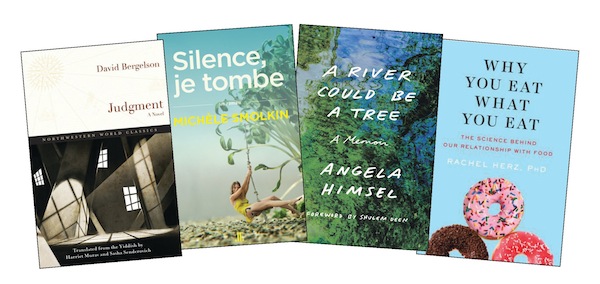
book cover - JudgmentSet in 1920, in the fictional shtetl of Golikhovke during the Russian civil war, Judgment, by David Bergelson (1884-1952), is a melancholic novel about humanity in a time of uncertainty, where different political factions are warring, each under their own ultimately meaningless banner; neighbours cannot trust one another, let alone strangers; and justice is meted out randomly by a cruel, indifferent force.

Stationed in an also fictitious abandoned monastery called Kamino-Balke, near Golikhovke, the sickly Bolshevik Filipov is in control of the area along the Ukraine-Poland border. There are smugglers who travel across the border for commercial reasons and Socialist Revolutionaries who travel across it in preparation for an uprising against the Bolsheviks. Jews and non-Jews live together in relative tolerance but political loyalties, ethnic ties and differing ideas of morality ensure a constant tension. All live in fear of being captured by one of Filipov’s agents, as guilt of a crime does not need to be proven for a person to be beaten, imprisoned and/or shot.

What makes this novel beautiful is Bergelson’s prose. Imaginative metaphors: “Large, invisible hands merrily picked up whole heaps of snow and just as merrily released them.” Animated objects: “… the coat lay there bent over, dejected, as if it had made a long, pointless, idiotic journey” and “The cannons’ muzzles – black, fat and eyeless – stared longingly in the direction of the forests around Moshne….” Humour: “Stone fences suited the inhabitants of Yanovo, for all of them were as stubborn as their stone fences: stone upon stone.” And empathy, in this case, for the undercover agent Yokhelzon, whose “eyes (which inspected everything, people said) had already taken in the horror of death – they winked joyfully, so that the horror would not show afterward.”

As should be obvious, Harriet Murav and Sasha Senderovich have done a masterful job of translating Judgment from Yiddish to English. They also provide a fascinating introduction to the novel, its historical context, the author and his other works (Bergelson was executed in 1952, on Stalin’s orders), the book’s title, form, themes and use of language.

Senderovich will be at the book festival on Feb. 10, 3:30 p.m.

***

book cover - Silence, je tombeMichèle Smolkin’s novel Silence, je tombe is a witty, philosophical novel that explores how people can become isolated from one another, including themselves. Told from the perspectives of a few protagonists, readers will likely relate to many of the feelings expressed.

The novel starts with a pregnant Tania, as she, her husband Paul and their toddler Margot are making the drive to their new home in “Manhattan, Kansas, The Little Apple,” from Vancouver. Tania’s disenchantment is obvious and she expresses her anger towards her husband – who, as a professor of philosophy, couldn’t find a job elsewhere – with vicious (and very funny) sarcasm, mostly in her thoughts, but aloud, as well. She had imagined a different life for herself – living in New York, the Big Apple, for one thing; and certainly not in the Bible Belt. As a Francophone Jew, she anticipates that fitting in might be a problem.

As the book progresses, we get to know Tania, Paul and a disturbed man named Kevin, plus a couple of other minor but important characters. Through them, we contemplate love, what attracts people to one another and what forces them apart, what happiness is, what actions might be unforgivable, how our childhoods influence our adulthoods, and, of course, the inadequacy of words for certain situations, and understanding why, sometimes, silence is the only possible response.

Smolkin’s talk – the book festival’s first-ever French-language event – will take place Feb. 10, 5 p.m. (Note: Festival program shows incorrect time.)

***

book cover - A River Could Be a TreeA River Could Be a Tree is, thankfully, not the memoir of a person who goes from believing fanatically in one religion to being swept away as unquestioningly into another, though it might seem like it would be, given some aspects of the press material. “How does a woman who grew up in rural Indiana in a fundamentalist Christian cult end up a practising Jew in New York?” asks part of the blurb on the book flap. Well, for starters, Angela Himsel seems to always have been an inquisitive person, and never an avid follower of Herbert Armstrong’s Worldwide Church of God. She was an obedient child, but is still struggling with understanding how her parents believed so much in the church doctrine that they didn’t give her sister the care that might have prevented her death at a young age.

A River Could Be a Tree is a measured, often humourous, always intelligent memoir. Himsel starts with a prologue that gives readers a very large hint as to what led her to ultimately convert to Judaism: she and her boyfriend Selig were, “just once … careless about birth control.”

But the journey to that point is long and more complicated, and Himsel takes readers through it with the benefit of hindsight, hard-won insights and a writing style that is serious, honest but unsentimental, and filled with initially unexpected levity. As but one example, a mere three paragraphs into Chapter 1, in which Himsel talks about her parents’ religious heritage, Roman Catholicism and Lutheranism, she writes about Martin Luther, that, at age 41, he “married a nun, a woman he had helped smuggle out of a convent in a herring barrel. While irrelevant to Luther’s religious beliefs, a nun in a herring barrel is always worth mentioning.”

And A River Could Be a Tree is well worth reading. Himsel will speak at the book festival on Feb. 11, 7:30 p.m.

***

book cover - Why You Eat What You EatThere is so much information in Why You Eat What You Eat: The Science Behind Our Relationship With Food by Rachel Herz. And a refreshing aspect of the book is that it’s not written from a dogmatic, all-knowing viewpoint. Herz acknowledges that sometimes studies come to different conclusions, sometimes scientific progress means that what was once thought true is disproven, and that different people will experience food, exercise and other things differently. Readers looking for certainty might be disappointed, but those wanting to learn will learn a lot. Who doesn’t want to know, for example, why tomato juice is one of the most popular drink orders on planes? Does sugar really help the medicine go down, so to speak, i.e. reduce the effects of pain? And why can buying ethically branded or organic products make us less charitable?

But Why You Eat What You Eat is more than an amalgamation of trivia. Herz has compiled a very readable and relatively comprehensive resource that will, as the title promises, help explain why we eat what we eat; how all of our senses – taste, smell, sight, touch and hearing – affect how we experience food. And knowing these things just might make us feel better about ourselves, and make choices that would serve us better.

Herz will be at the book festival on Feb. 13, 6 p.m.

World’s craze for sand

The World in a Grain: The Story of Sand and How It Transformed Civilization by Vince Beiser is a finalist for the 2019 PEN/E.O. Wilson Prize for Literary Science Writing. The award is given to a “book that exemplifies literary excellence on the subject of the physical or biological sciences and communicates complex scientific concepts to a lay audience.”

At the core of PEN America is the ideal of freedom of speech, “recognizing the power of the word to transform the world.” For his entire career, Beiser has been trying to change the world with his writing and, with The World in a Grain, he educates readers about the phenomenal importance of sand in making thousands of things, from concrete to glass to fibre-optic cables, and how dependent on it we are. So valuable is sand that people steal it and even kill for it, and our unbridled use of it, in concrete in particular, might just kill the planet.

To bring these harsh realities to light, Beiser adeptly and engagingly – sometimes with humour – mixes empirical evidence, scientific explanations, interviews with people directly connected to or affected by sand mining, profiles of relevant historical figures and his own commentary, as well as some factoids, which he calls “Interludes.” He comes to the not-surprising-but-disheartening conclusion that there’s only one solution: “human beings have to start using less sand. For that matter, we have to start using less of everything.”

Beiser dedicates the book to his wife, Kaile, and their children, Adara and Isaiah. While they live in Los Angeles, he grew up here. The Jewish Independent interviewed him about his upbringing, his career and, of course, his book.

JI: Could you tell me where you were born, how you ended up in Vancouver, and how your parents’ involvement in social causes influenced your choice of profession?

VB: I’m from a venerable Vancouver family, though I wasn’t born there. My grandfather’s family – the Landos – came over from England around the turn of the 20th century, first to Prince Rupert and then to Vancouver, where they worked in the fur business, of all things. My mother [Roberta] and her siblings were all born and raised in Vancouver – mostly in the same house where she still lives! My brothers and I were all born in the U.S. (myself in New York City), where my father [Morton] was working. We moved to Vancouver when I was 10, and I grew up there until I took off to college in California. I come back just about every summer.

My parents were always very engaged with the world, and the idea of trying to make it a better place – my father as a mental health researcher, and my mother mainly through her work with all kinds of arts and cultural organizations. We did a lot of traveling as well, which really opened my eyes to just how lucky we were and how much less so are so many other people. Meanwhile, I also had an uncle, Vancouver native Barry Lando, who was a highly decorated producer at 60 Minutes, so I grew up watching his shows and hearing about his adventures all over the world. I never consciously thought that I wanted to have a job like that, but it certainly made an impression.

JI: What role does Jewish culture and/or Judaism play in your life and work?

VB: I’m proud to be a Jew, and that heritage has definitely had an impact on my professional life. Knowing our long and brutal history of oppression helped sharpen my desire to work for social justice, to do what I can to help right, or at least bring attention to, wrongs wherever I find them. I started my career in Jerusalem, covering the First Intifada as a freelancer for both Israeli and Palestinian publications. Later, I wound up working for an Israeli magazine, The Jerusalem Report, first in Eastern Europe covering the wars in the former Yugoslavia, and later as their New York correspondent. I’ve probably written more about Jews and Jewish issues than anything else except sand!

JI: What took you from Vancouver and how did you establish yourself in Los Angeles?

VB: I went to college at the University of California at Berkeley – I really wanted to get to the States, which I thought was a much more exciting place than then-sleepy little Vancouver. From there, I spent years traveling and working all over the world, first as a hitchhiking backpacker, and later as a freelance journalist (there’s often not a lot of difference between the two lifestyles). I spent several years in the Middle East and then Eastern Europe, then came back to the U.S., where I bounced around from New York to San Francisco to Las Vegas (that’s right, I lived in Las Vegas). I was living in San Francisco when I met a delightful young woman living in L.A. I was doing a lot of work in L.A. at the time, writing for the L.A. Times Magazine and other places, so had an excuse to visit her often and, well, 17 years later we’re married, with two kids and a mortgage and the whole package.

JI: In an interview you did with David Simon, you talk about journalism, fiction and film, and Simon comments that no one reads anymore. What are your thoughts on that, on the state of journalism and your decision to write a book?

VB: These are dark days for the business of journalism, of course, with local newspapers dying off en masse and money drying up for those that are left, thanks to the internet. Most of my career has been spent writing for magazines, and a terrifying number of the ones that I’ve written for over the years have disappeared or been reduced to emaciated shadows of their former selves – The Village Voice, Spin, Rolling Stone, US News & World Report, and on and depressingly on.

book cover - The World in a Grain
The World in a Grain can be purchased on Amazon and at other bookstores.

But, contrary to what everyone expected with the advent of the internet and the Twitterization of discourse, people do still read, at length and in numbers. There are plenty of long, deep articles published online that attract hordes of eyeballs – the trick no one has cracked yet is figuring out how to make money off of them. Oddly, the book industry is still doing relatively well; most people still seem to prefer physical, paper books to reading something of that length on a screen. So, moving from magazines into book writing is not only something I’ve always wanted to do – it’s also a tactical move aimed at keeping me solvent. I’m branching into movies and TV for the same reason. If you’re going to survive as a freelance journalist in the 21st century, you’ve got to tell your stories and get paid every which way you can.

JI: Can you describe how the topic of sand first came to you, why it piqued your interest and about the path to the book’s publication?

VB: I’m a full-time freelancer, so I’m always hustling for stories, which involves trawling through a lot of obscure publications. One day in early 2015, I stumbled across a story on a little environmental website from which I learned two things. One, sand is the most-consumed natural resource on earth after air and water; that alone made me sit up and take notice. Two, that there is so much demand for the stuff that we are inflicting tremendous environmental damage all over the world to get it, stripping bare riverbeds and beaches and, in some places, people are even being murdered over sand. Like most people, I had never even thought about sand as a commodity, let alone one so important people might be killed over it.

I thought this all sounded crazy but, with a little research, I found it was true. The violence, I discovered, is by far the worst in India. So, I convinced Wired magazine to send me to India, where I reported a feature on the murderous ‘sand mafias’ that bedevil that country. The piece came out in spring of 2015 and got a great response from readers. I knew by then there was much, much more to the story – a book’s worth, I figured. That summer, I spent a few days alone on a tiny property we own on Gabriola Island pounding out a book proposal. My agent in New York sold it almost right away to the folks at Penguin Random House, and I was off to the races.

JI: How would you describe your level of optimism about the future?

VB: Really depends on the day, or hour. But I’ve got kids growing up in this world, so I don’t have much choice but to hope for the best!

From Hitler’s library

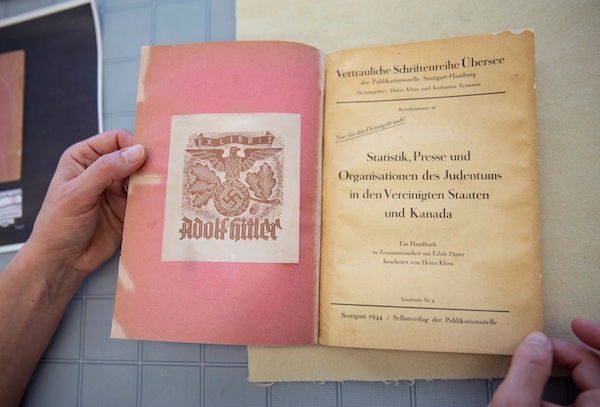
Library and Archives Canada recently acquired this 1944 book previously owned by Adolf Hitler. (photo from Library and Archives Canada)

Library and Archives Canada recently acquired a rare 1944 book previously owned by Adolf Hitler. The 137-page German-language report Statistik, Presse und Organisationen des Judentums in den Vereinigten Staaten und Kanada (Statistics, Media and Organizations of Jewry in the United States and Canada) was compiled by Heinz Kloss. The data contained within it provides details on population statistics in certain cities, as well as key organizations and presses of Canadian and American Jewish communities. The bookplate bears a stylized eagle, swastika, and the words “Ex Libris Adolf Hitler,” indicating it came from Hitler’s personal library.

Kloss, who visited the United States in 1936-1937, was a noted German linguist whose specializations included German speakers living in the United States. He was the head of the Publikationsstelle Stuttgart-Hamburg, which dealt with research on nationality issues, particularly in the United States, and this book was part of a confidential series and for official use only.

The work hints at the story of what might have happened in Canada had the Allies lost the Second World War. It also demonstrates that the Holocaust was not a purely European event, but rather an operation that was stopped before it reached North America. The book adds many insights worthy of reflection for Canada about the Second World War, and is an important tool to fight Holocaust denial.

“It is fundamental for a national institution like Library and Archives Canada – and other memory institutions around the world – to acquire, preserve and make available documents no matter how controversial or contentious they could be,” said Guy Berthiaume, librarian and archivist of Canada. “It allows us to educate and to advocate for the most complete historical record possible. The truth of history is woven from many sources, and it is only when history is presented in its entirety that it can support the free exchange of ideas that lies at the heart of a democratic society.”

This book by Kloss was likely brought to the United States as a war souvenir, as thousands were taken by American soldiers from the Nazi leader’s alpine retreat outside Berchtesgaden in the spring of 1945. The library acquired it from a reputable Judaica dealer who had obtained it as part of a collection owned by a Holocaust survivor, and it will be preserved in the Jacob M. Lowy Collection, where other important items related to Holocaust remembrance reside.

The acquisition of this book highlights the library’s mandate to acquire material that reflects the published record of Canada, as well as to preserve the memory of the Holocaust. It is also a way to let us reflect on what would have happened in Canada had the Second World War ended differently.

“This invaluable report offers a documented confirmation of the fears felt so acutely and expressed by so many Canadian Jews during the Second World War: that the Nazis would land on our shores and, with them, the annihilation of Jewish life here,” said Prof. Rebecca Margolis, department of modern languages and literatures and Vered Jewish Canadian Studies Program, University of Ottawa, and president, Association for Canadian Jewish Studies. “While these fears may seem unfounded given the geographic distance of Nazi Europe to Canada, this handbook offering detailed statistics of Jewish populations across North America underlines their nightmarish potential.”

Saved by Dutch Resistance

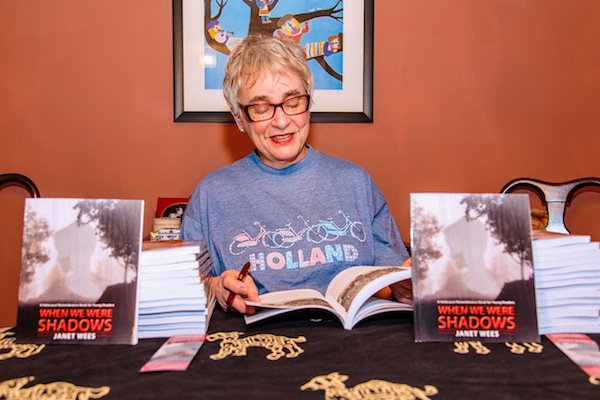
Janet Wees at a book signing for her novel When We Were Shadows, which she’ll be bringing to the Cherie Smith JCC Jewish Book Festival on Feb. 10. (photo by Jack Cohen)

Ze’ev Bar was 5 years old in 1937, when his family fled Germany to the Netherlands, where they lived in safety for a few years. But, in 1940, as the Nazis extended their hold on Europe, the family had to go into hiding, managing to survive the Holocaust with the help of members of the Dutch Resistance.

Calgary-based educator and writer Janet Wees tells Bar’s story of survival in the book When We Were Shadows. She will present the novel for younger readers (ages 9-13) on Feb. 10, 10 a.m., at the Jewish Community Centre of Greater Vancouver as part of the Cherie Smith JCC Jewish Book Festival, which runs Feb. 9-14. Wees and five other authors – Leo Burstyn, Miriam Clavir, Arnold Grossman, David Kirkpatrick and Helen Wilkes – will briefly introduce their works at the event A Literary Quickie.

“My reasons for writing this book were twofold,” Wees told the Independent. “One, to help relieve Ze’ev from having to repeat his story over and over to schoolchildren because it was so upsetting for him, yet he felt it needed to be told so they would know what happened during the Second World War in their country. Hopefully, having had the book translated into Dutch in Holland, that might be happening. I have had letters from mothers of children who are reading the book in Dutch for book reports.

“My other reason was to expose North American children to the plight of children during war, to the bravery of the people who helped save lives at risks to their own.”

Among the real-life members of the resistance featured in the novel are Opa Bakker, Tante Cor, and Edouard and Jacoba von Baumhauer, all of whom have been recognized as Righteous Among the Nations by Yad Vashem. Wees said, “I made a promise to von Baumhauer’s son that I would honour the people who risked their lives helping to build the Hidden Village [near Vierhouten] and hide, assist and feed the people who were fleeing the Nazis.”

Wees visited the memorial site of the Hidden Village in 2005, and again in 2007. She interviewed Bar in Amsterdam in 2008.

“We spent three to four days in his dining room, talking, crying, laughing; I taped and wrote,” she said. “Once home, I poured it all out on computer and began to sort and edit and change, and watched it take shape. Of course, life interfered, and sometimes it was so intense, hearing his wavering voice on tape, that I would have to take a break. By 2011, it felt ready for an editor. After that, I submitted it, naively giving myself 12 rejections – apparently J.K. Rowling had 12 rejections before Harry Potter was accepted – before I reconsidered my direction.”

A change in direction did occur. In 2014, Wees was accepted into a mentorship program and, with that guidance, realized that the novel “needed a boy’s voice and an empathetic setting, where children could identify with the protagonist.”

Over some four months, Wees said, “I essentially rewrote the book using a different format and incorporating a boy’s voice. At the end, there was a reading and the book was so enthusiastically received that I knew I was on the right track.

“It felt like I had kind of lost perspective, as I was so close to the story and, even though I would have times of ‘Wow! Did I write that?’ seeing it through others’ eyes really gave me a boost. I began submitting again and, this time, the 11th publisher contacted was the one!”

The book was accepted by Second Story Press in 2017.

“I always wanted Second Story Press to be my publisher because of their Holocaust Remembrance Series for Young Readers. I read other books in that series and felt this was a good fit,” said Wees.

While When We Were Shadows is Wees’ first book, she has published articles in educational journals and in news magazines. In addition to other literary projects, she has written drafts for two children’s books, she said, “based on something I did growing up in Saskatchewan, and one based on my pen pal’s granddaughter’s activity with her Oma in Holland.”

The 60-something Wees first started writing her pen pal when she was 12 years old.

“My pen pal Henk had to find a pen pal in an English-speaking country for his English class in school. He put an ad for a pen pal in the Regina Leader-Post and I saw it and responded,” she explained. “He told me, on my first visit, as we were looking over all my letters he’d saved, that my letter was the funniest so he chose me as his pen pal.

“We wrote constantly but lost contact for a few years during which we both got married and started families. I reconnected, in 1972 or thereabouts, and, knowing how families in Europe usually stay in their family homes, I wrote to the old address. Lo and behold! There they were! After that, it was letters with Henk’s wife because she was better at that point with written English, but we telephoned and, upon the onset of computers, we emailed and then FaceTimed.

“I went to visit them for the first time in 1991, and have been back 10 times since…. On one of the trips where I stayed one month on the island (Terschelling), Hennie (Henk’s nickname) and Loes took me to see the memorial site of the Hidden Village and the urge to learn more about this site was palpable.

“Two years later,” said Wees, “we went again, and I sat for longer in the replica huts and tried to imagine what went on. It smelled like our dirt basement in Togo, Sask., and just thinking about living in that basement for 18 months gave me a bit of an idea of the sense of being confined; the smells, the dark, the cold. And I decided that I had to write a book, if not for my former students who were now in university, for their children. Sadly, Hennie passed away this past April without seeing the published book, but I used his name (with his permission) for one of my characters, so he lives on through the book. If not for him, this book may never have existed.”

In their first discussions about the novel, Wees said she and Bar had “talked about making it an ‘adventure’ of a boy during wartime.” The original title was Boy of the Forest. “But,” she said, “as I was writing, I realized this was not an ‘adventure’ as we perceive adventure, and he concurred, so I changed my title to Whatever It Takes. My publisher chose the final title, When We Were Shadows, and I love it because it personifies the whole concept of living in the shadows – unseen, and unable to see.”

In revising the original manuscript to be from a young boy’s perspective, she said her focus was on “the emotional being of Walter [Ze’ev changed his name as an adult] and how he perceived what was happening, being sheltered and wanting desperately to know and to do something, and about the selflessness of others. I wanted it to be about the people in his world, what was happening inside his head and heart, more than what was happening outside.”

Wees said the character of Walter took over “and his voice flowed through so eloquently and so quickly that there were many days I never budged from my computer for hours, missing lunch and working until dark. I ‘heard’ him in my head. I could ‘see’ what was happening. Until I actually was writing, I always thought that was bunk when I heard other authors say that their characters take them on their own journey. But now I know it happens.

“I also discovered that what I’d taught my students about editing, I had to follow as well, so I did most of my editing by reading the book aloud. I found errors that way in facts, such as tents not having zippers in the 1940s but pegs instead. I was able to find correct weather for dates in the letters by searching online.”

This diligence no doubt contributed to When We Were Shadows being nominated for the Forest of Reading Red Maple non-fiction award of the Ontario Library Association, which describes the award program’s aim as getting young readers (ages 12 to 13) to engage “in conversation around the books and … to use critical thinking while reading.” The awards will be presented in May.

In the writing of When We Were Shadows, Wees said, “I have become friends with von Baumhauer’s grandson and wife. While writing this book, I also found out that my grandmother lost sisters-in-law to the death camps and her brother was killed on the Russian front. Until then, I had no idea how our family was affected by the Holocaust, as I was unaware of family still living overseas. I am now in touch with the great-granddaughter of one of those women.”

For the full book festival schedule and tickets, visit jewishbookfestival.ca.

Friendship interrupted

The Princess Dolls by Ellen Schwartz, with illustrations by Mariko Ando, takes place in Vancouver in 1942. Esther and Michiko are best friends. They dream that one day they will be princesses together; in games, Esther is Princess Elizabeth and Michi is Princess Margaret. When they spy dolls fashioned after the real-life princesses in the toy store window, the girls dare to hope that they’ll each get their favourite for their birthday, something else they shared, both having been born on the same day.

However, when Esther gets her royal doll as a gift, but Michi doesn’t, the girls’ friendship is strained. Before they have a chance to patch it up, Michi and her family – ultimately along with more than 21,000 other Japanese-Canadians – are forced to leave the West Coast, losing their home, business and possessions. Michi ends up in Kaslo, B.C.

A story thread throughout The Princess Dolls is Esther’s family’s worry over family members in Europe, as the Nazis round up Jews and send them to transit camps, about which Esther’s parents and grandmother know little.

The Princess Dolls is kind of a companion novel to Schwartz’s Heart of a Champion, in which 10-year-old Kenny Sakamoto dreams of being as good at baseball as his older brother, who is the Asahi team’s star player. Also set in Vancouver in 1942, the Sakamoto family’s neighbours and good friends, the Bernsteins, are Jewish. As she told the Independent when that book was released, “I wanted to point out that the treatment of Japanese-Canadians, although obviously not nearly as lethal or horrific, was comparable to that of Jews in Europe,” said Schwartz. “In both cases, a minority was being persecuted simply because of their religion or nationality. Giving Kenny a Jewish best friend would make both characters sympathetic about this issue.” (See jewishindependent.ca/uniquely-b-c-baseball-story.)

Schwartz will talk about The Princess Dolls on Feb. 10, 11 a.m., at Richmond Public Library, as well as at Vancouver Talmud Torah later that week as part of the Cherie Smith JCC Jewish Book Festival. For the festival schedule and tickets, visit jewishbookfestival.ca.

Sharing their stories

Makeda Zook, left, and Sadie Epstein-Fine, editors of Spawning Generations. (photo from Demeter Press)

Sadie Epstein-Fine and Makeda Zook will be in Vancouver for the Jan. 17 launch of Spawning Generations: Rants and Reflections on Growing Up with LGBTQ+ Parents (Demeter Press, 2018), which they co-edited.

“It is really important to us that this book was written and edited by queerspawn. So often our stories are told for and on behalf of us by researchers, journalists and academics,” Epstein-Fine told the Independent. “Our intimate, personal family lives have been under the microscope for our entire lives, proving to the world that we turned out all right. By curating stories from our community, including our own stories, Makeda and I ensured that we were not, as we like to call it, airbrushing our stories, but that we were allowing our contributors to tell the nitty gritty, the details of their stories that they have never been able to tell.”

In the book’s introduction, Epstein-Fine and Zook explain that the term queerspawn to describe someone who has one or more LGBTQ+ parents was coined by Stefan Lynch, the first director of COLAGE, an American “network dedicated to connecting and supporting queerspawn,” which has one chapter in Canada (in Toronto).

book cover - Spawning Generations

“By giving a name to our identities and experiences, he laid the foundation for connecting and politicizing queerspawn; Lynch gave us a term to organize around,” they write, acknowledging that the term “is not without controversy. Although some people feel empowered by reclaiming both words (‘queer’ and ‘spawn’), others do not like the association with ‘spawn of the devil.’” Another term, “gayby,” also has its proponents and its critics, those who “find it infantilizing and only representative of people whose parents identify as gay,” note Epstein-Fine and Zook.

Ultimately, the editors chose to use queerspawn for the anthology because it is “unapologetic and bold.” As well, it is “the word most often used in Canada and the United States and, as such, it helps us find each other; it is a common word we can rally around. We often feel highly visible in straight communities and invisible in queer ones. The term ‘queerspawn’ creates a space for us, and helps us to feel strength in numbers and a sense of belonging at times when we feel all too visible. When we feel invisible, naming ourselves as queerspawn tells the queer community that we are still here, even if we have grown up.”

Epstein-Fine was born in Toronto in 1992 to two moms, in an activist home, “surrounded by 11 other women.” She carries on her family’s activist tradition and describes herself as a queer(spawn)-political theatre maker.

According to her bio, Zook “was born in Vancouver in 1986 to her two lesbian feminist moms. She was raised in a mixed-race family surrounded by anti-oppression politics and her OWLs (older, wiser lesbians).” She works in sexual health promotion for a feminist nongovernmental organization.

Epstein-Fine shared with the Independent how she and Zook came to be the editors of Spawning Generations.

“Demeter Press approached Makeda and I to edit the anthology because they saw a gap in their literature,” she explained. “They mostly publish books about motherhood, through a feminist lens, and they realized that, while they had a lot of literature about queer parenthood, they didn’t have anything from the children. This is a trend in the majority of queer parenting literature – we hear a lot from the parents, but rarely from the kids raised in queer households.

“Yes, it’s true, Makeda’s and my primary focus is not editing. Previous to editing this anthology we were both writers, which is how we got connected to this book. Our (queerspawn) community is small and disparate, there is not a plethora of options available. When Demeter first approached me with this project, I tried to think of folks who could do this project, and there was no obvious answer.

“Makeda and I learned to be editors in trial by fire,” she admitted. “We always say that we didn’t just grow alongside this project, but that this project grew us. After three years of working on this project, we now feel confident in our editing skills, which we didn’t feel previously.”

And the pair has done a commendable job in keeping the essays on point. The editing is such that each contributor maintains their own voice, which adds to the book’s readability and interest. Contributors range in age, from 9 years old, to teenagers, to 20-somethings and older queerspawn. And the writers come from all over the world, from as far away as London, England, and as close as Victoria; one was born in Vancouver but seems not to live here anymore. While all the contributors have being the child of one or more LGBTQ+ parents in common and have shared some similar experiences, each story is unique.

“There was a call for writers, which we spread as far as we could,” Epstein-Fine explained about how the essays for the anthology were chosen. She said they asked COLAGE and several organizations and people they know in Canada to publicize the call, which went out in the winter of 2015, with a due date of May 1 that year.

“We received 25 submissions and we took every single one,” she said. “We thought that each person had an interesting story to tell and we were committed to helping them tell their story the way they wanted it to be told. We initially thought that we wanted to be more selective and, if we had received more submissions, we would have been forced to be. However, the wonderful result of us taking everyone is that our book is not just filled with works from professional writers, but we have contributors with a range of experiences – from people who have never written a personal essay to professional writers. It gives a real scope of our community.”

The Spawning Generations book launch takes place Jan. 17, 7 p.m., at Massy Books, 229 East Georgia St., in Vancouver. For more information, visit facebook.com/spawninggenerations.

Shalvi reaches the sky

Alice Shalvi, an Israeli professor and educator, has played a leading role in progressive Jewish education for girls and advancing the status of women in Israel. Her autobiography, Never a Native (Halban Publishers, 2018), reads almost as a personal diary. Otherwise, how could this 92-year-old recall the most minute details of her life?

The youngest of two children, Shalvi was born in Essen, Germany, to Benzion and Perl Margulies, religious Zionists who owned a wholesale linen and housewares business. In 1933, soon after Hitler’s rise to power in Germany, their home was searched, prompting her father’s move to London, England. The rest of the family followed in May 1934.

In London, Shalvi’s father and brother imported watches and jewelry. When the Blitz began, they temporarily moved to Aylesbury, 50 kilometres north of London.

In 1944, Shalvi studied English literature at Cambridge University. In 1946, she was sent to the Zionist Congress in Basel as a representative of British Jewish students and, in 1949, after completing a degree in social work at the London School of Economics, she immigrated to Israel, settling in Jerusalem. She became a faculty member in the English department of the Hebrew University of Jerusalem and she earned her PhD there in 1962.

In May 1950, Shalvi met Moshe Shelkowitz (changed later to Shalvi), a recent immigrant from New York, whom she married in October of that year. They had six children between 1952 and 1967; Moshe Shalvi died in 2013.

The 25th issue of Nashim: A Journal of Jewish Women’s Studies and Gender Issues (fall 2003) was dedicated to Alice Shalvi, “who made the dream of a journal devoted to Jewish women’s and gender studies possible.” When the concept of Nashim was first presented to her, the special issue notes that Shalvi greeted it not only with enthusiasm but as an idea whose time had finally come – she and her friends, pioneers of second-wave Jewish feminism, had raised it long before. “Subsequently, as rector of the Schechter Institute (1997-2001), [Shalvi] added her voice to the approval process for the issue’s first publication. She has remained on Nashim’s editorial board ever since, contributing her wise and warm guidance on issues of editorial and academic policy and herself serving as consulting editor for our issue on Women, War and Peace.”

In an interview by Elana Maryules Sztokman for the Lookstein Centre at Bar-Ilan University some years ago – after Shalvi had been awarded the 2007 Israel Prize for life achievement – Shalvi commented: “I felt that, through the work we had done on behalf of women, an enormous change had occurred in the status of women, in the self-image of women, in the self-assurance of women and, most importantly – because that’s what the prize recognized – in the awareness of the importance and centrality of the subject of the status of women in society at large.”

Shalvi spoke about the Pelech School for Girls and the Israel Women’s Network. “The school has created a generation of young modern Orthodox women who are changing that entire social system within modern orthodoxy,” she said. “The other thing I’m proud of is the years at the network, which saw the largest number of legislative changes and reforms in women’s status because what I call the ‘alumnae’ of the network were so prominent in the Knesset.”

In her autobiography, Shalvi emphasizes “that it’s all about the home,” and acknowledges the impact her parents had on her. “What I saw at home,” she writes, “was an open attitude, observance but openness. My mother always used to set an extra place at the table on Shabbat in case my father brought home a stranger from synagogue, as was the custom in those days. And, in my family, I learned about tzedakah in the very best sense – always a readiness to help others, not only from my father, who did it on a both public and personal level, but also from my mother.

“The other thing I absorbed was Zionism. It was a strongly Zionist household, and my father was very active in the religious Zionist community. From very early on, I knew that I would come on aliyah one day. I didn’t know when, but it was definitely there in the future.”

When asked to convey one message to the next generation, Shalvi said, “Reach for the sky and don’t give up. Don’t ever give up. Even if you know you’ll never attain what you’re reaching for, persist. Keep at it. I like to quote Robert Browning’s ‘Andrea del Sarto’: ‘Aye, but a man’s reach must exceed his grasp / Or what’s a heaven for.’ Keep on striving because, even if you don’t attain that goal yourself, the chances are that, for the next generation, it will be easier.”

Sybil Kaplan is a journalist, lecturer, book reviewer and food writer in Jerusalem. She created and leads the weekly English-language Shuk Walks in Machane Yehuda, she has compiled and edited nine kosher cookbooks, and is the author of Witness to History: Ten Years as a Woman Journalist in Israel.

Gourmet anything but lazy

Susan Mendelson, founder of the Lazy Gourmet, shares a little about herself and her business at the launch of this year’s The Scribe. (photo by Kenneth I. Swartz)

One of Vancouver’s most successful food industry professionals shared her story recently, helping to launch this year’s edition of The Scribe, the journal of the Jewish Museum and Archives of British Columbia.

The topic of the 2018 issue is food, covering restaurants and related sectors from the early days of the community up to destinations that are still operating today. Susan Mendelson, best known around town as founder of the Lazy Gourmet, brought her thespian side to the audience at the Western Front Nov. 28, eliciting laughter as she guided the packed hall on a tour through her remarkable career.

“My mother’s mother, Grandma Faye, was a large influence in my life,” Mendelson said. An extraordinary baker and cook renowned in her small Jewish community of Quebec City, Grandma Faye took it as a challenge to keep a deep freezer filled with baking for when friends dropped by or to be ready for a tea party.

As a child, Mendelson loved to cook and bake. When the Six Day War broke out in Israel, in 1967, the family rallied to raise funds to send to Israel. Young Susan planned a bake sale in their backyard. She made all of her favourite squares and cookies and the neighbours snapped them up. Mendelson’s mother only told her years later that the cost of the ingredients was on par with what was raised that day. Thankfully, Mendelson told the audience, that wasn’t a harbinger of things to come.

Mendelson came to Vancouver to study at the University of British Columbia and gravitated to the theatre department. Her theatre professor, Larry Lillo, became a close friend. He broke the news to Mendelson that she would never be a great actress … though he really loved her cheesecake.

After third year, Mendelson took a break from school and worked in a group home for troubled teens. There, she met Deborah Roitberg, with whom she made the food for the kids in the group home. An instant friendship developed.

After traveling to Europe and Israel, Mendelson thought she would return to school and pursue social work. Around that time, Lillo had founded Tamahnous Theatre, an experimental ensemble that was becoming the resident company at the Vancouver East Cultural Centre. He hired Mendelson as house manager, which allowed her to go to school during the day and work at the Cultch, as the institution is familiarly known, at night. But the salary didn’t cover her expenses, so she began to make cheesecake to sell at intermission, later adding carrot cake and Nanaimo bars to her repertoire – “when the curtain came down at intermission, the lobby was stormed by people pushing in line to make sure that they got their piece of the cake.”

Anne Petrie of CBC radio’s afternoon show called Mendelson, having heard about the cheesecake phenomenon, and asked her to come on the program.

“I told her that I was putting myself through university with the recipe, but that I would come onto her show to tell her listeners how to make chocolate cheesecake, a recipe that my friend Miriam Gropper had given me,” Mendelson said.

Her cheeky attitude was a hit with audiences, and she was asked back. She returned for Valentine’s Day, talking about aphrodisiacs. Soon she had a regular radio gig paying $25 per appearance.

Mendelson’s boss at the Cultch started asking her to cater opening night parties. Wedding catering followed and then Mendelson was given the responsibility of catering to all the performers at the first iteration of the Vancouver Children’s Festival. She and Roitberg discussed opening a take-out food business.

“Our concept was that people would bring in their casserole dishes and platters and we would fill them with our food and they would take them home and pretend that they had made them themselves,” she said. “We would call ourselves the Lazy Gourmet, in honour of our customers who wanted gourmet food but were too lazy to make it themselves.”

Over the years, Mendelson had shared scores of recipes with radio listeners and some asked her to put them in book form. Mama Never Cooked Like This sold out and went into reprints; it was picked up by an American publisher.

To coincide with the publication of her second book, which was written for children and titled Let me in the Kitchen, the producer of the Children’s Festival, Chris Wootten, asked Mendelson to produce her own show. The best part of that experience, Mendelson recalled, was that a single dad in the audience brought his 7-year-old son and they bought the cookbook and made recipes

from it. “Six years later, I met those two,” she said. “And, seven years later, I married the dad and became stepmother to the most wonderful young teen. I was so happy that Jack and Soleil had experienced that show and that in some way we shared that amazing experience of my life.”

TV appearances followed and Mendelson was asked to write a souvenir cookbook for Expo 86.

But the trajectory was not entirely positive. After expanding the Lazy Gourmet from one store to three, the company began losing money. They eventually abandoned two of the storefronts and Roitberg left the business to raise a family.

Soon after the birth of daughter Mira, Mendelson was invited to cater a new event that was coming to Vancouver: the Molson Indy Vancouver.

“If you thought that the Children’s Festival wore me out … you can’t even imagine what that event did to me physically,” she said. “But, of course, I loved it and, by the last few years of the race, which took place on Labour Day weekend – Jack will tell you that it was our anniversary weekend that we didn’t celebrate for nine years – we were also catering the Abbotsford Airshow, which took place two weeks beforehand and, two weeks before that, we catered the Skins Game at Predator Ridge in the Okanagan.”

In addition to hard work, Mendelson credits her success to hiring people who she says are smarter and more talented than herself. A couple of years ago, she gave shares in the company to two long-term team members and moved into a part-time role. The company continues to expand, including a lifecycle catering department. “We call it womb-to-tomb catering,” she said, citing baby-namings, britot milah, b’nai mitzvah, weddings and funerals, as well as personal events. More recently, Mendelson took on catering the lunches at Vancouver Talmud Torah.

The Scribe launch also included words from Cynthia Ramsay, editor and publisher of the Independent, who has also, for the past nine years, edited The Scribe.

“When I started the job, the journal was a mix of academic essays and community-related history,” Ramsay said. “But it soon changed to become a means by which the museum could highlight its collection; the oral histories, photographs and other artifacts that it houses on the community’s behalf. We’ve done issues on the Jewish Western Bulletin, the Jewish Independent’s predecessor; on the furniture industry; scrap metal dealers; the clothing industry; on some of the community pioneers who are buried in our cemeteries all around the province; and, this year, of course, our issue is on the food and service industry.”

She credited museum staff Alysa Routtenberg, Marcy Babins and Michael Schwartz, and the publications committee, which this year included Routtenberg, Perry Seidelman, Gary Averbach, Debby Freiman, Fred Swartz and Ronnie Tessler. The JI’s production manager, Josie Tonio McCarthy, does the layout for the journals.

Seidelman, president of the JMABC, urged audience members not to throw out photographs or documents. “Give them to us,” he said.

The sad road from Auschwitz

The theme of Reckonings: Legacies of Nazi Persecution and the Quest for Justice (Oxford University Press, 2018), the new book by eminent English historian Mary Fulbrook, is justice. Or, rather, injustice, as she exposes how ex-Nazi perpetrators, and bystanders to their murderous policies, have evaded (and continue to evade) due process and acknowledgment of moral responsibility for their (in)actions.

Every level of strategy open to these criminals and cowards is exposed in Reckonings. Fulbrook reveals all the political, psychological, pragmatic, legal (and illegal), scapegoating, self-serving, self-exculpatory, “we were victims too”-type excuses by which the morally corrupt and unconscionable avoid due process and personal liability.

Fulbrook rightly says, at the end of Reckonings, “there can be no answer to the questions of why and how cruelty on this scale was possible.” So, what, she asks, can the “honest” historian do? Her answer sums up the well-realized objective of this magisterial new book: “Historians can clarify patterns of involvement in and responsibility for Nazi persecution and explore the implications both for those who lived through it and those who came after.”

Nazi criminality is, of course, a hugely complex historical issue, but Fulbrook’s strategy is simple and direct: it is to “reconstruct the ways in which wider social and political developments intersected with individual lives” such that “large numbers of people were mobilized in service of a murderous cause.”

image - Reckonings book coverReckonings is rich with such exploration of “individual lives,” both of persecutors and bystanders, and it rings also with the agonizing accounts of dozens of victims, among whom Fulbrook gives frequent and welcome voice to the rarely referenced persecuted sub-groups of homosexuals, and victims of Nazi euthanasia policies.

Fulbrook’s central focus is, however, justice: justice failed and justice delayed, delayed by silence, by endless rationalization, by foot-dragging, by the pollution of the legal system by former Nazis (described as “themselves swimming in a sea of guilt”) and, no less disturbing, by the pragmatics of (primarily American) Cold War strategists, anxious not to offend a potential ally against the Soviet Union.

Reckonings is unusual history in its welcome lack of “normal” arm’s-length objectivity: Fulbrook is uncompromisingly fierce in her condemnation of those who were responsible for this “maelstrom of murder.” Throughout the book, she remains directly and openly angry, and determined to “nail down” these murderous ignoramuses, just-following-orders immoralists and “I knew nothing” liars. One feels the heat of Fulbrook’s grit and determination: each page rings out with a loud, “they will not get away with this as long as I can help it.”

Reckonings is divided into three parts. Part One, the most “traditional” part of the book, explores the various sites of this “maelstrom of murder,” beginning with Auschwitz, but moving carefully beyond, to less and less better-known killing centres, especially in southern Poland – where there were many forgotten violent “microcosms of violence,” as she calls them.

Part Two is, as Fulbrook’s title suggests, the heart of the book: here, the focus shifts to the attempts to bring perpetrators (both men and women) to justice. She lays out the proceedings of the various major trials – Auschwitz, Sobibor, Belzec, Dachau, Hadamar, the Einsatzgruppen trial, etc., right up to the present – but also includes trials relating to perpetrators of euthanasia and other crimes. She outlines, in fascinating detail, the differences between the ways that East and West Germany approached bringing Nazis to justice: the former being famously more diligent than the latter, leading to a flood of ex-Nazis to the more “tolerant” West in the early years after the war. This flood included all the euthanasia personnel, who left their families behind in the GDR to escape justice. (The West accepted the “just following orders” defence; the East did not. About 400,000 people benefited from this and similar lax standards in the West.)

The third part, “Memories,” is about how survivors remember, and how Nazis forget. It combines a plangent exploration of the personal experiences of individuals living around the world who have survived persecution – most of whom have never received compensation or recognition – with accounts of how perpetrators and their minions managed (and still manage) to cover their tracks, and how this evasion affects their children and grandchildren.

The most memorable chapter of this final part is called “The Commemoration of Shame.” She notes here how the “shame” of the perpetrators is almost always buried in the sea of guilt-ridden commemoration throughout Germany, as is the pain of forced and slave labourers, the acknowledgement of which would still have legal (compensation) ramifications for German industry. Fulbrook also notes here that it wasn’t until 2014 that the first memorial appeared for the victims of Nazi euthanasia policies.

Reckonings ends in despair. “So few perpetrators brought to account; so little justice.”

Ian Kershaw has written that “the road to Auschwitz was built by hate but paved by indifference.” Fulbrook reveals that the road from Auschwitz is not a whit less hateful and, certainly, no less met by indifference.

Graham Forst, PhD, taught literature and philosophy at Capilano University until his retirement and now teaches in the continuing education department at Simon Fraser University. From 1975 to 2010, he co-chaired the symposium committee of the Vancouver Holocaust Education Centre.

A duty to play with language

(image by Jim Andrews)

Almost half of Adeena Karasick’s latest volume of poetry, Checking In (Talonbooks, 2018), is comprised of whimsical Facebook status updates, most of which have deeper meaning on second and third thought. Together, they speak, as the book’s description notes, “to our seemingly insatiable desire for information, while acknowledging how fraught that information can be.”

“It was a totally compulsive exercise over four years, where literally everything I read or watched or where I went or what I heard was fodder for the text,” Karasick told the Independent about the faux updates’ origins. “And, I must admit, I threw away as many lines as I kept.

“Sometimes, it was just that I couldn’t get a song out of my head and then would just riff on it,” she said, giving as examples, “Ulysses is listening to Siren Song on Spotify”; “Gustave Klimt is listening to KISS”; and “Salvador Dali is doing the Time Warp. Again.”

Sometimes, she said, it was linguistically driven, such as, “E & G are saying F off” and “Bold italics are refusing to move into an upright position.” Or, “it was just pure, silly fun” to create updates like “William Wordsworth is wandering lonely on iCloud,” “Edvard Munch is watching Scream 3,” “Google is mapping the territory” and “Narcissus is using his selfie stick.”

“It was so obsessive,” said Karasick, “that even now that the book’s been published, my brain is so wired to creating those one-liners, I walk around the streets reading every sign and riff on them: ‘Thin Lizzy is watching her carbs,’ ‘Fatwa is doing a cleanse,’ ‘The Pre-Pesach Jew is clearing her cookies,’ ‘The Long, Long Sleeper is Woke.’”

Karasick’s sense of play is evident throughout Checking In. Even when describing heartbreak, confusion and other emotionally charged states, the joy she derives from words, from language and from constructing layers of meaning, is obvious.

“I think I’ve always had a really dark sense of humour,” she said, “and there’s something about taking that which is frightening or deeply disturbing and disempowering it – by not so much making fun of it, but ironically or parodically making it strange, decontextualizing it, hyberbolically defamiliarizing it.

“A lot of my work takes hard-hitting political issues, whether that be the Holocaust in Genrecide (Talonbooks, 1994) and superimposing it with the policing and massacring of language, or dealing with 9/11 in The House That Hijack Built (Talonbooks, 2004).… ‘There was a Big Building that Swallowed a Plane … How Insane to Swallow a Plane….’ A sense of jouissance (pleasure, play) really permeates all that I do. There’s nothing more exhilarating for me than playing inside language, finding unexpected liaisons, connections, sound clusters. It’s a type of erotics of the text that is for me very jewy; that jouissance, a jewy essence: all diasporic, nomadic, exilic, ex-static.

“I see this ‘play’ as operating with an ‘assimilationist’ brand of Jewish humour,” she explained, “not of bombastic neurosis, but one that threatens to unleash chaos, creates unsocialized anarchy, embodies unpredictability – impassioned, engaged, shticky, outrageous and earnest all at the same time – in a post-Woody Allen/Jon Stewart/ Sarah Silverman/Sandra Bernhardish kind of way. And, sometimes, it’s audacious, subversive, provocative and, in the true definition of ‘irony,’ explodes ontologically and cuts into the fabric of things; the smooth functioning of the quiet comfortability or the ‘homeyness’ of our world. That is the role of art.”

photo - Adeena Karasick
Adeena Karasick’s newest collection of poetry is Checking In. (photo by Safia Karasick Southey/talonbooks.com)

And one cannot separate Karasick’s art from her Jewish heritage – it’s “part of my DNA,” she said – and from her study of Jewish texts. With a PhD in kabbalah and deconstruction, it is not surprising that, in speaking about the concept of play, she pointed to 13th-century kabbalistic mystic Avraham Abulafia’s Science of the Combination of Letters, in which, she said, “we are instructed to play inside the language, using ancient practices of recombinatoric alchemy, gematriatic (numerological) substitution, combination, and, through lettristic ‘skips’ and ‘jumps’ slippage, meaning is infinitely re-circulated.

“According to kabbalistic thinking,” she said, “we are commanded to permute and combine the letters; focus on them and their configurations, permutations; combine consonants into a swift motion, which heats up your thinking and increases your joy and desire so much, that you don’t crave food or sleep and all other desires are annihilated. And nothing exists except the letters through which the world is being recreated, through a continual process of constructing and reconstructing borders, orders, laws, mirrors, screens, walls…. And, in accordance with the strictures of Abulafian play, to properly play is to travel inside the words within words, traces, affects, projections, sliding and slipping between the forces and intensities distributed through the texts’ syntactic economy. And this very play speaks both to how everything is infinitely interconnected – reverberant with our social, consumerist, communicative patterns – generating a contiguous infolding of meaning.”

She connected this type of play to “the actual conversation habits of Yiddish.”

“According to etymologist Michael Wex – in his Just Say Nu (Harper: New York, 2007) – Yiddish itself is inscribed in derailment, evasion, avoidance, where the norm is not to be ‘clear’ but to ‘seduce and lead astray,’ to say the reverse of whatever’s been said. For example, as we know, to say, ‘Hi, how are you,’ ‘Shalom aleichem,’ the answer is ‘Aleichem shalom.’ Answers are answered with a question, repetition, reversals, circumlocutions, interruptions, insertions (ptoo, ptoo, ptoo). Compliments are avoided in favour of their opposite. Or, like how you should never say what you mean because naming something (such as cancer, leprosy, pig) could bring it into existence.”

As for her own existence, Karasick said, “All my life, I’ve been fiercely drawn to all that seems enigmatic or paradoxical, and get great pleasure in connecting the unconnectable; drawing from different genres, lexicons or mediums and reveling in ways they inform each other in radical and innovative ways, inviting us to see the world anew.”

While she has spent years teaching philosophic and critical theory, and media and pop culture at various universities, as well as attending lectures on media ecology and ontology, she also watches “a lot of trashy TV,” she said. “I like classical jazz and MTV videos. I read [Louis] Zukofsky, [Slovoj] Zizek and Vogue magazine. And my favourite thing to do is to mash these language systems together into a kind of linguistic tzimmes; each flavour, taste, texture informing the other, expanding the palette.

“It’s especially exciting for me to break down that binary between high and low culture; draw from the music hall and the circus, erotics and spirituality; and play with ways all of this information erupts as a palimpsestic web of both sacred and secular echo-poetic referents.”

Karasick writes “on the road, on buses, trains, subways, boats; in motion,” she said. “I write best amid the bustle of life and, oddly, when I’m really busy is when I’m most inspired. I’m always hunting and gathering, drawing on the world around me. Though, I must say, when drenched in aching nostalgia, frustrated by contemporary politics or steeped in throbbing desire is when the work especially flows.”

Approaching the poetry

“Contour XLV: With Asura,” “Lorem Ipsum” and “In Cold Hollers” are all “homophonic translations, and so they all fall under the same rubric,” said Karasick of three of the poems in Checking In during a brief poetry lesson over the phone.

She explained, “Each of these [works] take the same sounds of an original poem by somebody else and I’ve translated them. I’ve done an avant-garde, post-modern translation by using the same sounds and rhythms of the original poems but changing all the words, so that if one read it simultaneously with the original poem, it would sound like the same poem, but it’s completely different. It’s a way of commenting on the previous piece; it’s translating it, moving through and across different modes.”

“In Cold Hollers” is a translation of Charles Olson’s 1953 poem “In Cold Hell, In Thicket”; “Contour XLV: With Asura” is based on “Canto 45 with Usura,” a poem by Ezra Pound, which Karasick described as a “famously antisemitic, women-hating, Jews and women are pigs kind of poem”; and “Lorem Ipsum,” which is in English, but plays on the sounds of the Latin of Cicero’s “De finibus bonorum et malorum” (“On the Ends of Goods and Evils”). “Lorem ipsum is the standard placeholder text used to demonstrate the graphic elements of a document or visual presentation,” writes Karasick elsewhere. “I am interested in exploring how the notion of ‘place holding’ gets reworked through an impossible relationship both in love and in language.”

image - Checking In book coverAs to how to approach a poem that you’ve never read before, Karasick said, “On one level, it depends on how deeply one wants to penetrate the text. The way I like to read is to not worry about what everything means per se, but rather … in reading, I think the most important thing is to feel the text, to go inside and feel its rhythms, its textures…. I work a lot with sound, so I’m really interested how sound itself communicates meaning and so, therefore, a lot of this type of work is about moving with the rhythms and the textures and some of that crazed emotion, how that bleeds through, just through the way that it sounds and feels in your mouth.”

Turning to the poem “Lorem Ipsum,” she said the words mean “pain itself.” She has translated Cicero’s treatise on the theory of ethics into a “passionate love poem” about the “difficulties and grueling angst that one traverses through that. Just like love itself, or pain itself, isn’t something that’s easily definable, so it is with the poem itself, which takes us through this journey of multiple ways that are easily comprehensible and other parts that are strangely defamiliarized and confusing because these very strong emotions are fiercely that…. Just like in life, you come across things that are completely foreign and impenetrable, so, similarly, the poem interweaves through the familiar and the defamiliar, the expected and that which completely takes you into new arenas of wonder and confusion.”

Karasick similarly takes Pound’s “Canto 45” and, playing with the Yiddish word asura, which means forbidden, and the English word usury, creates a new work that’s both a scathing commentary on Pound’s, as well its own poem, with its own meanings.

About “In Cold Hollers,” Karasick said she used the word “hollers” because it’s “homophonically related to hell, but it’s hollering in, calling back into Charles Olson’s original ’53 piece; and his original title, ‘In Cold Hell, In Thicket,’ refers to the opening of Dante’s ‘Inferno.’ What seems simple, it just has layers and layers and layers of history, literary history, philosophical history, as well.”

The title of Olson’s poem refers particularly to “selva oscura,” she said, “which is the dark wood that Dante wanders into in the middle of his life … so Olson’s poem, which riffs on that, is a similar excursion into a visionary experience, where he struggles to come up with a new understanding … from his own midlife … putting a voice to his own time. It is a personal drama of experience, conflict; it really speaks to the wrenching process of living and loving that, by turns, is grueling and funny and dramatic and trivial. My translation of that is dealing with all of those things and, in a way, it’s like, do you remember that old Gwen Stefani song, ‘I Ain’t No Hollaback Girl’? – I am a hollaback girl. I am hollering back, in cold hollers, to this cold hell, and basically calling into that history of both Dante and Olson, the history of post-modernism, 65 years later.”

In talking about Olson’s work and hers, Karasick said, “I sometimes like thinking of translation as trans-elation because you can never really translate anything because of culture and all the different references – in my piece, in my trans-elation, the attention is focused on a world of connected life, the personal, the political, the poetic as a system of relations. And, lastly … highlighting how the words themselves are imaginative participants; the words themselves are creating and recreating the sense of connecting the personal, the political, the poetic.”

And it’s not just the words, but how they are placed on a page that matters in poetry. So, for example, Karasick’s “In Cold Hollers” not only plays on the sound and meaning of Olson’s poem, but also mirrors its typography. “I wanted to keep it very much as he had it,” she said of where the lines break and other aspects of the formatting.

“The notion of the physicality and the materiality of where the words are placed on the page has just as much meaning as what they are communicating. We’re so often used to looking at the left margin … but I want the phrases to be moving and fluid, and that sense of how the white space between the words is equally as important as the words themselves. We can go back to kabbalah and the black fire on white fire, that the whole page becomes a series of fiery energy.”