Persistence a common theme

There is a bounty of books to read and review at the Jewish Independent. One of the many perks of my job is that I have so much culture literally at my fingertips. But, given the weekly deadlines and other demands of running a newspaper, I can’t always be au courant. So, hopefully I will be forgiven for reviewing four books published last year for this Passover issue: a memoir, a work of fiction (perhaps 😉 and two young adult novels. I’m excited to report that two of the books were written by people who have written for the JI and one was written by a local community member.

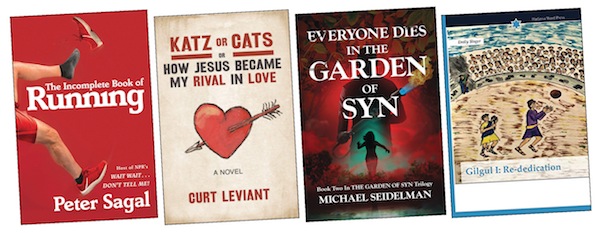
My favourite podcast is Wait Wait … Don’t Tell Me! And, even though I don’t run, one of my favourite magazines is Running Room. I’m not sure how I got onto their mailing list, but I always enjoy reading people’s inspirational stories of why they started running, I like the recipes and nutritional advice and the training tips, which are useful for other types of exercise. Anyway, all that to say I was excited when the host of Wait Wait, Peter Sagal, who is Jewish, came out with his new book, The Incomplete Book of Running (Simon & Schuster, 2018).

book cover - The Incomplete Book of RunningSagal shares personal stories about why he started running, some of the marathons in which he has participated and people he has met along the way, notably a couple of runners who were blind (or almost), for whom he acted as a guide. Scattered throughout, he offers various facts and figures about running; its health benefits, as well as its downsides (I did not know about, to put it delicately, the digestive issues long-distance runners can face). He speaks somewhat vaguely but openly about the dissolution of his first marriage and he is refreshingly honest about his struggle with depression.

Running has helped Sagal deal with difficult circumstances, and continues to not only be a form of exercise for him, but something that informs how he lives. Among other things, running has taught him persistence and has made him more courageous; it has contributed to his “faith in the possibility of positive change” and his realization of just how enduring is love.

I admit that, despite Sagal’s enthusiasm, reading about multiple marathon experiences, as a non-runner, got a little tiresome. And the book isn’t chronological, so I wasn’t always sure of what point we were at in Sagal’s life. But, those minor criticisms aside, I enjoyed the book a lot, especially Sagal’s conversational style of writing and his humour. Having listened to him almost every week for so many years, it felt, at times, that he was right there, telling me his story; that I was listening to him, rather than reading him.

* * *

There is no doubting that Curt Leviant is a talented writer, that he has a wicked sense of humour and a heightened sense of observation and awareness. Katz or Cats; Or, How Jesus Became My Rival in Love (Dzanc Books, 2018) is his most recent of many novels and fans will not be disappointed.

A book editor, John, and a writer, Katz, meet on the subway. On their commutes into New York, Katz shares what is ostensibly his brother’s love story, though it may be Katz’s. Part of the novel’s plot revolves around just how true, or fictional, is the story of Katz’s brother, who also goes just by his surname, Katz.

book cover - Katz or CatsAs the story goes, Katz (or Katz) meets a woman on a train. Maria is supposedly a devout Christian, but she has no trouble permitting a stranger to put his arm around her on first meeting, nor having sex pretty soon thereafter with said stranger, Katz, who she thinks might be married. Their relationship – and the novel – comprises much sex, a lot of talking about sex and many discussions about religion – Jesus, specifically, and Maria’s recurring feelings of guilt for not being what she thinks a good Christian should be.

As Katz relates the tale to John, the editor interjects every once in awhile to question apparent contradictions or errors in the telling. Some aspects – Katz’s marital status, for instance – remain unclear, and purposefully so.

Ironically, perhaps, given that the premise of the novel is a writer telling a story to an editor, Katz or Cats would have benefited from some tighter editing. More than one topic recurs and some points are made multiple times. While Katz’s wit and intelligence provide much to think about, I didn’t find him to be a sympathetic character, so “listening” to him became difficult. And, while I’m not a huge fan of political correctness, I found his treatment of Maria to be condescending and rude at times, and some of his quips to be on the edge of disrespectful towards other cultures. Though Katz refers to Maria more than once as smart, her waffling and some of her responses to Katz – and his reactions to her – don’t really support that notion.

Overall, while provocative in many ways, I found Katz or Cats to read like a book from another era. Many male writers, from Seneca to Henrik Ibsen to Thomas Mann to Leviant himself, come up in conversations in the novel, reinforcing my feeling that this book would be most appreciated by older, male readers. But I could be wrong. When I shared my views with Leviant – who regularly writes for the Jewish Independent’s holiday issues (see page 34 of this issue, for instance) – he shared that a similar novel of his, translated into French, got great reviews from young women critics.

* * *

Ever since reading No One Dies in the Garden of Syn in 2016, I have been waiting for the second book of local writer Michael Seidelman’s trilogy featuring teenage heroine Syn. And, late last year, my wait was over.

book cover - Everyone Dies in the Garden of SynEveryone Dies in the Garden of Syn (Chewed Pencil Press, 2018) starts with a violent prologue that both heralds what’s to come and starts to explain the “Creepers” – weird-looking creatures that seem to be combinations of two people or a person and an animal or insect – we met in the first novel.

In the introductory pages of Everyone Dies, Seidelman, in addition to moving the story along, reminds readers of what has come before. The action in this book centres around Syn’s need to rescue her sister, who has been kidnapped by Cole, a “boy” who befriended and then betrayed Syn – or, from his point of view, was befriended and betrayed by Syn.

Still missing as Everyone Dies starts are Syn’s parents, who disappeared when she was 5. Because of Syn’s actions in the first book, the garden, which once had healing powers – “no one dies” – has lost them, so now “everyone dies,” or can die, in the garden. Therefore, the situation is that much more dangerous now for Syn, who suffers from cystic fibrosis. Whereas she didn’t have to worry about her health in the first novel, it becomes another thing she has to battle in the second.

And there is many a battle in Everyone Dies, and lots of running and chasing. There were a few times I lost track of which universe (there are multiple) we were in, and, sometimes, who was fighting whom, but the action moves along and the tension builds. There’s a wonderfully satisfying twist at the end. And so begins the wait for Book 3.

To read more about Seidelman’s first Syn novel, visit jewishindependent.ca/first-book-of-trilogy-now-out.

* * *

“When my 13-year-old son devoured Bulfinch’s Mythology after reading Rick Riordan’s Percy Jackson, I realized we need an exciting, thought-provoking series based on Jewish history, something that will send our kids reaching for a Torah, a Talmud or a Book of the Apocrypha,” wrote Emily Singer to the Jewish Independent in an email about her new book, Gilgul I: Rededication (Hadassa Word Press, 2018).

Singer, who lives in Israel, is a writer and a high school teacher. When she and her family lived here, she taught at Vancouver Talmud Torah. She has written several articles for the Jewish Independent so, when she contacted the paper about Gilgul, I happily agreed to review it.

book cover - Gilgul INot surprisingly, knowing Singer’s skill as a writer, Gilgul is a compelling and radical take on the Chanukah story. While all the book’s hero David wanted to do was to play the game skyros with his friends, the game takes on a deadly seriousness for the 15-year-old when King Antiochus sacks the Temple and starts a war against the Jews.

David must be smart, brave, strong and compassionate to stay alive and save his family and his people. He must figure out who to trust, and the fact that it’s not always clear who the good guys and bad guys are adds tension and meaning to the novel. Even with the help of his equally heroic sister Leya, some unexpected courageous allies and a little magic, David has his work cut out for him. Gilgul will leave readers thinking anew about Chanukah, the rededication of the Second Temple, the Maccabees, the miracle of oil, and more.

Learn from a cooking master

I don’t do it often, but I like cooking. Actually, I cook almost every day, but rarely cook with a capital C. My mother taught me the basics, and I appreciate not only good food, but the company that generally goes with it. When a close friend took a cooking class and shared some of the science behind what makes an excellent meal versus a mediocre one, I was fascinated.

In looking for more in-depth information than is normally in a cookbook, I came across the bestseller and multiple-award-winner Salt Fat Acid Heat by Samin NosratSamin Nosrat, which was published by Simon & Schuster in 2017. The timing of my discovery was not coincidental. Nosrat’s Netflix series by the same name had recently premièred, in October 2018.

I knew there was a small Jewish connection to the book – author and food expert Michael Pollan had written the foreword. But then, the same friend who inspired my interest in the technical aspects of cooking told me she thought the illustrator might be Jewish. And, she was right! Wendy MacNaughton – whose clients include the New York Times, Wall Street Journal, Time Magazine, Bon Appetit, Gastronomica and many others, including Simon & Schuster – is Jewish. (With a name like Ramsay, I should have looked into it further right away; next time, I will.) With this added information, I could easily justify asking for a review copy from the publisher, and did.

book cover - Salt Fat Acid HeatSalt Fat Acid Heat is not a cookbook that you just pop open, pick a recipe and make it, though you could do that. There are plenty of recipes for salads, pasta, fish, chicken, meat, sweets and more. Shaved carrot salad with ginger and lime, garlicky green beans, beer-battered fish (which also contains vodka, apparently), and fresh ginger and molasses cake are top of my list to try. There are a couple hundred pages of recipes, plus some suggested menus, chefs and authors to look for online or in books, a four-page bibliography, an index and an illustrated list of kitchen and pantry essentials.

In this latter part of the cookbook, there is also a Cooking Lessons section based on the enormous amount of information Nosrat imparts in the first 200 pages about salt, fat, acid and heat. So, for example, to put what you learned about seasoning from within (salt), make spicy brined turkey breast; about emulsions (fat), pasta Alfredo; about layering acid, balsamic vinaigrette; and about preserving tenderness (heat), some scrambled eggs. Other lessons focus on timing, knife skills and improvising with leftovers.

What makes this cookbook a must-have for foodies and cooks of any level, is not only the detail into which Nosrat goes about the four elements that make for good cooking, but that, in discussing the details, she communicates and almost transfers her love of and excitement about food and cooking to the reader. It’s hard to read this book and not be tempted to head to the store to buy the umpteen types of salt that exist (who knew?) or a selection of olive oils to taste, to the market for the freshest of fruits and vegetables, or to the butcher for the best cuts of meat.

Nosrat is all about the experience of cooking – taste and taste again, and don’t be afraid to experiment. As Pollan writes in the foreword, “Even though it contains plenty of excellent recipes, this is a book concerned foremost with principles…. Master these principles, [Nosrat] promises, and you will be able to cook delicious food of any kind, in any tradition, whether a salad dressing or braise or a galette.”

illustration - Salt Fat Acid Heat caesar salad made by Samin Nosrat, illustrated by Wendy MacNaughton
A Caesar salad, as made by Samin Nosrat and illustrated by Wendy MacNaughton in Nosrat’s Salt Fat Acid Heat.

The full-colour illustrations are critical to what makes Salt Fat Acid Heat such an incredible resource and enjoyable read. From drawings of things that don’t lend themselves easily to depiction, such as grains of salt, a chemical reaction and saffron, to making tables, charts, Venn diagrams, frying instructions, etc., more fun and easy to understand, MacNaughton helps Nosrat explain the art and science of cooking.

The size and weight of Salt Fat Acid Heat is daunting, until you open it. As Nosrat writes about how to use the book, “Pay attention to the techniques, the science and stories, but don’t worry too much about committing it all to memory. Come back again later to revisit the concepts that are relevant to you.” But, most importantly, she emphasizes, “Don’t forget to enjoy the pleasures, both small and large, implicit to cooking and eating with people you love!”

Making change her business

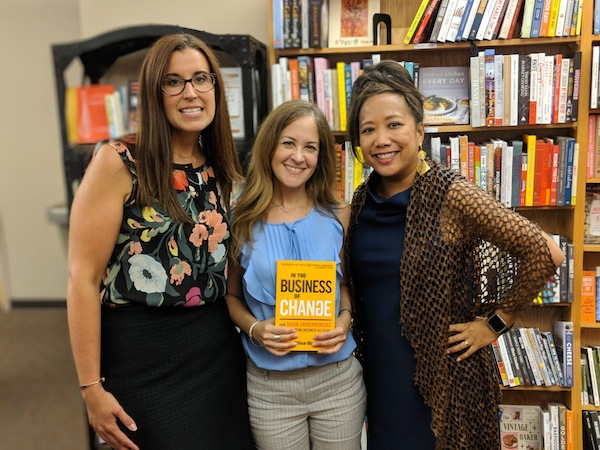
Elisa Birnbaum, centre, with Laura Zumdahl of Bright Endeavors, left, and Maria Kim of Cara Chicago. (photo from Elisa Birnbaum)

Toronto-based Elisa Birnbaum, editor-in-chief of SEE Change magazine, aims to inspire and give hope in many ways. Her book In the Business of Change: How Social Entrepreneurs are Disrupting Business (New Society Publishers, 2018) is but one of those ways.

“I’m a lawyer by training, but was always a writer on the side, enjoying writing and storytelling,” said Birnbaum, who was born and raised in Montreal in an Orthodox Jewish family. “I decided to try writing out for a little bit and to go back to law after. That was 15 years ago. I never went back to it.

“I was writing a lot about the nonprofit and charitable sector in Canada, as well as in the U.S., and I was also writing a lot about business, a strong interest of mine, too. I noticed how there was a melding of the two – how a lot of challenges in the nonprofit and charitable sector … how they could be helped through business and through business savvy…. So, when I saw what social enterprise was all about and how it was using business to solve social challenges, I realized the importance of that. I became really intrigued and interested. It was an area that, I thought, ‘Hey, this is something I really want to explore further.’”

Birnbaum started pitching stories about social enterprises to any editor who would listen. While some of her work went out via mainstream media, Birnbaum felt more was needed, so she co-founded SEE Change, which is devoted to telling the stories of social and environmental enterprises.

“I thought they symbolized a new way at looking at business,” she told the Independent. “I really felt this was the future, with how we work with business and how communities can tackle social challenges through business, and these types of savvy-ness and skills.”

After years of publishing the magazine, Birnbaum wanted to put together a book of such stories, both to delve more deeply into the phenomenon and, hopefully, to inspire and teach readers how to take on the task of starting a social enterprise.

“A lot of times, I’d get some young people or even older people who were interested in social entrepreneurship themselves, and they’d like advice and tips, and were constantly looking for more information from anyone who’d done it before,” she said. “So, I thought, I could also provide lessons learned, tips, advice and resources … so, a bit of storytelling, as well as a resource for those who are starting up or looking to start their own.”

As far as the response to the book so far, Birnbaum said she has been asked by schools and organizations to speak about the topic. “There were people who had never heard about it before and are now really inspired by the storytelling, which is great,” she said. “There are other people…. I was at a couple of universities recently, and some students there said they picked up the book and were now interested in starting their own social enterprise.”

According to Birnbaum, a very broad definition of a social enterprise is a business, whether nonprofit or for-profit, that has a social or environmental mission at its core, as opposed to a business that has profitability and sustainability at its core. The unique aspect of social entrepreneurship, she said, is that it approaches business in a new way.

In her book, Birnbaum makes a point of highlighting a large array of social enterprises from around the world, including a few in British Columbia. For example, Saul Brown’s Saul Good Gift Co. (itsaulgood.com) creates gift boxes filled with locally made artisan food that people can give their loved ones across Canada, and Reena Lazar’s Willow (willoweol.com) helps with end-of-life planning.

photo - Fresh Roots offers students experiential learning opportunities.
Fresh Roots offers students experiential learning opportunities. (photo from Fresh Roots)

Marc Schutzbank, director of Fresh Roots (freshroots.ca), grew up in the United States and moved to Vancouver to finish his education at the University of British Columbia 10 years ago on a Fulbright scholarship, looking at the economic viability of urban farming. This line of study led him to an organization called Plant to Plate, in Pittsburgh, Penn., where he attended University of Pittsburgh.

“As part of my research, I was looking at urban farms in Vancouver – if they were growing, how much food they grow, who they’re sharing it with,” Schutzbank told the Independent. “I have a finance degree, so I was looking at if they were making any money. As I was doing that, there were a couple of people who were doing work in the social space. So the goal wasn’t to grow and sell food; the goal was to share it or to reduce barriers to employment. And so, as I was getting to know them, Fresh Roots was moving from backyards into school grounds.”

One particular backyard caught Schutzbank’s attention. He wanted to know how much food was being grown in such a small space. He discovered, to his amazement, that this one backyard could feed three families. As they expanded to eight backyards, they could feed 35 families.

One of those backyards was adjacent to an inner-city elementary school with a rundown garden plot. The school invited Fresh Roots to develop the plot. As they did, the students, teachers and parents became increasingly interested. The teachers began using the garden as part of their curriculum, as a place to build learning capacity.

“It turns out that, when kids are outside growing food, their academic confidence increases,” said Schutzbank. “They are able to find some success, and this is often in places with kids that are having a hard time finding success inside the classroom [in straight rows]…. Learning like that doesn’t work for everyone.”

photo - Marc Schutzbank, director of Fresh Roots
Marc Schutzbank, director of Fresh Roots. (photo from Fresh Roots)

Another benefit of this was that bullying decreased at the school, as kids had a positive physical outlet. As well, Schutzbank found that, as the saying goes, “If you grow it, you eat it.”

Other schools picked up on what was happening and asked Fresh Roots to do the same at their schools. Fresh Roots is now at four high schools and one elementary school.

Fresh Roots also started a salad bar program for students – twice a week, all of the students get to eat the produce from the garden.

“In Canada, we are the only G7 nation that doesn’t have a federal meal program,” explained Schutzbank. “It’s a bit crazy that Canada doesn’t have that. All those kids without lunches are hungry, regardless of how much food is at home. It’s really critical for learning, to have food…. So, at Fresh Roots, our vision is good food for all – so everybody has access to healthy land, food and community.”

In addition to the food they grow, Fresh Roots supports and encourages teachers to have classes outside in the garden. “They need to touch, taste and feel,” said Schutzbank of the students. “Those are really critical parts of our senses and a really important way of learning.”

As well, Fresh Roots provides employment – especially in the summer – for youth who are struggling.

Schutzbank said you can’t grow food without eating and sharing it, so Fresh Roots’ philosophy is “around sharing all the food back through the programs and everything we are doing.”

Rebeca Kuropatwa is a Winnipeg freelance writer.

Love starts with the self

Most of us are familiar with the concepts of “inherent worth” and “unconditional love.” But many fewer of us actually live by these precepts. Anne Andrew would like to help change that fact. She does this in her work, as well as in her new book, What They Don’t Teach in Prenatal Class: The Key to Raising Trouble-Free Kids and Teens, the launch of which takes place April 11, 2 p.m., at the Isaac Waldman Library at the Jewish Community Centre of Greater Vancouver.

In the introduction, Andrew shares, “My experience as a worried parent of a once-troubled teenager (now a well-functioning adult) and my wish to help other parents avoid the sleepless nights, debilitating fear, helplessness and despair, led me to write this book. Our family’s ordeal lasted more than six years and, during that time, we learned strategies that not only helped us survive but actually allowed us to thrive…. At the same time, I was working as a school principal and became aware of the mental health crisis that was starting to take hold in younger and younger students.” As examples, she notes that 77% of children report having been bullied at school and 80% of 10-year-old girls wish they were thinner.

Andrew was a school principal at Temple Sholom for 20 years. “It’s likely,” she writes, “that one or more of your children will face some kind of difficulty, whether it’s an eating disorder, bullying, drug addiction, depression or other mental health issue, and it is almost impossible to predict whose child that might be. You can’t always see it coming – we certainly didn’t!”

Based on what she was learning from her family’s therapist, Andrew “concluded that there is an absolute and fundamental concept that underpins healthy human life.” That concept – inherent worth – is the subject of the first section of What They Don’t Teach in Prenatal Class. Part 2 focuses on unconditional love, explaining “why it is so difficult for us to accept and own our inherent worth, then explain[ing] how this can be done and become part of your ‘way of being.’” The third part of the book discusses parenting priorities, “kindness versus grades,” and “teaches how to parent out of love – not fear.”

While targeted to parents, What They Don’t Teach in Prenatal Class is a valuable guide for anyone who has negative opinions about themselves, which, to hazard a guess, is the vast majority of us.

“Part of the reason that I named my book the way I did is that it would be ideal if parents did some of the self-work ahead of having children,” Andrew told the Independent. “That way, they’d be better prepared to face the challenges of parenting and they would have a deeper understanding of how their children pick up negative beliefs right from the beginning. They’d have a bit more time and space to think clearly about the bigger picture in terms of purpose and priorities before the baby arrives. Imagine if prenatal classes included a few sessions on this topic!”

One of the tools Andrew presents in her book is the Choose Again Six-Step Process, which was developed by Diederik Wolsak, founder and program director of Choose Again Attitudinal Healing Centre and author of Choose Again: Six Steps to Freedom. Wolsak wrote the foreword of What They Don’t Teach in Prenatal Class. In it, he notes that Andrew – who is a Choose Again facilitator – “has written a manual which draws directly from her own heroic and victorious battle with depression and her transformation of some crippling core beliefs. But, more to the point, it tells the story of two people, parents, coming to terms with what they needed to heal to become real parents. Real parents teach by demonstration. Real parents are transparent and not afraid of what they’ll encounter when they begin their own journey to removing all barriers to love.”

By healing a negative belief about ourselves, we can change our behaviour. “By following our familiar feelings, we can retrieve early childhood memories in which we can discover the genesis of our beliefs and we can begin to transform them,” writes Andrew. “You have to be in the feeling for it to work – it is a process that has to be felt, not an intellectual exercise.” In brief, when you’re upset, for example, acknowledge that you’re upset; take responsibility for the feeling – it is not your child’s fault, but rather “a negative belief that you made up in early childhood has been triggered”; focus on the feeling and identify it; remember the feeling and try to determine when you first ever felt it; once you have that memory, contemplate how you judged yourself in that moment and how you thought others judged you; and, lastly, try “to fix your mistaken belief by a process of forgiveness that replaces your mistaken belief with the truth of you – that you are inherently worthy, whole and complete.”

If loving ourselves isn’t hard enough, parenting out of love, and not fear, is as much or more of a challenge. Not blaming your children for your anger, not punishing them for acting out, etc., would seem to require infinite patience and constant self-awareness.

“If people read my book and are feeling overwhelmed, then I would say do one thing, and that is to have a gratitude practice,” said Andrew. “I have a section in the book on exactly how to do that and I know that it’ll make a huge difference. Begin with one thing and then perhaps add another.

“Awareness is half the battle, so simply being aware that young children are developing negative beliefs about themselves will be helpful in the ways you respond to your child’s behaviour. I’ve presented the concept of inherent worth as the antidote to all of these beliefs, so I have actually simplified parenting into one challenge – how to get across to our children that they are inherently worthy beings. They don’t have to establish their own worth by getting good grades or winning competitions. I’ve suggested several techniques, so parents just need to adopt the ones that will work for their family.

“Many of the things that I suggest are simple, such as remembering to smile at your children more often – put a smiley face sticker on your phone, on the fridge or on the bathroom mirror to remind you. Mindfulness can be practised at the dinner table or getting ready for bed by helping children focus on their senses in the here and now.

“Parenting is a marathon, not a sprint,” she continued, “and it is OK to take awhile to get into the stride, stumble and get back up. Parents tend to judge themselves rather harshly (we all do!) and that’s not helpful. Be gentle with yourself and know that it is impossible to make a mistake – we make healing opportunities for ourselves and our children!”

Andrew invites “parents to use the day-to-day parenting upsets as portals to self-healing so that parenting becomes a journey into self-awareness. This in turn benefits the kids enormously. When parents heal their own negative beliefs, they won’t worry about being judged by others, they won’t be drawn into competitiveness and will not need to over-program their children, so that makes life and parenting less stressful and more fun for the whole family.”

Andrew is a parenting coach, and she presents workshops in the United States, Canada and Europe. She said parents take what they can from her recommendations.

“Parents who have taken my workshops, on which my book is based, report that they have more patience, greater understanding of their children’s behaviour and their own, and the ability to communicate more effectively with their children as well,” she said. “I have been told that the methods are transformational and that was certainly my experience. One parent (Roanna Glickman) told me that she dived headfirst into self-healing using the Choose Again Six-Step Process and she has transformed her life and her kids are thriving as a result. She said, ‘It may seem like more work initially but, when you take away the power struggle, it’s way less work in the long run.’”

Andrew shared feedback from another parent, Pam Roy, who said, “Parenting isn’t about trying to do it right but about learning along the way, being authentic with your kids when we don’t get it right; making yourself better helps you be more present and aware with and for your kids.” While acknowledging that self-work is time-consuming and difficult, Roy said it is crucial and, if Andrew’s suggestions “feel overwhelming or time-consuming, that should trigger that there’s work to be done. Change aversion is there but, when these fears come up, it’s the more reason they should be looked at.”

One of the more surprising pieces of advice, perhaps, is to be careful with praise. “How many of us do what we do to win approval from our bosses, peers, spouse, other family members and even our children?” writes Andrew. “When that approval is not forthcoming we beat ourselves up wondering what we did wrong or reminding ourselves that once again we failed.”

As to how to reduce our dependency on external validations of our worth, Andrew told the Independent, “Firstly, I suggest you gradually phase out praise – it tends to be a habit so takes awhile to correct. Notice when you automatically use praise and then follow it up with a question that indicates your sincere interest in whatever it is that was praised. Praise-dependency tends to undermine the concept of inherent worth – it encourages kids to look outside themselves for their worth.

“As far as knowing how to handle praise and criticism, knowing one’s inherent worth is the way to handle praise and criticism. Neither praise nor criticism has an impact on one’s inherent worth, though it may have an impact on self-esteem. Criticism says more about the person doing the criticizing than it does about the one being criticized. Children can be taught to just say ‘thank you’ to anyone who offers them criticism (or praise for that matter). The criticism can be taken for what it is – a neutral fact to be examined or ignored – not an emotionally charged thing.”

If you can’t make the April 11 launch, What They Don’t Teach in Prenatal Class is available on Amazon, and Andrew is currently putting her workshops online so that parents can access them more easily. She said they should be available in May or June at anneandrew.com.

Could the plague come back?

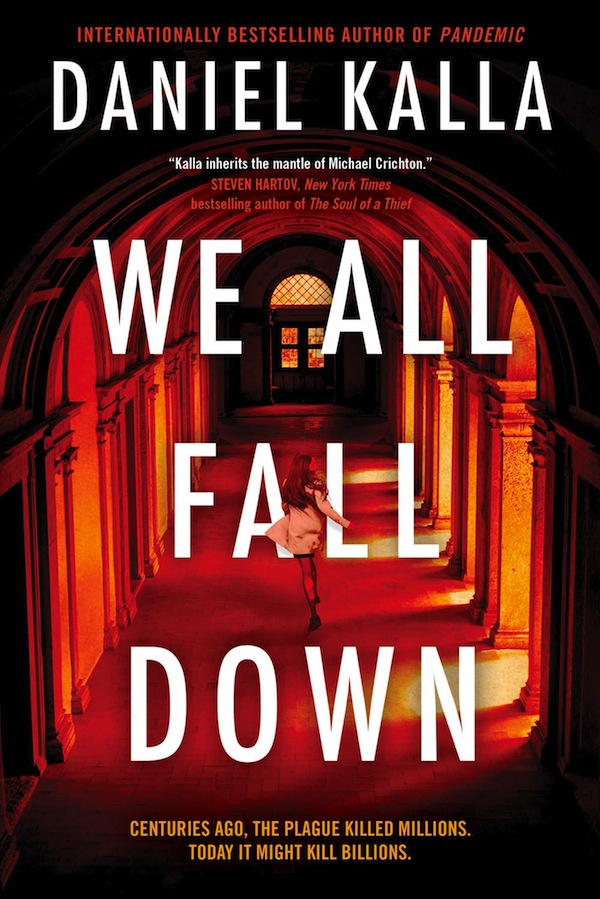
With his latest novel, We All Fall Down (Simon & Schuster, 2019), Vancouver writer and emergency-room physician Daniel Kalla covers both familiar and new territory. He once again postulates with scary enough realism what might happen if there were an outbreak of a deadly disease, but this time, it’s the plague – the same bacteria that caused the Black Death in the 14th century.

Kalla, who is head of emergency at St. Paul’s Hospital and a clinical associate professor at the University of British Columbia, will talk about his new book on April 17 at Incite: Riveting Crime Tales, presented by the Vancouver Writers Fest and Vancouver Public Library, in partnership with the Crime Writers of Canada. He will be joined by fellow Vancouverite Eve Lazarus, author of Murder by Milkshake: An Astonishing True Story of Adultery, Arsenic and a Charismatic Killer (Arsenal Pulp Press, 2018), about the murder of Esther Castellani by her husband Rene in 1965 in Vancouver, and Toronto-based Kim Moritsugu, whose latest book is The Showrunner (Dundurn, 2018), described as a “Hollywood-noir, darkly humourous suspense.”

We All Fall Down is set in Genoa, Italy. It alternates between current-day events – the site of an old monastery that has been demolished to make way for new condominiums seems to be ground zero for the reemergence of the plague – and the year 1348, when that monastery’s inhabitants are almost decimated by the Black Death, as is much of Europe. There is a link between the two outbreaks and North Atlantic Treaty Organization infectious diseases expert Alana Vaughn, called in from Belgium, is among those who must figure it out, along with a World Health Organization expert, Canadian epidemiologist Byron Menke, and Alana’s former lover, Dr. Nico Oliva, who sounded the alarm when a patient was brought into his hospital, coughing up blood and with a bubo (lump, swelling) in her armpit. The patient had been working on the construction site when she took ill and was dead soon thereafter.

The rapidity with which the plague takes a life drives the urgency to determine its sources and stop its spread. The most emotive chapters of We All Fall Down are short. Kalla briefly introduces readers to various people in the midst of tender or happy moments, who then suddenly feel chilled or choked by phlegm and blood. These scenes add meaning to the consistently provided death tolls, and personalize the suffering. Readers will empathize, and shiver.

As in his previous novels – Pandemic (Forge Books, 2005), about a fictional new flu, more deadly than SARS, and Resistance (Tor Books, 2006), about the outbreak of an antibiotic-resistant bacteria – the disease in We All Fall Down is deliberately being spread. Initially, Alana’s theory is that it is bioterrorism, but eventually the WHO-led team comes to another conclusion and the race is on to find the perpetrator.

In the mid-1300s, one-third to a half of the European population was killed within three years, a character in the novel notes – “The worst natural disaster in all of recorded history.” And the novel offers a glimpse into that horrific time via the diary of a barber-surgeon, Rafael Pasqua, who lost his wife to the plague. His story is graphic at times, and it is he who relates how Jews were attacked and persecuted, as the assumed cause of the devastation. Kalla juxtaposes this persecution and violence with that of Muslims in the modern-day instance of the outbreak, as it is first thought that Muslim terrorists might have developed the plague as a bioweapon. Despite hundreds of years of evolution, people’s fear and desperation still drive them to seek a scapegoat.

Less interesting in We All Fall Down are the romantic storylines: Alana and Nico dealing with their past relationship, Alana’s new relationship with Byron, and Rafael’s with Camilla, the daughter of a Jewish friend and fellow physician. At least the medieval love story adds some tension to the plot, as Jews become more and more at risk as the plague continues unabated. And, in truth, the relationships provide some respite from the death taking place all around the characters.

On the whole, We All Fall Down is a good read. Kalla, being an emergency physician who has researched and written about different pandemics, makes the possibility of the Great Plague resurfacing seem frighteningly possible. There are countless benefits of globalization, but it certainly makes containment of an epidemic that much harder. It is a sobering thought.

Incite events are free, but registration is required. To attend Riveting Crime Tales, which takes place in the Alice MacKay Room at the central branch of VPL downtown at 7:30 p.m. on April 17, fill out the form at writersfest.bc.ca/programs/incite/incite-form.

Architect of bestselling book

Daniel Libeskind designed the Jewish Museum in Berlin. (photo ©Hufton+Crow)

A gifted musician turned world-renowned architect, Daniel Libeskind can now add bestselling author to his list of accomplishments, with his unique book Edge of Order (Clarkson Potter, 2018), written with Tim McKeough.

Libeskind was born in Poland to Holocaust survivor parents. He spent his first 11 years in a communist, totalitarian state.

“I was born in a homeless shelter right after the war, and we were then lucky to be able to leave the first time the Iron Curtain opened,” Libeskind told the Independent. “We were able to go to my first paradise, which was Israel. Israel was only 8 years old at that time. It was amazing to go from black-and-white to full colour and the beauty of liberty.”

Of Libeskind’s father’s large family, his only surviving sister, who survived Auschwitz, was living in New York. So, after only two-and-a half years in Israel, the Libeskinds made their way to the United States.

But, before leaving Israel, Libeskind was an accordion virtuoso, at only 13 years old. Winning a competition with Itzhak Perlman, he had the opportunity to play for Isaac Stern. After hearing him, Stern suggested that Libeskind transition into playing piano, but Libeskind found the adjustment too difficult.

“Maybe that’s why I became an architect,” he said. “If I hadn’t played the accordion, I would have never been an architect, I would have become a famous pianist. I have to say that Isaac Stern, who I knew subsequently, told me I was the only person that they ever gave this [honour] to that didn’t become famous in music.”

In the United States, Libeskind’s family settled in the Bronx. When it came time for him to choose a career path, he didn’t know what to do, as he excelled in math, science and art.

“I really wasn’t sure because, in my life, I had never met an architect, an engineer, a doctor…. I had little idea of so-called professions that existed in a world somewhere beyond the Bronx,” he said. “I discovered that architecture combined all my interests – painting, drawing, mathematics, science … all the things I loved to do.”

Libeskind tried working for some well-known architects, but felt uninspired. So, for many years, he worked as a professor of architecture at various universities around the world and then as head of a school of architecture.

image - Edge of Order book cover“I really invented a path of architecture through my drawings,” he said. “My drawings were not figurative drawings of imaginary buildings. I drew the internal structure of architecture, what architecture is when you don’t have a client. I drew these drawings almost like musical scores.

“For many years, I did that and I was considered, like some others, as a paper architect … somebody who’s just on paper. But, then I won the competition for what later became the Jewish Museum in Berlin…. It was not originally called the Jewish Museum, it was called the Berlin Museum with a Jewish department, but I negated that, as I never believed Jews should be a department….”

It took more than 10 years to build the Jewish Museum in Berlin. It was scheduled to open the fall of 2001, but then 9-11 happened, so the opening was delayed.

Libeskind felt the need to go to New York. When construction on the World Trade Centre site was being considered, Libeskind was asked to be a judge of the entries. He could not make it to the judging on time, so instead entered his own design idea. He won the competition and became the master planner of the project.

In writing Edge of Order, Libeskind wanted to share his creative process and how he approaches architecture.

“I believe every member of the public is capable … of not only appreciating design and architecture but of participating in it, hands-on,” he said. “I always say, ‘Every human being can pick up a brush and start painting. Anybody can sit down and write a poem. Anybody can take their iPhone and make a film. Anybody can sit down and write a melody. But, when it comes to architecture, they think it’s a world of the impossible.”

photo - Daniel Libeskind’s book, Edge of Order, which he wrote with Tim McKeough, is a bestseller
Daniel Libeskind’s book, Edge of Order, which he wrote with Tim McKeough, is a bestseller. (photo by Stefan Ruiz)

In Edge of Order, Libeskind shows how architecture is just another artistic field that anyone can do, explaining how buildings are not made by some abstract hieroglyphic methodology, but are part of culture, just like music and geometry. The book encourages people to participate and engage with architecture directly where they live.

“Most people think … everything is irreversible, that you’re born with it and that’s that. People don’t realize that they can change,” said Libeskind. “They can make the world a better place, a more meaningful place.

“Architecture is such an important aspect of the world,” he continued. “We take it for granted, but it’s what the world looks like to us, the window we have to the world.”

Libeskind wrote Edge of Order with the hope of inspiring people to think about how they can do things, instead of feeling like they don’t have the credentials or know-how to design their dreams. He thinks that everyone is an architect and he wants to help people realize that they, too, can build.

“My ideal reader could be a young person who doesn’t know what they want to do, or it can be an older person who had always wished to be an architect,” said Libeskind. “My point is that everybody can be, and that everybody already knows so much more about architecture than about anything else … because we all live somewhere … even if you’re homeless.”

He said his idea is about freedom – “freedom to build, to really direct the world to a better way.”

In Edge of Order, Libeskind also talks about the importance of embracing democracy and that we need to be vigilant against forces that would impoverish the human potential.

“When I see what is happening in the world … of course, we see the evils around us and we have to fight against them … and have the sense that the world is a better place than we see on television or on the news,” he said.

Currently, Libeskind is working on dozens of museums around the world, spanning all the continents.

“I’m such a lucky architect on every continent,” he said, adding, “I’m a very fortunate person.”

Rebeca Kuropatwa is a Winnipeg freelance writer.

Revisit the Jewish fabric arts

When I was very young, I learned to embroider. My mother was a fabulous seamstress, but sewing was not my thing. Later, around middle school, an aunt taught me how to knit. I picked up crocheting but never really liked it or excelled at it. However, I took knitting to all levels, including a dress for myself, and, later, I returned to various kinds of needlepoint, coming to love them.

On my and my husband’s bedroom wall, there are framed embroidery pieces, each with its history, which I collected in the 1970s. I would have liked to have in my collection some work from Jewish women, who had done embroidery before immigrating to Israel from various countries, but they had stopped doing such work, and all the pieces I have were made by Arab women, who continued the craft.

It was with this background that I thoroughly enjoyed perusing the new-to-me pages of Jewish Threads: A Hands-on Guide to Stitching Spiritual Intention into Jewish Fabric Crafts by Diana Drew with Robert Grayson (Jewish Lights Publishing, 2011). The author explains her journey from sewing to fabric crafts, from editing for the division of Random House that published books on handicrafts to being awakened spiritually while editing for spiritual book publisher SkyLight Paths.

In Jewish Threads, there are 30 projects and 30 interesting stories (written by the author’s husband) about each artist and their project. The contributors come from the United States – Alabama, California, Kentucky, Massachusetts, Minnesota, New Jersey, New York, Pennsylvania, Vermont, Washington – and Israel.

The book has four parts: at home, in the synagogue, celebrating holidays and through the Jewish lifecycle. For the home, there are wall hangings, a needlepoint and a purse. For the synagogue, there is a runner, a Shulchan Aruch cover, placekeepers and Torah mantles. The holiday section includes challah covers, a quilt, a vest, puppets, a matzah cover, an afikomen holder and a seder plate. And, lastly, the Jewish lifecycle section includes quilts, a challah cover, a tallit and tallit bags. Another five “inspirations” include several chuppahs, a tallit bag, a wall hanging and a bimah cloth.

The techniques include quilting, appliqué, embroidery, needlepoint, cross-stitch, crochet, knitting, felting and needle felting.

Although decidedly not for beginners, each project lists details for getting started, what you’ll need and step-by-step instructions, sketches and how to finish. The “final threads” chapter offers how-to’s for quilt-making, lettering, a stitch guide, resources and projects for sewing circles, parents and children and holidays.

Sybil Kaplan is a journalist, lecturer, book reviewer and food writer in Jerusalem. She created and leads the weekly English-language Shuk Walks in Machane Yehuda, she has compiled and edited nine kosher cookbooks, and is the author of Witness to History: Ten Years as a Woman Journalist in Israel.

Mizrahi to perform here

Isaac Mizrahi’s cabaret show, which is at the Rio Theatre on March 18, is a preview of his new book I.M.: A Memoir. (photo by Britt Kubat)

Celebrated fashion icon Isaac Mizrahi is bringing his multiple talents to Vancouver. On March 18 at the Rio Theatre, he will be performing his cabaret show I & Me, accompanied by the Ben Waltzer Jazz Quartet.

Mizrahi’s North American tour is timed with the release of his new book, I.M.: A Memoir (Flatiron Books). The show, which includes poignant stories and fun songs, covers anecdotes about his life, his mother, what it was like growing up in an Orthodox Jewish Syrian community in Brooklyn, the challenge of being gay, and rising to the top of the fashion world. “It’s done with a lot of humour,” he told the Independent. “I hope it’s compelling, amusing and resonates with the audience.”

The songs, he explained, go along with the story. “I chose songs that can dramatize the story,” said Mizrahi, who has performed with Waltzer in clubs for more than 20 years. “My opening number is ‘I feel Pretty’ and, believe it or not, I am not singing it with irony.”

Mizrahi also delivers his own rendition of Cole Porter’s “You’re the Top.”

The first time Mizrahi showed off his talents in front of a crowd was in elementary school, when he started doing impressions for his peers.

“When I was about 7 years old, I went to see Funny Girl with my family and was so inspired by [Barbra] Streisand I started imitating her. Then I impersonated Judy Garland and Liza Minnelli,” recalled Mizrahi, who attended yeshivah from kindergarten through eighth grade. “I would do these female impressions inappropriately in places like the lobby of shul!”

But it was designing clothes for the rich and famous that made Mizrahi a household name. When he entered High School of Performing Arts in New York City, he had planned on going into show business. However, by the time he was a junior, he switched gears and found a better way to express himself. “I realized all my friends were gorgeous, thin, blond and movie-star types, and I was fat and I didn’t have that self-image,” he said. “So, I re-thought my career and decided to work in the fashion industry. It enriched me so much, and gave my life a different kind of story and platform.”

His interest in the world of fashion didn’t come from out of the blue. His father was a children’s clothing manufacturer and Mizrahi, who was obsessed with reading fashion magazines, had sewing machines at his disposal. “I started to make puppets and sew clothes for them,” said Mizrahi, who added that he liked doodling sketches of outfits in the margins of his Hebrew books. “By the time I was 10, I had this big puppet theatre in the garage and I made their clothes. My father had sewing machines everywhere and he taught me how to sew. By the time I was 13, I was a really good sewer and I started making clothes for my mom and myself. It became this fun, compelling thing. My mom, who is now 91 years old, was really into fashion and encouraged my interest.”

After high school, Mizrahi attended Parson’s School of Design in New York City. His first fashion job was working at Perry Ellis, then with designer Jeffrey Banks, and then Calvin Klein. Along the way, he honed his skills, in such areas as selecting fabric, sketching clothes and participating in design meetings. By the time he was 26, he went out on his own.

In 1989, he presented his first show, which catapulted him into fame and his couture soon dominated the fashion mags. He dressed celebs for red carpets, and his clients included Michelle Obama, Meryl Streep, Hillary Clinton and Oprah Winfrey.

“Designing for Michelle Obama was such a thrill,” he said. “And Barbra Streisand was so lovely. I tailored a suit for her and Women’s Wear Daily erroneously attributed it to Donna Karan. Barbra wrote me a note saying, ‘We know who really made this suit!’”

But Mizrahi’s successful journey has had its lows. While he made countless guest appearances on television and in movies, earned an Emmy nomination for best costume design for his work in Liza Minnelli Live and was the subject of the acclaimed documentary film Unzipped, which chronicled his 1994 collection, his company was losing money and closed after his fall 1998 collection.

He returned to fashion in 2002, teaming up with Target and becoming one of the first high-end designers to create affordable clothes for the general public. In 2009, he launched his lifestyle brand Isaac Mizrahi Live!, sold exclusively on QVC. In 2011, he sold his trademark to Xcel Brands. Among his many credits, he hosted his own television talk show, The Isaac Mizrahi Show, for seven years; he wrote two books; and he narrated his production of the children’s classic Peter and the Wolf at the Guggenheim Museum. In 2016, he had an exhibition of his designs at the Jewish Museum in New York. Currently, he sells on QVC and via Lord & Taylor, and serves as a judge on Project Runway: All Stars.

Throughout all of his fashion endeavours, he has found time to be on stage. Mizrahi, who is a charming storyteller, said he loves doing live cabaret. “I hope the audience will really enjoy themselves when they see my show, and laugh and enjoy the music,” he said. “I want them to get the idea who I am and how I got there – and I want them to know the story of my life.”

When asked what he’d like his legacy to be, the designer, entertainer and showman referred to his Judaism. “My name is Isaac, which means laughter in Hebrew,” said Mizrahi, who considers himself a cultural Jew. “I think, most importantly, I want my legacy to be about humour.”

Tickets to I & Me at the Rio Theatre are $58 in advance and $60 at the door. They can be purchased at riotheatre.ca/event/isaac-mizrahi-i-me. The March 18 show starts at 8 p.m.

Alice Burdick Schweiger is a New York City-based freelance writer who has written for many national magazines, including Good Housekeeping, Family Circle, Woman’s Day and The Grand Magazine. She specializes in writing about Broadway, entertainment, travel and health, and covers Broadway for the Jewish News. She is co-author of the 2004 book Secrets of the Sexually Satisfied Woman, with Jennifer Berman and Laura Berman.

Building an epic relationship

Sam Laliberte and Jared Schachter share what they’ve learned about long-distance relationships in The #LDR Activity Book(photo by Ricky Pang / Sincerely Image)

The first quote in The #LDR Activity Book is from American writer Meghan Daum: “Distance is not for the fearful, it’s for the bold…. It’s for those knowing a good thing when they see it, even if they don’t see it enough.”

Sam Laliberte and Jared Schachter, co-writers of the activity book for people in, or contemplating, a long-distance relationship (LDR) knew a good thing when they saw it, and didn’t let Schachter’s move from Toronto to San Francisco get in the way.

“For two years,” they write in The #LDR, “we were long-distance loves, capturing our visits on Instagram and maxing out our data plans during weekly video calls. We picked up many lessons (most learned the hard way) and fun activities to keep our relationship strong AF despite living three time zones apart. It definitely took work, epic relationships don’t just happen, but we made it through and now we want to share our learnings with the world.”

In an email interview with the Independent, Laliberte and Schachter said they “always wanted the book to be interactive and fun for couples, since long, text-heavy books can be daunting and would be less conducive to creating positive interactions between couples.”

The #LDR Activity Book has eight chapters covering topics at the core of any relationship, even with yourself: understanding your personality, how you like to give and receive love, your values, what triggers you, envisioning the future, and more. Each chapter begins with an explanation of why the topic – expressing love, communication, IRL (in real life) visits, keeping the spark alive, values, trust, conflict resolution and planning – matters, followed by some “best practices”: assuming good intent, for example, giving “your partner the benefit of the doubt and operat[ing] under the impression that they’re trying their best.” Laliberte and Schachter then share a few tips of what worked best for them and, of course, there are several activities, some of which you complete on your own; others, with your partner.

Laliberte and Schachter wrote this book with Schachter’s mother, Beverley Kort, who is a registered psychologist in Vancouver, with more than 40 years’ experience counseling couples. They also interviewed dozens of other couples “who survived and thrived as long-distance lovers.”

“On top of all this,” they told the Independent, “we were also honest about the fact that our long-distance relationship didn’t work out. We too were scared of the associated stigma and didn’t have any resource to turn to, to help alleviate some of our concerns. The ability to create something for other couples [in a long-distance relationship] was really exciting for us.”

photo - pages of The #LDR Activity Book
The #LDR Activity Book takes couples through various activities.

Laliberte and Schachter are still together, though, just closer geographically.

“We’ve been in a relationship for almost three years now,” they said. “We spent one-and-a-half years in a full long-distance relationship (Toronto-San Francisco) and, now, because we have flexible jobs, we spend a majority, but definitely not all, of our time together. We were separated for two months at the end of 2018 but are now on an extended travel together in South America for four months.”

Feedback about the book – which Laliberte and Schachter encourage readers to share – has been very positive, they said, giving a couple of examples. Thessa (New York) and Anthony (Dublin) wrote about The #LDR, “Absolutely love it. The quality is great, the art and quotes in the book are gorgeous, and information in the book is spot on.” Sara (Los Angeles) and Charles (Toronto) emailed, “#LDR was a fun way to build our relationship after knowing each other for only a week! We met at a music festival and spent the next year living on different coasts and time zones, and used this book to provide a framework for exploring our new relationship.”

A longtime long-distance couple with whom the JI shared the book completed several sections, some that reinforced what they were already doing – daily rituals (regular texts and phone calls) and planning out IRL visits, for example – and some that either introduced new ideas or suggested activities they wanted to do more often, such as creating a joint vision board and talking about important moments during texts and calls, respectively.

To fund the publication of The #LDR Activity Book, Laliberte and Schachter ran a Kickstarter campaign. Seeking $6,000, they received contributions of more than $10,000 from almost 200 backers, with their initial funding goal being covered in less than 24 hours. The result is a smart-looking, durable, 63-page, full-colour, hardcover (with metal corners), spiral-bound “scrapbook.” More importantly, it is a book full of good advice and beneficial activities and exercises, if you (and your partner) are willing to be open and put in the time. And the learning continues online.

“We’ve also now partnered with a sexologist to create a bonus chapter on ‘Sex from a Distance,’ after a number of readers began asking more detailed questions about this area,” Laliberte and Schachter told the Independent. “It is available for free download if you signup for our email newsletter on our website.”

The #LDR Activity Book is for sale on ldractivities.com for $35 per copy, or $60 for a set of two. Laliberte and Schachter have created a special discount code for Jewish Independent readers: use JINDEPENDENT20 to receive 20% off.

***

On Feb. 17, Sam Laliberte and Jared Schachter were interviewed on the podcast From Long Distance to Marriage. The episode can be found on audioboom.com.

PJ Library extends program

Florencia Katz and family. (photo from Florencia Katz)

PJ Library, which provides Jewish children with free Jewish-themed books and CDs, has expanded its program and now serves readers up to 11 years old.

Available in Jewish communities across North America, PJ Library is supported by local Jewish federations and many other donors. In Winnipeg, the program is in its 10th year, and Florencia Katz has been coordinating it since 2011. As a mom of two, she has experienced firsthand the impact the books have on her kids.

Eventually, Katz’s children aged out of the PJ Library program, which is for kids ages 6 months to 8 years old. But now, with the new program, PJ Our Way, Katz’s younger child, Tali, can once again enjoy the perks of PJ.

“PJ Our Way is the next chapter of PJ Library, for kids ages 9 to 11,” explained Katz. “Kids throughout the United States and Canada are eligible to enrol in the program from the day they turn eight-and-a-half until the day before their 12th birthday.

“The Harold Grinspoon Foundation, with the generous support of PJ Alliance Partners, provides PJ Our Way subscriptions at no cost to families or partner communities.”

PJ Our Way is considered the next chapter of PJ Library because it follows the same goals of the original program: engaging families and children in Jewish values, content and, ultimately, community.

PJ Our Way offers tweens the possibility of engaging online – allowing them to choose their own book, write book reviews, blog and more.

“My children and family have enjoyed the PJ Library program for years and, as avid readers, my kids were quite sad to stop receiving books at home once they aged out from PJ Library,” said Katz.

“My daughter, Tali, currently 10-and-a-half, was over the moon when I told her that she can now sign up to PJ Our Way. On the morning of the launch of PJ Our Way in Canada, before going to school, we signed up as one of the first sign-ups in Winnipeg, and maybe all Canada.

“As a parent, I am excited that, through this amazing program, my daughter will have the opportunity to keep reading quality Jewish-themed literature. The possibility that this program offers to engage online to choose the book, watch and read reviews, and submit their own reviews makes [it] attractive and exciting for this demographic.”

Tali was excited to pick her first book and spent some time on the PJ Our Way website, reading reviews and the synopses of all the available books, before choosing.

After narrowing her choice down to two books, she asked her mom for help deciding which to pick. After reading each book summary herself, Katz went to the parent section of the site to read more about the Jewish concepts and values and about the positive role models featured in each book. This helped her suggest which book her daughter might enjoy the most.

“Besides the synopsis and the concepts and values section provided for parents, there is also a section called Talk it Over, which suggests a question to discuss with your child after reading the book,” said Katz.

“I will definitely check all the information out and make a point of including it into our conversation about the book if it comes up. I will also suggest to my child to write a review of the book after she is done, so other kids can read it, the same as she read reviews when she picked the book. I want this experience to be enjoyable and fun, so I will not put any pressure or make it feel like a school task.”

Katz said the more Tali reads and learns about Jewish culture and tradition, the better equipped she will be to make her own decisions on how to live her Judaism when she grows up.

Candice Tenenbein, another parent who is part of the Winnipeg PJ Library initiative, is also very excited to have her older son, Jacob, 9, be part of PJ Our Way.

“Every month, our boys eagerly await their newest PJ Library arrivals,” said Tenenbein. “Both of our boys are avid readers. Recently, we were becoming sad that our older son, Jacob, was graduating out of this program. When we heard from Katz that PJ Our Way is now available in Winnipeg, we immediately signed up! We love that the books are exciting and fun to read, and that they all have a Jewish connection.

photo - Candice Tenenbein and family
Candice Tenenbein and family. (photo from Candice Tenenbein)

“In our home, we celebrate Shabbat and all the Jewish holidays. These books and the online portion will add more layers to raising our children to be more knowledgeable about, and proud of, their Jewish heritage.”

Tenenbein is also looking forward to her sons spending time on their iPads in a more educational and productive manner, instead of just watching videos. PJ Our Way offers a safe and protected online environment.

At the Tenenbein house, all family members read the books provided by PJ Library, as they love to discuss their favourite parts of each one and share their thoughts of how the books impacted them.

“Jacob is especially excited that his friends will also be joining PJ Our Way,” said Tenenbein. “The kids are planning to choose the same books each month, so they can have their own book club.

“Growing up, my mother, may she rest in peace, instilled in us a love of reading and a pride in our Jewish heritage. Now, as a mother myself, I understand how truly important opportunities are which provide for our kids to understand what the religion means to them and their daily lives.

“This is especially important in today’s environment, where antisemitism and its newer anti-Israel BDS face are becoming more prevalent. My husband and I are grateful for the excellent education our children receive at Gray Academy [in Winnipeg]. PJ Library and PJ Our Way are excellent supplements for helping foster and strengthen these feelings in our children.”

Jacob is also excited about going online and becoming part of a larger community of Jewish peers. He is looking forward to being able to share his thoughts about each book and read what others have to say.

“He cannot wait to begin blogging once he reads his latest PJ Our Way book!” said Tenenbein.

These days, getting paper mail is not common, so PJ kids receiving a free gift in the mail, addressed just to them, is a unique and individual part of the experience. The online aspect then allows them to connect with other Jewish kids who are reading the same books as them. For more information, visit pjourway.org.

Rebeca Kuropatwa is a Winnipeg freelance writer.