Pinson writes definitive book

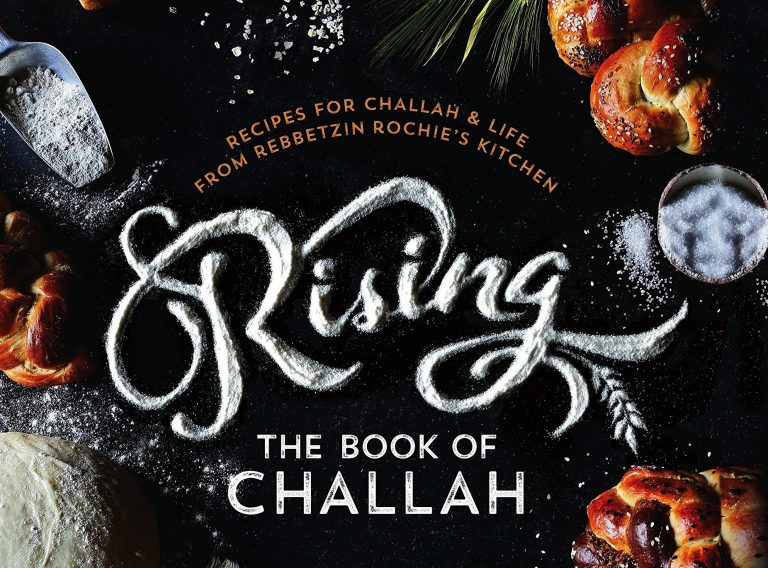
If I wrote that I had been trying to get a review copy of Rising: The Book of Challah by Rochie Pinson (Feldheim Publishers) since November 2016, readers would find that hard to believe, but the book only arrived at my door recently.

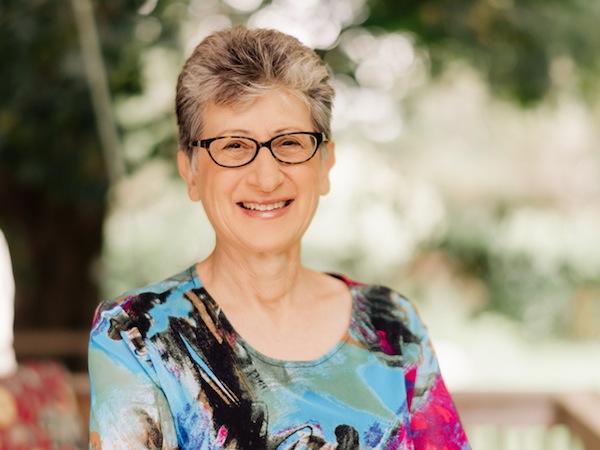
Pinson, who grew up in Vancouver, is co-founder of the IYYUN Centre for Jewish Spirituality with her husband, Rav DovBer Pinson, in Carroll Gardens, Brooklyn. They have four children. She mentors women and teaches various classes. She also conducts a challah-baking workshop, which she teaches worldwide, including in Vancouver.

image  - Rising book coverFor Rising, Pinson has written 352 pages about challah. This book is about her philosophy, spirituality, history and everything you wanted to know about challah. And, yes, it includes recipes – 38 of them for challah and seven for toppings.

“The intent of challah,” writes the rebbetzin, “is to reveal our innate power to nurture and nourish, and reclaim our mothering potential in all the forms it can take.”

Section I, “The Story of Challah,” explains how, as a new bride, Pinson arrived in Kobe, Japan, which had no kosher bakery, and soon got into making 40 challot a week for the Jewish community.

The book then expands to other information about challah, spirituality and other topics, including a detailed examination of each ingredient and information on the concept of “rising.”

Section II is the cookbook, with reviews and details of ingredients and equipment and troubleshooting.

There are eight recipes, including her own classic challah recipe, gluten-free challah and vegan challah; eight holiday specialties, like apple-and-honey challah and pretzel challah; six recipes from around the world, including Moroccan challah, Yemenite challah and Bukharian challah; nine challah innovations, such as a “fish” challah (shaped like a fish with salmon, tuna, mushrooms and other vegetables), a deli challah (with deli meats) and a rainbow challah (using food colouring); and eight recipes for leftover challah, like babka, cinnamon bars and French toasts. Rising also has recipes for seven different challah toppings, including cream cheese frosting, and accompaniments for other dishes, such as challah stuffing and challah croutons.

Section III is called “Laws and Customs,” which is mainly self-explanatory, though it also includes challah meditations. A glossary and index conclude the book.

There are more than 100 colour photographs in Rising and many sketches, such as 37 ways to braid and shape a challah.

Rising really is the definitive “everything you ever wanted to know about challah” book, written with love and nurturing. It contains a huge amount of information, including the story of Pinson’s life “as realized through challah baking, and challah baking as a metaphor for balanced, integrated nurturing of our self and our loved ones.”

This is the book to give to anyone who bakes challah, and to anyone else who might be contemplating it.

Sybil Kaplan is a journalist, author, compiler/editor of nine kosher cookbooks and a food writer for North American Jewish publications, who lives in Jerusalem where she leads weekly walks of the Jewish food market, Machaneh Yehudah, in English.

History through Eva’s eyes

Gabriella Goliger’s Eva Salomon’s War is an intriguing novel. (photo by Ben Welland))

Award-winning Canadian author Gabriella Goliger has written Eva Salomon’s War (Bedazzled Ink Publishing, 2018), an intriguing novel set between the rise of the German Nazi state and the founding of the state of Israel – two complex historical phenomena whose aftershocks we are still experiencing. But, for Eva Salomon, those huge events are mainly engines moving her own story forward from timid German-Jewish adolescent to courageous Israeli young woman. The novel takes us through many intricacies of the competing historical strands that form the background of Eva’s life. Readers familiar with various bits and pieces of the history can connect the dots through her eyes.

Written as a first-person bildungsroman, the book opens as the Nazis close in on the Jews, who are wondering which of the many possible responses to embrace. Should they stay and resist? Stay, pray and keep their heads down? Should they emigrate, and, if so, where? Should they join the movement to build a Zionist workers’ state in Palestine? So many choices, so many unknowns, and so much peril attached to each decision.

Eva’s beloved older sister, Liesel, immigrates to a socialist kibbutz in the Galilee. Sixteen-year-old Eva and her embittered, widowed father migrate to Tel Aviv. We know what happens to the relatives who feel too old to make the trip.

image - Eva Salomon’s War book coverThe character of Eva is loosely based on Goliger’s own aunt. Letters between Eva and Liesel give us many illustrative details of Jewish life in Palestine in those years. In Breslau, they had enjoyed middle-class lives. In Palestine, they quickly have to learn working-class skills and they have to adapt to their shabby new realities among people with no time for pity or introspection.

Kibbutz life is physically harsh but relieved by the high level of ideological commitment between the comrades: “I sleep in a tent and the food is plain, but I never have to think about where my next meal is coming from. Everything is communal and allotted to me, down to my shoes and socks.” Eva flees the misery of life in her father’s tiny flat and finds a place to live with Malka, a Hungarian Jewish seamstress who helps her accommodate to her reduced circumstances.

Malka transforms Eva from a ragged miserable waif to a well-dressed young woman who can make her way in the vibrant, uncertain Jewish Palestinian world. Eva learns the meaning of “ein breirah” – no choice – a theme resonating not only throughout the novel but throughout the decades to the present day as one formative part of Israeli Jewish culture.

Eva finds work as an ozerit (cleaning lady) and starts putting together a life of sorts. She finds a music shop that affords her a bit of pleasure – “my refuge, my paradise” – phonograph records feeding her delight in classical music and her longing for romance. Fittingly, it is where she meets Constable Duncan Rees of His Majesty’s Palestine Police. Their romance encapsulates many conflicting layers of identity, culture, desire and belonging.

Throughout the novel, most of the characters are rent by doubts and competing loyalties. Only the fanatics of all stripes know certainty. The portrayal of Eva’s unbending Orthodox father, seemingly bereft of feeling for his wayward daughter, I found puzzling. We never see anything through his eyes, never understand his inner realities.

Eva is at war with her father, with all rigid religious and political belief systems, with her situation of loving the wrong person, and with her own competing claims of duty. Her personal war intersects with the fighting in Europe, the fighting between Arabs and Jews, the infighting between the various Zionist factions and, crucially, with the growing resistance to the British presence in Palestine.

Eva is a Jewish refugee. Duncan is charged with upholding British laws controlling Jewish immigrants. Despite the growing cultural-personal-political tensions, Eva enjoys their romance. She experiences pleasure and the delights of physical intimacy, which she keeps secret as much as possible. “The more he was my secret, the tighter, I felt, was our bond.” Their emotional intimacy is harder to sustain. One feels it can’t last and I wondered throughout how Goliger was going to handle it (no spoiler here).

The British White Paper on Palestine brings it all to a head. Tensions explode into violence all over the land, from many different directions, aimed at “traitors” to all the intersecting causes. For each faction, “we” are highly individuated and the others are an undifferentiated “they.” Eva, essentially an apolitical person, is helplessly caught up in the sectarian brutality.

One can’t help but read the novel through the prism of the tragic unfolding of events since 1948. Goliger vividly illustrates the human urgencies propelling Arabs and Jews in all directions, and the emotional realities behind all the ideologies.

Near the end, I was reminded of Anne Frank’s “In spite of everything, I still believe people are good at heart.” Eva reflects, “I believe a better world is dawning because … because ein breirah. I must.”

Deborah Yaffe lives in Victoria, where she formerly taught in the women’s studies department of the University of Victoria. An active secular Jewish feminist since reading Elana Dykewomon and Irena Klepfisz in the 1980s, she is grateful for the many Israeli individuals and organizations working against Jewish persecution of Arab Israelis and Palestinians.

Creating their own changes

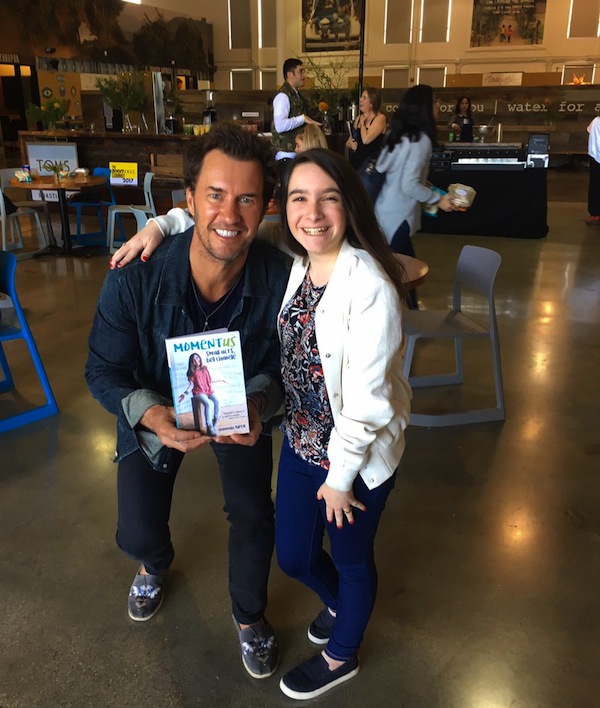
Blake Mycoskie, founder of TOMS, with Hannah Alper. Mycoskie is one of the role models Alper features in her book Momentus: Small Acts, Big Change. (photo from callmehannah.ca)

In Momentus: Small Acts, Big Change (Nelson Trade, 2017), Toronto-based teen activist Hannah Alper profiles people who are doing humanitarian work. Each chapter is devoted to a person who is doing significant tikkun olam (repairing the world) in any number of areas, from the environment to indigenous rights to mental health.

Alper uses a specific formula to describe what her book is essentially about: issue + gift = change. The issue is something an individual is passionate about, whatever the cause might be. The gift is something a person is blessed with or a hobby they might enjoy or want to pursue. With just these two aspects, individuals can change the world.

In the introduction of Momentus, Alper briefly talks about how she got involved in humanitarian work. She and her parents were coming back from a Digital Family Summit, which is a conference to help young individuals use the internet safely. Blogging was never something she had envisioned herself doing, but this conference changed her mind. While still there, she began her own blog, titled “Call Me Hannah.”

Initially, she did not know what she would write about. Then, her parents gave her some encouraging words. They told her to write what she was passionate about. Being 9 years old at the time, Alper was learning about the environment and the problems animals were facing because of habitat loss and deforestation. It especially bothered her because these were problems caused by humans.

Alper began to receive comments from people who were actually trying to do what she advised in her writing. She herself became involved in the World Wildlife Fund and Environmental Defence. But, even though she enjoyed helping these organizations, she felt that something was still missing.

Because of her blog, Alper was invited to WE Day as media. WE was founded by Canadian brothers Craig and Marc Kielburger, and WE Days across North America, the United Kingdom and the Caribbean bring thousands of change-minded people together to celebrate their contributions and be inspired by one another and by well-known speakers. Alper explains that people cannot buy a ticket to a WE Day, but earn an invitation to it through their work.

image - Momentus book coverTwo years after her first WE Day, Alper helped promote the event as a representative of the organization. During her first tour, she shared the story of Nobel Prize winner Malala Yousafzai. On the second, she co-hosted a social empowerment section and, in Momentus, she briefly talks about her time meeting other young people during a WE Day tour in 2014. She says that seeing others who were also trying to create change was refreshing to witness.

Role models in different categories have been a main inspiration for Alper’s work and each chapter of her book focuses on one of these mentors and the work they are doing. She hopes that, by highlighting such role models, readers will come to understand that they, too, can make a difference, no matter how old they are, or where their interests and passions lie.

The Kielburgers, Yousafzai, Lilly Singh and Brad Montague are among the change-makers included in Momentus, as is one of Alper’s biggest role models, Severn Cullis-Suzuki, whose father is David Suzuki. Watching a 1992 video in which Severn spoke at the United Nations Earth Summit made Asper realize that she had the ability to take a stance on environmental issues – and that her voice could be heard and make a difference.

“My greatest hope from this book is that people finish it and believe that they have the fullest power and capacity to make a difference,” writes Alper on her blog. “Then, they go out into their community [and take] action. I cannot tell you how excited I am to see how people create their own change.”

One voice can impact so many that a chain reaction can occur when it comes to solving problems. Reading about young people who are passionate about fixing or improving deep-rooted problems is inspiring. As the proverb says, “If you want to go fast, go alone. If you want to go far, go together.”

Chloe Heuchert is a fifth-year history and political science student at Trinity Western University.

Unique science fiction volume

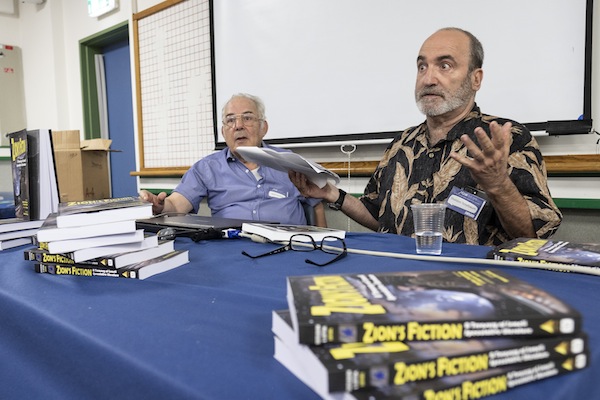
Emanuel Lottem, left, and Sheldon Teitelbaum. (photo by Roni Sofer)

After four years of hard work, Sheldon Teitelbaum and Emanuel Lottem have completed the first instalment of Zion’s Fiction: A Treasure of Israeli Speculative Literature.

Today, Montreal-born Teitelbaum lives with his family in Los Angeles, but, before that, he lived in Israel for many years – starting with five years in the Israeli army, a period of service that included the 1982 Lebanon War.

“I lived to tell the tale and, when I came back, I received an offer from some local magazines and newspapers, including the Jewish Post & News [in Winnipeg], to write pieces for them, which I accepted, in addition to working on the night desk as a sub-editor,” Teitelbaum told the Independent.

Then, he was hired by the Weizmann Institute of Science as a writer, which he did for a couple of years before moving with his family to California. There, he began writing for the Los Angeles Times, as well as writing a number of articles for the New York Times, Wired, Entertainment Weekly and other publications, while also working at University of Southern California as a science writer.

About Zion’s Fiction, Teitelbaum said, “It is not a book of my stories. I have absolutely no apparent talent in writing stories. But, I have been involved in Israeli science fiction and have been reading it for 40 years. And, it occurred to me at a certain point that the local (Israeli) fiction had reached a level of confidence that merited the attention of the world. As a result, I called up my partner, Emanuel Lottem, who is Israel’s premier interpreter, translator actually, of science fiction … and, I Skyped him and said, ‘You know, I just want to lay down two words to you – Zion’s fiction.’ Apparently, his jaw dropped. It just says the whole story.”

Teitelbaum contacted science fiction grandmaster Robert Silverberg, who he has interviewed in the past, and pitched the idea. Silverberg was hooked and agreed to provide a foreword and to connect them with agent Eddie Schneider of JABberwocky Literary Agency in New York.

As it turned out, publishing houses were not interested and, if not for the last publishing house on their list, they would have had to wait even longer to see their idea in print.

Once they had a publishing house, next came the difficult task of determining what would go into the book.

“We actually had twice as many stories than we needed,” said Teitelbaum. “We decided to save them for the next volume. However, we had a book launching at the Israeli Science Fiction convention in September, and we met with the head of the Israeli Society for Fantasy and Science Fiction. In conjunction with them, we’d publish their newly released volume – a collection of the best of the best of the Geffen winners of the last 17 years.”

(The Geffen Awards are named after the late Amos Geffen, one of the first editors and translators of science fiction in Israel.)

“As you might know,” continued Teitelbaum, “translation is a hideously expensive engagement. And they were gracious enough to take on the initial translation with Emanuel, and I was ready to hunker down with the actual line editing.”

All 16 stories that were selected for the first volume of Zion’s Fiction have received positive reviews worldwide. They are very different from the kind of speculative fiction people read in the West, according to Teitelbaum.

For most Israelis, when it comes to science fiction, Teitelbaum said, “It’s a thing that’s extremely fragile – more fragile than you’d find anywhere else in the world … because, when Hezbollah bombs starts flying, everyone’s nose is to the ground … and there ain’t no room for the fantasy.

“Not to mention that Israel is situated at a crossroads fortress called Megiddo, which the Greeks gave the name Armageddon, which is a lodestone for apocalyptic worry and fretting all over the world … and especially in Israel, [where] nobody does a better job of trying to put off disaster by writing about it.”

The Israeli science fiction that is broadly popular is that which deals with near-future developments in society, with specific connections to what is going on politically.

In terms of readership, Teitelbaum feels Zion’s Fiction will appeal to academics, noting, “There are several Jewish studies programs in North America and Europe [interested]. As someone who volunteers at the local high school my kids went to, teaching science fiction as a course for senior English, I know that, if you want to get kids to read, this is one of the ways to do it.

“I also know that Introduction to Science Fiction in undergraduate classes has upwards of 600 people, and I’d hope this series would ultimately provide academics with a reason to fashion courses on the subject of the Israeli fantastique.”

Teitelbaum also thinks that Zion’s Fiction could serve as an excellent gift for anyone with a soft spot for Israel or an interest in Israeli writing, or for science fiction lovers wanting to explore a unique segment in the genre.

“Unlike American Jewish science fiction, which hits you over the head with issues of religion and intermarriage and, you know, all of the shtetl nonsense, Israeli science fiction is a lot more subtle,” said Teitelbaum. “It doesn’t deal with the Holocaust directly in most instances, although you can see that it’s an underlying theme.

“It takes place in the near future, rather than the far. It’s a little more realistic than you would find in American science fiction. It doesn’t concern itself with Jewish folklore from the old country. It wears its Israeliness easily. Its Israeli characters are identifiable as Israelis.”

Zion’s Fiction is widely available and has already been translated for sale in countries such as Japan, Korea and Russia, with interest expressed in Turkey and Germany. For more information, visit zionsfiction.com. To order the book, go to amazon.com.

Rebeca Kuropatwa is a Winnipeg freelance writer.

Moving but challenging book

There are many puzzling things about the book God is in the Crowd. It is published by a prominent Canadian publishing house (McClelland and Stewart) but was printed in the United States. It is written by an American-Israeli, Tal Keinan, who was the beneficiary of a first-class prep school education, Exeter, in New England, and was the recipient of an MBA from Harvard. His book is, in some ways, a hodgepodge of personal reminiscences of life in a broken family in America, encounters with various strands of American Judaism, and a passage to Israel, where he beat the odds and became a fighter pilot in the Israeli air force.

Keinan’s English prose style is exceptionally moving, literate and attractive. This is especially true in the section where he describes the rigours of his training and, later, in a discourse filled with self-reproach when he discovers that he has bombed the wrong target during an attack in Lebanon. The author’s thoughts on flying and his lyrical, almost poetical, style reminds this reviewer of French author Antoine de Saint Exupery’s book Night Flight, in which the rhapsody of flying is celebrated with fervour and a certain panache.

Among the many subjects that Keinan tackles in this strangely compelling personal journal is the current configuration of Israel’s population, which he sees as a tripartite collective composed of territorialists, theocrats and secularists. Although his predilection is for the third category, he has much to say about the religious origins of Israel and the Jewish people. In fact, he credits Rabbi Yehudah Hanassi with resuscitating Judaism after the destruction of the Great Temple of Jerusalem through his compilation of the Mishnah in the first century of the Common Era.

Because he finds the world Jewish community dangerously fragmented, and Israel unresponsive to smaller start-up enterprises, Keinan, who founded Koret, a fund for small businesses, and who is active in the Steinhardt Foundation (Birthright), proposes a very ambitious program to galvanize young Jews through, among other things, a vibrant Jewish summer camp experience, higher education in Jewish sources and a commitment to financial obligations to sustain these three essentials. His ideas are complex but he does provide extensive details to buttress his argument.

image - God is in the Crowd book coverThose who look for logical and sequential ideas in this challenging book will be somewhat disappointed in its title, which claims that “God is in the crowd,” an idea the author promotes in ways that are not entirely clear despite the praise heaped on Keinan by six distinguished commentators whose views are on the back of the book jacket, as well as an endorsement on the front of the jacket by Lord Jonathan Sacks. This reviewer must have missed something in his reading of the chapters in which the author talks about “crowd wisdom.”

Based on an experiment to discern how many gum balls were displayed in a large glass container at one of his investment shows, Keinan suggests that the collective guesses were closer to the correct number than individual number choices and, from this observation, the author leaps into generalizations about how Jewish unity among Diaspora Jews was secured by “crowd wisdom,” no matter the geographical, religious or cultural disposition of the disparate communities. Keinan tends to annoy the reader by discoursing on this idea and then abruptly changing his agenda by addressing other concerns, and then returning to the “crowd wisdom” theme.

Despite the ambiguities in his discussion of “crowd wisdom,” Keinan has one section in this autobiographical memoir that merits high praise. During his service in the Israeli air force, the author developed a friendship and admiration for a fellow pilot – a secular kibbutznik who was a model for Keinan both in terms of aeronautics and moral compass. The friendship continued after their air force service and then, one day, years later, Keinan saw that his old buddy was wearing a kippah. Keinan writes with a heavy heart that the longtime friendship dwindled slowly and finally dissolved.

Arnold Ages is distinguished emeritus professor at the University of Waterloo in Ontario.

Give a gift of language

Tina Turner, the late Leonard Cohen, TV presenter and comedian Bill Maher, the bands Madness and Led Zeppelin, actor Richard Gere and others have recently been added to the list of celebrities like actors Tom Selleck and Ben Stiller, musician Mick Jagger and former president Barack Obama who, perhaps unknown to them, have helped learners of Hebrew around the world acquire new vocabulary. Two years after the publication of the book Hilarious Hebrew: The Fun and Fast Way to Learn the Language, a fifth print run – which is also an extended edition – has recently been published.

image - Hilarious Hebrew book coverCo-creator and Hebrew teacher Yael Breuer is convinced that, once readers find out that singer “Tina Turner does not hold a grudge,” for example, they are not likely to forget that the Hebrew word for grudge is tina.

“The method is a great way to memorize Hebrew vocabulary but, in fact, could be adapted as a teaching aid for any vocabulary in any language, and we have been asked about producing versions of the book for French, German and even Chinese speakers,” said Yael Breuer.

The book has been popular with Jews and Christians, tourists and students, and is sold in shops, Jewish museums and online. “The book was placed on the recommended book list by famous London-based Foyles bookstore and someone recently told me, half-jokingly, that our method could help lift the biblical curse of the Tower of Babel, which caused communication problems by separating people into speaking different languages,” she added.

image - Hilarious Hebrew page - ChinaHilarious Hebrew is divided into sections, which helps users identify words according to their need or interest, including vocabulary for vacationers, shoppers and restaurant-goers. It has been used as an aliyah gift to new immigrants to Israel by the Jewish Agency and has also been adopted as a language teaching tool by Edinburgh Hebrew congregation, who have started converting some of the book’s illustrations into animations. Hebrew tutorials, based on the method, are now available on the internet and co-writer Eyal Shavit, who is a musician, is in the process of composing a song using the Hilarious Hebrew method. “Just like the book, the song will teach Hebrew words in an entertaining way that will stick in the listeners’ minds,” he said.

For more information, see jewishindependent.ca/from-nonsense-knowledge. And event information about the book is available on hilarioushebrew.com; it is sold by Amazon.

Everyone can say yes to life

At risk of universalizing a book with a particular theme, The Aging of Aquarius: Igniting Passion and Purpose as an Elder is valuable not just for those who are retired or pondering it – though it has plenty of age-specific content for that demographic. At root, it is a book about living well, and that makes it a valuable volume for people of any age.

Author Helen Wilkes, a Vancouverite and member of the Or Shalom community, has penned an optimistic, uplifting book. But let that not deceive the reader, she warns early on, into misjudging who she is.

“Lest you think I was born with a silver spoon in my mouth or that I am one of those insufferably cheerful people,” she writes in the preface, “permit me to introduce myself.”

She talks about being born to Jewish shopkeepers in a village in the Sudetenland, part of Czechoslovakia that was among the first places occupied by the Nazis in advance of the Second World War.

“Our village fell to Hitler when I was still in diapers and, as a consequence, I have spent a lifetime with fear and negativity as my constant companions,” she writes.

Her childhood was lonely and her parents uncommunicative. Her marriage ended when her daughters were 3 and 4 years old.

“Divorce at the time was still so shameful that it took my mother several years to accept what she and her friends labeled as my ‘failure as a woman.’”

Yet Wilkes pivots to optimism.

“If, despite a childhood in the shadow of the Holocaust, and if, despite a lifetime of experiencing myself as an outsider with little sense of self-worth, I have found cause to hold my head high and to face the future with optimism in my retirement years, there is reason for others to hope,” she writes.

This is not a handbook on aging so much as an illustration by example of how to do it right. She does acknowledge, though, that a person has to make the effort to age well. Each section of her book ends with ideas and actions that might help on the path to success.

“Everywhere, there are opportunities to meet new people, yet surveys indicate that social isolation is a major problem despite the fact that simply joining a club is as good for your health as quitting smoking, exercising or losing weight,” writes Wilkes, who has a PhD in French literature. “The Vancouver Foundation reports ‘a precipitous decline’ in how many people made use of libraries, community or recreation centres in 2017, that only about one in four people took part in any kind of community or neighbourhood project.… And that, in a city as diverse as ours, only about one in four people attended an ethnic or cultural event put on by an ethnic or cultural group different than their own.”

image - The Aging of Aquarius book coverFinding joy in the simple things – again, good advice for people of any age – is one of her key findings.

“Aging has made me a connoisseur of life,” she writes. “It has taught me to savour not what is rare or high-priced, but what is ordinary. The small moments that sometimes overwhelm me with heart-stopping joy. An incredible blue-sky day. The first sip of my morning coffee. The laughter of family and friends. Whenever I am walking in the woods with a boisterous dog, whenever I sit on a log at the beach while the sun dips slowly below the horizon and paints the sky with hues no artist could capture, whenever I stroll through a harvest market where farm-fresh produce overwhelms with its rich ripeness, whenever my grandchildren burst through the doorway to give me a hug, or whenever I am engaged in any number of absorbing activities, I so often have an overwhelming sense of not wanting to be anywhere in the world except exactly where I am at this moment.”

While she challenges the conceptions some people have of retirement as a time to sit in a hammock with a fancy drink, she does also acknowledge that, as Danny Kaye said, “to travel is to take a journey into yourself.”

She talks about an eye-opening trip to China, where she went as a chaperone to her 10-year-old twin grandsons. Having heard of the panoply of human rights abuses in China, she was shocked to see an English-language newspaper with a headline asking “How dare they?” above an article cataloguing racism and human rights abuses in the United States and other “free world” countries. Having heard about China’s reputation as a major contributor to global warming, she was pleased to see solar panels and wind turbines throughout the country. The rapid transit system they used to get everywhere contrasted with what she is familiar with in Vancouver.

“China held up a mirror that led me to reexamine the history I had been taught in high school and university,” she writes. “Day by day, it became more difficult to view the West as having brought enlightenment to backward Asians.”

Wilkes acknowledges that not everyone can travel to foreign countries and says there are ways to experience some of that diversity without getting on a plane.

“Next week, I anticipate attending a Hindu baby-naming ceremony to which I’ve been invited. Last week, I was invited for dinner at the home of a Muslim family from Pakistan. Being at their table, sharing our limited knowledge of one another’s culture, these to me are opportunities for much more than just personal enjoyment or emotional enrichment. They are occasions where it is possible to create a gram of kindness in a world where political and regional and religious differences tend to divide rather than link. I never fail to feel uplifted by experiencing our common humanity writ large. When I can no longer travel, I hope I will still reach out to people from other lands as graciously as people elsewhere have reached out to me,” she writes.

She speaks about another trip – this one to Berlin, for the launch of the German translation of her previous book, Letters from the Lost: A Memoir of Discovery, which explored her survivor’s guilt as she discovered, in adulthood, a cache of letters from family left behind in Czechoslovakia after she and her parents fled just after Nazi occupation of the Sudetenland.

“In Berlin, forgetting is impossible,” she reflects. “Over the years, Germany has made remembering an art as well as an official policy. Germany tells the world that it is only by remembering the past that we have any likelihood of avoiding similar mistakes in the future. The reminders are unavoidable. In Berlin, history is omnipresent. Even the sidewalks are studded with Stolpersteine, raised stumbling blocks inscribed with the names of Jews who once lived in the adjacent buildings.”

Since so many people’s identities are entwined with their profession, she writes, moving into retirement, for many people, can demand a complete reinvention of self. She proceeds to ask a litany of questions about what identity means, and even, as a member of a particular culture, what culture means.

“Such questions and many more continue to haunt me as I age,” she writes.

And, while she turns to books for answers, the process of asking questions may be an end in itself when addressing the existential issues the book confronts.

Among everything else it is, The Aging of Aquarius is also a very Jewish memoir. Both in her personal history and in the theological exploration she discusses near the end of it, her Jewish identity and experiences play central roles in the story.

At a book launch at Or Shalom on Nov. 4, Wilkes said she approaches the later years of life with many unanswered questions. But, as difficult as finding answers may be, she suggested responding affirmatively.

“I know it’s not easy, but if the answer to how is yes,” she said in conclusion, “let us all say yes to life. Yes to aging. L’chaim.”

Teaching about death

Dr. Jessica Zitter has both written a book and a movie about death and dying. (photo by Rikki Ward Photography)

Dr. Jessica Zitter, who works as an attending physician at a public hospital in Oakland, Calif., struggled with her job’s protocols for years. Until the day a nurse opened her eyes to the possibility that there was a better way, one that involved more compassion in the treatment of patients.

Zitter comes from a long line of doctors.

“They were into the art of medicine,” she said of the mentors she had when she first began her studies. “By that, I mean the art of surgery and intervening, and of doing things in a very precise way. There was something about that that I found heroic, and I wanted to be part of that world.

“So, I went to medical school – pulmonary and critical medicine – which I thought of as the most heroic of the specialties. I went on to start to focus on the machines, technologies, protocols and things that were part of the trade of being a pulmonary critical care physician. I tried to really perfect them … [thinking that,] if I use these perfectly, I’ll be able to help a lot of people.”

But, as she went along, she started to think differently. At first, she suppressed the feeling. “It was truly uncomfortable,” she said. “It caused me a lot of suffering.”

Zitter was using techniques and protocols on people who were not going to benefit from them, knowing full well that they would not benefit from them. Not only was she following her training, but she also wanted to please her patients – give them mainly good news and information about various procedures, instead of telling them the whole truth about their condition.

“I didn’t want to tell them, ‘Hey, I don’t think you’ll survive,’” said Zitter. “I didn’t want to say that because it’s too sad. I would communicate about things that were more practical like, if this happens, we will try this.”

A pivotal moment

Zitter’s approach changed after an encounter in the intensive care unit with a nurse from the family support team, called Power to Care.

“One day, I was about to put in a line [catheter] into someone who was really, really sick and likely dying, and the woman who headed that family support team was standing in the doorway watching…. I was about to put the needle in and she put her hand up to her face and she said, ‘Call the police,’ on a pretend telephone…. She said, ‘Call the police. They’re torturing a patient in the ICU,’” said Zitter. “And that was my epiphany moment. All these moments, I had this doubt. This was like a relief – you’re right, I am torturing the patient. What the heck? There was a clarity there that was really powerful.

“But, the sad truth is that I still put that needle in. I still put that catheter in that woman. The force of what I call the end-of-life conveyor belt is so powerful … not only the conveyor belt itself, but the drive to ‘protocolize,’ heaping on treatments … the culture in the hospital. It’s hard to break out. It’s hard to stop and take a pause, and say, ‘Wait a minute. What the heck?’”

The intervening nurse, Pat Murphy, in some ways became Zitter’s mentor on what it meant to be a doctor.

“I came to it late and from a place of profound dissatisfaction and moral distress, and I was just extremely lucky that I happened to be in one of four hospitals where this movement was starting to take hold,” Zitter told the Independent.

“And, I happened to have been open to it,” she added. She was able to get over her “human defence of not wanting to look stupid or like I didn’t understand … and to be able to say, ‘OK. Teach me.’

“I feel lucky that those two things were in check at that time,” said Zitter. “Not to say that I wasn’t filled with shame and embarrassment about what I’d been doing all that time, but the psychology…. Once you admit there’s a problem, then find a way to fix it.”

After years of immersing herself in this new paradigm, Zitter felt ready to share what she had learned. She published a book about it, called Extreme Measures: Finding a Better Path to the End of Life, in 2017.

As she was writing it, Zitter realized that, if a picture can impart a thousand words, maybe a movie would be able to convey even more. So, she put together a 24-minute documentary, Extremis.

Of the award-winning film, Zitter said, “It really shows the issues that come up in an ICU…. There is also a discussion guide that goes with it, so people can watch it and then come away from it with some lessons learned.

“This movie reaches a wide audience about really advanced care planning,” she said. “A lot of synagogues are using it, medical schools and nursing schools.”

Death education

Zitter was asked to teach sex education at both of her daughters’ schools.

“I want them to be able to make the best decisions they can make about their bodies and their health, and to be empowered to live the best they can,” she said.

But what about death education?

Extremis came out in late 2016. “It was nominated for the Oscars and a lot of my kids’ friends were watching it. And all these kids were really blown away by the movie and they were having a positive response to it,” said Zitter. “It made me think, ‘Why the heck aren’t we teaching kids about death? Why aren’t we having a conversation in high school, just like with sex ed?’ So, a friend of mine designed ‘death ed.’ We did it in her kids’ and my kids’ schools. It was really impactful.”

Zitter would love to see such a class in every school in the United States and Canada, along with other heath education classes, so everyone can have the opportunity to learn about a range of issues and discuss them.

Both the teachers and the students appreciated the lesson on death education, said Zitter. “There were no negative responses. Although some kids cried, and it was terrifying at first, they would then say, ‘That was sad, but I’m OK.’

“I was like, ‘It is sad that we are all going to die.’ But, you know what? It’s really good for these kids too, [because] it’s part of life. If we pretend no one’s going to die and don’t let our kids go to funerals, etc., we aren’t doing anyone a service.”

So far, Extremis has been translated into 90 languages and has been shown in 160 countries.

“We’ve got to tell people what’s actually happening and try to understand,” said Zitter. “I use myself as a prime example…. Why was I putting that catheter into a woman I knew was dying? What are these factors that are propelling me to do things that don’t make sense to me? The idea is to be more conscious of it, aware of it, and change it.”

For more information about the movie and the book, visit jessicazitter.com. The film trailer can be found on YouTube.

Rebeca Kuropatwa is a Winnipeg freelance writer.

Witnessing her history

In spring 2015, at Luneburg Regional Court in Germany, the trial of Oskar Groening, “the bookkeeper of Auschwitz,” began. Nineteen-year-old Torontonian Jordana Lebowitz, a granddaughter of Holocaust survivors, was among those who witnessed the proceedings. The young adult book To Look a Nazi in the Eye: A Teen’s Account of a War Criminal Trial (Second Story Press, 2017), written with award-winning author Kathy Kacer, is about what Lebowitz experienced before, during and after the trial.

The book has different components and is not structured like a usual biography or historical account. It includes Lebowitz’s recollections as told to Kacer, as well as selections from Lebowitz’s blog, which the then-teen wrote for the Simon Wiesenthal Centre in Toronto about the trial. Numerous Holocaust survivors, now living in Canada, speak about their experiences at Auschwitz. They also traveled to Germany for Groening’s trial.

Lebowitz shares her concerns about going to Germany and readers learn how she made the trip come about. After almost every chapter, there are excerpts of Groening’s testimony that Kacer has based on news articles and interviews, as there were no transcripts from the trial itself. These sections allow readers to know what Groening was thinking as his claims were being assessed by the court. Charged with being complicit in the deaths of more than 300,000 Jews, he was eventually found guilty.

Lebowitz epitomizes how individuals from my generation should act. Her main goal was to ensure that the experiences of Holocaust survivors would be recorded so that future generations would be able to access them, and learn from them. Her main purpose in going to the trial was to witness this history and make sure that future generations would know it, too.

Lebowitz had been to Auschwitz on a March of the Living trip. The program takes students from around the world to Poland and Israel, so they can see firsthand and learn about the Jewish communities that once existed in Europe and the tragedy of the Holocaust that wiped almost all of them out. It was on March of the Living that Lebowitz met Holocaust survivor Hedy Bohm, with whom she became close friends. Bohm was imprisoned in Auschwitz for three months and testified in the trial against Groening.

As the bookkeeper at Auschwitz, Groening not only witnessed many Jews coming off the trains, but confiscated their possessions as they arrived. He was not tried for being a murderer, but for helping the Nazis murder Jews. The German government wanted Groening’s trial to occur, as they wanted Nazis who were still living to be brought to justice, even if it was many decades later.

Lebowitz heard about the trial from Bohm, and then set to figure out how she could attend it. The Simon Wiesenthal Centre agreed to fund the trip if she would blog her experience in the courtroom for others to read and follow as the trial was taking place. She managed to convince her parents she could handle what she would face on the trip during the trial, and Thomas Walther, the prosecutor, helped Lebowitz find a place to stay in Germany and procured a pass to allow her into the courtroom.

image - To Look a Nazi in the Eye book coverTo Look a Nazi in the Eye is powerful in part because it reveals the compassion Lebowitz initially felt for Groening, in his frailty, sitting in the courtroom each day. He recounted heartbreaking stories of what had transpired in the camp. But, while Lebowitz believed at the start of the trial that he was truly sorry for what he had done, Groening’s stories began to change, and not for the better. He also said he was not guilty because he did not personally hurt or exterminate Jews.

As her daily accounts progress, there are humourous moments that balance out the horrific stories about Auschwitz. For example, purses and paper were not permitted in the courtroom. In order to blog, however, Lebowitz needed a notepad and pen. So, she snuck toilet paper and a pen that was hidden in a place the security guards would not find during a body search. Her persistence paid off, and Lebowitz managed to take notes each day. That her family and others read her blog posts gave her some assurance that she was succeeding in her mission of helping keep the history alive and relevant.

One part of To Look a Nazi in the Eye that is amazing is how Lebowitz interacts with the Holocaust survivors. Bohm, Bill Glied and Max Eisen were among the survivors who attended the trial and were brave enough to recount their experiences at Auschwitz. For them, and others, it was a duty to their family and themselves to ensure that some form of justice was achieved. At first, they seem pretty hesitant of a younger individual being at the trial, but later open up to Lebowitz more. Seeing a person from a younger generation advocating for this cause made them happy, in a sense.

Since returning to Canada, Lebowitz has remained involved in Holocaust remembrance. As the book’s website notes, she “came to understand that, by witnessing history, she gained the knowledge and legitimacy to be able to stand in the footsteps of the survivors who went before her and pass their history, her history, on to the next generation.”

Chloe Heuchert is a fifth-year history and political science student at Trinity Western University.

***

The following excerpt was published by CM: The Canadian Review of Materials and can be found, along with a review of To Look a Nazi in the Eye, at umanitoba.ca/cm/vol24/no2/tolookanaziintheeye.html:

“I wanted to leave,” replied Groening again in a voice that had grown increasingly hoarse. “I asked for a transfer to the front.”

Was it Jordana’s imagination or was Groening faltering under the strain of the trial and the intense cross-examination? She hadn’t noticed it before, but he looked decidedly weaker at this point in the proceedings than he had looked in the beginning. His face was haggard, his shoulders slumped, and his hands trembled.

Finally, Thomas [Walther] gathered his notes together and stood in the centre of the courtroom. “Behind me sit the survivors who are here to testify, along with their descendants,” he said. “I ask you, Herr Groening, did you ever think when you were in Auschwitz that the Jewish prisoners might stay alive and eventually have their own children?”

Groening shook his head and closed his eyes. When he finally responded, his voice was faint. “No. Jews did not get out of Auschwitz alive.”

A gift of holiday reads

Many authors of children’s Chanukah books still perpetuate two mistakes. One is that a chanukiyah is the same as a menorah, whereas the latter is actually the seven-branched Temple lamp looted by the Romans when the Temple was destroyed. The second is the rabbinic legend of the miracle of the oil, which is not actually part of the story of the Maccabean revolt and the Maccabees’ fight for the right to worship as Jews. The books reviewed here are sweet, but part of the time reading these books might be spent discussing these issues.

While Light the Menorah (Kar-Ben Publishing) by Jacqueline Jules, with illustrations by Kristina Swarner, calls the chanukiyah a menorah throughout and highlights the miracle of oil, this “manual for the contemporary Jewish family” contains sweet reflections for each night of the holiday, a form of history, games, songs, recipes, crafts and blessings geared for a family with 4-to-10-year-olds.

***

Dreidel Day (Kar-Ben Publishing), written and illustrated by Amalia Hoffman, is a cute board book for babies, infants and toddlers. It teaches readers numbers one through eight and some words related to Chanukah.

***

How It’s Made: Hanukkah Menorah (Apples and Honey Press) is by Allison Ofanansky and photographer Eliyahu Alpern. These two creative people have once again combined their talents to produce a new book in their “How It’s Made” series. Sadly, the authors only refer to the chanukiyah as a menorah. Nonetheless, this is an educational and fun book, which explains the materials needed to make a candelabra, shows examples of them and provides instructions on how to make one, as well as how to make candles and olive oil. The book ends with songs, a recipe for potato latkes, instructions for playing dreidel, a matching game and the blessings. The text is child-friendly and good for all ages, especially 4 to 8.

***

image - Hanukkah Cookies with Sprinkles book coverHanukkah Cookies with Sprinkles (Apples and Honey Press) by David A. Adler and illustrator Jeffrey Ebbeler was published a few years ago, but it was new to me, and I hope it’s new to others, as well.

Sara is a little girl who is very observant about things she sees from her apartment window. One day, she sees an old man pick up a piece of bruised fruit from a box next to the market. She then decides to leave things for him. Soon, she discovers he is the man who helps set up the chairs and collects books at the synagogue. She learns more about him as she practises the true meaning of tzedakah and spreads the idea to her family and classmates.

The book’s Note for Families provides context for the story and traditions of Chanukah, as well as the meaning of tzedakah, and challenges readers to think about ways they can give tzedakah, too.

***

Hanukkah Delight! (Kar-Ben Publishing) by Leslea Newman and illustrator Amy Husband is a board book. In it, all of the customs of Chanukah are rhymed with delight as a darling family of bunnies practises each one. The artwork is colourful and the details are really well done. The male bunnies and other male animals wear yarmulkes and the drawings of dreidels, children playing with the dreidels, latkes and presents are quite appealing. For any 1-to-4-year-old, this is a sweet way to introduce the holiday of Chanukah.

***

image - Potatoes at Turtle Rock book coverPotatoes at Turtle Rock (Kar-Ben Publishing) is written by Rabbi Susan Schnur and her daughter, Anna Schnur-Fishman, who are also the authors of Tashlich at Turtle Rock. It is illustrated by Alex Steele-Morgan, who also did the artwork for the Schnurs’ earlier companion book.

Potatoes at Turtle Rock is the story of a family – mom, dad, teenage son (Lincoln) and daughter (Annie) – who have, as pets, a chicken (Richie) and a goat (Ubi).

They also have their own Jewish holiday traditions. For Chanukah, the family goes to the woods, with Dad carrying a lantern, Mom carrying the chicken, Annie leading the goat and Richie pulling a sled. They make stops along the way, where Annie provides riddles.

Although a little off-beat, this book for ages 5 to 9 shows children that every family can be original and creative and create their own traditions for Jewish holidays.

***

A Hanukkah with Mazel (Kar-Ben Publishing) by Joel Stein and artist Elisa Vavouri is about Misha, a poor artist living outside Grodno, a city in western Belarus, in the late 19th or early 20th century. One cold winter night, he discovers a little cat. He takes her into the barn, where his cow lives, and then into his house. He names her Mazel, meaning luck.

Chanukah is about to arrive and he begins a painting of a chanukiyah, since he has no money to buy oil for his chanukiyah. The story evolves when a peddler stops and discovers Mazel is his Goldie.

With the themes of hope and luck, this is a very charming story for 3-to-8-year-olds.

Sybil Kaplan is a journalist, lecturer, book reviewer and food writer in Jerusalem. She created and leads the weekly English-language Shuk Walks in Machane Yehuda, she has compiled and edited nine kosher cookbooks, and is the author of Witness to History: Ten Years as a Woman Journalist in Israel.