A bleak take on our times

Bari Weiss, the New York Times columnist, grew up in Pittsburgh and so the shooting at the Tree of Life synagogue, in October 2017, hit even closer to home for her than for most Jewish North Americans. For many American Jews, she writes, it was the awakening after “a holiday from history.” It seems to have raised the question: Is the postwar reprieve from antisemitism coming to an end?

The majority of her tight, short book, How to Fight Anti-Semitism (Crown, 2019) is a litany of bleak, depressing anecdotes and statistics about the rise of antisemitic ideas and violence in North America and Europe. One imagines the title, which suggests action and optimism, being brainstormed by the publisher’s more upbeat marketing department over the alternative The Sky is Falling. But this is not to discount the value of the bleakness. It is a brief synopsis of rightful concerns around the political climate in the West in 2019.

The awakening, Weiss seems to acknowledge, was overdue. She recounts the 2006 kidnapping, weeks of torture and eventual murder of Ilan Halimi in Paris by a gang who assumed that, because Halimi was Jewish, he was also rich. As shocking as the ferocious crime, writes Weiss, was the response by the French authorities and the public, who largely chose to ignore the innately antisemitic nature of what had happened in order to retain a national self-perception that was challenged by the murder.

The consequences of what is happening, she warns, raise the stakes from the safety of Jews to the protection of the very idea of America.

“The object of our protection is not just the Jewish people. It is the health and future of a country that promised to be a New Jerusalem for all who sought it out,” she writes.

I am always disconcerted by the argument that, if we do not stand up for Jewish people when they are threatened, the enemies might eventually come for someone we actually give a damn about. But the evidence accumulates that this may be the best argument at hand.

Weiss summarizes the many antisemitisms – of left and right, of the Soviets and the fascists, of some Muslims and some African-Americans – even “Purim antisemitism” and “Chanukah antisemitism” (an interesting theory first advanced by the writer Dara Horn and it’s worth a Google). In brief, Weiss argues that the right of the spectrum considers Jews insufficiently white and not Christian, while the left contends that Jews are too white and overly privileged. Far-right antisemitism is more familiar, perhaps more clearly identifiable and is fought in partnership with what she calls Jewish people’s natural allies, liberals. Antisemitism on the left puts Jews in an especially challenging position.

She notes that the antisemitism and racism of Steve King, the far-right Republican congressman, is open to widespread criticism. “But criticize Women’s March leader Linda Sarsour for her repeated antisemitic outbursts? Criticize her and you are not just rendered racist and misogynist and an Islamophobe in league with Trump, you stand accused of putting her life at risk for trying to hold her accountable for promoting antisemitism.” (For her part, Sarsour two weeks ago declared that Weiss is “on the wrong side of history,” a statement so brazenly jaw-dropping that the publisher really should issue a revised edition of Weiss’s book just to include Sarsour’s latest.)

Weiss also walks into the lion’s den by making the equation between Muslim migration to Europe and increased antisemitic violence. And the stats she includes make challenging reading. A 2008 Pew poll indicated that 97% of respondents in Lebanon have negative view of Jews, followed by 96% in Jordan, 95% in Egypt and 76% in Turkey and Pakistan. She contrasts this with a 2015 Anti-Defamation League survey indicating that, in Germany, 56% of Muslims hold antisemitic views, compared with 16% of the general population. In France, it’s 49% to 17% and, in the United Kingdom, 54% to 12%.

When, at the end of the book, she actually gets to the nub of fighting antisemitism, Weiss outlines a number of strategies, few of which are novel but all of which are worthy.

“Resist hierarchical identity politics,” is one of her steps. “Corrupt identity politics on the right – the Olympics of Purity – tell the Jews that they can never be white or Christian enough. Corrupt identity politics on the left – the Olympics of Victimization – tell the Jews that they can never be oppressed enough.”

She calls on Jews to maintain liberalism for the sake of a healthy democracy, to support Israel, which includes demanding that Israel live up to its ideals, to “lean into Judaism” and “tell your story.”

She calls on Jews to “apply the kippah (or Magen David) test”: “If you would be uncomfortable wearing a kippah or a Magen David necklace in your neighbourhood, you should make a plan to improve your neighbourhood or make a plan to leave it.”

Most of her recommended ways to fight antisemitism presume that the reader is Jewish. This may be a fair assessment on the author’s part, but a non-Jewish person seeking to be an ally, who would find plenty of motivation in the first part of the book, will not find much actionable advice in the last short section. It should not, of course, be left only to Jews to fight antisemitism but, like the pragmatic decision to argue that the safety of Jews is a prerequisite to the safety of the entire society, it is probably a reasonable assumption at this point to accept that Jews are the most likely to do so. Which may simply underscore the problem her book is intended to confront.

Choosing life, despite lament

Craig Darch’s L’Chaim and Lamentations (NewSouth Books, 2019) is a bittersweet collection of seven short stories. Most of the characters in his first foray into fiction are older Ashkenazi Jews whose pasts are almost characters themselves. Yet, as strong as are their memories, these Jews are doing their most to live in the present, and to even assure the future.

Darch is the Humana-Sherman-Germany Distinguished Professor of Special Education at Auburn University, in Alabama, where he has taught for 37 years. He has lived several places in the United States, but New York City and Poland are the locations of import in these stories. At least one – “Who’s the Old Crone?” – was inspired by his birthplace, Chicago.

Having moved to South Bend, Indiana, with his family when he was 6 years old, Darch shares in an article on the Auburn website, “We attended synagogue in South Bend and continued to travel to Chicago to see my grandparents, where we frequented the famous Jewish deli called Ashkenazi. I remember always seeing the same three old men in there. I wondered about them, about their lives. Now, through fiction, I can give them names and their own story.”

image - L’Chaim and Lamentations coverIn the humorous tale Darch has imagined, Rabbi Fiddleman, “held court each day in Schwartzman’s with his two followers – Pincus Eisenberg and Mendel Nachman.” As described by another customer at the deli, the “group of three old men, the only other customers in the place, huddled together with covered heads at a booth in the far corner, all remnants from the Romanian synagogue, bankrupt and boarded up years ago. Now, with no place for them to go, the octogenarians arrived early each morning and stayed for several hours – sipping tea, noshing on the cheapest fare, and kibbitzing about spiritualism and life after death, debates that frequently drifted into polemical arguments concerning the metaphysics of Spinoza and Kant. Though generous with their opinions, when it came to money each one was more frugal than the next, and each had a knack for consuming great quantities of Schwartzman’s tea while nibbling a single bagel over the course of several hours.”

Darch’s characters are recognizable people with whom readers will feel loneliness and friendship (“Sadie’s Prayer”), fear (“Wasserman’s Ride Home”), heartache and bewilderment (“Kaddish for Two”), justice tinged with bitterness (“Leonard Saperstein & Company”), mystery and hope (“The Last Jew in Krotoszyn”), joy and possibility (“Who’s the Old Crone?”), acceptance and perseverance (“Miss Bargman”).

The young people in these stories represent both forces of change and the need for new traditions, as in the emotional story “Kaddish for Two,” in which a son finally gets the courage to tell his Orthodox parents that he is gay, and as preservers of the past, as in the somehow cheering “The Last Jew in Krotoszyn,” in which Magda, a 13-year-old non-Jewish girl, befriends Ruta, the story title’s last Jew.

“Ruta watched Magda run out the cemetery gate, heading toward home,” writes Darch. “Then Ruta shuffled slowly away, each step more difficult than the last. She stopped for just a moment to catch her breath. Bone tired, she rested her hands on her hips. She understood such fatigue was just one more signal, a tweak from the Almighty himself; her time in this world was coming to an end. But strangely, she had no fear of dying. She had faith that Magda would tend the cemetery and pass on the stories, the truth of Krotoszyn.”

Human connections – positive, negative and in between – are at the foundation of every story in L’Chaim and Lamentations. Enjoy.

Serve up a gift of food

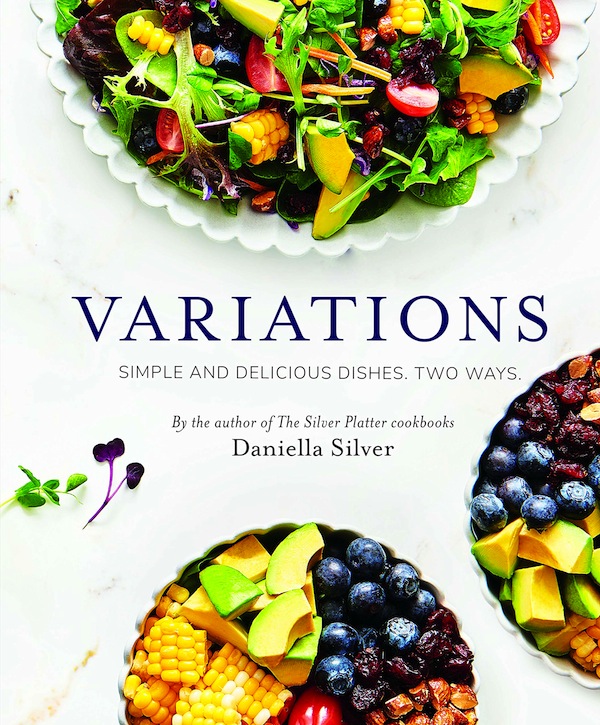
Daniella Silver, author of the Silver Platter cookbook series, has recently come out with Variations: Simple and Delicious Dishes. Two Ways (Artscroll Shaar Press).

In The Silver Platter: Simple to Spectacular, Silver offered recipes with basic ingredients, inviting readers to experiment. In The Silver Platter, Simple Elegance, she focused on recipes with a little more creative flair in presentation and attention to detail. In Variations, she shares with readers versatile recipes that can be served at least two different ways.

In the new cookbook, the basic recipe is on the left-hand page, with a note whether it is dairy, meat or pareve or any combination; if it is gluten-free, if it freezes well and the number of servings. The amounts are regular and metric. On the right-hand page is the variation. Both pages have colour photographs. In the book as a whole, there are 251 recipes and 273 photographs.

Variations’ 10 sections are appetizers (like Deli Egg Rolls and Dill Pickle Football Wings), soups (including Vegetarian Vegetable Quinoa Soup and Dinner Steak Soup), salads (such as Panko-Topped Kale Salad and Pretty Brussels Sprouts Salad), fish (French Fried Onion Salmon and No-Mayo Avocado Tuna Salad, for example), chicken (Old-Fashioned BBQ Chicken and Potato Latke Schnitzel, among others), meat (like Brisket Ends and Overnight Shabbos Corned Beef), dairy (Crustless Baby Red Potato Quiche, Baked Broccoli Tots, etc.), grain sides (such as Crispy Garlic Couscous and Fresh Orzo Salad), vegetable sides (like “Everything Bagel” Asparagus and Maple-Glazed Japanese Sweet Potatoes) and desserts (among which are Low-Fat Ginger Biscotti and Olive Oil Salted Raspberry Brownies).

There are a lot of creative ideas for experienced cooks and great new ideas for all cooks to explore. On her website (daniellasilvercooks.com), Silver says, “I wrote Variations because I felt it’s time to change things up. I want readers to get creative with the foods they prepare by understanding that a recipe can be versatile in preparation or presentation.”

As a food writer and cookbook author, I caught a couple of small but obvious technicalities. When Silver suggests a choice of two ingredients – honey or silan, soy sauce or tamari, for example – she does not mention both possibilities in her instructions for the variation.

When she suggests using a prepared pan, she is inconsistent in indicating in her instructions what preparing the pan means – vegetable spray, flour, etc. She is also inconsistent in telling the reader to preheat the oven as an initial step. Lastly, in the prime recipe, she uses numbers in the instructions; in the variations, she does not. Numbering all of the recipes would have made it easier for cooks, and I have done so below. Here are two recipes with their variations.

RUSTIC SHEET PAN CHICKEN
meat, gluten-free, freezes well, yields 4-6 servings

1 3 lb chicken, cut into eighths
4 peeled, trimmed carrots, cut in half crosswise then lengthwise
1 19 oz can chickpeas, rinsed and drained
1 cup dried fruit (raisins, apricots, prunes)
1 tsp kosher salt
1/4 tsp black pepper
2 tsp onion powder
2 tsp garlic powder
3 tbsp sweet paprika
2 tbsp extra light olive oil
3 tbsp pure maple syrup or honey

  1. Preheat oven to 375°F. Line a large rimmed baking sheet with parchment paper.
  2. Trim and discard excess fat from chicken. Arrange chicken, skin side up, in a single layer on prepared pan.
  3. Scatter carrots, chickpeas and dried fruit around chicken. Sprinkle with salt and pepper, onion powder, garlic powder and paprika. Drizzle with oil or maple syrup; toss to coat.
  4. Bake, uncovered, for 50-60 minutes, or until chicken juices run clear when pierced with a fork.

Variation: Rustic Couscous
for a meatless main, omit the chicken

  1. Cook 1 1/2 cups couscous according to package directions.
  2. Toss carrots, chickpeas and dried fruit on prepared baking sheet with spices, oil and maple syrup or honey.
  3. Bake, uncovered, at 375°F for 40 minutes or until golden.
  4. Place couscous onto a large serving platter, top with roasted veggies and dried fruit.

ROSE PETAL APPLE TART
pareve, gluten-free option, yields 10 servings

Dough
1 1/2 cups flour (or gluten-free flour)
1/4 cup brown sugar
1 tsp ground cinnamon
3/4 cup vegetable oil
1 1/2 tbsp vinegar

Filling
5-6 thinly sliced apples
3 tbsp brown sugar
2 tsp ground cinnamon
2 tsp fresh lemon juice

  1. Preheat oven to 375°F. Lightly coat a 9- or 10-inch flan pan or pie plate with nonstick cooking spray.
  2. In a large bowl, combine flour, brown sugar, cinnamon, oil and vinegar. Mix to make a soft dough.
  3. Press dough evenly against bottom and sides of prepared pan.
  4. In a medium bowl, combine sliced apples with brown sugar, cinnamon and lemon juice; gently mix well.
  5. Starting at the outer edge of pan, place apple slices slightly on an angle to form a circle, making sure to overlap the apples. Repeat with additional rows, working your way toward centre.
  6. Place additional apples in any gaps (apples should be tightly packed). Pour on any remaining liquid in apple bowl.
  7. Bake for 45-50 minutes.

Variation: Apple Crisps

  1. Preheat oven to 375°F.
  2. Peel, core and cut apples into large chunks.
  3. Place in large bowl; mix with brown sugar, cinnamon and lemon juice.
  4. Place in individual ramekins. Bake, uncovered, for 25-30 minutes.

Serve either the principle or variation dish hot or at room temperature.

Sybil Kaplan is a journalist, lecturer, book reviewer and food writer in Jerusalem. She created and leads the weekly English-language Shuk Walks in Machane Yehuda, she has compiled and edited nine kosher cookbooks, and is the author of Witness to History: Ten Years as a Woman Journalist in Israel.

Critical, short look at Nazism

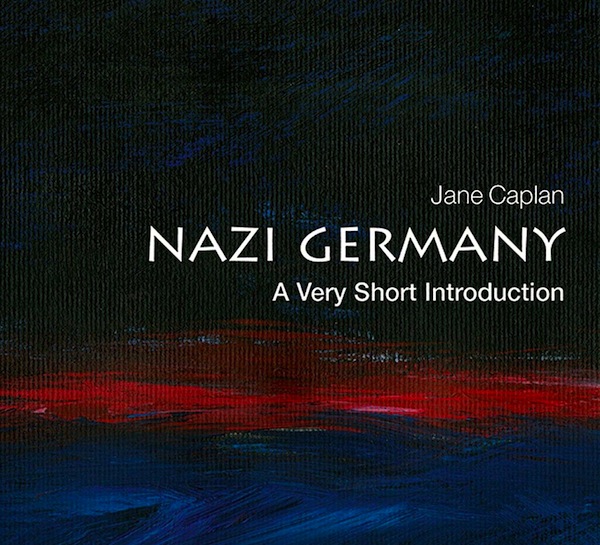
Oxford University Press launched the first of its “Very Short Introductions” in 1995. Since then, the series has reached more than 600 volumes, which have been translated into 45 languages. To write the most recent in this series, Nazi Germany: A Very Short Introduction (2019), OUP made the happy choice of venerated Oxford historian Dr. Jane Caplan.

In what seems like an almost insurmountable challenge, Caplan succeeds in describing the details of the “horrifying” main events of this historical catastrophe, and identifying its main criminals, without simplifying. And she writes with an “edge” that is missing in many history narratives: thus, she speaks of the “insolence” of the Nazis’ manipulation of language into “sickening euphemisms”; of the “fraudulent artifice” of Nazi political and social institutions; and of the “ultimate disgrace” Nazism proved to be, to the Germans and their country.

image - Nazi Germany coverIn describing how ordinary citizens lived through “the horror of Nazism,” Caplan offers many quotations from speeches, newspapers, memoirs, journals and diaries to demonstrate the reich’s totality of control over German culture and communications. This total control led to “a redefinition of automatic habits of thought and behaviour,” from clothes to be worn, to facial expressions to be shown, to the demands for “Hitlerschnitt” (forced sterilization), and even to the details of the “Hitlergrusse” (that is, “Heil Hitler”) and what happened to those who didn’t raise their arms in the prescribed way and time.

More than 20% of this compact volume is given over to details of the Holocaust, which Caplan describes with both insight and anger, although rightly insisting that a study of Nazism must not be “confined” to this “ultimate horror.” For there are other lessons to be learned from Nazi Germany, especially for citizens of the 21st century, with its alarming return to populist beliefs and behaviours. Nazism reminds us, she says, of the dangers of “the exploitation of popular fears and resentments, the retreat of confidence in public institutions, the structural power of economic and political elites, the weaponization of prejudice, and the eternal temptation to turn a blind eye.”

In brief, anyone who likes history served at the traditional historian’s arm’s-length would be well-advised to avoid this caustic, openly judgmental, short, but long-remembered volume.

Graham Forst, PhD, taught literature and philosophy at Capilano University until his retirement and now teaches in the continuing education department at Simon Fraser University. From 1975 to 2010, he co-chaired the symposium committee of the Vancouver Holocaust Education Centre.

The future requires chutzpah

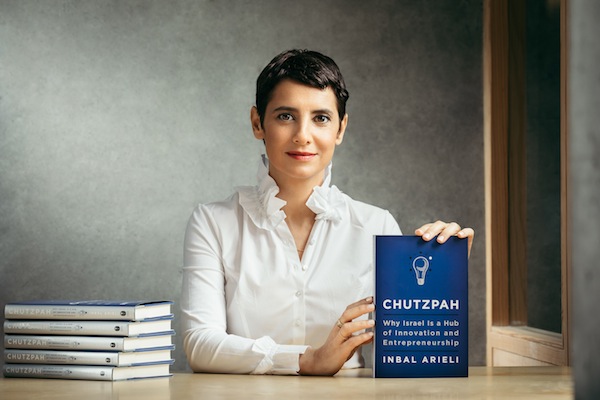
Inbal Arieli recently published the book Chutzpah: Why Israel is a Hub of Innovation and Entrepreneurship. (photo by Micha Loubaton)

Inbal Arieli has always been fascinated by what motivates and drives people, as well as what blocks their paths. “Throughout my career, which was mainly as a business executive, I always kept an eye on the human factor,” Arieli told the Independent. “And so, the businesses I started were somehow all related to that.”

Arieli, who is also a lawyer, is the owner and co-chief executive officer of Israeli start-up accelerator Synthesis. The company provides leadership assessment, as well as business training and development, in Israel, Canada and the United States.

“It is about the effect of the most critical skills that I think anyone should have today,” said Arieli about her recently published book Chutzpah: Why Israel is a Hub of Innovation and Entrepreneurship. “These are, according to the World Economic Forum, the skills which are required in the future, for anyone, regardless of your profession or future position. These are basic life skills – of critical thinking, decision-making, taking on initiative, etc., etc. There’s a long list of soft skills. The book is about these skills.

“What’s still interesting to me is, when looking at these skills, thinking about the future – the future of my kids, the future of the entrepreneurs here in Israel, the future of the job market in the world – about how can one practise these skills.

“The book shows the journey of a typical Israeli child from a very young age, as young as 3 or 4, until after military [age], young adult.”

In Chutzpah, Arieli shows how, in the five stages of childhood – infancy, childhood, adolescence, military service and then the big trip after the military – Israeli culture and society have produced principles, a framework and settings to foster these skills.

The book is not about Israel in and of itself. It is designed to help readers develop their own set of skills using the Israeli experience as an analogy.

Chutzpah (audacity), an ingrained trait, is very much nurtured in Israeli kids from a young age, said Arieli.

“From a very young age, chutzpah comes into play everywhere and anywhere,” she said. “Most of those skills, Israeli education and mindset … I think of them like muscles we all possess … only here, in Israel, we have access to the best gyms to practise these muscles.

“When you play at the playground, at age 3 or 4, the fact that you stand for your own opinion and find your own way of using the slide – an example I give in the book – that, in a sense, is a little bit of chutzpah. You don’t necessarily follow guidelines or practices. You bring your own personality [into your decisions and actions] at a very, very young age. So, it starts then, and then it fills up as we grow up here.”

Arieli sees Israeli society as being very open to giving freedom to everyone’s chutzpah – encouraging kids to exercise their chutzpah muscle, to be risk-takers, to stand out from the crowd, encouraging individualism along with a strong sense of collectivism. “Definitely, the framework that exists here, the environment, so many social structures are helping the muscles to remain developed and strong,” she said.

Chutzpah can be viewed as either negative or positive, and can be used in a positive or negative way. In Hebrew, one can differentiate between the two, depending on where the accent is placed. Arieli does not think it is important to differentiate between the two concepts of chutzpah. Rather, she contends that, just like any other muscle, the use of it needs to be calculated.

“Chutzpah is not a button you can press on or off,” she said. “It’s a mindset. In the context of innovation or entrepreneurship, I think it’s a very positive thing. And so are the other skills, ideas or principles spoken about in the book. I think it’s all a matter of finding the right balance between using them or not using them, and when to use them. What’s right for certain stages is less relevant for other stages.

“More than anything, I think it’s the combination of having these skills along with other skills is what’s optimal. But, I also think it’s very challenging to create an innovative society or an innovative team or group of people without allowing them to have a little bit of chutzpah.”

According to Arieli, just teaching kids how to work in today’s job market is a recipe for failure, as we have little knowledge of what work will even look like in their generation. The one and only thing we know for sure is that the future job market is uncertain. As such, the only way to prepare children is to equip them with the ability to be highly innovative and creative thinkers, capable of taking on initiatives by shaking things up and changing things.

“I wish for my kids that they will have as much chutzpah as possible when thinking about their future,” said Arieli. “They’ll have to reinvent themselves during their career several times and I want them to be proactive in that.”

Another trait Arieli talks about in Chutzpah is balagan (mess or chaos).

“Anyone who has visited Israel knows what I’m talking about – be it traffic, on the playground, in restaurants – everything is really chaotic here,” said Arieli. “But, that chaos, balagan, propels us toward new order, allowing us to rise every time from that balagan.”

Another factor Arieli discusses in her book is teamwork and “how Israeli society, while sometimes divided, at its core, has a galvanizing mechanism rooted in survival, through our culture … what we endured as a people and our mandatory army service … all of which unite us like no other nation on earth.”

For more information about Arieli or her book, visit inbalarieli.com.

Rebeca Kuropatwa is a Winnipeg freelance writer.

Eisen’s story of survival

As public opinion surveys continue to tell us that vast numbers of people know little or nothing about the Holocaust, it was encouraging that Max Eisen’s memoir, By Chance Alone, became CBC Radio’s Canada Reads 2019 choice, bringing this wrenching narrative to many more eyes and ears.

Born in Czechoslovakia in 1929, Eisen enjoyed a childhood filled with shenanigans and idyllic summer excursions to his maternal family’s farm – until the Nazi invasion of his country, in 1938.

image - By Chance Alone book cover“At 9, I didn’t fully understand what was taking place, but I noticed the rising tensions in my hometown,” he writes.

Eisen’s father’s friends assembled at their home to listen to a major address by the Führer on a crystal radio. “All of us understood basic German,” he writes. Hitler’s words, “Wir werden die Juden ausradieren” – “We are going to eradicate all the Jews of Europe” – clarified for the young Eisen the import of the moment.

While traumas befell the family from then on, it was in the night after the first seder in 1944 that the worst of the family’s catastrophe began to unfold.

At 2 a.m., after the family had settled into bed after what Eisen calls their “last supper,” a neighbour arrived at their property urgently insisting that the family hide in the forest because he had overheard gendarmes saying that they would gather all the Jews in the vicinity the next day. Because it was Passover and the Sabbath, Eisen’s grandfather declared that the family would not travel. At 6 a.m., gendarmes forced their way into the home, gave the family five minutes to pack a bundle and be ready to depart their home.

The complicity of bystanders before, during and after the Holocaust permeates the book.

“On both sides of the road, the townspeople jeered and cursed at us as we passed. Many were looking out the windows of the Jewish homes they now occupied.… Many townsfolk who bought goods on credit from Jews like my grandfather were happy they wouldn’t have to pay the money back. Our deportation was an economic windfall for them.”

In the chaos of arrival at Auschwitz, Eisen had no idea of the seriousness of the separation of himself, his father and uncle from the rest of their family. The three would be the only ones to survive the first selection.

The everyday “indignities and deprivations” they had experienced before quickly turned to horrors. The forced labour he endured, long shifts of excruciatingly exhausting work on starvation rations, was fatal to those less strong.

His father and uncle were moved to another barracks and, after selection one day, Eisen could not find them.

“I ran to a fenced off holding area where the SS kept the selected prisoners until they were ready to transport them to Birkenau to be gassed.… My father reached out across the wire and blessed me with a classic Jewish prayer…. The same prayer my father once uttered to bless his children every Friday evening before the Sabbath meal. Then he said, ‘If you survive, you must tell the world what happened here. Now go.’”

At one point, when Eisen let down his guard and relaxed for a moment, an SS guard delivered a blow with the butt of his gun on the back of Eisen’s head. The nearly fatal attack put Eisen in the camp’s infirmary, which proved one of the chances that led to the book’s title. A surgeon, a Polish political prisoner, assigned Eisen the job of cleaning and running the operating theatre. Although the responsibilities he was forced to undertake and the things he witnessed were appalling, the comparative comfort of the job may have saved his life.

As the Nazi regime was on its last legs, “the SS ceased distributing rations and the water system was shut down,” Eisen writes. “I woke up to the smell of cooking meat.… Several inmates sat around a small stove and watched as a pot boiled. I could not imagine how they had acquired meat, but when I crawled to the latrine where the cadavers were stacked, I noticed that some of the bodies were missing pieces from their buttocks.”

On May 6, 1945, the camp was liberated, but the term lacks much meaning in the context. Everything and everyone Eisen knew was destroyed. When the Americans provided food, a stampede of starving people led to deaths by trampling. Those who got food suffered ruptured stomachs and many died on the spot.

After overcoming a nearly fatal bout of pleurisy, Eisen faced yet more incarceration. After the communist takeover of Czechoslovakia, his plan to find freedom abroad was dashed. Because he came from the eastern, Hungarian-speaking part of the country, he tried to obtain phony Hungarian ID and join a mass of Hungarian refugees passing through to the West. Discovered, he was imprisoned for a year.

When finally released, Eisen was given 24 hours to get out of his native country. Eventually, he made his way to Canada where, since the 1980s, he has educated school kids and others about the Holocaust.

“It is in this way,” he writes, “that I have fulfilled my final promise to my father: telling the story of our collective suffering so it will never be forgotten.”

Creative, engaging memoir

Nora Krug’s Belonging offers a thoughtful and artistic exploration of identity and history. (photo by Nina Subin)

Nora Krug’s Belonging: A German Reckons with History and Home (Scribner, 2018) opens with a page made to look like it’s written in pencil on yellow graph paper. The illustration of a bandage takes up half the page, which is ostensibly “From the notebook of a homesick émigré: Things German.” Entry No. 1 is about Hansaplast, a type of bandage created in 1922 that Krug associates with safety, her mother having used it, for example, to stop Krug’s knee from bleeding after a roller-skating accident at age 6. “It is the most tenacious bandage on the planet,” writes Krug, “and it hurts when you tear it off to look at your scar.”

Belonging is the written and illustrated account of what happens when Krug decides to rip off the Hansaplast and examine the scars left by the history of her family – which had only been related to her in vague terms – and her country of birth, Germany. It is a creative and engaging memoir about Krug’s efforts to define for herself and reclaim for herself the idea of Heimat, tarnished by the Nazis’ use of it in propaganda.

image - Belonging book coverHeimat can refer to an actual or imagined location with which a person feels familiar or comfortable, or the place in which a person is born, the place that played a large part in shaping their character and perspective. Krug’s exploration of identity comprises archival research, interviews with family members and others, and visits to her mother’s and father’s hometowns – Karlsruhe (where Krug grew up) and Külsheim, respectively.

Alternating with the narrative of her discoveries are several notebook entries, on a range of items, from bread to binders to soap, which are both points of pride, as they are quality-made items, and metaphors. For example, Persil is “a time-tested German laundry detergent invented in 1907,” which Krug uses. However, she writes, “Some referred to the postwar testimonials written by neighbours, colleagues and friends in defence of suspected Nazi sympathizers as Persil Certificates. Persil guarantees your shirts to come out as white as snow.”

As well, Krug includes pages “From the scrapbook of a memory archivist,” which present odd and sometimes disturbing arrays of items found at flea markets on her research trips to Germany. These include Hitler Youth trading cards, a letter from the front containing a lock of hair and photographs of soldiers petting or holding various animals, mostly dogs.

But the main intrigue of the book comes from what Krug shares as she persists in her research, asking questions and scouring documents. She wants to find out all she can about her family’s involvement in the Holocaust, in particular that of her maternal grandfather, who died when Krug was 11, and her paternal uncle, who was drafted at 17 and shot and killed at age 18, before her father, a postwar baby, was born; her father was named after the brother he never knew. Despite her efforts, many of Krug’s questions remain unanswered.

At the end of Belonging, it’s not even clear if Krug – who readers find out early on married into a Jewish family – feels any less guilty or any more secure in her self and in her past. But she does manage to start the healing process on some family rifts. And she highlights a couple of steps towards healing that she witnesses in Germany. For example, of Külsheim – which had, in 1988, the 50th anniversary of Kristallnacht, abandoned a proposal for a memorial plaque where the synagogue once stood, before it was burned down the night of Nov. 10, 1938 – she writes: “Plans are made to restore Külsheim’s old mikvah, and a memorial stone is erected where the synagogue used to be, ‘as a manifestation of sadness and shame,’ Külsheim’s new mayor says on the day it is installed.”

The book ends as it began, with a notebook entry. No. 8 is Uhu, “invented by a German pharmacist as the first synthetic (bone-glue-free) resin adhesive in the world, in 1932.” Despite its world-record strength, which is why Krug imports it to repair everything from the soles of her shoes to broken dishware, Uhu “cannot cover up the crack.”

Cultivating self-awareness

Oren Jay Sofer believes that, with nonviolent communication, a person can learn “how to identify what is most important to you and what’s more important to someone else … and, then, how to come up with more solutions and ideas for complex situations.” (photo from Oren Jay Sofer)

Oren Jay Sofer, author of Say What You Mean: A Mindful Approach to Nonviolent Communication, took a longer route to finding his connection to Judaism. “Probably,” he said, “most of it was because the teachings weren’t really available for me growing up – the more mystical or spiritual teachings of Judaism.”

The Buddhist practice of meditation resonated with Sofer. Then, he happened upon Dr. Marshall Rosenberg’s practice of nonviolent communication. Through learning about it, Sofer gained an accessible and practical complement to the inner transformation of meditation. “The two really started to work together in a synergistic fashion – in my personal transformation, in my relationships and in my direction in life,” said Sofer. “That, over time, led me to the work I’m doing today.”

A couple of years ago, Sofer was approached by a publisher about writing a book on his practices. He jumped at the opportunity to share what he had learned from integrating meditation practice, nonviolent communication and other concepts through Dr. Peter Levine’s work of somatic experiencing, a way of healing trauma through the nervous system.

“I was getting feedback [from students] that there was something unique about bringing these systems together, that people found really helpful,” said Sofer. “So, I wanted to reach more people, to write it down in a way that other people can go through this sort of progress of learning that I’ve put together – that could be of great benefit to them personally and for our society, in terms of the kinds of divisiveness and polarization people are experiencing around the world in so many places.

“I wanted to reach more people and help them have the tools to have more meaningful conversations in their life,” he added.

Sofer has found that communication and mindfulness are effective vehicles for aligning one’s life with one’s values, insofar as the choices we make, the work we do and the conversations and relationships we have.

This way of communication is accessible to anyone, no matter what age, religious belief, race, gender, or otherwise. “It’s for anyone who wants to improve their communication and have better conversations – parents, employees, supervisors, spiritual seekers, students, anyone – that is something I find so powerful and gratifying about this work, that it unites us as human beings,” said Sofer.

“We all communicate. And, we do it pretty much all day long in every area of our life. Even when we are alone, we have that inner voice going. So, the audience isn’t limited in any way, because we all depend on communication in our lives and it’s one of the things that determines our happiness. I really see this as a life skill that’s important for everyone.”

According to recent research conducted by Shawn Achor and others, the social relationships and connections we foster are one of the greatest predictors of long-term happiness, as well as of many different health markers. And, the quality of our relationships, to a large degree, is determined by our communication skills.

image - Say What You Mean book coverThe book is set up rather like a field guide of how to communicate and converse. So, it’s not the kind of book you will read over one weekend or week. It is one you can read over several months, taking a few pages at a time, with exercises and principles interspersed throughout to work on and absorb.

“You can’t learn to swim by reading a swimming manual, right?” said Sofer. “You need to get into the water. You can’t learn to communicate from a book. You have to do it. But, the book can tell you how to do it in a way that you’re running experiments that will give you the information you need to figure out what will work best in your life and relationships. It’s really meant to be applied in a step-by-step way. And, it takes people through a whole arc of training with specific foundations to integrate into their lives.”

The book’s first foundation is to “Lead with Presence,” which Sofer views as an essential prerequisite for any effective conversation or meaningful relationship.

“We need to be here to have more self-awareness if we’re going to navigate the complex terrain of human interaction with any skill or clarity,” said Sofer. “So, there’s a whole section about what it means to have more self-awareness, how to cultivate it and how to bring it into our relationships and conversations.

“And, there are all kinds of practices, skills and pointers – everything from pausing, to developing more embodied self-awareness, to developing what I call ‘relational awareness,’ which is the capacity to be not just aware of yourself, but of the other person, space and energy between you.

“Then, the book looks at our intentions, which is a huge component of human interaction, happening beneath the words. Our non-verbal communication is, to a large degree, shaped by our intentions.”

With the goals of building the kind of goodwill, trust and collaboration that lead to more satisfying connections, Sofer guides the reader through a self-reflection about their habits, training, family, culture and society, to help them determine which parts need improvement.

“There are many different stories I tell about the power of intention in conversation,” he said. “The third section really looks at how we navigate conversations themselves – in terms of where we place our intentions, how we say what we really mean, how we know what we mean, how we come to more clarity about ourselves about what’s happening, and how we hear others more clearly, even when they’re speaking to us in ways that are critical.

“This section is really where the training in nonviolent communication comes in, looking at the mechanics of the conversation, how to become more skilful, how to identify what is most important to you and what’s more important to someone else … and, then, how to come up with more solutions and ideas for complex situations.”

According to Sofer, one of the roots of violence stems from our relationship to emotional and psychological pain, and the views and beliefs we hold about their origins.

“If I believe that you caused my pain, then there is a very short distance to the assumption that you deserve to be punished or to have retribution, being the cause of my pain,” said Sofer. “In nonviolent communication, we differentiate between the cause and the stimulus. Obviously, we affect one another in this world. We stimulate pain, but we don’t directly cause it. This is a very radical concept in many ways for people to take in.

“When we examine it, we start to see the truth of it, which begs the question if anyone can actually make you feel some way. And, you know, two different people will respond to the same event completely differently. One person will respond completely differently on two different days.

“So, the nonviolent component, in one way, is pointing to this link between our language and our willingness to use physical violence to accomplish our aims or meet our needs. When we think and speak in ways that are connected to our shared humanity, one of the aims of nonviolent communication is that violence no longer makes sense, as we’re in touch with a deeper layer of our existence.”

Sofer also speaks about the origins of nonviolent communication as a tool to create social change, noting “Without transforming our outlook, interactions and consciousness, it’s impossible to transform our society for the better.”

Sofer’s book, Say What You Mean: A Mindful Approach to Nonviolent Communication, is sold by many vendors, but there is a free gift offer when it is purchased from the author’s page, orenjaysofer.com/book.

Rebeca Kuropatwa is a Winnipeg freelance writer.

Laying out Israel’s case

Yossi Klein Halevi’s Letters to My Palestinian Neighbour is recently out in paperback. (photo by Ilir Bajraktari / The Tower)

Yossi Klein Halevi grew up in the right-wing Zionist youth movement Betar, the ideological stream of Ze’ev Jabotinsky and Menachem Begin. As a youth, he wore a silver outline of the land of Israel “as we understood it” that included not only the West Bank but also the area that became the kingdom of Jordan, which the British had severed from historic Palestine. As he’s aged, he’s emphatically mellowed.

His book Letters to My Palestinian Neighbour, recently out in paperback, is, he writes, “an attempt to explain the Jewish story and the significance of Israel in Jewish identity to Palestinians who are my next-door neighbours.”

He lives in the French Hill neighbourhood of Jerusalem and repeatedly throughout the book reflects on how he is face-to-face with the division between their places.

Each chapter – essay, really – begins with “Dear neighbour.”

image - Letters to My Palestinian Neighbour book cover“From my apartment, I can just barely see the checkpoint you must cross – if you have a permit at all – to enter Jerusalem.” He talks about when, “before the wall was built, before so much else that went wrong, I tried to get to know you.”

In 1998, he set out on a pilgrimage into Islam and Christianity, a religious Jew “seeking not so much to understand your theology as to experience something of your devotional life. I wanted to learn how you pray, how you encounter God in your most intimate moments.”

During those comparatively placid times, he recalls, Israelis made little effort to accommodate their neighbours.

“For many years we in Israel ignored you, treated you as invisible, transparent. Just as the Arab world denied the right of the Jews to define themselves as a people deserving national sovereignty, so we denied the Palestinians the right to define themselves as a distinct people within the Arab nation, and likewise deserving national sovereignty. To solve our conflict, we must recognize not only each other’s right to self-determination but also each side’s right to self-definition.”

Klein Halevi made aliyah from the United States in 1982. Now a senior fellow of the Shalom Hartman Institute – “Israel’s preeminent centre for pluralistic Jewish research and education” – he co-directs the institute’s Muslim Leadership Initiative, is the author of numerous books and is a prolific commentator and former contributing editor of the New Republic. He has made the book’s Arabic translation available to download for free.

He argues that each side must be allowed to define themselves.

“So who are the Jews? A religion? A people? An ethnicity? A race?… That question impacts directly on our conflict. It goes to the heart of the Arab world’s rejection of Israel’s legitimacy as the nation-state of the Jewish people,” Klein Halevi writes. “Even Palestinian moderates I’ve known who want to end the bloodshed tend to deny that the Jews are an authentic nation. So long as Palestinian leaders insist on defining the Jews as a religion rather than allowing us to define ourselves as we have since ancient times – as a people with a particular faith – then Israel will continue to be seen as illegitimate, its existence an open question.”

He acknowledges that the problem occurs on both sides.

“Some Jews continue to try to ‘prove’ that Palestinian national identity is a fiction, that you are a contrived people. Of course you are – and so are we. All national identities are, by definition, contrived: at a certain point, groups of people determine that they share more in common than apart and invent themselves as a nation, with a common language, memory and evolving story. The emergence of a nation is an inherently subjective process.”

But he attempts to disabuse Palestinians and Arabic readers of the idea that Israel can be overcome.

“I’ve often heard from Palestinians that, just as the Ottoman Turks came here and left, and the British came here and left, so, too, will the Zionists one day leave. That analogy ignores Zionism’s singular achievement. None of those invaders founded a thriving society, let alone a sovereign state. They eventually went back to their own homelands. More than anything else, I need you to understand this: the Jews succeeded where the Crusaders and the Ottomans and the British failed because we didn’t merely come here. We returned.”

This sense of destiny is evocatively expressed when Klein Halevi writes about the War of Independence.

“Our side began the war with three tanks and four combat planes. And we were alone. That, as it turned out, was a crucial advantage, because desperation forced us to mobilize our entire society for a war of survival. If your side had prevailed, few if any Jews would have been left here. As a result, the Jews fought with such determination that only a handful of our communities fell. There was nowhere left to run; we’d reached the final shore of Jewish history.”

But the author makes an effort to acknowledge some of the harsh realities of that victory and the subsequent Israeli control of Palestinian areas and its effect on people. He recalls a moment during a call-up during his reserve service.

“A chubby teenage Palestinian boy, accused of stone throwing, was brought, blindfolded, into our tent camp. A group of soldiers from the border police unit gathered around. One said to him in Arabic: ‘Repeat after me: one order of hummus, one order of fava beans, I love the border police.’ The young man dutifully repeated the rhymed Arabic ditty. There was laughter.… That last story haunts me most of all. It is, seemingly, insignificant. The prisoner wasn’t physically abused; his captors, young soldiers under enormous strain, shared a joke. But that incident embodies for me the corruption of occupation. When my son was about to be drafted into the army I told him: there are times when as a soldier you may have to kill. But you are never permitted, under any circumstances, to humiliate another human being. That is a core Jewish principle.”

He acknowledges his pain over an eventual partition that would, for example, see the Jewish holy city of Hebron as part of an independent Palestine. But, he says: “The only solution worse than dividing this land into two states is creating one state that would devour itself. No two peoples who fought a 100-year existential war can share the intimate workings of government. The current conflict between us would pale beside the rage that would erupt when competing for the same means of power. The most likely model is the disintegration of Yugoslavia into warring ethnic and religious factions – perhaps even worse. A one-state solution would condemn us to a nightmare entwinement – and deprive us both of that which justice requires: self-determination, to be free peoples in our own sovereign homelands.… If Jaffa belongs to you and Hebron belongs to me, then we have two options. We can continue fighting for another 100 years, in the hope that one side or the other will prevail. Or we can accept the solution that has been on the table almost since the conflict began, and divide the land between us. In accepting partition we are not betraying our histories, neighbour; we are conceding that history has given us no real choice.”

Near the end, Klein Halevi reflects that some simple human goodness could have made a massive historic difference.

“Israel is a restless society of uprooted and re-rooted refugees and children of refugees, and the dark side of our vitality is a frankness that can easily become rudeness, the antithesis of Arab decorousness. Israelis often don’t know how to treat each other with respect, let alone those we are occupying. We are a people in a hurry to compensate for our lost centuries of nationhood, a people that doesn’t pay attention to niceties. Sometimes I think that, if only we’d known how to show your people simple respect, so much could have been different here.”

The new paperback edition includes an epilogue of “letters” in response to his neighbourly missives. Some, the author admits, are predictably harsh, dismissive and threatening. But many are long, thoughtful and inspiring. Klein Halevi has started a conversation. It is invigorating and heartily recommended to be a part of it as a reader.

Stories about the Holocaust

On the Jewish Independent’s bookshelf are four books recently published by Second Story Press. All are inspired by real women and girls, and all share lessons of bravery, solidarity and compassion, as well as of the Holocaust.

Fania’s Heart by Anne Renaud and illustrated by Richard Rudnicki, The Promise by Pnina Bat Zvi and Margie Wolfe and illustrated by Isabelle Cardinal, and The Brave Princess and Me by Kathy Kacer and illustrated by Juliana Kolesova are hard-covered picture books for readers ages 7-11. All About Anne, by Anne Frank House and illustrated by Huck Scarry (son of children’s authors Patricia Scarry and Richard Scarry), is a soft-cover encyclopedia of sorts for readers ages 9-13.

image - Fania’s Heart book coverFania’s Heart is based on the story of Fania Landau Fainer, from Bialystok, Poland, who survived Auschwitz. In the book, her daughter, Sorale (Sandy), who is “almost 10,” finds a heart-shaped book in her mother’s dresser, where she “was not supposed to rummage.” She takes it to her mom, who tells Sorale about the book’s origin – a 20th birthday present of unimaginable meaning, made by fellow prisoners, at great risk, with breadcrumbs and stolen or bartered thread, pencil, paper and other materials. It is a story told with minimal sentimentality and with illustrations in the 1950s-style of the time in which it would have taken place in real life. An author’s note explains the Holocaust very briefly and how the card, which unfolds “like an origami flower,” ended up at the Montreal Holocaust Museum.

image - The Promise book coverIn The Promise, cousins Bat Zvi and Wolfe tell the story of their mothers, Rachel and Toby, who survived Auschwitz. It starts two years after the sisters were separated forever from their parents, who gave Toby three gold coins to use “only if you have to” and advised, “above all, stay together.” When Rachel becomes ill and is taken from the barracks, the coins play a crucial part in Toby’s rescue attempt. In a four-sentence epilogue are photos of the real sisters, but no context other than that in the story itself, which mentions Nazis and Auschwitz but not the Holocaust. The artwork for the book is somewhat creepy – the disproportionally large heads are photo-like, and placed on more traditionally illustrated bodies.

image - The Brave Princess and Me book coverLess emotionally powerful – in part because there is too much text – is The Brave Princess and Me, which relates how Princess Alice hid Jewish mother and daughter Rachel and Alice Cohen in her home. The Nazis invaded Greece in 1941, and The Brave Princess and Me starts in 1943. Princess Alice, the mother of Prince Philip, was born deaf and she uses her impairment to protect the Cohens. More about the princess, who was honoured as one of the Righteous Among Nations, is included after the story.

image - All About Anne book coverRounding out the publications is All About Anne, a relatively comprehensive telling of Anne Frank’s story, which uses drawings, photographs and text from the Anne Frank House museum in Amsterdam. Its content is based on the questions most frequently asked by visitors to the museum. While it centres around Anne, her life and her diary, it includes broader information about the Second World War and the Holocaust. It is an excellent resource.

For more information on these and other books from Second Story Press, visit secondstorypress.ca.