Autograph book resurfaces

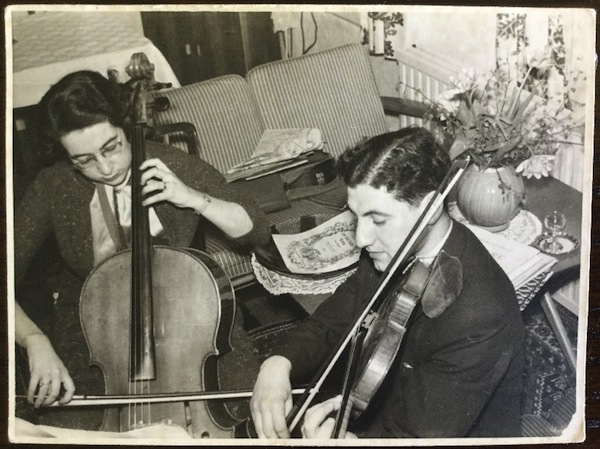
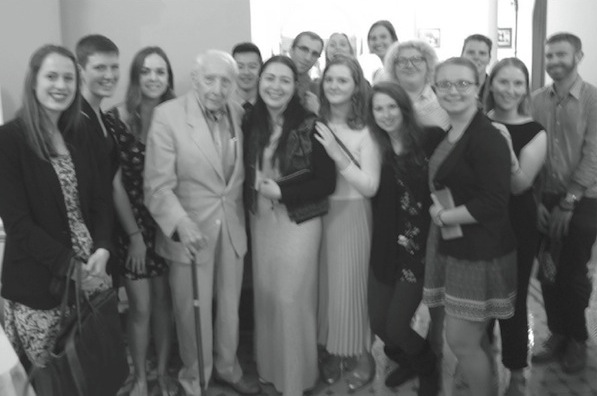
Susi and Mænni Ruben, Copenhagen, 1960s. Mænni Ruben’s autograph book, compiled in Theresienstadt, is the focus of a new online exhibit launched by the Victoria Shoah Project. (photo from Victoria Shoah Project)

The Victoria Shoah Project has launched a virtual exhibit of an autograph book compiled by Mænni Ruben, a Danish violinist and graphic artist held prisoner at Terezin (Theresienstadt) concentration camp outside of Prague.

The 1945 Theresienstadt Autograph Book Exhibit features panels and the 40-page book itself, which is replete with signatures, sketches and aphorisms from Ruben’s friends and acquaintances who were also incarcerated at Terezin.

The book records the closing period of the war as survivors were being liberated. It is a story not only of the horrors of Nazism, but of long-lasting friends, and the music and art that united them during dreadful times.

Ruben died in 1976 in Copenhagen. Though he never lived in or visited Canada, the book remained with his widow, Susi, who remarried after his death and settled in Victoria. Upon her passing, in 2018, the book came into the hands of Rabbi Harry Brechner of Victoria’s Congregation Emanu-El. He subsequently showed it to member Janna Ginsberg Bleviss, who became the coordinator of the exhibit project.

“When the rabbi showed the book to me last year, I could see right away that it was special and should go to a museum. It is in remarkable condition for being 75 years old and is a tremendous addition to Holocaust studies,” Ginsberg Bleviss said.

“I was fascinated by the book – who were these people and what happened to them? Reading the pages filled with optimistic greetings, illustrations and pieces of music was like finding a hidden treasure, waiting to be opened. I wanted to discover who these people were and hear their stories,” she added.

“This virtual launch [which took place Aug. 20] is meant to honour both Mænni and Susi, and the memory of those whose lives intersected in space and time in the Theresienstadt camp. None of the artists, musicians, composers or rabbis who wrote in the book are alive, but we can sense their lives through their traces here,” said Dr. Richard Kool, a member of the Victoria Shoah Project.

A number of panels show the powerful drawings of artist Hilda Zadikow, whose husband, sculptor Arnold Zadikow, died at Theresienstadt. One depicts the coat of arms of Terezin under a Magen David made of barbed wire. Another features three sad, grey sketches of the camp itself. In a third, there is a happier scene of colourful opera figures.

Her inscription in the autograph book reads, “Your old friend Hilda Zadikow wishes you all the best and delight in beauty.”

A poignant message comes from Rabbi Leo Baeck, an intellectual and leader of the German Jewish community and the international Reform movement, who wrote: “What you forget and what you don’t forget, that is what decides the course of your life will take.”

Pianist Alice Sommer Herz, the subject of the 2007 book A Garden of Eden in Hell and the 2013 Oscar-winning documentary The Lady in Number 6, was another prisoner at the camp. Sommer Herz, who died at age 110 in 2014, wrote in Ruben’s book: “In memory of music at Theresienstadt and in strong hopes of a better future.”

And a touching note comes from Miriam Pardies, someone Ruben seems to have known only in passing: “We know each other only from having greeted each other in a friendly way, but that too is a good memory,” she writes in the book.

“There is a huge educational value to these pieces for students learning about the Holocaust, or for researchers who want to continue exploring the stories of these most interesting people during an important time at the end of the Second World War,” remarked Brechner.

Ruben and his family were sent to Theresienstadt in 1943. A place where the Nazis kept prominent Jews, the camp housed musicians, intellectuals, artists, religious leaders and hundreds of children. In 1944, the inmates performed a concert for German visitors and the visiting International Red Cross – the performers were forced to act as though life at the camp was normal.

Losing his father at the camp, Ruben returned home after the war. A few years later, he met his wife. They married and both played in the Copenhagen Youth Orchestra – she on cello and he on violin. Mænni Ruben also worked as a graphic designer and Susi Ruben as a fashion designer; they were together for 24 years.

After her husband died, Susi Ruben’s company sent her to Israel, where she met Dr. Avi Deston. They married in 1978 and went to South Africa for 13 years, where Deston taught physics at the University of Transkei. On his retirement, they came to Victoria, in 1992.

The autograph book will be donated to the Canadian Museum for Human Rights in Winnipeg for their Holocaust gallery. To view the virtual exhibit, go to terezinautographbook1945.ca.

Sam Margolis has written for the Globe and Mail, the National Post, UPI and MSNBC.

Want to be a therapist?

Avrum Nadigel’s latest book, which he co-authored with the late Dr. David Freeman, is aimed at people contemplating a career in family therapy. (photo from Avrum Nadigel)

Therapist Avrum Nadigel’s latest book hit the shelves this month. Co-authored with the late Dr. David Freeman, Where Would You Like to Start: A Master Therapist on Beginning Psychotherapy with Families is structured as a conversation or interview between veteran therapist Freeman and then-newish therapist Nadigel.

Nadigel is a family marriage therapist based in Toronto. Originally from Montreal, where he had worked for the Jewish community for years, he moved to Vancouver for a spell. It was here that he met Freeman (who passed away in 2010).

Freeman had brought in various therapists to speak on marriage, love and respect at different events. Attending these lectures, Nadigel found what the therapists had to say “redundant and I didn’t find it very helpful for me. I had a pretty severe case of fear of commitment, and they all rambled on about the same thing. But, when David spoke, it blew my mind.”

About a year after hearing Freeman speak, Nadigel met, online, the woman who would become his wife, Dr. Aliza Israel. “She is from Vancouver, but was staying in Toronto at the time,” said Nadigel. “Now, we’re married and have three kids. And that all started because of David’s talk in Vancouver. David’s talk introduced me to a type of therapy called family systems theory.’”

Nadigel read many books on the topic, including Freeman’s, which made Nadigel rethink his previously held suppositions about relationships and marriage. “I changed the way I practise with my own clients,” he said.

Nadigel moved to Toronto when he was accepted into a residency there. He started up a private practice and began to look for someone to mentor him. At his wife’s suggestion, he reached out to Freeman in Vancouver, who, although semi-retired, was happy to supervise Nadigel via Skype.

Nadigel recalled some of the game-changing ways in which Freeman changed his way of thinking.

“When I was single, if I felt anxious or not good in a relationship, I was taught that this meant there was something wrong,” said Nadigel by way of example. A relationship “should be lovely, giving and with good communication, but, as soon as I get anxious, I bolt. Then, David comes around and goes … ‘Perhaps your own internal states of anxiety have nothing to do with the people you’re dating, but with your own internal struggle itself.’ It really changed how I saw discomforting feelings in intimate relationships. It helped me sit with them longer.”

Thinking about his eventual marriage to Israel, Nadigel said, “I often think back to that time and think, ‘How did all this work?’ Maybe, it was one part luck, one part theory and one part having a good therapist in my corner.”

In addition to Freeman’s counsel, Nadigel has done much study on family systems, notably he did post-graduate training with the Western Pennsylvania Family Centre, which teaches Bowen family systems theory, as formulated by the late Dr. Murray Bowen, a psychiatrist and founder of the theory.

Recalling his conversations with Freeman, Nadigel said, “David was very worried about two things. Number one, that people were focusing too much on hacks and behavioural changes, and that the system was much more powerful than that … and that the system would often, not always, but often, thwart any attempts the individual would try to make the change. So, he was very concerned that there were so few therapists offering a larger perspective about human suffering.

“The second thing he was very worried about – I think this is because he was a grandfather at the time of his death, he had two grandkids – was about the disconnect from wise elders in society. I think that’s really coming home to roost right now, the fact that we have the hashtag on Twitter, where it says, ‘BoomerRemover.’

“Some people are thinking that, well, it’s good about this coronavirus – it’s going to kill off all the old people and there’ll be more condos. I don’t know what the hell they are thinking but we really do see the elderly as an inconvenience in a lot of cases, and David thought this creates an impoverished culture – that, when you think of traditional society, it’s the elders who share life lessons that can only be acquired over time, through adversity and history. You can read a book, but it’s very different if an elder tells you what it was like to survive the Blitz in Britain. And David thought that young people in their marriages were impoverished, because of their lack of connection.

“So, with those two things,” said Nadigel, “I thought, maybe, if I can somehow convince David to write another book, I could be the young green therapist and he could be the senior guy. He could speak to me and motivate the next generation of therapists.

“I thought to myself that it should be snappy and quick.… I threw him the idea and I think the same day he got back to me and said he thought the format’s viable – except that, in this case, it would be Skype calls between a young therapist and a senior therapist…. We quickly started working on this once a week.

“Then, David had the manuscript and was going on vacation,” said Nadigel. “We had a few more chapters to write; he really liked where the book was going. Then, I got an email from him, a very brief email, which was odd, because he was much more verbose. It just asked if I could call him.

“I thought, that doesn’t sound good, that maybe he was going to say the book sucks. I called, and it was his now-widow [Judith Anastasia], who answered, and she said, ‘Avrum, I’m sorry to tell you, but David died of a heart attack while we were cycling in Croatia.’ I couldn’t believe it. It was a crazy summer. My dad died, my son was born and David died.”

image - Where Would You Like to Start book coverSeveral years later, with Anastasia’s blessing and to honour Freeman’s memory and work, Nadigel started to complete their book.

“The book gives you a taste of a master therapist, to experience the wisdom and thinking he brought to thousands of families and couples he’s worked with over 40 years,” explained Nadigel. “And, once you finish the book, you might feel it’s your responsibility now to go and further your training in this area.

“David’s life work was helping people understand that, if you want to do well with your own personal goals and struggles and gridlock, you have to understand what you’re up against,” said Nadigel. “And you don’t do that by just talking about your neurotransmitters and serotonin and dopamine, or meditation…. It’s about certain ways of the here and now, that you either distance or connect through relationships that are happening right now – that are happening with your mother, your father, your sister, your aunt, your cousin. The work is staring you right in the face right now.”

Family system coaching, consultation or therapy, said Nadigel, is based on “the theory and the road map of going back and reworking through some of the gridlock in your family. And those people who are successful at doing something and thinking differently [about] their problems with their relationships – siblings, spouse, kids, whatever – [are] bringing those successes to every relationship. And that does not happen in the clinician’s office.

“Also, this type of therapy understands that human beings don’t get into problems because of their thinking – they get into problems because they are flooded with feelings…. It tries to promote good thinking to balance out strong feelings, toward being a little more strategic in how you conduct yourself in your relationships.”

And Nadigel himself is an example of how the approach can work.

“I’ve often thought that, if I was reading about this book, the interesting angle I always found … is that I was a punk rock alternative musician in Montreal. I was commitment-phobic and really saw marriage and family, marriage considerably, as the death knell of all that’s good in life – [that it’s] boring and sucks the nectar out of a good life. Then, David comes along in Vancouver and he just creates a profound paradigm shift in me, and I have come to a wildly different understanding. I’ve become a marriage therapist myself, a father, all this kind of stuff, so a pretty fundamental transition.

“I was one of these people that, once upon a time, really had a strong distaste for the very thing I’ve embraced,” said Nadigel. “It really is all credit to this one little talk in Vancouver in the JCC. There’s hope there. It doesn’t take years and years. It could be a 50-minute talk.”

Nadigel has created a blog and podcast to support the new book. To access it, visit nadigel.com/start. Electronic and hard copy versions of Where Would You Like to Start are available at amazon.ca.

Rebeca Kuropatwa is a Winnipeg freelance writer.

A testament to free speech

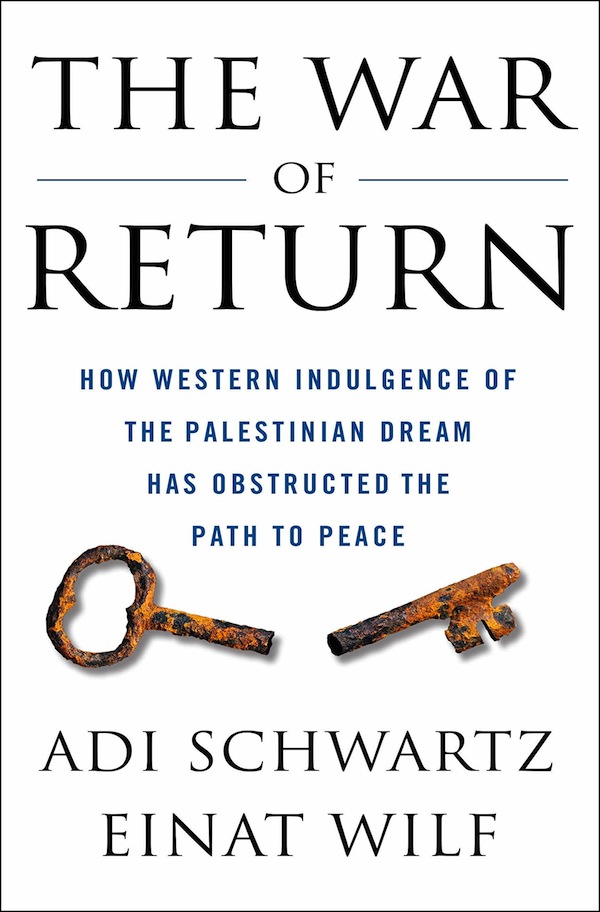
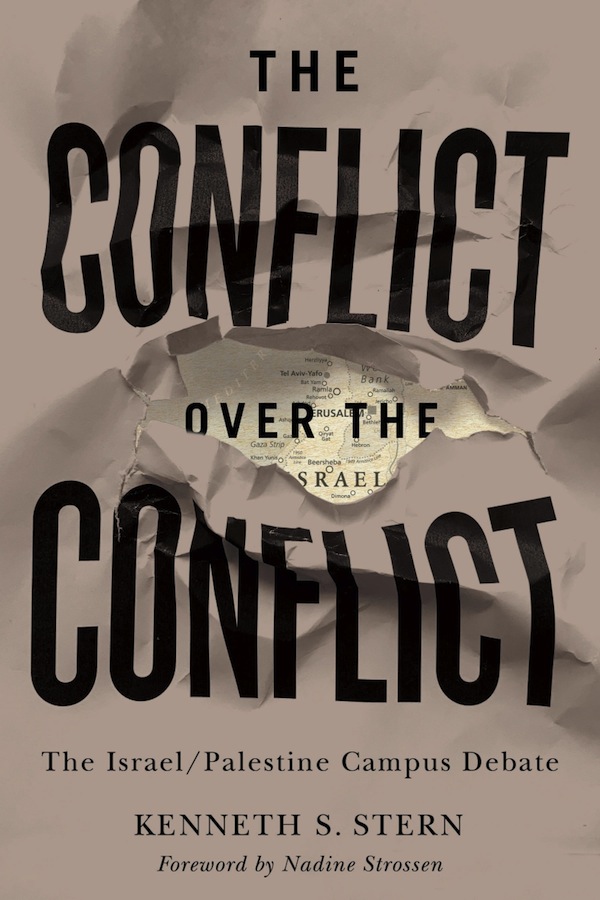
A new book on an incendiary topic turns out to be not quite as expected. The Conflict over the Conflict: The Israel/Palestine Campus Debate, by Kenneth S. Stern, may be the most comprehensive assessment of the (at least) 20-year battle on North American campuses between pro-Israel and anti-Israel forces.

Jewish and pro-Israel readers picking up the work might anticipate a litany of horrors, anti-Zionist if not antisemitic incidents, brawls, screaming matches, vandalism, boycotts and the like. There is that. But Stern argues that the perception that campuses are aflame in anti-Zionist rage is simply not true. More, he offers proof that the pro-Israel side is far from innocent of engaging in disgraceful tactics, too. There is ill will and there are bad actors on both sides. Most unexpectedly, as much as the book is about the conflict, it is more than anything an exercise in applied ethics on the topic of free expression.

Stern is the director of the Bard Centre for the Study of Hate, an attorney and an author. For 25 years, he was the American Jewish Committee’s expert on antisemitism and he was a lead drafter of the Working Definition of Antisemitism. He is also, it appears, something close to a free speech purist. As such, he rails against efforts by Israel advocates who have organized campaigns to censure (and censor) anti-Israel voices. He doesn’t let the other side off easily, either, calling out acts of harassment like drowning out pro-Israel speakers with the “heckler’s veto.”

The book, from New Jewish Press, an imprint of University of Toronto Press, begins with an empirical assessment. In institutions of higher learning in the United States, Israel is an issue in very few, he writes.

When speaking with Jewish audiences, Stern asks for a show of hands to gauge perceptions on anti-Israel attitudes. He asks for guesses on how many American colleges have divested from Israel.

“Many seem surprised when I say ‘zero,’” he writes. “There are relatively few campuses where Israel is a burning issue, and every year the number of pro-Israel programs … is usually at least double the anti-Israel ones. There are over 4,000 campuses in the U.S. – in the 2017-18 academic year, 149 had anti-Israel activity.… So the campuses aren’t burning.”

He does not dismiss the extreme tensions on a few campuses, however.

“[O]n some campuses where anti-Israel activity is prominent, pro-Israel Jewish students may feel marginalized, dismissed or vilified, sometimes with antisemitic tropes.” Identity politics and the conflation of Jewish people with “whiteness” creates racial conflict. “[T]he labeling of Jews as white becomes a problem when shared victimhood becomes a sacred symbol, a badge of honour, a precondition to enter a club of the oppressed. Antisemitic discrimination is rendered invisible.”

Though bigotry may play a role in the discussion, Stern does not see constructive resolutions in neologisms like trigger warnings, safe spaces and microaggressions.

“Faculty should have the right to give trigger warnings if they want, but I never do, and I think the idea is a horrid one,” he writes. “I teach Mein Kampf. It’s disturbing – get over it. College should prepare one to be an adult, and there are no trigger warnings after graduation day. Why are we encouraging students to be ostriches? Shouldn’t they, rather, be learning how to navigate things that will likely unsettle them over the rest of their lives?”

He quotes CNN commentator Van Jones, a strong civil rights proponent, who opposes “safe spaces” on campus: “I don’t want you to be safe ideologically. I don’t want you to be safe emotionally. I want you to be strong. That’s different. I’m not going to pave the jungle for you. Put on some boots and learn how to deal with adversity. I’m not going to take the weights out of the gym. That’s the whole point of the gym.”

Stern contends a fundamental error has been made in defining terms.

“We want campuses that are open to expression – including, perhaps even especially, difficult and disturbing ideas – but which protect students from real harassment and intimidation. Hate speech codes were efforts to say that ideas themselves can harass and intimidate. Ideas can and should make one uncomfortable (a comfortable college education is a wasted college education). But harassment is something different.”

Strategically, he argues, trying to censor hateful ideas is self-defeating and advances hate agents by martyring them.

“By trying to censor, rather than expose and combat, speech the students perceived as hateful, they were actually helping the alt-right and white supremacists,” writes Stern. “It’s no coincidence that the white nationalists in recent years have wrapped their racist and antisemitic messages around the concept of free speech. Why would progressives allow these haters to steal the bedrock democratic principle of free speech, disingenuously saying that this is what their fight is about? By trying to deny alleged racists platforms, progressives are helping white supremacists recast their vile message as noble protection of a right.”

Another strategic failure, he argues, is buying into the Palestinian narrative’s good/evil dichotomy.

“Israel’s case is best understood as inherently complex and difficult; playing into the ‘all bad’ and ‘all good’ binary of the other side renders those complexities invisible,” he writes.

The conflict on campus spills over, of course. Israel has created a list of 20 organizations, those that urge boycotts of the country, for instance, and bars their members from entering the country. Stern sees this as counterproductive: “You don’t make the case that blacklists (especially of academics) are proper if your goal is to oppose blacklists. You are conceding the argument.”

He gives an example of an anti-Israel campus activist who defends his group’s refusal to meet with Zionists “over cookies and cake” because “you Jews, in all due respect, you wouldn’t sit down with Nazis for tea and cake.”

He also reflects on the “Standards of Partnership” adopted by Hillel International, the Jewish campus organization, which proscribe engaging with groups or individuals that deny Israel’s right to exist, or who delegitimize, demonize or apply a double standard Israel, who support BDS or who exhibit “a pattern of disruptive behaviour towards campus events or guest speakers or foster an atmosphere of incivility.”

Writes Stern: “For those who are not yet ideological soldiers, but want to learn more, and want to do it around their campus Hillel, what sense does it make that adults are telling them they can only bring in certain types of speakers? Yes, the adults defined BDS as hateful. But does it make sense to tell students they have to go elsewhere than the Jewish address on campus to hear about it firsthand from those who support it?”

The litany of bad behaviours on all sides of the ideological divide is likely to make readers of Stern’s book uneasy, whether the reader is Zionist or anti-Zionist. But it is a rare and uncompromising testament to free expression that should give genuine free speech advocates an uplift, particularly in an era when ideologically driven regulation of expression and ideas, especially on campuses, has left many advocates of core liberal, academic values feeling beleaguered.

Two compelling reads from Simon & Schuster

Last year, I requested two books from Simon & Schuster Canada. Both contained strong female protagonists and stories that sounded compelling. While it took the pandemic slowdown before I had time to read them, I enjoyed both and would recommend them, albeit one with a caveat.

image - Woman on the Edge book coverLet’s start with the debut novel, the one I breezed through even though I found the premise tenuous. I wanted to know how Samantha M. Bailey’s thriller Woman on the Edge ended, even as I cursed aloud at the two main characters – Nicole Markham, founder and head of a widely successful athletic wear company, and Morgan Kincaid, a woman who has rebuilt her life after her husband was caught swindling people and then killed himself.

For reasons not revealed initially, Nicole hands her baby to Morgan at a subway stop, then jumps to her death, though video of the incident makes it seem like Morgan may have taken the baby then pushed Nicole onto the tracks. Alternating between Morgan’s attempt to clear her name and how Nicole came to give her baby to Morgan, the read is thrilling, even as it is too obviously contrived. At any point in time, a question or revelation from Nicole or Morgan could have shed light on their respective situations and cleared up critical matters. Yet, both women – unrealistically – keep their suspicions to themselves. The silences are necessary for the plot to work, so I chose to go where I was being led and relish the craziness of it all.

While there is no overt Jewish content in Woman on the Edge, Toronto-based writer and editor Bailey is Jewish. In her first novel, she shows a talent for creating dramatic tension, if not overall story structure. Despite its weaknesses, I found this novel a good escape read.

An absolute pleasure to read, and just as page-turning, is veteran author Alice Hoffman’s latest novel, The World That We Knew, set during the Holocaust. In it, there is magic. It is tangible – the golem Ava, created by Ettie, the precocious daughter of a respected rabbi, to protect Lea – and more abstract, in the loyalty of Ava to Lea and the beautiful friendship that develops between Ava and a blue heron along their journey.

image - The World That We Knew book coverAfter her husband is murdered and her daughter Lea is almost raped, Hanni knows she must get Lea to Paris, but she herself cannot leave Berlin. So, she turns to the rabbi for help, but making a golem is risky business and he won’t do it. Ettie, though, plans to escape with her younger sister, and Hanni’s payment will help her do that. Ettie has observed her father at work, and is able to bring Ava into being. As Ava becomes more seemingly human, however, and forms a bond with the blue heron, the main tension of the novel arises – will her appreciation for her own life and its possibilities outweigh her responsibility to Lea?

Many other tensions and relationships mingle with history, which is sometimes pedantically told but always interesting. The World That We Knew is a well-woven and moving story that offers an understanding not only of the past but of the emotions that motivate us and the connections we make with one another.

Survivor retained hope

A photo of George Pal with the class of 2016 I-witness Field School, which can be found in his recently released memoir, Prisoners of Hope.

Shoah survivor George Pal introduced the printed and electronic versions of his memoir, Prisoners of Hope: Rising from the Ashes of the Holocaust, to a Zoom audience on June 30.

His eyewitness account describes life at Auschwitz, where Pal, now 94, was interned in 1944-45 as prisoner #42821. The book is the result of the warm response to his presentations given through the University of Victoria’s I-witness Field School, a program that explores “the ways in which the Holocaust is memorialized in Central Europe, to build an understanding of how the lessons of the Holocaust are relevant in today’s world.”

His story demonstrates how rapidly upheaval can occur in a person’s life. Pal’s hometown of Mukachevo, now in Ukraine, found itself, by turns, under the rule of Czechoslovakia, Hungary, Germany and Russia – all within the first half of the century. “At the age of 17, I already had lived in several different countries, without ever having left town!” Pal observes.

The memoir’s title conveys Pal’s steadfast spiritual resistance to the horrors and brutality that he endured. He believes that many of his fellow concentration camp inmates shared this resolve. Eventually, he was “liberated” by the Russian army, and traveled back to Mukachevo, where he was reunited with his mother and sister. His mother had been interned in a ghetto in Budapest, while his sister had survived a concentration camp.

Pal soon moved to Budapest. A decade later, that city was invaded by the Soviet Union. By then a married engineer with two children, Pal went to Austria. Ultimately, he found asylum in Canada, where he became the dean of engineering at Mohawk College in Hamilton, Ont. There, he learned English. He already spoke Czech, German, Hungarian, Hebrew and a smattering of Russian. In 2006, he moved to Victoria. His journey has been one of patience, perseverance, love and hope.

image - Prisoners of Hope book coverThe release of his memoir proves timely, as nations worldwide explode in public protests urging their governments and police to confront their histories of systemic racism. Pal’s heartfelt plea reiterates the famous refrain “never again.”

“Having survived one of the most monstrous events in human history, I believe that it is my duty to testify. This is crucial especially because Nazi sympathizers and followers continue to exist throughout the world,” he writes.

In May 2019, Pal began working with Vancouver editor Lisa Ferdman, whom he credits for “her consummate skill and insight.” Her recent work as editor includes The Nazi’s Granddaughter: How I Discovered My Grandfather Was a War Criminal by Silvia Foti, soon to be released by Regnery Publishing, in Washington, D.C.

“It was an honour to assist Pal in sharing his story with a wider audience,” Ferdman affirmed.

The book launch featured Prof. Helga Thorson of the University of Victoria’s department of Germanic and Slavic studies; Shoshana Litman of the Victoria Storytellers’ Society; and a video-recorded conversation with Pal.

“For the past 10 years, George has shared his story in my Holocaust studies courses at UVic. In this way, he has affected the lives of countless students, who now carry his story with them as they face their own experiences of a world still struggling with racism, antisemitism and genocide – 75 years after the Shoah,” Thorson said.

“George’s stories of resilience offer concise glimpses of experiences few of us have endured. His writing helps us begin to understand the tremendous perils of unchecked racism in a very personal way,” Litman, Canada’s first ordained maggidah (female Jewish storyteller), reflected.

In one of the later chapters, Pal states: “I have often been asked, ‘Do you hate the Germans?’ My emphatic answer is always, ‘No! If I were to blame the entire German people for everything that happened to me, my family and all those who did not survive, I would be making the same mistake that the Nazis made in blaming the Jews for all of Germany’s woes.’ Such generalizing, or demonizing, is dangerous.”

Sam Margolis has written for the Globe and Mail, the National Post, UPI and MSNBC.

Honouring community

In her recently published book, Shalom Uganda: A Jewish Community on the Equator, Vancouverite Janice Masur writes about her life in Kampala, Uganda, where she moved as a child of 5 and stayed until the age of 17 in 1961, leaving just before Uganda achieved independence in 1962. The small Jewish community of Kampala has been all but forgotten, its history mostly undocumented and lost to time.

JI: How did the idea for this book come about, and when did you begin researching and writing it?

photo - Janice Masur
Janice Masur (photo courtesy)

JM: The idea originated in a modern East African history class I attended at Simon Fraser University. I began writing in 2005, traveling to interview octogenarians and nonagenarians, who [earlier in their lives] had arrived in Kampala. They included Holocaust survivors, individuals who might otherwise have gone to Kenya but could not afford to pay the required head tax, and those who arrived on work contracts of two to four years.

JI: Why was it important for you to try to capture the history of Jewish life in Kampala?

JM: I wanted to both document and honour my small Jewish community on the equator, an imploded star vanished in the diasporic galaxy. While many people are familiar with the Abayudayah who, in 1921, converted to Judaism in passive rebellion against British rule, my community is almost completely forgotten. There’s not even a cemetery to mark the existence of 23 secular families who, without a rabbi, Torah or synagogue managed to create a small, cohesive, but unreligious community. There is a great paucity of research literature on this topic and I have been told that, presently, Shalom Uganda is likely the only scholarship devoted to the Jewish community in Kampala.

JI: How did spending some of your formative years in Kampala leave a lasting imprint on your life?

JM: To this day I love mangos, and growing up in Kampala has made me feel comfortable in the company of all ethnic groups. This long-forgotten colonial world included boarding school attendance and, though much-hated, this education provided me with some excellent life lessons.

JI: Do you have any inclination to return to Uganda to visit or live?

JM: I have not had the courage to return yet, and think that perhaps memories are best left to glitter in the distance. I know that the town is much more densely populated and built up now than it was when I left, and that the red murram country roads are in ill repair.

image - Shalom Uganda book coverJI: Who do you believe will benefit most from reading this book?

JM: My intent is to place this book in all major libraries worldwide. It seems that all who have read Shalom Uganda so far seem to have learnt a new fact, enjoyed the memoir or want to tell me how their life was or wasn’t similar to mine. So, I believe that the book will be well read among a Jewish following or among scholars thirsting for information about Jewish history and life in far-flung places last century. I hope others enjoy reading my writing effort. It is a relief to have the story out in the open.

Lauren Kramer, an award-winning writer and editor, lives in Richmond. To read her work online, visit laurenkramer.net.

Poet writes of world events

Lillian Boraks-Nemetz has a new poetry compilation, called Out of the Dark, which will be released by Ronsdale Press in the fall. (photo from Lillian Boraks-Nemetz)

The death in late May of George Floyd, while he was pinned down on the ground by a Minneapolis police officer, has sparked continuing protests throughout the United States and the world. The tragic incident struck a nerve with Vancouver author and poet Lillian Boraks-Nemetz, and she composed “The Arm,” a poem about racism, in Floyd’s honour.

The poem begins: “Today I am George Floyd / I am a Jew / so I know how it feels / To be stifled / By the arm of hate / That extends toward anyone / Who is different in colour / Culture or creed.”

“Before he died, George Floyd said, ‘I can’t breathe.’ When I think of the enormity of the Holocaust and its implications in my life, I can hardly breathe,” Boraks-Nemetz, a Shoah survivor, told the Independent in a recent interview from her home in Vancouver.

“There were moments during the Holocaust when fear froze my throat and I couldn’t breathe,” she said. “The first time, I stood at the Nazi checkpoint dividing the Warsaw Ghetto from the rest of the world, I had to let go of my father’s hand and walk alone through the checkpoint, hoping the German guard holding a rifle won’t shoot me. The second time I couldn’t breathe was when I found out that my little sister was murdered by a policeman during the war only because she was a Jew. Like poor George Floyd, my sister didn’t survive.”

When asked what she hopes people who read the poem will take from it, she replied: “There are people in our community who do not identify with the anti-racism goings on. I do.”

She explained, “They talk about the black injustice, the indigenous injustice. I am talking about the Jewish injustice and the rise of antisemitism around the world. It seems as if this topic has been completely omitted from all conversations on racism by both Jews and non-Jews. These incidents, like the killing of George Floyd, touch every survivor of trauma one way or another.”

“The Arm” ends: “As the world burns / From loss, guilt and disgust / May the good people of this Earth / Rise and open their arms / Far and wide to release / Love, kindness and justice for all / Because today each one of us / Is George Floyd.”

The poem comes ahead of the release of Boraks-Nemetz’s new poetry compilation, Out of the Dark, which will be released by Ronsdale Press in the fall.

image - Out of the Dark book coverThe 100-page collection offers a cycle of poems in three parts about the poet, who has had to live with the memories of the Holocaust all her life. The first section describes the evils of suffering and prejudice, of war and destruction, and the loss of loved ones, even the loss of self.

“This is a ghetto / where humans live in neglected cages / within a fire that burns sleep out of their eyes,” one verse proclaims.

The second section offers “flickers of light” in locating paths to a more fulfilling life, once the poet understands, “We must always seek / new ways / of reaching one another / though each of us / is a world unto itself.”

The third section pays homage to the creative minds who preceded us and who have bequeathed us their gifts. And it explores the ability to live and love: “I run toward you / carrying the glow of marigolds / lighting your path to my love.”

Boraks-Nemetz is well-known in British Columbian and Canadian literary circles. In 2017, she published Mouth of Truth, a novel that also addressed the power of speaking up for justice. In it, the protagonist must confront secrets from her family’s past in Warsaw during the Holocaust, issues of guilt and discrimination, and verbal, psychological and physical abuse.

Canadian poet John Robert Colombo called Mouth of Truth “a work of great insight and fine delicacy about the human condition.”

Previous works by Boraks-Nemetz – The Old Brown Suitcase, The Sunflower Diaries, The Lenski File and Tapestry of Hope – have garnered Canadian and international awards, as well as praise in literary publications.

Outside her literary endeavours, Boraks-Nemetz is a campaigner for Holocaust education. She speaks frequently at local schools and at international events about the Shoah and is deeply involved with the Janusz Korczak Association of Canada.

To read “The Arm” in its entirety, visit Boraks-Nemetz’s website, lillianboraks-nemetz.com/2020/06/04/the-arm/#more-647. To pre-order her upcoming book of poetry, visit ronsdalepress.com/all-books/out-of-the-dark.

Sam Margolis has written for the Globe and Mail, the National Post, UPI and MSNBC.

Goosefeather book set to launch

Storyteller Naomi Eliana Pommier Steinberg’s years-long Goosefeather journey has taken her around the world. This photo was taken in Paris in 2015. (photo © lineka)

A travelogue of observations and experiences from the unique to the mundane, the personal to the universal, a mix of prose and poetry, Goosefeather: Once Upon a Cartographic Adventure has arrived. Its journey, which started in 2011 when storyteller Naomi Eliana Pommier Steinberg interviewed her grandfather in Paris, will culminate in a book launch in Vancouver on June 9 that will stream live on Facebook and YouTube.

Vancouver-based artist Steinberg asked her maternal grandfather, who was not Jewish, more than 100 questions. In particular, she told the Jewish Independent in a 2018 interview, “I wanted to know how he had helped my Jewish grandmother survive the Second World War and why he was a collector of maps, weights and scales. Given his work with the metric system, I also thought it would be interesting for us to talk about measurements in general.” (See jewishindependent.ca/around-the-world-in-382-days.)

More than a year of research followed and, while she was able to show her grandfather pieces of what would become the performance work Goosefeather, he passed away before the work was completed. The JI saw the 2014 Vancouver Fringe Festival show, in which, the article notes, “Steinberg intersperses what she knows and learns about her grandfather with observations about the concept of measurement, of time and space. What do we measure? Our waists, our burdens? What are our favourite measuring tools? A yardstick, the position of the sun?” (See jewishindependent.ca/jewish-flare-at-fringe-festival.)

The idea that there is no such thing as an exact measurement is accented in the book Goosefeather, as an opportunity for readers to consider what they don’t know, to accept and embrace the unknown, and the fact that there will always be a margin of error, not just in our measurements, but in our perspectives and approaches to life.

“What I arrive at in the book is that: ‘Practising right-relation is predicated on allowing space for not knowing, space for humility, space for listening.’ It is a term borrowed from Buddhism,” Steinberg told the Independent in an interview last week.

“In Judaism,” she said, “there is kavanah, the stilling of self to prepare for entering the mystery. The setting of intention. Before ritual gestures, we centre ourselves, humble in the light of all there is, intending to practise peace. For some, the experience is made desirable and the longing for union acute through visualization. Then, I believe that tzedakah is one of the ways we can practise right-relation. With my own liberal interpretation and limited understanding, I could say that Judaism wrote laws to ensure the circulation of wealth, including, for example, tithing and taxation systems. Tzedakah, charity, is a mitzvah – a very important good deed. Finally, slichot [forgiveness prayers], the ability to recognize what is important … what needs to be let go, instead of focusing on negatives.”

The ability to adapt, to make quick decisions and to remain positive serve Steinberg well as a storyteller, no doubt. These attributes also helped on her travels, where things didn’t always go as planned, or were even left unplanned until the last minute. Her 382-day journey – by almost every mode of transportation except airplane – covered just under 56,000 kilometres and took her to many countries, including Canada and the United States, as well as Australia, China, Japan, Russia, Norway, England, Scotland, France, Switzerland and Belgium. She performed Goosefeather, as well as did other storytelling, along the way – 37 productions in all, according to the press material.

From countless experiences, Steinberg has created a concise account that is informational, philosophical, lyrical and thought-provoking. Some days, she records the details of her travels; other days, she ponders larger questions; yet other days, she simply notes how something smelled or sounded.

“An itinerant artist is a human on the road,” she explained. “There are ups and downs on life’s road. Parts of the 382 days on the road were uncomfortable or stretched out, long and slow. Well, we know it’s not all just fun and games in life. I wanted to keep it real. Much of what I was trying to do by sharing those moments was enter the banality of the day-to-day; to bring readers’ bodies there, evoking images, awakening senses, remembering experiences. That’s what storytellers do!”

Steinberg not only performed during her travels, but gave workshops, in which she offers her experience in crafting a story to communications professionals and other groups, stressing the importance of play and movement.

“The diaphragm is a great muscle that holds a lot of tension,” she explained. “It works super-hard every day, as does the heart, to maintain a flow of oxygen to all parts of the body. That’s amazing. We can practise gratitude towards our bodies every day! Sometimes, the tension in the diaphragm can be released through conscious breathing, laughter, certainly through yawning, and, probably, hopefully, through crying. These are four good ways to release the diaphragm. When we play, the diaphragm gets shaken up a bit and we can relax. Try it!

“Play is fun, charming, disarming. Play is guileless. Otherwise, you may as well call it manipulation and dress it up in propaganda’s clothes. Play can be surprising, logic threatening, synaptic gap leaping. These transformations in perspective can be subtle yet profound.”

Such thoughts come full circle back to the concept of margins of error and how our recognition of their existence could make us less quick to judge and more open to others’ ideas and perspectives.

Steinberg cited American writer and translator X.J. Kennedy, who, she noted, “says: ‘To leap over the wall of self, to look through another’s eyes – this is valuable experience, which literature offers.’

“Lateral movement is good for the body,” said Steinberg. “In theatresports, there is a game called space-jump – you literally leap in and out of scenarios, putting your whole self in an imaginary situation. Playing this feeds agility, spontaneity and willingness.”

photo - Goosefeather cover
(photo from goosefeather.ca)

Books, she said, are essential for many people, including, or perhaps especially during difficult periods, such as the COVID-19 pandemic we are currently experiencing. “Escaping into other experiences, or trying to understand what’s happening through the lens of historical accounts, can be a kind of lifesaver,” she said. “Books provide solace in challenging times. The act of writing can record, reflect and frame.”

Describing Goosefeather as “a memoir and travelogue with literary aspirations,” Steinberg said, “I have tried to bring my strength as an oral storyteller from the stage to the page. I hope the readers of Goosefeather feel included in a process of emergence and discovery. That a lightness and delight is found in the journey and that there is emotional resonance with humanity and with the planet. In some ways, I want to position the book as an antidote to the propagation of fear and the dangers of isolation.

“We are living a tremendous story of transformation,” she said. “The most gripping stories I’ve listened to or read, the ones that were somehow useful to my psyche, were the ones that gave insight into how a character might navigate difficulty, or might share their love and appreciation for what makes life wonderful. Listening, generosity, caring … these are manifest around the globe in a thousand small gestures and are giving shape to our emergent global culture. My hope is that Goosefeather’s story, her journey around the planet, contributes to this.”

And is that journey now complete?

“I like the idea that the performance is over, and need that for my own closure,” said Steinberg. “It ensures celebration of achievement. I can say, ‘Done’ – journey around planet as singular gesture towards time-space, ‘check!’

“Then there is the show, which I suppose could be performed again, but I’d have to relearn the text fresh and new. I’ve toyed with the idea of Goosefeather’s character doing a different stage performance, but, truth be told, I don’t actually know what comes next after this book! Maybe someone will pick it up and help with soft cover distribution? For now, I have 500 hardcover, first-edition, silver-gilded books for sale, and the desire to produce an interesting and entertaining live-stream launch event.”

To learn more, visit goosefeather.ca.

Surviving the Gulag

Dressed for a Dance in the Snow: Women’s Voices from the Gulag by Monika Zgustova (Other Press, 2020) is the first book to focus exclusively on women who lived in the Gulag. It is an intimate look at nine women, who shared their experiences with Zgustova. Regrettably, several of them passed away before the book was published.

The word Gulag is the acronym for Main Administration of Camps (in Russian), which was the government agency in charge of the former Soviet Union’s forced-labour camp system, which started under Vladimir Lenin. The system continued through Joseph Stalin’s rule and the term is also used to refer to any forced-labour camp in the former Soviet Union, including camps that existed in post-Stalin times. The camps housed a wide range of people, from actual criminals to political prisoners.

Zgustova was born in Prague. In the 1970s, her parents took her and her brother on a trip to India. Instead of returning to Prague, they went to the United States, where she studied at the University of Illinois and the University of Chicago. She taught Russian in several American universities before moving to Barcelona, where she works as a writer and translator.

The book’s translator is Julie Jones, who is a professor emeritus of Spanish at the University of New Orleans.

In 2008, Zgustova traveled to Moscow, learned about the women of the Gulag and decided to interview some of them. To do this, she also traveled to Paris and London.

image - Dressed for a Dance in the Snow book coverZgustova writes in the book’s introduction that she wants her readers to learn about the Gulag “through the stories of the nine intelligent, sensitive and strong women [she] had the honour of interviewing.”

“What these women found in the Gulag was their hierarchy of values, at the top of which were books and invulnerable, selfless friendship,” writes Zgustova.

Zayara Vesyolaya, her sister and their friends were celebrating her sister’s successful thesis defence in 1940, when Vesyolaya was arrested, imprisoned and sent to Siberia. The people there would compose and memorize poetry and recite it at night to develop their minds through literature.

Susanna Pechuro was sentenced to 25 years in a forced labour camp for ostensibly belonging to a group of Jewish dissidents. She was in 11 prisons and seven work camps.

Ella Markman was part of an anti-Stalin group and sentenced to forced labour in the mines of the Arctic Circle.

Elena Korybut-Daszkiewica came from a Polish family, spent the war in Ukraine but was arrested as a collaborator and sent to work in the mines above the Arctic Circle, where she kept a Pushkin book that was passed from person to person.

Valentina Iyevleva was imprisoned after having an affair with an American and having his daughter.

Natalie Gorbanevskaya was arrested and sent to a psychiatric hospital because she went to a demonstration and was a well-known dissident.

Janina Misik, a Polish woman with a half-Jewish father, was sent to a work camp.

Gayla Safonova was born in a labour camp and raised there.

Irina Emelyanova is one of the most interesting of the women interviewed for the book, and the best known. Her mother was Boris Pasternak’s last love and the inspiration for Lara in Doctor Zhivago. She and her mother were sent to the Gulag after Pasternak’s death because of their connections to him.

Each woman’s story is moving and the theme running through all the oral histories is their strength in surviving. Zgustova also includes their struggles after their release. It is a remarkable book to read.

Sybil Kaplan is a journalist, lecturer, book reviewer and food writer in Jerusalem. She created and leads the weekly English-language Shuk Walks in Machane Yehuda, she has compiled and edited nine kosher cookbooks, and is the author of Witness to History: Ten Years as a Woman Journalist in Israel.

Illustrating Holocaust stories

Gilad Seliktar, left, and Rolf Kamp in Amsterdam. They are drawing the last hiding place of Nico and Rolf Kamp in Achterveld, which was liberated in April 1945 by Canadian troops. (photo from UVic)

A University of Victoria professor is orchestrating an international project that links Holocaust survivors with professional illustrators to create a series of graphic novels, thereby bringing the stories of the Shoah to new generations.

Charlotte Schallié, a Holocaust historian and the current chair of UVic’s department of Germanic and Slavic studies, is leading the initiative, which connects four survivors living in the Netherlands, Israel and Canada with accomplished graphic novelists from three continents.

The project, called Narrative Art and Visual Storytelling in Holocaust and Human Rights Education, is supported by the Social Sciences and Humanities Research Council of Canada. Its aim is to teach about racism, antisemitism, human rights and social justice while shedding more light on one of the darkest times in human history.

UVic is partnering with several organizations in the project, including the Canadian Museum for Human Rights in Winnipeg, the Anne Frank House in Amsterdam and the Vancouver Holocaust Education Centre.

Many historians of the genre have argued that the rise of graphic novels as a serious medium of expression is largely due to the commercial success of Art Spiegelman’s Maus in 1986. Maus, the first graphic novel to win a Pulitzer Prize, depicts recollections of Spiegelman’s father, a Shoah survivor, with Jews portrayed as mice, Germans as cats and Poles as pigs.

Schallié told the Independent that the idea for the project came from observing the interest her 13-year-old son has in graphic novels and the appeal Maus has had among her students, who have continually selected it as one of the most poignant and memorable materials in her classes.

“Though a graphic novel, Maus could hardly be accused of treating the events of the Holocaust frivolously,” she said from her office on the campus of the University of Victoria.

As most survivors are now octogenarians and nonagenarians, the passage of time creates an ever more compelling need to tell their stories as soon as possible.

image - Barbara Yelin’s illustration of Emmie Arbel, now
Barbara Yelin’s illustration of Emmie Arbel, now. (image from UVic)
image - Barbara Yelin’s illustration of Emmie Arbel, then
Barbara Yelin’s illustration of Emmie Arbel, then. (image from UVic)

“Given the advanced age of survivors, the project takes on an immediate urgency,” said Schallié. “And what makes their participation especially meaningful is that each of them continues to be a social justice activist well into their 80s and 90s. They are role models for the integration of learning about the Shoah and broader questions of human rights protection.”

The visual nature of a graphic novel allows it to bring in elements or depict scenes that are not possible with an exclusively written work, according to Schallié. A person may describe an event in writing but leave out aspects of a scene that might add more to the sense of what it was like to be there at the time.

One of the survivors participating in the project, David Schaffer, 89, lives in Vancouver. He is paired with American-Israeli comic artist Miriam Libicki, who is also based in the city. The two met in person in early January so that Libicki could learn the story of how he survived the Holocaust as a child in Romania.

In 1941, Schaffer was forcibly sent with his family to Transnistria, on the border of present-day Moldova and Ukraine, by cattle car. There, they suffered starvation and were subjected to intolerable and inhumane living conditions.

image - One of the illustrations by Miriam Libicki, who is working with survivor David Schaffer
One of the illustrations by Miriam Libicki, who is working with survivor David Schaffer. (image from UVic)

“The most important thing is to share the story with the general population so they realize what happened and to avoid it happening again. It’s very simple. History has a habit of repeating itself,” said Schaffer.

Libicki, who was the Vancouver Public Library’s Writer in Residence in 2017, is the creator of jobnik!, a series of graphic comics about a summer she spent in the Israeli military. An Emily Carr University of Art + Design graduate, she also published a collection of essays on what is means to be Jewish, Toward a Hot Jew. (See jewishindependent.ca/drawing-on-identity-judaism.)

“The more stories, the better. The wiser we can be as people, the more informed we can be as citizens and the more empathy we can have for each other,” Libicki said. “Graphic novels are not just a document in the archives; they’re something people will be drawn to reading.”

image - Gilad Seliktar drew this sketch of Rolf Kamp
Gilad Seliktar drew this sketch of Rolf Kamp. (image from UVic)

The other illustrators are Barbara Yelin, a graphic artist living in Germany, and Gilad Seliktar, who is based in Israel. Yelin is the recipient of a number of prizes for her work, including the Max & Moritz Prize for best German-language comic artist in 2016. Seliktar has illustrated dozens of books – from publications for children to adult graphic novels – and his drawings frequently appear in leading Israeli newspapers and magazines.

Brothers Nico and Rolf Kamp in Amsterdam and Emmie Arbel in Kiryat Tiv’on, Israel, are the other three survivors who are providing their accounts of the Holocaust.

The books will be available digitally in 2022. A hard copy version of each book is planned, as well. When finished, the graphic novels will be accompanied by teachers guides and instructional material designed for schools in Canada, Germany, Israel, the Netherlands, the United Kingdom and the United States.

UVic hopes to match a larger number of survivors with professional illustrators in the future. To learn more, contact Schallié at schallie@uvic.ca. You can also visit the project’s website at holocaustgraphicnovels.org.

Sam Margolis has written for the Globe and Mail, the National Post, UPI and MSNBC.