Memoir goes beyond borders

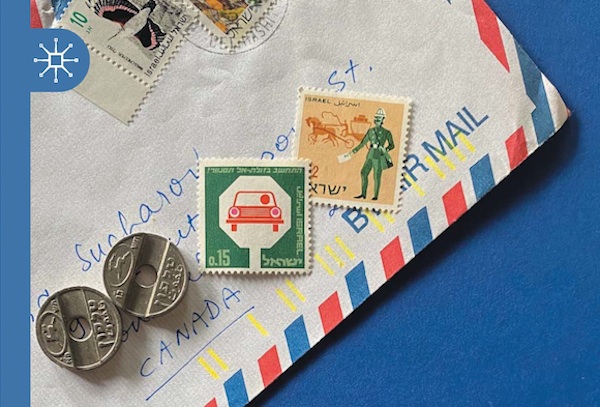
Many Jewish Independent readers will be familiar with the name Mira Sucharov. Whenever the paper ran her op-eds, at least one passionate letter to the editor could be expected. Agree with her or not on the topic of the Israeli-Palestinian conflict, she makes you think. And her latest book, Borders and Belonging: A Memoir, offers insight into how her mind works and how she has come to form her continually evolving ideas on the controversial subject.

But it’s not all politics and there’s no academic speak, though Sucharov is well-trained and has much experience in these areas – she is a professor in Carleton University’s department of political science and is University Chair of Teaching Innovations; she has developed courses for the university and has won teaching awards; she has multiple writing and editing credits. Borders and Belonging explores Sucharov’s political views and their development, but gives more time to childhood experiences, both happy and anxiety-ridden, including being a child of divorce, past romantic crushes, tales from Jewish summer camp, insights gained from living on a kibbutz, and more. It is an at-times cringeworthingly open coming-of-age story.

image - Borders and Belonging cover“I gave my dad and my mom parts to read, and I checked the scene about my daughter with her, as I did want at least their tacit blessing that this memoir wasn’t going to cause pain,” said Sucharov when the Independent asked about her candidness. “As for other family members, I basically let the chips fall where they may. I did make an effort to generally not try to ‘score points’ regarding other family members, for the most part. There’s a maxim in writing creative non-fiction (memoir), one that my writing mentor emphasized to me as well: write from scars, not wounds. Not only did I not try to actively make my family and friends appear in a bad light, I tried, most of the time anyway, to spotlight my own foibles and vulnerabilities. I think it makes for a more interesting read anyway. No one wants to read a memoir written by a narrator who is defensive and who is unaware of her own flaws.”

And Sucharov reveals many of her perceived flaws. She has dealt with high levels of anxiety her whole life, it seems, and, in many an instance, her stomach flips or lurches from feelings of rejection, excitement over a boy, worry over being among kids she doesn’t know, pleasure at being in beautiful surroundings, or tension at being confronted by someone who disagrees with her.

In addition to the sometimes-brutal self-assessment, readers will also be struck by Sucharov’s memory. The details – books read, games played, reimagined conversations, etc. – are noteworthy. And Sucharov did take notes, she said. She kept a journal for a couple of summers when she was a camp counselor and when she was in Israel in the early 1990s. But, she said, “I remember a lot. For some childhood scenes, I juxtaposed memories of objects I knew I owned (specific toys, games, clothing and books) with particular events I recall occurring. So, for example, when ‘Leah’ sleeps over, I don’t recall if I read Roald Dahl on that particular night, but I do know that I read lots of Roald Dahl at that point in my life, so I inserted it as a period detail.

“Same with the Archie comic being read in the cabin while I inadvertently undress in front of a boy, causing me great embarrassment. I don’t know for certain whether we were reading Archie comics on that particular day, but I do know that we read Archie comics during that time in our life. Adding these details is a way of setting scene and drawing the reader into a world, rather than writing, ‘we used to read Archie comics.’ I treasured my toys, books and games. I’m still trying to forgive my mom for selling my remote-controlled R2-D2 robot toy at a garage sale for five bucks one summer, while I was away at camp.”

By way of another example, Sucharov said, “As for the separation scene that takes place before I’ve even turned 4: my own memory is that my parents asked me to pick toys to place in one house and in another. Recently, though, my dad gave me a different account: he said that he and my mom took me into their bed, placed me between them and broke the news. I do not recall this. So, instead, I used the memory that I did have, even if it had been partly of my own creation. In that case, it may not have been totally accurate, but it succeeds at capturing the emotional dynamics of the event – me having to cope with my parents’ separation, which was traumatic.”

Other aspects, such as exactly which scary Disney movie she watched at her dad’s, were verified with one of her “all-time favourite tools: IMDb!” And some instances she recounts are composites of multiple moments.

Sucharov has no regrets about laying so much out there publicly. “I’m a firm believer in modeling vulnerability,” she said.

“In writing and in teaching, it creates a crucial connection between writer or professor/instructor and reader or student,” she added. “By introducing our backstage selves, it can help others better learn how to soar. It is an ethic of generosity.”

Uncovering the story within

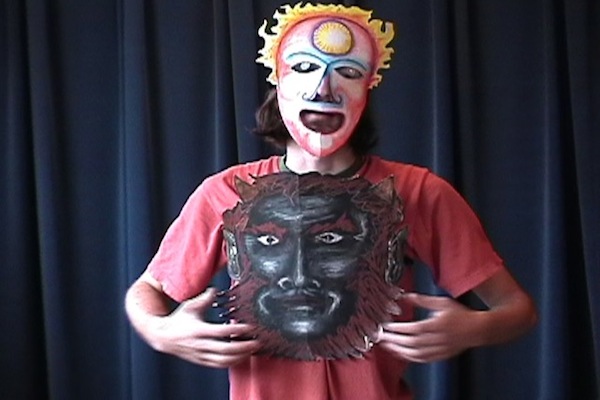
A participant in Yehudit Silverman’s The Story Within process shows off their self-made mask. (photo from Yehudit Silverman)

This past spring, Prof. Yehudit Silverman’s new book came out. In The Story Within: Myth and Fairy Tale in Therapy, the Concordia University professor emerita walks people through a step-by-step process to healing.

“When a person embarks on this journey, they feel called to a story, but they don’t know why,” said Silverman. “And it’s the sense of the unknown that’s really important…. Sometimes, in conventional therapy, we just go around in circles and might not necessarily get to the deeper layers that are inaccessible to us. But, through the arts and through the use of a character from a myth or fairy tale, gradually we can access those areas in ourselves.”

In Silverman’s approach, clients start by choosing their own story after going through a couple of exercises. “That process of choosing the story is therapeutic and healing in itself, because it’s part of the person’s sense of their own sense of knowing their own strengths and their own intuition, which is really important,” she explained. “Also, it’s important to stay with one character in a story for a long time, allowing the depth work to be done … recognizing what the character’s quest is, which is so important in myth and fairy tale, which is why I think they are still so relevant.

“The protagonist is on a quest and has to face obstacles and challenges,” she continued. “That can be so helpful when people are facing their own challenges and obstacles, so they don’t feel so alone. Also, they get to work with fiction, which is very safe, providing a certain amount of distance.”

People choose their stories for different reasons.

“Someone might be really drawn to a character that is having to do an impossible task, like in Rumpelstiltskin, where the girl has to make straw into gold,” said Silverman. “A lot of people think they are facing an impossible task, so they might then choose that story.

“Sometimes, it’s just the title of the story. I worked with an adolescent who was homeless and, sadly, addicted to drugs. When I worked with her, she chose the story of the handless maiden, which led to, sadly, to the revelation of her having been abused as a child. It was just the title that drew her.”

Once people choose a character, they start to build a mask. Then, they build the environment for the character and go through the steps that are described in Silverman’s book. The process is usually done within the context of a group, so that it is witnessed, which, according to Silverman, aids significantly in healing.

“They work with other people so that, at some point, they actually direct someone else in their mask and in their costume,” she said. “They get to look at what their character looks like to an outsider. And then, they have people embodying the obstacle and the helper, so they actually embody going through the quest and the challenges of the character.”

Silverman once worked with an anorexic teen who chose the character of Dorothy from The Wizard of Oz. “For her, the tornado was her eating disorder that took her to the Wonderful Land of Oz … which was, for her, magical. It was the ‘Land of Starvation’ and the good witch, Glenda, was actually evil for her, because she was trying to get her to go back to Kansas…. I realized that, for her, everyone in the hospital was evil, was going against what she felt was her sense of reality and her sense of what was magical and important, which was her starvation.

“And so, little by little, she worked with it and she embodied the tornado,” said Silverman. “She was actually swirling around and started crying, and realized how destructive it was. It was the first time she had had that realization – she didn’t have it when people were just talking to her.”

The teen connected and embodied the “chaotic energy of the tornado,” said Silverman. “She began to realize it was destructive and, then, she very slowly started healing. But, for her, having that story was essential.”

Although COVID-19 has made holding in-person group sessions impossible for Silverman, it has opened the door to including people from all over the world in the online groups she leads.

image - The Story Within book coverThe Story Within outlines Silverman’s process step-by-step, taking readers through each one, and it can be useful for both therapists looking to implement the technique, as well as anyone wanting to understand why they do what they do.

“If you’re going through something that is severe or you are in crisis, you should definitely see a therapist,” said Silverman. “And, if you’re going to use the book, you should only use it in context of therapy. But, for people looking for personal healing and a way to have creative reflection about what their life and quest is, then it is definitely for those people – for seekers, for artists and, also, for therapists, as something to integrate into their process with clients. And that’s something I do a lot of right now – supervising therapists insofar as how to integrate this into their work.”

Silverman said already established groups can use the book, as well, to form a more solid structural foundation perhaps. And, “there are so many people at home right now, and they are really questioning what their life is about,” she added. With the anxiety, she said, “having this structure, where they can go through a creative process … is so life-giving. It really allows us to express what’s going on inside into an outside form.”

Rebeca Kuropatwa is a Winnipeg freelance writer.

Tahini’s tastiness, versatility

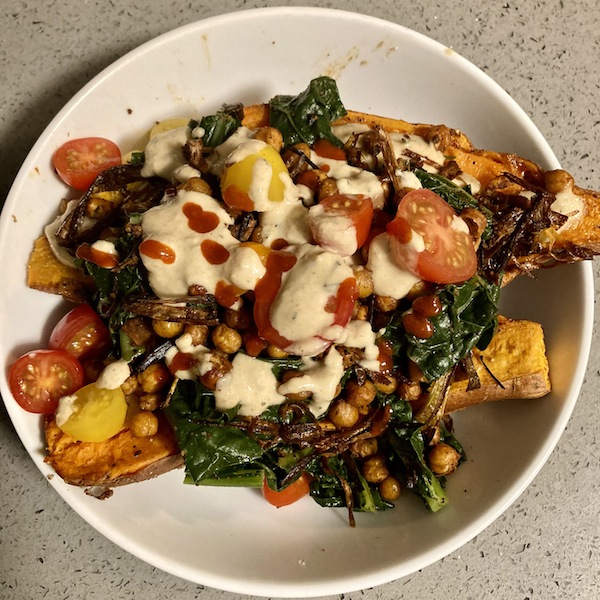
These loaded sweet potatoes were satisfyingly filling. (photo by Ingrid Weisenbach)

In a word: yum. I tried out four recipes in The Tahini Table: Go Beyond Hummus with 100 Recipes for Every Meal by Amy Zitelman with Andrew Schloss. All were delicious. All worth making. I will definitely bring more tahini into my life, but not every day, as the meals are somewhat complicated to make; at least they were for me.

Published by Surrey Books, an imprint of Agate Publishing, the cookbook is gorgeous. The colour photos by Jillian Guyette and the overall look and layout make The Tahini Table as much eye-candy as cooking guide. The first chapter is all about tahini – what it is, how to use and store it, with a foray into hummus and halvah and ingredients one should have close at hand, such as avocados, various oils, garlic and onion, yogurt, different vinegars, date syrup, etc. There is a relatively helpful instruction on how to mince garlic and a section on herbs and spices. Each recipe is labeled with the diets with which it is aligned; vegan or gluten-free or Paleo, for example.

There are six chapters, covering sauces, dips, breakfasts, lunch-type food and sides, main courses and, finally, desserts. While Zitelman promises easy and quick recipes – and perhaps they are if you do as recommended and stock up on the sauces, dressings and dips – I was starting from scratch. The two mains – the benedict and the sweet potatoes – each took almost two hours to make. Only once I started did I see, for example, that one of the benny recipe ingredients was pickled red onion, carrot or radish … go to page 127. So, off to make that before I could proceed. Oh, and don’t be fooled, as I was, by the directions for the pickles – for the benedict, you only need to make pickled onions, so adjust accordingly, unless you’re also wanting to have the carrots and radishes for other purposes. (In the end, I was happy to have made all three, but I was quite hangry while making them.)

Zitelman, who is a co-founder with her sisters of Soom Foods, writes in the introduction, “we founded Soom Foods with a vision that tahini would be a staple pantry item in the American market simply because it is a delicious, nutritious and versatile ingredient. Although this ambition was somewhat far-fetched at the time, tahini is increasingly recognized as a superfood that is rich in omega-6 fatty acids, protein and calcium.” More reason, if I needed it, to experiment further with the recipes in The Tahini Table. Here are the ones I’ve kitchen-tested so far, sans Zitelman’s informative and delightful preambles or suggestions, because of space limitations.

photo - The Tahini Benedict was very tasty
The Tahini Benedict was very tasty. (photo by Ingrid Weisenbach)

TAHINI BENEDICT
(serves two)

sauce
2 large egg yolks
1 tbsp freshly squeezed lemon juice
1⁄4 cup premium tahini paste
1⁄2 garlic clove, chopped
1⁄4-1⁄2 tsp sea salt
2-3 tbsp boiling water

eggs
1 tomato, cut into 4 rounds
3 tsp extra virgin olive oil, divided
fine sea salt and freshly ground black pepper, to taste
1⁄2 tsp ground cumin
1 tbsp white vinegar
4 large eggs

assembly
2 English muffins, split and toasted
1⁄2 cup pickled red onion, carrot or radish (see below)

To make the sauce: Fill a blender with very hot tap water to warm up the container. Wait five minutes, then drain. Add the egg yolks, lemon juice, tahini, garlic, salt and two tablespoons boiling water. Blend on medium speed until just combined, about 30 seconds. If the sauce is too thick, add the remaining one tablespoon of boiling water and blend to combine. Set aside.

To make the eggs: Turn on the broiler to high and position the broiler rack as close to the heating element as it will go.

Coat the tomato rounds with two teaspoons of the oil and set on a broiler pan. Season with salt and pepper and sprinkle on the cumin. Broil until the surface is speckled but the tomato is still firm, about three minutes.

Meanwhile, fill a 10- to 12-inch skillet with water and bring to a boil over medium heat. Add the vinegar.

Crack each egg into a separate cup or ramekin. Gently slip each egg from its cup into the water. Turn the heat to medium-low so that the water in the pan barely simmers.

Poach the eggs until the whites are set and the yolks remain creamy, about two minutes.

To assemble: Put an English muffin on each plate. Top each half with a broiled tomato. Use a slotted spatula to remove each egg from the water, wait a few seconds to let any extra water drain back into the pan, then place it on the tomato. Top each with sauce and a little pile of pickled red onion. Serve immediately.

QUICK PICKLES
(makes about three cups)

6 carrots, peeled and julienned
1 red onion, peeled and very thinly sliced
12 red summer radishes, trimmed and thinly sliced
1 1⁄2 cups apple cider vinegar
1 1⁄2 cups water
6 tbsp honey
1 tbsp fine sea salt
1⁄2 tsp crushed red pepper

Put each of the cut veggies in their own pint container.

In a small saucepan, combine the vinegar, water, honey, salt and crushed red pepper and bring to a boil over medium-high heat. Pour a third of the pickling mixture over each of the veggies. Let cool for about 30 minutes before serving.

Store in closed containers in the refrigerator for up to two weeks.

LOADED TAHINI SWEET POTATOES
(serves four)

1 leek, trimmed, halved lengthwise, thinly sliced (white and pale green parts)
1 (15-ounce) can chickpeas, rinsed and drained
2 tbsp extra-virgin olive oil, divided
1 garlic clove, minced with coarse sea salt
1 tsp ground coriander
1⁄2 tsp ground cumin
1⁄2 tsp smoked paprika
pinch ground cinnamon
fine sea salt and freshly ground black pepper, to taste
4 medium sweet potatoes, halved lengthwise
1 bunch lacinato kale, coarsely chopped
1 cup orange-rosemary tahini sauce (see below)
12 cherry tomatoes, quartered
1⁄4 cup chopped fresh
flat-leaf parsley
hot sauce, to taste

Turn the oven to 400ºF.

Toss the leek and chickpeas with one tablespoon of the olive oil on a rimmed sheet pan. Add the garlic, coriander, cumin, paprika, cinnamon, salt and pepper and toss to coat everything evenly. Push the leek and chickpea mixture to the edges of the sheet pan.

Rub the cut surfaces of the sweet potatoes with the remaining one tablespoon of olive oil and season with salt and pepper. Put the sweet potatoes, cut-side down, in the centre of the sheet pan. Bake until the potatoes are fork-tender, about 45 minutes.

While the potatoes are baking, boil the kale in a good amount of salted water until tender, about 10 minutes.

When the potatoes are tender, put two halves on each plate and flatten them with the back of a large fork. Transfer the kale to the sheet pan and toss with the chickpeas and leeks. Drizzle some of the tahini sauce over the potatoes and pile the veggies on top. Top with more tahini sauce and the tomatoes, parsley and hot sauce.

ORANGE-ROSEMARY TAHINI SAUCE
(makes about 2 cups)

1 tbsp extra-virgin olive oil
2 tbsp finely chopped fresh rosemary leaves
2 garlic cloves, minced with coarse sea salt
grated zest and juice of 1 orange (about 1⁄3 cup)
2 tbsp freshly squeezed lemon juice
1 cup premium tahini paste
1 tsp ground cumin
3⁄4 cup ice-cold water

Heat the olive oil in a small skillet over medium heat just until warm, less than a minute. Stir in the rosemary, remove from the heat and give it 10 minutes or so to cool down and get flavourful.

Meanwhile, combine the garlic, orange juice and lemon juice in a medium bowl. Let it sit for one to two minutes. Whisk the orange zest, tahini and cumin into the garlic mixture until just combined. Don’t worry if it gets thick and grainy. Whisk in the water, a quarter cup at a time, until the sauce is smooth and creamy. It should be the consistency of a creamy salad dressing, like ranch.

Stir the cooled rosemary oil into the tahini.

Store in a closed container in the refrigerator for up to three days.

TEHINA REGINA COOKIES
(makes about 40 cookies)

1⁄2 cup premium tahini paste
1 cup granulated sugar
3 large eggs
1 1⁄2 tsp vanilla extract
1⁄8 tsp almond extract [optional, I’d say, as I could barely taste it]
2 1⁄4 cups all-purpose flour
2 1⁄2 tsp baking powder
1⁄2 tsp fine sea salt
1⁄4 tsp ground cardamom
1 cup white sesame seeds

photo - Tehina Regina Cookies – a few never made it to the cooling rack
Tehina Regina Cookies – a few never made it to the cooling rack. (photo by Cynthia Ramsay)

Mix the tahini and sugar in a large bowl until well combined. Beat in the eggs, vanilla and almond extract until the mixture is smooth.

Mix the flour, baking powder, salt and cardamom in a medium bowl, then stir the flour mixture into the batter just until there are no visible dry spots. The dough will be very stiff. Wrap it in plastic and refrigerate for at least one hour or as long as 24 hours.

Set two oven racks near the centre of the oven. Turn the oven to 350ºF. Line two sheet pans with parchment paper or silicone baking mats.

Put the sesame seeds in wide bowl. Scoop the dough with a one-tablespoon measure and arrange as mounds on a big sheet of aluminum foil, plastic wrap or parchment. Wet your hands and roll the mounds into egg-shaped ovals. As each one is made, coat all over with sesame seeds and place on the prepared pans, about one inch apart. You will probably get 13 to 14 cookies per pan.

Bake until golden brown, about 10 minutes. Cool the cookies for two minutes on the pans, then transfer them to wire racks to cool completely. When the pans are at room temperature again, form the remaining batter into cookies and bake in the same way.

Store in a closed container at room temperature for up to two weeks.

Shabbat with Bubbie

“I learned about climate marches and I learned about dancing bubbies,” said my niece Fae, 9, when we were discussing Bonnie Sherr Klein’s new children’s book, Beep Beep Bubbie, over FaceTime. Among other things, my niece Charlotte, 7, learned “you can learn to ride a bike at 53 and anything is possible.… And I learned about grandmothers who can shush a crying boy.”

Amid much laughter, including talk about dogs pooping – Bubbie has a dog – and what my nieces recalled of Vancouver from their visit here last year, Beep Beep Bubbie offered more discussion than I had anticipated. But, before I get to that, I have to say, for the record, that my nieces have dancing bubbies in their lives, and bubbies who can shush crying children, so they more related to these aspects of Bubbie’s character than learned from them. With that qualification and butt covering, I continue with the review, starting with the basic story of the book.

It is Shabbat and Kate and her little brother Nate are going to visit their grandmother, who is going to take them to Granville Island to buy apples for Rosh Hashanah. The kids have been told there’ll be a surprise waiting for them at Bubbie’s. That surprise, though – Bubbie’s new scooter – isn’t a happy one initially for Kate, who “already missed the Bubbie she used to have. That Bubbie danced and took them to climate marches.” However, during the afternoon’s adventures, Bubbie’s scooter not only allows her to venture farther from home than she otherwise would have been able to manage, but has other advantages, as well.

After their trip to Granville Island, Kate shares a library book that she’s brought along for the visit. About American educator, activist and suffragist Frances Willard, Kate and Nate find out that Willard “fought for women to have the right to vote. When Frances was 53 years old, she learned to ride a bicycle to show that women could do anything.” A conversation ensues about why Willard wouldn’t have known how to ride a bike. “People were afraid women’s ankles would show under their petticoats,” explains Bubbie. “Can you believe it?”

Well, at my nieces’ house, this part of the book was met with disbelief and more laughter, as Charlotte was keen to show off her ankles, which were hard to see, given the placement of their computer and her being the height of a 7-year-old. But, before things deteriorated into mayhem, Fae said, “I also learned that girls are tough.” And, she “learned another reason why women weren’t treated fairly in the past.”

“And what was that reason?” I asked.

“Because women didn’t ride bikes because their ankles were going to show. And they couldn’t vote, [it was] like they didn’t have an opinion.”

“It’s definitely not fair,” said Charlotte about people thinking that girls showing their ankles was wrong.

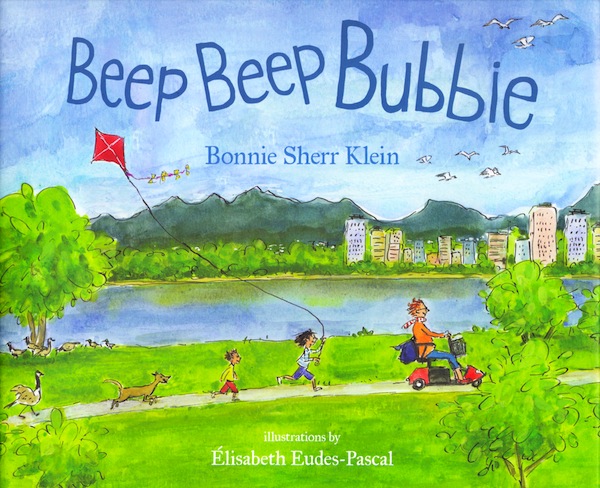
All in all, Beep Beep Bubbie elicited much talk and not an insignificant amount of gymnastics. The illustrations by Élisabeth Eudes-Pascal are wonderfully colourful and fun; full of energy and movement. Both Fae and Charlotte gave a resounding “yes” when asked if they liked the pictures.

One the drawings is a two-page spread of Bubbie, Kate and Nate and the park, where they join in the fun of flying kites. One young person is in a wheelchair, and Charlotte asked why Bubbie had chosen a scooter instead. Not knowing the answer, I asked the author. Here is her response: “I chose a motorized scooter over a wheelchair, btw, because it felt more sportif,” wrote Klein in an email, “and I am lucky enough to be able to transfer, which keeps me a bit more mobile.”

I like knowing, but the reasons aren’t important, as far as the story goes. Art is to be interpreted and my nieces and I talked about a lot of ideas, from serious to silly, during our FaceTime book review session.

Published by Tradewind Books, Beep Beep Bubbie can be purchased from pretty much any online bookseller. Enjoy!

Not what you expect

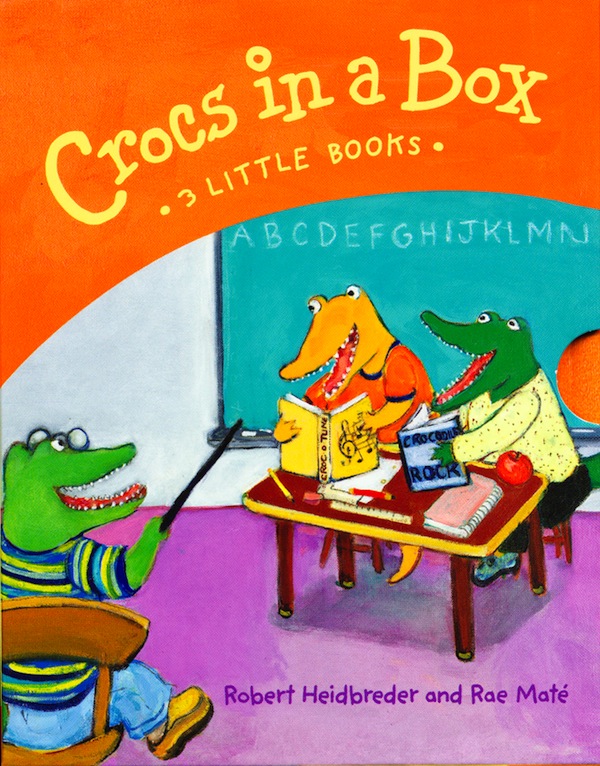
So much of what we do in life we do almost automatically. For better or worse, we anticipate what’s coming next and, often, we’re right. But a trio of children’s books just published by Tradewind Books will amuse young readers and refresh the perspectives of their adults. Crocs in a Box, written by Robert Heidbreder and illustrated by Jewish community member Rae Maté, contains three expectation-smashing little hardcovers: Crocodiles Say …, Crocodiles Play! and Crocs at Work!

In Crocodiles Say …, it’s the bright, cheerful and iconic crocodiles of Maté that are at odds with Heidbreder’s words. In one scene, for example, we see three restrained crocs, the epitome of manners, “never rude.” The crocs “chew and swallow, their mouths closed tight. Crocodiles say … [page turn] Always be polite!” Well, it has to be said that the crocs are doing anything but eating politely.

In Crocodiles Play!, the crocs get all dressed up for one type of sport, such as baseball, but then play … basketball?! And, in Crocs at Work!, we are treated to a healthy dose of silliness, as the crocs engage in doctoring, cooking, painting and other work, all with a small twist, lots of joy and no little mess.

This collection would make a great Chanukah gift, expected or not!

Celebrate helping & helpers

The Ninth Night of Hanukkah begins, appropriately enough, on the first night of the holiday…. Dad has brought pizza for dinner and Max and Rachel and their parents eat it among unopened and partially opened boxes in their new apartment. (image from book)

Change is a constant in our lives and things don’t always go as planned. Learning how to deal with the unexpected and to be able to ask for help and to be appreciative of it are all valuable lessons. And when such concepts can be literally illustrated and told in story form, they tend to stick better.

The Ninth Night of Hanukkah, written by Erica S. Perl and illustrated by Shahar Kober, is about home and helping, and takes its inspiration from the ninth candle on the chanukiyah, the shamash (Hebrew) or shammes (Yiddish), the helper candle. At the darkest time of the year, family, friends and community are the main lights that get us through and, especially amid the pandemic, a reminder of the love and support we have around us is particularly important.

image - The Ninth Night of Hanukkah book cover

The Ninth Night of Hanukkah begins, appropriately enough, on the first night of the holiday. But something is different. Dad has brought pizza for dinner and Max and Rachel and their parents eat it among unopened and partially opened boxes in their new apartment. Their cat looks on. “No menorah? No latkes?” the kids wonder. Mom assures them that, tomorrow, they’ll find the Chanukah supplies amid all their things.

On the second night, Max and Rachel make a menorah with some wood, nuts and bolts, paint and glue. Not only is their real menorah still missing but the candles can’t be found either, so the kids – with Mom’s permission – go off to borrow some candles from a neighbour, and Mrs. Mendez in 2C happily obliges.

Each night, the family makes do with the help of a different neighbour. Each night is nice, “but it didn’t feel quite like Hanukkah.”

Spoiler alert … eventually, the box with the family’s holiday stuff arrives – but too late. The delivery comes on Day 9. But Max and Rachel are not so easily deterred. They concoct a plan to celebrate the holiday and their neighbours. “And, best of all, it felt exactly like Hanukkah.”

Perl’s text has a rhythm. The repetition each night of how “it didn’t feel quite like Hanukkah” accents how hard it is to accept new situations. Yet the fact that the family makes each night special, shows that, despite what we might be thinking or feeling, we can act in ways that still celebrate life and all for which we are grateful.

The illustrations by Kober are colourful, with a retro feel, and have a lot of energy. Creative use of white space helps direct the action. And the two-page spreads have an expansive feel to them, like the reader is right there in the apartment with Max, Rachel and their family and new friends.

The book ends with a nice note from Perl about Chanukah and her family’s tradition, followed by a list of nine ideas of how to make your own “Shamash Night.”

A PJ Library book, which is also available from most any bookseller, The Ninth Night of Hanukkah lights all the right candles and would make a great holiday gift.

Shoah survivor offers a warning

Judy Weissenberg Cohen, at the age of 92, recently published her memoir, Cry in Unison. (photo from Riddle Films)

On erev Yom Kippur, in a Nazi concentration camp, a group of Hungarian Jewish women and girls prevailed upon two comparatively sympathetic kapos to obtain a lone candle and a single siddur.

Judy Weissenberg Cohen, a Toronto woman who, at the age of 92, recently published her memoir, was one of those girls.

“In this place, where we felt that instead of asking for forgiveness from God, God should be asking for forgiveness from us, we all wanted to gather around the woman with the lit candle and siddur,” she said during a virtual book launch Sept. 14. “She began to recite the Kol Nidre very slowly so we could repeat the words if we wanted to, but we didn’t. Instead, all the women burst out in a cry in unison. Our prayer was the sound of this incredible cry of hundreds of women. I have never heard, before or since then, such a heart-rending sound. Something was happening to us. It was as if our hearts were bursting. Even though no one really believed the prayer would change our situation, that God would suddenly intervene – we weren’t that naïve – the opportunity to cry out and remember together reminded us of our former lives, alleviating utter misery even for the shortest while. In some inexplicable way, it seemed to give us comfort. Even today, many decades later, every time I go to Kol Nidre services, I can’t shake the memory of that sound. This is the Kol Nidre I always remember.”

Cohen’s book, Cry in Unison, was published by the Azrieli Foundation’s Holocaust Survivor Memoirs Program. Cohen’s is the 113th memoir published by the program. The books are offered to schools and universities across Canada at no cost, providing educators with an accessible entryway to teaching about the Holocaust by approaching history one story at a time.

Cohen was born in 1928, the youngest of seven children in the Weissenberg family.

In 1938, when she was 10 years old, her parents and other Hungarian Jews became increasingly alarmed by news from adjacent countries, including the Anschluss of Austria, followed a few months later by Kristallnacht.

When the mass transport of Jews from Hungary began, in 1944, Cohen spent days in a boxcar with 78 others, with two buckets – one for drinking water, the other for a toilet. On arrival in Auschwitz-Birkenau, as they disembarked from the cattle cars, a worker approached women with children and “very quietly in an urgent tone” told the young mothers to hand their children over to the grandmothers.

“At the time, we didn’t know what it meant,” Cohen recalled. “The fact was [the worker] asked the young mothers to give children over to the grandmothers because he knew that, within hours of our arrival, the grandmothers who looked 45 years or older and Jewish children 14 and younger immediately will be murdered in the gas chambers of Birkenau. He wanted to save the young mothers. If you didn’t carry a child, then you lived. If you carried a child, even if the child wasn’t yours, you went to the gas chamber with the child.”

Cohen and her sisters were showered, shaved and given dirty hand-me-down garments. Sent outside without towels to dry themselves, Cohen could not locate her sisters.

“Only when they started to talk … and all of a sudden we started to laugh in our painful way,” she recalled. “How drastically we changed within a few hours.”

Cohen was subsequently transported to Bergen-Belsen concentration camp and then to a forced labour facility that was a sub-camp of Buchenwald.

In the spring of 1945, on a death march through the German countryside, she was finally liberated. The realization came in a German man’s choice of language.

With other girls and women, Cohen was sleeping in a barn during the march. “In the morning, there was a loud knock on the barn door,” she said. “We woke up all of a sudden from our shallow sleep and there stood a guy in the doorway. I still remember, it was a beautiful sunny day, the sun was behind him and he stood there like a dark silhouette. And, in a nice, strong voice in German, he said, ‘Fräuleins!’”

The women were startled as much by the word as by the awakening.

“Did he really say Fräuleins? A German addressed us as Fräuleins?” they asked one another, “The war must be over. A German hasn’t addressed us in a civil tongue for ages.”

He immediately continued: “Fräuleins, you are free.”

The terms liberation and freedom may be equivocal given what Holocaust survivors experienced. In Cohen’s case, she returned to her hometown in Hungary, certain that if she, the youngest, had survived, then surely her elders, who were more capable of caring for themselves, would likewise be coming home.

“I don’t know why I dared to be logical about the Nazi genocide,” she said.

Instead, she was reunited with one brother, one sister and two cousins.

“So it was very traumatic,” she said. The trauma was accentuated by the fact that some of the returning villagers had been on work battalions and had not experienced the death camps, and in fact had no knowledge of them.

“I had to be the messenger to tell them that their wives and their little girls were murdered in the gas chambers in Birkenau,” she said. “They didn’t believe me. They actually [considered] me insane.”

She went to a displaced persons camp – constructed on the grounds of the razed Bergen-Belsen concentration camp – and lived there for two years, learning a trade. But, when the opportunity came to emigrate, it wasn’t as a dental technician that she was chosen.

The Canadian government was seeking 2,500 garment workers. Though she had no experience, Cohen faked it and came to Montreal ostensibly as seamstress. (She moved with her family to Toronto in 1961.)

“But, with all other difficulties that we overcame through the time, I finally learned, with kind helping people, how to put together a dress and made some kind of a living,” she said. “The contract was only for one year, but I stayed for three years.… During those three years, I also prepared myself to change skills, change profession. I learned French, I learned English, I took a course to become a bookkeeper with typing ability and switch to office work.”

There was no psychological support and the term post-traumatic stress disorder did not yet exist.

“I don’t think we realized that we were traumatized,” she said. “You went through difficult times but it didn’t have a name. It so happened that my sister and I, and my brother, we had self-help among ourselves…. The emotional baggage, as far as I’m concerned, and I can only speak for myself, that had to be put on the back burner. It no longer was a priority to talk about it. Furthermore, nobody wanted to listen to us…. We just went on living as new Canadians and establishing new lives basically on the ashes of the old, and even became happy Canadians, got married, had children. We became like all other Canadians, overcoming all emotional difficulties by not giving them eminence in our lives.”

Cohen became a public speaker, sharing her Holocaust experiences with schools and other audiences after she had a run-in with neo-Nazis in downtown Toronto. She also has become a researcher and author on the topic of the unique experiences of women in the Holocaust.

Above all, Cohen said, she wrote her memoir in the 10th decade of her life as a warning.

“Mainly, I would like you to understand that this generation and subsequent generations must learn from us while we are still alive that this kind of depravity, one human to another, was possible and did happen and, unfortunately, it could happen again,” she said. “We are writing it to you all as a warning, as a very serious warning of what can happen even in cultured, educated, civil societies.”

“Right of return” a poison pill?

Among Middle East observers, there has long been a view that the demand for a Palestinian “right of return” is a bargaining chip that would be negotiated away in a final status agreement, perhaps in exchange for a symbolic but small number of Palestinian refugees admitted to Israel and a substantial amount of money as compensation.

In a new book, two prominent Israeli progressives argue that this assumption is wrong, that the right of return is an unwavering demand from the Palestinian side and, as a result, represents a poison pill that guarantees no resolution to the conflict or to Palestinian statelessness.

“The Palestinian conception of themselves as ‘refugees from Palestine,’ and their demand to exercise a so-called right of return, reflect the Palestinians’ most profound beliefs about their relationship with the land and their willingness or lack thereof to share any part of it with Jews,” write Adi Schwartz and Einat Wilf in the book The War of Return: How Western Indulgence of the Palestinian Dream has Obstructed the Path to Peace (All Points Books, 2020).

Wilf, a former Labour member of the Knesset, and Schwartz, an academic and journalist for Ha’aretz, have undeniable left-wing credentials. But, while the Israeli left has long been associated with the idea of compromise and idealism, the authors contend that there is little room for any sort of resolution as long as Palestinians cling to the idea that five million or more of them have the right to citizenship in Israel. Part of the failure of successive peace plans, they write, stems from the inability of negotiators to recognize the Palestinians’ tenacity in holding fast on this core issue – and argue that Israelis need to recognize that truth.

“[D]ecades of shuttling, strong-arming the sides, and endless hours of negotiations came to naught because none of the diplomats or negotiators truly understood and dealt with the root causes of the conflict, choosing instead to turn away and focus on that which appeared easier,” they write.

The status of Palestinian refugees is unique in the world. They have their own international agency devoted to the issue: UNRWA, the United Nations Relief and Works Agency for Palestine Refugees in the Near East, while all other refugees fall under the United Nations High Commissioner for Refugees. In this sole instance, the definition of “refugee” has been amended to become an inheritable status, meaning that the several hundred thousand Palestinian Arabs dislocated by wars in 1948-1949 and 1967 have ballooned to more than five million – even though many or most of the original refugees have died and the vast majority of those seeking “return” have in fact never lived or set foot in the state they claim for their own.

While exponentially more people were made refugees in the same era – in Europe, in the Indian subcontinent and at least 800,000 Jews forced from Arab- and Muslim-majority lands across the Middle East and North Africa – Schwartz and Wilf argue that Palestinians view themselves as having experienced a unique injustice.

They quote Aref al-Aref, a Palestinian writer who was mayor of East Jerusalem under Jordanian rule in the 1950s: “We have been afflicted by a catastrophe, we the Arabs in general and the Palestinians in particular, during this period of time in a way in which we have not been subjected to catastrophe in centuries and in other periods of time.…” Another Palestinian scholar, in 1950, wrote: “It is the most terrible disaster befalling the Arabs and the Muslims in modern history.… It is a deep-rooted disaster, far-reaching and full of dangers. It is an evil growing by the day and by the hour.” Another writer compared it with the Muslims losing Spain in the Middle Ages.

This almost apocalyptic language precludes compromise on what Palestinians have been promised through the generations by their leaders, according to the book. And, while plenty of voices, including academics, activists and politicians, have argued that the right of return would not be such a terrible thing for Israel’s well-being, the authors provide plenty of evidence that the proposed migration of millions of Palestinian Arabs into Israel is perhaps less about justice for refugees than it is about doing to the country through demographics what the Arab world has been unable to do militarily.

“It is well known and understood that the Arabs, in demanding the return of the refugees to Palestine, mean their return as masters of the homeland and not as its slaves. With greater clarity, they mean the liquidation of the state of Israel,” said a senior Egyptian politician in 1949, at the beginning of the refugees’ long history.

As an article in a Lebanese newspaper put it, the Palestinians’ return would “create a large Arab majority that would serve as the most effective means of reviving the Arab character to Palestine while forming a powerful fifth column for the day of revenge and reckoning.” Arab League Secretary-General Azzam Pasha viewed the refugees’ return as making it possible for “an irregular army that would be in a position to cause a great deal of inconvenience to the Jews by acts of sabotage.”

To ensure that the plan was not foiled, no matter how long it took to reach fruition, a now-seven-decade-old scheme was hatched to prevent Palestinian refugees in Syria, Lebanon, Jordan and elsewhere from putting down roots, argue the authors.

“The rehabilitation of the refugees in Arab countries would have meant the end of the war, but that was not what the Arabs wanted,” they write. While the Palestinians were made pawns of the Arab League’s campaign of “denormalization” against Israel, the book portrays most refugees as at least semi-willing players. Attempts to find resolutions to their statelessness have been met with outrage. When Canada’s foreign minister suggested some Palestinian refugees might find a permanent home in Canada, he was burned in effigy in Nablus.

UNRWA, which was presumably begun with the best of intentions, has been consumed by politics and corruption and usurped into what the authors contend is effectively a globally funded branch of the Palestinian liberation movement. Agency-funded textbooks used in Palestinian schools have been shown for decades to inculcate Jew-hatred, venerate terrorists and incite violence. Nevertheless, Palestinians receive through UNRWA among the most per capita humanitarian aid in the world and live a life of which most refugees – and the poor in most Arab countries – can only dream.

From the start, UNRWA’s first annual report, in 1951, noted that many or most refugees were enjoying a better way of life than they had before 1948, receiving universal free education and quality healthcare. The UNRWA schools, now with more than three generations of alumni, have created a uniquely well-educated population of refugees, but, along with reading, writing and arithmetic, the curriculum has created “an embittered, angry and frustrated generation, raised on myths about ethnic cleansing by the Jews, the perfidy of Arab leaders, a sense of victimhood and a refusal to take responsibility for the results of the Palestinians actions in the years and months before Israel’s birth and thereafter,” Wilf and Schwartz write.

The book does not paint an optimistic picture. Western diplomats, peacemakers and politicians refuse to recognize the Palestinian demand of return seriously and continue to believe it can be negotiated away.

“If return were truly just a bargaining chip,” write the authors, “it could have and would have been bargained long ago for a Palestinian state. Rather, it is a Palestinian state that is repeatedly bargained away in order to keep fighting for return.”

There are plenty of issues to discuss – if there were negotiations occurring – but, they argue, the entire Palestinian case rests on the thing Israel must reject.

“The one article that Israel could absolutely not agree to, as it entailed its very suicide, was the one without which the conflict would never end,” write Schwartz and Wilf.


Word Vancouver online

Bonnie Nish, executive director of Word Vancouver. (photo by Andrew Bagoly)

“We believe that Word Vancouver is a vehicle for community connection. It is important on so many levels right now to provide a space for collaboration, discourse, and a safe and accessible platform for people to share their stories,” festival executive director Bonnie Nish told the Independent.

Normally, the annual event takes place in Downtown Vancouver and people drop in to see author talks and participate in other activities. This year’s festival will be online, running Sept. 19-27.

“Like most organizations, we knew we had to either cancel or pivot by late March,” explained Nish about the impact of COVID-19. “Our festival takes place in September, so we had more time than others to make this decision.

“Word Vancouver’s mission,” she said, “is to bring readers and writers together to celebrate literary arts. The question was could we make the change from an in-person festival to an online festival and still serve this mission. We decided that, yes, we could, and, in doing so, we might even extend our reach with the in-person barrier removed. We could now seamlessly collaborate with national partners like Word On the Street Toronto and authors who were not physically in Vancouver, while keeping our main focus on local authors.”

Several changes had to be made.

“We needed to get prepared for the new online delivery format,” said Nish. “With the live in-person festival, we would not have any pre-registrations, as people would just walk into the events as they happened at the Vancouver Public Library. Now, we have a complex communications plan, along with a registration system, so our audience can secure their place and be given step-by-step instructions on how and when to participate.”

On the down side, she said, “We were working with a great site management team last year and we are sad we aren’t able to have them on our team for this festival.”

There have been other challenges, as well.

“We have had to prepare for the decrease of revenue from the exhibitor booths by reducing our staffing substantially,” said Nish. “Our board is very supportive of our new situation but they are also very risk averse, as they should be. We have found the most amazing volunteers and, for that, we are truly grateful. Programming is reduced somewhat, but we still have managed to book 140 authors and schedule over 50 events. Our community collaborations are stronger than ever. We have reinvented the exhibitor platform and now offer online exposure both on our website and during the events. It is a hard sell to some, but we honestly think the reach and return for exhibitors will be close to on par with the in-person version.”

Of the 140 authors participating this year, many are members of the Jewish community, and the Independent was able to speak with two of them – Alex Leslie and Rhea Tregebov – in advance of the festival.

image - Vancouver for Beginners coverLeslie writes poetry and short fiction, but is working on her first novel. Her latest collection is Vancouver for Beginners (Book*hug, 2019), and its poems are filled with powerful imagery and strong views about her beloved city, where she was born and raised. Leslie’s unique use of language, infused with obvious passion for her subject matter, is energizing to read. Every one of these poems is political in that they call on readers to think about the way in which they inhabit the world, how they think of ownership, place, community and many other concepts. Most of the entries are short narratives (or microfictions) that, in a page, encapsulate the feeling of being in a certain neighbourhood; what we lose when we normalize poverty alongside great wealth; the opportunities we miss when we forget our past, or the misery in our present.

JI: Could you share a bit about your background, both as it pertains to writing, and to your involvement with the Jewish community?

AL: I’ve wanted to be a writer since I was a very young child. In my early 20s, I started taking short fiction more seriously as a writer and trying to publish in literary journals. It took awhile to place my first story, through a long period of reading, frustration, rejection and editing. From there, I published stories until I had enough to put together a manuscript, and that book, People Who Disappear, came out in my late 20s. I’ve essentially continued in the same way – working on material for long periods of time, attending readings, drilling away at projects around the time I spend on my paid work in the mental health field. I’ve always been a wanderer between fiction and poetry communities.

photo - Alex Leslie brings Vancouver for Beginners to Word Vancouver
Alex Leslie brings Vancouver for Beginners to Word Vancouver. (photo courtesy)

I’m a member of Or Shalom synagogue in Vancouver and co-curate a storytelling series there…. The Jewish side of my family is originally Ashkenazi, from shtetls in Ukraine, in the regions around Lvov and Odessa (when they immigrated they wrote down they were “Russian”). We’re what is called diasporic, as the communities we came from were lost to the Shoah (Holocaust).

JI: Jewish characters have appeared in your writings. What are some of the ways in which our Jewishness informs your political, cultural or other views/actions?

AL: Yes, my book of stories that came out in 2018, We All Need to Eat, centred around a young Jewish woman named Soma, and Jewish identity is a backbone of that book, as she processes the current rise of the alt-right and her family history that’s bound up in fleeing persecution in Eastern Europe.

For me, a core Jewish value is tikkun olam, which translates roughly to “repair of the world/universe.” Tikkun olam influences my work in the mental health field, as there is the prerogative there of contribution and not turning away from difficult areas of the mind and the concept that energy and goodness can be found in dark places. Persistence and dark humour – humour where others may not find humour! – are practices I’ve taken from Jewishness as well.

JI: Do you still co-curate Koreh at Or Shalom? Why is it important for people to have a platform to publicly read their work?

AL: Yes! Our next Koreh is on Saturday, Sept. 12, for Selichot. We have 10 readers! I curate this with Or Shalom’s Rabbi Hannah Dresner. This Koreh is centred on the idea of the pandemic as a crossing or transformation and everyone is welcome to be part of our audience. Here is the link with the Zoom information: orshalom.ca/event/leil-selichot-a-koreh-event-with-high-holiday-melodies.

This is our third year of curating Koreh. I feel it’s a special space for people who may not consider themselves “writers” to share stories, poems and reflections on their experiences and how they relate to the world. We’ve had Korehs focused on the natural world, on repose/restoration, on sanctuary. Rabbi Hannah asked me to co-curate it with her when we started it up. It was really her concept in the beginning and it’s been a pleasure to get to know so many writers and listeners adjacent to Koreh.

JI: What compels you to write and publish?

AL: My love of writing coincided with my love of reading. I’ve honestly wanted to be a writer since kindergarten. I remember writing stories about our neighbours, and my mother copying them out again in her handwriting. As I got older and wrote more and more, publishing emerged as a natural goal.

I read constantly and loved that I could see the world precisely from another person’s emotional perspective. I suppose that I wanted to replicate that experience, and share in it. Also, for me, it was about language, and using and manipulating language as a medium. Selecting, ordering and controlling words is a fascination for me, the way I suppose a mathematician may feel about algebra, or an investor might feel about predicting stocks. It’s a system.

JI: What is the importance to you of words?

AL: I think that words can put you in another person’s mind, so the power here would be empathy, radical transportation. Words also have a power of deep-layered description – so the power would be complex evocation, mixing emotional and physical parts of reality, making something 2-D into something 3-D, like a life-giving power.

Words can also move us to action. During the pandemic, I have been reading a lot. Endless online stuff is tiring and alienating after a long period of time. I’ve read a few extraordinary novels during this time – two are Breasts and Eggs by Mieko Kawakami and Lost Children Archive by Valeria Luiselli. I also read Norman Doidge’s two books about neuroplasticity. I’m grateful for how these books moved me and took me out of this moment and showed me something I couldn’t have imagined on my own.

* * *

Born in Saskatoon and raised in Winnipeg, Tregebov moved to Vancouver from Toronto in 2004 to teach in the creative writing program at the University of British Columbia. Though she retired in 2017, she holds the position of associate professor emerita and continues to teach a bit. She has written several children’s books and is working on her eighth collection of poetry. Rue des Rosiers (Wolsak & Wynn, 2019) is her second novel.

image - Rue des Rosiers coverBased on events leading to the 1982 terrorist attack in Paris on Goldenberg’s Deli, which killed six people and injured many more, Rue des Rosiers is a poignant and lyrical story about two women with vastly different backgrounds but both trying to figure out who they are and their place in the world. Canadian Sarah Levine makes decisions by flipping a penny that she carries with her and, at 25, she is decidedly lost, for a number of reasons. When she has a chance to go to Paris, she does and, while there, her story crosses over with that of Laila, an Arab immigrant living in one of the city’s slum neighbourhoods. In the author’s notes, Tregebov writes that she hopes her novel will “act as a memorial to the six people who died in the attack.” It does that, and more.

JI: Rue des Rosiers has so many layers and motifs, tightly woven, not a phrase seems superfluous. Can you share some of your creative process, from the idea of the novel to its publication last year?

RT: The novel began with two impulses: to explore the relationships among sisters and to understand the impact of terrorism on perpetrators as well as victims. Both are rooted in personal experience. I am one of three sisters, and I was living in Paris in 1982 very near where the attack on Rue des Rosiers occurred. Working through these issues was a long, sometimes joyous, sometimes exhausting process.

JI: Could you speak a bit about how Judaism or Jewish community infuse your work and/or life?

photo - Rhea Tregebov, author of Rue des Rosiers, is one of several Jewish community members participating in Word Vancouver this year
Rhea Tregebov, author of Rue des Rosiers, is one of several Jewish community members participating in Word Vancouver this year. (photo courtesy)

RT: I grew up in the shadow of the Holocaust and the moral issues the Holocaust raises are core. I also grew up in a vital Winnipeg community that modeled ethical commitment and progressive values that I still find of immense value.

JI: Coteau Books, which initially published your novel, has closed. What are some of your thoughts on the future of publishing?

RT: Small presses like Wolsak & Wynn (who, happily, have picked up the novel) are a mainstay of literary publishing. We still have an infrastructure of support that allows these smaller presses. I’m concerned that the consolidation that characterizes the larger presses may contribute to a narrowing of available voices and perspectives.

JI: In an interview, you say, “I’ve said that the book is trying to ascertain the humanity in inhumanity.” Are there any risks in doing this, in finding the humanity in inhumanity?

RT: It can be difficult to attempt to empathically understand behaviour that is anathema to one’s own moral schema. I didn’t want to justify or validate acts or attitudes that dehumanize the Other. But, as one of the characters in the book says, “I’m interested in goodness, the mystery of goodness.” And, to examine goodness, one has to examine evil as its corollary.

JI: In another interview, you mention being “intrigued by the problem-solving involved in writing a novel.” Can you flesh out that idea?

RT: These large projects are so complex and absorbing. In the early stages, you have to hold a world that isn’t yet fully formed in your head. I’ve joked that it felt like wearing a giant hat! I (mostly) love the cut and paste and revision aspects of writing, how solving one small element sometimes acts to realign the entire book in a positive way.

JI: I’m always intrigued by imagery that enriches the storytelling, but is not technically needed for the story to be told. In Rue des Rosiers, you write sentences like, “A scraggly American elm sapling is handcuffed to a post as if it’s committed some crime”; “A gardener in blue coveralls sweeps the sand path, wiping away the traces of pigeon footprints”; “Light is a wave and a particle and so are the bees.” When or how do these types of flourishes enter your writing process?

RT: I think they’re a natural product of my life as a poet. Much of my writing is about looking, and I process looking through words. So having imagery present in the narrative is integral in world-building.

* * *

Word Vancouver is completely free and some events are already full, so visit wordvancouver.ca sooner than later. The festival is welcoming financial support via donations, its Adopt an Author and silent auction programs, information about which also can be found on their website.

Stories that explore the mind

A husband competes with his oldest daughter for his wife’s affections, a man ponders whether he is more attracted to a 10-year-old girl or her divorced older sister, a woman has an abortion she didn’t necessarily want, a young man violently rebels against his abusive father. Jonah Rosenfeld tackles difficult subject matter in his short stories, with no compulsion to solve any particular problem or correct behaviours, but to explore the thoughts and feelings of his characters, and thereby offer insight into parts of humanity that we may shy away from contemplating. English readers can now access these stories and ideas, originally conceived in Yiddish, thanks to a newly published translation by Langara College’s Rachel Mines.

The Rivals and Other Stories (Syracuse University Press, 2020) comprises 19 of Rosenfeld’s stories. Born in Chartorysk, Russia (now, Chortorysk, Ukraine), the prolific writer lived from 1881 to 1944, immigrating in 1921 to New York, where he was a major contributor to the Forverts. In total, he wrote 20 volumes of short stories, a dozen plays and three novels. Rosenfeld’s “stories provide a corrective to the typical understanding of Yiddish literature as sentimental or quaint,” writes Mines in the book’s press materials. “Although the stories were written decades ago for a Yiddish-speaking audience, they are surprisingly contemporary in flavour.”

The first Rosenfeld story Mines read, in Yiddish, was The Rivals (Konkurentn), six or seven years ago. “I’d only been studying Yiddish for a few years at that point and was reading to improve my language skills,” she said. “I was so impressed with the story that I decided, just for practice, to translate it into English. Later on, I found out that an English translation had already been published in [Irving] Howe and [Eliezer] Greenberg’s A Treasury of Yiddish Stories, but, by then, I was hooked on both Rosenfeld and Yiddish translation.”

Mines was a Yiddish Book Centre Translation Fellow in 2016 and The Rivals was her translation project during that fellowship year. “I’d already translated several stories before that, but 2016 was when everything started coming together in terms of improving my skills as a translator,” she said.

The project was her own idea, not work assigned by the Yiddish Book Centre, although the centre did support it.

“I should also mention,” she added, “that Vancouver is a veritable hotbed of Yiddish translation (who knew?), with a number of active translators, all of whom have been helpful at various times. Helen Mintz, in particular, was a huge inspiration and support. Her book of translations, Vilna My Vilna, a collection of Abraham Karpinowitz’s short stories, was published (also by Syracuse UP) in 2017. Helen and I spent several years together on Skype, regularly workshopping each other’s translations and helping each other out with advice and information. We’re still doing that, in fact.”

It is his exploration of the psyche that attracts Mines to Rosenfeld’s work.

“I’m interested in psychology – always have been – and particularly in people’s unconscious, and sometimes counterintuitive, reasons for thinking and behaving the way they do. So Rosenfeld’s insight into the darker corners of the human mind was an instant draw. I should say that his stories stand up very well to many current theories of human thought and behaviour. For example, the protagonist of The Rivals is a classic malignant narcissist – he ticks all the boxes. It’s interesting to note that Rosenfeld’s story was first published in 1909, several years before Otto Rank’s and Sigmund Freud’s theories of narcissism came out. Rosenfeld was an intuitive psychologist, and a very perceptive one.

“Another reason Rosenfeld’s stories appeal to me is that they work very well in a 21st-century, multicultural setting,” she said. “I’ve taught a number of the translations to first-year students at Langara, and students are attracted by his stories’ takes on immigration, women’s rights, male-female relationships, generational conflict, culture clash – this list goes on. Clearly, these ideas are as relevant today as they were when the stories were first written.

“Finally, I like Rosenfeld’s attitudes to his characters, even the less admirable ones. He seems interested in and sympathetic to their dilemmas; as an author, he doesn’t judge or blame his characters – he leaves that up to his readers. I like that Rosenfeld is more interested in exploring his character’s situations and psychology than he is in blaming or moralizing.”

Mines, who is retiring this year, taught in the English department at Langara College since 2001. One of the department’s main offerings has been a first-year class on the short story, she said. “Around the time I started translating, I started introducing stories with a Jewish theme to my classes. A bit to my surprise, despite coming from non-Jewish backgrounds, my students found the stories interesting and engaging, so I gradually added more and more stories with Jewish content. The last few years, I’ve been teaching Rosenfeld’s stories exclusively. My students love the stories and readily identify with (or at least understand) the characters and their predicaments. We’ve had many lively discussions!”

In an introductory chapter to The Rivals, Mines poses several questions she hopes keen PhD students or other researchers will take on, including where Rosenfeld’s place might be in the American literary canon. With the disclaimer that she is “just a lowly translator,” Mines said, “But, if pressed for an answer, I’d have to say it’s Rosenfeld’s psychological insights. He’s not entirely unique – other Jewish and/or American authors of his time were psychologically astute and wrote compelling character studies. But Rosenfeld went a bit beyond, in that his stories are almost Greek tragedies – his protagonists fail in their quests (for love, belonging, security, etc.) not because of external forces, but because of some internal, self-defeating habit of thought that they may not be consciously aware of. Rosenfeld isn’t the only author to explore this type of psychological dichotomy, but he does so very consistently.”