A death well-planned – an excerpt from Anne of Oasis

image - Anne of Oasis book coverIn Anne of Oasis, drawing on my many years as a physician psychotherapist, I tell the detailed, fictional story of what goes on in the therapy room when an eccentric, 70-year-old is obsessed with changing her life – or ending it. Anne bumbles through what she views as mysterious rituals with the therapist, explores secrets, re-jigs behaviours and, five years later, finds bliss. Here is the final chapter.

***

Chapter 26: June 2008

For two years, Doug heard sporadically from his mother and continued his requests for pearls. She made it clear to him and his brother she wasn’t coming out to Kelowna anymore. They occasionally visited her in Toronto, or in Golden, where she was staying with Eleanor for longer and longer periods of time.

When he received the phone call from a Toronto hospital, Doug asked if she’d fallen and busted her hip. They said it was more than that. They had found her unconscious on the street in Toronto with no ID, except for a piece of paper with Doug’s number on it as her next of kin. They admitted her as an Unknown Person and she was failing fast. If he wanted to see her alive, he had better come quickly.

He didn’t know what to do. He had promised to be there if she needed him for assistance in dying peacefully, but this was different. Yet how could he leave her to die on her own?

“She’s still your mother,” his wife offered.

He flew out as soon as he could. He arrived at the Toronto General Hospital, where Admitting confirmed there was no patient by the name of Anne Bishop. But a woman had been admitted as an Unknown Person. Doug wandered the halls searching for his mother.

“She was moved to a different floor.”

“She’s in ICU.”

“She’s not in ICU.”

Finally, he stepped into the Cardiac ICU and in the corner he saw a pile of breathing bones. Tube in mouth, IV in arm, sas-sas-sas of a respirator. Unknown Person at the foot of the bed.

“Is this her?” he asked the nurse at the desk.

“She was found with only this slip of paper on her.”

“That’s my name and number.”

“She apparently suffered a sudden, massive heart attack on the street.”

As Doug approached the bed, he recognized the bony lumps on her hands, the chewed-up fingernails, the crepe skin. It was definitely Mum. He gasped. His eyes filled, the lump in his throat tightened. He turned and rushed to the nursing station.

“Please, can the tubes be removed? She didn’t want heroics.”

“We barely know her name. We can’t follow any directives without proper ID and signed papers detailing her wishes.”

He took off uptown to retrieve the Dying With Dignity papers his mother had been talking about for years.

Stepping into his mother’s house, it felt haunted, full of yesterday’s glory. Dust everywhere. Her clothes neatly stashed, but neglect inhabited the place. He walked from room to room, observing photos everywhere – on window ledges, on kitchen counters, on the bedside table. Pictures of Jesse and Catherine and Doug and Bruce and Pam and Sue in every combination. Sitting next to each image was a shiny rock or pebble. He picked up each clear Plexiglass frame and stared. He was shocked to see how she surrounded herself with family. He began to sob.

He found the papers in the second drawer of his grandmother’s mahogany desk, exactly where his mother had said they’d be. Everything was perfectly organized and signed. He grabbed the requisite forms, glanced around at the family photos and returned to the hospital. They removed the tubes.

He returned to the house for a few hours’ sleep and arrived back at the hospital next morning, to find she had again sprouted pipes. The staff explained that overnight she had taken a turn for the worse and they tried to save her.

Angrily showing them the papers again, he repeated her wish to die quietly, and they removed the tubes a second time. He wrapped Mum in her favourite turquoise velour blanket he had brought from her home, took her in his arms and held her exactly as she held him as a sick boy on the farm. He noticed a flicker of a smile cross her face, then she took her last breath.

Just then, Eleanor appeared.

Through their tears, Doug and Eleanor awkwardly made their way to her house together. They expected to start planning how to say goodbye to Anne. But she beat them to it. She had detailed her every wish. They simply had to fulfil them.

“You know what?” Doug asked. “She knew what she was doing all those years ago around Dying With Dignity. We thought she was nuts, but it’s sure helping us now.”

“She was utterly determined in every aspect of her life,” Eleanor replied.

“What do you think we should do with the rocks? My brother thinks we should pitch them.”

“She schlepped them home from every spot she ever visited. Each and every one was special to her,” Eleanor sighed.

“I think we should leave some at the cemetery.”

Because Doug knew Mum hated missing appointments, he searched in her handwritten, dog-eared address book for Dr. C’s number.

“I’m so sorry,” Dr. C responded when he told her the news.

“It’s odd speaking to you in person after hearing about you for so long,” Doug said. “I’m happy to hear your voice. I need to tell you how important you were to my mother. Thank you for helping her.

“She was still difficult to deal with, but she seemed a lot happier. I also want to thank you for all the pearls of wisdom I received second-hand. Mum loved sharing them and they have been extremely helpful in my life.”

“We will all miss her.”

“As per her wishes, we are having a funeral service tomorrow afternoon at 2 p.m. at the Mount Pleasant Cemetery. We would be honoured if you would come.”

“Thank you. It would be a privilege. I’ll see you there.”

Tuesday afternoon, at 2 p.m., under a blistering sun, Doug, Eleanor and Dr. C, along with a handful of grey-haired men and women, gathered as they lowered the casket into the ground. Doug pulled out a heavy purple velvet Crown Royal bag and spoke.

“When I called Dr. C to notify her of Mum’s death, I asked what we could do with the stones Mum collected on her travels. She informed me that according to Jewish tradition, leaving a stone on a loved one’s grave signifies you have been to visit. Because of Mum’s lifelong appreciation of all things Jewish, placing stones on her grave would be a mitzvah, or a blessed act of kindness.

“I am honoured to ask each of you to dig into this bag, which held my marbles as a kid, to take out a pebble and place it on Mum’s final resting place.”

Tears rolled down his face. Doug held the bag open. Eleanor, Dr. C and the others lined up. One by one they removed a rock and placed it on the earth as it was shovelled onto the casket.

For more information, visit sharonbaltman.com.

A story of Hava Nagila

Among Intergalactic Afikoman’s newest picture books is I Am Hava: A Song’s Story of Love, Hope & Joy, written by Freda Lekowicz and illustrated by Siona Benjamin. It tells the story of the song “Hava Nagila,” from its birth as a niggun (melody without words) in Ukraine, to Jerusalem, to when it received its name and lyrics (though exactly from whom is still a mystery), and its journey around the world to popularity well beyond the Jewish community.

Hava Nagila means “Come and Rejoice,” explains the book, and this story – told by the song herself, personified as a blue-skinned Indian-Jewish girl in a sari – is full of movement and colour. It boldly celebrates the diversity of the Jewish people and our culture.

“For me, Hava’s story is a story of universality and multiculturalism,” Benjamin, who grew up as a Bene Israel Jew in India, writes at the end of the book. “Universality is always born from the specifics. The specifics for me are my Jewishness, my Indianness and my Americanness.

“Many blue-skinned characters populate my paintings,” she continues. “Hava is blue because blue is the colour of the sky and the ocean. Blue is the colour of the globe. Blue is also such a Jewish colour. It’s in the tallit. It’s in the tzitzit. It’s in the Israeli flag.”

Montreal-born Lekowicz also connects personally with the story. She shares that her parents, after the Holocaust, were in a displaced persons camp in Germany. “Like other Holocaust survivors,” she writes, “they were broken and in mourning. Yet the joyful sounds of Hava Nagila sometimes echoed in the camp. ‘Let us celebrate,’ it urged. The song symbolized hope and resilience.”

This lovely and imaginative book does joyous justice to this well-known song.

Beautiful Persian cookbook

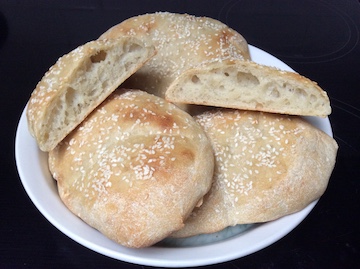
While my Barbari bread (above) looked nothing like the photo from the book (below), as my dough was too wet to allow for the requisite creation of vertical ridges, it tasted really good nonetheless. (photo by Cynthia Ramsay)

I was very excited to try out Persian Delicacies: Jewish Foods for Special Occasions by Angela Cohan. Living on the North Shore, I have met several people whose heritage is Iranian, though not Jewish, and I’ve eaten Persian food, but never made it. The idea that I could make my own “delicacies” was enticing.

Cohan is a Los Angeles-based writer and editor, so it’s no wonder that her cookbook reads well and looks fabulous. The layout is pretty and logical. The colour photos are beautiful. This is a great gift for a seasoned cook, or a cook that’s willing to have a few misadventures and so-so meals before they get the hang of things.

photo - Barbara bread as it’s supposed to look
Barbara bread as it’s supposed to look. (photo from Persian Delicacies)

In the preface, Cohan, who moved to the United States with her family in 1979, writes, “I was inspired to compile the specialty recipes of my mother, my late grandmothers, and other family members and friends in this cookbook. This book is as much theirs as it is mine. It is a tribute to my heritage as a Persian woman as well as an evolution of recipes since living and cooking in the United States for the past three decades.”

I remember watching my grandmother cooking. She seemed to randomly toss in this, shake in that. It appeared to the uneducated eye that measurements were not measured at all. I get the feeling that this is somewhat the case with this cookbook. Guesstimates in many cases rather than meticulously precise cups, teaspoons, etc. And the assumption that one knows how long to knead dough, for example.

image - Persian Delicacies book coverThe recipes I tried – dolmeh (stuffed peppers), Barbari bread and sesame brittle – seemed easy enough. I chose them because I was on a deadline and had all the ingredients at hand. I will continue to explore this cookbook, as my first foray was promising but not that successful, in part because, instead of adapting the measures, I decided to follow the instructions come what may. So, even though I knew that my pepper stuffing was too bland, my dough was too sticky and my brittle too bendy, I made them as per the recipes. Everything was edible but nothing was delicious. Next time, I will use, respectively, another pinch of salt or another clove of garlic, more flour (or less water) and less honey. I can’t wait to try my hand at making kuku seeb zamini(potato frittata), tahdig (crispy rice), turmeric chicken, lavash bread and more.

Each recipe in Persian Delicacies comes with a brief description, either of what it is, from where or whom it came, and other useful tidbits. At the end of the book, there is some information on special occasions, with the examples of Norouz, the start of the Persian New Year, and Shabbat, and traditions associated with them, in particular as they relate to foods. A glossary of many of the ingredients and their health benefits is an interesting component.

DOLMEH
(serves 3)

3 or 4 bell peppers
1/4 cup olive oil
1 cup diced yellow onion
1/2 cup scallions, chopped
2 cloves garlic, peeled and finely chopped or minced
1 cup quinoa, cooked
1/2 cup fresh dill, finely chopped
1/2 cup fresh tarragon or parsley, finely chopped
1 tsp ground cinnamon (optional)
salt and pepper to taste

  1. Preheat the oven to 350°F.
  2. Cut the top of the bell peppers and remove the seeds and veins.
  3. Heat the oil in a skillet or a saucepan. Add the onions, scallions, and garlic and cook until soft, about four minutes.
  4. Add the quinoa, dill and tarragon and season with salt and pepper. Remove from heat.
  5. Spoon the quinoa mixture into the peppers. Place the stuffed peppers on a baking tray or baking dish and bake for 45 minutes. Add salt and pepper to taste. Top with chopped parsley and cinnamon (optional).

BARBARI BREAD
(serves 4)

1 1/2 cups warm water
1/2 tsp active dry yeast
3 cups all-purpose flour plus 1 tbsp additional flour
1 tsp salt
3 tbsp water
1/4 cup sesame seeds

  1. Add the yeast to the warm water, stir, and set aside.
  2. In a large bowl, combine the flour and salt. Add the yeast mixture. Knead the dough on a flat surface.
  3. Place the dough in a bowl and cover with plastic wrap. Let it rise for an hour.
  4. Preheat the oven to 325°F.
  5. In a small saucepan, stir one tablespoon flour and three tablespoons water over a medium-low heat.
  6. Uncover the risen dough, cut into four pieces, and roll out in an oval shape using a rolling pin.
  7. Place the dough on a cookie sheet. Using your finger or a small knife, create vertical ridges on the dough. Brush with the flour and water mixture. Sprinkle with sesame seeds.
  8. Bake for 25 to 30 minutes.

A child survivor reflects

At 80, Dr. Robert Krell opens up in his new book.

Dr. Robert Krell, child survivor, psychiatrist, community leader and founding president of the Vancouver Holocaust Education Centre, is probably known to most readers. But few people, perhaps even those closest to him, know him as well as they will after reading his extraordinarily vulnerable new memoir.

Krell acknowledges that he has held much back from the public and his closest family and friends. But, at 80, he has decided to open up in a book called Sounds from Silence: Reflections of a Child Holocaust Survivor, Psychiatrist and Teacher (Amsterdam Publishers).

Krell begins by talking about the duality of his life – the hidden child who, as an adult, tried to remain hidden versus the public figure whose career and community activities have placed him at the fore of various fields; the sadness at his core versus the upbeat visage he presents to the world.

“I have allowed family members and friends to see my inherent optimism and love of life. I live with few regrets,” he writes. “Blessed with a fascinating career, lasting friendships and an incredible family, I have kept at a distance my profound sadness, chronic fears, devastating shame, incapacitating shyness, and nightmares and preoccupations shaped by my earliest experiences and forged in an atmosphere of potential annihilation.”

Krell was 2 years old when his Dutch Jewish parents placed him in hiding with the Munnik family, who he would come to view as his actual parents. He was reunited at age 5 with his birth parents, Emmy and Leo Krell – a miracle on many fronts given the small proportion of Dutch Jews to survive to 1945.

image - Sounds from Silence book cover“After liberation, life became very complicated,” he writes. He had been treated well by his rescuing family, unlike some Jewish children, “but strangely, even those ‘good’ circumstances exacted a psychological toll that never quite healed. After all, my relatively ‘benign’ circumstances were still completely off the scales of what is normal, including separation from my parents, shattering of security, and vague awareness of persecution that contributes to the feeling of shame experienced by a child as having done something wrong to cause the situation. Years later, as a child psychiatrist, I would see this phenomenon in children who, faced with parental separation, assumed responsibility.”

His parents also survived in hiding and his mother in particular never stopped mourning the complete loss of both sides of their extended families.

“I was raised by psychologically wounded parents, no less so than if they had been in the camps,” says Krell. “For three years, they lived in fear of being caught, and that fear exacted a psychological toll that one cannot underestimate.”

Trying to recreate a life, they considered making aliyah to the new state of Israel, but their business before the war had been furs and the climate in Canada was more conducive to that specialty. They came to Vancouver in 1951.

Like many survivors, the Krells found new “family” at Schara Tzedeck Synagogue. Despite many survivors bearing a “burning rage against G-d,” the shul was a second home. His father refused to open a prayer book. And yet, years later, when he was in a position to be philanthropic, he spoke with Rabbi Mordechai Feuerstein and donated $30,000 to buy prayer books for the High Holy Days so that congregants wouldn’t have to carry them to and from synagogue on those days.

“Why would a man who no longer prayed purchase prayer books?” asks Krell. “The rabbi characterized Dad as ‘a man of faithful disbelief.’”

Habonim, the labour Zionist youth movement, was a major stabilizing force for young Robbie. He would attend weekend events, summer at Camp Miriam and do normal Canadian teenage things like matinees at the Stanley Theatre on Granville.

A late-in-life baby, his brother Ronnie, was born in 1956, and his mother’s disordered parenting shifted from the first born to the younger.

“Her subsequent attention to Ronnie grew so intense that even my 16-year-old self realized that he fulfilled her need to replay the years in which I had been lost to her. That need virtually enslaved my younger brother and freed me.”

While building a career as a clinical psychiatrist, professor and academic administrator, Krell and wife Marilyn were raising three daughters.

“I can barely believe that my survival as a young boy has led to the rebirth of an entire Jewish family that now includes nine gorgeous grandchildren,” he writes. “My good fortune scares me. Our world looks so dangerous, and the future of life – Jewish life – remains so precarious. But day-to-day, we are a close family, and every day brings much joy – so far.”

Krell was a leader in Canadian Jewish Congress regionally and nationally. In Vancouver, he became immersed in Holocaust remembrance and education. Kristallnacht commemorative lectures and other Holocaust remembrance events were often begun under the auspices of CJC.

With theologian William Nicholls and English literature teacher Graham Forst, Krell launched what has become a decades-long annual symposium for high school students on the Holocaust.

He was also among the first people anywhere to begin video recording the testimonies of Holocaust survivors.

Krell was also pivotal in the organizing of a succession of world conventions: first, for Holocaust survivors and, later, for “child survivors,” a term he acknowledges was not in use until the 1980s. Hidden children were not viewed as Holocaust victims in the way that survivors of the camps or partisan fighters were. Krell is among a small number of people who helped usher in a reconsideration of the wartime experiences of these children.

In 1984, he gathered 18 survivors and children of survivors in his living room and committed to creating a Holocaust education centre in Vancouver. But some of the older attendees remembered an as-yet unfulfilled promise to create a permanent local memorial to the Shoah, so the group decided to keep that commitment first.

“The memorial was unveiled on Yom Hashoah, April 26, 1987, in the presence of 1,300 members of the community,” notes Krell. “The survivors now had a metzeivah, a ‘burial site,’ albeit symbolic, to visit and to grieve.”

In 1994, the Vancouver Holocaust Education Centre opened, with Krell as founding president.

One time, when he was on the national board of CJC, the organization considered ending their efforts to bring (by then aging) war criminals to justice.

“I argued for continuing the effort,” says Krell. “My measure of success was different. I told my colleagues that it was not only about successful prosecution but also their knowing that, one day, they might hear a knock on the door. The sleep of Nazis should be no less disturbed than that of Holocaust survivors.”

Throughout the book, Krell recalls brushes with history and the figures who make it.

On a trip to Israel as a young adult, he was able to get a seat at the Eichmann trial, thanks to an aunt who had married into the family of Gideon Hausner, the prosecutor of the case. On the same trip, Krell went to Sde Boker and ran into David Ben-Gurion.

A few years later, Krell volunteered to serve in the 1967 war as a doctor fresh out of his internship but, given the chronology of the Six Day War, by the time he got to Europe, the conflict was over.

Two years after that, on another trip to Israel, his plane was hijacked by the Popular Front for the Liberation of Palestine.

Krell was able to attend the ceremony when his family-in-hiding – Albert and Violette Munnik and their daughter Nora – were inducted by Yad Vashem as Righteous Among the Nations (posthumously for Albert).

Krell’s book evokes an array of emotions. The psychiatrist’s self-assessment provides a sometimes startling look inside.

“I kept my rage suppressed, not repressed,” he writes. “It was not unconscious. I knew that it was there. I felt in danger from it and feared losing control. I played, studied and worked hard, surrounded by good friends.”

Museum releases new book

Jewish Museum and Archives of British Columbia releases its new publication Looking Back, Moving Forward after its AGM on Nov. 16.

The Nov. 16 annual general meeting of the Jewish Museum and Archives of British Columbia (JMABC) is the culmination of the museum’s 50th anniversary year of celebrations. The special occasion will not only feature Dr. Morton Weinfeld, Chair in Ethnic Canadian Studies at McGill University and author of numerous books on Canadian Jewry, but also the release of the new JMABC publication Looking Back, Moving Forward: 160 Years of Jewish Life in BC.

Taking place at Congregation Beth Israel, the 6 p.m. AGM will be followed by a reception at 7 p.m. and the keynote address. Weinfeld’s most recent publication is a revised and updated version of his book Like Everybody Else but Different: The Paradoxical Success of Canadian Jewry. His virtual presentation will highlight the unveiling of the JMABC’s Looking Back, Moving Forward.

Local historian Cyril Leonoff, who passed away in 2016, established what has become the JMABC with a group of volunteers in 1970. In his research on the B.C. Jewish community, he combed ship manifests and discovered that the first Jews to arrive in the province came to participate in the Gold Rush, in 1858.

The museum’s new book is a testament to the variety and tenacity of Jewish life all over British Columbia. The publication comprises interviews, archival research and community contributions from more than 200 B.C. Jewish community members and it includes more than 400 photos.

Organized into four sections, the book begins with a collection of essays on the history of Jewish life in various regions of the province. This section is followed by short descriptions of historic, modern and new Jewish agencies and organizations that serve(d) the social, cultural, political and religious interests of the Jewish community. Short biographies of notable B.C. Jewish figures from all areas of public and communal life make up the third part of the book. And, finally, a family-sponsored section gives some personal descriptions of a variety of families within the community.

A central mission of the JMABC is to raise awareness of the importance of everyday artifacts to the overall picture of Jewish history in British Columbia. Photos of a family barbecue or a trip to the beach, flyers, letters and other such memorabilia personalize history. Over the years, the museum has created exhibits, films, books and other research material, making its archives as accessible to the public as possible.

The JMABC is hoping to ride the wave of enthusiasm and support from the past year of 50th anniversary activities, as it continues its role as both keepers and disseminators of history within the community and as ambassadors of the Jewish community to broader B.C. society.

Copies of Looking Back, Moving Forward: 160 Years of Jewish Life in BC are now on sale through the JMABC website at a 10% discounted price up until Nov. 16. After the AGM, the price will increase to $50 in general and to $100 for the limited edition hardcover version.

To attend the Nov. 16 event in-person or online, buy your $18 ticket via jewishmuseum.ca/fiftiethbooklaunch.

– Courtesy Jewish Museum and Archives of British Columbia

A happy family holiday

Mini poems that rhyme and colourful  illustrations combine for a family-filled, fun-filled and food-filled holiday book for younger revelers. Hanukkah, Here I Come! (Grosset & Dunlap) by writer D.J. Steinberg and illustrator Sara Palacios is an energetic account that touches upon all the many things a kid might look forward to on Chanukah.

Starting with the setting up of the candles and the stacking of the presents, the meal prep also begins. The children help out their parents.

We briefly learn about the brave Judah Maccabee, “Macca-BAM! Macca-BOOM!” and how he and his brothers made history and the Jews took back their Temple. We light the candles, sharing in the joy with the neighbours across the street, who can be seen from their apartment windows. First gifts are unwrapped and selfies are taken – these illustrations are particularly delightful, as we see and read: “Click! That one cut off my sister.

“Click! Where’s my mother’s head?

“Click! That one’s dark and blurry.

“Click! That’s Mom’s finger instead.”

image - A page from Hanukkah, Here I Come! (Grosset & Dunlap) by writer D.J. Steinberg and illustrator Sara Palacios
A page from Hanukkah, Here I Come! (Grosset & Dunlap) by writer D.J. Steinberg and illustrator Sara Palacios.

There is chocolate gelt, a lesson on how to play dreidel and a visit to Bubbe and Grandpa’s (implying a mixed family perhaps, that the grandfather is not Zayde). Latkes and apple sauce – or are you on Team Sour Cream, instead? – follow. The happy noise of the family celebrating together mounts and dinner is served, with a warning that your jelly doughnut dessert might just explode all over your face.

The last night of Chanukah arrives all too soon.

Editor’s Note: Unfortunately, because of supply chain issues, the publication of Hanukkah, Here I Come! has been postponed to fall 2022.

Playing with words, and more

Think you’re not a puzzle person? Think again. “We solve puzzles of every sort, every day. They show up in so many of our life choices – in our decision-making, in our development of human relationships, in time-management, and so on,” writes local Jewish community member Jonathan Berkowitz. “Although puzzles are usually considered to be activities of recreation, having any facility with puzzle-solving enhances other life skills. It helps you with listening, parsing, decoding, defining, lateral thinking – in short, problem-solving.”

In his recently published book, The Whirl of Words: Puzzling Past and Present (FriesenPress), Berkowitz gets into the nitty gritty – history, philosophy, etymology, mechanics – of puzzle construction and solving in a conversational style that makes for good reading, even if you don’t absorb all the details on the first go. In fact, an ability to give something the once-over and then revisit it is an important aspect of puzzle-solving. It’s the second of eight steps that Berkowitz offers for solving puzzles, which would serve well for any puzzling situation.

Puns, by the way, are a part of wordplay, which, writes Berkowitz, “involves perceiving patterns where none were expected. Pattern matching is a hallmark of intelligence. It is at the root of science and art. Much of thinking is really just finding the underlying pattern.”

Berkowitz is adept at both science and art. He appears regularly on CBC Radio 1, where he is “the Word Guy” on the show North by Northwest. He creates and solves puzzles and is a member of the National Puzzlers’ League. Oh, and he’s a professor of statistics at the University of British Columbia’s Sauder School of Business.

image - The Whirl of Words book coverThe Whirl of Words is about all kinds of wordplay, the main types of which, Berkowitz explains, “involve letter play (wordplay involving the letters of the alphabet and their usage in words without regard to sound or sense), sound play (wordplay involving the sounds of words without regard to letters or meanings) and meaning play (wordplay involving the meanings of words without regard to letters or sounds).”

There is a chapter on numbers, both as words (one, two, three, etc.) and as mathematical concepts. There are discussions of the potential cognitive and other benefits of puzzle-solving, such as learning about a range of topics, from sports to geography to politics.

“Word puzzles improve vocabulary, grammar, spelling and communication skills, boost memory and enhance cognitive and analytical skills,” writes Berkowitz. “By improving your problem-solving skills, you may also improve your performance at work and in other areas of life. They can be a positive factor for your mental health, because focusing your attention on a puzzle can aid relaxation, ward off anxiety, and keep your emotions under control. After all, how can you think negative thoughts when you’re concentrating on a puzzle? And, doesn’t it feel fantastic when you solve a puzzle?”

Going back to his eight steps, out of context, they could be mistaken for a self-help guide:

  1. “The puzzle is in the details. Read the instructions carefully. Then read them again.”
  2. “Give it the once-over, twice. Assess the challenge.”
  3. “Don’t just sit there, try something.”
  4. “Don’t give up; persist.”
  5. “Open your toolbox.” What approach might lead to a solution?
  6. “Use the force wisely. Be systematic and efficient.”
  7. “Sleep on it…. Like a train, once you are on a track, it is difficult to change tracks. Put the puzzle aside and come back to it with fresh eyes and a refreshed brain.”
  8. “You are not alone. It is perfectly fine to seek help from resources.”

As is also true with general life circumstances, the key to getting better at something is to practise. And Berkowitz provides plenty of puzzles for readers to solve, as well as the answers to them at the end of each chapter.

The Whirl of Words includes a selected biography for those interested in further learning, and a much-needed glossary – most readers will discover many new words and terms while enjoying this book.

To read excerpts from The Whirl of Words and to purchase a copy of it for yourself or a fellow puzzle lover, visit thewhirlofwords.com.

Working at residential school

St. Michael’s Residential School in 2013, Alert Bay, B.C. (Courtesy Hans Tammemagi, from the book St. Michael’s Residential School: Lament & Legacy)

In 1970, Nancy Dyson and her husband, Dan Rubenstein, worked for a short time at the Alert Bay Student Residence, previously and most commonly known as St. Michael’s Indian Residential School. Dyson shares their experiences, with a brief section by Rubenstein, in the book St. Michael’s Residential School: Lament & Legacy (Ronsdale Press, 2021).

“This book is a must-read for all Canadians,” writes Chief Dr. Robert Joseph, ambassador for Reconciliation Canada and a survivor of St. Michael’s, in the foreword. “It is honest, fair and compelling. It is a story that screams out for human decency, justice and equality. It also calls for reconciliation and a new way forward! Two recently wed idealists arrive at Alert Bay on Canada’s Pacific central coast to work at St. Michael’s Residential School. They hire on as childcare workers. Little do Dan and Nancy in their youthful enthusiasm know they will be shaken to the core before too long.”

Yet, despite being shaken, the couple did not realize the extent of the abuse and harm being inflicted on their charges, nor that such abuse was being carried out across the country – and had been since the first schools opened in the 1800s to when the last one closed in 1996.

“In 2015, the Truth and Reconciliation Commission (TRC) Reports were released. Like many Canadians, we were shocked by the findings,” writes Dyson in the introduction. “Over a hundred-year span, thousands of Indigenous children had experienced what we had witnessed at St. Michael’s. Especially shocking were the stories of sexual abuse that had occurred along with the emotional and physical abuse we had witnessed. When we read the survivors’ statements and realized the lasting, tragic legacy of the schools, we felt compelled to share our story.”

The couple does so with the intent to bear witness to the survivors’ experience. “In adding our voices to the voices of survivors,” writes Dyson, “we hope that the history of residential schools will not be forgotten or denied.”

Dyson and Rubenstein were married in March 1970 in Rubenstein’s family home, near the campus of Vassar College, in Poughkeepsie, N.Y., from which Dyson graduated in May that year. A brief series of events landed them in Vancouver, where they decided to stay awhile, because Canada “seemed more benign and compassionate than the United States, which was then severely polarized by the Vietnam War.”

While staying with friends, they learned about openings for childcare workers at the residential school in Alert Bay. Along with one of those friends, they applied for the jobs and succeeded in getting interviews. The school administrator explained to them that St. Michael’s, which had been run by the Anglican Church, was taken over by the federal government in 1969 – this was a national change in policy, because of a Labour Relations Board of Canada ruling a few years earlier that school staff had to be paid as much as government employees doing similar jobs. The churches couldn’t afford the increased costs, so the government took over. Though, as Dyson notes – in dialogue given to the administrator – the churches still had “a strong influence.”

At the time that Dyson and Rubenstein joined St. Michael’s staff, the school wasn’t a school anymore, but a residence, with most of the kids attending public school in Alert Bay and the handful that made it to Grade 9 taking the ferry to Port McNeill for their education. Including Dyson and Rubenstein, there were seven childcare workers for 100-plus kids. Dyson was put in charge of 18 teenage girls and Rubenstein the 25 youngest boys, most of whom were 6 or 7 years old.

From the beginning, even before their interview, as they walk up the concrete steps of the residence, and notice the rusty radiators and drab hallways, they have misgivings. Their friend declined the job offer, but they accepted, thinking “it has to be better than living in the States.”

During their brief tenure at St. Michael’s, they witnessed the brutal treatment of the children, in the name of discipline, as well as the poor food, clothing, shelter and, of course, the kids weren’t allowed to learn anything about their own culture. There were suicides, some girls prostituted themselves, some students took their anger out on their peers.

Dyson and Rubenstein tried to support the kids and did indeed connect with a few of them. The couple tried to force some changes, along with other people in Alert Bay, but there was really no way they could improve the situation. Ultimately, Dyson couldn’t take it anymore and quit. Rubenstein, however, still wanted to try and change things from within, despite having been attacked with a knife by a cook who thought that the Jew among the Anglicans was the Antichrist. Rubenstein was fired from his job after he and Dyson shared their concerns about the residence with government inspectors.

image - St. Michael’s Residential School book coverThe names of people in the book have been changed and the dialogue is based on memory. Dyson inserts excerpts from the TRC reports into her narrative to reinforce not only what she is saying about St. Michael’s but to show that what was happening there was, sadly and disgustingly, happening at residential schools across Canada.

Rubenstein’s story comes as an epilogue, after a section with some of his photos from 1970/71, as well as a few more recent ones, including of the reconciliation ceremony in Ottawa in 2015. Rubenstein writes about the continuing impact of the residential schools and some of his realizations. He speaks candidly of the difficulties he has in reconciling what he witnessed with the image he has of Canada “as a just and compassionate country.” As well, he admits, “I also struggle to reconcile my own sense of decency with my failure to advocate on behalf of the children after I left St. Michael’s. Like other Canadians – former childcare workers, teachers, administrators, principals, clergy and government officials – I remained silent.”

Dyson and Rubenstein have written St. Michael’s Residential School: Lament & Legacy not only to state publicly what they witnessed and did or didn’t do. They want to encourage other Canadians to join in the process of reconciliation, and offer some ideas for entry points, mainly the TRC reports. The book ends with a quote from the TRC’s final report:

“Reshaping national history is a public process, one that happens through discussion, sharing and commemoration…. Public memory is dynamic – it changes over time as new understandings, dialogues, artistic expressions and commemorations emerge.”

St. Michael’s Residential School: Lament & Legacy is available for purchase at Amazon and other booksellers. In the acknowledgements, Dyson and Rubenstein note that a portion of the royalties received for the book “will be donated to Reconciliation Canada and the Indian Residential School Survivors Society.”

Correcting historical record

Jonas Noreika, who was executed by the Soviets in 1947, has been revered in his native Lithuania and by its expatriate community as a national hero and an anti-communist patriot.

This vaunted hero, however, has come under intense scrutiny of late, largely as a result of the findings of his own granddaughter, Silvia Foti. Her research has revealed that Noreika, whose nom de guerre was “General Storm,” was in fact a Nazi collaborator, responsible for the murder of thousands of Lithuanian Jews – sometimes, on his own initiative.

In her new book, The Nazi’s Granddaughter: How I Discovered My Grandfather Was a War Criminal (Regnery Publishing, 2021), Foti documents her path from hearing stories about his almost legendary stature to her discovery of the disturbing truth.

The book, the writing of which had been undertaken to fulfil Foti’s mother’s (Noreika’s daughter’s) dying wish, was intended as a tribute. Foti succeeded in assembling hundreds of documents related to Noreika’s life, including an antisemitic pamphlet that he authored in 1933, and KGB transcripts of his prison interrogations.

At first, Foti did not want to believe the story that was emerging from the various written sources, finding it “too scary, too painful, too shameful.” Nonetheless, as a journalist, she could not ignore the rumours that she encountered during her investigative trips to Lithuania. She pursued the matter, in the hope that an examination of her grandfather’s acts during the Second World War would exonerate him.  Ultimately, she found so much evidence about his role in killing Jews that it was impossible to act as though it did not exist.

“I wanted to throw the manuscript away so many times, to just drop the whole project. I kept asking myself, Why me? Why am I the one to discover all this? I finally came to realize that, because I am the granddaughter, I would most likely get the most attention,” Foti told the Independent. “I am a practising Catholic, and I pray over this story constantly. My strength came from believing that this is the truth, and the truth needs to prevail, no matter the cost to me.”

What started out as a journey of discovery has now been the recipient of international attention. Foti’s story has been covered by the Wall Street Journal, the New York Times and the BBC, among others.

“So much seemed accidental, inadvertent. I didn’t mean to discover that my grandfather was a Holocaust perpetrator. I didn’t mean to discover that the government of Lithuania refuses to acknowledge his role in the Holocaust and, instead, has declared him a hero,” Foti said.

In 2018, when she was 18 years into her project and believing it was nearing completion, she learned of a lawsuit by Grant Gochin, who lost 100 relatives in the Holocaust, against the Genocide Research and Resistance Centre of Lithuania.  They compared notes and joined forces in getting the story out to the international community.

The revelations about Noreika were, to say the least, not easy for many Lithuanians to accept.

“Today, now that the book is out, I face anger, fear and resentment from many Lithuanians who are still in denial over Lithuanians’ role in the Holocaust. I get hate email and death threats, accusations that I work for the Russians, that I’m a traitor to Lithuania, even that someone else wrote the book instead of me. So many Lithuanians think Grant wrote the book,” Foti recounted.

“Grant has an accounting degree and I have two writing degrees and yet, for Lithuanians, it’s easier for them to think Grant hypnotized me and wrote the book,” Foti added. “Lithuanians still have a lot of superstitions concerning Jews. They just can’t believe a Lithuanian would accuse her own grandfather of such horrors. In some ways though, I understand them, because I was there about 20 years ago – minus the superstitions.”

Foti believes, at present, that Lithuania has backed itself into a corner and needs to admit that the Genocide Centre, “its great arbiter” of what took place in the country during the Holocaust, has made a grave error in deeming Noreika a hero. Nevertheless, she does not think such an about-face will happen anytime soon.

“It would be a hari-kari move that would necessitate that the Genocide Centre fall on its sword. How could a mere granddaughter in Chicago uncover so much information about Jonas Noreika, and how could the nation’s legions of historians under the government’s payroll not?” she asked.

“This was Lithuania’s last graceful chance to own up to its role in the Holocaust,” she said. “It could have saved face if its legal system did its due diligence. Unfortunately, the court systems there have a reputation for being corrupt; holdovers from the Soviet era. Because Grant Gochin has exhausted all legal avenues in Lithuania, he now is able to take it to the European Union’s International Court of Human Rights.”

The Nazi’s Granddaughter was edited by Lisa Ferdman of Vancouver.

Sam Margolis has written for the Globe and Mail, the National Post, UPI and MSNBC.

Novels miss the mark slightly

I was very much looking forward to two recent novels. Both are love stories, but unconventional ones. I enjoyed them, and read them cover to cover – generally, I allow myself to stop reading, watching or listening to whatever it is I’m not enjoying, so that I wanted to know how the stories ended is a compliment to the writers. But I was disappointed in the novels, ultimately. In both instances, I felt a little robbed of emotional impact.

Perhaps, given their protagonists, I shouldn’t have been surprised that the cerebral aspects of the books would outweigh, even quash, the heart-rending effects. Morningside Heights by Joshua Henkin (Pantheon Books, 2021) is about an uber-accomplished, hyper-intelligent professor who is struck by early-onset Alzheimer’s. Never Anyone But You by Rupert Thomson (Other Press, 2020) is about two real-life cultural icons who were in the same social circles as people the likes of Ernest Hemingway and Salvador Dalí.

Love faces adversity

Within the first 20 pages of Morningside Heights, I didn’t particularly like either Prof. Spence Robin or his wife, Pru. He is an all-star academic, winning awards and grants of all sorts; he has ambition and has achieved some power in his world, and carries himself as such. He is Jewish but changed his name early in life, “to escape the Lower East Side.” He is Pru’s teacher, though only six years her senior, and downplays her concerns of being seen on campus as just his girlfriend, not as a person in her own right. And it is only after he semi-proposes that he tells her he has a sister with brain damage, who he visits rarely, and that he’d been married before and has an estranged son from that marriage.

For her part, Pru lets Spence get away with all these things. Worse, she abandons her own beliefs and dreams, basically, to be with him. For example, she keeps kosher before she meets him and in their early days together, but lets that go by the wayside. She has her own promising career that she gives up because her own areas of interest overlap with his award-winning expertise. He lets her become his shadow. He lets her main purpose become supporting him, while not reciprocating or appreciating that support at all, it seems.

So, it’s hard to empathize with the individual characters when their lives are completely upturned by Spence’s Alzheimer’s, which begins to affect him in his late 50s. That said, one doesn’t wish ill on anyone. The challenges both Spence and Pru face are severe, and Henkin brilliantly communicates the difficulties on both sides. Spence’s confusions and his not being able to understand fully the state he’s in are as heart-wrenching as his strong will and refusal to step down from work or admit his frailties are frustrating. Pru’s sadness at the loss of her partner and the heavy responsibilities of caring for him are palpable.

Perhaps the weight of these feelings and circumstances is part of what inspired Henkin to give – in my opinion – too much ink to Spence’s troubled son. Spence and Pru’s daughter Sarah doesn’t figure as prominently, but a lot of time is spent on Arlo and, in some respects, Arlo allows readers to get to know more about Spence. But those story threads interrupted, for me, the potential intensity of the Spence-Pru storyline, which, I have to admit, was both a relief and a letdown. I wasn’t surprised that Henkin has personal experience with dementia. In an online interview with the publication Shelf Awareness, he shares, “Although much of Morningside Heights is invented, it is, in many ways, my most autobiographical novel to date. My father, like Spence, was a professor at Columbia who developed Alzheimer’s, though my father developed it much later in life than Spence did. In writing about the ways Pru lost Spence, I was re-experiencing my mother’s loss, and my brothers’ and my loss.”

The rawness of that real pain is tempered in the novel, perhaps out of personal necessity. And perhaps most readers will appreciate that emotional distance, but I was hoping for a more intimate portrayal.

Not-so secret love

Never Anyone But You also lacks intimacy, even though it is about Suzanne Malherbe and Lucie Schwob, who fall in love and become both personal and professional partners. Thomson writes about the real-life French artists in a somewhat didactic and distanced way. He has done all his research but never fully inhabits or gives full life to his characters, who must have been quite passionate and committed people to have accomplished what they did under the circumstances in which they did it.

The women knew each other from childhood but end up becoming stepsisters when Lucie’s father (who was Jewish) connects with and eventually marries Suzanne’s mother (who was Catholic). Suzanne is immediately captivated by Lucie when they meet more formally; Suzanne is almost 17 years old and Lucie a couple years older than that. Never Anyone But You is told from the perspective of Suzanne.

Early on, the two decide to collaborate – Lucie’s words and Suzanne’s drawings. Lucie transforms herself into Claude Cahun before Suzanne reinvents herself as Marcel Moore. But the new persona cannot heal Claude’s bouts of depression and, throughout her life, she struggled to stay alive.

Claude and Marcel were unofficially (because they weren’t men) part of the Surrealist scene in 1920s Paris but their artistic (notably, photographic) success was tempered by the Second World War. They leave Paris in the late 1930s and take refuge in Jersey, where they use their talents to unsettle and educate the Nazi soldiers who occupied the island from 1940. It was their hope that their leaflets would demoralize the soldiers, and even cause some of them to desert. Marcel was fluent in German, so they could make the subversive material appear as if it were coming from one of the soldiers. Eventually, the two would be discovered and arrested. Though they would suffer imprisonment, they survived the war.

The bravery of Claude and Marcel is remarkable, as is their dedication to each other, though Claude is depicted as being unlikeable at times, between her mental health issues and her being more fluid with her sexuality than Marcel, ie. she had other relationships. Nonetheless, for Marcel, there was never anyone but Claude, though it is difficult to see why there was such devotion and loyalty on her side, and Thomson’s novel doesn’t answer that question. Ultimately, the two were together for more than 40 years, until Claude’s death in 1954, so there was, I guess, really never anyone but Marcel for Claude, either.