
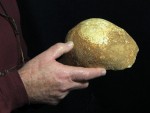
A skull found at the Dan David-Manot Cave supports other evidence that modern humans (Homo sapiens) evolved in Africa or in the Middle East, not in Europe. (photo by Clara Amit, Israel Antiquities Authority)
Francesco Berna, a Simon Fraser University assistant professor of archeology, is part of an Israeli-led team of scientists that has unearthed major clues about the first modern humans in northern Israel.
A paper published in Nature on Jan. 28 – co-authored by Berna – documents the discovery of a 55,000-year-old, partial human skull with a distinctive modern human, bun-shaped “occipital” region, at the Dan David-Manot Cave in the western Galilee.
The study involved researchers from the Israel Antiquities Authority, Geological Survey of Israel, Weizmann Institute of Science, Tel Aviv University, Ben-Gurion University of the Negev, Hebrew University, University of Haifa, University of Vienna, Harvard University, Case-Western University, Max Planck Institute for Evolutionary Biology, Columbia University and SFU. It is headed by Prof. Israel Hershkovitz, Dr. Omry Barzilai and Dr. Ofer Marder, and funded by the Dan David Foundation, Israel Academy of Sciences, Irene Levi Sala CARE Archeological Foundation, Leakey Foundation and IAA.
Berna and his colleagues believe that this skull’s date of origin and where it was found support other evidence that modern humans (Homo sapiens) evolved in Africa or in the Middle East, and migrated from there about 65,000 years ago. This contrasts with the hypothesis that the human species first evolved in Europe.
One of the migration routes by which modern humans spread out across the world passes through the Levant (the Mediterranean basin), which is the only land crossing between Africa and Europe, but until now, no modern human remains that date to the period between 65-45 thousand years ago had been discovered.
The Manot skull’s inner and outer surfaces were covered with cave deposits that were dated by means of uranium-thorium to 55,000 YBP (years before present). A morphometric analysis showed it is that of a modern human being with similarities to modern skulls from Africa on the one hand and the ancient skulls of modern humans from Europe on the other.
Berna helped the scientific team understand how ancient humans used Manot Cave at the time of the skull’s origin and how the cave, its archeological remains and the skull got to their present state.
Megan Thibodeau, one of Berna’s graduate students, explored the use of fire in this cave. Their work is helping scientists confirm whether this skull is from the most recent evolution of anatomically modern humans, which showed up in Europe first, and eventually the rest of the world.
“The skull found at Manot is absolutely comparable to ours and different from other skulls of early modern humans previously found in Israel and dated to 100,000 years ago,” explained Berna. “This earlier group of humans had some slight anatomical differences from us.
“But, most importantly, they didn’t produce stone tools, mobile sculptures and cave paintings such as the one that our direct ancestor produced in Europe and the Middle East, starting at around 40,000 years ago. Earlier modern humans apparently hadn’t yet developed our brain.”
To date, five excavation seasons (2010–2014) on behalf of IAA, TAU and BGU have been conducted in the cave, which is located 40 kilometres northeast of the Mt. Carmel prehistoric caves. Preparations are being made by the Ma’ale Yosef Regional Council, Moshav Manot and the Jewish National Fund for the development of the cave for visits by the public.