
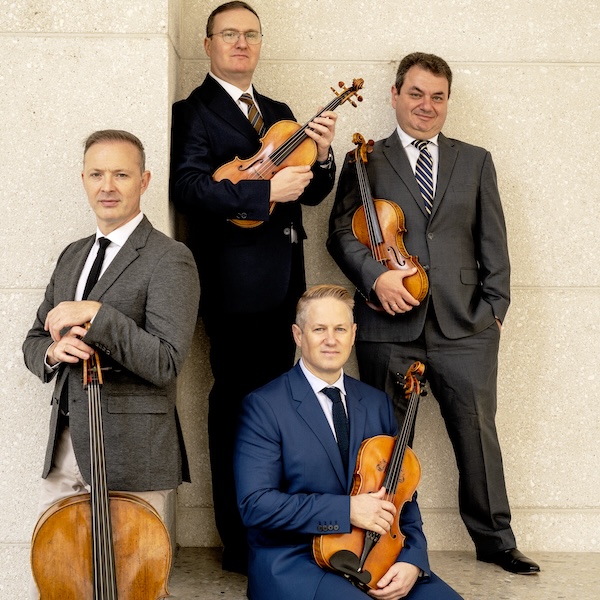
The Vancouver Recital Society welcomes the multiple-award-winning Jerusalem Quartet back to the city for a concert at the Vancouver Playhouse Oct. 19. The program features works from Hadyn, Janácek and Beethoven.
This year marks the 30th anniversary of the establishment of the Jerusalem Quartet. Since their first appearance for the VRS in 2001, the ensemble has become a regular and beloved presence on the world’s concert stages. They have appeared many times in Vancouver, and a highlight in the annals of the VRS was their five-concert performance of all the Shostakovich string quartets in the Telus Theatre at the Chan Centre in 2006. They are returning to Vancouver to perform the same program they played in their Wigmore Hall debut 25 years ago, an appearance that launched them to international fame. It features Hadyn’s Quartet in B-flat major, Op. 76, No. 4 (“Sunrise”); Janácek’s Quartet No. 1 (“Kreutzer Sonata”); and Beethoven’s Quartet in B-flat major, Op. 130, with the Grosse Fugue finale, Op. 133.
The Jerusalem Quartet is Alexander Pavlovsky (first violin), Sergei Bresler (second violin), Kyril Zlotnikov (cello) and Ori Kam (viola). Both individually and as the quartet, the musicians have performed around the world, garnering numerous accolades.
Born in Ukraine, Pavlovsky immigrated with his family to Israel in 1991, and is a graduate of the Jerusalem Academy of Music and Dance.
Bresler was also born in Ukraine. He started to play violin in age of 5 and, at the age of 12, gave his first recital. He immigrated to Israel in 1991, where he studied at the Rubin Academy of Music and Dance in Jerusalem.
Zlotnikov also studied at the Rubin Academy, having begun his studies at the Belarusian State Music Academy, and Kam, who was born to Israeli parents in La Jolla, Calif., grew up in Israel and studied there, as well as in the United States and Germany. Kam started his musical education at the age of 6, began playing the viola at 15 and had his debut at age 16.
The Jerusalem Quartet has found its core in a warm, full, human sound and an egalitarian balance between high and low voices. This approach allows them to maintain a healthy relationship between individual expression and a transparent and respectful presentation of the composer’s work. It is also the drive and motivation for the continuing refinement of their interpretations of the classical repertoire, as well as exploration of new epochs.
In 2019, the quartet released an album exploring Jewish music in Central Europe between the wars and its far-reaching influence, featuring a collection of Yiddish cabaret songs from 1920s Warsaw, as well as works by Schulhoff and Korngold. The second instalment of their Bartok quartet recording was released in 2020. Starting this year, the quartet began recording exclusively for BIS records, with their first release featuring three quartets by Shostakovich: Nos. 2, 7 and 10.
Although the Quartet No. 2 was composed in 1944, it makes no direct reference to the war; yet, this is a substantive work, dark, powerful and, at times, dissonant. Quartet No. 7, consisting of three short movements played without interruption, is an enigmatic and deeply personal work dedicated to the memory of the composer’s wife. For all its questioning and complex inner references, Quartet No. 10 is among the most immediately appealing of Shostakovich’s later works. By this stage in his life, his music tended to speak in a quieter voice and to a more intimate audience.
The Jerusalem Quartet’s performance at the Playhouse on Oct. 19 starts at 3 p.m., but there is also a pre-concert talk, at 2:15 p.m. For tickets, visit vanrecital.com.
– from vanrecital.com and jerusalem-quartet.com