Skip to content
  • Home
  • Subscribe / donate
  • Events calendar
  • News
    • Local
    • National
    • Israel
    • World
    • עניין בחדשות
      A roundup of news in Canada and further afield, in Hebrew.
  • Opinion
    • From the JI
    • Op-Ed
  • Arts & Culture
    • Performing Arts
    • Music
    • Books
    • Visual Arts
    • TV & Film
  • Life
    • Celebrating the Holidays
    • Travel
    • The Daily Snooze
      Cartoons by Jacob Samuel
    • Mystery Photo
      Help the JI and JMABC fill in the gaps in our archives.
  • Community Links
    • Organizations, Etc.
    • Other News Sources & Blogs
    • Business Directory
  • FAQ
  • JI Chai Celebration
  • JI@88! video

Recent Posts

  • Zionism wins big in Vegas
  • Different but connected
  • Survival not passive
  • Musical celebration of Israel
  • Shoppe celebrates 25 years
  • Human “book” event
  • Reclaiming Jewish stories
  • Bema presents Perseverance
  • CSS honours Bellas z”l
  • Sheba Promise here May 7
  • Reflections from Be’eri
  • New law a desecration
  • Resilient joy in tough times
  • Rescue dog brings joy
  • Art chosen for new museum
  • Reminder of hope, resilience
  • The national food of Israel?
  • Story of Israel’s north
  • Sheltering in train stations
  • Teach critical thinking
  • Learning to bridge divides
  • Supporting Iranian community
  • Art dismantles systems
  • Beth Tikvah celebrates 50th
  • What is Jewish music?
  • Celebrate joy of music
  • Women share experiences 
  • Raising funds for Survivors
  • Call for digital literacy
  • The hidden hand of hate
  • Tarot as spiritual ritual
  • Students create fancy meal
  • Encouraging young voices
  • Rose’s Angels delivers
  • Living life to its fullest
  • Drawing on his roots

Archives

Follow @JewishIndie
image - The CJN - Visit Us Banner - 300x600 - 101625

Author: Linda Gradstein TML

Sderot residents hope Tel Aviv finally understands them

Sderot residents hope Tel Aviv finally understands them

Motorists in Tel Aviv take cover from an incoming terrorist rocket. (photo from IDF Spokesperson’s Unit via Ashernet)

In Sderot, Simone Mizrachi wearily follows her two-year-old grandson as he happily jumps on the bouncy castle in a large indoor playground. A balloon pops and she jumps. The playground has four large underground bomb shelters in case of rocket attacks.

“Enough already,” said Mizrachi about the dozens of rockets fired at this small town in recent days. “My grandson is the second generation already living through these rockets. When we see smoke from the rockets, I try to tell him, ‘Look at the clouds up there,’ but he knows it’s not clouds. At age 2, he already knows what’s going on.”

Mizrachi has lived in this lower-middle-class town of 24,000 for 32 years and has raised her four children here. For the past 13 years, she said, Sderot has been under constant rocket fire. Because it is less than a mile to the border with the Gaza Strip, there are only 15 seconds to get to a shelter after the siren sounds. The Israeli government has spent hundreds of millions of dollars to build bomb shelters here – at bus stops, schools and in private homes.

Now, for the first time, rockets are hitting Tel Aviv. Mizrachi said she hopes Israel can end the rocket fire all over the country. But, she added, there is a certain satisfaction in the idea that Israelis in bourgeois Tel Aviv now understand what Sderot has been living with all this time.

“Where have they been for the past 13 years?” she asks angrily. “Now, they are finally getting a taste of what it is like to live here. There are times that we get 60 rockets a day. Maybe now that they feel it, the government will finally do something.”

Read more at themedialine.org.

Format ImagePosted on July 18, 2014July 17, 2014Author Linda Gradstein TMLCategories IsraelTags bombing, Sderot, Simone Mizrachi

Haaretz conference provides platform for renewing peace push

To some, it was a (peace) camp reunion. To others, it served notice that peace with the Palestinians has returned to its place atop the agenda of Israel’s political left following its dalliance with socioeconomic issues. To the more than 2,000 participants in Haaretz newspaper’s Israel Peace Conference held last week at Tel Aviv’s David InterContinental Hotel, it was an elegant opportunity to mingle with the iconic stewardship of days past – topped by Shimon Peres – while honing the movement’s agenda among those poised to embrace the next wave of leadership, such as opposition head and Labor Party leader Isaac Herzog and activist-turned-politician Stav Shaffir, who personifies the bridge from social activism to the politics of peace.

The history of the Israeli Peace Conference was itself microcosmic of the fortunes of the movement it supports. The idea began amid optimism born of word of U.S. Secretary of State John Kerry’s peace mission, according to conference chief executive officer, journalist Akiva Eldar. “The original idea was to push [Israeli] Prime Minister Binyamin Netanyahu and Palestinian Authority President Mahmoud Abbas to say ‘yes’ to Kerry but, around April, everything came to a halt,” he told this reporter.

“We kept pushing it off, finally setting it for July,” said Eldar, senior columnist for Al-Monitor. But, by the time the date rolled around, a new set of obstacles had presented themselves in the form of the kidnapping and murder of three Israeli teens followed by the killing of a Palestinian youth. The atmosphere became more toxic to the point where key Palestinian participants, chief negotiator Sa’ib Erakat and businessman Munib Al-Masri, pulled out of the conference. Yet, the decision was made to continue as planned. According to Eldar, “We decided we don’t give veto power to terrorists on both sides.”

Read more at themedialine.org.

Posted on July 18, 2014August 27, 2014Author Felice Friedson TMLCategories IsraelTags Akiva Eldar, Haaretz, Israeli Peace Conference
Ventanas to play at Folk Fest

Ventanas to play at Folk Fest

Tamar Ilana, centre right, and the Ventanas will perform at the Vancouver Folk Music Festival, which takes place July 18-20. (photo from the Ventanas)

It is no wonder that the music of Tamar Ilana and the Ventanas is eclectic, with influences from around the world. Ilana has not only traveled the world, studying in both Canada and Spain, but performs with a group of talented musicians whose expertise and interests are as wide-ranging as her own. When she and the Ventanas play at the Vancouver Folk Music Festival next weekend, July 18-20, they will offer, as their name suggests, “windows into other lands and cultures.” And, they will have you up dancing.

Born in Toronto, Ilana lived in the heart of the city with her mother, Dr. Judith R. Cohen, an ethnomusicologist and performer specializing in Judeo-Spanish (Ladino) songs. She studied French and graduated high school with a bilingual diploma. “However,” she told the Independent, “I also feel like I grew up in Spain.”

Explained Ilana, “I began accompanying my mother on her field trips when I was 4 (my first trip was to Israel), and then Spain when I was 5. I have had a few homes in Spain over the years. First, Ribadavia, Galicia, where I would roam the castle grounds (now closed to the public) and contemplate the small length of the old graves there, and how short people must have been. Then Hervás, Cáceres, which will forever be ‘mi pueblo.’ When I was 12, I met a family there who took me in as their own and, when my mom would romp all over the peninsula, studying, researching and traveling, I would often stay in Hervás with my ‘family’ there, and join up with my mom for shows. It is in Hervás that I really feel I learned Spanish, grew up a lot, and became a lot of who I am today.”

At 14, Ilana went to Ibiza with her mother, who “was retracing Alan Lomax’s footsteps from 50 years previous.” Since then, Ilana has spent many summers there, she did her third year of university in Barcelona, and studied flamenco in Seville for a year. “So, really, Spain is my other home,” she said.

“My father is part Native Canadian (Cree-Saulteaux), part Romanian and part Scottish. I have not lived with him since I was a baby, but we are close and he has always been a big part of my life. He came to visit me in Barcelona and Seville both times I lived there. He is not a musician but he is a huge supporter of the arts and my life. He says he is my No. 2 fan (my mother being No. 1, hahaha). Both my parents definitely support me as a performer.”

“Science, although I do love it as well, was almost just a form of rebellion from music! But I have now accepted music as who I am.”

Despite being surrounded by music, and performing from a young age, Ilana graduated from University of Toronto with a B.Sc. in biology and worked in the field briefly. “Science, although I do love it as well, was almost just a form of rebellion from music!” she said. “But I have now accepted music as who I am.”

The list of countries to which Ilana has traveled is long. “I used to complain a lot about traveling and performing … and I said that, when I grew up, I wanted to be ‘normal,’ with a house, a car, a 9-5 job. But, I guess, deep down, I always enjoyed the actual singing part. Now, singing, performing and traveling are just so much a part of me that even when I tried to change myself with my biology degree and then working 9-5 for two years in renewable energy, I felt like an imposter. Now, I feel like myself.”

Ilana began her study of flamenco when she was 8, captivated by a performance by Esmeralda Enrique (in Toronto): “I said to my mom, ‘I want to do that,’ and she said, ‘So go talk to her.’ I did, and I began studying dance with her that same year. I have been immersed in the flamenco world ever since.”

When studying in Barcelona in 2007, Ilana did a workshop with Montse Cortés, and “fell in love with flamenco singing.” She said she felt like all the parts of her life were being pulled together.

“Flamenco is everything,” said Ilana. “It is sorrow, it is happiness, it is love, it is death. It is every emotion you could possibly feel all together. It is also technically difficult, which is a good challenge. Flamenco is amazing in that if you speak ‘flamenco,’ you can get on stage with anyone else who speaks ‘flamenco’ and do a whole show without ever speaking to each other in any common tongue.”

Ilana continues to study with Enrique, and sings with her company. She also teaches dancing and singing out of Enrique’s studio, the Academy of Spanish Dance in Toronto.

Though she was working with fantastic people, her mind and soul were on her music and dancing, “what I was going to sing, what I was going to wear, who would be doing the show with me, how to promote it.” So, she left her job, sold her car, left everything she had dreamed of having as a child, and went to Seville.

The path has required courage on more than one occasion. After graduating U of T, she worked as co-campaign coordinator of the Green Energy Act Alliance. Once the act was passed, she was offered a promotion by the nonprofit with which she was working, “but it did not feel right,” said Ilana. Though she was working with fantastic people, her mind and soul were on her music and dancing, “what I was going to sing, what I was going to wear, who would be doing the show with me, how to promote it.” So, she left her job, sold her car, left everything she had dreamed of having as a child, and went to Seville.

“I felt like I was singing flamenco but, really, I felt like I did not know what I was doing, and the only way to know what I was doing would be to go immerse myself in that culture for an extended period of time,” she explained. “It was difficult. The first day at the Fundación Cristina Heeren Escuela de Arte Flamenco was hard – the other singers were so good! Up until then, I had felt like I was a good singer, but that day I felt like I had never sung before in my life! I came home crying. I cried many times at that school – sometimes I was even told I would never be able to sing flamenco because I was not from there! But those hard words actually contributed to the power of flamenco singing, and I began to sing stronger and with more confidence and more knowledge.

“My singing and my understanding of flamenco changed drastically that year (2010-2011), and I returned in 2013 with a Chalmer’s Professional Development Grant to study for another three months. My goal when I first went to Seville was to learn a cante libre (form with no rhythm) and I learned many, which I still sing today, such as ‘Granaína.’”

Although Ashkenazi, Ilana grew up surrounded by Sephardi music and culture, it being her mother’s specialty. “She is a preserver of many old songs that almost no one sings anymore,” said Ilana. “To her, these precious songs are treasures to be guarded dearly.

“I did not grow up religious,” she added, “but we always celebrated the High Holidays with my extended family, and sometimes went to shul. My mother likes going to the synagogue of the Indian Jews here in Toronto sometimes because she is ever interested in different musical cultures and how different communities celebrate, sing and dance according to their customs.

“We often lit candles and sang the prayers on Shabbat, and we traveled to Israel many times as I was growing up…. I recently returned to Israel after many years, this time with Taglit Birthright, and I stayed to visit my cousin and also to play some flamenco in Tel Aviv with friends I had met in Seville.

“Although I am not religious, I feel like the Jewish people are my family, and that there is a common understanding somehow between us all, no matter where we are from in the world. I find this feeling difficult to explain to non-Jews sometimes, but it is a deep feeling I have.”

“Although I am not religious, I feel like the Jewish people are my family, and that there is a common understanding somehow between us all, no matter where we are from in the world. I find this feeling difficult to explain to non-Jews sometimes, but it is a deep feeling I have.”

Before she went to Seville, Ilana was performing with various groups in different projects – a glimpse of her website shows that she still has a host of projects on the go – and, while she was away, these musicians “formed a collective dubbed Fedora Upside-Down (based on the fact that many are buskers, and the idea was to bring folk and world music to the streets to make it more accessible to the general public). It truly felt as though all my worlds had collided, and everyone was just waiting for me to come home and fit right in. And I did!”

From a flamenco rehearsal with Dennis Duffin, Ilana was connected with Mark Marzcyk, leader of Lemon Bucket Orkestra (LBO). The trio was joined by LBO percussionist Jaash Singh and, said Ilana, “We jammed all of summer 2011, in the heart of Fedora Upside-Down, our community and best friends and colleagues. By the time the fall came around, we started being invited to play shows and we called ourselves Ventanas, which means ‘Windows’ in Spanish, after the idea that we are a series of windows into other lands and cultures.”

The only part missing, she said, was an oud player. Singh suggested his friend Demetrios Petsalakis. “He appeared in my kitchen and it was as though he had been there all along!” said Ilana. “We invited him out to our weekend gig … and he showed up and played all the tunes with no charts and barely a rehearsal, just picking them up on the fly. And so, our original quintet was formed.”

Though Ilana dances on some of the pieces, the transition between dancing and singing can be hard, so Ilana invited Ilse Gudiño to join the group, and LBO dancer Stephania Woloshyn also was a guest performer many times. “These are the seven members on our debut self-titled EP,” noted Ilana.

Alexandra Talbot joined when Gudiño had a baby, and now tours with them, and “violinist, composer, friend and Fedora Upside-Down colleague Jessica Hana Deutsch” is also on this tour, as is percussionist Derek Gray.

“Our creative process is always changing,” explained Ilana. “Basically, I am the leader and can make the final call on things. But, since I play with such talented musicians and each one of them knows their styles and cultures so incredibly well, I really just trust their judgment on most things. Mark has a gifted ear for arranging, so especially at the beginning, we would follow his suggestions. Demetrios has a certain ability to compose music that sounds as if it is an old, traditional song, and

Dennis always adds a flamenco feel to it with his voicings and rhythmic changes. Everyone really brings their musical lives to the table and we take it from there. Anyone can suggest a song, teach it, and everyone’s input is heavily taken into consideration before anything is set in stone. Basically, everything is a group decision, and it works surprisingly smoothly.”

The Ventanas’ appearance at the Vancouver Folk Fest is part of a cross-Canada tour and, said Ilana, “Right now, I am planning on going to WOMEX in October to make some important connections and also meet with a few friends there to plan our first European tour. We plan on performing in Spain, Portugal, France, Italy and Germany in the next year. We might even make it to Greece. WOMEX is in Galicia this year, which will bring me right back to when I was 10 years old and traveling there a lot.”

While Ilana has never been a member of LBO, she has been their guest in various shows, and she has “shared many stages with them, traveled and performed with them.” As it happens, LBO will also be at the Vancouver Folk Fest and, said Ilana, “Ventanas and Lemon Bucket will join forces at VFMF. Come and see how!”

For more about the Ventanas, visit ventanasmusic.com. For the full lineup of Folk Fest performers and other information, visit thefestival.bc.ca.


Format ImagePosted on July 11, 2014February 8, 2015Author Cynthia RamsayCategories Arts & CultureTags Judeo-Spanish, Judith R. Cohen, Ladino, Lemon Bucket Orkestra, Tamar Ilana, Tamar Ilana and the Ventanas, Vancouver Folk Music Festival
The Normal Heart comes to Jericho Arts Centre

The Normal Heart comes to Jericho Arts Centre

Daniel Meron co-stars in The Normal Heart, which runs July 18-Aug. 16. (photo by Javier R. Sotres)

Larry Kramer is an incendiary activist who was among the first – and most irate – to raise alarms about a new disease that began killing gay men three decades ago. Kramer was at the forefront of the movement to direct public – and, notably, government – attention to what would become known as AIDS.

Kramer’s play, The Normal Heart, is a polemical cri de coeur written at the North American height of an epidemic that has become the world’s leading infectious killer and the cause of 36 million deaths to date. That is a number almost equivalent to the number of people currently living with HIV, the virus that causes AIDS. And, while extraordinary scientific advances have been made in controlling the symptoms of the disease, most of those treatments remain out of reach for the vast majority now fighting the virus, who are in the developing world.

While the severity of the health crisis has now become clear to most people, Kramer was writing in a time when almost no government resources were allocated to the virus and few in the power structure – from media and medicine to the president of the United States – seemed to care or even acknowledge that gay men were dying in exponentially increasing numbers.

A Jewish playwright, Kramer drew parallels to the world’s reaction to the first reports of the Holocaust. A later book by Kramer, in 1989, would be titled Reports from the Holocaust: The Story of an AIDS Activist.

The Normal Heart opened on Broadway in 1985. Its power remains, with an HBO drama broadcast in May of this year, starring Mark Ruffalo, indicating that social sensitivities to the issue have progressed perhaps as much as the retroviral medical advancements that have made the virus something closer to a manageable disease than the certain death sentence it meant as recently as a decade ago.

The play is now being staged in Vancouver. In it, Daniel Meron, who received a bachelor of fine arts degree in acting from the University of British Columbia, plays Felix Turner, the closeted lover of the main character, Ned Weeks, a stand-in for the playwright Kramer in this barely concealed autobiographical play.

It is a script trembling with rage and Meron sees the topic in a continuum of Jewish activism.

“There is definitely a strong sense of social justice in the Jewish tradition and, like Kramer, I find myself fighting for those who can’t stand up for themselves,” said Meron, who was active in Hillel and the Jewish fraternity Alpha Epsilon Pi during his time at UBC.

“The thing that stands out to me from doing this show was how the U.S. government, the gay community, and the entire world wanted to turn a blind eye to the entire situation,” he said. “As Ned [Kramer’s character] mentions numerous times in the play, the events that took place are eerily similar to the Holocaust.”

Meron, who was born in 1987, said he was struck by the impact The Normal Heart had among gay men who lived through that period.

“Before starting the journey of this play, I wasn’t aware how important The Normal Heart was to so many people,” he said. “It reminds me of speaking to Holocaust survivors. I feel so fortunate to play such an integral part of this story. The greatest thing for me would be to do justice to the story of all the men and women who fought and continue to fight for LGBTQ rights.”

The Normal Heart previews July 14, opens July 18 and runs in repertory until Aug. 16 at Jericho Arts Centre with two other plays as part of the Ensemble Theatre Company Summer Festival. Details and tickets are available at ensembletheatrecompany.ca.

Pat Johnson is a Vancouver writer and principal in PRsuasiveMedia.com.

Format ImagePosted on July 11, 2014November 3, 2014Author Pat JohnsonCategories Arts & CultureTags AIDS, Daniel Meron, Ensemble Theatre Company, Jericho Arts Centre, Larry Kramer, The Normal Heart

Ignorance in violent protest at Palestine House

The tragedy of four murdered teenagers in Israel has had more than emotional repercussions here in Canada. But it is unfair to blame foreign events for the shameful actions that took place in a Toronto suburb last Thursday, July 3.

The previous Monday, June 30, Eyal Yifrach, 19, Gilad Shaar, 16, and Naftali Fraenkel, 16, the three kidnapped Jewish teens, were found slain. Mohammed Abu Khdeir, a 16-year-old Arab, was subsequently killed in what appears to have been a revenge murder by a group of Jewish assailants.

Into this moment of tragedy and tension, in an act with predictable repercussions, the Jewish Defence League announced it would hold a protest over the murders outside Palestine House, in the Toronto suburb of Mississauga.

The Palestine House Educational and Cultural Centre bills itself as a not-for-profit organization that “serves as the educational, cultural and social centre for the Palestinian community in the Greater Toronto Area (in particular) and in Canada (in general).”

The Jewish Defence League, which was founded by the late Rabbi Meir Kahane, is viewed by many as a right-wing extremist group with vigilante tendencies. The respected Southern Poverty Law Centre has added the JDL to its hate group watch-list. The Anti-Defamation League has accused the JDL of harboring “thugs and hooligans.”

Predictably – the JDL having given advance notice – they arrived at Palestine House (backed up by some members of the motorcycle club Yidden on Wheels) to greet a large throng of Palestinian Canadians and their supporters already chanting anti-Israel slogans and waving anti-Israel placards and Palestinian (and Canadian) flags. What ensued was caught, as almost everything seems to be these days, on video. It leaves both sides looking like jackasses. Three people were injured as police struggled and failed to separate the mobs of competing thugs, most of the minor injuries seemingly from whacking with flagpoles as both sides paraded their respective ensigns and used them as weapons.

To say the scene was juvenile is an understatement. Jewish extremists show up, knowing their mere presence, let alone their antagonistic actions, will provoke another group at a time of understandable international tension. Not surprisingly, some of the Palestinian supporters took the bait. Mayhem ensued. Chauvinistic slogans and provocative gestures ruled the day. A couple of people were mildly hurt, but it could have been much worse.

By Canadian standards, though, this was a particularly nasty scene. And, while the fact that it happened during the week of Canada Day does not make it worse, it certainly doesn’t make it better.

The JDL and some similar groups view themselves as the embodiment of a “new Jew” that learned the tragic lessons of passivity. But if the JDL represents the future, we reject it entirely.

If the concept of a “new Jew” is at all legitimate, it is most reflected in the state of Israel. This type of “muscular Judaism” is about more than brute force. It is about attempting to defend and exemplify the values upon which Israel is based, and that it continues to strive to represent: rule of law, justice, fairness, humanitarianism, intercultural collaboration and mutual respect regardless of immutable characteristic. These are the same values that have made Canada among the safest, most secure, successful and welcoming nations for Jews, Palestinians and so many other people.

Events outside Palestine House last week suggest that both the JDL and those who engaged with them – pretty much all men, it might be worth noting – have something to learn about Canadian values.

Posted on July 11, 2014July 9, 2014Author The Editorial BoardCategories From the JITags JDL, Jewish Defence League, Palestine House, Yidden on Wheels

Israel is my home, heart

I was caught completely off-guard by the question: “Don’t you sometimes long to run away from all this war and violence and madness and terrorism? You could always go back to Australia.”

This was when, like every other Israeli, and probably Jews around the world, I was listening to the news every hour, hoping that the three kidnapped boys would have been found, safe and unharmed. At that time, there was no news yet.

I looked at my friend, a tourist from my birthplace. I didn’t know how to answer her. Once I would have known. I would simply have said “yes,” and my eyes would have filled with tears of nostalgia for the comfortable lifestyle, the ordinariness of everyday living, of only bothering to listen to the news if I wanted a sporting result or the weather forecast; all the security – emotional, financial, physical – that I’d left behind when I made aliyah.

She was looking at me strangely and, I suppose, a lot of time must have passed since she asked me the question. To me, the answer had become extraordinarily complex. A simple “yes” or “no” would not suffice.

We were sitting on a park bench in Beit Hakerem, in Jerusalem, where I live. It was Sunday afternoon, and I’d looked at the scene before us hundreds of times without truly registering it. A little boy was walking his dog on a leash. A pretty girl was jogging, music from an electronic device giving her the beat and rhythm. A grandfather wheeled a baby carriage. A young couple sat near us sharing a falafel and looking into each other’s eyes. Nothing special. Nothing dramatic.

All the drama had been played out in the weeks and months and years before her visit. Down south in Gaza. Up north in Lebanon. Rockets from Syria. Weeks of needing to hear the news every hour. Years of watching funerals on TV of beautiful young soldiers and ordinary people who were in the wrong place at the wrong time. Making phone calls to ensure that grandsons in the army, involved in searching for the missing boys in Hebron, were safe.

How could you “run away” from all the things that had shaped your life for decades? Of course, you could leave, but you’d take all that caring and commitment with you. It would feel like an amputation, and you’d never be a whole person again.

Over the years, I’ve been back to Australia for holidays, but they were never successful visits for long. For a few days, I’d bask in the warmth of seeing family and friends, enjoying their attention and the luxury of their lives. But then, someone would make a thoughtless remark about Israel, and I would bristle at their lack of understanding and feel that I had to defend the country. I’d long to be back home in Jerusalem, where I could talk about, even criticize, the government and corrupt politicians, the lack of good manners and the insane Israeli drivers, because I’d be talking to people on the same wavelength. It was different, very different.

The familiar scene in the park suddenly became very dear to me. I didn’t know any of these people, but I loved them. They were my family. I hoped the young lovers would marry; that the grandfather would live to see the baby’s bar or bat mitzvah; that the little boy with the dog would never have to fight in a war.

Finally, I had my answer. “No, I don’t long to run away. It’s not easy, but we understand what all the sacrifice is about. And it’s home,” I added as an afterthought. And, after all, home is where the heart is.

Dvora Waysman is the author of 13 books. She has lived in Jerusalem for 43 years.

Posted on July 11, 2014July 9, 2014Author Dvora WaysmanCategories Op-EdTags Israel
Delightful – and easy – dairy recipes for summer

Delightful – and easy – dairy recipes for summer

Leah Schapira’s and Victoria Dwek’s sunflower salad, from their most recent cookbook, Dairy Made Easy. (photo by Daniel Lailah)

There’s almost no need for me to try out the recipes from Leah Schapira and Victoria Dwek anymore. Their Made Easy cookbooks are “triple-tested” and I’ve reviewed enough of them to know that the recipes will result in delicious meals. But, an excuse to try a new dish, especially a new dessert – I just can’t pass that up.

This time, using Dairy Made Easy, which was released, appropriately, just before Shavuot, I made the sunflower salad, baked roasted veggie pasta and lemon curd ice cream, but there are other salads, pastas and desserts, as well as soups, appies, pizzas and breakfasts. While Schapira and Dwek favor more packaged/frozen ingredients than I prefer, and a little more salt and sugar, I find their recipes amenable to adaptation and feel completely at ease with replacing, for example, frozen cauliflower with fresh, and using less/more of almost anything. Even if the consistency or look isn’t quite as nice, the taste is every bit as good.

SUNFLOWER SALAD

1 head romaine lettuce, chopped, or 5 cups baby spinach leaves
2 mangos, peeled and diced
1/2 red onion, finely diced

Dressing:
4 oz. (115 grams) goat or feta cheese
2 tbsp olive oil
2 tbsp white wine vinegar
1/2 tsp Italian seasoning

Sunflower brittle:
1 tbsp butter
1/4 cup salted hulled sunflower seeds
1/4 cup sugar 

In a large bowl, combine lettuce, mango and red onion. Set aside.

Prepare the dressing. In a small bowl, use a fork to mash goat cheese with olive oil, vinegar and Italian seasoning. You can also use a mini chopper for a smoother consistency.

Prepare the brittle. Melt butter in a sauté pan over medium heat. Add sunflower seeds and toast for 30-60 seconds. Remove from pan and set aside. Add sugar to the pan and stir constantly until sugar is melted, about three minutes. It should be brown and completely smooth. Stir in sunflower seeds, pour into a thin layer onto a sheet of parchment paper and flatten as much as possible. Let harden. Chop into small bits, using a mini chopper or the bottom of a can.

Toss salad with dressing. Top with sunflower brittle. Makes four servings.

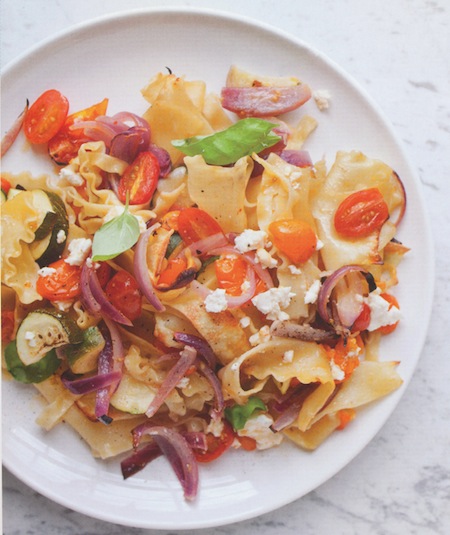
photo - Baked roasted veggie pasta
Baked roasted veggie pasta (photo by Daniel Lailah)

BAKED ROASTED VEGGIE PASTA

1 lb fusilli or penne pasta
2 pints cherry tomatoes, halved
2 red onions, cut into wedges
1 zucchini, cut into half moons
1/4 cup olive oil
1/2 tsp garlic powder
kosher salt, to taste
coarse black pepper, to taste
6 oz. (170 grams) feta cheese
1 tbsp chopped fresh or frozen basil

Prepare pasta according to package directions.

Preheat oven to 400°F. In a nine-by-13-inch pan, combine cherry tomatoes, red onions and zucchini. (More veggies can be added to the mix; red peppers substituted for the tomatoes.) Toss with olive oil and garlic powder. Bake for 30 minutes, stirring occasionally.

Add pasta to vegetables and mix well. Season with salt and pepper.

Preheat oven to broil and broil for 10 minutes, stirring after five minutes.

Add feta cheese and basil; stir to combine (the heat will melt the cheese). Serve hot or at room temperature. Makes eight servings.

photo - Lemon curd ice cream
Lemon curd ice cream (photo by Daniel Lailah)

LEMON CURD ICE CREAM

1 graham cracker pie crust
5 egg yolks
juice and zest of 2-4 lemons (about 1/3 cup juice)
1 cup sugar
2 cups heavy (i.e. whipping) cream

1. Crumble piecrust (which can be made using graham cracker crumbs or crushed tea biscuits mixed with some melted butter) and sprinkle crumbs into the bottom of individual serving dishes, or one large serving dish. Set aside.

2. Combine egg yolks, lemon juice, zest and sugar over a double boiler. Cook, whisking constantly, until thickened, six to eight minutes. Let cool.

3. In the bowl of an electric mixer, beat cream until stiff. Gently fold two-thirds of the lemon curd into the cream, a little at a time. It’s not a problem if there are swirls of yellow in the mixture. Pipe or spoon over crumbled crust. Drizzle with remaining lemon curd. Freeze until ready to serve. Makes eight to 10 servings.

Format ImagePosted on July 11, 2014July 15, 2014Author Cynthia RamsayCategories LifeTags Dairy Made Easy, Leah Schapira, Victoria Dwek
Assortment of salads for summer

Assortment of salads for summer

For those who can’t make it to Pips Neapolitan Pizza in Jerusalem for its panzanella, pictured above, the bread salad recipe here is similar. (photo by Barry A. Kaplan/Jerusalem)

Admittedly, I am very old-fashioned in my kitchen. I have two sets of antique, wood card-catalogue drawers where I store recipe cards, plus another set of drawers that a former neighbor, a wood worker, made especially for me. And, yes, I use these indexed recipes all the time. I have a variation of Post-it notes with a blue tab sticking up that I attach to any recipe cards I use very often so I can find them easily. When thinking about which recipes to share here, I went to the tab labeled “salads around the world,” and picked out these, as they’re perfect for summer.

BREAD SALAD
Italians call it panzanella. In Arabic, fatt means “crush” and, with the Turkish suffix oush, it becomes fattoush, particularly popular in Lebanon. Any kind of crusty, heavy, dense, day-old bread will work.

3 medium tomatoes, chopped, or 16 cherry or plum tomatoes, halved
3 Kirby cucumbers, cut up, not peeled
1/2 red pepper, chopped
1/2 green pepper, chopped
1/2 another color pepper, chopped
4 green onions, sliced
1/3 cup black olives
3 tbsp chopped fresh parsley or cilantro
2 cups cubed bread
8 hard-boiled eggs, chopped 

Dressing:
1/4 cup olive or canola oil
2 tbsp red wine vinegar
2 garlic cloves, minced
1 tsp paprika
salt and pepper to taste

Three to four hours before serving, combine oil, vinegar, garlic, paprika, salt and pepper in a jar. Close the lid, shake and set aside. In a salad bowl, combine tomatoes, cucumber, peppers, onions, olives and parsley. Add 1/4 cup dressing, mix and refrigerate about two hours.

One to two hours before serving, add bread cubes and toss; refrigerate for half an hour.

When ready to serve, sprinkle chopped eggs over salad and remaining dressing, and mix. Makes four servings.

ANTIPASTO SALAD
Traditionally, an antipasto is the first course served before an Italian meal, but this salad is a nice start for any meal.

2 cups bite-size pieces romaine lettuce
2 cups bite-size pieces head lettuce
1/3 cup shredded white cabbage
1/3 cup shredded red cabbage
1 small red onion, chopped
1 small red pepper, chopped
1 small green pepper, chopped
1/3 cup cherry tomatoes, halved
1/8 cup chopped black olives
1/2 cup artichoke hearts, drained and chopped
1/3 cup mozzarella cheese, cubed
1/2 cup any other kosher Italian cheese, cubed

Dressing:
1/3 cup olive or canola oil
2 tbsp red wine vinegar
1 garlic clove, crushed
dash paprika
dash oregano
dash basil
dash dry mustard 

Mix dressing ingredients in a jar. Close lid and shake well. Set aside.

In a salad bowl, combine lettuces, cabbages, onion, peppers, tomatoes, olives, artichoke hearts and cheeses.

Just before serving, pour dressing over salad and toss. Makes four servings.

ASIAN COLESLAW
When I serve Asian food, particularly stir fry, I sometimes would like a side dish other than rice or noodles, and this coleslaw fits. In Israel, we don’t have water chestnuts readily available, so I substitute with cooked kohlrabi, which is readily available and inexpensive.

1 cup shredded bok choy
1/2 cup shredded carrots
1 cucumber, diced
1/2 cup sliced water chestnuts or cooked kohlrabi
1/2 diced red pepper
1 tbsp chopped fresh cilantro
1/4 cup bean sprouts

Dressing:
3 tbsp rice vinegar
1/3 cup sesame oil
1 tsp sugar
1 tsp low-sodium soy sauce
1 garlic clove, minced
1/2 tsp ginger (optional) 

In a salad bowl, combine bok choy, carrots, cucumber, water chestnuts (or kohlrabi), red pepper, cilantro and bean sprouts.

In a jar, combine rice vinegar, oil, sugar, soy sauce, garlic and ginger. Close with a lid and shake well.

Set aside.

Just before serving, add dressing and toss. Makes four servings.

Sybil Kaplan is a foreign correspondent, lecturer, book reviewer and food writer in Jerusalem. She has compiled nine kosher cookbooks. She leads weekly walks in English in the Jewish produce market, Machaneh Yehudah, and writes the restaurant features for Janglo, the oldest, largest website in Israel for English-speakers.

Format ImagePosted on July 11, 2014July 9, 2014Author Sybil KaplanCategories Life
Family-run Domaine du Castel has achieved many firsts

Family-run Domaine du Castel has achieved many firsts

Eli Ben Zaken, centre, with sons Ariel, left, and Eytan. His daughter, Ilana, is also part of the business. (photo from castel.co.il)

The third in a series featuring nine Israeli wine producers features Eli Ben Zaken of Domaine du Castel, in the Judean Hills, 10 miles west of Jerusalem. The first two articles – on Barkan and Shiloh wineries – were published in the Jewish Independent on May 2.

Christopher Barnes: When did you found the estate?

Eli Ben Zaken: There was no official foundation because I never thought of really making a winery. I planted in ’88 a few vines in a small plot next to the house in the Judean Hills, in Moshav Ramat Raziel. We made wine in ’92, we bottled it in ’95, it was a great success. Not many bottles – just about 600.

CB: How fast did you grow?

EBZ: We grew 2,000, 3,000 a year, and then eight, and then 12, 15, 20. By the year 2000, we made 80,000 bottles. Then we stayed around 80,000.

CB: Tell us a little about the terroir, the soils and the climate in the area that you make your wine.

EBZ: It’s a very good wine country. In fact, the region was making wine for the Temple thousands of years ago. It’s very good, it’s clay and limestone, it’s stony, it’s well drained because it’s hilly. It has a good influence from the sea compared to other regions, which are also very good, but different, like Upper Galilee and Golan Heights. They don’t have an influence from the sea because they are more continental. The days would be much warmer, but the nights also much cooler. They will have maybe more color and more body, but certainly they will lack the elegance that we have because of the influence of the sea, which is always keeping us at a balanced level of temperature. Usually, the heat is not too hot, and the summers are less cool, it’s true. Today, we can know the difference.

When I was the first to plant vines, by mistake maybe, in the Judean Hills in [the] modern era, today we have in dunam – a dunam is a 10th of a hectare – we have about 300 dunams, and the region has nearly 3,000 dunams. That means all the industry has understood the importance of the hills around Jerusalem and have planted vines.

CB: How many different wines are you making right now?

EBZ: We were making, at the beginning, one wine. In ’98, we added a second red wine. Our wines are blended wines with Bordeaux grapes, like cabernet, merlot, petit verdot, cabernet franc, malbec, they are always blended. The white is a chardonnay, 100 percent, barrel-fermented, classical Burgundy wine method. We’ve made a rosé for the past four years, which is merlot, cabernet franc, malbec – early picking, pressed like a white wine, and really it is very fresh and light, a nice summer drink.

CB: Tell us a little bit about the influences in terms of your winemaking. You mentioned that you made Bordeaux blends. Was that something intentional that you decided on, or how did you come about that?

EBZ: I really started making the things I like to drink. I was not bored drinking wine and, actually, I didn’t like it [at first] because I was given low-quality wine to taste. When I got into wine I was already in my thirties, and got more and more into gastronomy and drinking wine. When I decided to make some wine at home, it was really as a hobby.

CB: How would you say your wines are unique versus the other types of wines that are made in Israel?

EBZ: I don’t think I like the word unique in the sense that everyone is unique, not mine as opposed to the mass of the others. They’re also unique. As I said, what is very, very interesting is the terroir of the Judean Hills, the elegance of the wines. Someone was pointing out in an article I read lately that all the wines from Israel got top marks from Parker – the really “top, top” were Judean Hills wines. Somehow, at the end of the day, this is what appeals most, but then, I’m biased.

CB: Of course, of course. Is it a family business now?

EBZ: It is, yes. I have three kids. They aren’t kids anymore, the youngest is 41! They’re running the winery. I am the winemaker, but I have to ask for permission to do things. My daughter and my sons are in the business. I have a daughter and two sons. I let them make their own decisions.

I can say, at my age now, I can look back. I was led in that path without [the] intention … of becoming a winemaker or making a business of wine. I was led through that path by God, destiny – it’s hard to tell, but certainly I did things which, by chance, were firsts: the revival of the Judean Hills as a wine region, I brought the petit verdot first in Israel, I made blended wines when blended wines were the cheaper wines in the wineries in Israel and top wines were single varieties. I was lucky in the way I went, doing firsts.

– This article is reprinted courtesy of the Grape Collective, an online publication for all things wine. For more information, visit grapecollective.com.

Format ImagePosted on July 11, 2014July 9, 2014Author Christopher BarnesCategories TravelTags Christopher Barnes, Domaine du Castel, Eli Ben Zaken, Judean Hills
Israel master chef hopes to foster peace through cooking

Israel master chef hopes to foster peace through cooking

Nof Atamna-Ismaeel reacts to her win. (photo by Yonatan Sindel/Flash90 from israel21c.org)

“This is the most exciting night of my life,” said a grinning, teary-eyed Nof Atamna-Ismaeel, upon her selection as winner of the fourth season of Master Chef Israel.

The April 5 broadcast had more than a third of Israel staying at home on a Saturday night to see who among the remaining three finalists would be crowned this year’s culinary champion of the most popular show on local television, even beating its close competition, Chef Games, which debuted this fall.

Israeli-Arab Atamna-Ismaeel ended up besting competitors Ido Kronenberg, a businessman from Savyon, and Meseret Woldimikhal, an Ethiopian-born immigrant in the process of converting from Catholicism to Judaism, who lives in Rishpon.

Atamna-Ismaeel was a judges’ favorite from the get-go. This year’s auditions for the show, based on the British reality program of the same name, involved two steps: a blind tasting of a sandwich prepared behind the scenes by a wannabe contestant, and a second dish cooked on screen by those whose sandwiches met with the judges’ approval.

Read more at israel21c.org.

Format ImagePosted on July 11, 2014July 9, 2014Author Ruthie Blum ISRAEL21CCategories IsraelTags Master Chef Israel, Nof Atamna-Ismaeel

Posts pagination

Previous page Page 1 … Page 637 Page 638 Page 639 … Page 663 Next page
Proudly powered by WordPress