

For more cartoons, visit thedailysnooze.com.
Author: freelancer

Campaign nears $8m
Harvey Dales, 2014 Federation annual campaign general chair, speaks at a Jewish Federation of Greater Vancouver donor event. (photo from Jewish Federation of Greater Vancouver)
As he tallied up the fundraising dollars earlier this month for this year’s Federation annual campaign, Harvey Dales noted with satisfaction that almost $7 million had been pledged in Vancouver since the campaign began in September. With a month to go until it wraps up in January, he’s aspiring to reach the $8 million mark.
“Our campaign had been relatively stagnant for the past few years, with only slight increases,” he reflected. “This year, which is my last year as campaign chair, I felt it was important to reach the $8 million mark because there are just so many needs.”
Dales and his team established a matching fund, where six donors promised a total of $125,000 in matching funds; that meant every unrestricted dollar of increase to the campaign made by any other donor would be matched. Another matching campaign was established with a focus on 20-to-35-year-olds, this one a two-for-one match.
The two matching funds have been so successful that Federation found itself on the verge of running out of matching funds a few weeks ago. “We went out and raised further funds, another $30,000, to top up the fund and ensure we could continue with the matching,” Dales said. “We’re still seeking additional funds for the match fund, and I’m very confident it will bring us to our $8 million goal.”
For the first time in many years, each one of Federation’s divisions has seen an increase in the dollars pledged compared with gifts from the same donors last year. That includes major donors, men’s philanthropy, women’s philanthropy, community and young adults. “The gifts that have come in have been incredible,” he told the Independent. “One individual who hadn’t made a gift before pledged $750. Another newly wedded couple explained they’d really stretched their budget by giving us $360 last year, but this year they were giving us $540 because of the matching funds.”
“I believe it’s so important for the community to know how vital Federation is,” he continued. “It’s our social needs network for the community, whether it’s funding for social services, education, youth, outreach or seniors. Both here, overseas and in Israel, there are so many recipient agencies that rely on Federation for the bulk of their funding to provide desperately needed services.”
Vancouver’s community is extraordinary for how many individuals commit to volunteering and canvassing for the annual campaign, he added. “In campaigns in other cities, the canvassing is done by professionals, but here in Vancouver our community is just so involved.”
To contribute to this year’s campaign, visit jewishvancouver.com.
Lauren Kramer, an award-winning writer and editor, lives in Richmond, B.C. To read her work online, visit laurenkramer.net.

Portraying the mess of life
Claire Hesselgrave as D in Wide Awake Hearts. (photo by Eric Chad)
“I want love. I want only love,” confesses C, a playboy, amid a lengthy list of his shortcomings. A rare, vulnerable moment of honesty? Or is he merely reciting his lines in a movie scene?
Such is the nature of Wide Awake Hearts by Brendan Gall, now playing at Little Mountain Gallery. One is never certain of what is real, or personal, and what is being acted for public consumption.
Of course, being a play, everything is scripted and for entertainment, however, within Wide Awake Hearts are four characters whose professional and personal lives overlap to an indistinguishable degree. Apparently named according to when they first speak/appear, A (Sean Harris Oliver) is married to B (Genevieve Fleming) and he hires his best friend C (Robert Salvador) to perform opposite her in a new movie that he has written and is producing. By the time D (Claire Hesselgrave) arrives on the scene to replace a recently fired editor, the tensions are high, and the line between what is part of the film and what is “actually” happening between the characters is well and truly blurred.
Despite being an editor, part of whose job, as D states, is to make sense out of the senseless, D’s presence only adds to reality’s murkiness. First of all, editors can only work with what they are given, what’s been shot; they can’t create anything, she explains, they can only interpret. And she’s not an objective outsider, which makes her job that much more difficult. D has been in a long-running on-and-off-again relationship with C. Meanwhile, C is in love with B, and A is jealous of what he believes is happening between C and B. As D laments, “Sometimes, the mess wins.”
That mess is life, not Wide Awake Hearts, which is a sharply written, insightful play. Tempers and desires run hot and C’s confession is one of the few quiet, calm moments that, along with the occasional biting (funny) comment, break the tension. Each character has a monologue that also serves to narrow the focus, slowing the pace before it once again ramps up.
All four actors do an excellent job of working in the intimate space of Little Mountain Gallery, sometimes a foot or two away from the audience as they perform, for example, a raucous sex scene. Director Brian Cochrane and stage manager Breanne Jackson deserve kudos for that, too, as does Sabrina Evertt for her set and props, as well as for her costumes; sound designer Jay Clift’s work is only noticeable when it should be. For the most part, everything comes together such that being in the audience is like being a voyeur, part of the action yet removed from it.
The production team being so small, it would a shame not to mention Eric Chad (projection designer), whose talents could have been exploited more; assistant director Jamie King; and publicity and front of house, Angie Descalzi. This combined Hardline Productions and Twenty Something Theatre effort, in which everyone involved seems to be doing double or even triple duty, delivers as much or more than many larger, more flush productions.
Wide Awake Hearts is at Little Mountain Gallery, 195 East 26th Ave., until Dec. 20, Tues-Sat, 8 p.m. Tickets are $22 plus service charge from brownpapertickets.com, with $15 matinées Dec. 13, 14 and 20, 2 p.m. For more information about the production companies, visit hardlineproductions.ca and twentysomethingtheatre.com.

Laughter guaranteed
Left to right, Josh Drebit, Donna Soares, Allan Zinyk and James Long in Cinderella: An East Van Panto. (photo by Emily Cooper)
If Canada wants to be an energy super power, it’s going to have to run some pipelines through some plays. Well, some pantos. Starting with Cinderella: An East Van Panto, now on at the York Theatre until Dec. 28.
As with the inaugural East Van Panto last year, which took Jack & the Beanstalk to strange and hilarious new heights, this Cinderella is only loosely based on the fairy tale. In this version, Ella – Cinderella is only a mean nickname given to her by her wicked step-hipsters (not a typo) – loses her mother in a tragic food truck accident. Her father directs his grief to improving safety standards and is awarded for his efforts with the Mike Duffy Food Truck Safety Award, or something along those lines. He falls in love with the Government of Canada representative who presents him the medal. Marriage soon follows, the father is offered a senatorship, which takes him to Ottawa, leaving his beloved Ella – played wonderfully as the straight man to everyone else’s wackiness by Donna Soares – in the hands of her stepmother.
In true panto fashion, Ella’s new family is played by Allan Zinyk as the matriarch and Josh Drebit and James Long as her sisters. As they order Cinderella about, the audience gets to boo every meanness, and cheer Cinderella’s every win. While Jewish community member Drebit ably pulls off the fishnets, his comedic talents really shine as Feral Cat. Drebit, Long (as Rat) and Dawn Petten (as Old Crow) are about as far away from Disney cartoon birds and other forest animals as one can get, but “the other vermin,” three young actors as mice, are absolutely adorable – and, in a panto, the audience is allowed to “ooh and ahh” at their cuteness.
Zinyk also plays bad guy Ronald Grump, costumed in a business suit and an awful wig that’s only marginally worse than that worn by the character’s inspiration, Donald Trump. King Grump decides to hold a ball (there are lots of ball jokes, FYI) to celebrate the opening of Grump Towers (plural, even though there’s only one). At the ball, there will be a beauty pageant – a speed-dating marathon, actually – to find a wife for his son, played by Petten channeling Justin Bieber. (Petten also plays the hippy narrator/canvasser, Len Til, to perfection.)
And this brings us back to pipelines, and the spills that the suit-wearing, hard-hatted forewoman notes “only happen in movies and on the news.” As the chorus (pipe)line is passing through Cinderella’s family home, sadly, there is a spill – a spill that Cinderella must clean up before she can go to the ball. With the help of her vermin friends and, in one of the funniest scenarios to be conceived, a vacuum-harmonica-playing David Suzuki (played by Zinyk, you have to see it to believe it) and her B.C. Ferry Godmother, the belle gets to the ball.
But does she marry her prince? You’ll have to go to the panto for the answer – and for all the witty, weird, Vancouver-specific humor, the inventive costumes (Cinderella’s gown appears like magic), the charming music, the fitting choreography, the inspired sets and props, the bold and beautiful backdrops.
With Cinderella, the creative team of playwright Charles Demers, musician Veda Hille and director Amiel Gladstone have improved on what was already an intelligent, silly, energetic, crowd-pleasing formula. The lead actors in this year’s production are joined by the very talented chorus of Bailey Soleil Creed, Sean Sonier (who rocks a tutu) and Alexandra Wever, as well as the children who share the roles of the mice.
If you’re wondering what to give that person on your Chanukah list who has everything, at least 99 percent of non-Grumps would enjoy this show. For times and tickets, visit thecultch.com or call 604-251-1363.
Estrin captures essentials
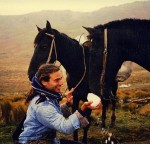
Avie Estrin in Colombia. (photo from Avie Estrin)
On Dec. 4, Avie Estrin’s solo show Blessed People opened at the Sidney and Gertrude Zack Gallery. Many of Estrin’s photos are taken in far-away places. There are Tibetan lamas gardening and a Yemenite bride in her fantastic headgear. An old man in a turban looks as if his perceptive eyes can see straight into your heart. A group of yeshivah students dance in the street. A young girl peeks out from behind a large heavy door. The door is ajar, and only fragments of the girl’s face are visible, but there is joy in her curious eyes. She has escaped her handlers, if only for awhile, and relishes her fleeting moments of freedom. Each picture tells a story.
In an interview with the Independent, Estrin talked about his life with photography, its challenges and rewards.
JI: What prompted you to mount an exhibit of travel photos? Do you shoot photos locally?
AE: Interesting question. I never understood this exhibit as a travel theme per se. While there are images from everywhere, a good number are taken right here, in Vancouver and the Lower Mainland. On the other hand, if “travel” is what others see, I’m OK with that. I can’t dictate what the show is about, since in the end it’s about what you see, not what I think I saw. I would only say that for me, it’s about real people, it’s about real life. It’s about all of us.
JI: Tell me about this show.
AE: The photos span from the early ’90s to as recently as six months ago. Photos were taken with an array of different cameras, from an old-fashioned SLR to early digitals, but nothing more modern than 2004. While I was always very particular about quality, my equipment is modest and minimal.
Photos range from hiking the Himalayas to horse trekking the Andes and Amazon basin, to more domestic venues right here in Vancouver. I could go on about harrowing experiences forging flooded rivers on horseback in Ecuador or negotiating at gunpoint with Colombian guerilla in the outback. While it makes for great storytelling, the real point is that, by and large, my experiences were joy-filled encounters with gracious peoples from across cultures, people who embraced me, brought me into their homes and shared with me the little they had. I hope the exhibit illuminates this sentiment in some small way.
JI: What do you look for in a frame?
AE: Whatever the subject, I am looking for what is essential to it. I don’t for a moment deceive myself that whatever I am experiencing in a given moment can be accurately represented or reproduced in a static concrete format … with any degree of authenticity. But if I can capture just a fragment of whatever the catalyst in that ephemeral moment, that indefinable but quintessential essence of a thing, then maybe I have done it some justice.
JI: Is there a connection between photography and your profession?
AE: It’s been said before, “all things are connected.” When we attempt to compartmentalize our lives, we are merely hanging veils between our bedrooms. The common thread is not so much what we do but how we do it.
JI: You write poetry, too. Are your poems and your photos linked?
AE: To answer this question I would simply recommend going to the exhibit, seeing the work, reading the poems, and then you decide.
JI: Do you ever use Photoshop?
AE: Photoshop? What’s that? Seriously, without getting too technical or mundane, there is no such thing as “untouched” digital photography. The moment you take a jpeg image with your point and shoot, your camera’s firmware is instantly doing a circus act to compress that eight mega-pixel shot you took down to a one or three megabyte image. Aside from losing at least 60 percent of the original image data, you are also letting your camera indiscriminately dictate what 60 percent to throw away. Even in raw format, there is no getting away from post-processing. For better or worse, the days of “untouched” photography are gone forever.
JI: Do you give copies of your photos to your subjects and, if so, do you offer them free of charge?
AE: Various images in Blessed People were taken in the pre-digital era, so showing people immediate results was in many cases not an option. I had a strict practice of sending people hard copies of their images, but often practicalities. such as remoteness, non-existent postal services, etc., didn’t allow for this either. As to charging people for the privilege of capturing their image … isn’t there something in halachah against that? There should be.
JI: What are the biggest challenges and rewards of your work?
AE: I have no idea what a real travel photographer does. For me though, doing is reward in and of itself. Doing without intentionality isn’t “doing” at all. It’s merely a happening. And intentionality implies challenge; otherwise, it would be a redundant endeavor. I love challenge. I love to do.
Olga Livshin is a Vancouver freelance writer. She can be reached at olgagodim@gmail.com.
Out-of-bounds tactic stinks
Anti-Israel groups have used dubious tactics over the years, but they stooped to unprecedented depravity recently when someone Photoshopped a photo of emaciated Holocaust survivors.
A Facebook page with 91,000 followers (at press time) posted a picture of survivors, presumably taken at the time of a camp liberation, manipulated to appear to be holding signs with terms like “Stop the Holocaust in Gaza,” “Israel Assassins” and “Stop US aid to Israel.” At the bottom, a caption reads, “Whatever happened to ‘Never again?’” The image received hundreds of likes and many shares, including from organizations that have until now posed as legitimate voices for Palestinians.
The picture is instantly offensive for obvious reasons. But it is additionally repugnant on a number of grounds, beyond the explicit desecration of historical memory.
Anyone who can equate the Israeli-Arab conflict with the Holocaust – and, further, depict the Jews of Israel as the instigators and perpetrators – holds a view of contemporary and historical events so removed from fact that their opinions should be discarded from the discourse. The problem is, they’re not.
In fact, the meme of Israel perpetrating a holocaust against Palestinians is rampant. On social media, in the comments sections of mainstream media, in conversations with moderately informed neighbors and friends, the concept is almost inevitable.
You may have heard of Godwin’s Law, the theory that, the longer a political discussion (on any topic) continues, the greater the likelihood someone will compare someone or something to Hitler or Nazis. A parallel – call it Godwin’s Corollary – could almost be written in stone: Whenever two or more people engage in discussion of Israel’s actions, someone will inevitably accuse the Jewish state of having learned from the masters, or of doing unto others what was done unto them in Europe.
The concept is appalling and, yet, it seems to be irresistible. It has been said that Jews are like everyone else only more so. Throughout the history of Jews as scapegoats, others (as well as some Jews in the past and today) project onto the Jewish people the sins of humanity and then proceed toward the inevitable end that scapegoating demands. How perfect for our cynical time that we should have a modern fable that so succinctly and conveniently proves our assumption that even the victims of the most venal atrocities can – and would – in a generation or two turn around and perpetrate the same on others.
This ahistoric fable implies that, because Jews are Nazis, they deserved the Holocaust and whatever other retribution is seen fit to dispense. And, if Israel is the “reward” for the Holocaust, then it can be taken away as appropriate punishment, as well. That the “facts” do not in any way approach reality is irrelevant. It is a fable intended to teach a moral lesson, and truthiness is beside the point.
There is another fault almost as grievous. Anti-Israel groups often employ the Jewish historical experience against the Jewish state – routinely employing Holocaust and Nazi imagery, along with other culturally appropriated concepts like apartheid. To a fair observer, these thefts of the experiences of others would be an admission that the bare facts of the Palestinian experience are not enough to convince and so they must be dressed up in masquerades of the historical traumas of others. But fair observers are not driving this discussion. The more ghastly the accusations that can be thrown at Israel, the more voraciously they are adopted by the haters.
At the very same time, these voices do everything in their power to negate the Jewish historical experience as a justification for Jewish self-determination and Zionism. Any reference to the Holocaust that might aid Israel’s case is hollered down as exploitative, as bringing a knife to a fist fight, as too weighty an historical weapon to introduce to the contemporary context. The Holocaust, in today’s environment, can be used against the Jewish people, but to raise it in a way that could justify Jewish strength or self-defence is ruled out of bounds.
Burial society is holy work
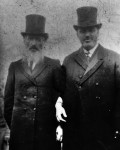
The consecration of Schara Tzedeck Cemetery in New Westminster in 1929. Eliya Ahroni, left, shammas of the synagogue, with shul president Chaim Leib Freedman, who was also founder of the Vancouver Chevra Kadisha in 1910. (photo from Jewish Museum and Archives of British Columbia L.00306)
The organization that oversees three of Metro Vancouver’s Jewish cemeteries does not want to discourage anyone from planning ahead and purchasing plots right now. They do, however, want to dispel rumors that the cemeteries are running out of space.
“I’m not trying to discourage people from buying plots,” said Howard Jampolsky, executive director of the Schara Tzedeck Cemetery Board, “but we do have adequate land in New Westminster [for now]. We feel that we have probably between 25 and 40 years left in New Westminster of burial land available, based on projections and current rates.”
The Schara Tzedeck Cemetery Board operates Schara Tzedeck Cemetery in New Westminster and a newer one in Surrey. It also is involved with the City of Vancouver in overseeing the Jewish area at Mountain View, the city-owned cemetery on Fraser Street.
Other Jewish cemeteries in the area are run by Temple Sholom, the Reform synagogue in Vancouver; Har-El, the Conservative congregation on the North Shore; Beth Israel, the Conservative congregation in Vancouver; and Beth Tikvah, the Conservative congregation in Richmond.
In an interview with the Independent, Jampolsky clarified the administrative structure of Jewish funerals and burials in the Vancouver area. Although other congregations have cemeteries, the Schara Tzedeck Cemetery Board is solely responsible for everything that happens in the preparation for Jewish funerals, regardless of affiliation or denomination.
The Chevra Kadisha, the Jewish Burial Society, effectively operates as an adjunct to the cemetery board, which is an independent organization originally created in 1929 under the auspices of Congregation Schara Tzedeck, the oldest and largest Orthodox synagogue in Vancouver. The Chevra Kadisha, which literally means the “holy society,” consists of volunteers who prepare the deceased for burial. More than three millennia of Jewish rites are embodied in the rituals performed by the Chevra Kadisha.
Beyond this most intimate act, the cemetery board also oversees the entire process before the service at the cemetery.
“We provide all the funeral services,” Jampolsky said. “[These include] the registration of the deceased, the picking up at the hospital or the home, taking them out to our funeral home, which is attached to the cemetery in New Westminster, providing the ritual preparation for burial, services of the Chevra Kadisha, which include sitting with the deceased from the time they come to us until the burial, and everything to do with the conducting of a funeral.” Rev. Joseph Marciano is Schara Tzedeck’s funeral director.
If the funeral is at one of the Schara Tzedeck cemeteries, the entire process remains under the board’s purview. If the deceased is to be buried in another cemetery, the cemetery board is responsible for everything up until they transport the person to the cemetery, where the rabbi and congregation take over. As a result, regardless of denomination, all Jewish deceased in Metro Vancouver receive full Orthodox preparation for burial.
Jampolsky stressed that one does not need to be a member of Schara Tzedeck to be buried in one of their cemeteries, one need only be Jewish.
The board, which is made up of eminent community members, is co-chaired by Jack Kowarsky and Charles Diamond. Diamond’s father, Jack Diamond, z”l, initiated the board’s current structure decades ago.
The Mountain View Jewish Cemetery has been undergoing a restoration this year, after decades of limited attention. J.B. Newall, the monument company located across from the cemetery, has renovated many of the oldest headstones.
“The headstones that are 100 years old look like they’re brand-new,” Jampolsky said. “It’s going to be a really remarkable place to walk through.”
In addition to the physical restoration taking place under the leadership of Shirley Barnett and a committee of volunteers, a campaign aims to raise funds for perpetual care to maintain the cemetery as it should be.
The oldest Jewish cemetery in the metro area – and the only one inside Vancouver city limits – still sees one or two funerals a year, Jampolsky said, despite the widespread belief that it is full.
Unlike the cemeteries in New Westminster and Surrey, which are fully operated and maintained by the cemetery board, the Jewish section of Mountain View remains under the ownership and operation of the city, like the larger cemetery from which it is separated by a hedge.

Jampolsky said a leading cemetery architect told him that the New Westminster cemetery is among the nicest in North America, in terms of natural beauty, upkeep and maintenance. Hollywood North has noticed, too.
“We’ve had movie companies come and want to film there and we’ve turned them away,” Jampolsky said. “We don’t need the revenue from that. We don’t think it’s respectful to the deceased.”
The board is a nonprofit organization and costs are covered by funeral expenses – $11,000 includes every aspect of preparation and the funeral if the deceased is being buried in a Schara Tzedeck cemetery; $5,575 if they are to be buried in one of the other Jewish cemeteries. The cost of the plot is also currently $11,000 at the Schara Tzedeck Cemetery in New Westminster. Twenty percent of all plot fees are set aside in trust for perpetual maintenance.
Families with financial constraints are offered discreet, compassionate assistance, said Jampolsky. “We believe that every Jewish person has a right to a Jewish burial, a full halachic Jewish burial that is like any other, and we’ll never turn back from that.”
Jewish tradition makes funerals not only plain in style and appearance, but comparatively simple in terms of planning, Jampolsky noted. Every Jewish person is buried in identical caskets, made of plain unadorned wood and no metal, with holes in the base to hasten decomposition and return of the body to the earth. There is none of the competitive materialism typical of the funeral industry, where anecdotes abound of families being upsold on higher-end caskets and elaborate ceremonies.
Jewish funerals are almost identical, he said, regardless of the individual’s position in life. The same care is given to respect the individual throughout the preparation.
“I really believe that we do an important, invaluable job for the community and that we do good and holy work, we do it well, every single person is treated with the utmost care, respect, whether they’re living or they’re deceased.”
Pat Johnson is a Vancouver writer and principal in PRsuasiveMedia.com.

NCJW anniversary draws crowd
At NCJW’s 90th anniversary party, left to right, Robyn Lenn, Ezra S. Shanken, Debby Altow, Catherine Stoller, Sharon Allentuck and Cynthia Ramsay. (photo by Joanne Emerman)
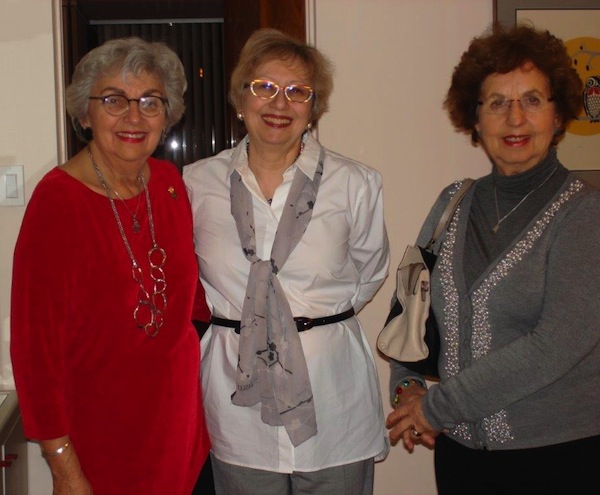
The Vancouver section of National Council of Jewish Women of Canada welcomed national president Sharon Allentuck of Winnipeg and Robyn Lenn, president of International Council of Jewish Women, to a jam-packed 90th anniversary party at VanDusen Botanical Garden on Nov. 16.
Vancouver president Catherine Stoller and anniversary committee members greeted the approximately 125 people to a farmers’ market of food, bubbly and partner-agency displays. Council members had a chance to renew friendships, visit the displays of B.C. Transplant Society, Vancouver Coastal Health, HIPPY/MOSAIC, the JCC Jewish Book Festival, Children of the Street, Elizabeth Fry Society, and Council’s signature projects, Books for Kids, Operation Dressup and ALUMA of Israel.

Enjoy an afternoon movie
Would you like to go to the movies? Yes? That is exactly what about 80 people did on Nov. 25 at the Peretz Centre for Secular Jewish Culture, thanks to the wonderful combined effort of Jewish Seniors Alliance and Vancouver Jewish Film Centre, which co-host a movie screening scheduled on the afternoon of the last Tuesday of every month.
Upon arriving, we were treated to a light buffet of bagels, sweets, fruit and beverages, then we headed to the large auditorium, where VJFC director Robert Albanese welcomed the audience and introduced the day’s film, The Outrageous Sophie Tucker.
After Gyda Chud, on behalf of JSA, made some announcements, including that the previously scheduled JSA Empowerment series talk Oy Vey, My Back! will be presented in March, Albanese spoke of the variety of films that the film centre will be presenting over the next few months. Then, Sophie Tucker “entered” our world.
Tucker was born Sonya Kalish to Ukrainian Jewish parents in 1886 as they fled from czarist Russia. She only became Sophie Tucker after she adopted her former husband’s name, Tuck, and added the “er.” That name became a password that could be used to gain entry to celebrities and even presidents.
In the film, authors and biographers Lloyd and Susan Ecker relate much of Tucker’s story.
When very young, she worked in her parents’ kosher restaurant, a job she did not enjoy. One day, her father asked her to distribute pamphlets at theatres as the actors left, since most of them were Jewish. He thought it would increase the number of diners.
While doing this task, Tucker heard the music from inside a theatre, she snuck in and what she saw changed her life forever, as well as the lives of her future audiences. She ran away to New York, leaving her family, but knowing where she belonged.
She tried vaudeville but, not being a classic beauty, she had difficulty being accepted “as is,” so she sang in “black face.” Eventually, her powerful voice began to be heard. When she forgot her makeup one day and sang as herself, the show was a success – she never performed in black face again.
Irving Berlin wrote music for her and she “stopped the show” when she sang. Tucker worked without a contract; her word or a handshake was sufficient.
Tucker was respected and she respected others, asking for their names, numbers and addresses upon meeting them and entering those contacts in a book, which eventually housed 10,000 names. She would write to these people if she were coming to their towns, asking them to come see her perform. She was the original Facebook – only it was the Tuckerbook.
Ted Shapiro, her accompanist for 46 years, had the unique talent of being able to interpret the mood that Tucker wished to portray.
In later years, mobsters took over the ownership of many nightclubs and Tucker befriended Al Capone. He enjoyed having her sing, as she brought people into his Chez Paris. He called her a “human cash register.”
In the years to come, Tucker decided to share what she knew and opened a school teaching young women how to be “Red Hot Mamas.”
She knew how to market herself: in the 1930s, she was the spokeswoman for soup; in the 1940s, she advertised blouses for the fuller mamas, saying she enjoyed being overweight – “Too much of a good thing is wonderful!” She prided herself on having creative and huge hairdos, calling herself the “Modern Marie Antoinette,” and always carried a large filmy handkerchief as she performed.
In 1929, the biggest entertainer was Al Jolson and he sang in the first talkie. That same year, Warner Bros. had Tucker debut in the movie Honky Tonk, where she sang “Some of These Days,” a song with which she is still identified. Judy Garland learned how to “sell a song” from Tucker.
During the war, Tucker was one of the performers to whom soldiers wrote and received answers. She was a pinup girl along with Betty Grable.
There was a young Jewish soldier who was obsessed with music and hauled around his records, vowing that he would play Tucker’s rendition of “My Yiddishe Mameh” in Berlin when he beat Hitler. Unfortunately, he died before he could accomplish this goal but his fellow soldiers fulfilled his vow, much to the anger of some German soldiers, as that song had been banned in Germany. The victors played it for eight hours through the streets of Berlin.
Tucker remained on top for 58 years, into the television era. Along the way, she befriended many, including Josephine Baker, who, because she was black, was having a hard time being allowed to perform – until Tucker invited her to sing with her.
Tucker’s talent and her voice were both immeasurable, but her true outstanding ability was in marketing herself when there wasn’t the media infrastructure there is now. She was indeed the last of the Red Hot Mamas, a glowing ember, memorable, still admired, still inspiring!
Expressing what we all felt, Chud thanked Albanese for enriching our lives with this movie, then we all went home with the echo of a song in our hearts, “Some of These Days.”
Binny Goldman is a member of the Jewish Seniors Alliance of Greater Vancouver board.
Herstory on the screen
A corrective of sorts to the Old Testament’s predominantly patriarchal view of seismic events and everyday tribal life, Lifetime’s emotion-tapping adaptation of The Red Tent fulfils one’s modest expectations for a primetime soap opera in period garb.
Anita Diamant’s best-selling saga of female self-actualization and familial tribulation, centred on Jacob’s daughter Dinah, is rendered here as an aspirational fable informed more by Harlequin Romance than hardscrabble reality. Viewed as harmless entertainment and a desert respite from winter, The Red Tent provides acceptable escapism, but if you’re hoping for an earthy, accurate sense of how people actually lived in those days, or a spiritual experience (on television?!), those prayers won’t be answered.
The Red Tent aired earlier this month on Lifetime. If you can get your hands on it, either as a DVD or in rebroadcast, the two-part miniseries comprises three hours of couch time (minus commercials).
The titular scarlet structure serves as a community centre and haven for Jacob’s four wives and their daughters. In this comfy, cozy enclave, the young Dinah acquires extraordinary self-confidence – presumably from seeing firsthand the essential role of women in the family. Their most cherished skill is midwifery, partially for its autonomy (the men assuredly want no part of assisting births) and because it’s closely linked to females’ unique function. As one woman puts it, “We are the lucky ones, for we alone are the ones who can give life.”
The experience of childbirth in biblical times was presumably more primitive than New Age-y, so you’ll be rolling your eyes at the miniseries’ insistence on hinting at suffering without bringing us down by actually showing it. (My biggest peeve about the show’s glamor quotient is that everyone has perfect teeth and nobody ages, despite the skin-wrecking trifecta of sun, wind and sand.)
The film’s greatest challenge, however, is plausibly reconciling a 21st-century feminist point of view (embodied by Dinah) with the societal limitations placed on women in those days. It’s jarringly anachronistic, for example, when Dinah shocks her closest sibling, Joseph, by announcing she’ll choose her own husband at such time as she determines. But it does provide the foundation for her character’s aggressive interfaith love affair with the king’s son, Shechem. This passage of the Bible has been interpreted in several ways, but The Red Tent presents their sexual relationship as mutually consensual and an expression of love.
That doesn’t soothe Jacob’s pride in the least when he’s informed that Dinah and Shechem have married, and things go south in a hurry. Whatever sins the menfolk proceed to commit, the second half of The Red Tent – spotlighting Dinah’s life in exile – takes pains to show that women are as capable of men at inflicting cruelty.
Part 2 of the miniseries embraces such reliably eye-watering themes as separation from, rejection by and reconciliation with one’s children. They may comprise the meat and potatoes of the plot, but the heart of Dinah’s journey involves accepting the family and tradition she was born into and the talent for midwifery that she inherited.
The Red Tent implicitly honors the continuum of women that preceded and followed Dinah, extending to the present day. At the very least, this female-oriented interpretation offers an exceedingly interesting counterpoint to Ridley Scott’s testosterone-fueled Exodus: Gods and Kings, which opens this weekend, and picks up – chronologically speaking – shortly after The Red Tent ends.
Michael Fox is a writer and film critic living in San Francisco.