
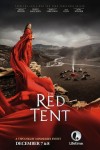
A corrective of sorts to the Old Testament’s predominantly patriarchal view of seismic events and everyday tribal life, Lifetime’s emotion-tapping adaptation of The Red Tent fulfils one’s modest expectations for a primetime soap opera in period garb.
Anita Diamant’s best-selling saga of female self-actualization and familial tribulation, centred on Jacob’s daughter Dinah, is rendered here as an aspirational fable informed more by Harlequin Romance than hardscrabble reality. Viewed as harmless entertainment and a desert respite from winter, The Red Tent provides acceptable escapism, but if you’re hoping for an earthy, accurate sense of how people actually lived in those days, or a spiritual experience (on television?!), those prayers won’t be answered.
The Red Tent aired earlier this month on Lifetime. If you can get your hands on it, either as a DVD or in rebroadcast, the two-part miniseries comprises three hours of couch time (minus commercials).
The titular scarlet structure serves as a community centre and haven for Jacob’s four wives and their daughters. In this comfy, cozy enclave, the young Dinah acquires extraordinary self-confidence – presumably from seeing firsthand the essential role of women in the family. Their most cherished skill is midwifery, partially for its autonomy (the men assuredly want no part of assisting births) and because it’s closely linked to females’ unique function. As one woman puts it, “We are the lucky ones, for we alone are the ones who can give life.”
The experience of childbirth in biblical times was presumably more primitive than New Age-y, so you’ll be rolling your eyes at the miniseries’ insistence on hinting at suffering without bringing us down by actually showing it. (My biggest peeve about the show’s glamor quotient is that everyone has perfect teeth and nobody ages, despite the skin-wrecking trifecta of sun, wind and sand.)
The film’s greatest challenge, however, is plausibly reconciling a 21st-century feminist point of view (embodied by Dinah) with the societal limitations placed on women in those days. It’s jarringly anachronistic, for example, when Dinah shocks her closest sibling, Joseph, by announcing she’ll choose her own husband at such time as she determines. But it does provide the foundation for her character’s aggressive interfaith love affair with the king’s son, Shechem. This passage of the Bible has been interpreted in several ways, but The Red Tent presents their sexual relationship as mutually consensual and an expression of love.
That doesn’t soothe Jacob’s pride in the least when he’s informed that Dinah and Shechem have married, and things go south in a hurry. Whatever sins the menfolk proceed to commit, the second half of The Red Tent – spotlighting Dinah’s life in exile – takes pains to show that women are as capable of men at inflicting cruelty.
Part 2 of the miniseries embraces such reliably eye-watering themes as separation from, rejection by and reconciliation with one’s children. They may comprise the meat and potatoes of the plot, but the heart of Dinah’s journey involves accepting the family and tradition she was born into and the talent for midwifery that she inherited.
The Red Tent implicitly honors the continuum of women that preceded and followed Dinah, extending to the present day. At the very least, this female-oriented interpretation offers an exceedingly interesting counterpoint to Ridley Scott’s testosterone-fueled Exodus: Gods and Kings, which opens this weekend, and picks up – chronologically speaking – shortly after The Red Tent ends.
Michael Fox is a writer and film critic living in San Francisco.