Daniel Ogorek and Morgan Davis rescue Rabbi Emeritus Joseph Radinsky in a canoe. (photo from UOS)
The historic flooding that hit the Houston area late last month dealt an especially hard blow to the city’s Jewish community. The United Orthodox Synagogues of Houston suffered extensive, significant damage in almost every area of the complex, as did many of the homes of its local congregants. The devastated synagogue is also home to the Goldberg Montessori School.
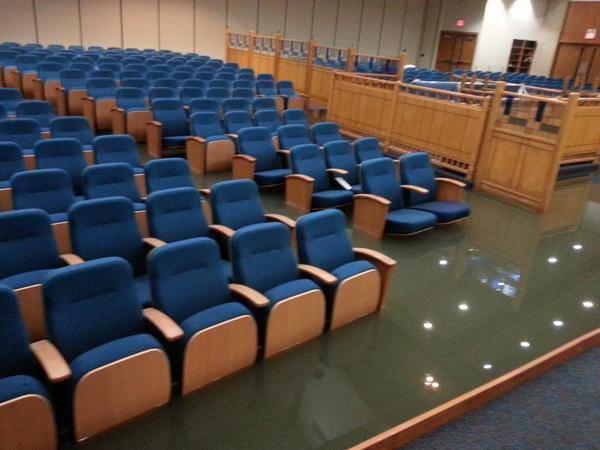
The flooded synagogue sanctuary. (photo from UOS)
“It will take months to repair our spiritual home,” said Rabbi Barry Gelman. It will also take millions of dollars. Parts of the Meyerland area, including UOS, spent the days after the flooding May 26 under up to four feet of water and, while the floodwaters have receded, the recovery is only beginning.
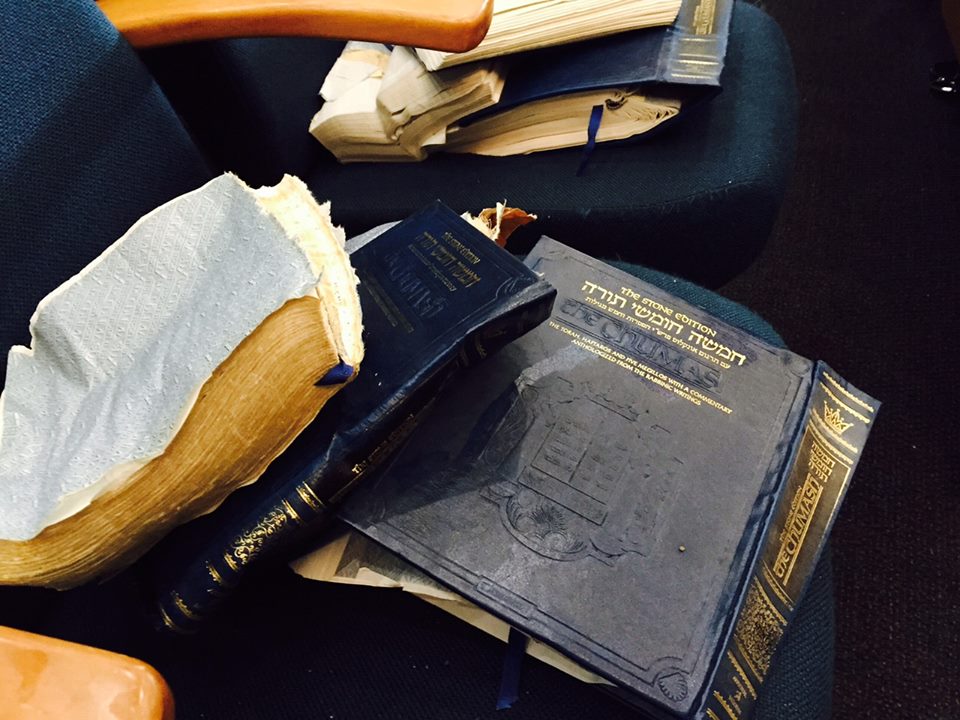
The synagogue’s damaged chumashim. (photo from UOS)
For nearly 50 years, UOS has actively served as a community beacon for the Meyerland area residents, but now the synagogue is forced to turn to its neighbors for help. They are raising funds to support not only the structural repairs needed on the buildings themselves, but they hope to offer a portion to some of their members who are in critical need. Max Reichenthal, UOS president and local business owner, said many of the more than 300 families who attend the synagogue received extensive damage to their homes, vehicles and belongings. He said UOS members have been extraordinarily comforted in their darkest hour by the outpouring of all manners of support they have received, not just from local synagogues, but from community organizations throughout the United States. The community is hopeful that donations will continue to come through the UOS website, uosh.org, to fund the relief effort.
Ben Groberman outside of Moishe House’s new location in the 41st and Granville neighborhood. (photo from Ben Groberman)
The Vancouver chapter of Moishe House has found a new home. It will be the third location since the local branch started here three and a half years ago.
Vancouver Moishe House is part of an international nonprofit organization. Originally started in Oakland, Calif., in 2006, the organization’s mission is to provide a gathering place for young Jewish students and professionals who are looking to engage with their peers in a non-formal setting. The houses are run by three to five local students – in Vancouver, it’s generally been four students – who get rent subsidies in exchange for planning and organizing weekly events. Currently, there are 77 chapters of Moishe House around the world. While more than 50 of them are in the United States, there are houses in 16 other countries, including two in Israel (Jerusalem and Tel Aviv) and two in Canada, the other house nationally being in Toronto.
The Vancouver house started in 2011 in East Vancouver, where it was active for two years, then it moved to Point Grey, gaining popularity with nearby University of British Columbia students. It’s now located in the Granville Street and 41st Avenue area.
One of the current residents, Ben Groberman, believes that the new location will offer opportunities to the house and its residents.
“We are very happy with our move,” said Groberman over the phone while unpacking boxes in his new room. “Most of our community members live along the Granville and Oak corridor; it will be convenient for them to join in.
“It also provides us with great opportunity to work with our community partners on some new ideas and programs that will draw new people to our events. We had a wonderful time at Point Grey, we had good connection with Hillel and the UBC students; now we hope to reach new people and engage with some new crowd.”
The new house also will allow the addition of another member to the core group and, in the coming weeks, there will be a change in residents. Two incoming members from Ontario will replace current residents returning to that province and the fifth member, who will join the house from California, will move in next month.
After settling in, Groberman promises to be in full action for the summer and beyond.
“The best way to join the events is to contact one of the house members over Facebook or join our email list,” he said. “We have events for all kinds of people, from Shabbat dinner, Sunday brunch, movie nights, feeding the hungry; we have Havdala parties on Saturday nights, BBQs, going to museums, galleries, watching sports together. It’s always changing, and you get to meet so many people, it’s an amazing experience. I feel very privileged to take part in it and love to share the experience with others.”
Moishe House is designed for Jewish people in their 20s and 30s but others are invited to join their activities by emailing [email protected].
Shahar Ben Haleviis a writer and filmmaker living in Vancouver.
The 800th anniversary of the Magna Carta falls on June 15. It is a significant document not only in the history of England and the history of democracy, but also in the history of the Jews. There is a surprising (to some) aspect to the seminal document of British constitutional monarchy.
If you tune into the right channels on the wireless this weekend – don’t you love how that word has gone from archaic to high-tech in less than a generation? – you will probably hear much about the anniversary of this pivotal document. You might not hear about the Jewish angle to the story.
The Magna Carta emerged, effectively, as a constitutional document in the days when constitutional limits to the rights of kings were unknown. England’s King John was confronted by 25 barons who weren’t so happy with their relationship and, lo, faced with the threat of insurrection, he became the accursed monarch who, with the stroke of a quill, under duress, set the stage for the limitations of divine right that have resulted in the reduced British monarchy we see today.
Eight centuries ago, the king had his barons and knights, the nobles had their vassals and so on down the feudal pecking order. And then there were the Jews.
Jews in England at that time, and in many places at other times, existed outside the carefully proscribed feudal system. There were advantages to this exclusion – who wants to be a serf? – until there were not. The king was the protector of the Jews, which seemed like a sweet deal – until it was not.
Like nobles, Jews had a direct relationship with the monarch. Unlike nobles, they had little in the way of leverage when the relationship went south. For the masses, there was nothing endearing in the Jews’ special relationship to the king.
The Magna Carta is a document that, for the first time, set limits on the rights of the king in his relations with his nobles and, by extension, theoretically anyway, his public. Appropriately enough, it also outlined the relationship between the king, nobles and Jews.
This turned out to be a problem. The Bible forbids “usury,” the application of interest on loans “to your brother.” Christians, under a widespread interpretation, would not lend with interest to other Christians. The ironic corollary to this is that Christians did not lend at all, or at least not often. Jews, on the other hand, forbidden from owning land, banned from many of the crafts guilds, were seriously limited in their professional options. Jews found niches as butchers and in some other fields, but moneylending was a lucrative option where few options existed. It was also a dangerous position for a socially vulnerable group. Who doesn’t love a lender in the brief period of time when you need money? But who needs the demands for repayment?
At a time – the first time – when the king was being held to account, being in cahoots with the monarch was not a summer day in Yalta. Or Dorset, as the case may have been.
Since Jews could not own real estate, debtors who died saw their estates confiscated by the Jews’ protector, the king. The Magna Carta codified that, if a subject died indebted to a Jew, the obligation owed would revert to the king, but without interest. Likewise if the Jewish debt-holder dies – if the Jew to whom money was owed died before the debt was repaid, the interest would be forgiven.
Another clause specified that debts were to be paid through liquid assets, not through land, which meant that the king could not expand his real estate holdings through his relationship with Jews, thereby reducing the value to the king of this special relationship. And new taxes were imposed on Jews that exhausted the community economically, further reducing their worth to the monarch.
When John’s son, Henry III, was on the throne in 1253, he declared: “No Jew remain in England unless he do the king’s service, and that from the hour of birth every Jew, whether male or female, serve us in some way.”
By the end of that century, the last Jew was expelled from England, a consequence, in no small part, of clauses in the Magna Carta and their intended and unintended consequences.
A son’s fascination with diggers has led to many other farm-related and animal designs. (photo by Shula Klinger)
When our son, Joel, started to talk, most of what he said was, digger, referring to the large machines that dig earth, so I started drawing them for him. Soon, he became passionate about tractors, so I started drawing those, too – because, like you, I would bend over backwards to meet my child’s needs.
Our Joel has always known his mind. And he has always known that his mother will turn herself into a pretzel when it comes to his education. I also learned how to draw forklifts, dump trucks and specialized mining equipment: road headers, skid steers and face shovels. Essential knowledge for every pretzel-shaped mother.
After several months and hundreds of diggers later, I had a box full of cut-out vehicles. I bought colored card stock and cut out what I hoped were the last 12 diggers. I framed them in an old IKEA frame and put it in Joel’s room, intending to hang it later.
Joel had his own plans, of course. It turns out that 2-year-olds aren’t particularly worried about hanging pictures at the proper height. Instead, his picture sat on the floor where he could poke the glass, name the vehicles and chatter at length to his pictures.
Having thought of his picture as something colorful to fill a spot on his wall, I soon learned that it was a bunch of other things: a teaching aid, a prompt for language development and a favorite companion. It was a comfort, a reflection of his passions and his developing identity. And, sure, it was in his bedroom sometimes, but mainly it traveled to whichever room he was playing in. I never did hang it up.
The diggers were followed by new designs for other families, and countless hours of conversation with them about art. I learned that very young children have strong opinions about shape, color and which medium is best for their project. I learned how art appreciation plays a role in family relationships that is just as significant as the time we spend on outings or reading together. It’s spiritual time, like meditating together, or contemplating abstract ideas, from the biggest ideas to why spiders are able to climb on ceilings without falling off.
The photos I received of toddlers teaching infant siblings about their art showed me that images can be a catalyst for extraordinary reactions in even the youngest kids. I also had my mind changed about what kinds of art children wanted. When a mother asked me if I offered custom versions of my posters, I hesitated. When I realized that she wanted a copy of diggers, “but in girl colors,” I got to work.
When choosing art for our children, there is much more to the decision than meets the eye. Of course, we want the content and color scheme to appeal to our young connoisseurs. We hope that it will complement the design of the room that surrounds it. But, as we see and hear how children respond to this art, it reminds us, as parents, that our own eyes need to open as wide as theirs.
Art appreciation is a kind of literacy and it can lead to explorations of identity, of self-expression, of relationship to and with others. It can elicit feelings of pride in ownership, feelings of attachment and a sense of agency. As she looks at an image, a child’s gaze can be curious, critical, contented, peaceful, excited, inspired. A child may be solving problems, learning about the world or checking his understanding of an issue. Indeed, they have the same types of reactions as adults. Art can engage, stimulate and challenge young minds, which is why we need to take care when choosing pieces for children’s spaces.
Megan Zeni and Kelly Johnson are dedicated to creating fun, educational spaces for children. Both former teachers, their company, Room to Play, helps families make the most of their homes, to create spaces that are stimulating without being cluttered or overwhelming. “Art sets the tone in room; colors, patterns and textures can have a calming or energizing impact,” explained Zeni.
These are all elements to consider, especially as we remember that the art we’re choosing may be the last thing a child looks at as his eyes close at night. Here are some things to think about when choosing or making art for young children:
Children have favorite colors from a very early age.
What do they care about?
Does the art fill a wall and strike a chord?
Does it inspire the child to touch it, talk to it?
Does it spark a conversation between your child and you or a sibling?
Questions to think about and ask your child, to encourage a sense of attachment and ownership of the art, include:
What do you see? What do I see?
Which colors do you see?
How many…?
Which element is the biggest? Which is the smallest?
Should we frame it?
Where should we hang it? Should we bother?
Shula Klinger is an author, illustrator and journalist living in North Vancouver.
Gwen Epstein is the second on right in this photo of Sister Suffragette, performed by Razzmatap. The troupe’s upcoming show at the Rothstein has already sold out. (photo from Razzmatap)
The audience at the Norman Rothstein Theatre on June 27 will be treated to a uniquely entertaining show – The Best of Razzmatap.
The local amateur tap ensemble’s members are all women, among them representatives of diverse professions – from a judge, to a teacher, to a physical therapist – and a range of ages, from 40s to 80s. Founder, director and choreographer Jan Kainer talked to the Independent about the group’s roots.
“When my daughter was 7, I started a little class with some of her friends, so she would have an opportunity to tap dance. One class grew to several classes at Kerrisdale Community Centre and, in about 1987, I added an adult class. It was just for fun and fitness. After about six months of class, I asked the adults if they wanted to participate in a Christmas concert. Only one person was willing but, by yearend, the group had worked up the courage to dance in public, and they never looked back…. After we started doing performances and competitions, we decided we needed a name. Everyone put in suggestions, and we voted on Razzmatap.”
The initial core members are still with the ensemble, and several new members have joined through the years, explained Kainer. “The dancers’ average age is 65,” she said. “Our oldest dancer is 86, and I do have to take her health and strength into consideration. I choreograph around the strengths of the dancers in the group, so it forces me to work at making the dances interesting.”
A multiple-award-winning troupe, the upcoming show at the Rothstein, like many Razzmatap events, is already sold out. Kainer thinks the group’s success is largely due to her dancers’ obvious delight on stage. “My group has learned over the years how to tell a story and how to express the joy they feel when dancing. I think it shows.”
One of the dancers, Gwen Epstein, shared her enthusiasm with the JI. “Our teacher Jan Kainer is wonderful,” Epstein said. “When she works on new dances, she tries to give everyone a small solo, to showcase what the individual dancers do best, but, most of the time, we dance as a group, and everyone participates in almost everything.”
Epstein joined Razzmatap about 20 years ago but, like Kainer, she has danced most of her life. “I always liked dancing,” she said. “My mom was a ballet teacher. Of course, I started with ballet classes but I liked tap dance better.”
She took tap dancing lessons until high school, then took a break from her late teens to early 20s. When she got married, she resumed dancing and never stopped, not while raising her three children and not while working full time as a microbiologist.
“I was with a couple of different groups for awhile,” she remembered. “When my daughter was 6, I took her to tap dancing lessons and learned that the teacher also had an adult group. I joined it. It was Razzmatap.”
According to Epstein, the group participates in several tap dance competitions every year and usually wins. “We like to compete,” she explained. “We’ve competed in B.C. and in Germany. We also traveled to New York, Chicago and San Francisco for workshops. We danced in Tap on Broadway in New York. It was fun.”
Everything connected to her favorite group is fun for her. “Tap dance is such a happy activity. The music is lively. You dance and you think of Fred Astaire and Singing in the Rain. You want to smile. Even though none of us is very young, dancing makes us feel young. People come to rehearsals and complain – my knee hurts, my back aches, my feet are sore, some wear knee braces – but then we start dancing and we dance.”
The group usually rehearses twice a week for two hours, but now they have increased to three times a week in preparation for the new show, and everyone is excited. “Everyone has to come to the rehearsals,” she said. “We’re all very enthusiastic about the coming show.”
In the June 27 performance, Epstein will appear in nine dances out of 10, but her favorite is the one where she gets to reminisce on stage – in dance, of course. “I perform in my mom’s clothing in that dance, and it makes me think of her. This dance is very important to me, especially now, when she passed away.”
Each dance of Razzmatap is a story, told in music and movement. Some pieces have serious historical connotations, while others invoke a vague sense of nostalgia or memories of bygone eras. Of course, to create the right ambience for such dances, the performers need multiple props.
“We make all our props ourselves,”
Epstein said. “One dance needed human-sized man puppets as our dancing partners. Another needed suitcases. And then there are costumes. Of course, Jan sets the tone, like the color or sequins, but we make them.”
Epstein has quite a collection of costumes by now, from 20 years’ worth of dancing. “I keep them all in labeled boxes. It’s interesting when we have to travel with all of them.”
Epstein enjoys all aspects of performing: the spotlight, the music, the public. “Before the show, you’re nervous, but after, you feel such a thrill,” she said. “And the audience loves our shows. They are smiling, laughing…. I like entertaining people. When I was young, I didn’t think to make dance a career. I still think it’s nice to have a good job and a hobby you love, but if I had another chance, I might have chosen to be a professional dancer.”
Olga Livshinis a Vancouver freelance writer. She can be reached at [email protected].
Prof. Zvi Shiller in the RAV Lab. (photo from israel21c.org)
Within a few years, you may be traveling in a car with nobody at the wheel. Whether you call it an autonomous, driverless or self-driving vehicle, this automobile of the near future needs a host of complex components, some now under development at Israeli companies and academic laboratories.
“You will be able to go to, let’s say, Paris or Tokyo, rent a car, swipe a card and tell it where you want it to go. You won’t have to know the area or the traffic rules,” explained Prof. Zvi Shiller, founder of the department of mechanical engineering and mechatronics at Ariel University and director of its Paslin Laboratory for Robotics and Autonomous Vehicles (RAV Lab).
The biggest benefit will be fewer traffic accidents than we have today – which cause more than 30,000 casualties annually in the United States alone – by eliminating human error in driving. But that requires a very, very smart car.
In the RAV Lab, Shiller and his students are developing algorithms that will automatically modulate speed and handling in response to constantly changing, unpredictable road conditions. Driverless cars will need this capability to meet future safety regulations.
“Today’s driverless cars, introduced by leading car companies such as Ford, Volvo and even Google, can drive very well on a road that is smooth and flat. Our research is about driving over a surface with bumps, ruts and hills,” said Shiller. “This is much more difficult because you can easily lose stability on that kind of terrain. If you’re driving too fast over a bump, you may jump into the air. You have to know at which speed you can drive safely without losing contact with the ground. You may need off-road driving capabilities less than 10% of the time, but you can’t trust a car that cannot handle those 10%.”
The current research continues Shiller’s work at the University of California-Los Angeles Laboratory for Robotics and Automation, which he founded and headed for 14 years before joining Ariel University in 2001.
At the RAV Lab, Shiller and his students have developed a small mobile robot that manoeuvres between obstacles at high speed, showing how the driverless car would handle itself.
“I haven’t seen a similar robot moving as fast,” said Shiller. “This stems from our ability to compute the optimal velocity that exploits the robot’s motion capabilities.”
A couple of years ago, the lab published their results from testing a simple version of this algorithm against one developed at the Massachusetts Institute of Technology, where Shiller earned graduate degrees in mechanical engineering.
“Our algorithm computes a collision-free path among 70 tightly spaced obstacles in half a millisecond, compared to 500 milliseconds (0.5 seconds) it took the algorithm from MIT,” he reported. “That’s 1,000 times faster!”
RAV Lab’s technology could be one of a few systems for driverless cars to come out of Israel. The different systems address everything from motion planning to cyber-security.
Among the companies working on self-driving car technologies is Jerusalem-based Mobileye, whose driver-assistance software is already built into approximately 3.3 million vehicles worldwide. Mobileye reportedly is collaborating with American electric car manufacturer Tesla on developing its driverless vehicle.
Shiller said that one of the most difficult functions to automate is the 3-D mapping system to take the place of human perception in identifying and avoiding moving and stationary hazards in the car’s vicinity.
“Researchers are still working on this,” he said. “Once we map the region around the vehicle, we can use this information to do the next part, which is planning the vehicle’s motion. That’s where my research comes in.”
Making life easier
Over the years, Shiller’s students have produced robots that climb stairs, clean windows, operate wheelchair lifts, dispense pills, push baby strollers uphill, turn pages and accomplish other everyday tasks. They’ve built up a portfolio of almost 90 robotic products over the last 10 years to solve daily life problems in a futuristic way. “Some of these are world firsts,” said Shiller.
The RAV Lab’s research has been supported by Israel’s ministries of science, transportation and defence, the Israeli Space Agency, General Motors and the Paslin Foundation.
As head of the Israeli Robotics Association (IROB), Shiller is optimistic that Israel can become a world leader in smart robotics.
“Quite a few of the Israeli robotics companies are world leaders in their fields,” he said, citing examples such as Robomow, the Dolphin swimming pool cleaner, the SpineAssist surgical device, Mobileye and the ReWalk exoskeleton.
“The research we do in Israel is state of the art,” said Shiller. “I believe that if we build upon the infrastructure developed over the last 25 years in the remarkable Israeli high-tech industry, we can become world leaders in robotics as well.”
Israel21C is a nonprofit educational foundation with a mission to focus media and public attention on the 21st-century Israel that exists beyond the conflict. For more, or to donate, visit israel21c.org.
StoreDot’s technology would enable drivers to charge their car batteries in less time than the company needs to explain how it works. (screenshot from israel21c.org)
StoreDot made headlines when it unveiled its prototype instant phone battery charger at last year’s Microsoft ThinkNext exhibition in Tel Aviv. The flash-battery/flash-charger unit could be available on smartphones by the end of this year. And, at the 2015 ThinkNext in early May, the Israeli company announced that it intends to demonstrate its five-minute ultra-fast-charge car battery next year.
This groundbreaking technology would enable drivers to charge their car batteries in less time than StoreDot needs to explain how it works.
StoreDot specializes in cost-effective, environmentally friendly nanotechnologies using organic materials that increase electrode capacitance and electrolyte performance. This is the recipe for making batteries that can be fully charged in minutes rather than hours.
While competitors in the electric-vehicle space seek to increase mileage per battery charge, StoreDot is focusing on dramatically reducing charging time.
“This is part of our larger initiative to commercialize a proprietary game-changing technology of fast-charging batteries that would transform the lives of smartphone users as well as drivers,” said StoreDot chief executive officer Doron Myersdorf.
The privately owned StoreDot, incorporated in Israel in 2012, also announced the opening of its new facility in Herzliya, housing an organic chemistry lab, battery material development lab and R&D battery production line.
Israel21C is a nonprofit educational foundation with a mission to focus media and public attention on the 21st-century Israel that exists beyond the conflict. For more, or to donate, visit israel21c.org.
הורהליצרניותהסיגרותלשלםלמעלהמ-15 מיליארדדולר. (צילום: Andrew Magill via commons.wikimedia.org)
התביעה הגדולה בתולדות קנדה: בית המשפט העליון בקוויבק הורה ליצרניות הסיגרות לשלם למעלה מ-15 מיליארד דולר למעשנים
בית המשפט העליון של מחוז קוויבק הורה לשלוש יצרניות סיגריות הגדולות ביותר קנדה, לשלם 15.6 מיליארד דולר למעשנים. זאת לאור הנזקים הכבדים שנגרמו להם מעישון. מדובר בתביעה יצוגית בהיקף הכספי הגדול ביותר בהיסטוריה של קנדה עד היום. כצפוי שלוש יצרניות הסיגריות אימפריאל טובקו קנדה, ג’י.טי.איי מקדונלד קורופרשיין ורוטמנס-בנסון אנד הדג’יס אינק, הזדרזו כבר והודיעו כי יערערו על פסק הדין שפורסם לפני מספר ימים.
ההליך המשפטי המורכב נגד חברות הסיגריות החל לפני כשלוש שנים. התביעה מתייחסת לנזקי העישון שנגרמו למעשנים בחמישים השנים האחרונות. בפועל מדובר בשתי תביעות שאוחדו: הראשונה של כמאה אלף מתושבי קוויבק שחלו בסרטן עקב העישון וחלקם כבר נפטרו, והשנייה של כתשעה מאות אלף מתושבי קוויבק שמכורים לעישון סיגריות.
בפסק הדין ציין בית המשפט העליון כי ליצרניות הסיגריות אחריות ישירה לנזקים שנגרמו למעשנים, בזמן שהן בחרו שלא לעדכנם בדבר נזקי העישון הכבדים הצפויים להם. הנתבעות טענו מצידן כי המעשנים היו מודעים לנזקי העישון שצפויים להם, וכן כי הסיגריות נמכרות בקנדה באופן חוקי ובאישור הממשלה הפדרלית.
יצויין כי בית המשפט לערעורים של מחוז אונטריו דחה לפני מספר ימים, בקשה של יצרניות הסיגריות לבטל תביעה נגדן. ובכך ניתן אור ירוק להמשיך בתביעה מצד ממשלת אונטריו נגד חברות הסיגריות שהיקפה לא פחות מחמישים מיליארד דולר. גם במחוזות של בריטיש קולומביה וניו ברנזוויק הגשו תביעות דומות לבתי המשפט המקומיים, נגד יצרניות הסיגריות. ואילו בשאר המחוזות בקנדה גם נפתחו הליכי תביעה שעדיין לא הגיעו לבתי המשפט.
ועוד בנושא המלחמה ביצרניות הסיגריות: בחודש מאי הוקמה קרן צדקה של המיליארדר היהודי-אמריקני, מייקל בלומברג, לשעבר ראש עיריית ניו יורק, כדי לסייע לממשלות ברחבי העולם להילחם בתעשיית הסיגריות. הקרן אמורה לסייע למדינות שמתקשות לצמצם את העישון, באמצעות אספקת יועצים משפטיים לתמיכה בחקיקה נגד יצרניות הסיגריות. תקציב הקרן של בלומברג ארבעה מיליון דולר בשלב זה, ומובטחות לה תרומות מהקרן של ביל ומלינדה גייטס.
לפי הערכות בארגוני הבריאות העישון גרם למותם של עשרה מיליון איש במאה העשרים, והוא ויגרום למותם של מיליארד איש במאה הנוכחית.
הכלב הוא חברו הטוב ביותר של האדם: כלבת לברדור עזרה לילדה להעיד בבית המשפט
לראשונה בקנדה נעשה שימוש בכלב כדי לעזור לעדים במצוקה להעיד בבתי המשפט הפליליים. כל גורמי האכיפה, השפיטה והעובדים הסוציאליים מציינים בחיוב רב את השימוש בכלבים לראשונה לצרכים יחודיים אלה.
ילדה שחוותה תקיפה מינית ונמצאת בטרומה קשה מאוד נעזרה בעדותה לפני מספר ימים בבית המשפט המחוזי בעיר סרי, בכלבה בת שבע מסוג לברדור צהוב העונה לשם קאבר. הכלבה ממשרתת במשטרת העיר דלתא מאז 2010. השימוש בכלבה בעת הדיונים בבית המשפט התאפשר, לאחר שהשופט בתיק אישר את בקשת פרקליטות המדינה להיעזר בה.
ברגעים הקשים במשפט כאשר קורבן התקיפה המינית התקשתה לתאר מה עבר עליה עת הותקפה, היא חיבקה וליטפה את קאבר שהייתה צמודה לרגליה, ופשוט הרגיעה וניחמה אותה כל הזמן.
במסגרת ניסוי במשטרת דלתא בשלוש השנים האחרונות, קאבר הובאה לחקירות של קורבנות של מעשים פליליים, כדי שתעזור להם להירגע בזמן שמסרו את עדותם. לאור הצלחתו של הניסוי היוצא דופן הזה, הוחלט כאמור לראשונה להיעזר בכלבה גם בין כתלי בית המשפט. גורמים שקשורים במשפט הביעו סיפוק מהפתיחות שבית המשפט גילה כאשר איפשר להשתמש בקאבר.
After years of writing poems that blend his Algerian/Arabic background and his Ashkenazi-influenced schooling, Israeli poet Erez Biton, 73, this year received the Israel Prize for Hebrew literature and poetry. Born to Moroccan parents in Oran, Algeria, in 1942, he is the first Israeli of Mizrahi descent to win the country’s top literary honor, though he is no stranger to awards for his work.
“Poetry is like a tale of an elusive dream, but one must not give up,” Biton told the Independent. “One must, to a certain extent, pursue this elusiveness and try to catch it and change it into the poetic expression. The coping is with the controlling, the conscious, the immediate, which prevents an encounter with the twilight sensation that enables the poem to dawn.”
Biton envisions poetry as an independent, physical sense. “The poem is a continuation of you, added to you by the poetic ability,” he explained. “Just as it is difficult to catch the tale of a dream, so does the poem impose, sometimes for the good, sometimes for the bad.”
By internalizing the poetry of such writers as Hayyim Nahman Bialik, Nathan Alterman, Yehuda Amichai, Zelda Schneurson Mishkovsky, Amir Gilboa, Dahlia Ravikovitch and Avot Yeshurun, Biton said he developed a poetic stance of his own. “If, at first, I wrote love poems of a boy seeking his path to the world of poems, which were defined as universal existential with no description of time and place, then, in my additional poetry, I had become totally concrete, and thus saw myself as different from others.”
Biton started on his artistic journey with the help of Elisheva Kaplan, a piano teacher at Biton’s school who stopped teaching in order to dedicate her life to translating written books into Braille. This was essential for Biton, as he lost his sight at the age of 10.
Kaplan brought some of Biton’s poems to Shimon Halkin, an Israeli poet, novelist, teacher and translator (who passed away in 1987). Upon reading Biton’s work, “Halkin suggested that I send my poetry to [the now defunct literary magazine] Keshet,” said Biton. “I received an enthusiastic letter from the editor of Keshet, Aharon Amir, in response to reading my poems ‘Jaffa Street,’ ‘Variations on One Subject of Bach,’ and more.”
When Biton lost his sight and left hand to an explosive device he found while playing, he recalled, “This was a type of loss, a death of an intimate entity, which until the age of 10 and a half, was a part of me. And, to lose that, [it’s as though] something dies in you. With this death, I am in negotiation.”
Biton decided to become a social worker instead of a writer. “There was no one I could show my poems to,” he said. However, he added, “as a result of my encounter with human suffering as a social worker, I acquired compassion, sensitivity to others, which were later absorbed into my poems.”
Biton immigrated to Israel in 1948 with his family. The year after he lost his sight, he went to school at Jerusalem’s Institute for the Blind. He received his bachelor’s in social work from the Hebrew University, his master’s in psychology from Bar-Ilan University, then worked as a social worker for many years. He also worked as a journalist and was a columnist for Maariv. His first book, Mincha Marokait (Moroccan Gift), was published in 1976.
Biton’s decision to become a social worker stemmed from his identification with the hardships involved with making aliya. His experiences have also contributed to his poetry.
“The process of my growth ripened in me foundations of lyric sensitivity that came to expression in the poetic writing,” he said. “A writing of truth can grow through a deep encounter with different life situations and I say that all human suffering is not foreign to me. Therefore, I find in myself a space of accommodation and also of the unusual and the different.”
Biton expressed gratitude for the recognition he has attained, saying if he is to be considered part of the chain of poets that includes writers such as Bialik, “a great grace will be done with me. And grace will be done with me also by those who will see me as someone who opened a certain door, because it took time until people started to talk my language.”
Biton does not see himself as a man of religion, but said, “Moroccan associations echo in me, biblical associations echo in me. All the materials I treasured, which I internalized – poems of Bialik – all the materials that I absorbed, especially the Moroccan language, it was an immense joy to me to give an echo to something from an entirely different me.
“One of the unique components in the writing of my poems is the use of expressions in Arabic…. During the healing of the internal tears, I found myself writing poems that embed in the Hebrew syntax expressions in Moroccan Arabic, which was my childhood language.”
His work has paved the way for others. “I used in my poetry groundbreaking Moroccan expressions and, eventually, other poets used the expression ‘Moroccan’ as a title to the names of their creations,” he said.
“I’m in a battle of two phases. One says blindness is a great lacking, an endless depravation of encountering the world…. On the other hand, when I am a bit more reconciled with myself, there are also the possibilities of hearing, touching and listening to the speaking of people, as a type of melody.”
Of course, not only his cultural background has influenced his writing. “On the sensory level,” he said, “I’m in a battle of two phases. One says blindness is a great lacking, an endless depravation of encountering the world … emphasized by the recognition of the memory of seeing until the age of 11.
“On the other hand, when I am a bit more reconciled with myself, there are also the possibilities of hearing, touching and listening to the speaking of people, as a type of melody. The sensation, the touch of a woman, the face of a woman, the lips of a woman – all of these are at the other side of the scale of what there is.”
Integral to his success has been his wife. “In my attempt to understand the proceeds that happened in my work, I cannot ignore the significance of my marriage to Rachel in the year 1982,” he said.
Biton’s wife, Rachel Calahorra, is an architect and graduate of the Technion in Haifa. She was born in Israel to parents who emigrated from Athens. The couple met in early 1980.
“What was special in our relationship was we believed in each other, in the intellectual capability and the emotional side of deep love,” said Biton. “Our connection as a couple led also to a mutual intellectual cultural search toward an integration … between East and West.
“The marriage, the starting of the family, and its expansion in the birth of our children, Asaf and Shlomit, sharpened in me the question of blindness and my place as a blind person in the family, as a father and a husband.”
Biton found himself writing poems like, “The Joy of Your Eyes” and “Arrangement with a Firstborn.”
“Without a doubt,” he said, “my marriage to Rachel was a very significant turnaround, not only in the course of my life, but also in my writing, with the complexity of her life with me as a blind person, in her endless support of my overall actions.”
While Biton has won other awards for his work, with the receipt of the Israel Prize this year, as well as the Bialik Prize for lifetime achievement and the Yehuda Amichai Prize last year, he said he now feels more accepted.
The Israel Prize committee described his poems as, “The epitome of courageous dealings, sensitive and deep with a wide range of personal and collective experiences centred around the pain of migration, planting roots in the country and the reestablishment of the Mizrahi identity as an integral part of the overall Israeli portrait.”
In his speech at the prize ceremony, Biton said, “My parents were like an open book to me. My mother was a collection of poetry in Arabic, carrying an ancient Jewish legacy. And, indeed, so I have become an accumulation of childhood experiences, experiences of lively observation, of freedom of movement in spaces, climbing on trees and on fences, and a lot of running.
“I was an accumulation of sounds, of dialects, or poetry, from my father’s home. Eleven years of freedom of movement and seeing … sensory treasures were collected in me … of which I make use still today.”