
Windows into the shul

The Beth Israel Mural Project goes beyond the synagogue’s parkade, with a website that features each artwork, as well as information about the holiday depicted, and more. (screenshot)

Windows into the synagogue, windows into Judaism. The Beth Israel Mural Project features 13 works of art, each based on a Jewish holiday. Adorning the shul’s parkade, they welcome visitors.

“During COVID, Sy Brown started the Good Times Club at the BI. The goal was to bring in new programming into the shul for the over-50 crowd,” explained project manager Reisa Schwartzman. “We have had blood drives, book clubs and walking clubs. I came up with the idea to do a mural in the garage.

“At first, the idea was to do one large mural. The challenge was that there are parking signs that could not be removed so it motivated us to think out of the box a bit. The smaller framed murals allowed it to have the effect of being windows into the shul.
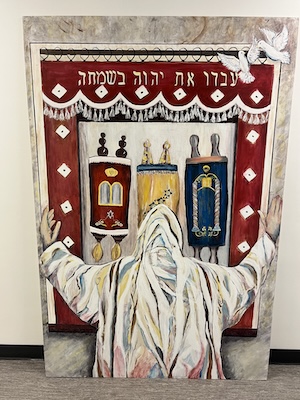
photo - Ramona Josephson was the lead artist on one of the two murals portraying Shabbat
Ramona Josephson was the lead artist on one of the two murals portraying Shabbat. (photo from Beth Israel Mural Project)

“The next steps were to call out to the congregation to see who would like to participate. At this time, all meetings were held on Zoom due to COVID. Once the committee had the members, we then went out to the congregation – we wanted the entire membership to feel included, to see what they wanted to see in the garage. The overwhelming feedback was the holidays.”

Volunteers were assigned a holiday and the committee helped with each image. “This is when the real work began,” said Schwartzman. “But, up to this point between COVID and summer holidays, it was two years.

“With Peter Sarganis, an amazing artist himself but also an art teacher, he guided us on the steps required to take our wonderful images through the multiple steps to get each image on the boards. Once the boards were ready to go, we met each Sunday afternoon for painting for several months. There were committed painters who would come in during the week to work as well. This was a labour of love! The energy in the room when we were painting was fabulous. Focused artists and painters working together to bring these works to fruition.”

Sarganis answered the callout to members because, he said, “As an artist, I thought it would be a creative way to combine my love of Judaism, the Beth Israel Synagogue, collaboration and painting.”

Sarganis became the project’s art director and a lead artist and designer of one of the two Shabbat works.

“I love Shabbat. From Friday evening family dinners; to Shabbat morning services; to the candles, wine, challah and artifacts used – I can simply say I love it,” Sarganis said of his choice of holiday to portray. “The Shabbat panel I designed and painted is an abstracted representation of our family’s candle holders, Kiddush cup and challah cover.”

About the project, he said, “We had a wide range of expertise, from those who don’t paint at all to those who paint a lot. The common thread that kept us going and made this a beautiful group to be a part of was everyone’s passion for the project. 

“As a professional artist and someone who has taught at a fine arts school for the past 29 years, it seemed the role of me becoming art director happened organically, it was not something that was there at the start of the project,” he added. “This included helping the designers of the panels with their designs, bringing in tools and equipment to help facilitate the transferring of the designs onto the large panels, advising the groups of painters on the painting process and/or techniques, figuring out (with Reisa) the placement of the panels in the parkade.”

“I really believe that we can beautify the most simple areas to make them more impactful,” said Schwartzman. “Having these windows in the garage makes the experience of going to the BI start right from parking your car. But we didn’t stop there. Krystine McInnes came up with the idea that we should add QR codes to each image so that people could open their phones and learn more about each holiday, the customs and history. We hope we can use these to fight antisemitism as well, or just to help educate. We decided to paint on boards rather than the wall itself so, if needed, we could have them traveling.

“One thing different about our art is that none of the pieces are signed. This was with the commitment that the works were collective, designed and inspired by several artists and painted by the community we built. It is a community effort for our shul.”

While the lead artists aren’t indicated on the murals in the garage, they are credited on the project’s website, bethisraelartproject.com: Beryl Israel (Purim and Tu b’Shevat), Sheila Romalis (Hanukkah), Ramona Josephson (Rosh Hashanah, Sukkot and Shabbat), Debby Koffman (Simchat Torah), Janice Masur (Shavuot), Luca Carati (Yom Hashoah and Yom Yerushalayim), Nassa Selwyn (Pesach and Yom Kippur) and Adele Lewin (Simchat Torah). In addition to the QR code integration, McInnes designed the project website, which features information on the holidays, their history and customs from several sources, including work done by Jean Gerber and Jonathan Berkowitz and a dozen or so websites.

The paint was donated by Benjamin Moore Paint and the boards and framing by Burton Mouldings, said Esther Moses, Beth Israel executive director. Ralph (z’l) and Elaine Schwartzman donated to help make the project possible, she said.

“My parents believe in supporting our community and have always been supporters of several Jewish agencies here and abroad,” explained Schwartzman. “Once they heard about what I wanted to do, my mom called the shul and made a donation to make sure we could complete the project. Supporting the shul, the arts, community and engagement for people are all reasons they stepped forward.”

image - Beryl Israel was the lead artist on the Tu b’Shevat mural
Beryl Israel was the lead artist on the Tu b’Shevat mural. (photo from Beth Israel Mural Project)

“I am so proud of Beth Israel and our members who worked on the murals. They are strikingly beautiful,” said Rabbi Jonathan Infeld, the synagogue’s senior spiritual leader. “They bring light to our congregation and are a great educational tool. They brought people together for an important common cause. The murals are another way that we help bring Jews closer to God, Torah and Israel at Beth Israel.”

While he helped, for example, with the Hebrew on one of the works, Infeld admitted, “I am involved in many different aspects and programs of the synagogue, this is one that I did not play a large role in though. Yes, I helped with some of the Jewish content. But anyone who knows my artistic abilities knows why I left this project to others to accomplish.”

The project – which took a total of three years from conception to installation – “was a great way to add colour to our parkade in a meaningful and Jewish way,” said the rabbi. “The murals are educational and exceptionally beautiful. But, most importantly, they created community amongst people of all ages.”

Overall, it has been a huge success, he said. “People love seeing [the murals] when they enter the parkade. They love looking at them and learning from them. I know that the participants loved making them.”

“This project was really a labour of love by all who participated,” agreed Schwartzman. “Peter was incredibly supportive with his knowledge and guidance. There were so many amazing artists that we all learned from each other, helped each other and celebrated together. We really hope that these images bring the shul much enjoyment and support them in any of their programming when possible.”

“This project took a lot of time and work – and was worth every moment,” said Sarganis. “I met some wonderful people, and got to know people I already knew even better. A beautiful community project.” 

So many choices to be made

The late afternoon, right after school or summer camp, is go time for many parents. These are the moments where my twins have every kind of need, from taking off their outside gear and emptying lunch bags to signing permission forms, getting help on projects, and more. It is a period of chaos, usually with a desperate need for snacks as well as dinner preparation, all rolled up. There are days when things are calm, sure, but there are other times when I savour my last moments of quiet at 3:25 because from 3:35 until 6:30 or so, after dinner, I am a whirlwind doing Marathon Mom work.

Our public junior high this year presented us with Mega Options activities for the last few days of school. While the various options were hyped to students in advance, only whispers of this made it home. So, on an average Monday afternoon in June, my kids told me to be sure to open the special Mega email fast, as all the best activities would fill up. At 4:30 on the button, my inbox told me about the many Mega Options I would need to hurry to fill out to meet my twins’ expectations.

There were so many choices: Métis sash-weaving and historic cemetery trips, Inuit printmaking and Indigenous storytelling, Euro-style soccer tournaments, Pickleball, phone photography, kinesiology and nutrition lab field trips to a university, and more. There were bike treks, orienteering, the list went on. The selection was huge. Not every outing had a description or information. Some choices came with big fees. Others were free.

It was a huge rush to decide. We watched some activities fill up even as we tried to sign up – and, with twins, we had to sign up twice. In the end, my more social kid called one of his close friends. On the other end of the phone line, I heard his mom, a teacher I am friendly with, coaching him through. It was a great solace to know I was not alone in sorting through this!

Within moments, both my twins were signed up, with their friend, for one day of board games, outside games, and baking bannock and eating together. The other day was reserved for going to Assiniboine Park, Winnipeg’s version of New York City’s Central Park, and always a fan favourite. I emailed the other mom afterwards. “Sheesh!” she replied. “That was stressful – lol.” It was. She was completely right. The Mega Options format left me strung out and worried. Did we make the right choices? What does “A day at Assiniboine Park” mean? There was no description. What do we parents need to provide? Lunch? Money? Rides?

After the decisions were made and the activities secured, I was relieved. The fun warm weather choices our boys made were free, easy and uncomplicated. Sure, it wasn’t going to be a big learning experience, but the decisions were made. We no longer had to dwell on the choices themselves. 

After stepping back, I realized that these late afternoon blitzes are so hard because they can be unpredictable and disorderly. There are multiple tasks thrown at parents at once, when we’re not necessarily at our best energy-wise. Both flexibility and preparedness are necessary. There’s no telling if today I’ll have to be a math whiz, an event planner, or a custodian, cleaning up after a kid is sick in the hallway. (Hey, it happens.)

The skills required to manage the late afternoon rush aren’t just relevant to kids. As adults, and as Jewish people, we are often offered “Mega Options” when it comes to making choices. We don’t have one specific menu item at restaurants, nor do we have a single kind of Jewish ritual, religious life or home observance. We face tons of choices every day. Further, while the pandemic narrowed some options, the post-pandemic world has vastly increased them. When our usual routines are disrupted, we’re forced to evaluate what we’ve done all along. Is streaming a religious service easiest?  Are we healthy enough to attend in person? What is the COVID protocol (or non-protocol) these days, even as the virus still circulates? Sometimes, we crave situations where the decisions are just made for us, even as we know it would be better to make up our own minds instead.

This was our world before Oct. 7. Afterwards, the choices became even larger. Now, questions of safety and freedom from harassment also come into play. We choose whether to wear anything identifiably Jewish when out on the street. We question if we’ll feel safe attending this Jewish venue. Is attending this graduation/parade/campus/event going to force us to deal with protesters or hate speech? Then there’s: Are we still safe, wherever we live? Should we be considering a move to someplace safer? Is there somewhere safer? 

We could pretend that all these choices are a part of the modern age, but we know from Torah study, the many debates of the Talmud and Jewish history that the act of making choices is an essential part of what it means to be Jewish. From the first, we were shown hard choices and real consequences: from Leviticus 10’s Nadav and Abihu, who chose to sacrifice “strange fire” and were struck down for it (a bad choice, apparently), to Deuteronomy 30:19, which summarizes a long list of choices we can make, concluding, “I have put before you life and death, blessing and curse. Choose life….” 

The Mega Options presented to celebrate the end of school is nothing when compared to big decisions in life. One could just shrug it off as no big deal – but life is a series of little choices, one after another, that can affect everything. Survivors of major disasters often explain how they “just missed” the accident because they felt sick, woke up late or forgot to make their lunch. Historically, Jewish refugees described how they left at a moment’s notice, with only a suitcase, or just the clothes on their backs.

We don’t always know which choices are the big ones, or the good ones. Some of the best choices result in happy, long-lasting results, like meeting one’s life partner, discovering a passion or skill, or experiencing an amazing natural event like a meteor shower or the Northern Lights. Here’s to hoping our choices are easy and small ones, and that these options lead to all positive things. Here’s to celebrations, miracles and good deeds this summer – may we all have more “mega” pleasant choices ahead. 

Joanne Seiff has written regularly for the Winnipeg Free Press and various Jewish publications. She is the author of three books, including From the Outside In: Jewish Post Columns 2015-2016, a collection of essays available for digital download or as a paperback from Amazon. Check her out on Instagram @yrnspinner or at joanneseiff.blogspot.com.

About the 2024 Summer JI cover

image - JI Summer 2024 cover Vancouver Jewish Community Garden coordinator Maggie Wilson took the photo that graces this year’s cover of the Jewish Independent Summer issue. According to the garden’s newsletter, “A few strawberry plants opted to try their luck in the gravel and managed to produce the season’s first strawberries!”

The garden was established in 2020 by Vancouver Talmud Torah, Congregation Beth Israel and Jewish Family Services. It was made possible by the Diamond Foundation, which secured a long-term lease of the land for future development and is allowing the land to be used on a temporary basis, and the Jewish Federation of Greater Vancouver, Jewish Community Foundation and Ronald S. Roadburg Foundation, who provided significant financial seed gifts.

The recent newsletter shared, “We have already harvested a crop of vibrant radishes, arugula, kale and herbs. Children and adults alike have enjoyed tasting nectar-laced kale flowers, and JFS’s chef used the fresh radishes in her Tuesday salad.

“The peas, seeded by VTT’s Grade 1 students, have started to ripen. The first small batch was harvested for JFS by VTT’s Green Thumb Club.”

Groups from JFS, VTT and BI “have spent time in the garden this spring, contributing their muscles, enthusiasm and appetites! 

“JFS staff came to move wheelbarrows of compost into the garden beds to top-up and replenish the soil. They then enjoyed a picnic lunch in the garden.”

VTT students from grades 1 through 7 have come to help and learn in the garden, as have students from BI’s Hebrew school, and BI staff.

For community members looking to get involved in the garden, its website – jewishcommunitygarden.ca – is now live. Check it out for all things garden, including a continually updated slide show so you can follow along as the garden changes throughout the seasons. Upcoming volunteer opportunities will be posted, and information on how you can get involved. Everyone is welcome – there are tasks for all abilities and experience levels.

ישראלים מרגישים לא בטוח ברחבי העולם

למלחמה בין ישראל והחמאס ברצועת עזה יש השלכות חמורות לגבי ביטחונם של הישראלים הגרים מחוץ למדינה. המראות הקשים של ההרוגים הרבים בעזה מסיבים נזק גדול לישראל. רבים בעולם כמעט ושכחו מה הביא לפעילות של ישראל בעזה – אירוע השבעה באוקטובר הנחשב לדבר בלתי נתפס. ולמרות זאת, בעולם מתעסקים כיום בעיקר בצד הפלסטיני הסובל מהרוגים ופצועים רבים, בו בזמן שרצועת עזה הולכת ונמחקת

הפגנות נגד ישראל, ישראלים, יהודים ומוסדות ישראלים ויהודים בעולם מתרחשות כל העת במקומות רבים. הכעס והשנאה המופנה כלפי ישראל כבר מזמן חצה את הקו האדום ולא זכורה תקופה כזו בעבר

בנוסף להפגנות יש גילוי שנאה ואלימות כלפי ישראלים ויהודים הגרים בערים שונות במערב. גם תיירים מישראל מרגישים כבר שלא בנוח לטייל במקומות שונים

המטה לביטחון לאומי פרסם לפני מספר שבועות היום את הערכת האיום לישראלים בחו”ל מצד גורמי טרור, במטרה להגביר את המודעות של הציבור הישראלי לאיומי הטרור במקומות שונים בעולם. במוקד: בקשה מהישראלים להימנע מהגעה למדינות שכנות של שיראל ובהן: לטורקיה, מרוקו, מצרים (כולל חצי האי סיני) וירדן. וכן מומלץ באופן כללי לא להחצין סממנים ישראליים או יהודים

בהודעה שפרסם המטה לביטחון לאומי נכתב כי בשנים האחרונות מזוהה מגמה מתמשכת של החמרה באיום כלפי ישראלים ויהודים בחו”ל, שהוחרפה מאז תחילת מלחמת חרבות ברזל (בחודש אוקטובר אשתקד), לאור עלייה במוטיבציה של גורמי טרור שונים בעולם לממש פיגועים. במסגרת זאת, בולט האיום האיראני שהתעצם ולצידו גם חמאס וגורמי ג’האד עולמי, המקדמים ביתר שאת פיגועים נגד ישראלים ויהודים מחוץ לישראל

עוד נכתב כי בחודשים האחרונים סוכלו עשרות פיגועים נגד יעדים ישראלים ברחבי העולם. לאור זאת, הדגישו במטה לביטחון לאומי כי פוטנציאל איומי הטרור כלפי ישראלים ויהודים כעבור למעלה משבעה מתחילת המלחמה – גבוה במיוחד

חודשים האחרונים התגברו הפרסומים של ארגונים אלו ותומכיהם, הקוראים ומעודדים לפגוע ביהודים וישראלים ברחבי העולם. במדינות המערב, האיום המרכזי הינו מצד מפגעים בודדים, אשר פועלים בהשראת הארגונים ועלולים לממש פיגועים כנגד ישראלים ויהודים, כפי שאירע למשל בשוויץ ששם נדקר אזרח מקומי יהודי בראשית חודש מרץ. זאת, ביתר שאת לאור אווירת המלחמה, האנטישמיות וההסתה חסרת התקדים נגד ישראל, ישראלים ויהודים ברחבי העולם

גורם המדיני ציין כי גם משחקי היורו שיתקיימו במהלך קיץ בגרמניה והאולימפיאדה שתתקיים בצרפת, שני אירועים שעשרות אלפי ישראלים צפויים לפקוד אותם, הם אירועי שיש לנקוט בהם זהירות מיוחדת. עיקר החשש הוא מגורמי ג’יהאד עולמי, כאשר גם ישראלים ויהודים על הכוונת, אמר הגורם הישראלי. בכל רגע נתון יש מאמצים חובקי עולם כדי לבצע פיגועים נגד ישראלים ויהודים, הוסיף אותו גורם. יחד עם גורמי ביטחון מקומיים, קהילת הביטחון של ישראל מבצעת אינספור פעולות על מנת לסכל. מפעם לפעם יש פרסומים על סיכולים, אך מה שמתפרסם הוא קצה הקרחון של מה שקורה באמת

אני עצמי חזרתי לאחרונה מנסיעה בת שבועיים בספרד כולל הערים ברצלונה ומדריד. לאור המצב המתואר לעיל נקטתי באמצעי זהירות מירביים. לא הסתובבתי ליד שום ארגון יהודי או ישראלי ולא דיברתי עברית בשום מקום. אני לא נושא שום סממנים ישראלים או יהודים בכל מקרה אך הפעם הקפדתי במיוחד. ולכן גם לא הבאתי עימי לטיול הפעם ספר בעברית. ראיתי בטיול לא מעט דגלים פלסטינים התלויים באזורים שונים בברצלונה וספרד וזה לא בדיוק נעים