
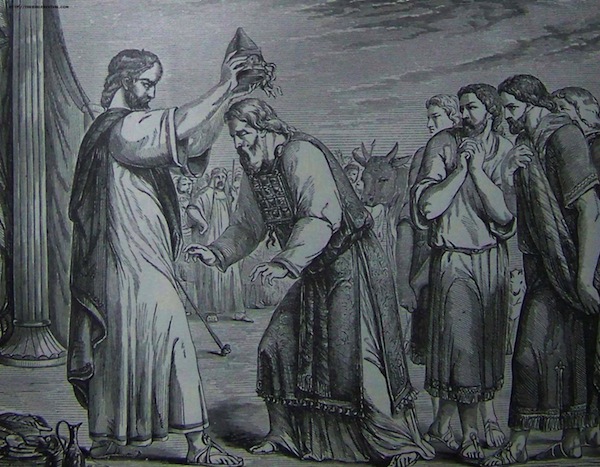
“Consecration of Aaron and His Sons,” an illustration from the 1890 Holman Bible, 1890. Aaron’s high priest attire is elaborately described in the Hebrew Bible. (photo from Wikipedia)
Fashion in the Bible? What does that mean? The biblical text actually offers us an idea of what people wore in those times – and even why.
For the majority of us, the most familiar example of biblical fashion is found in Genesis 37:3 in the description of young Joseph’s problematic coat of many colours. This coat, which was gifted by Joseph’s father Jacob, served to anger and increase the jealousy Joseph’s brothers towards him. Consequently, they throw him in a pit to be left to his fate: to die of thirst, to be killed by a wild animal or to be picked up by traveling merchants.
From a chronological point of view, however, the first real example of Old Testament fashion comes at the very beginning of Genesis. In this instance, G-d has decided to exile Adam and Eve from the Garden of Eden. As we all know, G-d was angered by Adam and Eve’s disobedience in eating from the Tree of Knowledge. While He is upset with them, He obviously still cares enough to provide them with warm coverings, more than the fig leaves they chose for themselves: “the Lord G-d made garments of skin for Adam and his wife and clothed them.” (Genesis 3:21)
Moving on in the Book of Genesis, we read that, when Abraham’s servant Eliezer escorts Rebecca (who will become the second Matriarch) back from Aram-Naharaim, she sees Isaac (who will become the second Patriarch) for the first time. She asks Eliezer about Isaac’s identity. After he tells her, she modestly conceals her face: “‘It is my master.’ And she took her veil, and covered herself.” (Genesis 24:65)
Veils are used for a different purpose in the story of the widow Tamar and her widowed father-in-law Judah. In this story, Judah does not fulfil his promise to make his youngest son her husband in accord with the practice of levirate marriage. (Judah thinks that Tamar has basically brought about the death of his first two sons when, in fact, it was G-d’s doing.) Judah also subjects Tamar to widowhood when she should have been free to remarry.
In response, Tamar takes drastic action. She hides her true identity behind a veil. She sits at the side of the road, where, presumably, she could be taken for a harlot or public woman: she “put off … the garments of her widowhood and covered herself with her veil and wrapped herself.” (Genesis 38:14) Without Judah being any the wiser, she allows him to have intercourse with her and, when a pregnant Tamar presents Judah with his staff and seal, he realizes what he has done and acknowledges his wrongdoing. The Bible tells us that she secures her place in the family by having twin sons from this union. The biblical reader doesn’t know more about Tamar, but one knows that Perez, one of her twins, will provide the lineage for King David.
One might think that, after hundreds of years of slavery, the Hebrews would want no reminders of their life in Egypt. But, according to the biblical text, the Hebrews took clothes from the Egyptians: “And the children of Israel did according to the word of Moses; and they borrowed from the Egyptians … clothing.” (Exodus 12:35) Significantly, before the Hebrews hear G-d declare the 10 Commandments, Moses instructs them to prepare themselves by laundering their clothes: “And Moses went down from the mount unto the people and sanctified the people; and they washed their garments.”(Exodus 19:14)
According to Rabbi Simeon – a scholar who was active between 135 CE and 170 CE – at the time of the Exodus from Egypt, the Hebrew weavers did not take their looms. Yet the Hebrews’ clothes never wore out in the 40 years of desert wandering. In Deuteronomy 8:4, it states: “Thy raiment waxed not old upon thee.”
We read that, in keeping with her status as part of the royal family, King David’s daughter Tamar (like Joseph before her) wore a vibrant robe: she “had a garment of many colours upon her; for with such robes were the king’s daughters that were virgins appareled.” (2 Samuel, 13:18) Not befitting royalty, King David’s firstborn son Amnon rapes Tamar, his half-sister, then throws her out.
Both violated and rejected, Tamar tears her robe, going into mourning: “And Tamar put ashes on her head and rent her garment of many colours that was on her; and she laid her hand on her head and went her way, crying aloud as she went.” (2 Samuel, 13:19) Absalom, her full brother, has her stay in his household for the rest of her life. Two years later, Absalom takes revenge by having Amnon killed.
When Queen Esther had to talk with her husband, King Ahasuerus, she put on her royal apparel (Scroll of Esther 5:1). Had Esther been made wary by the fate of her predecessor, Queen Vashti? As we recall, King Ahasuerus ordered Queen Vashti to appear “wearing her royal crown.” (Scroll of Esther 1:11) One rabbinical tradition interprets this to mean that the king’s instructions were to wear only her royal crown; in other words, to appear naked (Babylonian Talmud, Megillah 12b). According to that tradition, Queen Vashti refused because she did not want to be put on display before a bunch of guys who had been drinking for a week straight. Vashti’s refusal apparently resulted in her banishment. Admittedly, she paid a heavy price, but it would appear as if both these queens admirably set the terms for how they would respond to their husband.
Of all the given examples, the most elaborate description is given to the clothes Aaron (Moses’s brother) wore as the high priest. The description is more or less repeated in a few places, but here is the narrative of Moses dressing Aaron: “And he put upon him the tunic, and girded him with the girdle, and clothed him with the robe, and put the ephod upon him, and he girded him with the skilfully woven band of the ephod, and bound it unto him therewith. And he placed the breastplate upon him…. And he set the mitre upon his head; and upon the mitre, in front, did he set the golden plate, the holy crown.” (Leviticus 8:7-9) The clothing, like the text itself, is meant to impress.
The Hebrew Bible has been around a long time; in its present form, most likely since the second century CE. The clothing it describes may truly be termed sustainable fashion.
Deborah Rubin Fields is an Israel-based features writer. She is also the author of Take a Peek Inside: A Child’s Guide to Radiology Exams, published in English, Hebrew and Arabic.