Radical innovation requires changes to law

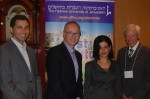
Left to right: Bo Rothstein, CFHU Vancouver president Randy Milner, Prof. Michal Shur-Ofry and Justice Bruce Cohen. (photo by Michelle Dodek)

The main boardroom at Farris was full of lawyers who had come to hear Prof. Michal Shur-Ofry of the law faculty at Hebrew University of Jerusalem. The Oct. 6 event began with a brief presentation by University of British Columbia law professor Christie Ford on her experience at Hebrew University in the spring as part of the Mitchell Gropper Law Faculty Professorship Exchange. Bo Rothstein, a partner at Farris, gave a warm welcome and introduced the keynote speaker, an internationally recognized expert in intellectual property (IP).

Shur-Ofry’s lecture was titled From Newton to Shechtman: Can Intellectual Property Facilitate Nonlinear Innovation? She told the story of Dr. Dan Shechtman, an Israeli researcher who observed “quasicrystals” in 1982, a discovery that scientists were convinced was impossible; Shechtman nearly lost his career as a result of publishing his findings. In 2011, however, he was vindicated when he was awarded a Nobel Prize in chemistry for this discovery. The dramatic story of this Israeli Nobel laureate illustrates aspects of nonlinear innovation, those that shift existing paradigms.

Another example of such a paradigm shift, said Shur-Ofry, was the introduction of cubism by the artists Pablo Picasso and Georges Braque. Their movement away from the representational depictions that had previously dominated art was at first ridiculed. Once accepted, however, their innovative contributions became a crucial building block of 20th-century art and beyond.

The world is currently biased against radical innovators, Shur-Ofry maintained, but she believes that “a de-biasing mechanism” is possible through IP law. This area of law, which encompasses copyright and patent law, can help artists, scientists and other innovators to be brave and to contribute their novel innovations without the kinds of risk taken by the Picassos or Shechtmans, she said.

“If an artist first sells a piece for just $900, and then it is resold for $85,000, the artist is entitled to a share of that sale price.”

Citing droit de suite, a law adopted by the European Union and 70 other countries that gives artists protection by entitling them to part of the proceeds of subsequent sales of their art, Shur-Ofry explained by way of example, “If an artist first sells a piece for just $900, and then it is resold for $85,000, the artist is entitled to a share of that sale price.” She acknowledged that while this type of remuneration exacts a cost on doing business, its benefit to artists who are innovators can drive others to produce novel works, instead of commercially proven, formulaic art.

It is this type of law, along with other incentives to inventors, that Shur-Ofry champions. She described patent laws that would grant access to the successful results of works protected through patents, as well as the “negative knowledge” that results in even greater innovation and discovery. Great problems are often solved by discovering an error in the paradigm, she explained. Therefore, access to the challenges and roadblocks in developing technologies may be the key to solving even greater problems. She said that she hopes to convince lawmakers that changing IP laws will encourage non-linear innovation and be universally beneficial.

The Mitchell Gropper Law Faculty Professorship Exchange facilitates annual exchange between Hebrew University and UBC law professors, and enables annual lectures by visiting Hebrew University law professors. For more information about the exchange or the programming of CFHU in Vancouver, visit cfhu.org or contact executive director Dina Wachtel at 604-257-5133.
Sexual harassment still a problem

When Winnipeg lawyer Yude Henteleff tried to change the way in which sexual harassment was viewed in Canada 25 years ago, he had hoped for more change by 2014.

At the time, he was the judge appointed to a case that involved a waitress who was being sexually harassed by another employee at the restaurant where she worked. After going to the owner of the restaurant and asking for his help and getting nowhere, she turned to the courts. While her case followed another with similarities, which ruled that the accused was not guilty, her case landed in Henteleff’s courtroom.

In Janzen v. Platy Enterprises Ltd. (1989), Henteleff found in favor of the plaintiff. His verdict was 144 pages long and included substantial evidence to support his decision, which he hoped would help the case stand the test of time.

photo - Yude Henteleff
More than 25 years ago, Yude Henteleff tried to change the way in which sexual harassment was viewed in Canada. (photo from Yude Henteleff)

The case went through appeals that won but, in the end, it went on to the Supreme Court of Canada, where the verdict was reinstated. It has since been referred to more than 500 times in cases and verdicts throughout Canada.

Henteleff would be the first to say that we have a long way to go until sexual harassment disappears from the Canadian landscape, as it “continues to happen every day to hundreds of thousands of girls and women around the world to an extent that never seems to diminish.

“There are many instances that one can point to, which seem to indicate that, at least in Canada, as a result of the decision in Janzen v. Platy and other decisions which have since occurred dealing with the issue of sexual harassment, that, indeed, positive transformation has occurred – and that is marvelous,” he said.

“On the other hand, when you read recent studies, you really have to sit up and take notice that so much more has to be done, that sexual harassment is still rampant and widespread. We have legislation passed against bullying and the like, but why do these attitudes still persist to such a degree that it’s still so much to the continued disadvantage of women and girls?”

At the time of his Janzen v. Platy decision, Henteleff awarded lost wages plus exemplary damages to each of the two women. He did so because he “felt the economic consequences, amongst others, to women being sexual harassed was quite severe and no previous case I’d read had taken that into account. And, I thought it was about time that employers realized that, not only would they lose a case, but they would lose money out of their pocketbooks.

“Ultimately, I felt it was the strongest message one could give to potential harassers – that, hey you know what, this is going to cost you and you better think twice about doing what you’re doing or think twice about not speaking with your employees in such a way, that they wouldn’t continue to harass co-employees.”

Henteleff added, “When it was appealed to the Court of Queen’s Bench the first instance, they reduced it [the financial aspect] quite considerably,” he said. “When it went to the Court of Appeal, they reduced it even more, to the point where it just became a light slap on the wrist.

“The fact that, for the first time ever, the Supreme Court of Canada not only dealt with this issue, but dealt with it in a way that made it very clear sexual harassment was simply not acceptable.”

Henteleff views the current legislation and policies at various workplaces as quite adequate. But, he said, “Where the fault lies is in attitude. Attitudes have to be changed. The only way you can change it effectively is within the school system and that isn’t being done. But, it also has to be with society as a whole. Why school systems have been so resistant, why faculties of education have been so resistant, is a real puzzle to me.”

While Henteleff acknowledged that nowhere else in the world is doing a better job than Canada with respect to dealing with sexual harassment, he said, “We know it’s bad enough here and that should be enough for us to say we need to do much more than we’ve been doing so far to deal with this problem.”

As for Dianna Janzen, she continues to share her experience, because she knows from her work with Women’s Legal Education and Action Fund that the issue is very much alive.

“She is an example of how a young woman who wasn’t the least bit active in this area has become active because of her own personal experience,” said Henteleff about Janzen. “She isn’t afraid to share all the nuances of it, which shows a great deal of courage on her part.

“On the other hand, we know of thousands of women to whom this happened that are scarred forever, who remain silent, where it continues to eat at them because of how horrible that experience is to them psychologically, emotionally and physically. There are many statistics as to the long-term consequences, the negative ones, the serious ones, on women who suffer sexual harassment. They still have to deal, for the rest of their lives, with this horrific, horrible experience.

“One of the greatest problems facing mankind and womankind,” he continued, “is exemplified by the continued horrible violence against women – and this is because of attitudes rooted in thoughts and ideas that should no longer be parts of who we are as a society.

“Human beings have been searching for human rights, harmony, equality, respect and dignity for all. What we’ve done post-Janzen v. Platy falls far short of achieving these objectives for women and girls.”

Rebeca Kuropatwa is a Winnipeg freelance writer.

Untangling the womb maze

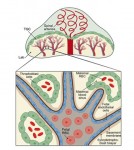
Fluid-filled structures in the placenta. (photo from wis-wander.weizmann.ac.il)

The fetus in the womb totally depends on the blood bond with the mother. Spotting irregularities in the flow across the placenta could therefore be crucial for detecting fetal distress,

but currently no reliable method is available for monitoring the flow or detecting other signs of the distress in its early stages.

Magnetic resonance imaging, or MRI, can be safely performed during pregnancy, but currently available MRI methods are not suitable. Problems include the motion of the fetus or mothers’ breath, the varied structure of placental tissue and the tangled maze formed by maternal and fetal blood vessels.

In a new study in mice conducted with advanced MRI methods, Weizmann Institute scientists have now revealed in unprecedented detail the dynamics of the flow of fluids within the placenta. This feat was all the more impressive, as a mouse placenta is around the size of a dime. As reported recently in the Proceedings of the National Academy of Sciences, they managed to identify three different types of fluid-filled structures: maternal blood vessels, which account for two-thirds of blood flow in the placenta; fetal vessels, which account for about one-quarter of the flow; and embryo-derived cells infiltrating the mother’s vasculature, which account for the rest of the flow and in which the exchange of fluids between mother and fetus takes place. The researchers also found that in maternal vessels, blood flows by diffusion, whereas in fetal vessels, the flow, stimulated by the pumping of the growing fetus’ heart, is much faster. In the cells that have infiltrated the mother’s vasculature, the dynamics of the flow follows an intermediate pattern, driven by both diffusion and pumping.

Two sophisticated MRI methods were combined to enable the study: one geared toward monitoring diffusion and another directed at identifying structures with the help of a contrast material. They could be applied successfully in large part thanks to an innovative scanning approach, spatiotemporal encoding (SPEN), a Weizmann Institute technique. Because SPEN is ultra-fast and makes it possible to separately encode signals from such different materials as air or fat, it allowed the researchers to overcome disturbances created by movement and the variability of placental tissue. If developed further for safe and reliable use in humans, this combined approach holds great promise as a noninvasive means of detecting fetal distress caused by disruptions in the placental flow. It can be particularly valuable when fast decisions about inducing labor need to be made, for example, in such complications of pregnancy as preeclampsia.

The study was a joint effort of two laboratories: one headed by Prof. Michal Neeman of the biological regulation department and the other by Prof. Lucio Frydman of the chemical physics department. The research was performed by two graduate students, Reut Avni from Neeman’s lab and Eddy Solomon from Frydman’s lab, together with Ron Hadas and Dr. Tal Raz of the biological regulation department, and Dr. Peter Bendel of chemical research support, in collaboration with Prof. Joel Richard Garbow from Washington University in St. Louis.

For more Weizmann news, visit wis-wander.weizmann.ac.il.

Calderon begins discussion with Bride

Newly elected Knesset member Ruth Calderon caused a sensation last year when she engaged a member of the Sephardi religious party Shas in a discussion of Talmud during her inaugural speech in the Knesset. She had brought her copy of the Talmud to the podium and read a short excerpt about Rav Rehumi, who stayed at the yeshivah to study on Yom Kipper eve. He fell to his death at the moment that his wife realized he was not coming home.

Calderon read the cryptic tale first in Aramaic “for the music” and then in Hebrew. The story is one of 17 included in A Bride for One Night, an English translation (by Ilana Kurshan) published earlier this year by the Jewish Public Society. The book was originally published in Hebrew, in 2001.

image - A Bride for One Night cover
In the lingo of these modern times, this book is a “disruptor.”

Although the talmudic tale focuses on Rav Rehumi, Calderon in the book re-imagines the event from the perspective of his unnamed wife. The vivid first-person account portrays the wife’s challenging life, from her joy in marriage to her anxiety as she waits.

Similar to the format of the Talmud, Calderon also offers commentary on the story. “Just between us,” she writes in her breezy style, “Rev Rehumi was a rather mediocre scholar.”

Calderon draws a parallel to the legends of Odysseus, who took 10 years to return home after the Trojan War. “The time has come to turn to the true hero of the story, she who carries Rav Rehumi on her shoulders. She is like Odysseus’ Penelope,” Calderon says, referring to the wife of the wandering warrior. “If Rav Rehumi achieved any fame, it is thanks to his wife.”

The commentary, with footnotes, offers some observations about the Rav’s emotional life, romance and morals. Calderon also provides sources for further readings.

In the lingo of these modern times, this book is a “disruptor.” Calderon has flung open the doors to the study halls. She has liberated the ancient texts, taken them out of the exclusive preserve of religious male scholars and made them accessible to anyone who is interested in learning about how to be a good human being.

Calderon brings a strong woman’s voice to talmudic vignettes about a world that is, in her words, “topsy-turvy, frightening and funny. It is a world in which the impossible happens.”

A mortal steals the knife of the Angel of Death, God asks to be blessed by a human being, the wife of a Torah scholar dresses up as a prostitute and seduces her husband, a rabbi sets a test for his wife that leads to her suicide. Legend, creative literature, relationship advice, folk sayings, guideposts for a moral life – Calderon turns the kaleidoscope just a little bit and the ancient Talmud becomes a text for modern times.

The title of the book, A Bride for One Night, comes from a text in the Babylonia Talmud. In two different passages, highly respected itinerant rabbis ask, Who will be mine for a day? The question is associated with a woman selected by the community as a “wife” for the duration of the rabbi’s stay. Calderon imagines these situations from the perspective of a widow who has been asked to be a bride for one night.

“I don’t know how one learns a story like this in a yeshivah,” she writes in her reflections on this scandalous passage. “I read it with mixed feelings.”

After considering several possible ways to understand the tale, she concludes that the concept of marriage for a day is intended as a test of Western conventions about love.

Calderon approaches the sacred text with the belief that the contemporary Jewish bookshelf should include the Talmud, Midrash, kabbalist works and other religious texts, as well as Jewish literature and Torah.

The Talmud and other sacred texts are the common denominators of all the Jews of the world, she said recently during an address to graduates of Hebrew College in Boston. More than half of the Jews in the world are secular.

Calderon was raised in a secular family and neither her school nor the local library had a copy of the Talmud. She had to search for copies of sacred texts. She began to study Talmud after her army service.

“This is something that belongs to me, is part of me and I had to reclaim it,” she told the graduates.

Long before she entered politics, Calderon was involved in studying Talmud and bringing sacred Jewish texts to all Jews, regardless of religious affiliations or their level of learning. She founded Elul in Jerusalem, Israel’s first “secular yeshivah” for men and women, religious and non-religious. She also started Alma, a Home for Hebrew Culture, in Tel Aviv.

For many years, she studied daf yomi, a daily page of the Talmud, with a chavruta, a study partner. She has a doctorate in talmudic literature from Hebrew University.

With this book, Calderon challenges the reader to imagine the life and inner thoughts of religious leaders, to see beyond the text on the page and flesh out all those mentioned in the tale. She takes ancient theology, often with outdated and distasteful concepts, and reinterprets them for the modern age.

Similar to Talmud, her book is best read with a study partner. She has said during the U.S. promotional tour for the book that the imaginative tales reflect what she was thinking at the time she wrote them, and that she might offer an entirely different point of view if she were to become engaged once again in studying those passages. Yes, she is right there. A Bride for One Night is just the beginning of the discussion.

Media consultant Robert Matas, a former Globe and Mail journalist, still reads books. A Bride for One Night is available at the Isaac Waldman Jewish Public Library. To reserve it, or any other book, call 604-257-5181 or email library@jccgv.bc.ca. To view the catalogue, visit jccgv.com and click on Isaac Waldman Library.


Soup ladled with love

Sharon Hapton (photo from Random House of Canada) 

When she first got together with friends to make soup for women and children fleeing domestic abuse in Calgary, Sharon Hapton recalled how the chef at the shelter broke down in tears when she saw their delivery of kosher-style chicken soup.

“The reason the chef was overcome with emotion was that there were Jewish women at the shelter at that time, and she knew how much it would mean to them,” she explained.

Hapton and her friends were overcome, too, but more with surprise than anything else. They were stunned to learn the shelter was accommodating Jewish women. “Not one of us had thought we were making soup for someone in our own community,” she admitted. “It was a humbling and defining moment to know that domestic abuse crosses all cultures.”

image - The Soup Sisters and Broth Brothers Cookbook  cover
The Soup Sisters and Broth Brothers Cookbook features recipes by acclaimed B.C. chefs, including Vikram Vij, Karen Barnaby, Rob Feenie and Lesley Stowe, among others.

That was five years ago and since then Hapton has been busy with Soup Sisters and Broth Brothers, her nonprofit social enterprise that organizes soup-making events in some 20 cities nationwide. She visited Vancouver on Oct. 8 to launch her second cookbook, The Soup Sisters and Broth Brothers Cookbook, featuring soup recipes by acclaimed B.C. chefs, including Vikram Vij, Karen Barnaby, Rob Feenie and Lesley Stowe, among others. Hapton’s favorite, though, is the recipe she grew up with, her mother’s potato leek soup. “There’s so much memory and nostalgia in it, it’s really delicious, simple and beautiful,” she says of the recipe.

The mandate for Hapton’s organization is to nurture and nourish women and children fleeing domestic abuse and family violence and seeking shelter in some 30 shelters across the country, including those in Vancouver, Burnaby, Surrey, TriCities, Kelowna, Victoria and soon Penticton, too. Participants pay $55 to attend an event in partnership with a cooking school, where they help to make up to 200 servings of soup under the guidance of a chef facilitator. Afterwards, participants enjoy a meal of soup, salad, bread and wine with other cooks in the kitchen. “It’s a night out where you learn about the shelter you’re supporting and enjoy the camaraderie in the kitchen,” Hapton said. Ninety-five percent of the participation fee goes to the culinary partner, which supplies the ingredients and the kitchen where the soup is made. By uniting with a culinary partner the organization ensures participants will receive good service, fresh ingredients and operational excellence as they make their soup.

Since March 2009, more than 500,000 servings of soup have been delivered to Canadian shelters, thanks to a network of 12,000 participants. Hapton said the need in women’s emergency shelters is endless. “Most of those shelters are unfortunately always full, typically with up to 50 women and children at any time.”

Soup Sisters and Broth Brothers has also been supporting youth in crisis, specifically kids aged 16 to 24 who are transitioning from being street involved. While women being housed in the shelters don’t tend to communicate much to the organization (perhaps because of security concerns, or the stigma associated with being a victim of domestic abuse), the kids are really communicative, she said. “We receive letters from them with thanks, telling us how the soup made them feel, and the results of a simple, simple gift are very tangible.”

Batches of fresh soup are delivered in containers adorned with handwritten labels. Quantities are supplied to last until the next event when soup is made, which can be up to a month away.

“My experience of being a soup maker led me to understand that soup is a very powerful way of taking care of people,” Hapton reflected. “I believed very strongly five years ago that this could be something bigger, and that’s exactly what has happened now.”

These days, she receives emails from people all over Canada who have heard or read about the program. When new communities show an interest in starting the program, she asks to meet three main coordinators for each group and helps them implement it.

“Every city, big or small, has a shelter,” she said. And many of them are now being supplied with tasty, fresh, regular batches of soup.

In Vancouver, Soup Sisters supplies soup to Kate Booth House, Imouto Housing for Young Women and Koomseh transition house, in partnership with the Dirty Apron Cooking School. The next soup-making event is Jan. 25, at 11 a.m. For more information, visit soupsisters.org or email vancouver@soupsisters.org.

Lauren Kramer, an award-winning writer and editor, lives in Richmond, B.C. To read her work online, visit laurenkramer.net.


No more ice scraping

Who would have thought a solution to ice stickiness would come from a semi-tropical country like Israel?

Prof. Hanna Dodiuk heads up the department of polymers and plastics engineering at Shenkar College in Ramat Gan. She specializes in adhesion and adhesives science and technology, characterization and formulation of polymer adhesives, special coatings, surface and interfaces analysis, nanotechnology and aging of polymeric materials.

photo - Prof. Hanna Dodiuk
Prof. Hanna Dodiuk heads up the department of polymers and plastics engineering at Shenkar College in Ramat Gan. (photo from Prof. Hanna Dodiuk)

Born in 1948 in Krakow, Poland, to two Schindler’s List Holocaust survivors, the family made aliyah to Israel in 1949. Dodiuk served in the air force, and then studied chemistry at Tel Aviv University. In 1979, she joined the Israeli Armament Development Authority (ADA), also known as Rafael. From September 1991 to June 1997, Dodiuk was the ADA’s director of its materials and processes department.

Her research led to the creation of a surface to which ice cannot stick, a material she created while on sabbatical with a large bio company in Germany. “They invited me to develop surfaces that don’t adhere to anything, that are easy to clean, and that have super-hydrotropic surfaces,” she said. The company needed this to develop what Dodiuk referred to as “a microfluidic machine.”

“This small machine can only work with very small water droplets at minus-12 degrees,” she said. “To take such a little amount, you have to ensure the fluid is not absorbed on the surfaces.”

In her research, Dodiuk turned to biology and nature, studying how leaves react with water.

“While most leaves are weighted by water, lotus leaves, even if in mud and water, aren’t, so they remain fresh and clean forever,” she said.

Using a high-resolution microscope, Dodiuk found that the morphology of the lotus leaf is very unique. “It has small mountains of microns that have a very small circle in the diametre of a nano range, which is 10 to minus-nine metres. A water drop cannot enter the width between two nano particles, so it begins to fall off and slide. Therefore, the water doesn’t add weight.”

Dodiuk said this is not a new chemistry concept. It has been used in Teflon-like materials for years. But, while Teflon works well with oil, water can still get it wet and weigh it down.

Early on, Dodiuk found great success with the lotus leaf. Three years into the research, ADA asked her to help create a super-hydrotropic coating usable on glass to prevent ice from interfering with navigational systems by sticking and blocking the view. Dodiuk found a lab that would allow her to imitate ice adhesion in Quebec, where she conducted the experiments.

“We’re the only [technology] in the world that can reduce the adhesion of ice,” said Dodiuk. “You cannot avoid it totally, but you can reduce by a factor of 18. If you reduce the adhesion of ice by a factor of 18, you really avoid ice adhesion.”

This surface has numerous significant applications. “Airplane wings can take off, but the special coating that was so great at reducing the adhesion of ice was simply not durable,” she said. “If, for example, they were to apply very high winds, it would start coming off and nano particles would be lost, as the adhesion of the micro and nano particles wasn’t good.

“With the lotus plant, if its surface is damaged, it will repair itself. But, technology doesn’t know [how] to repair itself, so they had to find another solution. That is when the University of Massachusetts stepped in with funding and lab facilities.”

Aided by two university students in the plastics engineering department working to create a special film with the right properties at a very low cost, Dodiuk said they are now halfway to completion. The final product will be a stick-on film, like Scotch tape, but with nano particles on one side, not visible to the naked eye. It will be able to be applied to anything, from windows and wings of airplanes to car windows during the winter.

“We always laugh at the end of the day,” said Dodiuk. “Israel [doesn’t] have an ice-adhesion problem, yet we invented the solution.

“Once you talk about super-isophobic, easy-cleaning or self-cleaning [technologies], everyone is sold.

“Even with textile, it would be one that never gets dirty. For things to get dirty, the dirt has to adhere. If you avoid adhesion, you’ll stay clean forever. Can you imagine not needing to wash your things, as nothing will adhere to [them]?”

“Can you imagine all of New York and Vancouver never needing to be cleaned?”

The potential application possibilities are endless and multi-directional, with spin-offs that can be used in elemental technology, like car or high-rise windows with no need to clean off dust or dirt. “Can you imagine all of New York and Vancouver never needing to be cleaned?” asked Dodiuk.

“With this special coating, those windows will remain totally clean. Just a little bit of rain will take off all the dust. The rain won’t stick to the window, only to the dust.”

Through it all, Dodiuk emphasized, she succeeded in accomplishing all of this work, to date, in a “male-dominated environment. I really think [women] should go into science and technology. [Many women] are going into many areas today, but not science and technology.”

Rebeca Kuropatwa is a Winnipeg freelance writer.


Don’t let age fool you!

He didn’t realize it at the time, but Norm Archeck has been a significant inspiration for me. A catalyst for some of my proudest physical accomplishments.

This story – of one friend motivating another to achieve fitness success – wouldn’t be anything special … if Norm wasn’t 84 years old.

Two and a half years ago, after I had already rid myself of my adult-life-long baby fat, I noticed Norm regularly coming to the front desk of the JCC and challenging anyone within shouting distance to do push-ups with him. Right there. Drop and give me 20. Or 40, in Norm’s case.
Caught in the crossfire one day, my male ego couldn’t refuse the challenge, so I threw in a quick 25. That same ego was forced to up that 25 to 30 the next day. This was really no big deal. Until a couple of months later I managed to push my body away from the JCC floor 111 consecutive times. Yes, in a row.

For the most part I stopped doing push-ups with Norm after that day. But only because I decided it was time to parlay those gains into a more rounded gym routine. Since then I have hit new personal fitness levels again and again, staring down my upcoming 40th birthday like it’s going to put 20 to shame.

Now, there is something to be said about right place, right time, right motivation. I was clearly ready to embrace Norm’s challenge that day. But without Norm it wouldn’t have happened the way it did.

Brushing off everything with a laugh or a smile, Norm is that guy the rest of us look at and say, “I hope I’m doing that when I’m his age.” So when he issues you a physical challenge it’s pretty hard to turn him down.

Throw in three knee replacements, a new hip, a win over colon cancer 15 years ago and open heart surgery seven years later and it’s hard not to smile when Norm says, “Come on, young man. Let’s do some push-ups!”

… in front of everyone you work with.

photo - Norm Archeck
Norm Archeck – you’ll have to train to complete his fitness challenges at the JCC.

“My friends say I’m a nut case,” he laughed while taking a break in the JCC fitness room. “That’s how I live my life. I forget about the things that are challenging me and live my life.”

Norm was an athlete in his younger days, always wanting to push the limits. As he aged his doctor told him that if he didn’t work out he might as well just fold up shop, so to speak.

“He says I wouldn’t be where I am today if I didn’t exercise. And he tells his other patients to just do what Norm does.”

More recently, just to change things up a little, Norm has taken on the plank – a popular core strengthening exercise – as his new daily JCC-front-desk activity.

Targeting an absurdly-long 5-minute plank, he’s come close many times while brushing off non-believers one minute at a time.

He tells a story of being at a relative’s house for dinner recently when his planking prowess was brought up at the table. A burly, middle-aged dinner guest called Norm to task.

“He laughed at me when I said I could do it,” Norm said. “He was kind of a big mouth. So he challenged me and I knew he would struggle. I did it for around four minutes and he quit around two. I get a call a month later and he tells me he has gotten to 2.5 mins.”

So if you are ever at the JCC and you see an old gent sitting on the floor by the front desk, he’s not filming a new “Help, I’ve fallen and I can’t get up” commercial. It’s just Norm, living his life on his terms.

Doctor trailblazes in Toronto

With its Centre for Bedouin Studies and Development, Israel’s Ben-Gurion University (BGU) encourages Bedouin students to enrol at the Negev university by providing financial assistance and programming aimed at retention and academic success. One of the first students to go through the BGU program is Dr. Rania Okby, who is currently doing a fellowship in advanced obstetrics in Toronto.

At the young age of six, Okby, who was born in Be’er Sheva, decided she wanted to become a pediatrician, because, she said, “I really loved my pediatrician. I never had any problems going there when I was a kid, and I kind of wanted to be like her.”

photo - Dr. Rania Okby at the Asper Campus in Winnipeg earlier this year
Dr. Rania Okby at the Asper Campus in Winnipeg earlier this year. (photo by Ariel Karabelnicoff)

Okby’s parents divorced when her father expressed his desire to marry another woman. “Polygamy is a common practice in the Bedouin community,” she told the Independent. “About 30 percent of Bedouin women are in a polygamy system. My mom didn’t agree to that. She said, ‘OK, whatever, you want to get married? OK. But, I’m going to leave the house.’ She left the house with six kids – four girls and two boys.”

Okby, while in high school, spent one day a week at BGU, part of the university’s recruitment programs for Bedouin high school students. One such program, Seeds of Medicine, helps identify the best students, those who have a chance to be accepted into medical school.

“We were two female students who did very well in the project,” said Okby. “We went through interviews like other candidates for medical school. And, that’s how I became a medical student.”

In her first year in medical school, Okby had the opportunity to help deliver a baby. “I remember how it felt to be part of giving birth, dealing with birth and helping women … so, I fell in love with obstetrics and gynecology … and that’s how I decided to do that,” she said.

As it happened, Okby went on to become the first female Bedouin doctor in the world.

“My whole family was proud I was accepted,” she said. “They saw how hard I worked. I studied in high school five days a week and then I went another day to study in the university. And, you know what? On the seventh day, I would volunteer on a few projects.”

Financing was not an issue, as BGU covered expenses and the university is supporting Okby while she is doing her fellowship in Toronto.

“Being at the university at large, the fact that there’s more and more Bedouins going to BGU – especially girls – because of the Centre for Bedouin Studies, connects the Jewish community with the Bedouin community in an interesting way,” said the doctor.

The way Okby sees it, “If you’re more exposed to different people or cultures, you understand that they are human beings, just like you. It doesn’t matter if they’re Jewish, right? So, being exposed to one another at the university, for sure, makes it better. And the more educated people are, the more they will hopefully accept one another.

“There are many friendships between Arabs, Bedouins and Jews. It’s normal, because if you’re in contact with people, you become more comfortable with them. There’s a lot of Jews who volunteer in the Bedouin community, and there are some Bedouin who volunteer in the Jewish community – not necessarily in their own community.”

What is paramount in Okby’s mind is, “Education, education, education. To become equal, we have to first become empowered. Bedouins suffer from very low social economic, education and health status … everything is lower. So, to become equal, we have to be empowered.”

Life in Toronto

During the first two months Okby was living in Toronto, a friend stayed with her, and the doctor’s mom also joined her during the second month. Since September, Okby has been living on her own, along with her two daughters, in an area referred to as “the Kibbutz.”

According to Okby, “There are about 35-40 families, Israeli families, in the area, and 97 percent of them are Jewish. Most of them are doctors who came to do their clinical fellowships, but some of them are post-doc. We live in the same area and most of our kids go to the same school, so the older kids help the new kids adapt to school.”

Okby’s youngest daughter just started Grade 1, and the parents had a party for all their kids who were starting first grade.

“Now, during Sukkot, everyone is celebrating,” said the doctor. “On exchange day, everyone who has things they don’t need brings them, and everyone picks what they need. We support each other, help each other, do trips and Friday night dinners together.”

Understanding the issues

Bedouins make up 25 percent of the Negev population. But, Okby said, “In labor and delivery, we’re about 55 percent, because we give birth to a lot of kids (the average is six to seven kids), we suffer from a lot of gynecological problems, we have a high rate of relative marriages and we have a high rate of malformation.

“We have three times the rate of neonatal deaths compared to the Jewish population. Forty percent of that is due to malformation, which is a result of relative marriages. Bedouin women [also] suffer from postpartum depression – 30 percent compared to 10 percent in Jewish society.

“It’s similar to the indigenous people here, in Canada. We have many of the same problems as the aboriginals.” This is one factor Okby plans to focus on when she returns to Israel. “The university is very interested in the issue, too,” said the doctor. “Maybe we’ll have a minorities health department or something like that to research it further, to make the situation even better for those kids and mothers.”

Rebeca Kuropatwa is a Winnipeg freelance writer.

Vancouver NCSY welcomes Steins

Rabbi Josh and Laura Stein with their daughter Yehudis at Niagara Falls. (photo from Josh Stein)

Josh and Laura Stein come from similar backgrounds – both grew up as unaffiliated Jews just a few kilometres from each other in Toronto, both became more interested in their Jewish heritage as teens through National Conference of Synagogue Youth (NCSY), and both ended up learning in Israel, where they met. Now, the married couple (along with their 10-month-old daughter Yehudis) has moved to Vancouver as Rabbi Josh Stein takes on a new role as the NCSY chapter coordinator in Vancouver, hoping to give back what they both gained from NCSY.

“I attended Jewish elementary day school and a public high school. I had no affiliation really,” he told the Independent. After becoming involved with an NCSY rabbi, he said, he learned about a Jewish heritage that he never had experienced before. After high school, Stein chose to spend two-and-a-half years in a yeshiva in Israel, where he became Orthodox.

“Going to Israel for the first time really opened my eyes to a different aspect of Judaism that I never experienced before,” said Stein. “That, coupled with a week in Poland [through a trip organized by his yeshiva], really opened my eyes to my Jewish heritage and kind of endowed with me the exploring of Judaism further from there.”

At the same time, his wife to be was going through a similar journey: she also had left her native Toronto to study in Israel, eventually meeting her husband through the same rabbi who they both met in high school and had sparked their Jewish quests.

After graduating with smicha, a bachelor of arts in Judaic studies, a bachelor of talmudic law and a teaching certification from the Israeli Ministry of Education, Josh Stein and his family moved back to Toronto. Recently, they found their next role, joining the Vancouver Jewish community.

“There are so many people who have helped us along the way in becoming Orthodox that we really felt that it was part of our duty to give back to the community and allow other students to be as fortunate as we have been in discovering our Jewish heritage,” said Stein.

As part of his new role, he’ll be organizing educational and social events for Jewish students in Vancouver, from Shabbatons to paintball sessions and weekly learning classes.

“Essentially, my job is to work alongside Rabbi [Samuel] Ross and bring in new energy to the younger kids coming in,” said Stein. They’ve already held the first Vancouver Shabbaton of the year, which brought together about 100 kids from Western Canada, as well as Seattle and Portland, to spend a Shabbat together in Vancouver.

“The kids had a blast, there was so much camaraderie and this feeling of being part of a greater community,” he said. They have also started weekly Torah High learning classes and have many programs lined up for the year.

NCSY, which has been in Vancouver for about 50 years (and is now in its 60th year nationally), aims to help Jewish teens discover and connect with their Jewish roots through fun, informative and educational programming and mentorship. Although Vancouver is known for its high intermarriage and assimilation rates, the number of Jewish youth involved in NCSY has grown in the past few years, which is one of the reasons why the chapter brought in the Steins.

“We brought them in due to sheer growth,” said Ross, NCSY Vancouver city director. “We are now seeing well over 200 kids a year. Perhaps five [or even two] years ago, kids were coming in here and there; now, the kids are coming in for two, three, four or five times every week for programs.

“In order to be able to continue our growth, we felt this was the right time to bring in the next couple who would complement what Gila, my wife, and I are presently able to offer.”

The Steins are looking forward to being part of the growth of Vancouver NCSY.

“NCSY to me is a family that unites our community as a whole. It’s an organization that really brings Jews together from all different aspects of life and makes them feel like they’re part of a family, no matter their religious level,” said Stein. “We hope to allow each student to find their own uniqueness about Judaism and internalize it for themselves.”

Vicky Tobianah is a freelance writer and editor based in Toronto. Connect with her on Twitter, @vicktob, or at vtobianah@gmail.com.