
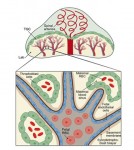
Fluid-filled structures in the placenta. (photo from wis-wander.weizmann.ac.il)
The fetus in the womb totally depends on the blood bond with the mother. Spotting irregularities in the flow across the placenta could therefore be crucial for detecting fetal distress,
but currently no reliable method is available for monitoring the flow or detecting other signs of the distress in its early stages.
Magnetic resonance imaging, or MRI, can be safely performed during pregnancy, but currently available MRI methods are not suitable. Problems include the motion of the fetus or mothers’ breath, the varied structure of placental tissue and the tangled maze formed by maternal and fetal blood vessels.
In a new study in mice conducted with advanced MRI methods, Weizmann Institute scientists have now revealed in unprecedented detail the dynamics of the flow of fluids within the placenta. This feat was all the more impressive, as a mouse placenta is around the size of a dime. As reported recently in the Proceedings of the National Academy of Sciences, they managed to identify three different types of fluid-filled structures: maternal blood vessels, which account for two-thirds of blood flow in the placenta; fetal vessels, which account for about one-quarter of the flow; and embryo-derived cells infiltrating the mother’s vasculature, which account for the rest of the flow and in which the exchange of fluids between mother and fetus takes place. The researchers also found that in maternal vessels, blood flows by diffusion, whereas in fetal vessels, the flow, stimulated by the pumping of the growing fetus’ heart, is much faster. In the cells that have infiltrated the mother’s vasculature, the dynamics of the flow follows an intermediate pattern, driven by both diffusion and pumping.
Two sophisticated MRI methods were combined to enable the study: one geared toward monitoring diffusion and another directed at identifying structures with the help of a contrast material. They could be applied successfully in large part thanks to an innovative scanning approach, spatiotemporal encoding (SPEN), a Weizmann Institute technique. Because SPEN is ultra-fast and makes it possible to separately encode signals from such different materials as air or fat, it allowed the researchers to overcome disturbances created by movement and the variability of placental tissue. If developed further for safe and reliable use in humans, this combined approach holds great promise as a noninvasive means of detecting fetal distress caused by disruptions in the placental flow. It can be particularly valuable when fast decisions about inducing labor need to be made, for example, in such complications of pregnancy as preeclampsia.
The study was a joint effort of two laboratories: one headed by Prof. Michal Neeman of the biological regulation department and the other by Prof. Lucio Frydman of the chemical physics department. The research was performed by two graduate students, Reut Avni from Neeman’s lab and Eddy Solomon from Frydman’s lab, together with Ron Hadas and Dr. Tal Raz of the biological regulation department, and Dr. Peter Bendel of chemical research support, in collaboration with Prof. Joel Richard Garbow from Washington University in St. Louis.
For more Weizmann news, visit wis-wander.weizmann.ac.il.