Vancouver now home for Liran Kling

Julia Glushko and Liran Kling at last year’s U.S. Open. (photo from Liran Kling)

Israeli tennis coach Liran Kling now calls Vancouver home. He moved here after being invited to do so by Canada’s No. 2 female tennis seed, Sharon Fichman.

Kling, 33, has played and coached tennis since he was a kid.

Born in Ramat Gan, he was one of the top junior players in Israel. After three years of army service, he attended College of Charleston in the United States on a tennis scholarship and then began coaching, in 2006, staying on for two years at the college before returning to Israel.

In 2010, Kling began coaching one of Israel’s promising young female players, Julia Glushko. Over four years, Kling helped Glushko become Israel’s No. 1 seed, a ranking she shares off and on with fellow tennis star, Shahar Peer.

After the 2014 Australian Open, however, Kling and Glushko parted ways. “It was a great experience for both of us,” said Kling of their time together. “We achieved a lot in the four years we worked together. There was just a mutual feeling that our partnership had run its course and we both felt it was time for a change. Julia is a great player and I wish her all the best in the future.”

 Moving to Vancouver

“When I stopped working with Julia, Sharon contacted me to see if I was interested in coming to work with her and her team in Vancouver,” said Kling.

“Sharon is Canada’s No. 2 player, after Eugenie Bouchard. She is ranked 127 in the world in singles and 90 in doubles. Her somewhat low ranking is due to the fact that she is coming back from knee surgery and, in the past, she had a number of wins against top 50 players, so we know she has the potential to do that and more.”

About working with Fichman, Kling said, “We believe she can be ranked among the top of women tennis.” He added, “Our Israeli background helps us find common ground and to develop a strong working partnership.”

Fichman was born in Toronto to Israeli parents and has an older brother who was born in Israel. She began playing tennis at age 5 and, at 13, became the youngest player to win Canadian nationals for girls 18 and under. Later, at 14, she became the youngest player in Canadian history to play on the Canadian Federation Cup team.

Before becoming a professional, Fichman was ranked as high as No. 5 in the world for girls 18 and under, winning the Australian Open and Roland Garros titles in doubles, and reaching the quarter finals in singles of two grand slams. As a professional, her career high ranking to date has been 77th in the world in singles and 48th in world doubles.

Fichman competed in the 2005 Maccabiah Games for Canada and won the gold medal in the women’s open singles event. She was the flag bearer for the Canadian Maccabiah Team.

“The Canadian Tennis Federation has been very supportive of me and my tennis career and I am proud to play for Canada,” said Fichman.

Kling and Fichman first met on the Women’s Tennis Association tour, when Kling was still Glushko’s coach. When Fichman began looking for someone to join her team in Vancouver, she said Kling was her first choice. “The fact that he is Israeli is simply a bonus,” she said.

“He is very observant and has a great eye for the game of tennis,” said Fichman about Kling. “As a former player himself, he understands what it takes to be successful as a professional tennis player, so I take a lot of confidence in his input and feedback on and off of the tennis court.”

Both Fichman and Kling are new to Vancouver. Fichman said both she and Kling “would like to be better introduced to the Vancouver Jewish community,” while Kling said, “I’m enjoying my time here…. As far as the winter season goes, I was told to bring an umbrella. I look forward to learning how to ski this winter.”

The two are working out of a tennis centre in Surrey.

Rebeca Kuropatwa is a Winnipeg freelance writer.
Food as delight and comfort

Yotam Ottolenghi is in Vancouver on Oct. 21 for a sold-out pre-Jewish Book Festival event to promote his newest cookbook, Plenty More. (photo from Yotam Ottolenghi)

Israeli-born chef, restaurateur and TV personality Yotam Ottolenghi has made a name for himself by bringing creative Middle Eastern and gourmet vegetarian cuisine into the homes of everyday cooks. His debut cookbook, Ottolenghi: The Cookbook, published in 2008, co-written with fellow Jerusalem native Sami Tamimi, features nearly 150 recipes selected from his restaurants. Ottolenghi has since published two other bestselling cookbooks, Plenty, which focuses exclusively on vegetarian cooking, in 2011, and Jerusalem, co-written with Tamimi, in 2012. The star chef and author is in Vancouver on Oct. 21 for a sold-out pre-Jewish Book Festival event to promote his newest cookbook, Plenty More, which was published this week by Random House.

“I always enjoyed food very much since I was very young, but never considered it as a career option,” Ottolenghi told the Independent. “But when I finished my studies at university, I decided to see if I could make it into the profession, so I enrolled in a culinary course in London in 1997 and really loved it. I thought it was very liberating and very immediately gratifying as opposed to the things I did before. It felt great feeding people and getting immediate feedback from them.”

After graduating from culinary school, Ottolenghi worked in various restaurants, but a defining moment arrived when he teamed up with a group of people and started a deli in London’s Notting Hill neighborhood that specialized in fresh food and pastries.

image - Plenty More book cover“I really enjoyed doing it, it became extremely popular very early on,” he said. “We made some nice vegetable dishes, things with pasta and grain that are deeply ingrained in the Middle Eastern food culture,” and it took off. Since then, he’s convinced millions around the world to open up their palates and culinary appetites and take a chance on Middle Eastern food.

In his newest book, Plenty More, vegetables are again the focus and he writes about his cooking methods and gives readers a glimpse into his process. “It was an organic process – the recipes are based on those I write for the Guardian newspaper’s weekend magazine – but the inspiration, or ‘penny-drop’ moment, came when I realized I wanted to organize the chapters around cooking methods rather than ingredients. Certain vegetables can get pigeon-holed – a courgette gets steamed, a squash gets roasted and so forth; focusing on the cooking method, instead, really allowed me to showcase how much more versatile vegetables are than this,” he said.

His next project is already in the works, he said. “I am working on a new book with our head chef at NOPI [in London] and we have plans to open a new Ottolenghi deli in East London next year. That’s keeping the big picture busy, and then the day-to-day work in the test kitchen continues on apace,” he said.

Ottolenghi said he hopes to continue immersing himself in the food world, and do the work that he loves to do – while preparing his own favorites, as well.

“What I love in food is the ability to surprise, delight and comfort all at once. My favorites will change depending on the context, so it will be meatballs cooked with dried Iranian lime one day and tinned smoked oysters tipped onto toast and eaten for breakfast the next,” he said.

Perhaps he’ll even gain a new favorite while he’s in Canada. “Festivals are just a great place to exchange ideas and enthusiasm with like-minded people so I’m looking forward to just being there, having a good time and learning about more ways I can get some great maple syrup into my cooking,” he said.

For more information about the Cherie Smith JCCGV Jewish Book Festival and a full schedule of events, visit jewishbookfestival.ca.

Vicky Tobianah is a freelance writer and editor based in Toronto. Connect with her on Twitter, @vicktob, or at vtobianah@gmail.com.


Living in world with chesed

Vancouver Talmud Torah Grade 7 students and some of their family members participate in this year’s Random Acts of Chesed Race on Sept. 28. (photo from VTT RAC Race Facebook page) 

“The world will be built with chesed.” – Psalms 89:3

In 2012, the Vancouver Foundation surveyed almost 4,000 people from across Metro Vancouver. The survey asked people what kinds of relationships they had, how deeply they engaged in community life, how committed they were to maintaining ties with the world around them. One out of every four respondents said they did not feel connected to others, nor to their community. In short, they felt lonely. When Vancouver Talmud Torah students heard about this, they decided to do something about it.

On Sept. 28 this year, as part of that continuing effort, VTT’s Grade 7 students took part in a RAC (Random Acts of Chesed) Race, designed to lift the spirits of people across the city. While Random Acts of Kindness is a worldwide organization, the chesed element began at King David High School here following the death of Gabrielle Isserow, a much-loved student who was known for her extraordinary kindness. It seemed only fitting that her passing be honored with a movement that inspires kindness to others.

At this year’s RAC event, 40 students were divided into 10 teams; more than 100 family members also took part. Their challenge: to help build a sense of community and connection by performing mitzvot, actions that could happen every day but, by and large, don’t. They included carrying someone’s groceries, cleaning up garbage off the street, giving a child a stuffed animal, giving up a seat on the bus to someone who looks tired; the offer of a hug, an invitation to dance; students freely offered friendly smiles, chocolates and compliments.

As VTT teacher and director of Jewish life Shoshana Burton explained, “In this RAC Race, we wanted to restore a sense of community, enhance a sense of connection to one another with humor and generosity.”

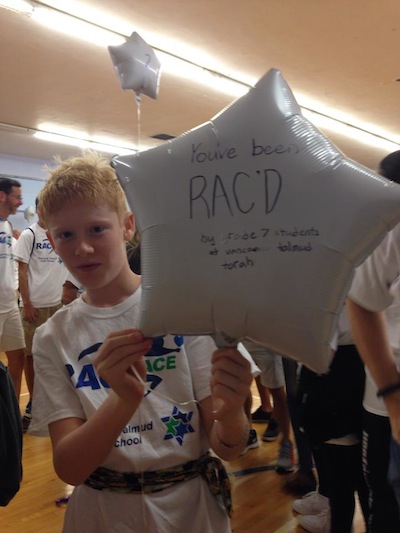
photo - Zevi Kline with a “You’ve been RAC’d!” balloon
Zevi Kline with a “You’ve been RAC’d!” balloon. (photo from VTT RAC Race Facebook page)

Each team was given specific directions about where to go and how to get there. The teams covered Richmond Centre, Yaletown, Kerrisdale and Mount Pleasant, among other areas. Backpacks were provided containing supplies for the day, including stuffed animals, Starbucks cards and cards that read, “You’ve been RAC’d!” Instructions were given about respecting others’ personal space and, from there, the students improvised with gusto. Challenged to drop their reserve, take initiative and show a little chutzpah, they rose to the occasion.

While some RAC recipients struggled with the notion that these acts of kindness were free, others danced, hugged, smiled and made bunny ears behind the kids’ heads in photographs.

“Take what you need” posters were also stuck on lampposts. Set up like a “for sale” notice, these posters had tabs for people to rip off but, instead of information about dog-walking, babysitting or items for sale, these slips offered passersby things like peace, freedom, encouragement, love and healing.

Parent Lisa Boroditsky was thrilled with the outcome. “It was so wonderful to see the kids connecting to strangers, interacting with community and spreading kindness. After all the laughs, hugs and smiles our group received, we feel like we made a few people happier today!”

Since the RAC Race, Burton said, the students just “keep coming.” Sometimes in groups as large as 20, they want to talk about our next project, she said, describing this student group as “unstoppable.”

When asked how the RAC program fits within the VTT curriculum, Burton explained, “Chesed is not a subject we study; it is the life we live.” Moreover, RAC is not bound to the classroom, she added. “RAC Race’s lessons were taught with real-world experiences. Students were encouraged to notice genuine needs that they might have not noticed before and to be compassionate in respectful ways.”

As an example, during the Sept. 28 event, student Joshua Switzer’s team came across a homeless man in Kerrisdale who looked “really depressed,” so they gave him a Starbucks gift card.

Said student Alisa Bressler, “When I’m walking around Kerrisdale, I am usually thinking just of myself. This time was different because we were there to help other people.”

An anonymous letter to Burton read, “You’ve opened a door in our hearts welcoming kindness. You make us eager to spread kindness, and also you teach us to be good people. How can we thank you more?”

“Kids continuously seek meaning and connections,” said Burton. “When they are provided with the opportunity to search for and recognize meaningful connections, they are empowered. They ask for more. They never cease to surprise me and always exceed my expectations.”

Concluded Burton, “I love how our school is tuned into the needs of the community now. Because of technology, schools’ roles are changing. It’s not only where we go for knowledge – it’s also a place to make connections and start building a caring community outside the walls of the school. These children will go out into the world with this in mind.”

Shula Klinger is a freelance writer living in North Vancouver.

21st-century furniture

An Eli Chissick-designed mirror, which will exclusively be available from SwitzerCultCreative in November. (photo from SwitzerCultCreative) 

You could say Renee Switzer got her love of the furniture business from her grandfather, who arrived in Canada from Poland in 1920 and opened a second-hand furniture store in Calgary. The tradition continued when her father entered the industry, too, with a company specializing in the manufacture of antique reproductions. Switzer worked in the family business until it was sold in 2010. A year later, she launched SwitzerCultCreative, motivated by a desire to create opportunities for Canadian designers.

“I love the furniture industry and the people involved in it, and I wanted to maintain the contacts I’d developed over the years,” she told the Jewish Independent. “After I moved from Vancouver to the Sunshine Coast in 2006, I discovered there’s a tremendous amount of homegrown talent that’s hidden away and needed to be developed and promoted, so that’s what I decided to do.”

Switzer builds and maintains business relationships between furniture designers, the craftsmen who create those designs and the clients who purchase the finished product. Her focus is modern, luxurious and sustainable 21st-century designs and her emphasis is on knowing every detail about the products she represents. That includes how pieces are made and finished, what materials are used, who creates and builds those pieces and why they are environmentally sustainable.

Among the collections she promotes is the Coupland Collection by Canadian novelist Douglas Coupland, the Baumhaus Collection by Jess and Nicolas Meyer, the Barter Collection from Kenneth Torrance and the AHRPA Collection created by Umberto Asnago, an Italian furniture designer.

More recently, Switzer was also determined to find an Israeli designer whose work would fit in with the collections she already promotes. “I really believed it was important to try and do something to counteract all the anti-Israel boycotts going on right now, boycotts that are nonsense,” the Roberts Creek resident said.

In an effort to find the right fit, Switzer began reaching out to organizations in Israel, making inquiries about different designers. When she saw the work of Eli Chissick, its high quality and focus on sustainability resonated with her immediately. “His pieces are unique and made primarily from salvaged woods,” she said of the 30-something award-winning designer. “He’s interested in sustainability and, though it’s hard to reduce the carbon footprint of a designer based in Tel Aviv, we are able to do that by making his pieces in North America.”

Chissick is a designer, artist and carpenter who is passionate about environmental sustainability. His latest series of recycled art is called “Wood-Con-Fusion” and each piece within the series began its life as an off-cut on the floor of a carpentry studio, destined for the scrap heap. “Eli is able to see the potential in the most unassuming pieces of fibreboard, veneer and Formica, and nothing goes to waste as he collects and sorts these pieces and presses them into sheets, which he uses to create unique pieces of furniture,” Switzer explained.

Two of Chissick’s designs are presently being manufactured in Vancouver and will be ready in November, licensed exclusively to SwitzerCultCreative. His five-foot mirror will sell for $2,800 and Switzer is confident it will quickly find a home.

Her buyers are primarily interior designers and architects for residential and hospitality projects all over North America through sales representatives with whom she has exclusive relationships and who believe in the products she represents. With no physical showroom in Vancouver, most of Switzer’s pieces are exhibited on her website, switzercultcreative.com. Her company also sponsors an annual design competition for students, where the winner has their design built and marketed for a year by SwitzerCultCreative. “Our aim is to promote unknown talent by providing a launching point for new designers to build their own brands,” said Switzer.

Lauren Kramer, an award-winning writer and editor, lives in Richmond, B.C. To read her work online, visit laurenkramer.net.

IDF soldier shares his story

Jewish National Fund Pacific Region brought in IDF veteran Ari Zecher to speak. The talk, moderated by Geoffrey Druker, left, talked to a group at the Jewish Community Centre on Sept. 22. (photo from JNF-PR)

This Rosh Hashanah, the Vancouver Jewish community was visited by Ari Zecher, who served in the Israel Defence Forces Maglan special forces unit during Operation Protective Edge in Gaza this past summer.

Part of the Jewish National Fund’s High Holiday appeal to help build mobile bomb shelters in Israel, Zecher was invited to share his experience as a soldier and as a young Israeli during this tumultuous time. Speaking at the Jewish Community Centre of Greater Vancouver and at various synagogues, Zecher thanked the local Jewish community for its unfailing and ongoing support, and highlighted the need for young and fresh ideas to move Israel forward towards a peaceful future for future generations.

Ilan Pilo, Jerusalem emissary and executive director of JNF Pacific Region, said: “We are grateful to Ari for taking the time to interact with over 1,000 members across our community and for speaking candidly about Israel’s challenges and hopes. As in the past, this year, JNF will continue to dedicate its work to enhancing the invaluable bond between Israel and the Canadian Jewish community in general, and our Vancouver community in particular. JNF salutes everyone who has made, or will make, a donation towards the important cause of keeping children in Israel safe during such difficult and uncertain times.”

For more information on the JNF’s bomb shelter campaign, call 604-257-5155 or visit vancouver.jnf.ca.

Mystery photo … Oct. 17/14

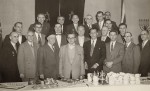
Group of men, Royal Canadian Legion, Shalom Branch No. 178, 1954. (photo from JWB FONDS; JMABC, L.14240)

If you know someone in this photo, please help the JI fill the gaps of its predecessor’s (the Jewish Western Bulletin’s) collection at the Jewish Museum and Archives of B.C. by contacting archives@jewishmuseum.ca.

Lessons from Nobel Prize

Last week, Malala Yousafzai and Kailash Satyarthi were jointly awarded the Nobel Peace Prize. The former may be more familiar to most of the world than the latter but, in pairing the two, the prize committee was making some very blunt statements about girls, children and long-held international enmities.

Yousafzai is a Pakistani Muslim. When she was 11 years old, she began writing a blog for the BBC about life under the Taliban in the Swat Valley area of northwest Pakistan. Her family operated schools in the area and the Taliban banned girls from attending. She persisted – not only in attending school but in becoming an international voice for girls’ education. When she was 15, in 2012, a gunman boarded her school bus, asked for her by name and shot her. Yousafzai survived and continues her activism with more determination.

Satyarthi is an Indian Hindu who has devoted himself to the cause of children’s rights, particularly opposing child labor and advancing education for all. His organization has rescued and rehabilitated 80,000 child laborers.

The Nobel’s choice of Yousafzai and Satyarthi made a statement not only about the value of childhood and education, but by choosing laureates from the belligerent neighboring countries of India and Pakistan, they were also underscoring the need to overcome long-standing animosities for the greater good.

There are many reasons why children do not receive the education they deserve – intertwined factors of poverty, violence, oppression, forced early marriage and more – but gender is a particularly gnawing factor in many parts of the world. The more a country limits girls’ education, the more backward the country is – and not in the culturally relativist sense of backwardness that is no longer politically palatable terminology, but in objective, empirical, economic terms. The statistics are staggering.

Every extra year of education a girl in the developing world receives can increase her income 15 to 25 percent. When mothers are responsible for household income, there is a 20 percent increase in child survival rates. Every additional year of schooling a mother receives reduces infant mortality by five to 10 percent.

The more education a girl receives, the fewer children she is likely to have – and they are likely to be healthier and to go to school themselves. And education reduces the likelihood that a girl will be pushed into marriage in adolescence.

As is so often the case, oppression of one group harms the larger society. Ameliorating the oppression of some advantages the whole. A 10 percent increase in girls’ school attendance can increase a country’s GDP by three percent. If all the moral and human justifications do not persuade governments, the numbers should convince them that girls’ education is an economic benefit.

Israel is a case study. From before the state was proclaimed, women have played central roles and been leaders in all aspects of civil society. It is not a coincidence that Israel – a barren, resourceless nascent state in 1948 – has emerged as one of the world’s most successful economies. There are a number of obvious and less obvious reasons for this, but the inclusion of women is one of them.

This is not to suggest that everything is roses. Men still dominate professorships and the sciences in Israel. Arab schools in Israel receive fewer resources than Jewish schools, though efforts are advancing to close this gap. (Christian Arabs, though, statistically have better graduation exam results than Muslim or Jewish students and attend university in numbers above the Israeli median.) Israel is also investing large sums in revamping Charedi education to better prepare religious men and women for the workforce.

But girls in Israel are more likely than boys to graduate high school and continue to university. The high school dropout rate for boys is almost three times that of girls. More than 56 percent of students in university are female.

Of course, such is the state of the world today that what lessons Israel may offer will be rejected out of hand due to the source but, by selecting an Indian and a Pakistani, the Nobel committee was clearly making a statement that urgent issues must be addressed regardless of old antagonisms.

The Nobel committee was also clearly recognizing the impact that a single person – or two individuals – can have on the way the world thinks and behaves.

Circumcision evolution

The “scientizination” of brit milah, circumcision, has had several implications, according to Dr. David Koffman, assistant professor, department of history, York University.

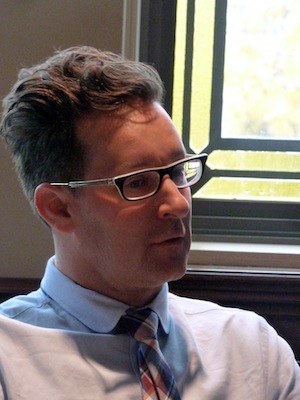
photo - Dr. David Koffman
Dr. David Koffman (photo by Rebeca Kuropatwa)

Koffman spoke at the University of Manitoba on Sept 19, hosted by the university’s Hillel Winnipeg. He centred his talk around the influence of the interdenominational New York Board of Rabbis, which was founded in 1914 to train and certify mohels. The board centralized, coordinated, promoted and professionalized Jewish circumcisions in New York state throughout the 20th century, he explained. They trained mohels in the newest surgical techniques, methods of asepsis and hygiene, newly developed clamps and devices, provided malpractice insurance and acted as a guild/gatekeeper for Jews entering the profession. By the mid-1960s, the board opened a school to train mohels.

“Its job was to control the narrative, to keep it Jewish in the face of changing norms in America,” said Koffman. “By the 1940s, the popularity of circumcision, long seen as Jewish barbarism, began to skyrocket among gentile parents for their newborn sons.”

Circumcision changed from being mainly a religious rite to a surgical procedure in the 20th century.

“Secular medicine’s enthusiasm for circumcision put Jewish medical men along with many other Jews in a bind,” said Koffman. “On one hand, the growth of endorsing opinion by experts about circumcision from a variety of medical subfields offered the most gratifying validation mohels and clergymen could ever hope for. Urologists, surgeons, gynecologists, even psychiatrists, indicated the right vilified by Christians in America no less than elsewhere before the 20th century. Mohels eagerly then sought medical training and certification and proudly fused religious rhetoric about brit milah with newfound medical rhetoric on health advantages.

“On the other hand, medicine’s capture of circumcision and its popularity among non-Jews presented an entirely new set of problems for religious Jewish leaders of the non-Muslim world. The penis, concealed in public, but revealed when naked in private, remained a key sign of Jewish difference where it mattered the most, to make more Jewish babies. Perhaps more threatening than the erosion of the boundary between Jews and gentiles was that science itself might strip the fundamental religious meanings….”

With respect to Christianity, Koffman explained, “During the Second Great Awakening, Christians turned to circumcision as the foil to the conversion experience. The reborn, or born again, were circumcised by accepting Christ … they were as un-Jewish as they could get. This was a metaphor of circumcision.

“Keep in mind that Jan. 1st in the Catholic calendar was the Feast of Circumcision, eight days after Jesus’ Dec. 25th birth.” This is a practice that no longer exists, however, as it was removed by the Church in 1960 and renamed the Solemnity of Mary, he added.

“There was a striking discord between Jesus and his followers that Jesus himself was circumcised,” he pointed out. “Most questions had little to do with the Jews…. Where, for example, did Jesus’ foreskin go? Was he reunited with it during the rapture?”

Turning to the science, Koffman said, “By the 1920s, circumcision was becoming the mark of high social standing for many, for it indicated that a mother had the ability and means to deliver her baby in a hospital by an attending physician.”

In the first two decades of the 20th century, civic planners argued that universal circumcision would help restrict the spread of tuberculosis, syphilis and other venereal diseases. Before this development, said Koffman, circumcision was, for Jews, at its core, “a sign of the holy covenant between God and Israel, as prescribed to Abraham in Genesis 10 … and [of] God’s promise to Abraham’s descendants.

“In essence, mohels ‘scientized’ milah but, in doing so, they invited new predicaments for the Jewish body. Embracing medicine achieved many short-term gains. It accrued medical status for mohels, insisting that they were on par with physicians.

“Perhaps most importantly, embracing the science of circumcision [made it possible] for American Jews to make a broad public reckoning of their historic contributions to medicine and science.

“The transformation of circumcision from ritual once exclusive to Semites to a medical procedure available to all also posed a threat to American Judaism because medicine for all its power hollowed milah of its mysteriously potent spiritual power. For the first time in Jewish history, there was a very real possibility of huge numbers of illegitimate milah, circumcisions performed on boys by someone other than a mohel, or at the wrong time, or in the wrong manner. The Jewish penis would grow to be indistinguishable from its non-Jewish counterparts. All this helps explain why the board worked so hard to represent mohels at hospitals, aiming to control its narrative.”

The board conducted research in the 1930s and 1940s about hospital-regulated circumcision, which required that mohels be certified. It encouraged public and private hospitals to make circumcisions available and encouraged hospitals to provide space to perform the rite, as well as educational materials to obstetrics and gynecology professionals about the benefits of circumcision.

“Jewish parents were increasingly having their sons circumcised in hospitals, paid for by insurance companies, instead of at home or at synagogue,” said Koffman.

“By the 1960s, religious justifications began to give way to the anxieties about the infant’s pain,” said Koffman. “Mohels, wearing their medical hats, assumed it a given or perhaps an integral part of circumcision.” One manual produced in the 1950s, entitled Welcome Home Mother and Son, included no fewer than eight references to pain and anxiety.

The board also supplied a steady stream of support materials to agencies, synagogues and rabbinical associations interested in promoting circumcisions in other states and countries. By the mid-1960s, the board positioned itself not just as a regulator of New York State, but as the custodian of the practice and an advocate of circumcision.

“Milah literature doubled down on the medical benefits, but also emphasized the theological benefits,” said Koffman.

“The great scholar Elliot Wolfson called Jewish circumcision ‘the cut that binds,’” said Koffman. “It’s a severance that connects Jewish boys to their fathers and grandfathers, to Jews across time and borders.”


Rebeca Kuropatwa is a Winnipeg freelance writer.



The indefatigable people

With antisemitism on the rise in France, England and around the world, and Israel once again facing strong headwinds, it seems like a good time to turn to history in search of some perspective on current events.

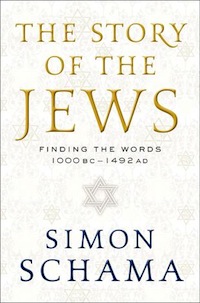
Earlier this year, PBS aired a popular two-part series on Jewish history written and presented by historian Simon Schama. The account was based largely on his book The Story of the Jews: Finding the Words 1000 BC-1492 AD (ecco, 2013), published last year in Great Britain. The second volume – from 1492 to the present – is expected this fall.

Schama, a highly accomplished, award-winning historian, has written 16 books and 40 television documentaries, focusing mostly on art histories and histories of France, the Netherlands, Britain and the United States. He has also written a book about Israel and the Rothschilds.

image - The Story of the Jews book coverIn The Story of the Jews, he abandons the distance of an academic historian right at the start. This is the story of his people, not an abstract theoretical exercise of writing history. He is emotionally invested in this project and his passion spills out on every page.

It is also clear from the beginning that he is foremost a storyteller. With incredible details, Schama delights the reader with engaging vignettes about both ordinary and powerful people. He recreates pivotal moments in history by describing the events in the life of individuals, from Sheloman, a young Jewish mercenary in service of the Persian authorities in 475 BCE, to Abraham Zacuto, a talmudist and astronomer who put together the almanac used by Christopher Columbus in 1492.

His chatty approach to history occasionally drifts sideways, as if he just thought about something else he has to tell you. It is sometimes difficult to keep up with him, as he jumps across centuries, from country to country, commenting about historical figures without much of an introduction.

Yet, the story he tells is compelling. Schama wanders through numerous far-flung Jewish communities offering fascinating glimpses of their lives and surprising perspectives on Jewish worship, relations with non-Jews and violence against Jews.

More than is usually acknowledged, the Jewish community has lived in harmony with paganism, Christianity and Muslim societies. Yet the portrait of Jewish history, as he presents it, is not pretty.

Despite periods of well-being, sometimes stretching over hundreds of years, the story of the Jews is an account of a people caught in a Sisyphean cycle of settlement, prosperity, persecution and devastation, over and over again, beginning in Egypt in the 13th century BCE.

Schama delves deep into the brutal rhetoric and cruel fantasies that provoked the recurring waves of murder and expulsion. Over two millennia, the venom spread from Egypt to Palestine and throughout the empires of Persia, Greece, Rome and Constantinople, through the Near East and the Iberian peninsula.

He shines an especially bright light on the vile attacks by the disciples and followers of Jesus, who turned Jews into god-killers and child murderers. He writes about Jewish moneylenders, international traders, tax collectors and confidantes of royalty who were once in favor and then were not.

Schama begins his story in Elephantine, an island in the Nile. The Persians in 525 BCE found a thriving, well-established Jewish community in Elephantine, with a temple that had many similarities to the First Temple in Jerusalem that had been destroyed 61 years earlier.

Documents describing Elephantine provide the first hard evidence of daily life of Jews in antiquity. The Elephantine community was wiped out by the mid-fourth century BCE.

Again and again, Jewish communities were decimated. England expelled its Jews in 1290; France issued edicts expelling Jews in 1306 and again in 1394. Spain followed in 1492 and Portugal in 1497. Schama identifies 29 towns under Christian rule across Europe that kicked out Jews between 1010 and 1540.

Many civilizations have thrived and then disappeared. But Judaism has always found a way to thrive and survive. Schama attributes the durability of Judaism to its devotion to words.

Judaism depends neither on its leaders, its places of worship nor its institutions. The Jewish people are the People of the Book; words are the invisible thread that binds Jews together over the millennia, Schama posits. And, according to his perspective, the Torah is the work of the religious and intellectual elite in the eighth to fifth century BCE, nearly 500 years after the Exodus was supposed to have happened.

Reverting to his role as academic, he notes that no evidence – archeological or otherwise – has turned up to substantiate the Exodus story. By his account, the Hebrew Bible is a picture of Israel’s imagined origins and ancestry that converges at some point with the reality of Jewish history.

The genius of the priests, prophets and writers, intellectual elites, was to make their writing sacred, in standardized Hebrew, as the exclusive carrier of YHWH’s law and historic vision, Schama writes. “Thus encoded and set down, the spoken (and memorized) scroll could and would outlive monuments and military forces of empires.”

The Hebrew Bible was fashioned to be the common possession of elite and ordinary people, he writes. The divinity was reflected in the words of the Torah, not in an image of a divine creature or a person. And the message of the Torah was not confined to a holy sanctuary. It is to be posted on the doorpost of every Jew and bound on the head and arms of all Jews as they prayed.

“No part of life, no dwelling or body, was to be free of the scroll-book … the Torah was compact, transferable history, law, wisdom, poetic chant, prophecy, consolation and counsel…. The speaking scroll was designed to survive incineration … the people of YHWH could be broken and slaughtered, but their book would be indefatigable.”

In other words, survival depends on, as his subtitle says, “finding the words” for Torah study and the story of the Jews.

Media consultant Robert Matas, a former Globe and Mail journalist, still reads books. Simon Schama’s book is available at the Isaac Waldman Jewish Public Library. To reserve it, or any other, call 604-257-5181 or email library@jccgv.bc.ca. To view the catalogue, visit jccgv.com and click on Isaac Waldman Library.

“Temporary” occupation

It’s a question that defines the debate over Israel’s policies and the state’s grand strategy: do Israeli human rights organizations monitoring the occupation merely serve as a fig leaf, adding an ethical patina to what is a fundamentally immoral situation?

Four months into his new position as head of B’Tselem, having come from the Association for Civil Rights in Israel, Hagai El-Ad and I spoke by phone recently about this and other issues. [To read the JI’s interview with El-Ad, click here.]

Given that the Israeli occupation of the West Bank and Gaza was supposed to be “temporary,” El-Ad is well aware that “at some point the term loses its meaning.” So, as he took the helm of B’Tselem last May, the organization issued a position paper provocatively named 47 Years of Temporary Occupation. As El-Ad put it, B’Tselem is shifting its focus from “fighting against human rights violations under occupation to a strategy [emphasizing] that the occupation will forever violate the human rights of Palestinians.” To this end, B’Tselem is now trying to end the occupation – not just help manage it.

It’s a laudable goal. But how achievable is it?

B’Tselem is starting with some concrete steps, however limited. For one, they have recently announced that they will not cooperate with Israel Defence Forces military investigations around Operation Protective Edge. Calling it “theatre of the absurd,” El-Ad believes that the military investigation system is one intended to “always result in impunity.” And this protected military violence is a necessary “lifeline of the occupation.” Hence, the need to squelch it.

As far as the bigger picture goes, El-Ad was cautiously optimistic: probably a necessary blend for anyone in human rights work in the Israel/Palestine morass. He takes comfort from what he sees as B’Tselem’s mission being fundamentally buttressed by the very human rights discourse extant in Israel. That the concept of human rights is a “relevant currency” in Israeli politics gives the organization an important starting point by which to leverage societal consensus. Though without the clout or mandate to engage in electoral lobbying efforts, working to end the occupation must be done very much at arm’s length from the policy sphere. Still, it’s a start.

El-Ad adds that he invites others to see what they can do “in their own communities” to disrupt the idea of the occupation as “business as usual.”

OK, so most of us can agree that the occupation is an undesirable situation, but what about the argument, issued frequently by Israel’s most strident defenders, that the status quo is a security imperative? If Hamas didn’t launch rockets, the thinking goes, the war in Gaza wouldn’t have been necessary. And, if West Bank Palestinians didn’t seek to blow up Israelis, the checkpoints and night raids and (the various) separate roads could be dismantled. And we all know about the apartheid, uh, separation, ahem, security wall.

Trading off between security on one hand, and human rights and ending occupation on the other, is a false dichotomy, El-Ad explained. In Gaza, “we’ve encountered time and again the theory that using more and more force will provide the desired outcome. But that’s not really working.” When it comes to day-to-day military policing in the West Bank to ensure the safety of Israeli citizens, we all know the chicken-egg argument: the internal checkpoints would be unnecessary were there not settlements (illegal under international law) to protect, hence, B’Tselem’s claim, in its 47 Years of Temporary Occupation document, that settlements are “the heart of the matter.”

Now that the fighting in Gaza has died down, B’Tselem is reflecting on its work compiling data on casualties, monitoring international humanitarian law violations – including by Hamas – and collecting first-person testimonies, attempting to put a face to the Palestinians in Gaza. El-Ad is quick to note that the media coverage in Israel tended to be one-sided, with little coverage of the war experience for Gazans. As an antidote, B’Tselem relied heavily on social media and web coverage to get additional information disseminated, despite a hacking attempt that left their website site crippled for a few days.

After talking to El-Ad, I’m left with a strange combination of hope and cynicism. As someone who cares deeply about seeing an end to the occupation, I’m buoyed by the fact that the head of Israel’s most important human rights organization has this broader goal top of mind. At the same time, absent the apparent political will in the top echelons of the Israeli government, I can’t escape the belief that intelligent, passionate and committed Israeli change-makers like El-Ad are too often left clapping with one hand.

Mira Sucharov is an associate professor of political science at Carleton University. She blogs at Haaretz and the Jewish Daily Forward. A version of this article was originally published on haartez.com.