
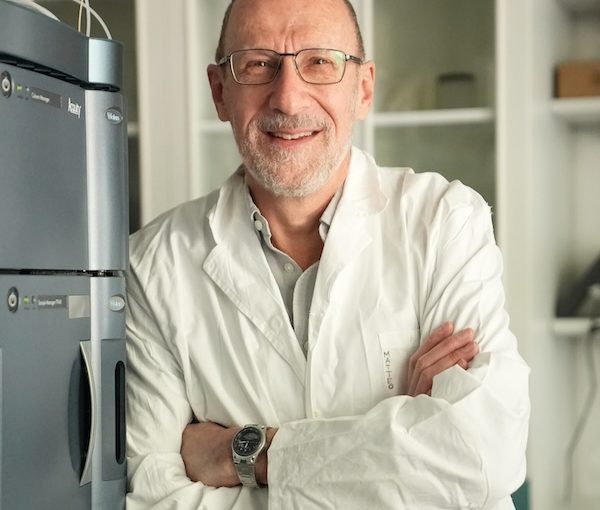
Prof. Brian Berkowitz, Sam Zuckerberg Professorial Chair in Hydrology, at his lab at the Weizmann Institute of Science. (photo from Weizmann Institute)
Prof. Brian Berkowitz of the Weizmann Institute of Science recently visited Vancouver and Calgary for meetings with members of the Weizmann Canada community.
Berkowitz, who was born in Edmonton, joined the staff of the Weizmann Institute in 1993. He received his bachelor and master of science degrees from the University of Alberta and his doctorate from the Technion-Israeli Institute of Technology. He worked as a research hydrologist for Israel’s Ministry of Agriculture for several years and as a visiting professor at the University of British Columbia for two years before joining the Weizmann faculty. A former head of the department of environmental sciences and energy research (now the department of earth and planetary sciences), he is the incumbent of the Sam Zuckerberg Professorial Chair in Hydrology.
Berkowitz’s research centres around the experimental analysis and computer modeling of fluid and chemical transport in geological formations, with emphasis on soil and groundwater systems. He and his colleagues are developing new models that realistically describe pollutant migration patterns; these models show conditions under which groundwater contamination can occur. He is also developing experimental methods for environmentally friendly chemical treatment of contaminated water.
Recently, he has become involved in research related to urology and treatment of kidney stones, and to the active treatment of lymphedema and related tissue-swelling disorders, including the development of biomedical devices.
Berkowitz – who is married and the father of three children – was first motivated to apply his physical science expertise to the medical field when his son was diagnosed with a serious kidney condition. Because what is the kidney if not a water filtration organ?
He applied his knowledge of fluid dynamics and chemical transport to the development of a ureteral stent that allows urine to drain from the kidneys to the bladder when there are blockages. The preexisting stents often caused pain and irritation in people who relied on them, and Berkowitz was able to develop a much-improved stent that was more comfortable and effective.
Building off that success, the professor has turned his attention to the development of a device that can treat lymphedema and related tissue-swelling conditions. Lymphedema is a condition in which fluid is not effectively drained by the lymphatic system and instead builds up in bodily tissue, often in the arms and legs. This is a common condition following some cancer treatments, among other causes.
Berkowitz worked with Yeda, the commercial arm of the Weizmann Institute, and a medical technology company called Sub-Q Bionics was formed to develop a device based on his research.
Sub-Q Bionics recently received the funding needed to further develop what is a sort of bionic lymph node that has the potential to transform how lymphedema is managed. The device will essentially be a drainage system that is implanted under the skin to help with the painful swelling caused by lymphedema. It would be the first treatment to actively drain lymphatic fluid from the limbs, offering relief to the more than one million people who suffer from lymphedema in Canada alone.
At the Weizmann Institute, which is ranked sixth in the world for research quality, scientists are given wide latitude to follow their curiosity and interests, even across scientific disciplines. As Berkowitz’s research exemplifies, this cross-pollination of ideas can often lead to unexpected and exciting discoveries that might not otherwise be possible.
In addition to being an acclaimed scientist, Berkowitz is an accomplished musician, having played bassoon professionally in the Edmonton Symphony Orchestra and in numerous chamber ensembles in Canada and Israel.
– Courtesy Weizmann Canada