Skip to content
  • Home
  • Subscribe / donate
  • Events calendar
  • News
    • Local
    • National
    • Israel
    • World
    • עניין בחדשות
      A roundup of news in Canada and further afield, in Hebrew.
  • Opinion
    • From the JI
    • Op-Ed
  • Arts & Culture
    • Performing Arts
    • Music
    • Books
    • Visual Arts
    • TV & Film
  • Life
    • Celebrating the Holidays
    • Travel
    • The Daily Snooze
      Cartoons by Jacob Samuel
    • Mystery Photo
      Help the JI and JMABC fill in the gaps in our archives.
  • Community Links
    • Organizations, Etc.
    • Other News Sources & Blogs
    • Business Directory
  • FAQ
  • JI Chai Celebration
  • JI@88! video

Recent Posts

  • BGU fosters startup culture
  • Photography and glass
  • Is it the end of an era?
  • Taking life a step at a time
  • Nakba exhibit biased
  • Film festival starts next week
  • Musical with heart and soul
  • Rabbi marks 13 years
  • Keeper of VTT’s history
  • Gala fêtes Infeld’s 20th
  • Building JWest together
  • Challah Mom comes to Vancouver
  • What to do about media bias
  • Education offers hope
  • Remembrance – a moral act
  • What makes us human
  • המלחמות של נתניהו וטראמפ
  • Zionism wins big in Vegas
  • Different but connected
  • Survival not passive
  • Musical celebration of Israel
  • Shoppe celebrates 25 years
  • Human “book” event
  • Reclaiming Jewish stories
  • Bema presents Perseverance
  • CSS honours Bellas z”l
  • Sheba Promise here May 7
  • Reflections from Be’eri
  • New law a desecration
  • Resilient joy in tough times
  • Rescue dog brings joy
  • Art chosen for new museum
  • Reminder of hope, resilience
  • The national food of Israel?
  • Story of Israel’s north
  • Sheltering in train stations

Archives

Follow @JewishIndie
image - The CJN - Visit Us Banner - 300x600 - 101625

Tag: freedom

Religion and the state

A week is a lifetime in politics, goes an adage. And so it would seem. Just one week ago, we posited that Binyamin Netanyahu’s coalition of the right was likely to form the next government in Israel. Since then, Benny Gantz, head of Israel’s Blue and White party, has been reinvigorated by Netanyahu’s challenges in pulling together a coalition, after original exit polls had the Likud-led coalition at 60 seats out of the 120 in the Knesset. This number has dropped through the actual vote count to 58, and it has changed the outlook.

As it has in the previous two elections, the result will hinge on the decision of Avigdor Liberman and his Yisrael Beitenu party, a right-wing but defiantly secular movement. Liberman has publicly released his demands for support. Among them: he will not support a government led by Netanyahu (or any other individual under indictment) and he wants to increase the number of ultra-Orthodox serving in the military, introduce civil marriage, thereby taking control of this lifecycle event from the exclusive purview of the rabbinate, and hand decision-making about commerce and transportation on Shabbat to local governments. Meanwhile, Gantz is having a rebellion in his own ranks about seeking support from the largely Arab Joint List in parliament. So, the process is largely back to where it’s been for more than a year, with no more certainty of who will form the next government.

Whatever happens, Liberman’s sweeping secularist proposals are nothing to ignore. The ally-turned-nemesis of Netanyahu, Liberman seems to have learned from the masters how to leverage minimal electoral success to enormous political advantage. In the past, it has been the religious parties that conditioned their support for desperate-to-make-a-deal leaders on getting key benefits and concessions for their respective communities. If Liberman succeeds in helping create a Blue and White government that implements some of his plans, it will represent the same tail-wagging-dog effect that religious parties used to assert Orthodox standards across much of Israeli society. Except Liberman will leverage his seven seats to repeal some or much of what those religious parties have achieved.

This Israeli moment brings to mind other rapidly changing political fortunes. Joe Biden, whose campaign was struggling to survive a few weeks ago, is suddenly (again) the undisputed front- runner for the Democratic nomination in the United States. There is another parallel between Israel and the United States that is currently evolving, this one less publicly known. While Liberman strives to diminish the connection between religion and state in his country, U.S. President Donald Trump is moving his country more in the direction of Israel’s religiously influenced society.

As in Canada, many religious organizations in the United States do an enormous amount of good, in many cases filling in gaps where government services can’t or won’t. Republican administrations have tended to expand – contract out, if you will – some social services previously delivered by governments, while the Obama administration, for example, introduced safeguards to prevent those agencies from discriminating against individuals or groups who they might deem outside their theological teachings.

Writing in the New York Times Sunday, Katherine Stewart, author of a book on religious nationalism, warned that Trump is eliminating those Obama-era safeguards and making it easier for publicly funded agencies to discriminate. For example, clients receiving services from a taxpayer-supported Christian organization could be forced to profess allegiance to Jesus in order to access services or an employee could be fired for not living a “biblical lifestyle,” the definition of which the religious organization, presumably, could define at their own whim.

A test case in Missouri seems innocent enough: a church maintains it should get federal funding to build a kids’ playground; that being refused such money represents discrimination against religion. The corollary is clear: if preventing tax money from funding religious organizations (even for something as innocuous as a playground) is discrimination, Stewart warns, “then the taxpayer has no choice but to fund religion.” This would represent an abrogation of one of the most fundamental cornerstones of the U.S. Constitution: the First Amendment, which declares, “Congress shall make no law respecting an establishment of religion, or prohibiting the free exercise thereof….” The framers of the Constitution were concerned not only that eliminating the barrier between government and religion would corrupt a government intended to serve all citizens but, perhaps equally, that it would corrupt religious institutions themselves. A number of the people on the test case’s side are also leaders among Trump’s evangelical constituency.

What was especially jarring when perusing the Sunday Times was a far more prominent story – on page A4, to be specific – about how Quebec’s secularism law is having a detrimental effect on civil servants, mostly women, from cultural minorities. The law, which precludes people who work in most roles in the public service from showing any external indications of religiosity – a kippa, a headscarf, a crucifix, a turban – is preventing individuals from beginning or advancing in their careers and, in some cases, effectively chasing them out of the province.

These disparate examples from three very different societies indicate the folly both of excessive religious interference in governmental affairs and heavy-handed efforts to have the opposite effect. Somewhere in the middle must be a commonsensical approach to these extremities. Of the three countries in the examples, Israel is perhaps the one where the challenges are most concrete and affect the most people. What, if anything, happens as result of Liberman’s gambit will be a fascinating experiment to watch.

Posted on March 13, 2020March 12, 2020Author The Editorial BoardCategories From the JITags Avigdor Liberman, Benny Gantz, Binyamin Netanyahu, democracy, Donald Trump, elections, extremism, freedom, Israel, Quebec, religion, secularism, United States
What is freedom?

What is freedom?

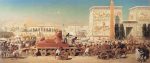
“Israel in Egypt” by Edward Poynter, 1867. (photo from Wikimedia Commons)

There is a certain inherent ambivalence when we think of the meaning of freedom and its association with the holiday of Pesach. One of the essential features of the liberation story is our freedom from human subjugation: “Yesterday we were slaves to Pharaoh, today we are free men and women.”

This freedom, however, did not come about as a result of a revolution instigated by the Jewish people but, rather, as the biblical story relates, through the redemptive hand of God. As a result, this physical redemption is often connected with a religious duty: “I am the Lord your God, who brought you out of Egypt, out of the land of slavery; you shall have no other gods besides me.” (Exodus 20: 2-3)

What is the nature of this connection? Is it an obligation or an opportunity? Is our commitment to God and the Torah a price we pay for the Exodus, or is it a gift – a gift made possible by our physical freedom, but one that we may choose whether or not to receive? The question we as Jews ought to reflect on this Pesach is whether the freedom from Egypt is limited to liberation from physical servitude, or does it include freedom of conscience and faith.

Historically, Jews did not engage extensively in questions of personal autonomy; at most, they spoke about what Isaiah Berlin referred to as “positive liberty” (Berlin, Two Concepts of Liberty). As opposed to the simple, more intuitive concept of negative liberty – “the freedom from” constraints or compulsion, positive liberty is “the freedom to” – the freedom to be all one ought to be, to do that which is the fullest expression of one’s potential. The notion of positive liberty is clearly present in the rabbinic tradition, in such statements as, “There is no free person but he or she who studies Torah.” (Avot 6:2) Freedom, for Jews, has traditionally meant “the freedom to” – the ability to achieve complete self-realization, through a firm, unwavering commitment to God and His word.

Standing alone, however, positive liberty is an extremely precarious concept. We need look no further than the 20th century, when different fascist leaders established their rule on a promise of positive liberty (the freedom to live in a stable society, the freedom to attain financial prosperity, the freedom to fulfil one’s destiny as a member of the master race), to appreciate the danger it harbours: the creation of oppressive, totalitarian regimes, violently trampling the rights of their citizens in the name of freedom. Without the underlying basis of negative liberty, positive liberty means nothing more than the freedom to do that which others determine you ought, to fulfil what others have decided to be your potential.

This question becomes all the more pointed in the context of the state of Israel. So long as Jews lived in Western liberal democracies, they vicariously inherited the value of negative liberty and functioned within its confines. But an essential question facing the modern state of Israel, the only Jewish democracy, is what concept of liberty does it officially espouse? Is Israel a “free state” that dictates the forms of Judaism that are most appropriate? Or does it guarantee its citizens the right and conditions to determine their own individual Jewish path?

If Pesach is going to be not simply a liberation story of our past but a modern, continuous liberation story “in every generation,” we must recognize that positive liberty is an incomplete liberty, that the freedom from Egypt – indeed, our very existence as a free people in our own country – must be accompanied by a commitment to religious freedom and the diversity it will engender.

The spirit of Pesach requires a national pledge to free Israeli society of all and any vestiges of religious coercion, including the manipulation of public funds in order to constrain spiritual choices. In the spirit of Pesach, we must commit ourselves to speaking only in the language of education, and never in the language of indoctrination and coercion.

One of the great paradoxes of Israeli society is that those who function in the name of positive liberty actively limit the actualization of the spiritual potential of Jews. Consequently, the state of Israel is one of the only places in which non-Orthodox Jews can barely receive a Jewish education. Religious coercion and legislation hasn’t furthered our marriage with God; rather, it has created an ever-increasing rift and divorce.

The freedom of Pesach has multiple dimensions. It is our responsibility to ensure it is understood and employed as a catalyst for progress, as a basis for assimilating the broadest notions of negative liberty within our religious language and values. Just as we reject being enslaved by Pharaoh, so, too, must we reject the subjugation of our minds and souls to any authority. In the end, if God is to be the God of the Jewish people, if Judaism and its values are to shape our lives, it will not be because we owe God for our redemption from Egypt, but because we choose a life with God as free men and women.

Rabbi Dr. Donniel Hartman is president of the Shalom Hartman Institute and author of the 2016 book Putting God Second: How to Save Religion from Itself. Articles by Hartman and other institute scholars can be found at shalomhartman.org.

Format ImagePosted on March 23, 2018March 23, 2018Author Donniel Hartman SHICategories Celebrating the HolidaysTags freedom, Israel, Passover, Shalom Hartman Institute

Posts pagination

Previous page Page 1 Page 2
Proudly powered by WordPress