Dawn Lerman, age 15 in this photo, at summer camp. (photo from Dawn Lerman via JNS.org)
In My Fat Dad: A Memoir of Food, Love and Family, with Recipes (Berkley Books, 2015), New York Times wellness blogger and nutritionist Dawn Lerman shares her food journey and that of her father, a copywriter from the Mad Men era of advertising.
Lerman spent her childhood constantly hungry. She craved good food as her father, 450 pounds at his heaviest, pursued endless fad diets, from Atkins to Pritikin to all sorts of freeze-dried, saccharin-laced concoctions, and insisted the family do the same – even though no one else was overweight. Her mother, on the other hand, could barely be bothered to eat a can of tuna over the sink; she was too busy ferrying her other daughter to acting auditions and scolding Lerman about cleaning the house.
My Fat Dad is as much a coming-of-age memoir as it is a recipe collection from Lerman’s upbringing and culinary adventures. Released as part of the 2016 JNS.org summer camps special section, below is an adapted excerpt from Chapter 17 of My Fat Dad, in addition to a recipe for fruit-infused bug juice.
My little sister April’s contract was renewed. She and my mom were going to spend the summer in Washington, D.C., where she was a principal orphan in the first national tour of the Broadway show Annie. I was going to Hillcrest Camp for a month before joining them.
Hillcrest was a performing arts camp in Connecticut where teenagers were allowed the freedom to arrange their own schedules. The activities ranged from glassblowing, to silk-screening, to acting, to stained glass-making, to, most important, free choice, which translated into hanging out with cute, artsy boys.
Marley was my best friend from middle school. We spoke daily, even though we’d both transferred schools after the sixth grade. She taught me how to line my eyes on the inside ring and the art of applying black nail polish to look edgy. Marley had already been to the sleep-away camp the past three summers and was instrumental in convincing my mom to allow me to go. She said the experience was life-changing, and she really found her voice as an artist in the printmaking shop. My mom thought I was getting too serious with my boyfriend, Hank, after I told him during the ninth grade prom that I loved him, so she signed me up immediately – even though she found the cost to be outrageous.
My mom equated every experience, every meal and every activity with cost. She talked about money incessantly, not in the normal way like other parents did. “We need to save up, we can’t afford it, let’s wait till it goes on sale, maybe next year,” she would say. It seemed to have nothing to do with if we could afford it, but everything to do with the fact she thought she was always being ripped off, unless it was a super-sale. Any normal purchase – food, clothes, toiletries – seemed to bring her physical pain and enraged her, causing her to lash out. I was usually on the receiving end of these outbursts, swallowing her rage and internalizing the message that I was not worthy of normal comforts.
I never really did anything wrong, but somehow I could never do anything right, and my mother constantly used words and tones that were so harsh that I was in a constant state of turmoil. The fact that I preferred fresh seafood and vegetables to soggy SpaghettiO’s for dinner somehow irked her, making her feel unappreciated and angered. I was not your typical kid, and my parents – my 450-pound dad and my flamboyant stage mom – were not your typical parents. The combination of our unique quirks and habits was often toxic and unsettling. So the thought of going to overnight camp – where I wouldn’t need to worry what diet my dad was on or if I would have enough money for food, as most nights I was left on my own – was a welcome relief.
Read more – and find the recipe for “bug juice” – at jns.org.
Ken Levitt, JSA president, with Debby Fenson, who was one of the singers at the event. (photo by Binny Goldman)
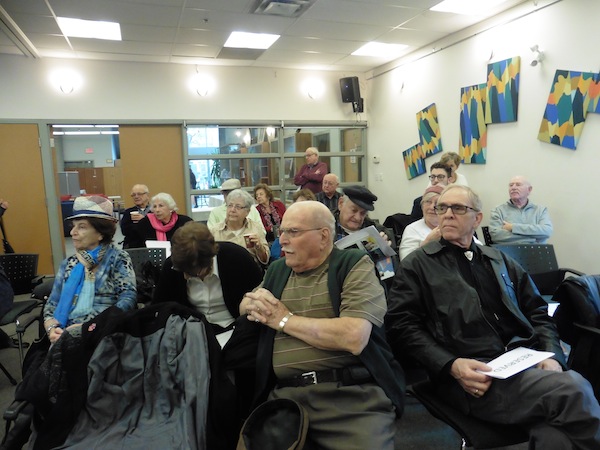
On Nov. 25, Jewish Seniors Alliance’s first Empowerment Series in partnership with the Jewish Museum and Archives of British Columbia was held at the Peretz Centre for Secular Jewish Culture.
Gyda Chud, JSA vice-president and Peretz president, and Ken Levitt, president of JSA, welcomed the 65 people gathered, with Levitt thanking Chud and citing her as an example of koach, strength, in all she did.
The theme of this year’s series is Food: The Doorway to Our Culture, so the partnership with the JMABC was a natural fit, as its theme for the year is “Feeding the Community,” said Michael Schwartz, coordinator of programs and development of the JMABC, who briefly described how the museum functions and the extent of its collection.
As for its theme, Schwartz said the JMABC has created a new podcast, called Kitchen Stories. Episodes include stories about Sephardi Jews adapting to the culture of a different land, and that of a blended family from Ukraine and Rhodes. Schwartz highlighted the story of a family in Haida Gwaii, where, he explained, contact is usually made through an event; a shared feast celebrating the catching of fish, for example, the preparing of the meal and then the partaking of it, all instrumental to the success of the project itself.
Often a dilemma is faced when adapting to a new food culture and discarding the former, said Schwartz. Questions often arise, Which self am I? Does this diminish my former self? Food represents identity, acceptability and relationships, he explained, adding that a new JMABC venture planned for the coming year is a supper club at the Peretz Centre, where each get-together will focus on a different cultural theme: Persian, Israeli and Mexican.
Shanie Levin, a vice-president of JSA, then shared stories of food with those gathered. Formerly involved in amateur theatre and more recently in Yiddish reading groups at the Isaac Waldman Jewish Public Library, Levin said she collected stories from several different perspectives. The first she read was an excerpt from Rhapsody in Schmaltz by Michael Wex, in which he lists the various blessings to be said before and after consuming foods. In the passage, Wex also notes the problem of dealing with a spoonful of milk that falls into the chicken soup. Does it render the whole soup non-kosher? Or just the pot? What if the family is poor and there is nothing else to eat? Referring to Wex’s book, Levin discussed how Ashkenazi Jews have remained close to their customs of origin while Sephardi Jews more often have adapted their food preparation according to the country in which they found themselves.
A crowd favorite was The Chicken Tale by Rabbi Daniel T. Grossman, which had everyone laughing, hearing about the rabbi who, traveling with a group of Jewish choir singers, finds himself in a town that knows nothing about the customs of Jews. Hoping to impress him, his hostess does some research at the local library. When she meets the rabbi, she informs him that she knows rabbis kill chickens, therefore, there is a chicken in the yard and the townspeople are waiting to witness the kill. However, the horrified rabbi says that he is not that kind of rabbi, but a praying and teaching rabbi. So, that night, they all eat fish.
Another story, A Town Called Roosevelt by Moishe Nadir, illustrated that a preconceived notion can be changed gradually with each course of a delicious meal.
A personal favorite was Challahs in the Ark by Rabbi Zalman Schachter-Shalomi, written about the time the Jews were expelled from Spain, eventually to relocate to Tzfat. The shul caretaker was desperate to know if he had found favor in God’s eyes. Knowing his wife was an expert challah baker, he asked her to bake 12 loaves, which he then placed in the Torah ark, thinking that, if they were gone in the morning, then he would know God had accepted his offering. In the meantime, the shamash, who had not been paid for many weeks and had a hungry family, was pleading with God to show him a sign that his prayers were being heard. Imagine his joy upon discovering the loaves of bread at the ark, which he thought to be a definite sign. This joy was echoed by the caretaker the next morning. Seeing the challahs were gone, he felt God had accepted them.
Serge Haber, Jewish Seniors Alliance emeritus president and JSA founder, left, and Larry Shapiro, second vice-president and executive board member of JSA, sit in the front row of JSA’s first Empowerment session of the year’s series. (photo by Binny Goldman)
The audience was reluctant to let Levin stop, so she read one more story, a short version of Sholem Aleichem’s Chanukah Gelt. Her delivery held listeners’ rapt; they could envision the action, as each story enfolded.
A musical program followed, featuring Debby Fenson, Deborah Stern Silver and accompanist Elliot Dainow. Fenson is ba’alat tefilah (Torah reader) at Congregation Beth Israel, where she teaches b’nai mitzvah students; Stern Silver is a trained soprano who sings with Fenson at Beth Israel; and Dainow is musical director of the Unitarian Church, as well as being an accompanist for soloists and various ensembles, including the Vancouver Jewish Folk Choir, which calls the Peretz Centre home.
Introducing their program, Stern Silver said the songs being presented were of Ashkenazi sources. They included “Tayere Malkeh,” a Yiddish drinking song, performed with a drinking cup and an empty bottle of wine, and a song about having to eat potatoes every day, which had the audience eagerly joining in with the chorus of bulbes (potatoes). The third song transported everyone to the Israeli marketplace, “Shuk HaCarmel,” and “Rozhinkes mit Mandlen” (“Raisins and Almonds”), a lullaby sung to children, brought tears of recognition and nostalgia.
Several instruments were handed out and those in the audience became participants in the performance of “The Latke Song” by Debbie Friedman. For the final song, “Finjan,” the audience enthusiastically clapped along.
It is impossible to capture the warm feeling of shared chavershaft (camaraderie) prevailing in the room; a fargenign, a pleasure.
In addition to Chud, who was the convenor, the event was made possible with the help of JSA staff, and Karon and Stan Shear filmed it for JSA’s website. Here’s to continuing the singing of our songs and sharing our stories m’dor l’dor, from generation to generation, af eybik, forever.
Binny Goldman is a member of the Jewish Seniors Alliance of Greater Vancouver board.
Ten years ago, Rosie Daykin opened Butter Bakery and Café in Vancouver. Five years ago, it moved to its current location on Mackenzie Street and began offering breakfast and lunch, in addition to baked goods. The bakery has grown to have its products distributed and sold in more than 300 grocery stores and high-end retailers, including Whole Foods, Dean and Deluca and Crate and Barrel.
Daykin published her first cookbook in 2013, Butter Baked Goods: Nostalgic Recipes from a Little Neighborhood Bakery, and her second in 2015, Butter Celebrates! A Year of Sweet Recipes to Share with Family and Friends, both via Appetite by Random House. Just last month, the U.S. edition came out from Knopf, with the subtitle “Delicious Recipes for Special Occasions,” and this reviewer received a copy.
After the essays “Essential Elements and Entertaining,” “Buts and Bobs for Successful Baking” and “Some Gentle Reminders,” the book jumps into the holidays – there are 117 recipes and 185 photographs.
There are recipes for almost every occasion. The book is divided into Valentine’s Day, St. Patrick’s Day, Easter, Mother’s Day, Butter Babies, Welcome Wagon, Butter Creams and Frostings, Summer Celebrations, Zelda’s Birthday Party, Halloween, Thanksgiving, Chanukah, Christmas and Happy New Year. A final essay is on packaging your goodies.
This is not a Jewish cookbook, however, there are new and creative holiday recipes and the offerings for Chanukah are sufganiyot, apple-stuffed challah and chocolate hazelnut rugelach.
As Daykin writes, “What kind of celebration could it be without baked goods?” With that said, here are two of her three Chanukah recipes. If you’re not feeling up to baking, you can always pick up something at the bakery, of course – and they also sell a variety of gift boxes that would bring a smile to many a face. Butter Bakery and Café is located at 4907 Mackenzie St., and is open Monday through Saturday, 8 a.m. to 5:30 p.m., and Sunday, 9 a.m. to 5 p.m.
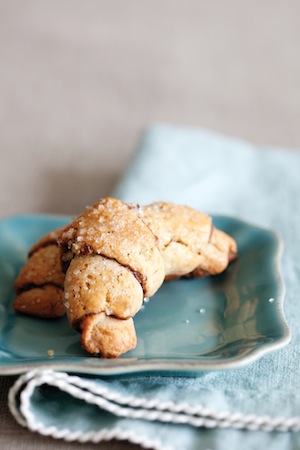
Rosie Daykin’s chocolate hazelnut rugelach.
CHOCOLATE HAZELNUT RUGELACH
“Traditional rugelach is filled with jam, fruit and nuts, but chocolate and hazelnut seemed just a smidge more celebratory to me,” writes Daykin. “It also provided me with another excuse to spread Nutella on something. These little crescent-shaped cookies fall under the more-ish category of baking. You eat one and you have to have more.”
1 1/2 cups pastry flour 1⁄2 tsp baking soda 1⁄2 tsp salt 1⁄2 cup cream cheese, full fat 1⁄2 cup butter, room temperature 1⁄2 cup granulated sugar 1 cup Nutella 1⁄2 cup hazelnuts
Finishing touches: 1 large egg 1 tbsp water Course sanding sugar
Makes: two dozen cookies.
You will need: two (11-by-17-inch) rimmed cookie sheets lined with parchment paper.
Storage: these cookies will keep in an airtight container for up to one week or in the freezer for up to three months.
On a large piece of parchment paper, sift the flour, baking soda and salt. Set aside.
In a stand mixer fitted with a paddle attachment, cream the cream cheese and butter on high speed until well blended. Scrape down the sides of the bowl. Add the sugar and continue to beat until light and fluffy. Scrape down the sides of the bowl.
Turn the mixer speed to low and slowly add the dry ingredients. Continue to beat until well combined.
Divide the dough in two. Wrap each piece in plastic wrap and chill in the refrigerator for at least two hours.
Preheat the oven to 350°F.
Place the Nutella in a small bowl and use a spoon to give it a good stir to help loosen it up. This will make it easier to spread across the tender dough.
Use a large chef’s knife to chop the hazelnuts. Set aside.
Place a chilled piece of dough on a lightly floured work surface and use a rolling pin to roll it into a circle about nine inches in diameter.
Use a small offset spatula to carefully spread the Nutella across the dough. The dough is very tender, so work carefully to avoid it tearing it. If it does tear, not to worry, just press it back together.
Sprinkle half of the chopped hazelnuts over the top of the Nutella.
Use the large chef’s knife to cut the dough into quarters and then each quarter into thirds, just like if you were cutting a pie.
Start at the wide end of a piece of dough and roll it toward the point. Bend the two ends in slightly to create a crescent shape and then place it on a prepared tray.
Repeat with the balance of the dough.
Combine the egg and water in a small bowl and whisk them together. Use your pastry brush to lightly coat the top and sides of each cookie. Sprinkle generously with the sanding sugar.
Bake for approximately 15 minutes, or until the cookies have puffed up and are a lovely golden brown. Remove the cookies from the oven and transfer them to wire racks to cool.
APPLE-STUFFED CHALLAH
“I wondered what would happen if I melded the idea of a butter cinnamon bun and challah loaf. Oh, believe me, people … good things happened. This bread is wonderful warm from the oven or lightly toasted with butter, but in French toast it has found its true calling. So, you might want to say ‘hola’ to this challah all the time.”
1 package instant yeast 1⁄4 cup warm water 4 cups all-purpose flour 1⁄4 cup granulated sugar 2 tbsp butter 1 tsp salt 2 tbsp liquid honey 2 large eggs 2 egg yolks 2 tbsp vegetable oil 3⁄4 cup water
Apple stuffing: 2 apples, peeled, cored and cut into 1⁄2-inch cubes (something tart, like a Granny Smith, works well) 2 tbsp dark brown sugar 1 tbsp liquid honey 1 tsp ground cinnamon
Finishing touches: 1 large egg 2 tbsp water Coarse sanding sugar
Makes: one loaf, eight to 10 slices.
You will need: one (11-by-17-inch) rimmed cookie sheet lined with parchment paper.
Storage: this challah can be kept well wrapped or in an airtight container for several days, especially because you can toast it.
For the challah, in a small bowl, sprinkle the yeast into the warm water. Set aside to bloom.
In a stand mixer fitted with a paddle attachment, combine the flour, sugar, butter and salt on medium speed. Continue to beat until the butter has been distributed throughout the flour.
In a liquid measuring cup, whisk together the honey, eggs, egg yolks, oil and water. Turn the mixer speed to low and add the liquid ingredients to the dry ingredients. Add the yeast with its water and continue beating until well combined.
Stop the mixer and change the paddle attachment to a dough hook.
Turn the mixer speed to high and let the dough hook knead the dough for at least five minutes, until it is shiny, smooth and elastic.
Place the dough in a lightly oiled bowl and cover loosely with plastic wrap. Place the bowl in a warm, draft-free spot and allow the dough to rise until it has doubled in size, about 90 minutes.
Meanwhile, prepare the apple stuffing. In a medium bowl, combine the chopped apple, brown sugar, honey and cinnamon. Use a wooden spoon to stir and coat all the apples. Set aside.
Once the dough has fully risen, remove the plastic wrap and punch down the dough to release the air produced by the yeast. Turn the dough out onto a lightly floured work surface and allow it to rest for about 10 minutes.
Use a knife to divide the dough into three equal pieces. Use your rolling pin to roll each piece into a rectangle approximately 14 inches long and six inches wide. Place one-third of the apple filling down the centre of a piece of dough. Pull one side of the dough over the filling and pinch to seal it closed on the other side and at the top and bottom. This will create a filled log of dough. Repeat with the other two pieces of dough.
Lay one of the logs vertically along the centre of the prepared cookie sheet. Lay a second log across the middle of it, with the ends of the log pointing at 10 o’clock and four o’clock. Then lay the third log across the middle on top, with the ends pointing at two o’clock and eight o’clock. Braid one side of the loaf from the middle down and then tuck the ends under. Turn the cookie sheet and repeat with the other side.
In a small bowl, combine the egg and water and use your pastry brush to generously coat the top and sides of the loaf with the egg wash. Sprinkle with the sanding sugar.
Cover the loaf loosely with a sheet of plastic wrap and set in a warm, draft-free place to rise again until it has nearly doubled in size, about 90 minutes.
Preheat the oven to 350°F.
Bake the loaf for 30 to 40 minutes, or until it is a lovely golden brown and a wooden skewer inserted in the centre comes out clean.
Remove from the oven and allow the loaf to cool for at least 20 minutes on the cookie sheet before transferring to a cutting board and slicing.
Sybil Kaplanis a journalist, foreign correspondent, lecturer, food writer and book reviewer who lives in Jerusalem. She also does the restaurant features for janglo.net and leads walks in English in Jerusalem’s market.
Kimchi seems to be the latest kosher craze. Here, Yeun Sun Shin, manager of South Korea’s Dongbangfood Oil Co. Ltd., shows off some of the company’s products at Kosherfest, which took place Nov. 15-16 in New Jersey. (photo by Dave Gordon)
Jewish fare extends well beyond the traditional Ashkenazi knish, kneidlach and kugel. Kimchi is the latest kosher craze, at least evidenced by the throngs of those who sampled it at Kosherfest, the annual food exhibition, which this year took place Nov. 15-16, at Meadowlands Exposition Centre in New Jersey.
For the uninitiated, the Korean staple is a cabbage-based food that contains white radish and spices.
Kosher-certified Koko’s line also includes gochujang (fermented red pepper paste) and doenjang (fermented soybean paste). Ziporah Rothkopf, Koko’s chief executive officer, not only boasted that her creations were the first of their kind in the kosher world, but that they were also among Kosherfest’s “best product award-winners,” and that she matched mainstream kimchi’s flavorings without including the usual shrimp brine.
Kosherfest, explains its website, “gives manufacturers, distributors and suppliers of kosher-certified products and services the opportunity to reach thousands of mainstream and independent kosher trade buyers from across the globe.”
The exhibition hall contained the expected offerings, but with a twist: hummus, including chocolate and orange-flavored; myriad wines, including ones called Moses and Unorthodox; artisan cheeses galore; endless new fruit beverages and sweets. There was even kosher toothpaste, SprinJene, which, unlike other toothpastes, say its spokespeople, doesn’t contain traces of animal enzymes, a no-no in the kosher world. (Non-Orthodox Judaism allows the consumption of any toothpaste.)
Nearly 300 exhibitors and companies were represented from around the world, including South Africa, Sri Lanka, Great Britain, Canada, Japan, Costa Rica, Korea, Czech Republic, Ukraine and, of course, the United States.
From the Philippines, FOCP presented organic coconut products, LTA Foods presented banana chips. From India came Lalah’s tamarind products, Eastern spices and Nila nuts.
Australia’s MC Foods came to show off their boutique salad dressings and marinades, with the hope of finding a distributor in the Americas. From Russia came Baltika beer, said by its spokesperson to be the second bestselling brew in Europe, behind Heineken – the company produces five billion litres a year and each of the 17 beverages in the brand has kosher certification, even though beer generally does not require it.
However, contrary to popular belief, nori, which is used in sushi, poses a unique kashrut obstacle, even if it contains “100% seaweed.” Rabbi Binyomin Y. Edery, the mashgiach of Kosher Japan, explained that kosher nori, despite being a vegetable from the ocean, requires a special process, as well as rabbinical supervision. Unbeknown to many, seahorses (not kosher) and various non-kosher fish eggs become intermingled with the seaweed and must be filtered out for the seaweed to be deemed kosher, a process that is not done at non-kosher manufacturing plants.
The workaround for the kosher world, said Edery, is to harvest the seaweed in a certain two-hour window prior to daybreak, when the waters are coldest and the creatures are least likely to swim.
Moving from ocean water to bottled water from the Czech Republic’s Fromin, which is collected from an artesian well 275 metres deep, and is sold in glass bottles that can cost up to $35 US for 1.5 litres. Available in North Africa and Europe, the kosher-certified company sought a North American distributor.
According to chairman Martin Landa, although water does not require a hechsher (kosher certification), he said many consumers want to be doubly assured there are no treif (non-kosher) additives or non-kosher products made in the bottler’s vicinity.
From Betula Pendula, also in the Czech Republic, comes goat colostrums – the fluid secreted by female goats right after giving birth, which is used in skin cream and immune-boosting pills.
In other quasi-milk news, Israel-based Mashumashu, makers of vegetarian, dairy-free artisan cheeses, including cheddar, gouda, mozzarella and feta, showed off how their products melt easily on a pizza, and boasted that few people could tell the difference between the real deal and their cheeses.
Meanwhile, the gluten-free trend has caught on with dozens of Kosherfest’s exhibitors, including Soupergirl of Washington, D.C., run by former comedian Sara Polin. She said she “sought a healthy, kosher and delicious soup” with “only ingredients you can pronounce,” so she made some. Among her company’s many products are curried split pea apple kale, lentil butternut squash, and beet gazpacho. She has been featured in the Washington Postand O, The Oprah Magazine.
Also on the gluten-free train was Florida-based DelaRosa, whose executive vice-president Yehudith Girshberg claims to be the only kosher, gluten-free and organic oat producer. They also make organic wines, vinegars, olive oils and tahini.
It appears as though the kosher world will soon be indistinguishable from regular supermarket fare, with the availability of kosher pepperoni and “cheese” pizza, kosher “facon,” kimchi and even duck sausage. If things continue on this trajectory, in the near future, there may be little kosher food makers can’t successfully imitate.
Dave Gordonis a Toronto-based freelance writer whose work has appeared in more than 100 publications around the world.
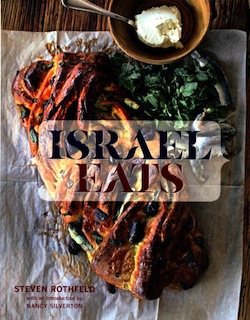
Steven Rothfeld is a travel photographer with an emphasis on culinary cuisine. He has written more than 10 books of photography and lives in Napa Valley, Calif. His cookbook Israel Eats (Gibbs Smith Publishers) came out earlier this year.
In the introduction, Rothfeld describes how he met an Israeli on a train in Italy in 1984. The fellow passenger asked Rothfeld why he hadn’t been to Israel. Twenty-five years later, reading Amos Oz’s memoir, Rothfeld’s imagination started working. In 2010, he finally made the trip.
“I encountered a world I had never imagined existed in Israel,” he writes, referring in large part to the vibrant cuisine.
He had worked on three books previously with chef Nancy Silverton so, when he conceived of Israel Eats, he asked her to join him.
Silverton is a chef, baker and author of eight cookbooks. She won the James Beard Foundation’s outstanding chef award of 2014 and lives in Los Angeles. She had been intrigued by Yotam Ottolenghi and Sami Tamimi’s cookbook Jerusalem and, in Israel, she discovered that “the cuisine of Israel is an extraordinary layering of flavors.”
And, writes Rothfeld, “Contemporary Israeli cuisine reflects a global consciousness rooted in a vast, mind-boggling array of cultural influences and traditions.”
Rothfeld and Silverton’s enthusiasm infuses this book.
After Haaretz journalist Ronit Vered explains the history of Israel’s cuisine from the 1950s to today, Rothfeld and Silverton embark on a tour of Israel – Tel Aviv-Jaffa, the north, the centre, the south, Jerusalem and the Judean hills, concluding with the “ecosystem of Israel Eats,” meaning the people who contributed to the book.
Each “chapter” has an introduction, with accounts of places Rothfeld and Silverton visited and people they met, and is followed by the recipes, each with its own introduction, source and beautiful color photographs.
Some of the recipes are from restaurants and chefs, others are from individuals and some are by Silverton. This is not a kosher cookbook but only five recipes are strictly non-kosher and most of those could be adapted by leaving out one ingredient that would not change the tone of the recipe; only one recipe is not adaptable. There are 90 recipes in total, and here are a couple.
HALLOUMI CHEESE FLOWER (two servings: “A single flower will only make you crave a bouquet.”)
3 tbsp olive oil 1 ripe, medium-size tomato, halved and thinly sliced 3 to 4 ounces halloumi or mozzarella cheese, thinly sliced salt and freshly ground pepper 3 large garlic cloves, thinly sliced 1 small fresh green chili, thinly sliced 10 cilantro sprigs
Heat oil in a heavy eight-inch skillet over medium heat. Arrange tomato slices in the skillet in the shape of a circle. Top the tomato slices with cheese slices. Sprinkle with salt and pepper. Arrange the garlic and chili slices atop the cheese. Bunch the cilantro sprigs in the centre of the skillet. Continue cooking until cheese is soft but not totally melted. Serve immediately.
VANILLA ICE CREAM WITH CHERRY TOMATO JAM (four to six servings: “an excellent and surprisingly tasty marriage”)
1 pound cherry tomatoes 1 2/3 cups sugar 2 tbsp water 1 tbsp black peppercorns 2 pints vanilla ice cream chopped fresh mint leaves
Combine the tomatoes, sugar, water and peppercorns in a medium-size heavy pot and bring to a boil. Reduce heat and simmer, stirring occasionally until the mixture is thick and syrupy and reduced by half, about one hour.
Divide the ice cream among bowls. Spoon the tomato jam over the ice cream. Garnish with mint.
Sybil Kaplanis a journalist, foreign correspondent, lecturer, food writer and book reviewer who lives in Jerusalem. She also does the restaurant features for janglo.net and leads walks in English in Jerusalem’s market.
A young Dawn Lerman with her grandmother, Beauty (photo from Dawn Lerman via JNS.org)
In her memoir My Fat Dad, New York Times wellness blogger and nutritionist Dawn Lerman (@dawnlerman) shares her food journey and that of her father, a copywriter from the Mad Men era of advertising. Lerman spent her childhood constantly hungry, as her father pursued endless fad diets from Atkins to Pritikin, and insisted the family do the same to help keep him on track. As a child, Lerman felt undernourished both physically and emotionally, except for one saving grace: the loving attention of her maternal grandmother, Beauty. Below is an adapted excerpt from My Fat Dad, in addition to a recipe for a healthier version of a Chanukah staple.
***
When I lived in Chicago, Jewish holidays were spent either at my Grandma Beauty’s house or my Bubbe Mary’s house. My grandmothers lived near each other on Chicago’s north side. I saw Beauty every weekend, but I would only see Bubbe Mary, my father’s mother, on occasional holidays. While my grandmothers had a lot in common – they were both amazing cooks – they were also very different.
Beauty adored me, but Bubbe Mary did not seem to have much time to see me. Also, Beauty was all about being healthy, using a lot of fresh fruits and vegetables in all her dishes. Bubbe Mary was all about recreating the dishes that made her feel closer to Old World traditions she left behind in Romania.
Every year at Chanukah, the whole family was invited to Bubbe Mary’s for a traditional Jewish dinner. She even included my mom’s parents, Beauty and Papa. What I loved most about holiday gatherings at Bubbe Mary’s house was seeing my first cousins, whom I adored but rarely ever saw – and listening to both grandmothers speak Yiddish. I never knew what they were saying, but something about the sound of the dialect combined with intense hand gestures and the aromas of the Jewish food left a lasting imprint.
Bubbe Mary grew up in Romania and traveled by boat to the United States when she was 13. She traveled with some of her sisters and brothers, but many family members were left behind.
Bubbe Mary used schmaltz to cook everything – from matzah balls to latkes to chicken livers. Everything was fried with schmaltz, which she kept in a glass jar above her stove. For Chanukah, she often went through a whole jar. She fried and grated so many potatoes for the latkes that her knuckles would bleed. She made sure if you were eating at her home there was plenty of food, and you would not leave without a full belly and a doggy bag.
The most memorable Chanukah at Bubbe Mary’s was when I was 8, the last one before my family moved to New York, and one of the last times I ever saw her.
Michael Wex, author of Rhapsody in Schmaltz (St. Martin’s Press, 2016), will close the Cherie Smith JCC Jewish Book Festival on Dec. 1.
“Heavy, unsubtle and, once it emerged from Eastern Europe, redolent of an elsewhere that nobody missed, the food of Yiddish speakers and their descendants is a cuisine that none dares call haute, the gastronomic complement to the language in which so many generations grumbled about it and its effects,” writes Michael Wex in the introduction of his latest book, Rhapsody in Schmaltz: Yiddish Food and Why We Can’t Stop Eating It.
“This vernacular food continues to turn up in vernacular form in the mouths of people who have never eaten it, or who don’t always realize the Jewish origin of the strawberry swirl bagel onto which they’re spreading their Marmite,” he writes. “We’ll be looking at the aftertaste of Ashkenazi food as much as at the cuisine itself. But before we can do so, we have to go back to the Bible to see why Jewish food exists and what it really is.”
Toronto-based Wex – who is the author of many books, including Born to Kvetch: Yiddish Language and Culture in All of Its Moods and How to Be a Mentsh (& Not a Shmuck) – will close the Cherie Smith JCC Jewish Book Festival on Dec. 1. His topic, appropriately enough, is Jews and Food.
In Rhapsody in Schmaltz, Wex takes readers from the Exodus from Egypt – “Most national cuisines owe their character to flora and fauna, crops and quarry, domesticated animals and international trade. Jewish food starts off with a plague” – to the modern delicatessen, which “might no longer be the social hub it was for earlier generations, but the food that it serves is still recognized as Jewish, even when the ingredients are combined in ways that can’t help but pain an observant Jew.”
Michael Wex (photo by Zoe Gemelli / St. Martin’s Press)
While written in a tongue-in-cheek manner, Wex’s love of Yiddish culture, if not of Yiddish (aka Ashkenazi) food, is apparent in every page. And each page is packed with information – that he somehow compiled on his own, without research assistants.
“Although all of my non-fiction is rooted in subjects with which I was already quite familiar, I’ve found that it’s the research itself, the jump from one source to the next, that tends to produce the sparks that lead to the better ideas,” he explained to the Independent of his creative process. “I don’t think summarized works or lists of facts provided by an assistant would allow for the immersion that I, at least, need in order to write a book.
“It generally takes me about a year to research and write a book – maybe 18 months, if you count the preliminary research that usually goes into preparing a proposal for a publisher. I generally start with a specific, if somewhat vague, question and then try to answer it: What makes Yiddish different from other languages? Why do Jewish people go on eating traditional Jewish food even when they spend most of their time finding fault with it and have abandoned the rituals and ceremonies with which such dishes were associated?”
With nine pages of endnotes and a 13-page bibliography, one might assume that Rhapsody in Schmaltz is a dry read. It is anything but – Wex’s style is completely irreverent. For example, in writing about the formation of the dietary laws, he comments, “the Israelites aren’t supposed to feel any more deprived of the right to eat certain creatures than most of us usually do about the right to get high on crystal meth or pee in the street.” He openly discusses over-the-top kosher practices, bodily functions, etc. Perhaps surprisingly, his writing hasn’t ever gotten him into trouble with his religious compatriots.
“The only ‘trouble’ I’ve encountered has arisen from misunderstanding,” he said. “For instance, I received a vehemently condemnatory email from a woman who objected to my having used the phrase ‘goat or kid’ in describing the Passover sacrifice; she was afraid that non-Jews might take the word ‘kid’ as proof that we really murder gentile children and use their blood to bake matzah. Otherwise, though, the response has been quite positive. A number of rabbis – Orthodox, Conservative and Reform – have written to tell me that they’ve used material from my books in their sermons; Born to Kvetch is frequently cited in the language column of Hamodia, an English-language ultra-Orthodox paper published in Brooklyn.
“Most feedback about Rhapsody in Schmaltz has focused either on readers’ memories of the foods mentioned or on the ritual or halachic reasons behind the forms they’ve assumed or the occasions on which they are eaten, including questions relating to their viability in a world in which most Jews are not religiously observant.”
For many readers, some of Rhapsody in Schmaltz will serve as a memory refresher of the origins of certain rules of kashrut or the types of meals that are traditionally prepared for various holidays. But there is much readers will learn and, while Yiddish food may have been a topic with which Wex was familiar before he began his research, there were a few findings that surprised him.
“The whole Crisco-Manischewitz nexus and the things that grew out of it was probably the main thing I learned; I’d known how important Crisco was for kosher marketing, but until I looked into it, had no idea of why,” said Wex. “The other thing that really shocked me when reading through cookbook after cookbook was the surprising popularity of brain latkes at one time – I knew that brains were once popular, but had never heard of consuming them in latke form.”
Tickets to the closing of the book festival, which takes place at the Jewish Community Centre of Greater Vancouver, are $24 and the event features a food reception – brain latkes not included. To order, call 604-257-5111, drop by the JCCGV or visit jewishbookfestival.ca.
Chef Michael Solomonov samples the wonders of the Levinsky Market in Tel Aviv. (photo from israelicuisinefilm.com)
The 28th Vancouver Jewish Film Festival starts next week. New this year is an all-ages weekend of films at Rothstein Theatre, which follows the Nov. 3-10 festival screenings at Fifth Avenue Cinemas. Not new is the diverse selection of thought-provoking offerings.
With the festival opener, In Search of Israeli Cuisine, foodies will get their fix and then some. Guided by Michael Solomonov, the chef-owner of Philadelphia’s Zahav restaurant, the viewer is taken on a global food tour all within the confines of the tiny state of Israel.
Is there even an Israeli cuisine, the film asks. Yes, says food writer Janna Gur. “It’s perhaps a nascent cuisine, a baby cuisine, but a very precocious baby,” she says.
Israeli cuisine, Solomonov says, is made up of “traditions that were brought here and also that were born here.” He asks one market vendor how long he has had a spice shop. The reply: “Four hundred years.”
The food of Israel mirrors the history of the country, particularly its economy. In the years after independence, cuisine was defined by economical, modest recipes that incorporated the agricultural resources of the new state. In the 1980s, when the economy boomed, Israelis traveled more and wanted at home the kinds of flavors they found abroad.
Philosophically, Israeli food developed alongside the new identity the people were creating for themselves and their country. People were ashamed of the past and embarrassed by the foods of their parents. Israel’s “new Jew” was supposed to leave sad history behind and create a new post-galut civilization.
“In Israel, when you say Polish cooking, it’s another way of saying bland, boring, guilt-ridden kind of food,” says Gur.
Yet, the effort to abandon the past was both successful and, thankfully, unsuccessful. Tradition, in fact, integrates change through adaptive cookery. The centrality of Shabbat has defined Jewish and, therefore, Israeli cuisine, because of the necessity of developing recipes that can cook slowly for up to 16 hours. And, even though most Israelis are not religiously observant, Shabbat can still be a sacred family experience. One person explains that watching American TV, where families gather twice a year for Thanksgiving and Christmas, seems foreign, because every Jewish mother wants her daughters and sons with her every Shabbat.
Also unlike in most of North America, the film illustrates mouth-wateringly that a vegetarian in Israel can eat like royalty with endless options.
Politics also intervenes. During the Oslo peace process, Palestinian restaurants flourished in Israel. “Food makes peace,” says an Arab-Israeli chef. But there are also accusations of cultural appropriation.
“They often accuse us of stealing it,” chef Erez Komarovsky says of Israeli cuisine. But food knows no borders, he contends. “Food is not political. Food is what is grown on this land by the people who are living in it. If they are called Palestinians or Israelis, I don’t care. I don’t think the tomato cares.”
“Israeli salad is actually Arabic salad,” Gur admits. “What makes it Israeli is the way we use it.” That means eating it three meals a day and, for instance, stuffing it in pita with schnitzel.
The evidence about what defines Israeli cuisine is not entirely conclusive. Though Komarovsky claims to know.
“The essence of the Israeli taste is lemon juice, olive oil and the liquids from the vegetables,” he says. “And this is the taste that you miss after two or three days when you go abroad.”
– PJ
Liberation after the Holocaust was not unalloyed joy. It was complex, emotional terrain that involved coming to terms with the reality of the extent of the destruction of European Jewish civilization, individual family members and entire communities. This mix of emotions is clearly shown in Magnus Gertten’s documentary Every Face Has a Name.
Hinda Jakubowicz stepping off the ferry in Malmö on April 28, 1945. (photo from everyfacehasaname.com)
Gertten took a film that was shot of arrivals to Malmo, Sweden, on April 28, 1945, and obtained the list of 1,948 passengers who arrived that day. Then he set out to put names to faces.
Elsie Ragusin was an Italian-American New York girl visiting her grandparents in Italy when the war began and they could not return home. When the Nazis occupied Italy, she and her father were arrested as spies and she became, as she says, the only American girl in Auschwitz.
She looks at her face on the film and says: “There, I’m thinking: ‘Can this be true?’” The smiling people handing out food seemed unreal to her. No one had smiled at them in the camps.
Gertten, a Swede, was moved to make the film when he saw parallels with the faces in footage of refugees arriving in Europe today. “Who are they?” he asks.
Fredzia Marmur, now of Toronto, sees herself on film, at age 9, wearing the same cloth coat she wore when her family left the Lodz ghetto. “There I am again,” she says of a little girl beaming into the camera.
The other women in the screen were together with her in Ravensbruck and, while Marmur admits she didn’t know what was happening, she took a cue from those around her. “I saw that everybody seemed happy, so I decided to be happy too,” she says.
Siblings Bernhard Kempler and Anita Lobel, 8 and 10 in 1995, try to reconstruct their thoughts at the time. Bernhard survived dressed as a girl and the pair stuck together, avoiding all others through their time in hiding and at Ravensbruck.
“It looks to me like I’m somewhere between happy and frightened,” says Bernhard. “A mixture of hope, a mixture of relief, a mixture of ‘Can I trust this?’ and some fear.”
He recalls his reunion with his parents. He was in hospital and the staff gathered around to watch what they expected to be a joyful scene. It wasn’t. His response, he recalls of meeting his parents after years of separation was, “Who are these people?” He suspects his parents wondered, “Who is this child?”
“I didn’t know who I was for a long time after that,” he says.
The film intersperses images from 1945 with those of present-day refugees arriving (some alive, some dead) in Sicily. A small but disturbing 1945 scene is ostensibly happy – women receiving clothes in Sweden – but the camera shows their nakedness, as if, even on liberation, their right to privacy was not granted.
People couldn’t always tell who they were seeing in the film. Judith Popinsky recognized four of the five young women who formed her surrogate family in Auschwitz after their families were murdered on arrival there. Only after some self-convincing did she determine that the fifth woman must be her.
“You encountered so many nameless faces throughout that period in time,” she says. “No one remembers them anymore. They lived anonymously. They were buried anonymously. At least now some of them have their names restored.”
– PJ
In One Rock Three Religions, the rock in question represents the city of Jerusalem. The Temple Mount – which Muslims call Haram al-Sharif – is the literal rock, where the two historical Jewish temples existed and where al-Aqsa Mosque and the Dome of the Rock now stand. The film captures the glory of diversity and the tragedy of division that coexist in the holy city.
Divisibility in a political sense has been mooted several times. The 1947 Partition Resolution saw a Jerusalem under international governance. The city was divided, from 1948 until 1967, with East Jerusalem under Jordanian occupation and West Jerusalem in Israel. However, Kanan Makiya, author of The Rock, insists that, from a human standpoint, it cannot be separated. “How do you cut a rock?” he asks. “Jerusalem belongs to more than one faith. No one person, no one faith can claim it.”
When the Temple Mount was captured by Israel in the 1967 war, some soldiers raised an Israeli flag over the Dome of the Rock. Gen. Moshe Dayan ordered it taken down and handed the keys to the Wakf, the Muslim religious authority. This was both a symbolic and a practical decision, particularly in contrast with the exclusion experienced from 1948 to 1967, when Jews were forbidden from the holiest Jewish sites.
The documentary focuses on the contending claims and assertions of rights. The founder of the Muslim Public Affairs Council says he has not seen Jerusalem because he will not stop at checkpoints and be searched “by soldiers that I consider occupiers.”
Some religious Jews say that, because the Temple existed where al-Aqsa Mosque now stands, they should be able to pray there as well as at the Western Wall. A Palestinian diplomat calls this a provocation.
Former Israeli diplomat Dore Gold contends that Palestinian and other Arab leaders frequently incite their followers with allegations that Israel is attempting to undermine or destroy the mosque and its environs. And the film features the Palestinian ambassador to the United Nations repeating the incendiary falsehood that the Jews are trying to build the Third Temple in the place of the Dome of the Rock. Some Muslims are quoted denying any Jewish connection to the location.
This sort of denial, recently codified by UNESCO in a resolution that erases Jewish and Christian historical ties to the holy site, is evidence that strength through diversity in a place of such importance is often more wishful thinking than reality.
– PJ
AKA Nadia is far more complex and compelling than you might first assume. (photo from 2teamproductions.com)
When you read the sentence-long review of AKA Nadia on some sites – “A happily married mother of two seems to have the perfect life, until her hidden past comes to light” – you make a few assumptions. Namely, that the two-hour film is a fairly fast-moving tale of deception and drama. The opening scenes, in which a host of events happens, back this up: lively protagonist Nadia (Netta Shpigelman), a young Arab girl, graduates school in Jerusalem and secretly marries her lover, a PLO activist; they move to England where, fairly quickly, he’s caught by the authorities and she’s left alone, branded a terrorist and with no easy way of returning to Israel.
It’s not until half an hour in that the movie reveals its style – thoughtful and slow-moving, far more complex and compelling than you might first assume. When we were first introduced to Nadia, it was in East Jerusalem in 1987. We’re now reacquainted with her 20 years later, in the city’s west. Having fled England, thanks to a young Jewish woman’s passport, she’s completely (and secretly) rebuilt her life, as a Jew called Maya. And this is where the movie focuses the bulk of its time, perhaps too much time, on her new roles: successful dance choreographer, mother of two and wife to a Jewish official at the Ministry of Justice.
It’s only to be expected that this pleasant middle-class family life shatters when her past catches up with her. And every aspect of the subsequent relationship breakdown is well-acted and artistically produced. You feel for both husband and wife, and of, course, you’re forced to think of the bigger picture, too – religious identity in Israel and the ramifications of being Jewish versus Arab. Even after the movie ends – which it does a little abruptly – you’ll be left contemplating these issues for days.
– RS
My Home doesn’t shy away from its aim: showing how much minorities in Israel are typecast. It starts by stating that minorities (mostly Muslims, Christians, Bedouins and Druze) make up 20% of the population, but are often viewed by the outside world as all being Arabs who resent the Israeli “occupation” and the Jewish “apartheid state.” To show this is far from the case, the documentary follows the work of four people, one from each of the minority groups listed above.
A scene from My Home, in which Muhamed Kabiya undergoes an ID check in Jerusalem. (photo from ruthfilms.com)
The result is a slightly disjointed, but incredibly interesting portrayal of people who are all different, but united in their bravery. There’s a Greek Orthodox priest and a Lebanese Christian, both promoting integration by “others” into Israeli society. But the two people who really resonate are Wafa Hussein, a Muslim Zionist and school teacher preaching acceptance of all ethnicities, and Mohammad Ka’abiya, an Israeli Bedouin who prepares Bedouin teenagers in his village for Israel Defence Forces service, having served himself.
The latter two have been labeled traitors by their communities because of their activism, but persist in striving for coexistence. And this is an aspect of the documentary that must be applauded – there is no sugar-coating the discrimination minorities face: “as an Arab, you wake up in the morning and tell yourself, ‘I have a lot to deal with today.’” But, the film ultimately is a heartening look at the complexities, both good and bad, of calling Israel “home.”
– RS
For tickets to the festival, visit vjff.org or call 604-266-0245.
Rebecca Shapirois associate editor of vivalifestyleandtravel.com, a travel blogger at thethoughtfultraveller.com and a freelance journalist published in Elle Canada, the Guardian, the Huffington Post and more.
The Jewish Museum and Archives of British Columbia’s Feeding Community project wants your story. (photo from JMABC)
What does an egg taste like when it’s been boiled for hours with onion peels and coffee? Have you ever consumed a meal while sipping on a carbonated yogurt beverage? What kind of oven do you need to make cubana, a dough that you leave on the fire from Friday late afternoon to Saturday?
These are just some of the questions the Jewish Museum and Archives of British Columbia has encountered in the early days of its research for the Feeding Community project. JMABC researchers have devoured cheesecake on Shavuot while talking about the use of dried lime in Persian cooking. They have asked a rabbi to divulge the secrets of his cholent recipe. They have pored over handwritten recipes and black and white photographs of Sephardi Jews in Seattle’s Pike Place Market. It’s been a rewarding and immersive sensory experience, learning about the community’s diverse roots and traditions – and the findings will be shared through a podcast being developed for the JMABC.
Some might say that too many cooks in the kitchen spoil the broth, but the opposite goes for making a podcast. The more people the JMABC hears from, the richer the podcast will be. The JMABC is interviewing members of the community, hoping to unravel what the act of eating and traditions of food mean for individuals and in terms of family. As much as the JMABC hopes people will listen to the series, it also encourages people to be contributors.
Whether your family arrived in Canada by way of Mexico, Minsk or Morocco, Argentina, Albany or Azerbaijan, South Africa, Sri Lanka or Shanghai, the JMABC would like to hear from you. To learn more about Feeding Community or to contribute information, email [email protected] or call 604-257-5199.