
The 96-year-old history of the Jewish Independent, which serves as a continuous record of Jewish communal life in British Columbia, was the topic of the second lecture in the Peretz Centre for Secular Jewish Culture’s 2026 Doikayt Speaker Series.
In a webinar titled “A Labour of Love: A Brief History of the Jewish Independent,” publisher Cynthia Ramsay discussed how the paper might even be more than 100 years old.
In 1925, there was a mimeograph – copies were printed using a hand-cranked machine – called the Vancouver Jewish Bulletin. Its connection to the 1928 mimeograph called the Centre Bulletin, the known origins of the JI, are unclear. Regardless, it wasn’t until the newspaper, by then called the Jewish Western Bulletin, was launched in tabloid form in 1930 that the clock on its history began.
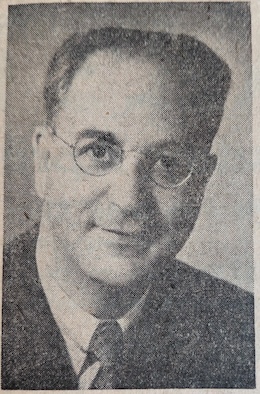
In its early years, the paper had to compete for local readers with a few other publications, both in English and Yiddish. Volunteers from the Vancouver Jewish Administrative Council, a precursor to the Jewish Federation of BC, initially oversaw the running of the paper.
“In 1937, one of the sales guys, Harry Musikansky, had the idea that the paper’s costs could be shifted over to a publisher, and the publisher could get all the advertising and keep all of the revenue, while the council kept editorial control,” Ramsay said.
This model, despite facing continual monetary challenges, endured into the 1960s. While David Sears took over as publisher for a year, in 1939, Musikansky took over the position and held it until 1945. There were several different editors during the publication’s early decades.
One subsequent publisher, Goodman Florence, demonstrated his frustration with trying to please the community in a 1949 editorial, shortly before he resigned. Florence observed that though “readers want everything under the sun and up to date, I have yet to be able to completely sell the simple fact that to do all of this requires considerable revenue.”
In 1949, Abe Arnold took over the reins of the paper as publisher, while his wife, Bertha, handled advertising. “As is the case in the newspaper in the early years, the male counterpart is front and centre. [Abe] Arnold ran the paper, but Bertha was in the background doing a hell of a lot of stuff,” Ramsay said.
The couple stayed on until 1960. Their 11-year tenure was filled with issues concerning revenue and salary, criticisms over the direction of the newspaper’s coverage, and debates on editorial partiality and council’s control over editorial decisions. In the 1950s, the main controversies seem to have been the United Jewish People Order’s expulsion from council (Zionist/right versus left) and kashrut-related letters/ads (orthodoxy versus other forms of Judaism), said Ramsay.
In 1960, Sam and Mona Kaplan came in from Winnipeg to steer the paper, and they would remain at the helm for 35 years. By 1962, the couple were able to turn down the decades-old community subsidy.
“The Kaplans really didn’t want to be at all connected financially to the council. There continued to be a publications committee; however, its role seemed to be reduced. The council still was able to put pretty much any advertising and event listings into the paper, but it seems like they really didn’t have much control over the paper,” Ramsay said.
The Kaplans used this independence to advocate for Soviet Jewry, Syrian Jews, Israel, Jewish education and other Jewish causes and institutions.
Ramsay’s history with the paper started in the summer of 1998, when she arrived as a proofreader. (For a short time in the late 1990s, an American publishing company managed the paper after the Kaplans retired.)
An economist by training, Ramsay’s intention was to return to Ottawa after her temporary position had ended. However, the lure of journalism proved too strong, and she decided to stay. In 1999, she, along with Pat Johnson and Kyle Berger, purchased the paper.
Johnson and Berger eventually moved onto other work, and Ramsay became the sole owner. In 2005, she chose to change the name, for several reasons. (See jewishindependent.ca/oldsite/archives/july05/archives05july22-11.html.)
“We had a contest for names,” she told the Peretz audience. “I didn’t like any of the names, so I picked the Independent. I had wanted to do the Optimist, but found out there was the Delta Optimist already.”
Ramsay shared a quote from the initial manifestation of the community publication, when Dr. JI Gorosh penned an editorial on July 15, 1925. He said the Bulletin would “work steadfastly and faithfully for the welfare of the Jewish community as a whole.” The aim then, as it is now, was to be the medium through which the Jewish community can express its ideals and announce its activities.
“We will strive not to deteriorate into a mere social gossip sheet, but to be a real service paper with a definite place in the life of the community,” Gorosh wrote.
Echoing that sentiment, Ramsay wrote in an editorial for the 95th anniversary issue of the paper: “While not ignoring the hurtful, the divisions, the controversies in our community or the larger universe, we try to cover stories in a way that doesn’t depress and paralyze action, but rather opens the door for solutions or at least positive attempts at change. We don’t want readers to put down the newspaper in despair, but rather to think about what they can do to contribute to a better world, whatever that means to them.”
The Independent may be the longest continually running Jewish newspaper in Canada, as countless other publications across the country have come and gone, or merged, over the last 96 years.
Ramsay said she would like to pass the paper on to another owner or owners after the paper celebrates its 100th anniversary in 2030, when she’ll be 60 and ready to retire.
“I’d like to get it to that point,” she said. “I truly think it is a treasure. I do want its future to be long, so I’ll be very careful with who I pass it on to. Hopefully someone wants it, because it is a labour of love at the end of the day.”
Sam Margolis has written for the Globe and Mail, the National Post, UPI and MSNBC.