Several athletes have recently been condemned for employing “the quenelle,” a one-armed salute critics say is a neo-Nazi gesture. Originated by a notorious French antisemitic comedian, the gesture, named for a French fish croquette, sees the perpetrators folding an arm across their chest with the other arm extended downward. Defenders say it is does not have racist connotations but is merely, depending on the telling, an “anti-establishment” gesture or an offensive move roughly equivalent to the middle finger. It has apparently been popular for years among French young people, but has risen to prominence after numerous incidents on the playing fields of Europe. American basketball star Tony Parker, who is from France, may have brought the quenelle to North American attention. He apologized, claiming he did not understand the gesture’s political or racial implications. What the quenelle means, according to a French Jewish communal leader, is clear and threatening.
“The gesture has gained popularity amongst young people, and reunites extremists from the Islamist camp, the extreme right and left, as well as revolutionaries with one common objective: the fight against the ‘Tel Aviv-Washington axis’ as well as Jewish power and Zionism,” Simone Rodan-Benzaquen, director of the Paris office of the American Jewish Committee, told JNS.org.
The act of folding an arm across the chest is an oblique move that, to the untrained eye, seems innocuous enough. This has allowed many, if not most, of the public figures caught performing the gesture to claim they did not know what they were doing. On the other hand, those who post to social media pictures of themselves doing the quenelle in front of synagogues, Holocaust memorials and the Jewish school in Toulouse, France, where a rabbi and three children were murdered in 2012, know precisely the significance of the salute.
French government officials are flummoxed about what to do. The country has extensive legal proscriptions against the promotion of racial hatred and the expression of hate speech, but the silent simplicity of the quenelle may, in some ways, endow it with its power while making it especially challenging to outlaw. The French government is pursuing means to ban the comedian who created the quenelle, Dieudonné M’bala M’bala, from performing or speaking in public. Of course, “outlawing” racism is rarely effective, and the apparent spread of the quenelle is a reminder that France and other European countries have a lot of work to do in confronting hatred.
If those who perform the quenelle gesture are sometimes able to hide behind ignorance and ambiguity over its meaning, another troubling sports-related incident is unambiguous.
A Dutch football (i.e., soccer) team jetted off to Abu Dhabi for a match, leaving one of its players behind in the Netherlands. Dan Mori, a defender for the Arnhem-based team Vitesse, is an Israeli Jew – and Emirates officials told the team Mori would not be permitted to enter the country. The team went anyway, asking Mori to stay behind.
In the team’s defence, the communications director claims the team “stays away from politics and religion. We have always done this. We are a soccer club.”
There may well be a damned-if-you-do and damned-if-you-don’t aspect to situations where external forces demand that people take a stand, or don’t. In sending the team to the game without its Israeli player, the team in no way stayed away from politics; they implicitly endorsed the racist policies of the United Arab Emirates.
Just as some quenelle perpetrators say they didn’t understand the meaning behind their actions, the Dutch soccer team may view the Emirati diktat as a position based on regional geopolitics of which Arnhem footballers know little. In fact, the exclusion of Israelis from Arab countries has always had the distinctive aroma of something more invidious than mere politics. It smells of the same effluence that has seen almost every Jewish community chased out of the Arab world in the past several decades.
People can say they do not understand the implications of their actions, plead innocence and insist they do not get involved in political disputes. But actions have consequences, and we each have an obligation to educate ourselves about the bad company we may join with our own seemingly innocent actions.
There is a saying in politics that when you’re explaining, you’re losing. So it should be an extraordinarily bad omen for Quebec Premier Pauline Marois, in the early days of her election campaign, to be forced to declare: “The Parti Québécois is not an antisemitic party.”
The defence was necessary after the clearly written views of one of Marois’ candidates became widely known last week. Louise Mailloux, a college philosophy instructor and Montreal-area Parti Québécois candidate in the April 7 Quebec election, is a staunch supporter of the PQ’s secularism policy. The party is proposing a Charter of Values that would prevent displays of religious affiliation – kippahs, turbans, hijabs, for example – by civil servants. The crucifix that stands at the front of the Quebec National Assembly would remain, interpreted by the PQ not as a religious statement but as a symbol of the province’s cultural heritage. Likewise, presumably, the enormous illuminated cross that bears down over Montreal from atop Mount Royal.
Mailloux, however, goes somewhat further than most secularists. One might call her a secular fundamentalist. She has written that circumcision is equivalent to rape. (In fairness, she said the same thing about baptism.) A particular interest of hers is kashrut, which she has called “robbery,” a “rip-off” and a “tax” paid “directly … to the synagogue.” (She says the same about halal certification.) She has demanded that kosher and halal products be banned because, she believes, they artificially inflate prices and the revenue from certification goes to fund “religious wars.”
It’s useful to be reminded of the kind of ideas that emerge from those with animus toward identifiable groups. A moment on the darker reaches of the internet reminds us that the nature of bigotry quickly twists into convoluted, bizarre and arcane conspiracies. There is an increasingly small market for ideas that express outright hate. That may have worked in past eras, but people and society have changed. To gain traction, such expressions now require some imagination. The “kosher tax” conspiracy theory is an ideal example. Take an issue about which the general public has only the vaguest awareness and build a dramatic and devious story around it. But this story is not new. It’s been most prominently pedaled by the Ku Klux Klan. Yet it is not as fringe an idea in Quebec as we might like to believe. When a provincial commission looking into “reasonable accommodation” of minority rights in Quebec, the Bouchard-Taylor commission, delivered its report in 2008, it explicitly mentioned the “most fanciful information … circulating among Quebecers” about kosher food. (In fairness, the Bouchard-Taylor hearings showcased an encyclopedic array of bad ideas held by Quebecers about a whole range of minority groups.)
When Jewish organizations heard of Mailloux’s views, they reacted with predictable outrage. In a party press release, Mailloux apologized – just not for her ideas.
“I never wanted to offend or hurt anyone,” Mailloux said. “If that has happened, I very sincerely apologize.”
Hours earlier, the PQ rescinded the nomination of one of its other candidates for online comments against Islam and supportive of the French far-right leader Marine Le Pen. But when Mailloux’s views became a top story, Marois stood firmly with her.
“She supports our secular charter and I appreciate her support,” Marois said, not hesitating to add that Mailloux “is an eloquent writer” and “I respect her point of view.”
It is always better to shine light on rancid ideas than to allow them to fester in hiding. Never more is this true than in the midst of a democratic election campaign. Given that this election campaign is shaping up to be largely about two issues – the future of Quebec in Canada and the future of minority rights in Quebec – Mailloux’s ideas could hardly have come to light at a better time. The voters of Quebec will make their opinions known on April 7.
Of course, even the democratic voice of a free people does not always reflect the best of human nature. Given the tenor of Quebec attitudes toward minorities and the fact that we are discussing the preparation of meat, a dictum comes to mind not from the Talmud, but from the sage of Philadelphia, Benjamin Franklin, who said that democracy is two wolves and a sheep voting on what to have for lunch.
Earlier this month, Kaplan’s Deli & Catering at 5775 Oak St. closed. On March 6, there were three signs on the door, one noting that the locks had been changed, and two concerning monies that had to be paid within five days. On March 18, the signs were still there. The doors were still locked. The property management company was continuing its search for new tenants.
Whether or not one frequented the deli, it is sad to see it go. Opened by Ida and Abrasha Kaplan in October 1967, Kaplan’s (with variations on what descriptors followed the name) was a veritable institution in the community. Its opening was heralded with a two-page spread in the Jewish Independent’s predecessor, the Jewish Western Bulletin.
Owners of two Pheasant Delicatessen locations at the time, the Kaplans kept Pheasant’s longstanding 4030 Cambie St. location until, it seems, from the pages of the JWB, April 1969, when it was taken over by Sigy and Molly Robbins. It looks like Pheasant lasted until 1972, when the Pyrogy House starts being advertised in the Bulletin at 4030 Cambie St.
The Kaplans bought Pheasant from Helen and Jack Finkelstein in 1962. The Finkelsteins had owned it since 1952. The for-sale notice the year prior noted the deli’s “good turnover” and “illness reason for selling” – the Finkelsteins bought it from Mrs. Sarah Nager, who seems to have been the first Jewish proprietor of the deli that first appears in the B.C. city directories in 1947.
When Kaplan’s opened in 1967, its modernity was lauded.
The Kaplans opened Kaplan’s Delicatessen & Restaurant, “[j]ust a couple of stores over from their former Oak and 41st location (their popular Pheasant Sandwich Bar and Delicatessen),” reads the Oct. 20, 1967, article on the opening. With a seating capacity of 58, the restaurant’s modernity and beauty was lauded, as was its family atmosphere.
In the March 19, 1981, JWB, Mr. and Mrs. Serge Haber ran an ad announcing Kaplan’s new management, and “the introduction of new delicacies from Montreal and Toronto to the already large list available.” As did the Kaplans, Serge and Elinor Haber would run holiday greetings and advertise regularly in the JWB.
In 2000, Haber sold Kaplan’s to Marshall Cramer, in part, Haber told the JWB at the time, because Cramer agreed to keep the staff and run the business as it had been in the past.
Cramer had the store at 5775 Oak St. until 2012, when Howie English took it over. Full of optimism when interviewed by Menschenings’ Alex Kliner, English would not succeed in his hope to “make Kaplan’s the most famous deli in North America.” Unless someone in the community buys the name and reinvents the restaurant, he’ll have been its final owner.
Cousins Michael, left, and Sam Zipursky co-founded FreshGigs.ca. (photo from Michael Zipursky)
When FreshGigs opened for business four years ago, they took the job-hunting business by storm, generating quick growth and interest. So it makes sense that they would link themselves up with another up-and-coming concept taking the world by storm.
FreshGigs.ca, a Vancouver-based jobsite that focuses on marketing and creative talent, has become one of the first companies in the city to accept the new, revolutionary Bitcoin currency as a form of payment.
Bitcoin is the first decentralized digital currency. Ideal for conducting international transactions due to the lack of fees or bank-adjusted exchange rates, Bitcoin has gained popularity since first being introduced in 2009.
“We see it as another currency and option for people to make payments to post their jobs,” FreshGigs.ca co-founder Michael Zipursky explained in an interview with the Jewish Independent. “Employers can pay for their jobs with Visa, Mastercard, American Express, Paypal and, now, Bitcoin. We focus on providing our clients the best service possible and giving them choices is part of that.”
Bitcoin made its first splash in Vancouver in the fall when the first Bitcoin ATM was installed in a Waves Coffee House in Downtown Vancouver. There, customers need to have their palms scanned in order to make transactions worth up to $3,000.
Zipursky said FreshGigs.ca is moving with the times because they see it as another step in fulfilling their original mission. “We started FreshGigs.ca because many people we knew were very skilled at what they did, they were great at marketing, advertising and design, yet they had trouble finding a job,” he said. “At the same time, employers are looking for qualified talent and didn’t have any good options in these industries. We saw an opportunity to create a jobsite that would connect these two groups in a meaningful and effective way.”
Today, FreshGigs.ca is serving companies like Best Buy, Canada Post, Tourism Whistler, Vancity and the Jim Pattison Broadcast Group.
FreshGigs.ca went ahead with the decision to accept Bitcoin despite the controversy that has surrounded its introduction into the marketplace. Financial institutions have cautioned that the electronic currency can too easily be used for money laundering or to fund illegal activities. The European Banking Authority has cautioned that Bitcoin lacks adequate consumer protection, as it can be stolen and chargebacks are impossible. The government of China recently restricted Bitcoin from being exchanged for local currency and, last year, the FBI seized 144,000 Bitcoin worth $28.5 million from an online black market. However, the use of Bitcoin continues to grow as its value increases. As well, more large or reputable international companies have jumped on the Bitcoin bandwagon, leading many to believe that it is here to stay, despite the pushback. Virgin Galactic, the Richard Branson-owned company aiming to send people to space is accepting Bitcoin, as has popular blogging platform WordPress. Many other organizations, such as PayPal and eBay are making plans to follow suit.
To use Bitcoin with FreshGigs.ca, a client simply needs to go to the Bitcoin payment page and enter the required information to process the order.
Back in Vancouver for the third time, Sidra Bell Dance New York presents a double bill of STELLA and garment March 27-29. The performances are co-presented by the Chutzpah! Festival as part of its PLUS series and the Dance Centre. Artistic director Sidra Bell spoke with the Jewish Independent via email about her background, what inspires her, the power of dance theatre and what makes her company unique.
JI: Could you share a bit about your background?
SB: I was born in New York City to mixed heritage and grew up in the northernmost part of Manhattan in a neighborhood called Inwood. My father’s background is Italian, Irish and Bohemian (on my grandmother’s side) and my mom is African-American. Both of my parents were raised in New York City, in the Bronx and Brooklyn respectively. My paternal grandparents came in through Ellis Island.
I identify with my mixed heritage and was always exposed to the various components that make me who I am although we didn’t specifically practise religion in our household. My parents are both pianists and met through music. They went to New York College of Music and went on to direct together, as well as teach. I am the youngest of four siblings who are all involved in the arts…. In some way or another, most of my family and extended family are artists or use art as an entry point into what they are doing now, and we are all largely entrepreneurs….
JI: How and when did you first discover dance? When did you discover choreography?
SB: I participated in preschool in an after-school dance program, Ms. Patti Ann’s Dance, in my kindergarten years. A couple of years later, my mom took me to an audition at the Dance Theatre of Harlem. I resisted mainly because I was extremely shy and very nervous. I started taking classes in ballet there at age 7 and fell in love with the language of dance and its rigor. I was a very serious child and loved delving into the form that was being taught. I excelled very quickly and was asked to join the weekday program on scholarship, which increased my level and the number of classes a week. By 13, I was taking classes with the professional division, particularly in my summers when I could participate in the intensives.
At age 14, I realized I needed to stretch away from just a classical training and that is when I was accepted into the Ailey School, where I spent two-and-a-half years on scholarship. It was during that time, as I became more exposed to modern techniques, that I became interested in generating my own movement vocabulary. I was able to create a few solos for myself that were showcased at Ailey’s student showcases and also at my high school, the Spence School, where they had a dance program. Because both were New York City based, these showcases were taken very seriously and showcased in well-attended venues such as Symphony Space.
From an early age, I knew that I had to be very rigorous in my craft. In college at Yale, I was part of a student dance company called Yaledancers that produced its own shows in the New Haven, Conn., community. I became more active in my choreographic process and there started truly investigating and making work. This was outside of a conservatory environment and it allowed me to work with my own movement invention. My college years were formative exploration years.
JI: Can you describe how a piece comes together, from inspiration to the stage?
SB: I simply start with movement. Movement has been a driving force behind all of my works. There is always a question around why movement is an important means of expression. This question leads to larger subtexts within a work and perhaps characterizations. What is important to me is to challenge my collaborators to investigate movement with various qualities, tones and entry points. This collaborative focus has led to wildly different worlds onstage. The dancers ingest the vocabulary and regurgitate it based on the tasks or objectives at hand. I find that the concept evolves as we dig deeper each day into the vocabulary. There is a lot of trying and playing in the studio. Sometimes we are at ease and just talking, which leads to insights into what the dancers are thinking about in relationship to the world around us. How does movement bring in larger overtones about the world around us? I love form and that is a huge emphasis. Inventing forms is my primary concern. As we continue, the lens and environment come into play, as well as how the dancers are interpreting each relationship. More recently, I have been working more closely with my lighting designer to create limits onstage that inform how the dancers will interact with the arena or environment set up for them.
JI: Is this Vancouver performance part of a larger tour? I see that STELLA is from 2012, but garment is a brand new piece. How did garment come about? How do the two pieces work together, if at all?
SB: This has been a wonderful year of touring for the company. We have already completed residencies and tours in Philadelphia, Pittsburgh … and Atlanta’s Tanz Farm. [Two weeks ago], we world premièred garment as part of the Kelly Strayhorn Theatre’s commissioning series KST Presents. STELLA was created in 2012 and world premièred at NYC’s Baruch Performing Arts Centre. Before arriving at Chutzpah!, we will be showcasing the same program of garment and STELLA in our San Francisco Season at Dance Mission Theatre.
Sidra Bell Dance New York performs garment in Vancouver March 27-29. (photo by Mark Simpson)
garment is about living in the skin you are in. Like STELLA, it deals with voyeurism and culture, but I think it drives towards the idea that we can rid ourselves of cultural constructs to re-establish or reclaim our personal and unique identities. Both works deal with popular constructs and individualism in an episodic framework. STELLA has a more cultish feeling, where you really see the dancers playing games and you can’t guess who “Stella” actually is until the end. garment sees the dancers reproducing trends and systems, and also working with joyful abandon. I think the two pieces are in conversation with each other and inhabit many different worlds within these general themes.
JI: Critics have called your work powerful, atmospheric, surreal, sensual and ferocious. I would add that your work is also in many ways hyper-modern, with industrial or “futuristic” qualities, from the costumes to the electronic soundscape you work within. It’s also very theatrical. Is there an overarching aspect of contemporary life that you’re exploring through your choreography?
SB: The main thread of my work is the personal questions that I grapple with. I think they are universal questions about our condition in contemporary life. As the world changes more rapidly, I grapple with my individual questions around identity, legacy, the afterlife, politics, community. The list can go on. I think I deal with these questions in my work, and not in a politicized way. The dancers contribute to this probing research and we work with play to reach and deconstruct content around these themes. Personas get developed through movement research and worlds get built from our collective thinking. I like playing this out on stage. There is often no resolution, but I am happy that there are always more questions. There is no one way to view the work and I like that the audience can reach in and find their own personal story. I am always surprised and pleased at the level of analysis an audience can bring to a moment. They bring up aspects I didn’t see and I think that is the beautiful quality that dance has. Its ephemeral and abstract nature can really make you feel. You may not know why you feel a certain way because it is truly coming from a visceral space. I like the fact that dance doesn’t have to deal with realism in such a direct way.
JI: What are the lines between dance and theatre, and what elements of performance bring them together? As well, can you share something about your work on Test and what draws you to work in the medium of film?
SB: I actively aim to eliminate the lines between dance, theatre and visual art. They are mediums that create a mutual, shared experience for the performers and the audience. I use whatever elements help me create those experiences for the viewer. I think this is why I have explored so many different aspects of dance and theatre. I use whatever technique or model that I believe services the work in the moment. I was the lead choreographer on Test (testthefilm.com), which has now been seen and awarded prizes worldwide. The film was shot and created on location in San Francisco. It was an incredible process working with Chris Mason Johnson, who wrote the screenplay and directed. He was a former dancer with Frankfurt Ballet and White Oak Project. I learned so much about the process of film making that I believe has improved my skills as a dance maker. Everything that was created on set was to service the storyline about dancers in the 1980s during the AIDS epidemic. My material was tempered to that era and I found it refreshing to have such a guide. It made me much more clear in the process of creating a choreographic work, which I consider to be a directorial act as well.
JI: How does your academic orientation and background impact your dance work, if at all? Are you currently teaching?
SB: I guest teach internationally. Teaching is a passion and I truly love the exchange I get to have with dancers from all over the world. My mind expands each time I lead a workshop because of the collaborative nature of working with such diverse communities. My academic background gave me a strong sense of language and articulation. My analytical nature has kept me interested in the research of movement not just its results.
JI: Are there differences in how you approach choreography for your own company versus commissions from other companies?
SB: My process is highly collaborative and I always go into a studio with very little expectation. This has produced very different works in each environment I visit. I like going into a new community on commission and introducing my language, but also learning about what gets that particular company excited about movement. With my company, we have such a history together that each work seems to be a reflection or a response to the last. I have been working with my dancers for some years and there is rich history that they bring to the studio but also a curiosity in moving forward.
JI: Vancouverite Rebecca Margolick is one of your dancers. Is there anything you can tell me about Rebecca’s contributions to SBDNY for her hometown audience?
SB: I met Rebecca when she was 16 years old at Arts Umbrella, where I taught and staged work. She was so wise and left a great impression on me. She brings a beautiful physical quality to the work but is also highly theatrical. When she is on stage she inhabits another aura. I find that fascinating about her. She is very discrete offstage but onstage she is a bold performer. She is a chameleon.
JI: Is there is anything else you would like our readers to know?
SB: This is our third visit to the Chutzpah! Festival as a company and I am so excited to be returning with these two works. I’m also thrilled to be co-presented by Chutzpah! PLUS and the Dance Centre. We love the city and can’t wait to see our Vancouver friends.
Sidra Bell Dance New York presents STELLA and garment March 27-29, 8 p.m., and March 29, 2 p.m., at Scotiabank Dance Centre, 677 Davie St. Tickets, $28/$24/$20, are available at chutzpahfestival.com or ticketstonight.ca.
Dov Elbaum speaks in Vancouver on March 30. (photo by Sasson Tiram)
Israeli journalist, writer and television host Dov Elbaum will be visiting Vancouver for a Cherie Smith JCCGV Jewish Book Festival-sponsored talk at the Jewish Community Centre of Greater Vancouver on March 30.
Starting his career in print media, Elbaum moved into book publishing and writing for television. Eventually, he moved in front of the camera; since 2007, he has hosted the popular parashat hashavua-themed show Mekablim Shabbat (Welcoming Shabbat). Elbaum is also involved in academic research and teaching on secular Jewish culture, and is the founder of the BINA Secular Yeshiva in south Tel Aviv. He is in Vancouver promoting the new English translation of his 2009 book Into the Fullness of the Void: A Spiritual Autobiography, and the Jewish Independent talked to him about his journey, Judaism in North America and Israel, and secular Jewish renewal.
JI: You have quite an interesting biography. While rejecting the ultra-Orthodox community you grew up in, you’ve remained deeply involved and curious about being Jewish. Where are you in your journey now?
DE: My journey from the world that I grew up in has been a long journey and it isn’t over yet. Still, I have gone through many significant points along the way. At the beginning, I was trying to get away, but today I find myself looking for a way to get to a renewed approach to Jewish culture, one that comes not through guilt or fear or obligation, but through love. And, when I approach Jewish culture in this way, through love, I see how my own path can help build connections to Jewish culture within secular Israeli society.
In the past in Israel, access to Judaism was through religious denominations, specifically Orthodox and ultra-Orthodox. Today, I am trying to find a way for secular Israeli Jews to approach Judaism positively, and not through negative definition, sof, which synagogues they don’t go to, or which mitzvot they don’t observe. In doing so, I am trying to develop new, nontraditional frameworks through which secular Israeli Jews can explore and express their Judaism. This is my current station on my journey.
JI: On the one hand, tshuva (return), on the other, she’ela (“lapsed”). Can you comment on the macro meaning of these opposite phenomena in Israeli society and perhaps what the numbers are in the two directions?
DE: I don’t think anyone has exact numbers of hozrei b’she’ela and hozrei b’tshuva in Israel. I imagine that the numbers are similar in both directions, though I might tend to believe that there are somewhat more hozrei b’tshuva. This is due largely to the fact that institutions of hazara b’tshuva receive a great deal of funding from the Israeli government as well as philanthropy from Israel and abroad.
But let’s talk about these phenomena spiritually rather than sociologically. I don’t like use of the words she’ela and tshuva in the context of exit from or entry into orthodoxy. I think that the meanings of these words in Judaism are much deeper than their current sociological use. In spiritual terms, she’ela and tshuva should be processes in every person’s life, and not connected to any one movement, denomination or label.
JI: Many of the progressive movements in Judaism in Israel have their origins in North America. How do you see North American Judaism influencing the religious landscape in Israel and vice versa?
DE: I think that Israeli culture has received quite a lot of gifts from North American Jewish thought. And, yes, I believe it’s true that a lot of the spiritual renewal in Israel has received spiritual and financial support from North American Judaism. I can also say that we Israeli Jews must give credit and appreciation to North American Judaism for teaching us how Judaism can develop and can be understood pluralistically.
At the same time, I think a most meaningful laboratory for Jewish renewal can happen when taking place in the Hebrew language and in the landscape of Jewish culture and society, as found specifically in Israel. When these ideas of Jewish renewal and pluralism come into contact with Jewish Israelis, the impact is fascinating; [it’s a contact that is experienced] much differently and more intensely so than in the Diaspora. Thus, when North American Jews come to visit and engage with Israel, they can influence as well as learn a great deal from Israel. We have much to learn from one another.
JI: In a lecture given by Micha Goodman, he suggests that Judaism in North America has been influenced by Abraham Joshua Heschel’s teachings, which were focused on the human experience. On the other hand, he says that Yeshayahu Leibovitch detested this approach, instead putting God at the centre regardless of whether this made Jews themselves feel spiritually enriched. Is this a good metaphor for Judaism in North America versus Israel?
DE: I don’t agree. I love and appreciate Micha Goodman, but I think such a metaphor of North America equals Heschel and Israel equals Leibovitch is not so precise. In fact, in recent years, I would say that Heschel’s ideas have had a much stronger impact in Israel [than those of] Leibovitch.
I don’t think that Leibovitch’s ideas had such a tangible impact on broader Israeli society. He voiced an important voice and many have been interested in his ideas, but still I don’t see the impact so directly on the ground. Heschel’s ideas, on the other hand, have had a very significant impact. Today, I feel that most of the secular Jewish renaissance movement in Israel feels closer to Heschel than to Leibovitch.
JI: There seems to be an awakening of interest in secular Jewish learning in Israel with BINA, your organization, and many other secular Jewish midrashot that have opened in recent years. Why is this happening now?
DE: I can think of a few reasons. First of all, I think that the assassination of Prime Minster [Yitzhak] Rabin in 1996 shook Israeli secular society profoundly. Secular Israeli society started to feel that they were losing hold on the country, and losing it to a particular group of religious Israelis whose mindset they no longer understood, whose world they no longer understood. Hence, a renewed interest in Judaism and the world of Jewish religion.
Second, and perhaps more importantly, secular Israeli society has been in an ongoing process of being emptied of the values upon which Israel was established. And now, the vacuum has expanded so much that secular Israelis have come to realize that if we want to continue to live in this wonderful and dangerous place called Israel, it needs to be clear to us what we are doing here. If a person doesn’t understand his or her role or purpose in this place called Israel, he or she won’t last here long. So, secular Israelis are starting to ask each other the most elementary questions of identity and purpose, and are going back to the old sources.
JI: Given all these movements, it seems possible to be both secular and connected to Judaism, but can there be continuity of such a connection over generations?
DE: First of all, that’s a great question. How do we pass these ideas and values to the upcoming generations is one of the deepest and most essential questions of Judaism. Take a look at the Sh’ma: “… and you shall teach them to your children and speak of them….” The Sh’ma asks us to make our values present in daily life. And I believe therein is the solution. In Israel, it is also easier. We speak Hebrew and live the Jewish calendar and, through the language and calendar, we can make Jewish culture present in a very tangible way. In Israel, it’s easier to be a secular Jew than in other places, because the language and the place make it easier to actualize Jewish culture in daily life without being religious in a traditional or halachic sense.
JI: Is there a manner in which knowledge and ownership of Judaism in Israel translates to political power?
DE: In the last elections, the Jewish secular renaissance in Israel earned a certain amount of political entrance through the election of MK Ruth Calderon and a few other MKs … that have understood the power and influence that this movement has, and they have seen fit to give expression to it…. The ignorance among the general public regarding the possibility of having a profound Jewish identity without connection to traditional organized religion is still widespread, and we have a lot of work to do, especially with everything that relates to public awareness and the establishment of new secular yeshivot that should receive government funding just like any other educational institution, which is something that has yet to happen.
JI: Can you talk about/explain the popularity of your show Mekablim Shabbat?
DE: I think it’s been popular because of all the things we’ve just mentioned. Israeli society has been thirsty for years for Jewish content without vestments of religion. On the show, I try to demonstrate that you don’t have to be religious in order to approach the Jewish canon, to read and explore it, to ask questions about it and about life, and to use it in order to think and to express ourselves. Israeli society has been very thirsty for meaningful Jewish content, but they don’t want it all wrapped up in religion. When I present it … without religious garb, they can connect to it.
JI: What would you like to share with the Vancouver community when you are here?
DE: That the time has come for these two different movements … to come together and think about how we can contribute to and learn from one another. We must learn from one another’s knowledge and experiences and explore how we can strengthen one another, and not let certain negative forces control and dominate the global sphere of Jewish culture and spirituality.
I look forward to opening up a dialogue and exemplifying some of the fruits of our labor in Israel through a re-reading of the Jewish sources, specifically one of the most-read texts in the Jewish tradition – the story of the Exodus from Egypt in the Passover Haggadah.
Maayan Kreitzman is a freelance writer living in Vancouver.
***
Tickets for Dov Elbaum’s March 30, 6 p.m., talk at the Jewish Community Centre of Greater Vancouver ($14/$10) are available at the centre, 604-257- 5111 and ticketpeak.com/jccgv.
Gary and Nanci Segal learn about bees at the Hebrew U Rehovot campus, home of the Robert H. Smith Faculty of Agriculture, Food and Environment. (photo from JNF Pacific Region)
This year, for the first time in Vancouver, Jewish National Fund and Canadian Friends of the Hebrew University of Jerusalem are together hosting the Negev Dinner.
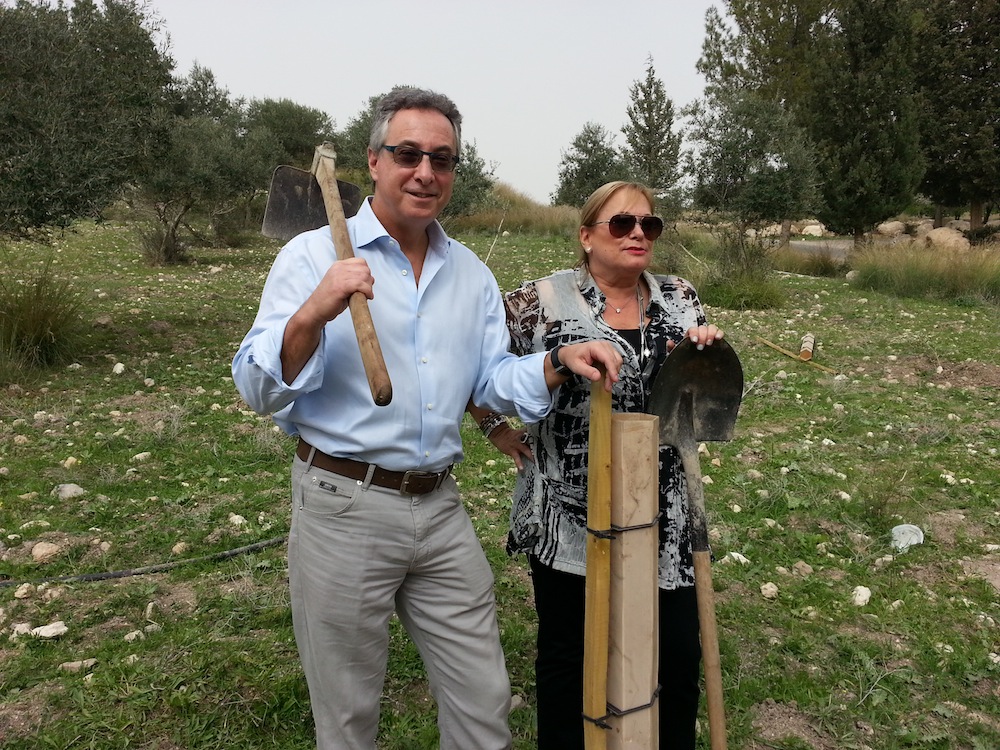
The dinner will pay tribute to businessman and philanthropist Gary Segal, whose “remarkable heritage” is “led first and foremost by a love of humanity, a love of the land of Israel and a deep social commitment and yearning for tikkun olam,” said JNF Pacific Region shaliach Ilan Pilo. The event will raise funds for an educational outreach program led by JNF at Hebrew U’s Joseph Meyerhoff Youth Centre.
“Gary and [his wife] Nanci wanted to support the JNF and HU and, when this project came up, they simply realized the importance of doing it,” Dina Wachtel, executive director of CFHU Western Region, told the Independent. In the program, she explained, “They are taking mainly at-risk youth from the periphery of the country, both geographically and socially, many of whom are kids of immigrants and hard-working citizens, and are offering them a lifetime opportunity … interaction with PhD and graduate students who teach them science and ecological sciences. Basically, these kids are exposed to a world that, for the most part, they are not familiar with and, by exposing them to hands-on lessons in science and allowing them to learn presentation and leadership skills, we are literally transforming their sense of pride and ability to believe in themselves that, yes, they can reach university and that it is not beyond their reach.
“Both Gary and Nanci know that Israel’s number one capital is its human resources and, by investing in these kids, they are literally investing in Israel’s most precious capital.”
Vice-president of Kingswood Capital Corp., Gary Segal’s philanthropic endeavors are numerous. Locally, they include – but are not limited to – Ronald McDonald House, VGH & UBC Hospital Foundation, Jewish Community Foundation, Louis Brier Home and Hospital, Kollel, Vancouver Talmud Torah Foundation and St. Paul’s Hospital Foundation. Among the work Gary and Nanci Segal (and their family) support is that of Dr. Rick Hodes, medical director of Ethiopia for the American Jewish Joint Distribution Committee.
“It was important to me to support a project that would have a direct impact on underprivileged youth, including the Ethiopian community that I have become involved with over the years; at the same time, it would have to be one that fits the mandates of both organizations,” explained Gary Segal about the choice of the JNF-HU project for the proceeds of this year’s Negev Dinner.
Seeing the JNF and CFHU projects firsthand
The Segals were in Israel earlier this month on a trip with Pilo and Wachtel. “The two days I just spent in Israel witnessing firsthand the outreach activities of the Joseph Meyerhoff Youth Centre at Hebrew U affirmed the absolute merits of this project and how it aligns perfectly with my stated goal for this dinner,” said Segal.
“I witnessed the enthusiastic way in which these young students embraced the wide range of activities, and heard from them directly how much they love being part of it,” he added. “These children would not have the opportunity to be exposed to such things through their homes and resource-challenged schools alone. A clearly devoted and emotionally invested teacher that I spoke with recounted how she overcame her own disadvantaged background to become a teacher, and how important it is to her to give these children the understanding and belief that they can aspire to a better life through advanced education. Most of the participating children have parents either in low-level jobs or else unemployed, and many of them come to school hungry so, on her own account, she brings food to school to be able to feed them. In addition to stimulating an interest in science and the environment through this youth centre program, the children go back and do research and make a presentation to the student body and parents, as well. The teacher explained how this develops public speaking and leadership skills and instils in them a new sense of self-confidence. At the same time, for the parents, it leads to a sense of pride in their children.”
The trip to Israel “was a mixture of viewing projects, gaining perspectives on Israel from a variety of people, experiencing the specific science outreach program we are supporting through the upcoming dinner, and having some fun,” Segal said.
In Jerusalem, the couple visited Mahane Yehuda, Teddy Park, the Old City and the Western Wall. On erev Shabbat, they had dinner at the home of Rabbi Ehud Bandel, the first Israeli native ordained in the Masorti (Conservative) movement. One evening, they took in a musical comedy show by the Voca People and, another night, Gary Segal dined with two Knesset members from the Yesh Atid party, Ronen Hoffman and Karine Elharrar. “Ronen is head of the Israel/Canada relations committee and has prior experience in various Israeli peace efforts; Karine is involved in disabilities awareness and accessibility,” explained Segal.
Sunday was spent touring JNF projects, he continued. They visited a new water bio-filteration pilot system in Kfar Saba, the Biriya Forest (“which sadly suffered a lot of tree-branch destruction from the winter snowstorm”) and the Hula Valley bird sanctuary park. “We saw everything in a somewhat different light,” he said, “as it was an extremely hazy day due to dust from Africa having spread all the way to Israel.”
On Monday, the Segals met with HU president Menahem Ben-Sasson on the Mount Scopus campus before heading to HU’s Safra Givat Ram campus to meet with Joseph Meyerhoff Youth Centre administrators and get an overview of the program they are sponsoring.
“Interacting with these lively and outgoing youth over the course of these two days was most definitely one of the highlights of the trip for me and Nanci, and my ability to converse directly with the kids in Hebrew made it particularly fun and personal for me,” said Segal. “In the spirit of my own quest for new experiences as an adult, I did something I never thought I would do – in one of the Monday morning labs, the instructor was talking about the West African python snake wrapped around his neck and, when he went to pass it to me, I actually took it from him and held it while encircled by some curious yet wary girls in the class – my first close-up, hands-on interaction with a snake.”
On the way to Tel Aviv, Segal said they stopped at the JNF Canada Park so that he and Nanci could “plant an olive tree and see the commemorative plaque for the grove we planted in 2000 in honor of our daughter Stephanie’s bat mitzvah.”
Gary and Nanci Segal in JNF Canada Park. (photo from JNF Pacific Region)
Before checking into their hotel, they met with the new Israeli health minister, Yael German, who, Segal noted, “before national office … was the very successful mayor of Herzliya for 15 years.” She gave them over an hour of her time, he said, discussing with them some of the many issues with which the ministry is dealing.
“Tuesday involved a visit to the Hebrew U Rehovot campus, home of the Robert H. Smith Faculty of Agriculture, Food and Environment,” said Segal. “We first were introduced to some of their international activities to assist countries to alleviate problems of hunger, disease and poverty through technical training and technology transfer. We heard about some fascinating research projects being undertaken in this regard, and had the opportunity to hear from a half-dozen post-graduate international scholarship students from Africa and Asia who are there to gain knowledge that can be implemented back home.”
For the rest of the morning, the Segals tagged along with children visiting from the periphery community of Kiryat Malachi. They saw the mechanical milking process and, said Segal, “another first for me, tasting fresh (sterilized) goat milk. We then moved on to a session learning about live bees and the workings of the hive and honey making. Before leaving the campus, we had lunch in the cafeteria with the children…. It gave me the opportunity to have a very moving and enlightening talk about the outreach program with one of their obviously very dedicated teachers.
“We then departed campus for the last element of our outreach experience – a visit to the periphery community of Kiryat Ekron. The mayor of this community of 11,500 people was very happy to take the time to greet and accompany us at the school, and the proud principal of the school explained to us how she had a vision to bring such a science-outreach program to her school and had searched far and wide and negotiated for about a year to make her vision a reality. We sat in on an entertaining chemistry class being led by the same Hebrew U graduate student we first met the day before in Jerusalem while leading a class there on trees and the environment. As we were leaving the school, I saw the presence of JNF here, too, in an outdoor classroom structure that had been funded by them. Another fond memory from this visit was successfully coaxing a number of young girls to serenade me with one of their favorite Israeli pop songs in Moroccan Arabic.”
The next day and a half comprised visits to more JNF activities, “including the Be’er Sheva River Park, the older settlements and newer pioneer settlements near the Gaza borders, and the impressive Sderot high school.” The region’s mayor explained the “programs available to the students, as well as the challenges of being in such a dangerously exposed area.”
Rounding out their 10-day trip, the Segals met JNF world chairman Efi Stenzler, spent time with friends and took a helicopter ride over the country with Wachtel.
A longtime involvement
Segal’s connection to JNF and HU extend much further back than this recent visit, of course. “From my Talmud Torah and Camp Hatikvah days,” he said, “I grew up with a strong feeling of connection to Israel and an understanding of its importance to the Jewish people. In terms of JNF specifically, though I felt I was already very familiar with the general nature of JNF’s activities in Israel through the blue pushke box, Tu b’Shevat, attending Negev dinners and my many discussions over the years with different Vancouver JNF emissaries, I must say that I was very impressed on this trip seeing the breadth and depth of JNF’s projects from before statehood through today, and the vast impact they have on the quality of life, security and future prospects of the Israeli people. They touch upon these areas in so many different ways.
“Regarding Hebrew U,” he continued, “I can honestly say that my decision to attend Hebrew U in 1971/72 for my second year of university studies played a pivotal role in developing many of my life interests and activities…. That was a very exciting and stimulating year and a half, from the first few months on kibbutz through the end of the school year in Israel, then followed by three months of adventure travel with my good buddy Ben Goldberg in East Africa, including being in Uganda during Idi Amin’s reign of terror. This opened up a whole new desire to learn about the developing world, leading to my post-BA year of travel across Asia and the Middle East in 1974/75. You could say, in a way, this all sowed the seeds for my current philanthropic work in Ethiopia and my interest in the Ethiopian community in Israel.”
The 2014 Negev Dinner takes place on Sunday, April 6, at the Four Seasons Hotel in Vancouver, starting at 5:30 p.m. For tickets and more information, call 604-257-5155 or e-mail [email protected].
On Dec. 16, 2013, Kinder Morgan Energy Partners filed an application with Canada’s National Energy Board for permission to proceed with its proposed expansion of the Trans Mountain pipeline system between Edmonton and Burnaby. “If approvals are received, the expansion is expected to be operational in late 2017,” says the company’s website. It also notes, “The proposed $5.4 billion project will increase capacity on Trans Mountain from approximately 300,000 bpd [barrels per day] to 890,000 bpd.”
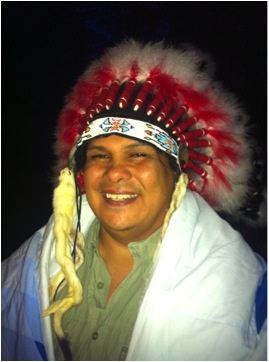
One of the leaders of the fight against this project is Sundance Chief Rueben George of Tsleil-Waututh Nation (TWN), who will be addressing this year’s Outlook fundraising dinner later this month. “I guess how I got involved, in a way, is embedded in me, with my cultural and spiritual teachings,” he told the Independent in a phone interview.
Sundance Chief Rueben George of Tsleil-Waututh Nation.
These teachings, he explained, include the protection of “the things that are sacred to us, and that’s our children, our families and also our land and our waters. You look at any religious or spiritual belief and you can see that water is used in most ceremonies and, in a sense, fire, too, because you have candles or incense, and we use sage or sweetgrass. We use the elements of … fire, earth, water and sky. We learn through the ceremonies that there is a sacredness to it, just like there is a sacredness to our children, so it was a natural transition for me to go from director of community development for Tsleil-Waututh Nation, overseeing all the social programs, employment and training, and education programs” to being, among other responsibilities, program manager of TWN’s Sacred Trust. The trust “is mandated to oppose and stop the Kinder Morgan Trans Mountain pipeline project,” explains its website.
“When we started,” said George of the fight against the pipeline expansion, “there was Rex Wheeler and Ben West and a [handful] of others. Rex Wheeler is one of the fathers of Greenpeace, and Ben West is one of the managers at ForestEthics. They couldn’t believe it when they saw a tanker going through our [TWN] territory, the Burrard Inlet, almost four years ago … and so they found us…. But we’ve been fighting the battle against things like this for years, and being traditional stewards of our lands. We did elk re-introduction programs, we’re doing salmon enhancement programs and, when we do things like that, those things benefit everybody. So, we’ve been doing this work and, with our treaty lands and resource payments, the Tsleil-Waututh Nation [has been doing it] for years as well, and my grandfather Chief Dan George did similar work.”
In addition to the pipeline, said George, “We’re also keeping a close eye on the whole that’s being distributed from Vancouver. There’s uranium going out of Vancouver, there’s a whole bunch of toxic and very dangerous things that are going through our waters and we’re watching those very carefully, as well.”
When the struggle against Kinder Morgan’s proposed expansion began, said George, the concern was mainly about Enbridge Inc. (Enbridge’s at-least $6.5 billion Northern Gateway project to build a new twin pipeline system running from near Edmonton to Kitimat was approved by the NEB last December, with 200-plus conditions.) Public awareness of Kinder Morgan was limited when TWN became involved, said George, but that has since changed.
Last fall, TWN received the gift of a totem pole from Lummi Nation in Washington state. “They wanted to work together with my nation because they see what we are doing against Kinder Morgan, and [it’s similar to] what they’re doing against the coal in Cherry Point,” explained George. “But they did a journey from Montana to Vancouver with that totem pole and in every nation they stopped at, there were prayers and there was a gathering, and through that process, they had 7.5 million people witness part of that journey … through internet or TV or newspapers. And then, when we went to Rio de Janeiro, the United Nations Earth Summit, there were a couple of pictures that were taken … [with] indigenous people around the Amazon, and there is 1.2 million views on that. So, from nobody having awareness to this, to bringing it to the international stage and showing the world that not only are the tankers not a good idea, the pipelines are not a good idea, [and] the Alberta Tar Sands are an atrocious idea, just like the rest of it.”
For economic prosperity, said George, “we don’t need this destruction that’s happening to our earth and our atmosphere and our waters. We need the world to know that we have green-energy alternatives. Tsleil-Waututh Nation, we own and we manufacture and we sell wind turbines.” He called it “ridiculous” that the Canadian government has given some $1.4 billion in subsidies to fossil fuel companies who are “not working for change.”
He held up TWN as one of the First Nations from which people could learn “what a government should be like.” He said that, when its wind turbines and other investments have success, “it’s not going to be an individual that’s taking off and becoming a billionaire” looking out for their own best interests.
“Instead of taking millions of dollars and negotiating with Kinder Morgan, we said no…. Like the 160 nations that signed the Fraser declaration [to ‘not allow the proposed Enbridge Northern Gateway Pipelines, or similar Tar Sands projects, to cross our lands, territories and watersheds, or the ocean migration routes of Fraser River salmon’], they said no, too….”
“We have a collective of a nation that did a referendum,” he said. “Instead of taking millions of dollars and negotiating with Kinder Morgan, we said no…. Like the 160 nations that signed the Fraser declaration [to ‘not allow the proposed Enbridge Northern Gateway Pipelines, or similar Tar Sands projects, to cross our lands, territories and watersheds, or the ocean migration routes of Fraser River salmon’], they said no, too…. When we do have success with our economic development – we’re not a perfect system but we’re working towards it – but when we do have success, that money supplement[s] … every program of the Tsleil-Waututh Nation.”
He gave the examples of environmental programs, such as those dealing with elk and salmon, as well as “social development, we help people to get off social assistance; and we help with the healing of our communities from the genocide that has happened [as a result of] the residential school experience; we have education; we have employment and training. All these programs are supplemented by our drive towards self-sufficiency. So, that, to me, is a government.
“And, when we make decisions for the better of our future generations, we sacrifice,” he admitted. “It would be easy for a lot of people to negotiate and say, yeah, I’ll take 10, 20 million dollars and let this pipeline go through, and maybe we’ll take some of the things that they’re offering and help our people out of poverty … but this is the sacrifice that we make. This is the sacrifice we have to do to create change. This is the sacrifice we have to do to have positive success that will go along the lines of what our culture and our spirituality teach us, and that’s not to cause destruction to what we [consider] sacred.”
George stressed the need to work with business partners who have the same values. He said that “this Canadian government, this Harper government, they don’t have the values that they’ll put forth to protect the sacred, their own children. Because they can’t make those decisions for themselves, we will – we will make those choices for them.”
George isn’t afraid of the David-versus-Goliath element of the struggle. He explained that indigenous people, who once “populated the Burrard Inlet with 15,000 people – we went down to 13 people, we were almost extinct. But those 13 people fought and they strived, and they maintained, and they stood up for the land, they stood up for the people, they stood up for those cultural indigenous rights. And I’m talking about those teachings of humanity, of love and respect, and honor and dignity and pride. If we treat well those things that we care for, like the land and the water and individuals, we’ll be making the right decisions.”
“My grandfather once said, if you’re going to be a pipe carrier or a longhouse West Coast ceremonial person, or you’re going to be Catholic or Jewish or Muslim … it doesn’t matter what you are, as long as you’re good at it. When you’re good at it – he meant, by following those teachings, what they represent and how you’re to live your life – there’s no boundaries between us and we can have a good relationship with one another.”
And his interfaith work has shown him that, when people recognize and live by “those fundamentals of humanity … there’s no differences between us. When we’re born, we’re born with no prejudice, no anger, no hate, no judgment…. It’s this society that we live in that warps us in the way we’re thinking…. My grandfather once said, if you’re going to be a pipe carrier or a longhouse West Coast ceremonial person, or you’re going to be Catholic or Jewish or Muslim … it doesn’t matter what you are, as long as you’re good at it. When you’re good at it – he meant, by following those teachings, what they represent and how you’re to live your life – there’s no boundaries between us and we can have a good relationship with one another.”
Emphasizing that pipelines and other such projects are not a First Nations or environmentalist problem, but rather everybody’s problem, George encouraged people to get involved. About his upcoming talk in the Jewish community, he said he hopes that “our collective religions and spiritual beliefs when we come together like this, where I come to be with your beautiful people, that we can spread the messages out, the teachings of humanity, and we can connect to those ones who don’t understand and bring some understanding of the true facts of what’s happening, and we can join together and make a movement that can create a better future for all of our future generations.”
The Annual Vancouver Outlook Fundraising Supper ($40/person) featuring Chief Rueben George will take place at the Peretz Centre on March 23, 6 p.m. An RSVP is requested to 604-324-5101.
Members of the Momo Minyan. (photo by David Berson)
Sometime in the next three months, two Tibetans will arrive in Vancouver from Arunachal Pradesh, a poor, remote region in the far northeast of India. When they get here, a group of Jews from Vancouver’s Or Shalom Synagogue will be waiting for them, ready to aid with their resettlement in this country. The group, which calls itself the Momo Minyan – momo after a Tibetan steamed dumpling – formed in June 2013 with the sole purpose of helping these Tibetans create a new life in British Columbia. In February, they completed and filed the sponsorship papers. Now, they wait. When the newcomers arrive, their work will begin in earnest.
The group will be supporting the two Tibetans financially, but their involvement will go beyond hard cash. “It means receiving them at the airport, finding a place for them to stay, ensuring they get registered for health benefits, helping them learn the language and find a job, and assisting them as they integrate socially,” said David Berson, a member of the minyan. The group will be responsible for accommodating the Tibetan refugees and ensuring they can access the services they require. It promises to be no small undertaking.
Back in 2010, at the urging of His Holiness the Dalai Lama, Prime Minister Stephen Harper agreed to allow 1,000 Tibetans from this rugged, contested area to resettle in Canada. Arunachal Pradesh is claimed by China as “South Tibet” and for the past 55 years the strip of land along this border has been home to thousands of Tibetans. To determine who was chosen to go to Canada, a lottery was held in the village’s public square, eventually granting a new life to one-sixth of the Tibetans from this area. The first wave of 55 arrived in Canada in December 2013. By the program’s conclusion, there will be approximately 200 refugees in British Columbia and others in Calgary, Ottawa and Toronto.
To make the transition to Canada possible, each one required sponsorship by a Canadian group or individual before they could obtain special travel documents and enter the country as landed immigrants.
Vicki Robinson, a facilitator for the Momo Minyan, said Or Shalom is the first synagogue in Canada to sponsor Tibetans under this program. The minyan has partnered with the Tibetan cultural society in this project. The United Church of Canada, a government sponsorship holder, has also helped to get the applications completed. “The United Church has a lot of experience in resettlement, working with the Canadian Immigration Committee and getting all the permits lined up,” Berson said. “They’re a conduit more than a partner for us.”
The Momo Minyan will be responsible for the Tibetans’ entire integration package, including finding and paying for an apartment, paying for health insurance and food. “Until we know who we’re absorbing, it’s difficult to know what kind of work will be appropriate,” Berson said of the process. The refugees, who have varying levels of education, come from poverty-stricken villages in this region, where they have limited access to medical care and often have to send their children away to school. “Their lives are threatened and they are a stateless people living in a disputed territory,” he noted.
The Tibetans have neither Chinese nor Indian citizenship. Some have more work experience than others, said Berson, who recently learned the Tibetans in this area tried to cultivate apple orchards for the past 10 years, but were more successful growing kiwi. Some worked in the agricultural sector in Israel, as foreign workers, he added. “The Canadian government is going to Arunachal Pradesh this month to interview them, so we’ll hear very soon about the Tibetans we will be receiving.”
The minyan has begun fundraising in the Or Shalom community and will extend its efforts to the wider community once more is known about the particular immigrants they are sponsoring. Eligibility for social assistance is not a possibility under the agreement with the Canadian government, which estimates sponsorship costs at $12,000 per person per year. With the cost of living in Vancouver, that won’t be enough, Berson said. “It’s guiding our efforts in terms of fundraising, but we think we’ll need more than that. The government is very nicely providing them with landed immigrant status, but not any other aid, per se, in the process. After five years, they will be eligible to apply for Canadian citizenship like any other landed immigrant.”
Members of the Momo Minyan united in a mutual agreement to participate in this humanitarian effort, one that resonated with many in the synagogue, Berson said. “The opportunity for us to be able to extend our hospitality to another group that has suffered exile and have a diaspora is probably one element why I got involved. The Tibetans are amazing people but they’re very reserved and shy in their mannerisms,” he added. “There’s going to be big cultural differences.”
Robinson was eager to step forward and join the minyan after visiting Tibet in 1994. “The Tibetan people stole my heart,” she admitted. “They are amazing, beautiful, spiritual, good people who are struggling in a very difficult situation. Since my visit there, I’ve been involved working with the Tibetan community in exile. I spent time working with the Tibetan Women’s Association in India for a year, where I met Tibetans from Arunachal Pradesh.” Robinson’s family came to Canada fleeing persecution, which was another reason she wanted to get involved. “I thought this would be good work to do – a way of giving back to the country that welcomed us,” she said.
Those interested in contributing to the resettlement efforts can contact Berson by email at [email protected].
Lauren Kramer, an award-winning writer and editor, lives in Richmond, B.C. To read her work online, visit laurenkramer.net.