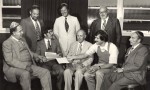
Group of men with documents, State of Israel Bonds, Vancouver, B.C., 1970. (JWB fonds, JMABC L.14607)
If you know someone in this photo, please help the JI fill the gaps of its predecessor’s (the Jewish Western Bulletin’s) collection at the Jewish Museum and Archives of B.C. by contacting [email protected].
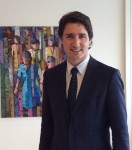
Justin Trudeau, leader of the Liberal Party of Canada, was in Vancouver on April 10, and addressed a roundtable lunch organized by CJPAC. (photo by Cynthia Ramsay)
The Canadian Jewish Political Affairs Committee (CJPAC) hosted a community roundtable lunch on Thursday, April 10, with Justin Trudeau, leader of the Liberal Party of Canada.
“CJPAC seeks to activate the Jewish community in the Canadian political process, and roundtables such as these provide opportunities to build relationships and engage with elected officials from all political parties,” explained Mark Waldman, CJPAC’s executive director, in an email after the event.
“CJPAC is a multi-partisan, national organization that has been active in Vancouver for many years,” he added. As an example of the organization’s work locally, he noted, “Recently in Vancouver, CJPAC hosted an event called Women in Politics, which was attended by more than 30 women. Participants engaged on a personal level with former and current female politicians from a number of political parties and levels of government.”
Thursday’s lunch meeting took place in a boardroom at Blake, Cassels and Graydon LLP downtown. It seemed like a couple of dozen community members were in attendance. As they were leaving, Trudeau spoke briefly with the Jewish Independent before heading to another appointment.
“… I’m glad to say that any government of Canada will be supportive of Israel, not for ideological or political or strategic reasons, but because the values Israel stands for are Canadian values of openness, of respect, of democracy, of equality, and we need more of that, particularly in the tough neighborhood that Israel is in.”
“It went great,” he said about how the roundtable went. “We talked about, obviously, Canada’s support of Israel, which is extremely important to me and the point I made is that I am an unequivocal supporter of Israel. We need a two-state solution of a Jewish state on one side and a Palestinian state. Where I take issue a little bit with the prime minister these days is just that he’s tended to make it a little more of a domestic football, with some people being more supporters of Israel than others, and I’m happy to say that I love the prime minister for his support of Israel and thank Mr. Mulcair for his personal support of Israel as well, and I’m glad to say that any government of Canada will be supportive of Israel, not for ideological or political or strategic reasons, but because the values Israel stands for are Canadian values of openness, of respect, of democracy, of equality, and we need more of that, particularly in the tough neighborhood that Israel is in.”
Domestically, there have been changes made or proposed at the federal level over the years that, in the opinion of some, challenge those very values of openness, respect, democracy and equality, a recent example being Bill C-23, or the Fair Elections Act. When asked to describe his vision of the role of a federal government, Trudeau responded, “First of all, we have to understand that Canada is a federation, not a unitary state, so how we engage with different levels of government as a federal government – partnership with provinces, partnership with municipalities – and understanding the work together that we do as different levels of government all serves the same citizens.
“Giving a government a majority doesn’t give them the capacity to perpetuate themselves indefinitely by tricking the rules; that’s what happens in developing countries, that’s not what’s supposed to happen in Canada.”
“But even within the way Parliament functions,” he continued, “I made a strong commitment last June towards open Parliament, which would mean less whipped votes; open nominations, which would mean no omnibus bills, no misuse of prorogation, a lot more openness, the transparency around online posting of our expenses. Actually, what we announced in June last year then triggered similar announcements from everyone and now all of Parliament is starting to post online, and that was something that we triggered. So, I think when you look at that, when you look at the partisan approach to the Fair Elections Act – which is a very unfair elections act – I’m certainly trying to get the message out to Canadians that we do not need elections to be fixed in advance in favor of the Conservatives, and that’s exactly what’s happening. Giving a government a majority doesn’t give them the capacity to perpetuate themselves indefinitely by tricking the rules; that’s what happens in developing countries, that’s not what’s supposed to happen in Canada.”
With the defeat of the Parti Quebecois on April 7, there is reason to believe that its proposed Charter of Values will also go by the wayside. However, at least some of the sentiment that allowed it to be proposed in the first place – fear over immigration – likely still exists and, over the last few years, more than one European government has called multiculturalism a failure. In light of this, the Independent asked Trudeau what he thought about the future of multiculturalism in Canada.
“Multiculturalism in Canada is about building a diverse, flourishing fabric of a country that is strong, not in spite of its differences, but because of those differences.
“The German model of multiculturalism failed because they brought over temporary workers from Turkey and never allowed them citizenship, didn’t treat them like Germans and, even a few generations in, they never became [citizens]. Multiculturalism in Canada is about building a diverse, flourishing fabric of a country that is strong, not in spite of its differences, but because of those differences.
“And, I’ll say two things on Quebec. First of all, I, as of last fall, spoke very strongly in a number of editorials to Canadians to not get overly worked up about this Charter of Values, to trust Quebecers because Quebecers were not going to accept this, and I was pleased to see them show that on Monday night, and show that very strongly.
“But the second element: it does demonstrate how politicians can twist perceptions, and a lot of Quebecers who initially expressed support for the idea of the charter did so thinking they were sticking up for equality; you know, ‘liberating people from the oppressive yoke of religion,’ because, of course, in Quebec, that’s what happened through the sixties with their Quiet Revolution. But, as soon as people explained to them, no, this is about people having to choose between their religion or their job, Quebecers said, well, that doesn’t work at all, and that’s exactly what we have.”
When asked if he had any final words before the interview ended, Trudeau said, “Just what a pleasure it is to be out here in Vancouver. I had a great conversation with a number of strong members of the Jewish community and, unfortunately, we didn’t have enough time, so I look forward to coming back and doing this again soon.”
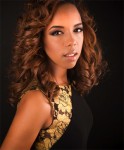
Hagit Yaso, the 2011 Kochav Nolad winner, will sing in Vancouver on May 5 at the Chan Centre in celebration of Israel’s 66th birthday. (photo from hagityaso.co.il)
One July night in 2011, on a crowded Haifa beach, the 21-year-old singer Hagit Yaso became that year’s winner of Kochav Nolad (A Star is Born), Israel’s version of American Idol. The outsider had triumphed. “It was the most exciting and most life-changing experience I’ve ever had,” she told the Independent by telephone from her home in Sderot.
Yaso is a fully qualified outsider. She is working-class, the child of Ethiopian refugees and a resident of the missile-and-mortar target town of Sderot. Only one kilometre from the Gaza Strip, Sderot is the target of frequent rocket assaults. A small town of only 20,000 people, everyone, she said, knows everyone. “It’s a small town. You get to know the people,” she said. “And I got a lot of support when I was on Kochav Nolad.
Now 24, Yaso has toured the world and released her first CD, a self-titled CD that is available at cdbaby.com and at amazon.com. Vancouver audiences will get a chance to see her May 5 when she headlines the community Yom Ha’atzmaut celebration at the Chan Centre for the Performing Arts at the University of British Columbia. The event’s main presenter, the Jewish Federation of Greater Vancouver, can take some pride in Yaso’s success. A scholarship from the Canadian Federations provided her voice lessons at Sderot’s Music Centre and the Vancouver Federation itself has taken a special interest in helping Sderot’s Ethiopian community. Federation also provides assistance to Sderot’s trauma victims.
The three months she spent on the television competition were grueling, Yaso said. ‘“The competition is very long, very confusing, with a lot of pressure and media.” She always believed she would win, though.
Her friend, the American filmmaker Laura Bialis, who lives in Tel Aviv, noted by phone that Yaso’s determination is one secret to her success. “You know, it was like everything she set out to do, she did,” Bialis said. “She wanted to get into the army band, she got into the army band. She wanted to get on Kochav Nolad, she got on Kochav Nolad. She wanted to win Kochav Nolad, she won.”
The two met when Bialis was shooting a documentary about music in Sderot. That film, Sderot: Rock in the Red Zone, is now in its final editing stage.
Yaso’s success is a point of pride for Sderot. Her win is also significant to Israelis of Ethiopian heritage. Vancouver resident Ronit Reda-Yona, an Ethiopian Israeli, said Yaso’s 2011 win “was an exciting moment for the Israeli society and especially for the Ethiopian community. Everyone in Israel who is Ethiopian feels like me: this is a good model for young people.”
Not only is Yaso well known in Israel but, in a short time, she has become an international success. She has performed at Jewish events in Paris, London, Canadian cities, American cities and Ethiopia. After Vancouver, she will tour Brazil.
“What is really amazing is that her career has taken off internationally in a really interesting way,” said Bialis. “She’s got this amazing voice, she’s gorgeous, she’s gracious, she’s sweet, and she has an amazing story.”
Thankful for parents’ courageous journey
Yaso’s parents, Yeshayahu and Tova, grew up and got married in rural Ethiopia. “They got married by shiddach,” said Yaso, who explained that the marriage was arranged and the two did not meet until their wedding day. In the early 1990s, the couple was forced to leave home. “Because they were Jewish, they suffered a lot and they had to run away from there and the option was to come to Israel,” Yaso explained.
Tremendous hardship stood between them and that destination. “They walked 400 kilometres by foot,” she said with some pride and awe in her voice. “It took them two and a half months to walk because it’s through the desert. They had to walk only at night and hide during the day because they were not supposed to leave [Ethiopia], and they were afraid…. They had to hide during the day because they were afraid of being caught.”
Yaso’s parents finally crossed the border into Sudan and were airlifted to Israel.
“They had nothing when they came here,” she said. Her parents built a life and a family of five children, in the small town where they still live. That home remains her home, too.
The Vancouver performance will include four songs she performed on Kochav Nolad. Yaso will sing in English, Hebrew, Moroccan Arabic and Amharic, the language of Ethiopia. The four-piece band that accompanies her is a group with whom she served in Israel’s army band. All three backup singers are from her hometown, including her sister, Shlomit.
Both of Yaso’s sisters performed with the town’s youth music ensemble. Many of Sderot’s young people dream of music careers. The ubiquitous bomb shelters sometimes double as rehearsal spaces. Perhaps this love of music helps soften a hard life that includes regular bombardment. When the air raid warning sounds you have 15 seconds to find shelter. Drills are constant, so life itself is always uncertain.
“It’s a city that suffers a lot from what’s going on in the south, from bombing and stuff,” said Yaso. “It’s not easy to live there. I manage by being optimistic, smiling and, when it gets harder, I sing.”
In addition to Yaso, performances at the community celebration of Israel’s 66th birthday at the Chan Centre will include the JCC Festival Ha’Rikud Dancers and a musical tribute written by Jonathan Berkowitz and Heather Glassman Berkowitz.
Michael Groberman is a Vancouver freelance writer.
There is a sense in the Montreal Jewish community that Quebec has entered a new era with the election of a majority Liberal government on April 7. Whether the defeat of the Parti Quebecois after 18 months in office was a rejection of its proposed Charter of Values or the possibility of another sovereignty referendum or, in fact, a show of support for Philippe Couillard’s offer of a more stable, focused government, Quebec has emerged from under the cloud of partisan strife.
Public opinions polls in the latter half of the 33-day campaign showed the Liberals were steadily gaining in popularity, yet few federalists dared count on the party’s capturing 70 of the 125 seats in the National Assembly and more than 41 percent of the popular vote.
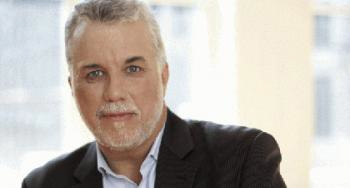
Philippe Couillard, leader of the Quebec Liberal Party, will be the next premier of the province.
Immediately following the election, community leaders were already speaking of a more positive climate, in which Jews “view themselves as part and parcel of Quebec and see their future here,” said Luciano Del Negro, Quebec vice-president of the Centre for Israel and Jewish Affairs. “The charter had broken a modus vivendi in Quebec in which we had acknowledged the French fact…. But all of a sudden, you not only had to speak French, but kowtow to the government in how you express your religious beliefs.”
The new government, Del Negro added, must move swiftly to repair the damage caused by the “toxic” debate over the launching of the charter last August by the PQ. Bill 60 was tabled in November.
The charter, said Del Negro, was not the major election issue. Rather, the result of the election was a clear rejection of what he saw as the PQ’s cynical ploy to stir up anxiety over the growth of religious minorities in order to get a majority and then create favorable conditions for a third referendum on sovereignty. “This is a resounding vote of confidence that we are all Quebecers, it’s the defeat of a divisive vision…. It’s not so much the end of the independence movement, but that the PQ is no longer seen as representing a force for progress, especially among the young.”
The strength of the third-party Coalition Avenir Québec, which gained four seats, is also indicative of the desire for a new way, he continued. “The PQ was the architect of its own demise. It threw away its principles. It sold its soul…. It’s a bit ironic that the party that was musing about firing workers [who might defy the charter’s ban on religious symbols among public employees] got fired themselves.”
The Jewish community’s tepid relations with Premier Pauline Marois soured during the campaign when she refused to repudiate comments by PQ candidate Louise Mailloux, who was accused of antisemitism for alleging that kashrut certification is, essentially, a religious racket in which Quebecers are victims. Mailloux, a college philosophy teacher, finished second, but almost 10,000 votes behind the incumbent, François David of Québec solidaire.
Del Negro said there is some history between the Liberal leader and the community from Couillard’s stint as health minister in Jean Charest’s government and since he became leader last year. “He has always been available to the community to discuss the charter and other matters,” Del Negro said. “We look forward to his being the premier of all Quebecers.”
Nevertheless, the possibility of some kind of new legislation reinforcing the principles of state neutrality and providing a framework for dealing with reasonable accommodation requests from religious groups can’t be ruled out. In January, the Liberal party issued its policy on the issue, which emphasized the necessity of public employees who represent state authority, such as police officers and prison guards, being permitted to wear religious symbols only after they have made the effort to “integrate.”
Couillard, a neurosurgeon who once practised in Saudi Arabia, stated at the time: “Our position hinges on respect for what we are and for what defines us collectively, historically and culturally. I understand and share concerns expressed by Quebecers regarding the rise of religious fundamentalism.”
The Liberal position is that the primacy of state religious neutrality be included in the Quebec Charter of Human Rights and Freedoms (as Bill 60 proposed) and that any accommodation made for a person’s religious beliefs be in keeping with that tenet, as well as respect for gender equality. It was a Liberal government under Charest that a few years ago tabled Bill 94, which would have banned face coverings in the delivery or receipt of public services. It died on the order paper. Contrary to assumptions about the popularity of the charter, most recent polls found 63 percent in favor in Montreal and about 53 percent overall.
“I think the government should exercise extreme caution in re-opening the charter of rights,” said Del Negro. “There is a consensus in Quebec on state secularism, the need for a framework to resolve reasonable accommodation requests, and on the equality of men and women, but the charter of rights is there fundamentally to protect minorities…. The Jewish community has always been incredibly cautious in dealing with the charter of rights. It believes it is adequate. There is de facto recognition of state secularism and the human rights commission has jurisdiction to deal with reasonable accommodation.”
The sole Jewish MNA, Liberal David Birnbaum, took 92 percent of the vote in Montreal’s D’Arcy McGee, the only riding with a Jewish majority. There is speculation that the newcomer could be named to the cabinet, possibly to the education portfolio.
Birnbaum, 58, was director general of the Quebec English School Boards Association and is a past executive director of Canadian Jewish Congress, Quebec Region. He replaces Lawrence Bergman, who resigned at the start of the campaign after 20 years in office.
Elsewhere, the fourth-party Québec solidaire (QS) elected a third member for the first time in its short history, Manon Massé in Ste. Marie-St. Jacques by a narrow 91 votes.
Massé, who has been a social justice activist for 30 years, was aboard the Canadian boat that was part of an international flotilla that attempted to reach Gaza in 2011. QS supported that unsuccessful effort to break the Israeli blockade and the left-wing sovereigntist party officially endorses the boycott, divestment and sanctions campaign against Israel. Ste. Marie-St. Jacques is in the Plateau Mont-Royal, and encompasses the block on St. Denis Street where the Le Marcheur and Naot shoe stores are located, which have been targets of BDS demonstrators in the last few years. As well, QS MNA Amir Khadir, an outspoken critic of Israel, was reelected for a third term in the neighboring Mercier riding.
Nevertheless, CIJA said they want to keep the channels of communication open with all parties. “We have a fundamental disagreement with the QS … but as long as it is kept civil and honest, we can agree to disagree,” Del Negro said.
B’nai Brith Canada also believes this is a time to “mend fences” and hopes Couillard will reach out to all Quebecers to allow them to “feel at home in the province once more.”
Moise Moghrabi, Quebec chair of the organization’s League for Human Rights, said the new government has to begin to heal the rifts caused by “one of the most divisive campaigns in Quebec history.”
– For more national Jewish news, visit cjnews.com.
Last week, Brandeis University rescinded an invitation to Ayaan Hirsi Ali, who was to have received an honorary degree at commencement in May.
Hirsi Ali is a Somali-born Dutch citizen, author, feminist, activist and outspoken critic of Islam. Her story, told in the memoir Infidel, is of a woman rejecting the culture in which she was raised and condemning it vociferously. An atheist and former Muslim, Hirsi Ali is categorically opposed to conventional Islamic approaches to women, particularly genital mutilation, to which Hirsi Ali was subjected at age 5. She has called for Islam to be “defeated,” not differentiating between “radical Islam” and the totality of the religion.
Hirsi Ali was elected to the Dutch parliament and has received countless recognitions from organizations in Europe and the United States, including the Moral Courage Award from the American Jewish Committee. She has also received serious death threats – threats literally pinned with a knife to the body of murdered Dutch filmmaker Theo Van Gogh.
Brandeis decided to cancel Hirsi Ali’s honorary degree after campus and outside activists expressed opposition to the honor. (The university alternatively invited Hirsi Ali to participate in a campus dialogue; she declined.) Critics argue that a speaker who uttered against any other religion the sorts of things Hirsi Ali says about Islam would not be welcomed on a respectable university’s campus.
But Hirsi Ali’s perspective comes largely from her personal experience. She is not an outsider whose views are clouded by ignorance and misperception. Her views, while controversial, are well-considered, rational and do not approach hate speech.
Reneging on an honorary degree adds a wrinkle of complexity. Commentators have condemned the rescinding of the honorary degree as a rejection of academic freedom and free expression. Others have said there is hypocrisy at play. Tony Kushner, the American playwright who calls the creation of Israel a “mistake” was honored by Brandeis University with an honorary degree, despite an outcry from Zionists. Why have similar outcries against Hirsi Ali been successful when those against Kushner were not? Is it because Israel is a more popular target than Islam, even at a Jewish-oriented university? Is it because Jewish institutions, conscious of the dangers of antisemitism, are more hesitant to approach anything that might approach prejudice toward other groups? The reasons hardly matter. A bigger issue is at play.
A university should be confident in their choice before they invite honorary degree recipients. Brandeis screwed up on that front and embarrassed themselves and their alumni by reversing the honor based on public complaints. At least one media outlet has called the school “cowardly.” Now the university – and others considering controversial speakers – must consider where their core values lie. Are universities to become a place where only time-tested and uncontroversial ideas are floated? Or are they to be the incubators of fresh ideas, spurred by contentious and free-ranging argumentation even on difficult, uncomfortable topics? A Jewish-oriented university especially should reflect the values of openness and debate that reflect our heritage. This incident should serve at the very least as a learning opportunity for Brandeis – and all places of higher learning and public discourse – about what intellectual exploration should truly mean.
Back in 2008, the Rabbinical Council of America (RCA) announced a new system of conversion, GPS (Geirus Policies and Standards). Ostensibly, their goal was to create a universal and centralized standard for all conversions. We warned then that the GPS system would result in invalidating conversions that had been done in the past in accordance with Orthodox law and approved by the RCA. (JTA, March 10, 2008, “RCA deal hurts rabbi, converts.”)
Unfortunately, we have been proven correct. In a letter sent by the Beth Din of America (BDA, which is under the auspices of the RCA) to the chief rabbinate’s office, it was stated that “we cannot accept the conversion of any rabbi who served in a synagogue without a mehitza.” The RCA should clarify if this refers to any rabbi who ever served in a synagogue without a mehitza, or if it refers to a rabbi who performed that specific conversion while serving in a non-mehitza synagogue. Either way, this pronouncement should alarm countless converts.
Back in the ’60s and ’70s, many Orthodox rabbis ordained at Yeshivah University served in mixed seated shuls. The rav, Rabbi Joseph B. Soloveitchik, felt that in certain communities, YU rabbis should serve because the shuls may one day construct a mehitza. The BDA letter now places the conversions of all of those rabbis in jeopardy. This means that the children and grandchildren of these converts, some living in Israel, could be declared to not be Jewish. This is a terrible violation of the law, which prohibits the oppression of converts.
It is also a violation of the RCA’s own promise when it declared, “… any conversions performed previously [before GPS] that met its standards then, would continue to be recognized.” (“RCA response to public attack on GPS geirus policies,” March 19, 2009) Prior to the GPS system, when conversions were questioned, the RCA would vouch for its members who were in good standing. The RCA didn’t think twice about Orthodox rabbis who served in mixed seated shuls in the ’50s or ’60s, as this was common practice. This has now changed.
When we wrote that the RCA would question conversions done prior to the 2008 GPS standards, we never asserted that the RCA would conduct a witch-hunt to actively search out converts, find them and declare them invalid. What we said was that those converts who now needed to have their conversions validated by the RCA would be in jeopardy as the RCA would cast aspersions on pre-GPS conversions by imposing post-GPS standards.
This is precisely what is happening. When a convert or their children or grandchildren make aliyah, he or she needs his/her Jewish status validated. Because of the centralization of the GPS standards, the chief rabbinate’s office now turns to the Beth Din of America for guidance. The upshot of this is that conversions performed by RCA rabbis who served in non-mehitza shuls for years – some who even went on to become presidents of the RCA – are now in question.
RCA validation of conversions may not be limited to converts who emigrate to Israel. It can also encompass those applying to Orthodox day schools in the United States or applying for membership in an Orthodox synagogue, as these schools and synagogues will be looking to the RCA for guidance.
In fact, the matter is even worse. As a result of the GPS system, the RCA now has a practice of not only evaluating converts at the time of conversion, but for years after. Most recently, a convert who converted through the GPS system informed us of a call received from an RCA official. Having heard that the convert was struggling with Orthodox communal norms, the official threatened to retroactively invalidate the conversion.
The RCA practices should be of great concern to every convert who converts today. Now, the RCA is not only invalidating conversions done prior to the GPS system but threatening to undo conversions done through the GPS system itself.
It is these issues that require immediate detailed clarification from the RCA. In the meantime, we should all be concerned about what seems to be both a retroactive application of current GPS principles and also a creeping reduction of the convert’s status in the Orthodox community.
Rabbi Marc Angel is founder and director of the Institute for Jewish Ideas and Ideals (jewishideas.org) and a former president of the RCA.RabbiAvi Weissis senior rabbi of the Hebrew Institute of Riverdale and founder of Yeshivat Chovevei Torah Rabbinical School and Yeshivat Maharat. They are co-founders of the International Rabbinic Fellowship (IRF).
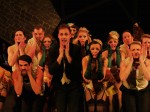
Jamie James as the Emcee, centre, with the ensemble of Cabaret. (photo by Kristian Guilfoyle)
Many know the title song from the musical Cabaret. You can hum it. “Life is a cabaret,” it tells us, but it is not a celebration of life. Rather, for those who know the play or have seen the film, it is a desperate plea for delusion. Sally Bowles denies the obvious, that Berlin is changing under Nazi influence. Weimar Germany is dying, but she refuses to see it. What will happen to her, we can only guess.
The new stage production by Pipedream Theatre Project, a community musical theatre company, is an opportunity to see John Kander’s and Fred Ebb’s (Chicago, Kiss of the Spider Woman) first Broadway hit, back in 1966. The stage version is quite different from the film, which is interesting in itself. Many songs and plot elements were cut or altered for the 1972 film starring Liza Minnelli.
The main story follows Cliff (Victor Hunter), a young American would-be writer who comes to Berlin to experience life and write a novel. He meets the British Sally Bowles (Rebecca Friesen), a performer at the notorious Kit Kat Club, and an affair ensues. She is pregnant. What will they do? A subplot involves the middle-aged Jewish shopkeeper, Herr Schultz (David Wallace), who falls in love with his landlady. Though he’s the victim of humiliations by Nazi supporters, he refuses to believe life will ever get too difficult for the Jews. After all, he tells friends, he too is a German. We can only anticipate his future with fear.
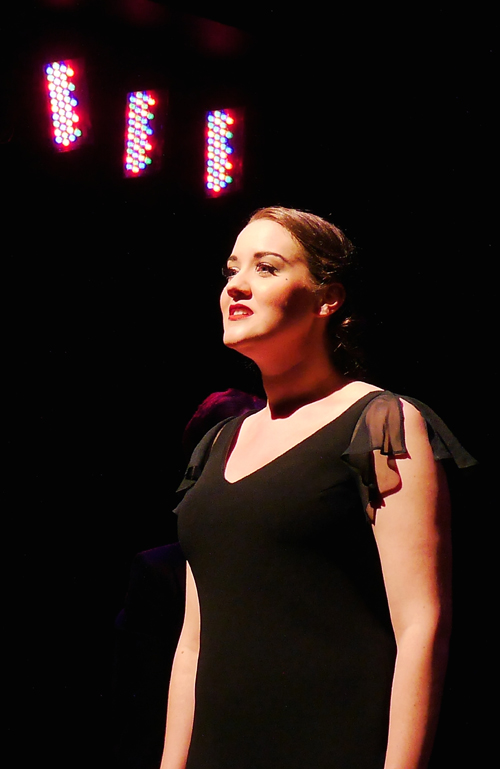
Rebecca Friesen as Sally Bowles. (photo by Kristian Guilfoyle)
In a sense, though, the story is secondary to the cabaret performances that fill and frame the drama. The Emcee (Jamie James), played in the film by Joel Grey, welcomes us with the well-known “Wilkomen.” Here he establishes his relationship with the audience: we are part of the audience of the licentious Kit Kat Club. The Emcee’s performances throughout the play will draw our attention away from the main story just as the characters’ love of illusion keeps them from seeing reality. The use of cabaret performances, interspersed with dramatic scenes, is the show’s greatest strength.
But the audience sees everything because we know what the characters cannot: the future. We are entranced by the cabaret performances, including the songs, “Two Ladies,” “Don’t Tell Mama” and “Mein Herr.” In fact, the women’s chorus, the Kit Kat Girls, is the strongest musical element of this production. Their group performances are alive, their combined voices loud, clear and melodic. As an audience, we also know how life will turn out for these naïve characters: the homosexuals especially. Weimar freedom will be countered with a brutal backlash.
The good men’s chorus performs the frightening song “Tomorrow Belongs to Me” well. The singers provide the appropriate tone shift mid-song that changes an upbeat ode to a bright future into an angry group anthem that dreams of cruelty and destruction.
The show’s best voice belongs to Stephanie Liatopoulosas, as the prostitute Fraulein Kost, when she leads the reprise of “Tomorrow Belongs to Me.”
Director April Green has chosen to make her emcee clearly heterosexual and more goofy than sinister. The style does not work for this character. The Emcee at the Kit Kat Club needs to be somehow creepy and transgressive in order to represent the kind of “decadent” behavior the Nazis wanted to destroy, so this characterization is too light for the role. The Kit Kat Girls’ dancing could have come from Guys and Dolls or West Side Story. It just isn’t very dirty.
One song that was problematic in the play’s first production back in the ’60s is problematic here. “If You Could See Her” is performed by the Emcee and a person dressed as a gorilla. This production has no gorilla costume, just a hairy man wearing a dress and some black makeup. The joke is that “if you could see her through my eyes” you would also love her. Beauty is in the eye of the beholder. But the final line of the song, almost whispered, goes: “If you could see her through my eyes, she wouldn’t look Jewish at all.” The point of this lyric is to disgust the audience with the Emcee’s antisemitism. During the musical’s first production, many audience members believed the whole song antisemitic and called for its cut. The word “Jewish” was removed from the original production and replaced with “meeskite,” or ugly. Subsequent productions have occasionally used the word “Jewish” instead. In the case of this production, the problematic word “Jewish” does not work. Because the Emcee is played as fresh and friendly, and the other performer is not in a gorilla costume, the song’s intention disappears. Rather than suggesting Jews are animals, and hoping the audience cringes, this version suggests Jews look like ugly women.
I suspect the production could not get a gorilla suit and figured the audience would know the character was an animal by the blackened face (not blackface, I hasten to add), and the fact that she likes eating a banana. The choice fails the taste test. This production should have used the word “meeskite,” as in the film and in many productions. In the absence of a gorilla costume, the song should have been cut entirely.
Pipedreams is now 10 years old and is dedicated to presenting infrequently produced musicals and providing opportunities to young musical talent. Last year’s production, Assassins, was nominated for an Ovations Award, a Vancouver version of the Tony Awards for musical theatre. Previous productions have included Nine (2010) and little-known works like Elegies: A Song Cycle (2011) and Adding Machine (2011). Cabaret is at Performance Works on Granville Island until April 19. Tickets vancouvertix.com.
From left, Meryle Kates, executive director, Toronto chapter, Stand With Us, and British journalist and author Melanie Phillips. (photo from Vancouver Hebrew Academy)
On April 1, at the fourth annual Faigen Family Lecture Series presented by Vancouver Hebrew Academy, British journalist and author Melanie Phillips tackled what she called “the herd of elephants stomping around the furniture.”
From 9/11 to the 7/7 bus bombings in London, through the Spanish train and Mumbai bombings, the activities of Hezbollah and Iran, she said, “There is a refusal in the West to acknowledge the link between all these disparate events … that all these phenomena, which take different forms, are a variation of the Islamic religious war, or jihad. Now, we know that this is the case because the perpetrators tell us this – they tell us this over and over again in varying terms.”
More than 150 people filled the downstairs auditorium at Schara Tzedeck Synagogue to hear Phillips speak, which she did after brief remarks from VHA board co-president David Emanuel; Gina Faigen, whose father, Dr. Morris Faigen, z’l, created the lecture series; and Meryle Kates, executive director, Toronto chapter, Stand With Us, who introduced Phillips.
Phillips, author most recently of The World Turned Upside Down: The Global Battle over God, Truth and Power (Encounter, 2010), said that, in Britain, when 9/11 happened, they were told it had nothing to do with religion: “It was to do with poverty, it was to do with lack of education, it was to do with alienation from the surroundings of society.” Referring to the perpetrators of terrorism, she said they were not poor, they were well-educated and, in Britain, they were being alienated, not by Western influences, but by Islamic preachers. Nonetheless, the British were told, “It was Bosnia, it was Chechnya, it was Kashmir and, above all, it was Palestine. So, the way of solving this problem … was you dealt with grievances. Get rid of the grievances, and you will get rid of the problem of terrorism…. It ignored the fact that all these people said over and over again they were doing it for religious reasons, they were doing it in order to defend God against modernity, against America, against the Jews and against the West. It ignored the verses of the Koran which framed these declarations of war being perpetrated on Jews and on the West.”
Phillips said the British government now has decided “what we’re living through is the perversion of the religion,” but it is more accurate to say we’re up against an interpretation of the religion with which not all Muslims agree and, indeed, of which many Muslims are “the principal victims.” However, she noted, offering the British security service as her source, between 2,000 and 4,000 young British Muslims are considered to be “active terrorists” and “they believe the true number is far greater than that.” She added, “opinion polls show that some 40 to 60 percent of British Muslims want to live under sharia law. Now, this is no small matter. Sharia law is in direct conflict with the state, it recognizes no such authority.”
Britain has a “very, very serious problem of religious fanatical radicalization but it has not accepted this.” Only recently, she said, it was reported that the prime minister has set up an inquiry into the Muslim Brotherhood.
Phillips argued that reticence in dealing with terrorism comes from a decent impulse most people have: the fear of being intolerant. She said we must never forget that there are many Muslims “who come to the West because they actually subscribe to Western ideals in that they want to live in peace and freedom, they want to have jobs like everybody else, they want to bring up their families in peace and security like everybody else…. There are people who are so enraged by Muslim, by Islamic terrorism … that they forget that, and I think it’s very important that we don’t forget that. But it’s equally important that we don’t ignore the other side of the story.”
Liberal democracies welcome minorities, she said, as contributing to and enhancing the culture. “The quid pro quo, however, is that minorities have to, in their terms, sign up to a kind of overarching national story, an overarching set of values.” If the rule of law doesn’t apply to everyone, she continued, then a country is no longer a liberal democracy.
In the late 1980s, Phillips began writing about the “cultural vacuum” she perceived was developing. “I started writing about things to do with family, with education, with multiculturalism. It just seemed to me that, over the years, something was going very, very wrong with all these issues; values were being turned on their heads.” She gave the example of family breakdown becoming more of an entitlement, a person’s right rather than a thing that should be avoided if at all possible. She spoke of education in Britain as becoming more child-centric, the belief that imposing constraints and rules on children limited their creativity, leading to illiterate and innumerate children. As well, she said, certain self-defined victim groups were being given a free pass on their behavior because they were supposed victims of the majority.
“… the culture of the nation, as expressed in education, as expressed in the laws passed by that nation … was deemed to be illegitimate because the nation was deemed to be illegitimate. Why? Because nations led to nationalism, and nationalism led to prejudice and war, and if you wish to avoid prejudice and war, you basically abolish the nation … you set up institutions which trumped the nation, transnational institutions, which bound nations together under an umbrella of common values, and those were deemed to be more legitimate than the nation because those brought people together, they were inclusive, they didn’t separate.”
She described human rights laws as pitting one set of rights against another, rather than being universal, as was claimed, and contended this was part of a more general view that “the culture of the nation, as expressed in education, as expressed in the laws passed by that nation … was deemed to be illegitimate because the nation was deemed to be illegitimate. Why? Because nations led to nationalism, and nationalism led to prejudice and war, and if you wish to avoid prejudice and war, you basically abolish the nation … you set up institutions which trumped the nation, transnational institutions, which bound nations together under an umbrella of common values, and those were deemed to be more legitimate than the nation because those brought people together, they were inclusive, they didn’t separate.”
In Phillips’ view, multiculturalism doesn’t mean that we should simply be tolerant and respectful of minorities, but rather, as a doctrine, says that every single culture should be regarded as having identical value as every other. “So, that means that you cannot hold liberal values because … if you’re up against a culture which basically believes that women are second-class citizens or that gay people should be killed, then you as a liberal society cannot impose your view that gay people should have civil rights and that women should have equality because you are being racist, because you are imposing your culture on their culture … consequently, it’s a liberal death warrant, it’s a liberal society’s death warrant, multiculturalism.”
As with other isms, Phillips said, multiculturalism has become unchallengeable. This has happened, she argued, because the West has told itself that religion is bunk. “In other words, instead of adhering to a program which owes its origins to what are considered to be divinely inspired rules of behavior, man … shapes the world, or reshapes the world, according to his own wishes…. So, we have a whole range of ideologies which now govern our assumptions in the West. We have materialism, the idea that everything … must be explained by material explanation. We have moral and cultural relativism, the idea that what is right for me is what is right…. We have deep-green environmentalism, which says that the world would be a great place if only it wasn’t for the human race mucking it all up.”
Phillips said that ideologies replace truth by power. “In the non-ideological world, one looks at facts and evidence and then other facts and evidence and one reaches a conclusion. With an ideology, you start with the conclusion…. The idea governs how you look at the world and, if there is evidence that conflicts with that idea, you have to wrench the evidence to fit that idea … one group fights for supremacy over another group, and that’s how you lose the sense of a national overarching set of values.”
On a whole range of issues, “it is no longer possible to have a rational discussion with people who believe in these ideologies, as upon each issue there can be only one story for them…. Reason is replaced by bullying, intimidation and the suppression of debate.”
Ideologies drive out reason, she said. “And, if there is no truth, there can be no lies either because truth and lies are merely alternative narratives in the jargon of the time.” On a whole range of issues, “it is no longer possible to have a rational discussion with people who believe in these ideologies, as upon each issue there can be only one story for them…. Reason is replaced by bullying, intimidation and the suppression of debate.”
Phillips noted the irony in the West’s replacement of religion with secular dogma. “Just as with medieval Christianity, with Islam through the ages, these ideologies represent a perfectly closed thought system which brooks no alternative because … each of them aspires to create a perfect world, they are synonymous with virtue and, therefore, brook no opposition.”
They have turned evidence and logic on their heads, she said, in a way that is particularly relevant to Israel. “Because of the ideology of multiculturalism and minority rights, self-designated victim groups, defined as those without power, can never do wrong, while the majority groups can never do right. So, it follows, the Muslim world can never be held responsible for blowing people up because they are, as people of the Third World, victims of the West.”
In this scenario, she explained, Jews can never be victims, they are not a minority because they are held to be all-powerful and in control of the media, Wall Street and America – “so much of the hateful discourse about Israel follows from that.” Phillips said this echoes the narrative within Islam. “Because Islam considers itself to be the perfect, unchallengeable word of God, it can never do wrong.” All aggression by Islam is, therefore, seen as “automatically self-defence,” while Western or Israeli “real self-defence is said to be aggression.”
Added to this, she said, is “transnational progressivism,” in which nations are innately divisive and Western nations “innately colonialist, rapacious and cruel.” Israel, therefore, is “triply damned”: “It’s a nation, bad. It’s a Western nation, very bad. It’s a Jewish, Western nation, racist. So, when Israel goes to war to defend its people against the thousands of rockets coming at it from Gaza or whatever it is, the thousands of rockets are regarded as immaterial. What is important is Israel’s military self-defence in the interests of a Western, ‘racist’ nation. Terrorism, by contrast, becomes resistance.”
The utopian nature of ideologies makes them, “by definition, the most high-minded of ideas and thus the most high-minded people subscribe to them, the intelligentsia, which wear them as badges of conscience.” Among the things this explains, she said, is “the phenomenon of left-wingers, high-minded people devoted to human rights and sexual promiscuity marching shoulder to shoulder on the streets of London and elsewhere with radical Islamists devoted to killing homosexuals and stoning adulterous women to death under the common band of human rights.”
Worse, she added, is that, when utopia “fails to materialize, and utopia always fails to materialize, its adherents, its proponents, are so enraged by the failure of what cannot fail … that they select scapegoats on whom they turn to take out their rage over the thwarted establishment of a perfect world, and the scapegoats become enemies of humanity.”
One of the commonalities between all these disparate ideologies, she said, is “hostility to Judaism, Israel and the Jewish people.” She attributes this, in part, to the fact that it was Judaism that laid down the moral foundations of Western morality, “which is under attack from moral relativism.” And herein lies her solution.
In Phillips’ opinion, “the essence of the problem is the displacement of religion, especially biblical morality, and its replacement by secular ideology.” So, the religious basis of the West needs to be restored. She thinks this is possible for two main reasons. “First, people are not adverse to spirituality…. What they don’t want to believe in is in organized religion, but that’s very different from saying they don’t want to believe or that they don’t instinctively believe in something that is supernatural…. The second is this, there’s an assumption in our modern world that in one box is reason and in another box is religion and the two can never meet…. The fact is that religion was the wellspring reason, order, progress, human dignity and liberty…. Without the Hebrew Bible, these things … would not have existed and, I would suggest, that as religion has been progressively edged out of Western life, so truth and morality have crumbled, leading to irrationality, prejudice and so forth.
“Western science grew, essentially, out of the revolutionary claim in the Bible that the universe was the product of a rational creator who endowed men with reason so that he could ask questions about the natural world.”
“And it was not just any religion that created reason and progress,” she continued, “but very specifically Christianity and the Hebrew Bible from which it sprang, the Hebrew Bible…. Western science grew, essentially, out of the revolutionary claim in the Bible that the universe was the product of a rational creator who endowed men with reason so that he could ask questions about the natural world…. The problem arose in our modern times, when science overreached itself and sought to explain the inexplicable … and so, scientific materialism became a kind of faith in itself, an explanation for all things, but that isn’t actually the case.”
It is the same with equality, she said. “It is the Hebrew Bible again which tells us that we are all created equal in the eyes of God and, therefore, we have to respect each other as human beings and, without that biblical story, equality would not exist, nor would we have our assumptions of putting the interests of others first, which lie at the very heart of a civilized … society.”
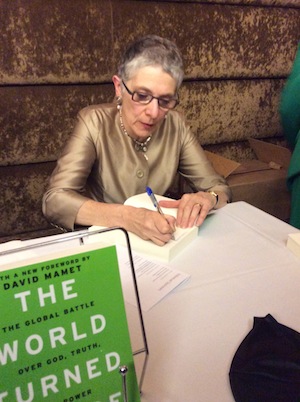
Melanie Phillips signs copies of her book The World Turned Upside Down: The Global Battle over God, Truth and Power for attendees at the April 1 Faigen Family Lecture.
The task of the West, she said, is “to re-Christianize, as the previous pope well understood. And I realize that to use those terms, to say the West must re-Christianize, causes a terrible frisson, not least among people in this audience. Christianity has not been an unalloyed pleasure for the Jewish people, but if we wish to defend and protect and assert Western culture, we have to accept that Christianity is at the root of Western culture, with all its freedoms and all its values…. And at the root of Christianity is the Hebrew Bible.”
As Jews, we must “help reconnect the Western world with those Jewish roots and values which are the root, are the very core, of the Western culture,” she said. “We have to stand up very clearly for stating the truths about the state of Israel, its history and its present situation.”
Phillips called the “attack on Israel” the most important “cause of our time, not just because we are Jews and we should care about the existence, survival and security of the state of Israel,” but “because attitudes to Israel are attitudes to truth, to justice, to morality, to decency, to civilization. If people are on the wrong side, essentially … of Israel, they are on the wrong side of truth, justice, morality and civilization…. Western culture is currently at great risk because its understanding of itself has been smashed into fragments. The way to save it … is by putting those fragments back together again…. The challenges are truly formidable but if, and only if, we have faith in ourselves, it can and must done.”
After a 15-minute Q&A, VHA head of school Rabbi Don Pacht concluded the evening on a light note, thanking Phillips for an informative lecture, as well as for her “wholesale endorsement of the Hebrew Bible,” of which he’s “a huge fan.” He also thanked the Faigen family for their sponsorship of the annual event.