Learning to nurture kindness

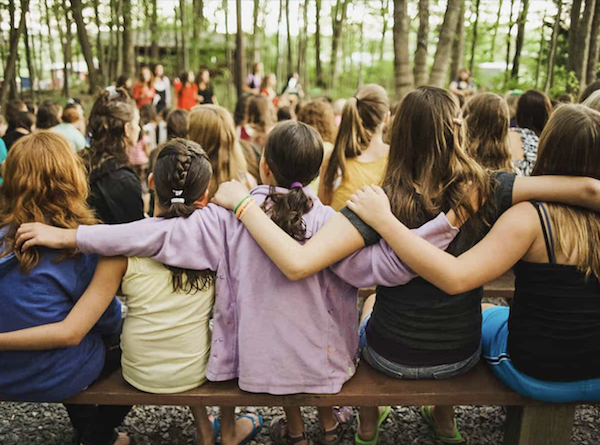
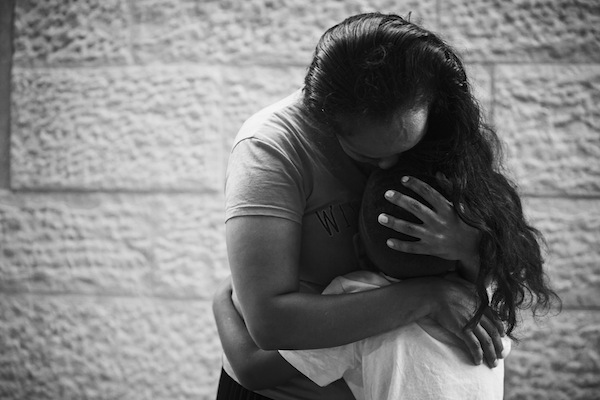
Foundation for Jewish Camp has been awarded a grant to explore how Jewish overnight camp nurtures and promotes character development. (photo from jewishcamp.org)

Foundation for Jewish Camp (FJC) has been awarded a three-year expansive research grant from the John Templeton Foundation to explore how the activities and rituals at Jewish overnight camp nurture and promote character development in adolescent campers and camp staff.

Findings of an earlier landscape survey of current virtue development practices at Jewish camps and a series of interviews with camp professionals identified kindness as the most common virtue camps desire to nurture in their communities. This next phase of in-depth research will focus on understanding how kindness is embedded into the structure of Jewish camp, how character virtues are taught, practised and modeled by camp leadership and staff, and how staff and campers are impacted.

The initial one-year planning grant, awarded in 2021, was used to develop conceptual frameworks and research design and instrumentation. This work included convening thought partners and learning circles to guide the project; conducting a landscape survey of current virtue development practices at Jewish camps; interviewing a select group of 10 camps to learn more about their current practices; and developing the proposal for the three-year study to evaluate the impact of character development practices on the minds, hearts and behaviours of adolescents and young adults who participate in Jewish camp.

According to Rabbi Avi Katz Orlow, FJC’s vice-president for education and innovation and the co-leader for this project, “Jewish camp in North America has a great history of making mensches – a Yiddish term for a person of great character and integrity – but that is not enough. We need to look critically and explore the metrics of character development. With the support of the John Templeton Foundation, we will define where we are headed in this work for the next decade. Surfacing and sharing best practices in character development will ensure we are making our best effort to raise new generations of thoughtful, resilient, caring, community-minded individuals. The world needs mensches now, more than ever before.” 

“We want to surface exemplary practices that support young adult camp staff to model and nurture kindness in themselves and others,” said Nila Rosen, FJC’s director of learning and research. “Our research will allow us to learn with the camps and develop additional resources and practices to elevate emerging and promising character development at camps across North America.”

These resources will expand on FJC’s Making Mensches Periodic Table – the resource bank for camp staff and educators to engage in the work of character development, whose popularity served as the basis for this inquiry.

FJC has selected five camps that are intentional in their construction and cultivation of a culture of kindness in their community. These camps will conduct a thorough exploration of how that shows up in their staff selection and training, relationship building, camp rituals, peer-to-peer support, professional development, branding materials, camp artifacts, signage, or explicit language used by leadership teams.

Dr. Richard Bollinger, senior program officer of character virtue development at the John Templeton Foundation, said, “We are excited about the potential impact of this project because spreading kindness within a community can create ripples of a ‘pay-it-forward’ nature that extend far beyond the initial kind actions. Along with the hundreds of thousands of campers, families and staff who participate in 300+ Jewish camps across North America each year, we are eager to share and learn with FJC and the field.”

– Courtesy Foundation for Jewish Camp

Neville sworn in with shofar

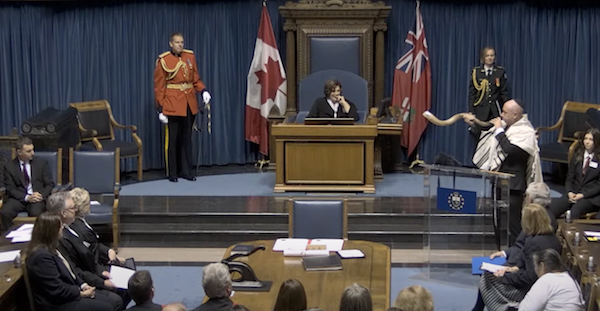
Anita Neville’s swearing-in ceremony on Oct. 24 included the blasts of a shofar blown by her rabbi, Anibal Mass. (screenshot)

Anita Neville says she “feels the responsibility” of being the first Jewish person to be appointed as the lieutenant governor of Manitoba – an office she was sworn into on Oct. 24, using a Hebrew Bible.

For the next five years, the vice-regal residence in Winnipeg will be where Neville calls home. And she was quick to start carrying out official duties like laying the first wreath during the province’s Remembrance Day ceremony, and reading the government’s Speech from the Throne to open a new Manitoba Legislature session on Nov. 15.

“The whole thing is new. The protocol is new. I’m fortunate that there are very knowledgeable, experienced people around me, so that makes it easier,” Neville told The CJN Daily in an interview from Government House, acknowledging that she has a steep learning curve for her new role.

Which is why, shortly after her swearing-in, Neville flew off to attend a round of orientation meetings. She also learned that she will be going to Buckingham Palace, at some point, to present her credentials to King Charles III.

“There are three others who have not presented their credentials to the monarch, so there are four of us in line,” said Neville. “I don’t know where I am in the order, but I look forward to it very much.”

Couldn’t lose face with grandson

Neville was at her cottage with her grandchildren in July when Prime Minister Justin Trudeau called to offer the position. She took time to think about whether she wanted this very public role. After all, she already had a fulfilling career in community service, including as chair of the city’s public school board, and then 11 years as the Liberal member of Parliament for Winnipeg South Centre, from 2000 to 2011. She’s also deeply involved in Jewish community matters, with her synagogue Shaarey Zedek, and the Jewish Heritage Centre of Western Canada.

At first, some members of Neville’s family were worried the new position might be too much for their 80-year-old mother and grandmother.

“I’ve got a very bad back,” she said. Neville walks with the assistance of a cane.

But her decision was made after she thought about her grandparents and her roots, having been born in the traditional Jewish immigrant neighbourhood in the North End of the city, then growing up after the Second World War, when barriers to advancement still existed for Jews.

What clinched it was when a grandson scolded her and said, “How could you not take the job? How many people get this opportunity?” Neville felt that she didn’t “want to lose face with Aaron.”

Considering saying no was “beyond his comprehension,” she said.

Jewish and Indigenous touches

The 26th lieutenant governor in Manitoba’s history made sure to put her own stamp on the official swearing-in. The formal ceremony was full of Jewish symbolism.

It not only involved her choice of Bible to swear the oath, but it also had the piercing blasts of a shofar blown by her rabbi, Anibal Mass – who delivered blessings and then led the audience with a loud “Mazel tov!”

The opportunity is something the daughter of Russian Jewish immigrants in Winnipeg’s North End never dreamed would be possible for somebody with such origins.

In her speech, Neville told the audience that her grandparents fled Bessarabia and Odessa a century ago, to escape a climate of murderous antisemitism, and to find freedom and opportunity in Canada.

“I wanted … the larger community of Manitoba to be aware of who I am and where I came from,” she said. “I did it thoughtfully. I don’t think I was over the top.”

It wasn’t only having Jewish rituals that marked a departure from previous swearing-in ceremonies. Neville pushed to include Indigenous people in the program, which she claims is the first time this has happened. It stems from her own decades of work on their behalf, and it will likely be a key part of her mandate.

An Indigenous elder, Myra Laramee of the Fisher River Cree Nation, delivered an invocation during the ceremony, and even called her longtime Jewish friend by the title of “Auntie.”

A positive signal: Neville

Neville’s swearing-in also came just three days before the Manitoba government adopted the International Holocaust Remembrance Alliance definition of antisemitism, becoming the fifth Canadian province to do so. (Canada adopted it nationally in 2019.)

While she did not have anything to do with the timing, and did not work behind the scenes on that file, Neville agrees both things are good for Jews.

“I think, for the Jewish community, it is a signal of positive acceptance, integration,” Neville said. “Not that it wasn’t there before, but it’s a kind of stamp. It’s like getting a check mark.”

Neville isn’t the first Jewish person to hold a similar appointment in Canada: that milestone was pioneered by Myra Freedman, who served as Nova Scotia’s lieutenant governor from 2000 to 2006. (Freedman held Shabbat dinners at the official residence and kept kosher.)

For her part, Neville plans to install a mezuzah at the entrance to her private quarters when she moves into the century-old Government House. And she won’t serve pork or shellfish.

When she was initially appointed, a friend immediately called

her, half-jokingly anticipating an invitation for the fast-breaking meal at the end of Yom Kippur. All Neville can say to that for now is, “We’ll see.”

Centre-left stance on Israel

Neville is a long-standing supporter of Israel, and her appointment comes amid rising antisemitism, including a torrent of hate for Israel and Zionism.

B’nai Brith Canada’s annual audit reported 223 anti-Jewish incidents in Manitoba last year, up from 92 in 2020, and 83 the year before that, according to Janna Minikovich, a spokesperson for the group.

Does Neville fear becoming a target for anti-Jewish sentiment in her new role? During her days in Parliament, she remembers receiving some hate mail, but she declined to comment further on her current opinions on Israel, besides describing those views as “centre left.”

Neville co-chaired the Liberal Parliamentarians for Israel caucus when she was an MP. Moreover, in the House of Commons, she raised the plight of the 800,000 Jewish refugees expelled from Arab lands, saying people needed to pay attention to this historic injustice.

But she also criticized Stephen Harper’s Conservative government for cutting federal funding to KAIROS Canada, an aid agency supported by several churches. The group supports the boycott, divestment and sanctions movement against Israel as a method of combating what it considers oppression of Palestinians. (Neville said at the time that, without clear explanations of the change in funding, it appeared Canada was stifling criticism of Israel.)

Operation Ezra volunteer

Neville has long been an advocate for social justice causes. One that is dear to her heart involves her work with a Jewish-led rescue organization in Winnipeg, Operation Ezra. The group has worked with other faith communities since 2015, to help bring 65 Yazidi refugees to Canada. (The federal government has brought in hundreds more under a federal sponsorship program starting in 2017.)

In between rehearsals for the Speech from the Throne and planning her move-in date to her new quarters, Neville made sure to turn up at the Winnipeg airport to greet the latest new arrival.

Ayad Alhussein, now 13, was captured by ISIS forces in 2014 – along with his entire family – when the Islamic extremists took over much of Iraq and Syria and set up a caliphate. Yazidis are not Muslims, and they were ordered to convert, or be killed. Ayad was just 5 years old at the time, and was kept prisoner for five years, until he escaped. He had been living in a displaced persons camp in Iraq, while two of his surviving sisters made it to Canada.

According to Michel Aziza, co-chair of Operation Ezra, it took constant pressure by the committee on local MPs and on immigration officials to get Ayad’s paperwork processed. “The world moved on, from Yazidis, to Afghans, to Ukrainians,” said a frustrated Aziza after Neville welcomed the slightly overwhelmed teenager.

Scenes like this underline why Neville’s swearing-in speech referred to her core values of “tikkun olam and tzedakah,” referring to herself as a descendent of refugees.

“I know that the Jewish community … because of what [feedback] I’ve received, has been very happy and very pleased with my appointment. And I feel the responsibility of it, let me tell you.”

To listen to Ellin Bessner’s podcast with Anita Neville, visit thecjn.ca/news/anita-neville-profile. The swearing-in ceremony can be viewed at youtube.com/watch?v=d0i3C2lce-g.

Sar-El faces a legal challenge

The Canadian arm of an Israeli organization that provides volunteers for the Israel Defence Forces (IDF) is facing a legal challenge to show that it does not violate Canadian law.

Sar-El Canada is slated to go to court in Toronto on Nov. 23 to argue that it does not violate the Foreign Enlistment Act.

The act states that “any person who, within Canada, recruits or otherwise induces any person or body of persons to enlist or to accept any commission or engagement in the armed forces of any foreign state or other armed forces operating in that state, is guilty of an offence.”

Sar-El Canada sends 100 to 150 volunteers a year from this country to Israel, the group’s national president, Jeff Sarfin, told the CJN. He said the organization had received nothing in writing about the legal challenge, and would issue a statement when it does.

Sarfin said those behind the legal challenge “are well-known anti-Israel activists known to cause trouble” and that “we consider this a non-issue.”

The case is the latest salvo from David Mivasair, a Hamilton, Ont.-based rabbi with a long history of activism targeting Israel, who called Vancouver home for many years.

Mivasair is joined on the private prosecution by Rehab Nazzal, a Palestinian-born, Toronto-based artist who was shot in the leg in Bethlehem in 2015 while photographing an IDF “skunk” truck, a non-lethal weapon used for crowd control.

A statement issued Sept. 28, by lawyer John Philpot, claimed that Sar-El Canada “acted as an intermediary to recruit or induce individuals to volunteer in a non-combatant role with the Israeli military. It is further alleged that, once in Israel, volunteers would reside on military bases, wear military uniforms and complete tasks that would otherwise be assigned to soldiers. These tasks allegedly included (but were not limited to) packing food rations or medical kits, cleaning tanks, painting helmets, radio repairs, and gas mask refurbishment.”

On Sept. 22, a justice of the peace approved a private prosecution against Sar-El, compelling the organization to appear in court in November.

“This will be only a first appearance, and there are a number of preliminary stages that the case will need to pass through before a trial date can be scheduled,” Shane Martinez, one of the lawyers representing Mivasair and Nazzal, told the CJN.

Recruiting in Canada for volunteers to assist the Israeli military “ought to be a concern of all Canadians,” Mivasair stated in a press release. He said the matter was brought to the attention of the federal government and the Toronto Police Service and “they both failed to act. We felt obliged to bring this prosecution as a civic duty to ensure respect for the rule of law.”

None of the allegations have been tested in court.

According to the Ontario courts’ website, a private prosecution is a legal process in which a person who has reasonable grounds to believe that someone has committed a criminal offence seeks to have the person charged and brought to court. The Foreign Enlistment Act is not part of the Criminal Code but criminal proceedings arising from it are “subject to and governed by the Criminal Code.” The act sanctions fines and imprisonment for those found guilty.

Sar-El Canada’s parent organization in Israel was established 40 years ago. Sar-El (a Hebrew acronym for “Service for Israel”) was originally set up to provide volunteer labour to farmers who were called up for military service, so their crops wouldn’t fail.

Sar-El operates in more than 30 countries and has to date sent some 160,000 volunteers to Israel to provide “broad logistical support to the IDF,” its website says. Volunteering takes place on IDF bases throughout Israel.

According to Sar-El, programs offer volunteers an opportunity to live and work beside Israeli soldiers and gain an insider view of Israel. Working alongside soldiers and base employees, the “non-combat civilian support duties” encompass packing medical supplies, repairing machinery and equipment; and cleaning, painting and maintaining the base.

The Sar-El program “is a morale booster and motivator for the soldiers,” the group’s website states.

David Matas, senior legal counsel for B’nai Brith Canada, said there “is no particular reason” the complainants in the Sar-El case should bring the matter forward. Typically, victims begin a private prosecution because they feel they have been ignored or turned away by police or the Crown.

The complainants in this case “do not identify as victims of any particular act of Sar-El volunteers. None of them personally claims to have suffered a loss as a result of what a Sar-El volunteer has done.”

The Foreign Enlistment Act, meantime, does not intend to include those who are not members of the armed forces. Sar-El volunteers “do not become members of the Israel Defence Forces [and] do not enlist in the Israel Defence Forces,” Matas told the CJN. “They are non-member support for the forces.”

Matas said the Crown can intervene in a private prosecution to stay a case, and that it would be “appropriate” for that to happen in this matter.

He pointed out that Ukraine has openly called for soldiers from around the world to join the fight against Russia. Oleskandr Shevchenko, Ukraine’s consul general in Toronto, told the National Post that “hundreds” of Canadians got in touch to offer assistance.

Allowing the Sar-El prosecution to proceed “would create an arbitrary situation where help for Israel is prosecuted and help for other states under armed threat is not,” Matas said.

In a related recent development, Canada’s justice ministry dismissed a petition that had called on the Liberal government to prosecute those who recruit and encourage recruiting for the IDF.

The petition singled out the Israeli consulate in Toronto, which had advertised “on several occasions an IDF representative available for personal appointments for those wishing to join the IDF, not just those who are required to do mandatory service.”

The petition was initiated by Mivasair and presented to the House of Commons in August 2021 by Hamilton NDP MP Matthew Green, but it died on the order paper when Parliament was dissolved for the federal election that followed.

Green reintroduced the petition this past June. On Sept. 22, the justice ministry replied that responsibility for the investigation and prosecution of offences under the Foreign Enlistment Act “rests with independent law enforcement and prosecution services.”

The campaign against the IDF’s recruitment of non-Israeli citizens in Canada began two years ago when several groups and some 170 prominent Canadians asked justice minister David Lametti to investigate the issue.

Israel’s Toronto consulate decried the action as part of a campaign “that attempts to smear the state of Israel and undermine [its] steadfast alliance with Canada.”

Israel’s consulate in Montreal at the time noted that consular services it provides are reserved for Israeli citizens and do not apply to non-Israelis who volunteer for the IDF.

At a news conference in October 2020, Lametti said Israeli diplomats serving in Canada “must follow Canadian law.” He referred the matter to the RCMP, which did not return calls and emails from the CJN seeking an update on the file.

Last year, Mivasair and Palestinian activist Khaled Mouammar asked the Canada Revenue Agency to investigate the Toronto-based Canadian Zionist Cultural Association for allegedly supporting the IDF.

Last May, following Israel’s brief war with Gaza, Mivasair was charged with one count of mischief after red paint, meant to symbolize Palestinian blood shed, was dumped onto the steps of the building housing Israel’s Toronto consulate. The charge was withdrawn in January.

– For more national Jewish news, visit thecjn.ca

Feeding those in need

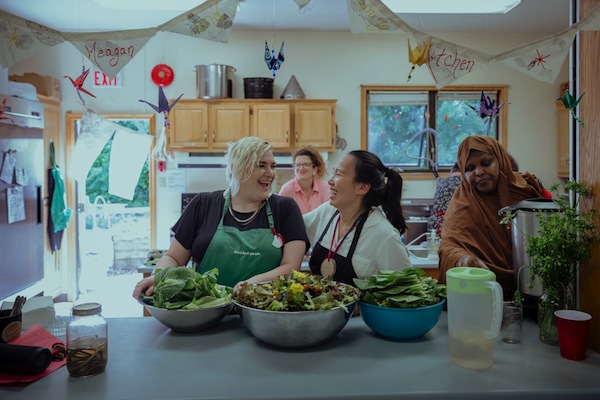
Mazon Canada’s Izzy Waxman, left, and Kathleen Novelia at Valley Community Learning Association in Nova Scotia. (photo from Mazon Canada)

Mazon Canada, a grassroots community foundation that helps feed Canadians of all ages, abilities, beliefs and ethnicities on behalf of the Jewish community, is making some big shifts entering the new year, as households across the country face mounting challenges involving food security. In addition to providing grants for food and equipment, and educating and advocating toward an end to hunger in Canada, Mazon says it will also be “harnessing the wisdom and power of communities.”

“We’re deepening relationships with our grantees, asking about how we can support them better, and making big changes based on that feedback,” said Izzy Waxman, Mazon’s executive director. “We realized we can have bigger impacts if we lift the restriction that our grants should only be spent on food.”

As an example, Waxman compared investing $2,000 on food with spending the same amount on a freezer. “The former will get you 2,000 meals at even our most efficient food bank partner, but spending $2,000 on a freezer to store rescued or donated food can rescue 1,000 pounds of food a month for at least 10 years. That’s 12,000 meals annually or 120,000 meals. This is something we might not have explored if we didn’t take time to listen to our partners and ask how we can support them better, treating them as the experts that we can learn from.”

Additionally, according to Waxman, Mazon is bringing a social justice perspective to hunger, which recognizes that more vulnerable groups need greater attention. By supporting and prioritizing marginalized communities, Mazon hopes to strengthen interfaith and intercultural alliances.

Further, Mazon is taking an active role in advocacy work. “While providing food is always our biggest expense by far, we can’t solve hunger by only treating the symptom. We have to address the root cause as well: poverty. That means starting a conversation in the Jewish community about addressing the cost of living, employment and our social safety net – including the housing crisis, disability supports, minimum wage and other issues affecting the poorest people in our communities,” Waxman said.

Helping low-income individuals in British Columbia since its founding in 1986, Mazon currently supports more than 25 organizations across the province, including hot meals for the homeless in the Downtown Eastside, community gardens at Indigenous elementary schools, hampers for Jewish seniors, food rescue operations to save edible food from landfills, and drop-in meals for people with AIDS and those experiencing addictions.

In 2021, Mazon, on behalf of the Jewish community, provided more than 300,000 meals through 205 partner programs in 92 Canadian towns and cities. Its reach extends from Victoria to Iqaluit to St. John’s.

A successful partnership program Mazon points to regionally is School District 50 (SD50), consisting of six schools on Haida Gwaii. As an archipelago, Haida Gwaii is especially vulnerable to disruptions in food supplies and the economy; because food must be shipped in from the mainland, basic nutritional staples can be very expensive.

To keep students fed, SD50 has used a strategy, called Local Foods 2 School, in which cafeteria food is sourced from nearby farms or local woods and waterfronts. Students visit the sources of the food to learn about how it is grown, gathered, hunted, preserved and prepared. Meals served at the schools are often cooked by students so they learn kitchen skills.

A significant number of SD50 students are Indigenous, thus community elders are involved in teaching traditional food and land skills. This approach, Mazon believes, supports the local economy and encourages resilience and food independence.

Looking for B.C. members

Believing it is important to have Jews from all over Canada who have on-the-ground knowledge of their communities and cities, Mazon is hoping to fill two vacant board positions with residents of British Columbia.

“That same grassroots ‘community-knows-best’ perspective we take to supporting frontline food programs matters in our leadership, too,” Waxman said. “We’re about to head into strategic planning and we need participation from Jews across the country to make sure it’s in touch with local priorities.

“I worry that the B.C. Jewish community doesn’t know about the work we’re doing in their name right in their backyards, and we need local leadership to help us raise awareness of how the Jewish community is responding to West Coast hunger. I know people would be so excited if they knew the Jewish community was helping people in their neighbourhoods,” she added.

Besides seeking a B.C. presence on its board, Mazon is looking for people to serve on its advocacy, fundraising, allocation and education committees.

In 2019, there were 4.4 million Canadians confronting food insecurity, according to Mazon. In 2021, the number jumped to 5.8 million and, by the end of 2022, it is expected to be even higher as a result of inflation. Inflation also makes it more difficult for food banks to serve people in need.

Mazon is distributing 100% of donations to its current Rosh Hashanah campaign to frontline food projects without overhead.

For more information, visit mazoncanada.ca.

Sam Margolis has written for the Globe and Mail, the National Post, UPI and MSNBC.

Masa Canada visits the coast

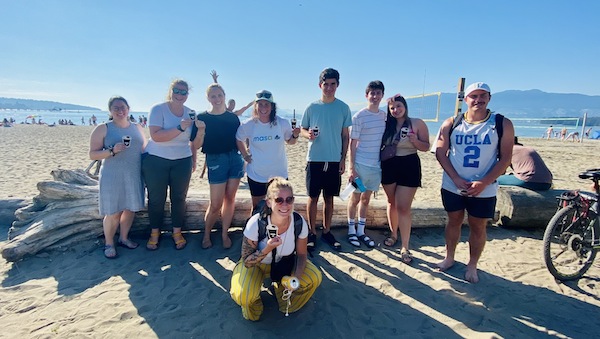
Mahla Finkleman, Canadian national manager of partnership and outreach for Masa Israel Journey (standing, fourth from the left), at Kits Beach in July with participants of the Shalom U’Lhitraot event. (photo from Masa Canada)

While the skies were closed for the first waves of the pandemic, with many organizations canceling their Israel trips, Masa Israel Journey saw an increase of almost 40% of North American students and young professionals traveling to Israel to partake in immersive four-to-10-month programs.

Since its establishment in 2004 by the Jewish Agency and the government of Israel, Masa has served more than 180,000 Jewish students and young professionals ages 16 to 35, from more than 60 countries. Offering experiences in gap, academic and career segments, Masa provides an unmediated and challenging journey into Israeli society, culture, politics and history, as well as access for global Jewry to Israeli businesses, social enterprises and academic institutions. Masa strengthens the Jewish leadership pipeline through the Impact and Leadership Centre, based in Jerusalem. When fellows return from Israel, they are ready to engage as active members in their community and many take on leadership roles.

Masa has regained a strong presence in Canada, with a new Canadian national manager of partnership and outreach, Mahla Finkleman, who sits within the Federation of Greater Toronto, and visits communities across the country. Since Finkleman started just over one year ago, Masa has sent more Canadians than ever before to Israel on programs.

This past summer, working from Vancouver, Finkleman partnered with the Community Kollel for a Shabbat dinner for Tu b’Av. Some 60 to 70 young professionals, including many Birthright alumni, gathered to learn about Masa opportunities and ways to get back to Israel for a meaningful experience, living like a local.

Earlier in the summer, in July, the first of three Shalom U’Lhitraot events took place, welcoming back Masa alumni from Israel and sending off others to Tel Aviv University, Masa Israel Teaching Fellows (MITF) and other programs.

A new condensed version of MITF is available now. MITF is an option for 21-to-35-year olds who have a bachelor’s or associate degree and whose mother tongue is English. Applications are due Nov. 1, with three city options to choose from: Rishon LeZion, Bat Yam and Ramle. The program, which costs $720 US, runs in 2023 from Jan. 5 to July 2, and is an exclusive partnership with Israel Experience.

Each city offers its own unique charm. In Bat Yam, you can take surf lessons and deep dive into the Israeli-Russian community. Rishon is Israel’s fourth largest city, with malls, parks, beaches and a zoo. And, in Ramle, an ancient city with mixed cultures and a rich history, the Pool of Arches is a top attraction, as is the Ramle market – additional perks are the spacious homes and a pool pass.

For more information, visit masaisrael.org/canada or the North American site, masaisrael.org. Anyone who has questions can also email Finkleman directly at mfinkleman@ujafed.org.

This Rosh Hashanah, look out for Masa alumni postcards on the seats of your local Vancouver shul.

Help break the cycle

Canadian Hadassah-WIZO’s S.O.S. – Starting Over Safely campaign is 27 hours long, beginning at 9 a.m. PT on Aug. 23. (photo by Mickey Noam Alon)

With the COVID-19 government shutdowns and mandatory quarantines, domestic violence has increased significantly across the globe over the past two years. The drastic increase in intimate partner and domestic abuse has been coined the “Shadow Pandemic” by the United Nations.

In Canada, one woman is killed in a violent act every two-and-a-half days. According to the provincial ministry for public safety and Statistics Canada, every year in British Columbia there are more than 60,000 physical or sexual assaults against women – almost all of them committed by men.

In Israel, the situation is just as critical. In the first year of the pandemic, 20,140 domestic violence complaints were lodged with police, an increase of 12% from the previous year. Twelve women were murdered in the first six months of this year.

In accordance with its mission, Canadian Hadassah-WIZO (CHW) is working to empower women by stepping up emergency support and services at this critical time. CHW is launching the second annual S.O.S. – Starting Over Safely summer campaign, with proceeds helping empower victims of domestic violence in Canada and Israel.

One of the most frightening things about domestic abuse is that half of the women murdered by their partners never experienced physical violence before. Domestic violence can happen to anyone, anywhere, anytime. This year, through a new partnership with Michal Sela Forum, CHW is also promoting an awareness campaign to help women understand the warning signs in a relationship.

S.O.S. – Starting Over Safely 2022 has three campaign priorities, including Franny’s Fund in Canada, and WIZO programs and the Michal Sela Forum in Israel. The following campaign goals are intended to empower at-risk women and children to break the cycle of violence in Canada and Israel:

  • Provide help for parents and families in need of an urgent response;
  • Provide access to critical resources such as legal counsel and counseling services;
  • Provide women and their children with the basic essentials to start over safely;
  • Empower women and their children by providing financial help, social and personal support, employment support, and access to a network of other women in similar circumstances;
  • Provide women and their children with specially trained canine protection; and
  • Fund respite summer camp experiences for at-risk youth.

“CHW strongly believes that every human being deserves the right to achieve their full potential, while living in safety and security. You have the power to empower,” said Lisa Colt-Kotler, CHW chief executive officer.

The 2022 fundraising goal is $350,000. All funds donated will be matched three more times by a community of dedicated donors recognized as “Matching Heroes” during the 27-hour campaign, which kicks off at 9 a.m. PT on Tuesday, Aug. 23, 2022. During the crowdfunding period, each gift donated on the website chwsos.ca is quadrupled.

To donate or learn more, visit chwsos.ca.

– Courtesy Canadian Hadassah-WIZO

Hate crimes on the rise

On Aug. 2, Statistics Canada released police-reported hate crime data for 2021revealing, once again, that hate crimes targeting the Black and Jewish populations remain the most common reported by police.

“We are deeply concerned that incidents of hate crime rose yet again in Canada in 2021,” said Shimon Koffler Fogel, president and chief executive officer of the Centre for Israel and Jewish Affairs (CIJA).

There were 642 reported hate crimes against Black Canadians in 2021, a slight decrease from the 676 reported in 2020, but an 86% increase from the 345 incidents reported in 2019.

Overall, hate crimes targeting religious groups increased 67% from 2020, breaking a three-year downturn. Incidents targeting the Jewish community grew by 47% from 2020 to 2021. Statistically, this reflects 1.3 in 1,000 members of Canada’s Jewish community reporting having been the target of a hate crime in 2021.

Jewish Canadians remain the most targeted religious minority for hate crime and second overall. There are approximately 380,000 Jews in Canada, representing only one percent of the population, yet members of the Jewish community were victims of 14.5% of all reported hate crime in 2021.

“Statistically, Canadian Jews were more than 10 times more likely than any other Canadian religious minority to report being the target of a hate crime. This is alarming,” said Fogel.

“This report should be a call to action for all Canadians to stand against antisemitism and all forms of hate…. We are grateful that police services across the country take these incidents seriously, but more needs to be done to protect vulnerable communities,” he said. “This includes greater support for security and safety at community institutions such as houses of worship; equity, diversity and inclusion education that includes training on antisemitism; and a national strategy to target online hate and radicalization.

“Although Canada remains one of the best countries in the world in which to be Jewish, or any other minority for that matter, these numbers should concern all Canadians. One hate crime is one too many.”

For more on the Statistics Canada report, visit www150.statcan.gc.ca and click on the link for the publication Juristat.

– Courtesy Centre for Israel and Jewish Affairs

Diverse allies critical

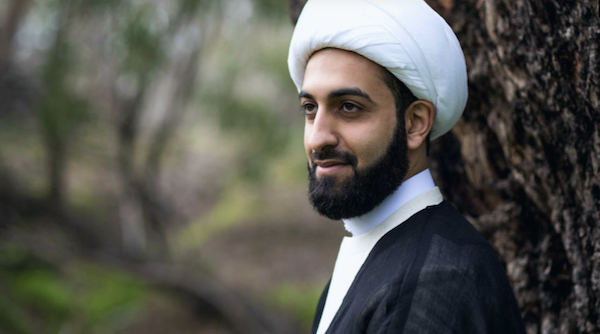
Imam Mohammed Tawhidi once preached hatred, but now is known as “the Imam of Peace.” (photo from imamtawhidi.com)

Imam Mohammad Tawhidi once preached hate towards Jews from the pulpit, and believed the very worst stereotypes about the Jewish people. He was indoctrinated by the Ayatollah’s preachers in Iran. But, today, Tawhidi is known as “the Imam of Peace” for a reason. He’s preaching coexistence and common ground for Jews and Muslims.

In late May, Tawhidi spoke at a United Grassroots Movement event at Beth Emeth Bais Yehuda, a Toronto synagogue, on how people of all backgrounds can – and should – unite against antisemitism and extremism.

An Iranian Muslim of Iraqi origin, Tawhidi sees his former peers actively engaging in hate-filled rhetoric. For example, as in years past, the politics of division and derision were widespread at the Al Quds march in Toronto earlier this year – chants included slurs against Israel and Jews.

Government officials are either incapable of preventing hatred on city streets and property, or unwilling to do so, he said. To answer problems such as these, he encouraged talk attendees to find, and bring together, as many allies as possible, to speak out and even take legal action wherever warranted.

Tawhidi’s change from preaching hatred, to becoming a friend of Israel and the Jews, did not come overnight.

First, he spoke out against ISIS war crimes in the Middle East and Africa. When he was met with condemnation from his peers, he said it opened his eyes to the radical elements that existed within his circle.

“I was still a fundamentalist, an extremist and antisemite,” he said of his views until then. “I thought I was doing this on behalf of God.”

And yet, he began thinking of how he could reconcile the slaughter of innocents in the name of Islam.

The next significant moment for the imam was when he met a Jew. Needing roadside assistance one day in England, it was a visibly Jewish man who helped him.

Later, Tawhidi was invited to a synagogue for an interfaith dialogue. Although he was skeptical, initially, of the people he was communicating with, he left the event feeling a special connection.

His decision to criticize ISIS and radical Islam and preach for peace with Israel and Jewish people was met with a severe backlash.

“I knew I would lose my community, but I also knew I would be welcomed into a new one,” he said.

If he could turn a corner, so can others, Tawhidi maintained. But if they can’t do quite that, then it’s important, he said, to at least defend the truth in public, so that the people who are on the fence or ignorant of the issues can be exposed to all sides.

It’s hopeful for us to note, he said, that the kinds of beliefs he once held are no longer normative in many parts of the Arab world. He highlighted the signatories to the Abraham Accords with Israel, which is breathing new life into modern coexistence, he said.

Further proof of the power of allies, said Tawhidi, is that he received nearly three-quarters of the vote in favour of him winning the position of vice-president of the Global Imams Council, a transnational nongovernmental body of Muslim religious leaders.

Tawhidi stresses that Islam is not a religion that hates Jews, and anything to the contrary is a perversion of the Quran.

To defend against antisemitism, he insisted that Jews and non-Jews must call it out, take legal action when merited, and bring together many communities: “Do not underestimate the power of your allies!” he said.

A staunch supporter of Israel and what he sees as Israel’s right to Judea and Samaria (the West Bank), Tawhidi said, in response to a question from the Jewish Independent, “There can be no circumstances where the Israeli government should give away any land that belongs to the Jewish people. The holy Quran has made it very clear that God, the God of Abraham, wants Jews to live in that region and for Jerusalem to be their capital. That is the teaching of my Quran, and it is clearly stated in Chapter 5, verse 20 onwards.”

As for developing allies out of those who do not support Israel, yet will speak out against antisemitism, Tawhidi said, “You can’t hate a people and you can’t hate a whole country, but I guess they have issues with certain policies of that government, so they need to provide productive and constructive criticism, so that the problems can be solved, and that solutions can be placed forward.”

However, he continued, “a blanket hate on a nation or a people does not come from a person that is worth making a friend, I don’t believe.”

Jon Wasserlauf is a freelance writer, and a political science major and law student based in Montreal.

Inclusivity curriculum

A page of the Intro to Judaism booklet that can be downloaded as part of the Periphery curriculum, which offers a framework to talk and learn about diversity within the Jewish community.

“Make space for a productive and respectful conversation” – this is the first suggested action to frame the use of the recently released Periphery curriculum.

Periphery – a film and photography exhibit exploring the ethnic diversity of Toronto’s Jewish community (jewishindependent.ca/discussing-jewishness) – came out last fall. The new curriculum builds on that 27-minute documentary. It comprises another nine short videos, all under eight minutes each, and lesson guides for students in grades 8 through 12 in both the Jewish and public school systems. There is also a guide for Jewish groups and organizations, which could be used for non-Jewish groups.

Launched by the Toronto-based nonprofit No Silence on Race and the Ontario Jewish Archives (a department of UJA Federation of Greater Toronto) with the organization Facing History and Ourselves (an American group with a Toronto branch), the curriculum is Ontario-focused. That said, most of the information is broadly based and relevant to Canadians no matter where they live, and no matter their age.

There are differences in the curricula for each of the three grade groupings (Grade 8, grades 9 and 10, and grades 11 and 12), the Jewish versus public school content, and the community dialogue package. However, the basic format and information is similar, with appropriate adaptations for probable starting points in knowledge and experience.

The common learning aims include “a greater awareness and understanding about who Jewish people are and the ethnic diversity within Jewish communities”; “Possess a stronger framework for understanding the complexities of intersectional identity, using their own identities as a foundation”; “Understand the difference between individual and group identity with a focus on belonging and recognition”; and the role of students and community members in creating inclusive community spaces. In addition, for example, the Jewish community curriculum also suggests that participants: “Discuss the intersections of race, privilege, mobility (i.e Jewish professional opportunities), power as it relates to Jewish identity and ashkenormativity.”

Before delving into the films and lesson suggestions, the curriculum offers a few activities that help frame what viewers are about to watch and discuss – beginning with making “space for a productive and respectful conversation.”

The most extensive part of the guides is the screening prompts and activities. They are organized by topics based on those of the videos, such as “Hyphenated Identities,” “Immigrating to Canada” and “Finding Strength in One’s Heritage.” They include pre-screening and post-screening questions for each film and topic, and these questions elicit self-evaluation and the sharing of stories and views on identity, race, multiculturalism, sexuality, antisemitism and social justice, as well as discussion of the experiences and opinions of the interviewees featured in the films.

The final part of the guide attempts to have participants take what they have learned out into the world, beyond the classroom or boardroom or office. For example, the title of the last section of the Jewish community dialogue is “Now What?: Social Justice within the Jewish Community and Beyond.” It begins with discussion from a global perspective – using a quote from Canadian anthropologist Wade Davis to talk about questions like, “What does it mean for us to hear from different voices of humanity?” It then highlights a quote from the Mishna and one from Pirkei Avot to further reflect on the idea that repairing the world, tikkun olam, begins within the community.

In addition to the curricula, there are related materials available to download, from worksheets to help understand the concepts being discussed and organize one’s thoughts, to an introduction to Judaism, to a glossary of terms. The poem “Unpacking the Periphery,” by Akilah Allen-Silverstein, can also be downloaded. It concludes “For each other as allies, I pray we can stand tall / Diminish the fine lines, deepen our understanding, / Listen with compassion / Listen with empathy / Act with courage / Act with reason / Because this is the season / To do better / To act on the Open Letters / To be more than trend setters / But intentional change makers.”

All of the Periphery curricula and resources are free and downloadable at peripheryexhibit.org.

“Never again” still resonates?

Left to right: Mia Givon, Lorenzo Tesler-Mabe, Kat Palmer and Erin Aberle-Palm. (screenshot from Kat Palmer)

Holocaust survivors and their descendants were joined by top elected officials and Jewish community leaders in a series of commemorations marking Yom Hashoah, Holocaust Remembrance Day, across Canada last week.

In Vancouver, community members gathered together at the Jewish Community Centre of Greater Vancouver April 27, while scores more watched remotely as the traditional in-person ceremony returned for the first time since the beginning of the pandemic.

Marcus Brandt, vice-president of the presenting organization, the Vancouver Holocaust Education Centre, welcomed guests and invited Holocaust survivors to light Yahrzeit candles.

“On Yom Hashoah, we join as a community to remember the six million Jews who perished in the Holocaust at the hands of Nazi Germany and its co-conspirators between 1933 and 1945,” he said. “It is also a day to pay tribute to the Jewish resistance that took place during the Holocaust.”

This year marks the 79th anniversary of the Warsaw Ghetto Uprising, which is the most notable of many acts of Jewish resistance to Nazism.

Marsha Lederman, a journalist who is the daughter of two Holocaust survivors, spoke of the importance of telling our stories.

“When I was growing up,” she said, “the Holocaust was everywhere and nowhere. As far back as I can remember, there were hints and references. My parents talked about things happening in camp. What was this camp? I knew it wasn’t like the summer camp that I went to. I knew a lot of their friends were also at these camps, but I didn’t know the details.”

At the age of 5, Marsha met a new friend whose home was filled with laughter and extended family.

“One day, when I came home from a visit at my friend’s house, I asked my mother what was really a simple, innocent question,” said Lederman. “She has grandparents, why don’t I? My poor mother. She was caught off guard and her answer was truly horrifying – at least as I remember it, because I know memory is very faulty. But, as I recall, she said I didn’t have grandparents because the Germans hated Jews and they killed them by making them take gas showers.”

This response raised more questions than answers for the young girl, not least of which was: “What did we do to make the Germans hate us so much and do they still hate us? It was a horrible introduction to the details of the tragedy of my family and it taught me another terrible lesson: be careful about asking questions because the answers could be murder.”

As a result, much of Lederman’s Holocaust education was gained “through osmosis, rather than sitting down and asking questions,” she said.

Her father died when Lederman was a young woman and, in a tragic turn of events, her mother died just as Lederman had bought a ticket to visit her in Florida, armed with a recorder to finally ask the questions she had hesitated to broach in earlier years.

“It’s taken me years to try to figure out what I could have learned in an afternoon at my mother’s kitchen table,” she said. “I have no way of knowing these things because I didn’t ask. We need to ask and we need to tell.”

Lederman explores these questions in a book being released this month, titled Kiss the Red Stairs: The Holocaust, Once Removed.

Amalia Boe-Fishman (née van Kreveld) was the featured survivor speaker at the Vancouver event. Born in the Netherlands, she was less than a year old when the Germans invaded her country. Her grandparents were soon transported to Auschwitz and murdered.

In what is an extremely rare phenomenon, Amalia, her parents and her brother all survived the war years because a Dutch Christian resistance fighter, Jan Spiekhout, and his family hid members of the de Leeuw family in a variety of hiding places over the course of years. Amalia’s mother even gave birth to another child in 1944. (That child, as well as Boe-Fishman’s oldest son, are both named Jan in honour of their rescuer.) Their survival was a statistical miracle. The Netherlands had among the lowest Jewish survival rate of any country during the Holocaust. Of 140,000 Dutch Jews in 1939, only 38,000 were alive in 1945.

Boe-Fishman recalled the day Canadian forces liberated the Netherlands – it was one of the only times in three years that she had set foot outdoors.

“It was strange and frightening outside and close to so many strangers,” she said. “The Canadian soldiers came rolling in on their tanks, handing out chocolates, everyone smiling, dancing, waving Dutch flags. Then I was told I could go home to my real family. But who were these strangers? I did not want to leave the family Spiekhout. They were my family. After all, I had not seen my real family for three years.”

In 1961, she traveled to Israel to meet members of her family who had made aliyah before the war and to reconnect with her Jewish identity. There, on the kibbutz she was staying, she met a Canadian, whom she married and they subsequently moved to Vancouver and had three children.

In 2009, Boe-Fishman and her three sons traveled to The Hague for the investiture of Jan Spiekhout and his late parents, Durk and Froukje Spiekhout, as Righteous Among the Nations by Yad Vashem.

“To be together with my children, my brother, and the grown children of the Spiekhout family, this was such a moving event in our lives,” she said.

As part of the Vancouver ceremony, Councilor Sarah Kirby-Yung read a proclamation from the City of Vancouver. Cantor Yaakov Orzech chanted El Moleh Rachamim. Lorenzo Tesler-Mabe, Mia Givon and Kat Palmer, members of the third generation, as well as Erin Aberle-Palm, sang and read poetry, accompanied by Vancouver Symphony Orchestra violinist Andrew James Brown and pianist Wendy Bross Stuart, who was also music director of the program.

The following day, a hybrid in-person and virtual event was held at the British Columbia legislature, featuring Premier John Horgan.

“On Yom Hashoah, we are challenged to ensure the words ‘never again’ are supported by action,” he said. “Over the past few years, there has been an increase in antisemitism in B.C., and the Jewish community is one of the most frequently targeted groups in police-reported hate crimes. That’s why our government will continue working to address racism and discrimination in all its forms.… Today, as we remember and honour those who were lost and those who survived, we must recommit to building a more just and inclusive province, where everyone is safe and the horrors of the past are never repeated.”

Michael Lee, member of the legislature for Vancouver-Langara, spoke on behalf of the B.C. Liberal caucus.

“Every year, we commemorate this day and remember the heroes and the Righteous Among Nations who stood up to oppose the most vile, hateful oppression,” Lee said. “We recognize the victims and survivors of the Holocaust, we make a solemn promise to never forget and never again allow such horrific actions to take place. This is a responsibility that we all must carry with us not only today but every day. It is a responsibility we must be better at upholding, as soldiers at this very moment commit war crimes once again in Europe. We have not done enough. Right here in Canada, we see another year of record rises in antisemitism. We have to do better.”

Lee called on the province to adopt the International Holocaust Remembrance Alliance Working Definition of Antisemitism.

MLA Adam Olsen represented the Green party.

“While time distances us from the horrific events, the memories and the stories remain steadfast in our mind and are carried and passed from one generation to the next,” said Olsen. “The Holocaust was an ultimate form of evil, persecution, oppression, genocide, complete disregard for human life, pushed to the most appalling degree…. The Holocaust is a stark reminder of the darkness, the wickedness, that can exist among us. However, it is also important to acknowledge that this is a story of strength, resilience and humanity and, to that, I raise my hands to all of the survivors, the Jewish community, that have ensured that the world knows and hears the stories. As difficult as it is to continue sharing them, we cannot stop hearing them or else we will fall victim to thinking that we have passed that now.”

Rabbi Harry Brechner of Congregation Emanu-El lamented the deaths of Holocaust survivors in the current war in Ukraine, “who died when they were cold, again, and hungry, again, and who died in the face of violence.”

“That never should happen and we all know that,” the rabbi said. “I don’t know how to make those big changes. I’m not a world leader. I’m the leader of a small congregation. But I think we are all leaders of our hearts and if each of us can make that difference, it’s got to have a huge ripple effect.”

Holocaust survivor Leo Vogel said that history records the end of the Holocaust in 1945. “But, for the people who lived through it and survived that horrible blight of human history, for them, 1945 is not when the Holocaust ended,” he said. “It continues to this very day to live in memories and nightmares and ongoing health problems.… The fascist attempt to eradicate the Jewish people must never be forgotten. The memory of the tortured and murdered cannot be shoveled underground as the Nazis did with the ashes. As children in the Holocaust, we were the youngest and, now, in our older years, we are at the tail end of those who can still bear witness.”

Vogel spoke of the unfathomable choice his parents made to hand him over, as a child, to a Christian family for hiding.

“Not long after that deeply painful decision to separate me from them, they were deported to Auschwitz and there they were murdered without ever knowing whether their desperate act to allow me to go into hiding saved my life,” he said. “I get cold chills when I think of the intense agony they went through in making their decision. It would have been their hope, I’m sure, that one day we would once again get together. That day never happened. Their pain must have been overwhelming. Many times, I have wondered what they said to each other and to me the night before they gave me away and, countless times, I have asked myself whether I would have had the strength to do an equal act when my children were young.”

In Ottawa, earlier on April 27, Prime Minister Justin Trudeau touted his government’s steps in fighting antisemitism, including the creation of a special envoy on preserving Holocaust remembrance and combating antisemitism, currently held by Irwin Cotler, and proposed legislation to make denying or diminishing the Holocaust a criminal offence.

“Earlier this year, our country and people around the world were shocked and dismayed to see Nazi imagery displayed in our nation’s capital,” the prime minister said, referring to trucker protests in Ottawa. “For the Jewish community, and for all communities, those images were deeply disturbing. Sadly, this wasn’t a standalone instance. Jewish people are encountering threats and violence more and more both online and in person. This troubling resurgence of antisemitism cannot and will not be ignored. The atrocities of the Holocaust cannot be buried in history.… We must make sure that ‘never again’ truly means never again.”

Shimon Koffler Fogel, chief executive officer of the Centre for Israel and Jewish Affairs, picked up on that theme, noting that the term “never again” was “born out of the Jewish experience but was always intended to be universal in its application.”

“How can we witness the atrocities visited on the Rohingya, the Uighurs or the Yazidi and claim the cry of ‘never again’ has meaning?” he asked. “How can we observe the unvarnished aggression against Ukraine and assert we have taken the lessons of the Holocaust to heart?”

He said he derives hope from the fact that Canada seems to have learned the lesson of the MS St. Louis, the ship filled with Jewish refugees that was turned away from Canada and other safe havens in 1939. Now, Canada is a place, he said, “where fleeing Syrian and Iraqi refugees can rebuild their lives, where Afghani women and girls can fulfil their dreams, where displaced, wartorn Ukrainians can find safe harbour.”

“I take great pride that Canada is so committed to Holocaust remembrance and education,” said Michael Levitt, president and chief executive officer of the Friends of the Simon Wiesenthal Centre, “A major reason is because of the survivors who, after suffering unthinkable adversity in Europe, rebuilt their shattered lives here, in our great country. Their strength, resilience and willingness to share their deeply personal and harrowing stories have been a gift and a source of inspiration to all Canadians.”

Dr. Agnes Klein, a Holocaust survivor, spoke of her family’s wartime experiences. Israel’s ambassador to Canada, Ronen Hoffman, commended Canada on adopting the International Holocaust Remembrance Alliance’s Working Definition of Antisemitism.

A day earlier, at another virtual commemoration from the Montreal Holocaust Museum, Holocaust survivor Max Smart told of his family’s harrowing Holocaust experiences.

Paul Hirschson, consul general of Israel in Montreal, compared the loss of Jewish life, with its incalculable loss of talent, in the Holocaust with the explosion of Jewish talent taking place in this century.

“Jewish talent lost was one of history’s greatest tragedies,” said the diplomat. “The talent emerging is perhaps the most exciting story of the 21st century…. Antisemitism is still widespread, also here in Canada. Montreal, where many survivors found a home, is no exception. We will defeat hate every time. Hatred will never again rob the world of Jewish talent.”