Skip to content
  • Home
  • Subscribe / donate
  • Events calendar
  • Business Directory
  • FAQ
  • News
    • Local
    • National
    • Israel
    • World
    • עניין בחדשות
      A roundup of news in Canada and further afield, in Hebrew.
  • Opinion
    • From the JI
    • Op-Ed
  • Arts & Culture
    • Performing Arts
    • Music
    • Books
    • Visual Arts
    • TV & Film
  • Life
    • Celebrating the Holidays
    • Travel
    • The Daily Snooze
      Cartoons by Jacob Samuel
    • Mystery Photo
      Help the JI and JMABC fill in the gaps in our archives.
  • Community Links
    • Organizations, Etc.
    • Other News Sources & Blogs
  • JI Chai Celebration
  • JI@88! video

Recent Posts

  • Or Shalom reopens its doors
  • JFS from past to future
  • Need holistic approach
  • Sharing stories, advice
  • Journalist shares fears
  • Skills to live together
  • Road to independence
  • Cutting grass with scissors
  • Zionism as a solution
  • Deceit, desire & the divine
  • Reclaiming sacredness
  • Creative project ideas
  • Summer squares and cobbler
  • Thou shalt … summer commandments
  • Legal help for students
  • Revisiting myth of Lilith
  • Wrong person rebuked
  • Canada’s mixed messages
  • Questions for museum
  • Symposium on antizionism
  • Making soccer political
  • CJPAC lauds Pulver’s impact
  • City recognizes Vrba’s legacy  
  • Organ donation saves lives
  • Theodore’s March premiere
  • A healing Shabbaton
  • Supplying healthy food
  • A chime of metal tags
  • Yellowknife seder a first
  • Ishai energizes, unifies
  • A Lag b’Omer to remember
  • Expanding the healing
  • Hannah Senesh – a unique hero
  • Community milestones … May 2026
  • Деньги до зарплаты на карту Займ до зп онлайн за 5 минут 2026
  • Микрокредит онлайн в Казахстане Микрозайм в Акшамат

Archives

Follow @JewishIndie
image - The CJN - Visit Us Banner - 300x600 - 101625

Category: National

Quick look at Canadian Jews

As of last Friday, June 16, the population of Canada surpassed 40 million people. According to data from the 2021 Canadian census released last year, 335,295 Canadians consider themselves to be Jewish by religion, up from 329,500 in 2011.

The 2021 census also asked about ethnic or cultural origin. In this instance, the number of people choosing Jewish as their ethnic or cultural origin (or one of several) decreased from 2011 to 2021, from 309,650 to 282,015, though the number increased in British Columbia, from 31,865 in 2011 to 34,395 a decade later. This article focuses on Jews by religion.

More than half of Canadian Jews live in Ontario, home to 196,100 Jews, while an additional quarter (84,530) live in Quebec. British Columbia’s 26,845 Jews are 8% of the national Jewish population. Other provinces with significant Jewish populations are Alberta, with 11,565 Jews, and Manitoba, with 11,390. Smaller Jewish communities exist in Nova Scotia, with 2,195 Jews, Saskatchewan, with 1,105 Jews, and New Brunswick, where 1,000 people listed their religion as Jewish.

In Canada, approximately 12,000 Jews (3.6%) identify as a visible minority, including 2,615 Black Jews, 1,505 Latin American Jews, 1,270 South Asian Jews and 1,155 Chinese Jews. Those numbers in British Columbia are 1,425 overall, including 235 Latin American Jews, 200 Black Jews, 170 Chinese Jews and 150 South Asian Jews.

British Columbia is home to the fastest-growing Jewish population in Canada, adding 3,715 Jewish residents since 2011, representing 16% growth. By comparison, Canada added 5,795 Jews to the national population, growing 1.8%. Ontario’s Jewish population only grew 0.3%, while Quebec’s Jewish population declined by 0.7%, making it the only province whose Jewish population decreased over the 10-year period. Western provinces recorded more robust growth: 6% in Alberta, 2.5% in Manitoba and 17.5% in Saskatchewan.

Home to a combined three-quarters of Canada’s Jews, the metropolitan areas of Toronto and Montreal both saw a decline in their Jewish population over the past decade. Meanwhile, Metro Vancouver’s Jewish population grew from 18,730 in 2011 to 20,125 in 2021, an additional 1,395 Jews. Elsewhere in Canada, Greater Ottawa’s Jewish community expanded, as did the metropolitan areas of Winnipeg, Calgary and Edmonton.

Even though their metropolitan Jewish populations decreased over the last decade, the municipal Jewish populations of Toronto and Montreal both grew slightly, suggesting a Jewish movement away from the suburbs and towards the city. Vancouver’s municipal Jewish population also grew during the same period, from 10,350 to 11,675, allowing it to surpass both Winnipeg and Ottawa to become the third-largest Jewish municipal population in Canada. While the City of Vancouver’s share of the B.C. Jewish population decreased slightly over the past decade, from 44.7% in 2011 to 43.5% in 2021, its percentage of Greater Vancouver’s Jewish population grew from 55% to 58%. Greater Vancouver is home to 75% of British Columbia’s Jews, down from its share of 81% in 2011.

Other B.C. cities with sizable Jewish populations include Richmond, whose 2,515 Jews make it the second-largest Jewish municipality in the province, and Surrey, where 900 people reported their religion as Jewish – although both cities’ Jewish populations declined since 2011. The District of North Vancouver had 845 people reporting Jewish as their religion in 2021 and Burnaby 620, both increases from 2011; and West Vancouver had 555, which was a decrease from 665 in 2011. Beyond the Lower Mainland, Victoria’s Jewish population grew from 550 to 960, Saanich’s Jewish community increased from 555 to 750, and the Jewish population of Kelowna more than doubled, going from 215 in 2011 to 530 in 2021.

In addition to provincial, metropolitan and municipal data, the 2021 census also provided information about electoral ridings. Vancouver Granville was the electoral riding with the largest Jewish population in Vancouver (3,275), while Vancouver Quadra was a close second (3,125), although the Jewish population of both ridings decreased since 2011.

Vancouver Granville remains home to 27.5% of Vancouver’s Jews, while Vancouver Quadra is home to 26% of the city’s Jewish population. The Jewish population of four other electoral ridings – Vancouver Centre, Vancouver East, Vancouver Kingsway and Vancouver South – all increased significantly, suggesting a population shift from Vancouver’s West Side to Downtown and East Vancouver. Using these electoral ridings as an approximate guide, 54% of Vancouver’s Jews live in the West Side, 27% live in East Vancouver and 19% live in Downtown Vancouver. By comparison, 64% of Vancouver’s Jews lived in the West Side in 2011, 20% lived in East Vancouver and 16% lived Downtown.

Along with religion, the Canadian census also gave information about language. Canadians who can speak Hebrew increased from 70,695 in 2011 to 83,205 in 2021, while Canadians who can speak Yiddish decreased from 23,750 to 20,155 over the same period. More than half of Hebrew-speaking Canadians, 47,380, live in Ontario, while more than half of Yiddish-speaking Canadians, 12,825, live in Quebec. Hebrew speakers in British Columbia increased from 4,505 in 2011 to 6,995 in 2021, while Yiddish speakers in the province declined from 540 in 2011 to 480 in 2021.

While the 2011 census only provided information about languages spoken, the 2021 census also gave information about Canadians’ mother tongues. In 2021, 19,595 Canadians spoke Hebrew as their first language. Meanwhile, 12,060 Canadians spoke Yiddish as a first language. In British Columbia, 2,260 people spoke Hebrew as a mother tongue in 2021, while 215 listed Yiddish as their first language.

To find out more of the census results, including immigration and other statistics, visit www12.statcan.gc.ca/census-recensement/index-eng.cfm and click on census datasets (1981-2021).

Michael Rom is Social Sciences and Humanities Research Council postdoctoral research fellow at the University of British Columbia. He received a PhD in history from Yale University, and has also held research fellowships at the Centre for Jewish History in New York City, the University of Cape Town and the University of São Paulo. His research examines Brazilian Jewish politics during the Cold War.

Posted on June 23, 2023June 22, 2023Author Michael RomCategories NationalTags British Columbia, Canada, Canadian census, Jewish population, population
Na’amat to gather in Calgary

Na’amat to gather in Calgary

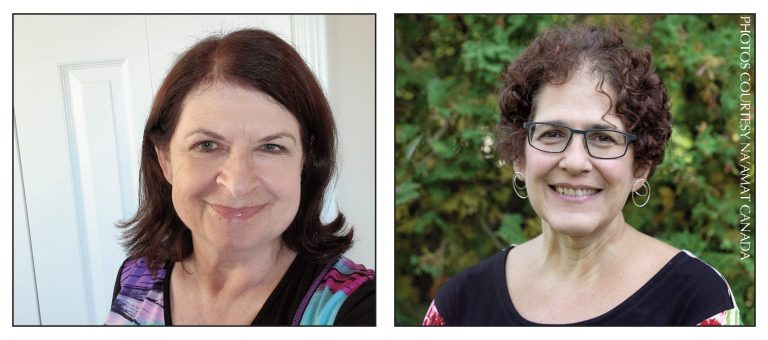
This fall, Susan Inhaber, left, will take over the presidency of Na’amat Canada from Dr. Sandi Seigel. (photos from Na’amat Canada)

Na’amat Canada’s 20th Triennial Convention takes place Oct. 13-15 at the Hilton Garden Inn in Calgary. The event will include a thank you to outgoing president Dr. Sandi Seigel of Hamilton, Ont., and it will welcome new president Susan Inhaber from Calgary, Alta. Inhaber will be the first national president from Western Canada since 1975.

Inhaber became a member of Na’amat Canada Calgary in 2000. “In short order,” she said, “I was president of a new chapter and, a few years later, I became the president of an amalgamated chapter. I served in that role for many years, immersing myself in all of the projects and programs that our group was involved with, including being the bingo chair, casino chair and grocery store gift card chair. My involvement in all activities continues to this day.  As city president, I was a member of the national board, later becoming a member at large and, lastly, the vice-president of Na’amat Canada.”

Inhaber has been to Israel several times with Na’amat. “Everyone who goes always comes back with a renewed sense of energy for the organization,” she said. “We can see the impact that we are making in the lives of others and that is what drives my passion for Na’amat. My next trip will be as the leader of our newest leadership cohort.”

Delegates from across Canada and guests from Israel and the United States will attend the fall convention, and special guests will include Hagit Pe’er, president of Na’amat Israel, and Shirli Shavit, director of the overseas division of Na’amat Israel. There will be speakers on the topics of antisemitism, human rights, breaking the glass ceiling, and more.

“It has been a privilege serving as Na’amat Canada national president since 2020,” said Seigel. “I am most proud that we have supported our organization throughout the pandemic and not only have we survived but thrived. We have built on our relationships with our chaverot internationally and in Israel and have had four successful fundraisers with Na’amat USA.”

Contributing to the success has been the quality of programming, both on Zoom and, more recently, back in-person, she said. “Despite many challenges, we have been able to transmit significant funds to support our work in Israel and continued to maintain important local projects such as our school supplies for kids program.”

Stepping down as president doesn’t mean leaving the organization. “I feel that I have lifelong friends at Na’amat, and it is wonderful to be united in the work that we do on behalf of Na’amat,” said Seigel. “As we near our convention in Calgary, I am excited for the future of our organization as we approach our 100th anniversary in 2025.”

For her upcoming three-year term, Inhaber said she is looking forward to continuing the relationship building that Seigel and, before her, Doris Wexler-Charow brought to the organization. “My main goal is to further grow our membership and donor base,” said Inhaber. “I hope to increase awareness of what Na’amat Canada does in Israel and Canada, especially among Western Canadians.”

For more information, contact Vivian Reisler at [email protected]. To register for the convention, visit naamat.com.

– Courtesy Na’amat Canada

Format ImagePosted on May 12, 2023May 11, 2023Author Na’amat CanadaCategories NationalTags conferences, Diaspora, Israel, Na’amat Canada, philanthropy, Sandi Seigel, Susan Inhaber, women
Negev Dinner returns

Negev Dinner returns

Lance Davis, chief executive officer of JNF Canada (photo from JNF Canada)

Noa Tishby, an Israeli who hit it big in Hollywood as an actor, writer and producer before bursting on the scene as an activist voice for Israel, will be in Vancouver June 29. She is the headliner for the first Negev Dinner in Vancouver since the pandemic.

The Negev Dinner is a tradition of the Jewish National Fund of Canada, with annual dinners taking place for decades in regions across the country.

Michael Sachs, executive director of JNF Pacific region, says that Tishby’s upcoming visit is a response to demand.

“A lot of people in the community really want to hear from her,” said Sachs. “The rising antisemitism, as well as the delegitimization of Israel – these are issues that are forefront in our community.”

Tishby is, he said, “one of the best spokespersons for the state of Israel and for the Jewish community at large.”

With her 2021 book, Israel: A Simple Guide to the Most Misunderstood Country on Earth, the Los Angeles-based Tishby placed herself firmly in the realm of show biz activist, but on a topic that many public figures avoid. (See jewishindependent.ca/tag/noa-tishby.) Her entertainment industry work includes appearances on Nip/Tuck, Big Love and NCIS, and she is the co-executive producer of the HBO series In Treatment, an adaptation of the Israeli series BeTipul.

“To be able to have her in Vancouver, we just couldn’t miss out on it,” said Sachs, adding that this young, dynamic woman has an appeal that can expand the reach of JNF and the Negev event.

“We are also working on student pricing and we want ‘angel’ tickets,” he said. “The idea is to get as many people in our community in front of her so they can hear her message.”

This dinner will not have an honouree like such events have had in the past. Part of that is simply the desire by the organization to try different things but it is also because, with JWest, the redevelopment of the Jewish Community Centre of Greater Vancouver, and other projects, there are “a lot of asks” in the community right now, said Sachs.

While JNF has sent out “save the date” notices for June 29, the location is not yet set. The organizing committee is co-chaired by husband-and-wife team Mike and Lisa Averbach. The project to which proceeds of the event will be allocated is to be announced in the next few weeks.

While the June event will be the first JNF gala in Vancouver since the pandemic, some took place in other regions last year, said Lance Davis, chief executive officer of JNF Canada. He has witnessed some pent-up demand to celebrate with community again.

“When people get together during cocktails and they haven’t seen each other for such a long time, the hugs and the warmth – it’s wonderful,” he said.

During the pandemic, JNF held Negev “campaigns” – fundraising initiatives that did not involve in-person events. Despite the financial and social impacts of the shutdown, Davis said the organization’s revenues have rebounded to pre-pandemic levels.

“It’s a wonderful news story that we are bouncing back and moving in the right direction,” said Davis, who has been CEO of the national organization since 2017, following five years leading the Toronto region.

JNF Canada, like Jewish and pro-Israel individuals and organizations worldwide, is coming to terms with the changed political dynamic in Israel. Binyamin Netanyahu’s new coalition, frequently referred to as “the most right-wing government” in the country’s history, is shaking up the global discourse on the region. The resignation of Israel’s ambassador to Canada, announced last Saturday, is just one reaction in an uncertain new environment. Davis, like leaders of other organizations, is emphasizing neutrality and independence.

“I just want to state unequivocally that JNF Canada is nonpolitical and nonpartisan and, as such, we are going to continue to do our work regardless of who is in government,” he said. “We are mission-driven and that means simply building the foundations for Israel’s future. We will continue to help the land and the people of Israel as we have done for decades with left, right and centrist governments. Nothing has changed. Our resolve to enhance the lives of Israel’s citizens is not impacted by the current regime and this is the time for Diaspora Jewry to communicate with our extended family in Israel that we are indeed a family and as such we will always be there for them.”

photo - Lance Davis, chief executive officer of JNF Canada
Lance Davis, chief executive officer of JNF Canada (photo from JNF Canada)

For all the ink spilled on the subject, Davis thinks the supporters of JNF Canada are sophisticated enough to understand the dynamics.

“For those people who say, I can’t be a part of this because I don’t support the government of Israel, I just hope that we can have a conversation with them,” he said. “You need not worry that one penny of that money goes to the government…. It’s only for charitable purposes and I think that if we are given the chance to explain this, people will understand we are nonpolitical and nonpartisan.”

The Israeli political climate may be a new variable, but JNF has not been without its critics over the years, some of whom accuse it of promoting Israeli “colonialism.”

“There is no question that there’s a whole host of anti-Israel parties who are taking an adversarial position,” he said. “I just wish that they would actually look at what we’re doing because is building a PTSD and health centre that serves all citizens, Jewish, Arab, Christian, Muslim, everybody – is that colonialism? Building a home for abused women with nowhere to go? It’s literally a lifesaving asset and, rest assured, Jewish Israelis and Arab Israelis will be using this facility – how is this colonialism? What exactly is it that they are protesting against?”

At a Negev Dinner in Vancouver a few years ago, which was raising funds to improve a facility for the most vulnerable sick kids in Israel, Davis saw protesters outside.

“I showed up at the dinner and I said, I wish these people understood what they were protesting against,” he recalled. “Because what you guys are doing is building a resource for the sickest kids, Jewish, Arab, Christian, Muslim – they’re all Israelis, they’re all welcome at this facility. Do they even understand what it is they’re upset about? And shame on them for protesting your efforts to build this facility for the most vulnerable children.”

One new initiative that Davis is particularly excited about is JNF Canada’s Climate Solutions Prize, a competition among Israeli researchers to fund breakthrough research focused on combating climate change.

“We’ve made an effort to raise $1 million a year over the next number of years,” he said. “We have a blue ribbon panel of scientists and engineers and businesspeople who review these researchers’ proposals.”

Last October, they presented the first awards, totaling $1 million US to the leaders of three research teams. Ben-Gurion University’s Prof. Itzhak Mizrahi and his team are working to ameliorate the methane emissions caused by cows. Dr. Malachi Noked of Bar-Ilan University seeks to reduce global emissions by improving ways to store renewable energy safely, efficiently, economically and in quickly accessible forms. Prof. Avner Rothschild of the Technion is working to produce green hydrogen through electrolysis of water.

Recipients are scientists who are well advanced in their work but need a boost in funding to achieve a breakthrough.

“This is the largest climate solutions prize that’s offered in Israel, by a long shot,” said Davis. “There are prizes to encourage green technologies, but in terms of the size and the scope, we are by far and away the largest prize.”

And, at this point, it’s an exclusively Canadian project. He hopes that other JNF organizations – there are about 40 countries with similar national bodies – will jump on board and make the prize a bigger success.

Israelis are renowned for successes in financial technology, cyber- and agri-tech, said Davis. “But, in terms of climate solutions, they really haven’t had a home run yet,” he said. “We felt that we need to give people a little push to get them over the top.”

Jewish National Fund of Canada was formally established in the late 1960s, but the iconic symbol of Keren Kayemeth LeIsrael, Jewish National Fund, the pushke, or blue box, has been in Jewish households in Canada and around the world for a century. The tin has been used for collecting coins that were forwarded to local offices around the world and combined to help build the nascent yishuv and then the state of Israel, beginning by planting trees and then expanding into all range of development projects.

Davis explained that JNF Canada is fully independent and not structurally connected with the Israeli organization.

“We are not a subsidiary,” he said. “We are not answerable to any other charity.… We get to decide what projects we take on. Canadians give money to things that they want to support and we bundle all that money from coast to coast and we take on projects.”

JNF Canada works with Keren Kayemeth LeIsrael on some initiatives but works with other charities on a range of undertakings.

“We, the Canadians, decide what we want to do and the Israeli entities are our agents,” he said. “They do the work for us. People often … have it reversed [thinking that] Israelis tell us what we need to do and we just do it. No, it’s the opposite. They work for us and that’s the way it should happen.”

Started in 1948, Negev dinners have taken place, usually annually, in Vancouver, Edmonton, Calgary, Winnipeg, Windsor, London, Hamilton, Toronto, Ottawa, Montreal, and Atlantic Canada. The name comes from the fact that the earliest dinners benefited projects in the Negev Desert. JNF Canada now funds projects throughout Israel, but the name has stuck.

“I think that when Canadians think about JNF a few things come to mind: trees, blue boxes and the Negev Dinner,” said Davis.

Format ImagePosted on January 27, 2023January 26, 2023Author Pat JohnsonCategories Local, NationalTags Canada, Israel, Jewish National Fund, Jewish National Fund Canada, JNF, Lance Davis, Michael Sachs, Negev Dinner, Noa Tishby

Community milestones … Daysons, Diamonds, Keils & Altman

On Dec. 14, JWest announced a $5 million gift from the Dayhu Group of Companies in association with the Ben and Esther Dayson Charitable Foundation. The visionary gift is part of a match that was initiated by the Diamond Foundation’s historic $25 million gift to support the development of the new Jewish Community Centre of Greater Vancouver site.

The Daysons have a long and significant history within Vancouver’s Jewish community. Ben and Esther Dayson both immigrated to Canada from Russia in the 1920s. In 1936, the couple was married in the original Jewish Community Centre in Vancouver, located on Oak and 11th. First settling in Saskatchewan, they moved with two small children to Vancouver in 1949. After a short time running a “15 cent store” in Marpole, Ben Dayson founded Dayhu Investments, which later became a leading real estate investment, development and property management company. The generations that followed Ben and Esther (née Nemetz) have carried on their parents’ and grandparents’ legacies, becoming successful in their own rights and continuing to give back to the community.

Shirley Barnett (née Dayson) and her brother, Philip Dayson, have fond memories of attending the JCC. As teenagers, they attended high school dances, went to youth group meetings, and learned the importance of volunteerism and giving back, all through spending time at the JCC. 

“Fundamentally, we believe that the Jewish Community Centre plays an integral role in an inclusive and healthy Jewish community, and it will provide a welcoming social, cultural, recreational and educational asset for all to enjoy,” said Barnett. “Our family has long appreciated the celebratory and community aspects of the Jewish Community Centre. The JWest project is the most important undertaking in the history of this region, and we hope that our gift inspires others to contribute to this space that will be a critical resource for thousands of people of all ages and from all walks of life.”

JWest is a partnership between Jewish Federation of Greater Vancouver, the Jewish Community Centre of Greater Vancouver and King David High School. The project will deliver a community centre with expanded space for the Vancouver Holocaust Education Centre, a new theatre and, in the second construction phase, a relocated high school and two residential towers that will provide mixed-use rental housing.

“It was the desire of our parents to support those both within the Jewish community and those in the wider community,” said Philip Dayson. “The Jewish Community Centre is not only the heartbeat of Jewish life in Vancouver, but it also continues to have an inclusive atmosphere that welcomes all. We are particularly thrilled that this project will bring much-needed social housing along with vital programs and services. We’re privileged to be able to support this community and this transformative project.”

“The Dayson family have been pillars in Vancouver’s Jewish community for more than three generations and, through this generous gift, they have demonstrated their continued commitment to Jewish life in Vancouver,” said Alex Cristall, JWest capital campaign chair. “We gratefully acknowledge the support this project has received from the Government of British Columbia, the Government of Canada and community members for this once-in-a-lifetime project.”

For more information about JWest, visit jwestnow.com/about.

***

photo - Leslie and Gordon Diamond
Leslie and Gordon Diamond (photo from Jewish Federation)

Gordon and Leslie Diamond will receive the 2023 Yakir Keren Hayesod Award in recognition of their committed leadership and unwavering devotion to Israel and to Keren Hayesod through their generosity and leadership with the Jewish Federation of Greater Vancouver.

The Yakir Award – Keren Hayesod’s highest honour – is bestowed upon individuals whose sense of mission, dedication and perseverance on behalf of their homeland and their nation have made an outstanding, long-term contribution to the state of Israel, the Jewish people and Keren Hayesod. The Hebrew word yakir means beloved, notable, worthy and, accordingly, the Yakir Award reflects the ultimate devotion and clarity of vision that a community leader can show. 

Jewish Federation nominated the Diamonds for the honour and this is the first time in two decades that a Western Canadian leader has been selected for it. The official ceremony will take place in Israel on the country’s 75th anniversary of independence.

***

photo - Shay Keil and his daughter Tali Keil presented a $106,649 cheque to B.C. Children’s Hospital Foundation chief executive officer Malcolm Berry in late October
(photo from Facebook)

Shay Keil and his daughter Tali Keil presented a $106,649 cheque to B.C. Children’s Hospital Foundation chief executive officer Malcolm Berry in late October. It was Keil’s second annual 30/30/30 campaign, marking his 30-plus years with Scotiabank and the goal of raising more than $30,000 by Sept. 30. He thanked other donors and the Keil Investment Group team: Angela Wadsworth, Vilma Castellani, Claire Brinkworth and Lydia Leung. In November, Keil was chosen by the Globe and Mail Report on Business as one of the 2022 Canada’s Top Wealth Advisors: Best in Province.

***

The national board of directors for Ben-Gurion University Canada (BGU Canada) has announced that

photo - Jack Altman
Jack Altman (photo from BGU Canada)

 is the new national president. He brings a wealth of volunteer leadership experience to his new role, plus a deep passion for philanthropy in the Canadian Jewish community.

Altman is the immediate past president of the Montreal chapter of BGU Canada, where he served for four years. He currently sits on the board of governors of Ben-Gurion University of the Negev and is the vice-president of La Société pour les Artistes en Milieux de Santé. He has been involved with many other organizations over the years.

Altman practised as a CPA for 50 years. He retired from his role as partner at Crowe BGK, where he remains as a consultant, and is the president of J. Altman Investments Inc.

BGU Canada thanks Mitchell Oelbaum, immediate past president, for his passionate service and unwavering commitment to the university.

Posted on December 23, 2022December 22, 2022Author Community members/organizationsCategories Local, NationalTags awards, B.C. Children’s Hospital Foundation, Ben Dayson, Ben-Gurion University Canada, BGU, development, Esther Dayson, Gordon Diamond, Jack Altman, Jewish Federation of Greater Vancouver, JWest, leadership, Leslie Diamond, philanthropy, Philip Dayson, Shay Keil, Shirley Barnett, Tali Keil

Charges are withdrawn

A criminal charge against the Canadian arm of an Israel-based organization that provides volunteers for the Israel Defence Forces (IDF) has been withdrawn because there was no reasonable chance for a conviction.

On Dec. 12, the Public Prosecution Service of Canada (PPSC), which assumed carriage of the case, withdrew a charge that Sar-El Canada violated the Foreign Enlistment Act, which prohibits Canadians from enlisting in or accepting any “commission or engagement” in the armed forces of a foreign country. The charge was withdrawn because there was “no reasonable prospect of conviction,” Sar-El Canada’s lawyer, John Rosen, told the CJN. “The case is now completed.”

The charge was approved in September by a justice of the peace in a private prosecution initiated by David Mivasair, a Hamilton, Ont.-based rabbi with a long history of activism targeting Israel, and Rehab Nazzal, a Palestinian-born, Toronto-based artist who was shot in the leg in Bethlehem in 2015 while photographing an IDF crowd control weapon. They alleged that Toronto-based Sar-El Canada broke the law because it recruited or induced individuals to volunteer for Israel’s armed forces. They further alleged that, once in Israel, volunteers reside on military bases, wear military uniforms and complete tasks that would otherwise be assigned to soldiers; those allegedly included packing food rations and medical kits, cleaning tanks, painting helmets, radio repairs and gas mask refurbishment.

In a statement, they said the “recruitment” in Canada of volunteers “to assist the Israeli military ought to be a concern of all Canadians.” They began a private prosecution after they said police and the federal government failed to act on a complaint.

Sar-El Canada sends 100 to150 volunteers a year from this country to Israel, the group’s national president, Jeff Sarfin, told the CJN when the matter began.

In a statement to the CJN, Sarfin said Sar-El Canada is “very pleased” that the charge was withdrawn. He said the “attempt by anti-Israel activists to intimidate us and the Jewish community has failed. We are also grateful to the support we have received from the Jewish community as we deepen and strengthen the connection between our community and Israel.”

Rosen echoed the sentiment. The complaint “was merely another failed attack on Israel and those who support it, this time by attempting to hijack Canada’s legal system,” he said. He said the charge should never have been authorized and agreed with the prosecution that there was never a reasonable prospect of conviction.

“More importantly,” Rosen added, “the prosecution of this baseless complaint would also have been against the public interest, given Canada’s implicit approval of similar activities that directly support Ukraine’s defence against Russia.”

Ukraine has openly called for soldiers from around the world to join the fight against Russia. Ukraine’s consul general in Toronto was recently quoted as saying that “hundreds” of Canadians got in touch to offer assistance.

Sar-El Canada’s parent organization in Israel was established 40 years ago. It operates in more than 30 countries and has to date sent some 160,000 volunteers to Israel to provide “broad logistical support to the IDF,” its website says. Volunteering takes place on IDF bases throughout the country.

Programs offer volunteers “an opportunity to live and work beside Israeli soldiers and gain an insider view of Israel.” Working alongside soldiers and base employees, the “non-combat civilian support duties” encompass packing medical supplies, repairing machinery and equipment, and cleaning, painting and maintaining the base. The Sar-El program “is a morale booster and motivator for the soldiers,” the group’s website states.

In a hearing in September before the justice of the peace who approved the charge against Sar-El Canada, Mivasair testified that, to the best of his understanding, the Foreign Enlistment Act prohibits recruiting people for “non-combatant engagements” with foreign armies.

Asked for a comment and whether an appeal is being considered, Shane Martinez, a lawyer for Mivasair and Nazzal, told the CJN: “We disagree with the decision of the Federal Crown and are exploring all available options.”

Two years ago, a campaign launched by progressive groups and 170 prominent Canadians alleged that illegal recruiting for the IDF of non-Israeli citizens was taking place in this country. Justice Minister David Lametti was asked to investigate. He referred the matter to the RCMP.

– For more national Jewish news, visit thecjn.ca. 

Posted on December 23, 2022December 22, 2022Author Ron Csillag The CJNCategories NationalTags David Mivasair, IDF, Israel Defence Forces, Jeff Sarfin, John Rosen, law, Rehab Nazzal, Sar-El Canada

Claims of speech suppression

Independent Jewish Voices Canada recently released the report Unveiling the Chilly Climate: The Suppression of Speech on Palestine. It was compiled by Dr. Sheryl Nestel and Rowan Gaudet for IJV Canada.

Nestel is a retired sociology professor from OISE (Ontario Institute for Studies in Education), University of Toronto, and Gaudet is a master’s student at the University of Bologna in the global cultures program; he has done research for IJV in the past. The text below is from their report’s executive summary.

Focused on the Canadian context, the report seeks to shed light on the wave of suppression of speech regarding Palestine that is sweeping North America and parts of Europe. It documents the impact of reprisals, harassment and intimidation faced by Canadian activists, faculty, students and organizations in relation to scholarship and activism in solidarity with the struggle for Palestinian human rights. There is a connection to be made here between these attacks and efforts by pro-Israel advocacy groups to market the International Holocaust Remembrance Alliance Working Definition of Antisemitism (IHRA), a document that has come under vigorous attack by defenders of academic freedom and Palestinian human rights. While its proponents argue that this definition will not threaten freedom of expression or inhibit criticism of Israeli policies, the findings of this report demonstrate that these basic rights are already under threat and could be further imperiled if the IHRA were to be widely adopted.

The contribution of this report is two-fold: 1) the amount and quality of information gathered here is unprecedented and speaks to the worrisome prevalence of harassment and suppression of speech on Palestine on campuses and in Canadian civil society and 2) it surpasses a simple documentation of instances of repression by employing an ethnographic methodology to analyze the so-called “chilling effect” and its impact on governmental, institutional and individual decision-making. This research project situates itself firmly within the realm of critical qualitative inquiry, which seeks to employ qualitative research for social justice purposes, including making such research available for public education, social policy formulation and the transformation of public discourse. The inquiry is also shaped by decolonizing methodologies of social science research, which seek to challenge institutions, academic and otherwise, which prioritize colonial forms of knowledge production and maintain institutional commitments that impede indigenous self-determination. Finally, Nestel and Gaudet follow the directives proposed by queer, feminist and antiracist research methodologies, which entreat people to consider how their positions in social hierarchies of race, class, sexuality and citizenship mediate their experiences.

In all, the researchers collected 77 testimonies from 40 faculty members, 23 students, seven activists and seven representatives of organizations. Testimonies were collected from participants in Ontario, Manitoba, British Columbia, Saskatchewan, Nova Scotia, Quebec and Alberta. Among the academics responding were representatives of 11 disciplines from 21 Canadian universities.

Interviewees recounted that their experiences included political intervention into hiring; attempts to prevent access to event venues; and the attempted cancellation of public events on Palestine, as well as targeting and doxing, including the inclusion of 128 Canadian academics and activists on the website of Canary Mission, an organization that purports to document “individuals and organizations that promote hatred of the U.S., Israel and Jews on North American college campuses.” Threats of violence and genuine acts of violence were experienced by student activists and these often contained racial and sexual slurs including threats of sexual violence. Students were subject to warnings and disciplinary measures by university administrators whom respondents often described as being hostile to Palestine solidarity activism on campus. Faculty respondents reported restrictions on academic freedom, self-censoring of expression on Palestinian human rights, discriminatory treatment by academic publishing platforms, harassment by pro-Israel advocacy groups and media outlets, attacks from colleagues, political interference by university administration, classroom surveillance by pro-Israel student groups, and anti-Palestinian and anti-Arab racism. Indeed, the suppression of speech on Palestine has significant consequences in academia, where it threatens principles of academic freedom and encourages surveillance of critical intellectuals and activists and of the oppositional knowledge that they produce. 

As the research by Nestel and Gaudet reveals, the precarious employment conditions of more than half of Canada’s university teachers mean that, because of the “chilly climate” around speech on Palestine, untenured or pre-tenure faculty are reluctant to pursue academic or activist work in this area for fear of endangering contract renewals or future career prospects including access to publishing platforms so central to the academic tenure and promotion process. 

Unsubstantiated allegations of antisemitic intent and support for terrorism are commonly leveled against pro-Palestine academics and activists. Significantly, Palestinians, Muslims and non-Arab racialized participants appear to have borne the brunt of direct attacks on their scholarship and activism. The emotional impact of harassment and suppression was felt most acutely by Palestinian students and faculty interviewed. Jewish activists were not immune to attack and were often characterized by opponents as “kapos” or “self-hating Jews.” 

The report also documents how both on- and off-campus Israel-advocacy organizations have been at the forefront of efforts to suppress speech and activism on Palestine. As University of Pennsylvania political scientist Ian Lustick has argued, the pro-Israel organizations have constituted a “vigilante” force, which has made it “increasingly difficult to criticize Israel without fear of lawsuits, accusations of antisemitism, demands for political balance in staging of events, blacklisting of participants, or other forms of personal or institutional harassment.”

This report signals that an atmosphere of repression and recrimination related to discourse and activism around Israel/Palestine is ubiquitous and insidious and should be unacceptable in a democratic society.

To download a copy of the full report, visit ijvcanada.org/unveilingthechillyclimate.

– Courtesy Independent Jewish Voices Vancouver

Posted on December 23, 2022December 22, 2022Author Independent Jewish Voices VancouverCategories NationalTags free speech, Israeli-Palestinian conflict, survey

BGU family mourns

Ben-Gurion University Canada chief executive officer Mark Mendelson passed away in Montreal without warning on Nov. 14 at the age of 73. 

Over the years, Mendelson’s imprint has been felt throughout BGU Canada. Helping create new purpose and hard results, connecting communities with Ben-Gurion University and Israel, his life, experience and leadership were transformative: the organizations he touched, the chapters he helped grow and the voices he helped raise, were the product of a life dedicated to the singular purpose of protecting and nurturing, manifested in boundless energy and enormous reach, helping BGU Canada grow.

“He took what was a small but respected organization to a national powerhouse,” said Montreal and Ottawa executive director Simon Bensimon. 

A leader who gave people around him the space to excel while daring them to wow him, Mendelson’s energy, enthusiasm and resilience were infectious, and served his gift for reaching out and making valuable connections between donors, volunteers and stakeholders. “A character who had character,” said B.C. and Alberta Region president Adam Korbin. “He was a blessing in my life, a mentor, confidant and friend.” 

As much of Canada’s nonprofit sector slowed and then scrambled for relevance and community engagement during the pandemic, Mendelson helped steward BGU Canada through and maintain the interest, enthusiasm and commitment towards the cause.

His legacy for BGU is omnipresent in the organization and on the ground in Israel. For the national organization, this is embodied in the new archives building in Sde Boker, for which Mendelson marshaled his best efforts and drive to realize and, ultimately, stood before as great affirmation of one of the crowning achievements of his BGU Canada career. 

Mendelson understood the importance of each national chapter. “From the outset, he was committed to putting Vancouver on the map and was determined that we should hold a gala,” recalled David Berson, executive director, B.C. and Alberta region. “His love for BGU and Israel were first and foremost – alongside fishing and food!”

The Montreal-born-and-raised son of Dr. Hyman and Audrey Lynne Mendelson, Mark spent a lifetime dedicated to Israel and Jewry – as a kibbutznik, as an IDF paratrooper, as a social worker, an entrepreneur and then as a leading advocate. He held fast in his belief in Israel, securing her future through grit, diplomacy, and the Jewish people’s greatest currency: knowledge.

“Much of my success as president, and much of what BGU is today, is because of Mark’s complete dedication to the task of building Ben-Gurion University,” said BGU president Prof. Daniel Chamovitz.

At Mendelson’s funeral in Montreal, Chamovitz recalled this “large man wearing a loud plaid sport jacket, bearing a gift of fresh salmon whose smell permeated the air, and having one of the most endearing smiles anywhere.” It was their first meeting. “I had been president for only three weeks and, somehow or another, no one had prepared me for Mark Mendelson.”

Mendelson had a keen understanding of the ongoing relationship between the Diaspora and Israel, and he followed through on his promise to Chamovitz that, despite Canada’s modest Jewish population, BGU Canada was poised to make a major jump in its philanthropy: “We punch way over our weight.”

“The university, the Negev, Israel and dare I say the world,” said Chamovitz, “is a better place because of him.”

– Courtesy Ben-Gurion University Canada

Posted on December 23, 2022December 22, 2022Author Ben-Gurion University CanadaCategories NationalTags Adam Korbin, Ben-Gurion University, BGU, Daniel Chamovitz, David Berson, Mark Mendelson
Learning to nurture kindness

Learning to nurture kindness

Foundation for Jewish Camp has been awarded a grant to explore how Jewish overnight camp nurtures and promotes character development. (photo from jewishcamp.org)

Foundation for Jewish Camp (FJC) has been awarded a three-year expansive research grant from the John Templeton Foundation to explore how the activities and rituals at Jewish overnight camp nurture and promote character development in adolescent campers and camp staff.

Findings of an earlier landscape survey of current virtue development practices at Jewish camps and a series of interviews with camp professionals identified kindness as the most common virtue camps desire to nurture in their communities. This next phase of in-depth research will focus on understanding how kindness is embedded into the structure of Jewish camp, how character virtues are taught, practised and modeled by camp leadership and staff, and how staff and campers are impacted.

The initial one-year planning grant, awarded in 2021, was used to develop conceptual frameworks and research design and instrumentation. This work included convening thought partners and learning circles to guide the project; conducting a landscape survey of current virtue development practices at Jewish camps; interviewing a select group of 10 camps to learn more about their current practices; and developing the proposal for the three-year study to evaluate the impact of character development practices on the minds, hearts and behaviours of adolescents and young adults who participate in Jewish camp.

According to Rabbi Avi Katz Orlow, FJC’s vice-president for education and innovation and the co-leader for this project, “Jewish camp in North America has a great history of making mensches – a Yiddish term for a person of great character and integrity – but that is not enough. We need to look critically and explore the metrics of character development. With the support of the John Templeton Foundation, we will define where we are headed in this work for the next decade. Surfacing and sharing best practices in character development will ensure we are making our best effort to raise new generations of thoughtful, resilient, caring, community-minded individuals. The world needs mensches now, more than ever before.” 

“We want to surface exemplary practices that support young adult camp staff to model and nurture kindness in themselves and others,” said Nila Rosen, FJC’s director of learning and research. “Our research will allow us to learn with the camps and develop additional resources and practices to elevate emerging and promising character development at camps across North America.”

These resources will expand on FJC’s Making Mensches Periodic Table – the resource bank for camp staff and educators to engage in the work of character development, whose popularity served as the basis for this inquiry.

FJC has selected five camps that are intentional in their construction and cultivation of a culture of kindness in their community. These camps will conduct a thorough exploration of how that shows up in their staff selection and training, relationship building, camp rituals, peer-to-peer support, professional development, branding materials, camp artifacts, signage, or explicit language used by leadership teams.

Dr. Richard Bollinger, senior program officer of character virtue development at the John Templeton Foundation, said, “We are excited about the potential impact of this project because spreading kindness within a community can create ripples of a ‘pay-it-forward’ nature that extend far beyond the initial kind actions. Along with the hundreds of thousands of campers, families and staff who participate in 300+ Jewish camps across North America each year, we are eager to share and learn with FJC and the field.”

– Courtesy Foundation for Jewish Camp

Format ImagePosted on December 23, 2022December 22, 2022Author Foundation for Jewish CampCategories NationalTags Foundation for Jewish Camp, Jewish camp, kindness, summer
Neville sworn in with shofar

Neville sworn in with shofar

Anita Neville’s swearing-in ceremony on Oct. 24 included the blasts of a shofar blown by her rabbi, Anibal Mass. (screenshot)

Anita Neville says she “feels the responsibility” of being the first Jewish person to be appointed as the lieutenant governor of Manitoba – an office she was sworn into on Oct. 24, using a Hebrew Bible.

For the next five years, the vice-regal residence in Winnipeg will be where Neville calls home. And she was quick to start carrying out official duties like laying the first wreath during the province’s Remembrance Day ceremony, and reading the government’s Speech from the Throne to open a new Manitoba Legislature session on Nov. 15.

“The whole thing is new. The protocol is new. I’m fortunate that there are very knowledgeable, experienced people around me, so that makes it easier,” Neville told The CJN Daily in an interview from Government House, acknowledging that she has a steep learning curve for her new role.

Which is why, shortly after her swearing-in, Neville flew off to attend a round of orientation meetings. She also learned that she will be going to Buckingham Palace, at some point, to present her credentials to King Charles III.

“There are three others who have not presented their credentials to the monarch, so there are four of us in line,” said Neville. “I don’t know where I am in the order, but I look forward to it very much.”

Couldn’t lose face with grandson

Neville was at her cottage with her grandchildren in July when Prime Minister Justin Trudeau called to offer the position. She took time to think about whether she wanted this very public role. After all, she already had a fulfilling career in community service, including as chair of the city’s public school board, and then 11 years as the Liberal member of Parliament for Winnipeg South Centre, from 2000 to 2011. She’s also deeply involved in Jewish community matters, with her synagogue Shaarey Zedek, and the Jewish Heritage Centre of Western Canada.

At first, some members of Neville’s family were worried the new position might be too much for their 80-year-old mother and grandmother.

“I’ve got a very bad back,” she said. Neville walks with the assistance of a cane.

But her decision was made after she thought about her grandparents and her roots, having been born in the traditional Jewish immigrant neighbourhood in the North End of the city, then growing up after the Second World War, when barriers to advancement still existed for Jews.

What clinched it was when a grandson scolded her and said, “How could you not take the job? How many people get this opportunity?” Neville felt that she didn’t “want to lose face with Aaron.”

Considering saying no was “beyond his comprehension,” she said.

Jewish and Indigenous touches

The 26th lieutenant governor in Manitoba’s history made sure to put her own stamp on the official swearing-in. The formal ceremony was full of Jewish symbolism.

It not only involved her choice of Bible to swear the oath, but it also had the piercing blasts of a shofar blown by her rabbi, Anibal Mass – who delivered blessings and then led the audience with a loud “Mazel tov!”

The opportunity is something the daughter of Russian Jewish immigrants in Winnipeg’s North End never dreamed would be possible for somebody with such origins.

In her speech, Neville told the audience that her grandparents fled Bessarabia and Odessa a century ago, to escape a climate of murderous antisemitism, and to find freedom and opportunity in Canada.

“I wanted … the larger community of Manitoba to be aware of who I am and where I came from,” she said. “I did it thoughtfully. I don’t think I was over the top.”

It wasn’t only having Jewish rituals that marked a departure from previous swearing-in ceremonies. Neville pushed to include Indigenous people in the program, which she claims is the first time this has happened. It stems from her own decades of work on their behalf, and it will likely be a key part of her mandate.

An Indigenous elder, Myra Laramee of the Fisher River Cree Nation, delivered an invocation during the ceremony, and even called her longtime Jewish friend by the title of “Auntie.”

A positive signal: Neville

Neville’s swearing-in also came just three days before the Manitoba government adopted the International Holocaust Remembrance Alliance definition of antisemitism, becoming the fifth Canadian province to do so. (Canada adopted it nationally in 2019.)

While she did not have anything to do with the timing, and did not work behind the scenes on that file, Neville agrees both things are good for Jews.

“I think, for the Jewish community, it is a signal of positive acceptance, integration,” Neville said. “Not that it wasn’t there before, but it’s a kind of stamp. It’s like getting a check mark.”

Neville isn’t the first Jewish person to hold a similar appointment in Canada: that milestone was pioneered by Myra Freedman, who served as Nova Scotia’s lieutenant governor from 2000 to 2006. (Freedman held Shabbat dinners at the official residence and kept kosher.)

For her part, Neville plans to install a mezuzah at the entrance to her private quarters when she moves into the century-old Government House. And she won’t serve pork or shellfish.

When she was initially appointed, a friend immediately called

her, half-jokingly anticipating an invitation for the fast-breaking meal at the end of Yom Kippur. All Neville can say to that for now is, “We’ll see.”

Centre-left stance on Israel

Neville is a long-standing supporter of Israel, and her appointment comes amid rising antisemitism, including a torrent of hate for Israel and Zionism.

B’nai Brith Canada’s annual audit reported 223 anti-Jewish incidents in Manitoba last year, up from 92 in 2020, and 83 the year before that, according to Janna Minikovich, a spokesperson for the group.

Does Neville fear becoming a target for anti-Jewish sentiment in her new role? During her days in Parliament, she remembers receiving some hate mail, but she declined to comment further on her current opinions on Israel, besides describing those views as “centre left.”

Neville co-chaired the Liberal Parliamentarians for Israel caucus when she was an MP. Moreover, in the House of Commons, she raised the plight of the 800,000 Jewish refugees expelled from Arab lands, saying people needed to pay attention to this historic injustice.

But she also criticized Stephen Harper’s Conservative government for cutting federal funding to KAIROS Canada, an aid agency supported by several churches. The group supports the boycott, divestment and sanctions movement against Israel as a method of combating what it considers oppression of Palestinians. (Neville said at the time that, without clear explanations of the change in funding, it appeared Canada was stifling criticism of Israel.)

Operation Ezra volunteer

Neville has long been an advocate for social justice causes. One that is dear to her heart involves her work with a Jewish-led rescue organization in Winnipeg, Operation Ezra. The group has worked with other faith communities since 2015, to help bring 65 Yazidi refugees to Canada. (The federal government has brought in hundreds more under a federal sponsorship program starting in 2017.)

In between rehearsals for the Speech from the Throne and planning her move-in date to her new quarters, Neville made sure to turn up at the Winnipeg airport to greet the latest new arrival.

Ayad Alhussein, now 13, was captured by ISIS forces in 2014 – along with his entire family – when the Islamic extremists took over much of Iraq and Syria and set up a caliphate. Yazidis are not Muslims, and they were ordered to convert, or be killed. Ayad was just 5 years old at the time, and was kept prisoner for five years, until he escaped. He had been living in a displaced persons camp in Iraq, while two of his surviving sisters made it to Canada.

According to Michel Aziza, co-chair of Operation Ezra, it took constant pressure by the committee on local MPs and on immigration officials to get Ayad’s paperwork processed. “The world moved on, from Yazidis, to Afghans, to Ukrainians,” said a frustrated Aziza after Neville welcomed the slightly overwhelmed teenager.

Scenes like this underline why Neville’s swearing-in speech referred to her core values of “tikkun olam and tzedakah,” referring to herself as a descendent of refugees.

“I know that the Jewish community … because of what [feedback] I’ve received, has been very happy and very pleased with my appointment. And I feel the responsibility of it, let me tell you.”

To listen to Ellin Bessner’s podcast with Anita Neville, visit thecjn.ca/news/anita-neville-profile. The swearing-in ceremony can be viewed at youtube.com/watch?v=d0i3C2lce-g.

Format ImagePosted on December 9, 2022December 7, 2022Author Ellin Bessner THE CJN DAILYCategories NationalTags Anita Neville, Judaism, lieutenant governor, Manitoba, Operation Ezra

Sar-El faces a legal challenge

The Canadian arm of an Israeli organization that provides volunteers for the Israel Defence Forces (IDF) is facing a legal challenge to show that it does not violate Canadian law.

Sar-El Canada is slated to go to court in Toronto on Nov. 23 to argue that it does not violate the Foreign Enlistment Act.

The act states that “any person who, within Canada, recruits or otherwise induces any person or body of persons to enlist or to accept any commission or engagement in the armed forces of any foreign state or other armed forces operating in that state, is guilty of an offence.”

Sar-El Canada sends 100 to 150 volunteers a year from this country to Israel, the group’s national president, Jeff Sarfin, told the CJN. He said the organization had received nothing in writing about the legal challenge, and would issue a statement when it does.

Sarfin said those behind the legal challenge “are well-known anti-Israel activists known to cause trouble” and that “we consider this a non-issue.”

The case is the latest salvo from David Mivasair, a Hamilton, Ont.-based rabbi with a long history of activism targeting Israel, who called Vancouver home for many years.

Mivasair is joined on the private prosecution by Rehab Nazzal, a Palestinian-born, Toronto-based artist who was shot in the leg in Bethlehem in 2015 while photographing an IDF “skunk” truck, a non-lethal weapon used for crowd control.

A statement issued Sept. 28, by lawyer John Philpot, claimed that Sar-El Canada “acted as an intermediary to recruit or induce individuals to volunteer in a non-combatant role with the Israeli military. It is further alleged that, once in Israel, volunteers would reside on military bases, wear military uniforms and complete tasks that would otherwise be assigned to soldiers. These tasks allegedly included (but were not limited to) packing food rations or medical kits, cleaning tanks, painting helmets, radio repairs, and gas mask refurbishment.”

On Sept. 22, a justice of the peace approved a private prosecution against Sar-El, compelling the organization to appear in court in November.

“This will be only a first appearance, and there are a number of preliminary stages that the case will need to pass through before a trial date can be scheduled,” Shane Martinez, one of the lawyers representing Mivasair and Nazzal, told the CJN.

Recruiting in Canada for volunteers to assist the Israeli military “ought to be a concern of all Canadians,” Mivasair stated in a press release. He said the matter was brought to the attention of the federal government and the Toronto Police Service and “they both failed to act. We felt obliged to bring this prosecution as a civic duty to ensure respect for the rule of law.”

None of the allegations have been tested in court.

According to the Ontario courts’ website, a private prosecution is a legal process in which a person who has reasonable grounds to believe that someone has committed a criminal offence seeks to have the person charged and brought to court. The Foreign Enlistment Act is not part of the Criminal Code but criminal proceedings arising from it are “subject to and governed by the Criminal Code.” The act sanctions fines and imprisonment for those found guilty.

Sar-El Canada’s parent organization in Israel was established 40 years ago. Sar-El (a Hebrew acronym for “Service for Israel”) was originally set up to provide volunteer labour to farmers who were called up for military service, so their crops wouldn’t fail.

Sar-El operates in more than 30 countries and has to date sent some 160,000 volunteers to Israel to provide “broad logistical support to the IDF,” its website says. Volunteering takes place on IDF bases throughout Israel.

According to Sar-El, programs offer volunteers an opportunity to live and work beside Israeli soldiers and gain an insider view of Israel. Working alongside soldiers and base employees, the “non-combat civilian support duties” encompass packing medical supplies, repairing machinery and equipment; and cleaning, painting and maintaining the base.

The Sar-El program “is a morale booster and motivator for the soldiers,” the group’s website states.

David Matas, senior legal counsel for B’nai Brith Canada, said there “is no particular reason” the complainants in the Sar-El case should bring the matter forward. Typically, victims begin a private prosecution because they feel they have been ignored or turned away by police or the Crown.

The complainants in this case “do not identify as victims of any particular act of Sar-El volunteers. None of them personally claims to have suffered a loss as a result of what a Sar-El volunteer has done.”

The Foreign Enlistment Act, meantime, does not intend to include those who are not members of the armed forces. Sar-El volunteers “do not become members of the Israel Defence Forces [and] do not enlist in the Israel Defence Forces,” Matas told the CJN. “They are non-member support for the forces.”

Matas said the Crown can intervene in a private prosecution to stay a case, and that it would be “appropriate” for that to happen in this matter.

He pointed out that Ukraine has openly called for soldiers from around the world to join the fight against Russia. Oleskandr Shevchenko, Ukraine’s consul general in Toronto, told the National Post that “hundreds” of Canadians got in touch to offer assistance.

Allowing the Sar-El prosecution to proceed “would create an arbitrary situation where help for Israel is prosecuted and help for other states under armed threat is not,” Matas said.

In a related recent development, Canada’s justice ministry dismissed a petition that had called on the Liberal government to prosecute those who recruit and encourage recruiting for the IDF.

The petition singled out the Israeli consulate in Toronto, which had advertised “on several occasions an IDF representative available for personal appointments for those wishing to join the IDF, not just those who are required to do mandatory service.”

The petition was initiated by Mivasair and presented to the House of Commons in August 2021 by Hamilton NDP MP Matthew Green, but it died on the order paper when Parliament was dissolved for the federal election that followed.

Green reintroduced the petition this past June. On Sept. 22, the justice ministry replied that responsibility for the investigation and prosecution of offences under the Foreign Enlistment Act “rests with independent law enforcement and prosecution services.”

The campaign against the IDF’s recruitment of non-Israeli citizens in Canada began two years ago when several groups and some 170 prominent Canadians asked justice minister David Lametti to investigate the issue.

Israel’s Toronto consulate decried the action as part of a campaign “that attempts to smear the state of Israel and undermine [its] steadfast alliance with Canada.”

Israel’s consulate in Montreal at the time noted that consular services it provides are reserved for Israeli citizens and do not apply to non-Israelis who volunteer for the IDF.

At a news conference in October 2020, Lametti said Israeli diplomats serving in Canada “must follow Canadian law.” He referred the matter to the RCMP, which did not return calls and emails from the CJN seeking an update on the file.

Last year, Mivasair and Palestinian activist Khaled Mouammar asked the Canada Revenue Agency to investigate the Toronto-based Canadian Zionist Cultural Association for allegedly supporting the IDF.

Last May, following Israel’s brief war with Gaza, Mivasair was charged with one count of mischief after red paint, meant to symbolize Palestinian blood shed, was dumped onto the steps of the building housing Israel’s Toronto consulate. The charge was withdrawn in January.

– For more national Jewish news, visit thecjn.ca

Posted on October 28, 2022December 22, 2022Author Ron Csillag The CJNCategories NationalTags B'nai B'rith, David Matas, David Mivasair, Israel, law, recruiting, Rehab Nazzal, Sar-El Canada, volunteer

Posts pagination

Previous page Page 1 … Page 5 Page 6 Page 7 … Page 34 Next page
Proudly powered by WordPress