Two Jews are on ballot

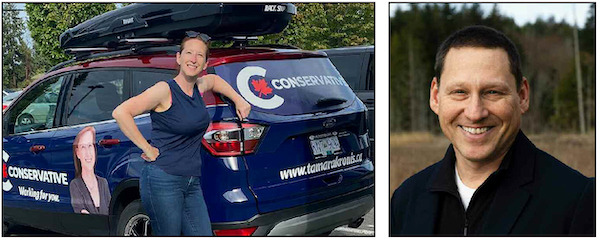
Jewish community members Tamara Kronis (Conservative party) and Avi Lewis (NDP) are running in the upcoming federal election. (photos from candidates)

British Columbia’s comparatively small Jewish community has produced a number of senior political figures, including the province’s first Jewish premier, Dave Barrett, and the current minister of finance, Selina Robinson, and minister of environment and climate change strategy, George Heyman. In this federal election, there appear to be just two candidates in British Columbia who are Jewish.

Tamara Kronis is the Conservative Party of Canada candidate for Nanaimo-Ladysmith. The riding is being closely watched by national observers as it is home to one of only two Green party MPs. Paul Manly, the incumbent, once sought an NDP nomination but was rejected by the party, apparently due to controversy over his positions on Israel and Palestine. While the other Green MP, former leader Elizabeth May, is seen as safe in her riding of Saanich-Gulf Islands, Manly appears to be in (at least) a three-way race with Kronis and New Democrat Lisa Marie Barron. Michelle Corfield is the Liberal candidate.

Kronis is a lawyer and heads a jewelry manufacturing and retail business. Until last month, she was associate chair of the Ontario Human Rights Tribunal and an independent director of Toronto Hydro. Earlier in her career, she served as director of advocacy for EGALE Canada, the national LGBTQ+ organization. She was a trial assistant at the International Criminal Tribunal for the former Yugoslavia.

Across the water and across the spectrum, Avi Lewis is the New Democratic Party candidate in West Vancouver-Sunshine Coast-Sea-to-Sky Country. A scion of Canada’s left-wing dynasty, Lewis is the son of journalist Michele Landsberg and Stephen Lewis, a former Ontario NDP leader and Canadian ambassador to the United Nations. His grandfather, David Lewis, was the leader of Canada’s NDP, from 1971 to 1975.

Avi Lewis is a journalist and activist who recently produced and co-wrote the Emmy-nominated animated short film about the Green New Deal, Message from the Future, with U.S. Representative Alexandria Ocasio-Cortez.

Lewis co-authored “The Leap Manifesto,” which was “a call to action on climate and inequality that was launched by an historic coalition of Indigenous leaders, unions and environmentalists, and signed by more than 50,000 Canadians,” according to Lewis’s website.

Lewis has an uphill climb. The riding, which straddles some of Canada’s wealthiest voters and the disparate communities along Howe Sound, has back-and-forthed between the Liberals and Conservatives in recent years. It is held by two-term Liberal MP Patrick Weiler, who is beating back a challenge from former Conservative MP John Weston. In 2019, the NDP candidate came fourth, well behind the Green party.

Environment a Jewish issue

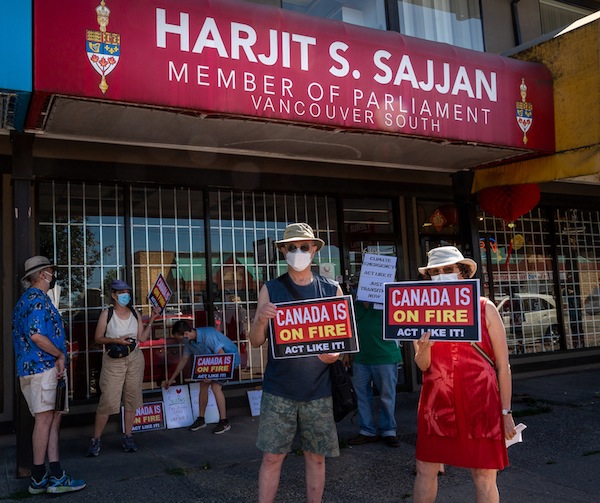
Or Shalom members Lorne Malliin and Marianne Rev organized a demonstration at the office of Harjit Sajjan, federal minister of national defence and MP for Vancouver South. (photo from Lorne Mallin)

The heat dome that sent much of British Columbia into an unprecedented spell of sweltering weather, followed by wildfires that have destroyed vast swaths of western North America, including the B.C. town of Lytton, and extreme weather events like Hurricane Ida have put climate and the environment at the top of many people’s priorities. With the federal election now days away, all federal parties have honed their pitches to voters on issues of the environment.

Jewish activists have been vocal on these issues recently, reflecting the growing realization that impacts of climate change are not a remote future potential but an immediate and measurable phenomenon.

Marianne Rev, a member of the tikkun olam committee at Or Shalom synagogue, was one of many Jewish people who participated in a series of demonstrations at the offices of scores of members of Parliament on July 29. With her friend and fellow Or Shalom member Lorne Mallin, Rev organized an event at the office of Harjit Sajjan, federal minister of national defence and MP for Vancouver South. Other local demonstrations took place at the offices of Vancouver Quadra MP Joyce Murray and North Vancouver MP Jonathan Wilkinson, who is also the federal minister of environment and climate change.

“It was part of an action organized by 350.org,” Rev told the Independent. The organization 350.org was founded in 2008 to build a global climate movement and was so named because 350 parts per million is the safe concentration of carbon dioxide in the atmosphere. (Concentrations are now 414.6 parts per million.)

“I’ve been increasingly involved in climate action, political action, climate justice,” said Rev, a retired physician.

While she was told in advance that Sajjan would not be available to meet on July 29, Rev was disappointed that, when her group of about 25 activists arrived at the office, it was closed. Nevertheless, she and a small group of others met with the minister on Aug. 9.

“We had an excellent meeting,” she said. “There were two very specific asks.”

Her group, as well as those participating across the country, asked MPs for a moratorium on all new or expanded production and transporting of fossil fuels, including the Trans Mountain Pipeline expansion. Second, they demanded a “just transition” away from fossil fuels to allow workers in those industries to shift to other sectors.

Rev said the response her group got from Sajjan was voiced by Wilkinson in the media.

“He blurted out the party line, which, shockingly, Wilkinson repeated many times over on the morning of the ninth, when the [Intergovernmental Panel on Climate Change] put out their report saying that we are code red for humanity,” she said. “[The government says] that we need the TMX to fund the transition to renewables. As such, it’s completely false.… It’s totally fallacious political B.S. that has been put out on the population for decades. Renewable energy is free. It’s not free to get there, but wind and sun is free.”

Rev gives credit to Adam v’Adamah, one of British Columbia’s pioneering Jewish environmental groups, and said that the environment and climate are logical concerns for Jews.

“Jews have always been very interested and driven regarding social justice, and the environment and climate are very much climate justice issues,” she said.

Rabbi Dan Moskovitz, senior rabbi at Temple Sholom, concurs.

“I’ve been involved with [environmental issues] informally for my entire life, but formally, as a congregation, three years ago we launched an initiative to make clear that the climate and the environment is a Jewish issue,” he said. “I see it in very religious terms in the sense that we are commanded to be guardians of the earth, stewards of the earth. So, it’s a mitzvah, a religious obligation, to be good stewards of the earth. I challenged my congregation to join me in that effort and I challenged our Jewish community and they’ve responded, to put this on our community agenda, to see this as a pressing concern for the Jewish community and for the Jewish people. The Jewish Federation has an environmental task force now. We have been talking with CIJA [the Centre for Israel and Jewish Affairs] to get it on their list of priorities and to get the politics out of it and to see it for what it is, which is an existential threat to this world that we are commanded to be caretakers and stewards of.”

As Jewish voters ponder their ballot choices, Moskovitz has some thoughts.

“Rhetoric is lovely and nice and, for the most part, all the campaigns, as I hear them, say basically the right things about the environment,” he said. “But who is doing something or who is in a position to do something? The time for talking is over.… If you don’t do what you’re preaching or praying for, then it’s just noise and we can’t afford more noise because, if we’ve seen anything over this past summer, with the fires here and in the States, and, as we saw the impact of what staying home during the early part of COVID did for our environment in allowing it to rest and to have its own sabbatical year … we can see that we can’t keep using and abusing this God-given gift, which is the world we live in. We are just renters here. We don’t own it.”

Volunteer during election

Oct. 21, 2019, seems like a lifetime ago, doesn’t it? That was the date of the last Canadian federal election. Since then, it’s been a world of endless uncertainties and instability.

The Jewish community has witnessed levels of antisemitism that haven’t been seen for decades. Hate crime numbers are way up. The aura of anti-Israel sentiment, especially following the conflict earlier this year in Gaza, has created an environment that has many feeling unsafe and anxious. The silence of many within the political sector has been cause for concern. On top of all of this, the havoc of the COVID pandemic is still felt daily.

Let’s be real: people are upset and worried. The past 22 months since the last election have presented incredible challenges to our well-being and shown that nothing is guaranteed. The Canadian Jewish community has demonstrated its resilience and fortitude but there is a lot more to do, especially when it comes to elections. We’ve seen firsthand what an important role the government plays in our lives, especially regarding the pandemic, so it’s vital that we extend our efforts more effectively in the political realm.

The Jewish community makes up less than 1.1% of the population and is concentrated in just a handful of ridings – 10 out of 338. That’s only three percent. Our numbers are continuing to decline. In politics, relationships matter. If we limit ourselves to involvement in only three percent of ridings and three percent of candidates, we are at a major disadvantage when it comes to our community and the things we care about.

To ensure our voices are heard, members of the Jewish community must continue to build relationships and educate MPs in ridings from coast to coast. This starts with political engagement, and it starts with each of us. As Rabbi Tarfon said, “It is not your duty to finish the work, but neither are you at liberty to neglect it.”

The good news is that we have the tools to get engaged so we can work beyond the local ridings where we vote. While the Canadian Jewish Political Affairs Committee (CJPAC) does not engage in or facilitate lobbying and advocacy, we do act as a concierge, helping members of our community to get engaged politically.

Another important factor is that change is inevitable with elections. In 2019, 98 first-time MPs (27%) were elected, 60 of whom were in ridings that flipped seats. A third of those 60 MPs defeated the second-place finisher by less than five percent of the vote. As for this election, at the time we wrote this, 26 incumbents had decided not to run for reelection. Many more ridings will change hands. This means that, no matter which way the election goes, our community will need to build new relationships with new parliamentarians.

We can jumpstart that process. Community members like you can volunteer and acquaint yourselves with candidates from beyond your own riding and across the country. Every campaign is in dire need of volunteers, and even just a few hours can be a huge help. Often just a few more volunteers can make the difference between winning and losing a race. Plus, the appreciation for a volunteer’s work – no matter how big or small – is something that’s not easily forgotten.

There is, of course, one element that’s changed the game with this election: COVID. While it’s still possible to engage in traditional methods of volunteering – door-knocking, handing out literature in the community, putting up lawn signs or working in a polling station – understandably, some are hesitant to participate under pandemic circumstances.

But fear not: there are many physically distanced ways to volunteer, including from your own home. And you don’t have to be politically experienced to do it. All you have to do is raise your hand and show up. CJPAC will connect you to the campaign of your choice.

For those who feel more comfortable with a bit of instruction, CJPAC’s team makes it simple by training you on the basics of campaign volunteering. You can volunteer in your local riding or in one of the other many ridings where a strong Jewish presence is absent. Perhaps that means traveling 20 to 30 minutes away from your home or simply making phone calls from your couch for a candidate in a more remote part of the country.

The first step is to sign up at cjpac.ca/volunteer, and CJPAC will connect you with the campaign or candidate of your choice.

As Jews, we are committed to community service and contributing to the greater society. While it’s been a rough several months, we don’t have to stand alone. It doesn’t matter what party you align with: it’s vital to the health and safety of the Canadian Jewish community to build relationships with all parties. We can accomplish that together by getting engaged.

Jeffrey Feldman is chair of the Canadian Jewish Political Affairs Committee and Mark Waldman is the executive director of CJPAC. This op-ed was first published on thecjn.ca.

Canadians head to the polls

(photo from cija.ca)

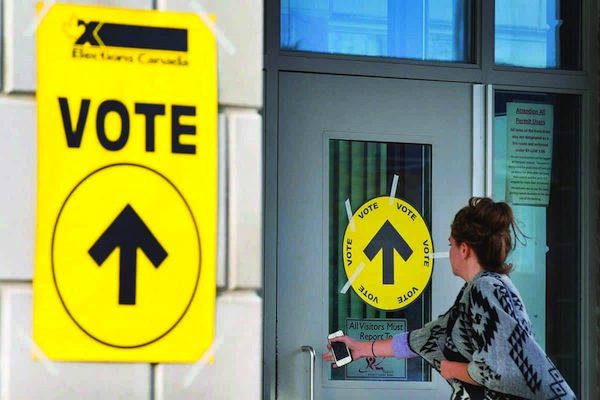
A federal election has been called, with the last voting day on Sept. 20, erev Sukkot. While the final day to vote does not fall on a High Holiday, the timing will have implications for Jewish Canadians.

Over the last few months, the Centre for Israel and Jewish Affairs (CIJA) has communicated to Prime Minister Justin Trudeau, many members of Parliament and Elections Canada its concerns about an early-autumn federal election potentially conflicting with the High Holidays. It will continue to work with Elections Canada to protect democratic participation for all Jewish Canadians.

To help the Jewish community participate fully in Canada’s democracy, CIJA has set up an elections hub, with information and resources on various policy issues and voting locations and dates, at cija.ca/canada-votes2021.

– Courtesy Centre for Israel and Jewish Affairs

* * *

Canada’s 44th Parliament is about to be formed and you can help shape it. The Canadian Jewish Political Affairs Committee (CJPAC) is able to connect Jewish community members with the campaign of their choice and get started.

Unprecedented challenges have dominated the past year and a half. The COVID-19 pandemic has upended all of our lives and the Jewish community has witnessed levels of antisemitism unseen for decades. Hate crime numbers are way up. The aura of anti-Israel sentiment has created an environment that has many feeling unsafe and anxious.

These times of uncertainty, however, are the perfect reason to get engaged and involved. Not just for you, but also for the community.

Elections are happening in 338 ridings across the country, so there is a whole lot of opportunity to get involved in whatever campaign you choose.

There are also many different ways to volunteer, all of which are COVID safe, including in person and from the comfort of your home.

Visit cjpac.nationbuilder.com/vfe21.

– Courtesy Canadian Jewish Political Affairs Committee

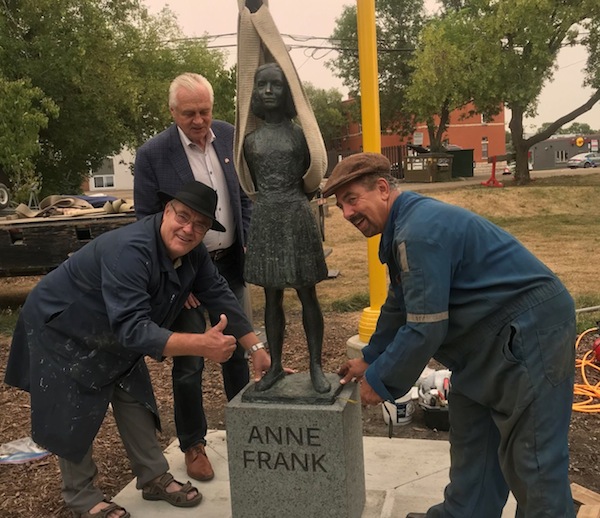
Edmonton’s Anne Frank statue

Officials in Edmonton unveil the first sculpture of Anne Frank in Canada. (photo by John Stobbe/Dutch Canadian Centre)

On Aug. 8, 2021, officials in Edmonton unveiled the first sculpture of Anne Frank anywhere in Canada. The world’s newest memorial to her – a life-sized bronze sculpture gifted by the Dutch Canadian Club, based in Alberta – now sits in a park in Edmonton. It is a replica of one that stands in Utrecht, Netherlands.

The unveiling marks the 75th anniversary of the liberation of Holland in the Second World War, and gives thanks to the Canadian soldiers who freed their country from Nazi Germany in 1945. But there’s a second meaning behind the timing – and it’s a strange coincidence. On this August weekend, 77 years ago, Nazis raided the secret annex in Amsterdam, where Frank and her family had been hiding for nearly two years, and arrested them. A few days later, they were sent to the Westerbork transit camp and, later, they would be shipped to Auschwitz.

On the Aug. 9 CJN Daily Podcast (ellinbessner.com/the-cjn-daily-podcast), readers can hear from the people who pushed for the statue and raised $75,000 to create and erect it, as well as from Gillian Horwitz, who runs Holocaust programming for the Jewish Federation of Edmonton, and Steve Shafir, the federation’s president, who were at the unveiling ceremony in person.

– For more Jewish national news, visit thecjn.ca


Action over words needed most

Action over words was what was most needed at this week’s National Summit on Antisemitism, hosted by the federal government. That was the consensus at a July 14 townhall in the lead-up to the summit. Hosted by the Centre for Israel and Jewish Affairs (CIJA), the virtual meeting drew about 1,300 Canadian Jews, some of whom expressed outright fear at spiraling antisemitism in their communities and on campuses.

The July 21 summit, and one on Islamophobia the following day, were announced earlier this month by Bardish Chagger, minister of diversity and inclusion, in the wake of a surge in antisemitic incidents this spring and the hate-driven murder of a Muslim family in London, Ont.

Addressing the townhall, Chagger listed Liberal achievements on fighting antisemitism, including Canada’s adoption in 2019 of the International Holocaust Remembrance Alliance (IHRA) working definition of antisemitism, and the appointment last November of former justice minister and human rights advocate Irwin Cotler as Canada’s first special envoy on preserving Holocaust remembrance and combating antisemitism.

In a statement announcing the summits, Chagger said invitations to attend were extended to her cabinet colleagues, members of Parliament “and officials throughout all orders of government to hear directly from Muslim and Jewish community leaders.”

The meetings were to assemble “a diverse group of community and political leaders, academics, activists and members with intersectional identities within these communities.”

Both summits were to be held virtually and take place “in a closed door environment to ensure the safety of those participating,” a spokesperson for Chagger told The CJN.

Live-streaming details had not been confirmed by press time, and a list of invitees had not yet been finalized, the spokesperson said, adding, though, that the federal Anti-Racism Secretariat is working directly with “community stakeholders,” while Chagger is working with MPs “to ensure a wide range of voices are represented” at the summit.

Cotler, who was to co-chair the national summit with Chagger, pulled no punches at the townhall, warning of an “old-new, global, escalating, virulent, sophisticated, and even lethal antisemitism” that reached “a tipping point” during the Israel-Hamas war in May.

He pointed out that last year saw the highest levels of antisemitic hate crimes since being measured, and that those numbers have already been eclipsed this year.

He cited “incendiary” antisemitic hate on social media, where, in one week this past spring, there were 17,000 tweets saying “Hitler was right,” or some variation of it. This makes the national summit “as timely as it is necessary.”

Cotler said the framework for an action plan would have to include a mandate to teach about the Holocaust and antisemitism in public schools; enhancing the adoption and implementation of the IHRA definition of antisemitism; fighting all hate crimes; holding social media platforms accountable for their content; zero tolerance of antisemitism in any political party; and to “appreciate that Jews alone cannot fight antisemitism. We need a constituency of conscience and of action.”

The summit was to provide “not only an opportunity to address antisemitism in words, but it must be what it is intended to be: an action summit, where words are translated into action, and not as a one-time [event] but as an ongoing combating of the scourge of antisemitism.”

An informal poll conducted during the townhall suggested that most respondents believe Jewish university students will feel excluded when they return to class this fall. Another poll during the townhall had 25% of respondents saying the rise of antisemitism here has caused them to consider leaving Canada, while a third question revealed that 39% of those answering said they have recently removed outward signs of their Jewish identity, such as Stars of David and kippot.

One participant spoke of keeping his passport up to date and handy just in case, while others wondered about the role governments can play in fighting antisemitism.

In his remarks to the townhall, Shimon Koffler Fogel, chief executive officer of CIJA, noted that what distinguishes the challenge Jews face is that they face hatred “from all sides”: the far left, far right, and from segments of the Muslim community.

“We have to challenge where necessary. We have to educate where the opportunity exists. But what we cannot do is surrender. We cannot be passive,” Fogel said.

The national summit’s focus was to be security and public safety, education and “civil society – issues of inclusion, acceptance, of not invalidating or delegitimizing the Jewish lived experience. We want the capacity to take increased ownership of our own institutional and community safety and security,” said Fogel.

He also hopes the summit will lead to a national campaign to enhance social media literacy. What’s most important, he added, is to see all levels of government work together to combat antisemitism. The “unprecedented” summit is not the end of the process, Fogel said. “If anything, it is simply the beginning.”

B’nai Brith Canada said it received in advance ideas for discussion at this week’s summit. They included:

  • Combating antisemitism must go beyond the principles enshrined in the federal Anti-Racism Strategy;
  • An emphasis on the importance of fostering Jewish life in Canada, recognizing the historical and contemporary contributions of Canadian Jews;
  • Promoting positive narratives about the contribution of the Jewish community to Canadian society;
  • Recognition that new forms of antisemitism are distinct from the traditional antisemitism to which Canadians are more accustomed;
  • Acknowledgement that anti-Zionism is a main driver of the new antisemitism and must be vigorously countered;
  • A commitment to mainstream the fight against antisemitism across all federal departments and agencies. This would include the Canadian Human Rights Commission and, by extension, involve provincial human rights commissions;
  • A commitment to create a national Holocaust, genocide and antisemitism advisory commission;
  • A commitment to implement the IHRA definition of antisemitism (and the IHRA definition of Holocaust denial and distortion) in a meaningful way and to actively promote adoption by the provinces/territories and municipalities;
  • And a commitment to convening a special forum and ongoing dialogue with the Council of Ministers of Education Canada to work with schools to develop effective methods to combat antisemitism.

In a statement, Michael Levitt, chief executive officer of Friends of Simon Wiesenthal Centre, also stressed that it’s important the summit “leads to real action, not words, including clear and defined next steps and funding to support initiatives to combat Jew-hatred, whether it’s in education, law enforcement, social media or another area.”

The townhall took place just as the Inter-Parliamentary Task Force to Combat Online Antisemitism released an interim report on how social media giants should handle online hate. Read more about it in Janice Arnold’s story for The CJN, which can be found at thecjn.ca/international-lawmakers-urge-action-on-online-anti-semitism.

– For more national Jewish news, visit thecjn.ca

CHW empowers victims

COVID-19 isn’t the only global pandemic to worry about; the worldwide increase in domestic violence has been coined a “shadow pandemic” by the United Nations. Globally, an estimated one in three women lives with violence and fear. But the number of domestic violence complaints in Israel, for example, has increased by 800% since the beginning of COVID. True to its mission, Canadian Hadassah-WIZO (CHW) is leading the way to empower women by stepping up emergency support and services at this critical time.

CHW strongly believes that every human being deserves the right to achieve their full potential, while living in safety and security. CHW appointed its first chief executive officer, Lisa Colt-Kotler, who is spearheading a transition and new direction for the 100-year-old organization, with a history of support for women and children in Israel and Canada. This summer, CHW is launching a quadruple matching 24-hour crowdfunding campaign and proceeds will help empower victims of domestic violence.

image - S.O.S. – Starting Over Safely logoCHW’s summer campaign, S.O.S. – Starting Over Safely, has three priorities for projects in Israel: CHW Youth Villages, which provide a safe haven for at-risk adolescents and supports mental health through a variety of outlets; Essential Kits for Families, which provides the basic necessities needed to help each family start over safely after they leave an emergency shelter; and the Safety Net Program, which will empower women and their children by providing housing, financial help, social and personal support, employment support, and a network of other women in similar circumstances. Safety Net has nearly a 100% success rate of breaking the cycle of violence and preventing victims from re-entering a domestic abuse relationship.

Aug. 24-25, funds donated will be matched three more times by a loyal community of donors recognized as “Matching Heroes.” During the 24-hour campaign, which kicks off at noon in each centre across Canada, each gift donated on the website chwsos.ca will be quadrupled.

And, on Aug. 24, at 5 p.m. PST, CHW is hosting a free, star-studded, 90-minute virtual telethon experience during which viewers will learn more about how to help empower victims of domestic violence. To watch, just click on the link from the campaign website.

For more details, contact Irena Karshenbaum, CHW development officer for Western Canada, at irena@chw.ca or 403-253-4612.

– Courtesy CHW

Many tributes for Rabbi Bulka

Rabbi Reuven Bulka (photo from thecjn.ca)

Rabbi Reuven Bulka, who served as spiritual leader of Ottawa’s Congregation Machzikei Hadas for 48 years, died of cancer early on June 27 in New York. He was 77.

Bulka moved to New York to be closer to his five children following a diagnosis of terminal liver cancer earlier this year. His funeral service took place there later on June 27, a video of which can be watched in its entirety online, via thecjn.ca/rabbi-bulka-obit.

Tributes to the beloved rabbi poured in.

Prime Minister Justin Trudeau praised Bulka for his commitment to his country and for inspiring parliamentarians to adopt Kindness Week.

“The Jewish community has lost a giant, the Canadian community has lost a giant and the world at large has lost an unbelievable person,” eulogized Bulka’s son, Shmuel Bulka, at the funeral service.

Shmuel Bulka noted that God “had called for the lefty” – a nod to his father’s love of baseball. “His life’s work was about making the world a better place than it was before he got here.”

He said, “A lot of people today, when they see people who are different, all they do is go toward the differences. Some people make a career out of exploiting the differences. My father was the exact opposite. He would always look for commonalities.”

Sen. Jim Munson, a close friend whose Kindness Week bill, inspired by Rabbi Bulka, received royal assent earlier this year, tweeted that his “heart aches” over Bulka’s death.

Ottawa Mayor Jim Watson praised Bulka as an outstanding community leader.

“He epitomizes kindness,” said Watson, who knew the rabbi for more than 30 years. “He was a larger-than-life figure in our community. He was a great supporter when the community needed him most.”

Andrea Freedman, president of Jewish Federation of Ottawa, told CBC that Bulka “had this amazing ability to just think through how something could be phrased that would help other people feel better.”

Retired Ottawa Police chief Charles Bordeleau said, “Rabbi Bulka was a pillar in our community and changed our country for the better. He was always there for Ottawa Police and a proud supporter of the men and women who keep Ottawa safe.”

Bulka’s passing “leaves an enormous void in our country,” tweeted CTV chief news anchor Lisa LaFlamme. “He was a man who built bridges and inspired goodness. A healer in a divided nation. I will miss our personal conversations and his public Remembrance Day benedictions.”

At a worldwide virtual prayer service for Bulka in January, former prime minister Stephen Harper said he’d had many opportunities to see the rabbi at local and national public events, and to visit with him.

“It is not for nothing Rabbi Bulka has been called Canada’s rabbi,” said Harper. “Throughout his long life, he has been a credit to his faith, to the wider community and great country.”

Harper said the main lesson he learned from Bulka is to live life from two perspectives, gratitude and hope. “Gratitude for all that we have, all that God has given us, and hope for what the future may bring,” said Harper.

Bulka was born to Rabbi Chaim Yaakov and Yehudis Bulka in London, England, on D-Day, June 6, 1944. Two years later, the family moved to the United States, where his father taught at Hebrew schools in Providence, R.I., and Rockaway, N.Y., before becoming rabbi of a synagogue in the Bronx.

Rabbi Reuven Bulka received semikhah (ordination) from the Rabbi Jacob Joseph Rabbinical Seminary in 1965, and earned a bachelor of arts degree in philosophy from City University of New York the same year.

He briefly served as an associate rabbi at Congregation K’hal Adas Yeshurun in the Bronx, before becoming rabbi of Congregation Machzikei Hadas in Ottawa in 1967. He received master’s and PhD degrees from the University of Ottawa in 1969 and 1971, respectively, concentrating on the life and work of Holocaust survivor and psychiatrist Viktor Frankl.

Bulka was an authority on Frankl’s use of logotherapy, which teaches that humans’ search for meaning in life is their prime motivational force. He later became the founder and editor of the Journal of Psychology and Judaism. He authored some 30 books and dozens of columns in the Ottawa Citizen. He was the go-to rabbi for reporters seeking a quote on a Jewish issue.

Bulka’s local initiatives included interfaith outreach and work with the United Way and with Canadian Blood Services.

A fixture at national Remembrance Day ceremonies in Ottawa for many years, Bulka’s name was “synonymous” with Remembrance Day, Maj.-Gen. Guy Chapdelaine, chaplain general of Canada’s Armed Forces, told last January’s prayer service.

He also noted Bulka’s support for Armed Forces chaplains and the Royal Canadian Legion.

Bulka was also awarded the Canadian Forces Medallion for Distinguished Service “for inspiring sermons, venerable presence and meaningful messages to Canadians during the national Remembrance Day ceremonies.”

The rabbi founded Kind Canada, a nonprofit that encourages kindness. In 2019, the city named Rabbi Bulka Kindness Park in Ottawa’s Alta Vista neighbourhood. The first national Kindness Week is slated for February 2022, and Canadians are called on to carry out acts of kindness in their communities during the third week of February every year.

The week could “potentially raise the Canadian consciousness of the importance of kindness, and the ensuing commitment thereto, to levels that will make our great country even greater and make a large dent in some of the critical issues we face, including mental health, the cost of health care and bullying, among others,” Bulka told the senate committee studying the kindness bill.

In 2010, the rabbi was awarded the key to the City of Ottawa. He was named to the Order of Canada in 2013.

He addressed the COVID pandemic at the prayer service for him, saying that, if anything was learned from it, “it’s that we’re all in this together, and the more together we are in this, the better we’re going to get out of it.”

He said the most important thing in life “is to appreciate each other.” Differences “fade into insignificance when we realize the blessings we have.”

Rabbi Bulka is survived by his wife, Leah, and five children: Yocheved Shonek, Rina Levy, Shmuel Bulka, Eliezer Bulka and Binyomin Bulka. His first wife, Naomi, died in 2001. He is to be buried in Israel in a private service.

– This article originally appeared on thecjn.ca.

Honouring women’s courage

Anne Petrie (photo from Maurice Yacowar)

The University of Calgary has organized a virtual exhibition to honour the efforts of Jewish women in the Canadian Armed Forces during the Second World War. Called She Also Served, it comprises a series of nine banners by various artists.

Originally scheduled to be displayed at the Military Museums in Calgary during Jewish Heritage Month in May, it has been made available online throughout 2021 and will be physically hung in May 2022. Of the 17,000 Jews who served in the Canadian armed services, more than 275 were women.

Among those selected to display their work is Anne Petrie of Victoria. For her banner, a digital print called “In the Tradition of Service,” Petrie chose to list all the known names of the Jewish Canadian servicewomen. She used a font that is reminiscent of the typewriters of the 1940s. Another layer of the banner has the names of 12 biblical heroines, confirming the tradition of Jewish women’s courage and dedication to serving their communities.

“I was immediately struck by knowing that, although they would not have had to hide their Jewish identity, it was still in those days not something that you would be comfortable being completely open about,” Petrie told the Independent. “Even if it was, at best, very casual antisemitism, it was a reality when they would have signed up. So, there you are fighting (even if it’s only at a desk) for something – a religion, a people, a culture – that you can’t really be openly passionate about.”

image - Anne Petrie’s “In the Tradition of Service,” 2021. Part of the She Also Served exhibit, now online
Anne Petrie’s “In the Tradition of Service,” 2021. Part of the She Also Served exhibit, now online.

For Petrie, She Also Served is an opportunity to reveal and contextualize the “Jewishness” of that other “them, the unsung and – worse – unidentified Jewish-Canadian women soldiers.” She said she is honouring them by naming them in “their doubly suppressed identities, as women and Jews.”

Petrie’s intention was to present the full names and rank (where available) of all the Jewish women known to have served. The collection of names fills the background layer of the 75-by-165-centimetre banner. Each name is in the colour of their respective services: olive green for army, dark navy for the navy and a lighter “air force blue” for the Women’s Army Corps. Emerging from the background in a larger, translucent Hebrew script, and in a camouflage pattern, are the names of Judaism’s biblical heroines, “themselves often subordinated by patriarchal tradition to the male heroes,” said Petrie.

“In making the banner itself, I was struck by how powerful it was to actually write out all the 279 names of the Jewish servicewomen that have so far been identified. I knew none of them personally, of course, but I felt that typing each name was a kind of acknowledgement and, strange as it sounds, I did feel a kind spirit or presence as I typed each of the names. I only wish we did know more about them, but I understand that research is continuing and, hopefully, there will eventually be stories attached to each of these women’s names,” she said.

Petrie thanked Janice Shulman and Rabbi Lynn Greenhough for their assistance with the project.

Prior to beginning her work as an artist, Petrie’s career spanned more than 30 years in radio and television, where she worked as a researcher, producer, documentary-maker, columnist and commentator in news and current affairs. She is also the author of several non-fiction books: Ethnic Vancouver, Vancouver Secrets and Gone to an Aunt’s: Remembering Canada’s Homes for Unwed Mothers.

After retiring from the CBC, she returned to school and obtained a bachelor of fine arts from the Alberta College of Art and Design in 2008. Since then, she has had a number of exhibitions. Her next exhibit, said/unsaid, is a two-person show with Jane Coomb – it opens at the errant artSpace gallery in Victoria (975 Alston St.) on July 9.

The other artists whose work is featured in She Also Served are Razieh Alba, Sophia Borowska, Alysa-Beth Engel, Lily Rosenberg, Talie Shalmon, Jules Schacter, Bev Tosh and Susan Turner. The representations exploring the servicewomen’s experiences range from naturalistic to abstract. Some works use archival photographs, while others use media include oil painting and paper-cutting.

The stories of 41 Jewish servicewomen are also featured on the website. These accounts were an impetus for the call for submissions for the exhibition, which was curated by the University of Calgary’s Prof. Jennifer Eiserman and librarian emerita Saundra Lipton. They ask for help in “completing the story” from anyone who has more information about the featured servicewomen and any of those identified in the list of names collected.

To view the exhibition, visit live-ucalgary.ucalgary.ca/she-also-serves/exhibition.

Sam Margolis has written for the Globe and Mail, the National Post, UPI and MSNBC.

CABGU gala now sold out

Mitchell Oelbaum, national president of Canadian Associates of Ben-Gurion University. (photo from in.bgu.ac.il)

Raising nearly $800,000 at a not-for-profit gala is no small feat, nor is having more than 1,200 people register for an event. When you add a pandemic to the mix and make it a virtual event, one might assume that it would be impossible to come close! But that’s precisely what the Canadian Associates of Ben-Gurion University (CABGU) did in just seven weeks.

“We are a lean but unbelievably keen staff at CABGU, with an incredibly generous and committed group of lay leaders,” said Mark Mendelson, CABGU’s chief executive officer. “Achievements like this make me so proud!”

Mendelson knew that every detail of the event was accounted for, beginning with the star attraction. Israeli actress Shira Haas, star of the popular Netflix series Shtisel and Unorthodox, recently nominated for both a Golden Globe and an Emmy, is the featured speaker. Fresh off her recent press tour for the newly released movie Asia, she will be joining the event live from Israel. Haas will be taking questions from Canada’s Sen. Linda Frum, who will be moderating the conversation along with Prof. Daniel Chamovitz, BGU’s president.

CABGU’s An “Unorthodox” National Virtual Gala for Brain Research at BGU raises money for the Canada Fund to Advance Brain Research. “The fund will go a long way in assisting researchers at the university with conducting groundbreaking and out-of-the-box research,” said Mitchell Oelbaum, national president of CABGU.

“CABGU launched the Canada Fund to Advance Brain Research at BGU in April,” added Mendelson. “We know that there is a strong appetite for the subject of brain research because so many of us know at least one person, if not more, who is impacted by neurodegenerative diseases here in Canada.”

Tickets for the July 7 virtual gala are sold out. However, a few sponsorships are still available at bengurion.ca.

– Courtesy Canadian Associates of Ben-Gurion University