New Jewish law group

Renowned lawyer and human right activist David Matas is being honoured by B’nai Brith Canada, as the organization launches the Matas Law Society.

Matas, who is based in Winnipeg, has long served as B’nai Brith Canada’s senior legal counsel, working closely with B’nai Brith for more than 30 years. He has his own private practise and, among other recognitions for his work, has been appointed a Member of the Order of Canada.

The new society is set to be a primary hub for Jewish members of Canada’s legal community. For now, while COVID restrictions remain, all events will be held virtually, with any Jewish lawyer, paralegal and law student able to join and participate from any location.

“David is doing so many wonderful things all of the time,” said Michael Mostyn, chief executive officer of B’nai Brith Canada. “He really personifies to me what a human rights advocate should be.”

photo - Michael Mostyn, chief executive officer of B’nai Brith Canada
Michael Mostyn, chief executive officer of B’nai Brith Canada. (photo from B’nai Brith Canada)

According to Mostyn, “There is a rich history of Jewish law societies in Canada. They are great, established societies. Currently, there’s one in Ottawa and one in Montreal. There used to be one in Toronto, but it closed down decades ago, essentially because the need was no longer there.

“As friends and advocates in the community, we were hearing a lot from the legal community about the need for an activist law society. So, the idea has been brewing for the last number of years. We already have a very strong advocacy program, government relations program and communications program. We wanted to create this law society as a forum for lawyers to get together, network and get some continuing education. It’s also a way for us to give back to the community, for those who care about the fight against antisemitism, racism, and the fight for human rights.”

The society will operate as a subcommittee of B’nai Brith Canada’s League for Human Rights, with news to come of scheduled activities and ways that legal professionals can get involved. Law students can join for free, and the annual cost for legal professionals is $250.

“It’s as easy as, if you’re a law student, paralegal or lawyer and you’re interested in advancing your own career and want to make a difference for the community, you just sign up on the website,” said Mostyn. “Then, you’d be put onto the email list … and, as soon as we will be publicly announcing any activities, those will also be reflected on the website.”

photo - B’nai Brith Canada has launched a new law society, named in honour of lawyer and human rights activist David Matas
B’nai Brith Canada has launched a new law society, named in honour of lawyer and human rights activist David Matas. (photo from B’nai Brith Canada)

“The time when it was first mentioned to me, it wasn’t mentioned to me as something that would be named after me,” Matas told the Independent. “It was mentioned as a way of getting lawyers involved … [in] legal-specific work related to B’nai Brith.

“There are a lot of legal issues that do arise. In fact, today, I put in an application for an intervention document. It’s a case about Mike Ward. He’s a comedian in Quebec who went after a handicapped guy in the audience in his comic routine.

“The person who was the target of this comic routine complained to the Quebec Human Rights Commission, successfully,” said Matas.

The case is now before the Supreme Court of Canada. “And we applied at B’nai Brith for interveners’ status, based on the experience of Dieudonné M’bala M’bala, who’s a French comedian who has used his comic routine to attack the Jewish community and has been fined many times … and has gone to court many times in France, Belgium and Switzerland. There’s even a European Court of Human Rights judgment on him. So, I suggested we intervene, and B’nai Brith agreed. We applied for intervention status and we got it.”

While Matas enjoys volunteering with B’nai Brith, he will not be able to do so indefinitely, and would love to get some help sharing the workload.

“Obviously, when you’re dealing with a volunteer organization, you want to get as many people involved as possible,” said Matas. “Not just to spread the load, but also you want to get more people aware, committed and involved. Advocacy can’t just be advocacy of one person; it’s not going to carry much weight. It needs to be as many people as possible.”

Mostyn is working on getting accreditation for the society’s seminars, as he and Matas hope that the continuing education component of the law society will help bring together a number of law students, who will eventually go out and work in the field and fuel change.

The society has been launched and many students have already signed up, said Mostyn.

As for what specializations in law those wanting to join the society may want to possess, Matas suggested “discrimination, equality and international law … also, libel law, which is very different from equality law or international law … or we have things about charities, tax and corporations. There are a wide variety of legal issues that come up.

“There’s a lot, in terms of advancements of rights, that occurs through the courts and also through parliaments and legislatures. Legal work isn’t only doing court work. It’s also sometimes advocating changes to law. You need, of course, a public component for that. That may not be lawyers, but often requires some legal expertise to point out the depths of the law and so on. I’d say there’s a real need here and I think it’s a welcome addition to the work that B’nai Brith is doing to add this.

“It’s also a great opportunity for lawyers to contribute and use their skills,” added Matas. “They can talk to each other in a way where everybody knows what they’re talking about.”

Rebeca Kuropatwa is a Winnipeg freelance writer.

Asper donation to HU

Left to right: Richard Leipsic, David Asper, Leonard Asper and Gail Asper. (photo from CFHU)

The Canadian Friends of Hebrew University has received $5 million from the Asper Foundation. This gift upholds a tradition of exceptional philanthropic support and collaboration between the Asper Family, based in Winnipeg, Man., and the Hebrew University of Jerusalem Israel (HUJI). It will allow Asper HUJI Innovate to expand its footprint and professional-led startup accelerators to develop significant external partnerships.

The Asper Foundation was founded in 1983 by Israel Asper (1932-2003) and Babs Asper (1933-2011), who believed that philanthropy is a driving force behind positive change in people’s quality of life. It supports major initiatives in the areas of Jewish charity, as well as culture, education, community development and human rights locally, nationally and internationally.

A portion of the recently donated funds will be used to establish an annual Asper Innovation Prize, valued at $35,000 US. The prize will be awarded during a juried competition, intended to encourage and recognize outstanding and promising student-led startups. The public event will also be used to showcase the university as a central force for global innovation within the Jerusalem ecosystem. (Jerusalem is currently ranked sixth in the new Global Startup Ecosystem Report).

“It was the entrepreneurial spirit and wisdom of our late parents, Israel and Babs, that established ties with the Hebrew University close to 60 years ago. We are very proud of our longstanding partnership and connection to innovation that began with the creation of the Asper Centre for Entrepreneurship in the Jerusalem School of Business Administration, in 2001,” said Gail Asper, president of the Asper Foundation. “We are excited to witness, through Asper HUJI Innovate, new generations of students and academics lay the groundwork for advancing ideas, for generations to come.”

The Asper HUJI Innovate platform encourages the entire university community, including students, faculty and alumni, and the Jerusalem community at large to develop their innovation and entrepreneurial capabilities. Established in 2018, it was created as a platform to ensure that graduates are best prepared for the challenges brought about by disruption, inherent in an evolving workplace.

“The HUJI Innovate program is highly prized by the entire university, and the Asper Foundation’s agreement to name and support the centre will surely lead to a great leap forward in the Hebrew University’s entrepreneurial enterprises,” said Prof. Asher Cohen, HU president.

The Hebrew University itself was founded in 1918, and officially opened its doors in 1925. It is ranked internationally among the 100 leading universities in the world, with six campuses, 200 majors and programs, and more than 5,000 courses.

“For over 100 years, the Hebrew University of Jerusalem has upheld the vision of its founders, including Albert Einstein, Martin Buber and Sigmund Freud, being at the forefront of creating Israel’s most significant and cutting-edge research, leading to inventions that serve our global community,” said Rami Kleinmann, president and chief executive office of Canadian Friends of Hebrew University, which was founded in 1944 by Canadian philanthropist Allan Bronfman.

CFHU provides support for the Hebrew University of Jerusalem to maintain its standing as one of the world’s leading academic research institutions, as well as aid in its continual pursuit to impact real change. CFHU is headquartered in Toronto and has six chapters across Canada, including here in Vancouver.

“This incredible gift will positively impact thousands of students, faculty and alumni,” said Kleinmann, “essentially shifting the course of research and engagement between the university and myriad business communities at large – it is extraordinarily profound.”

Justice slams the UN

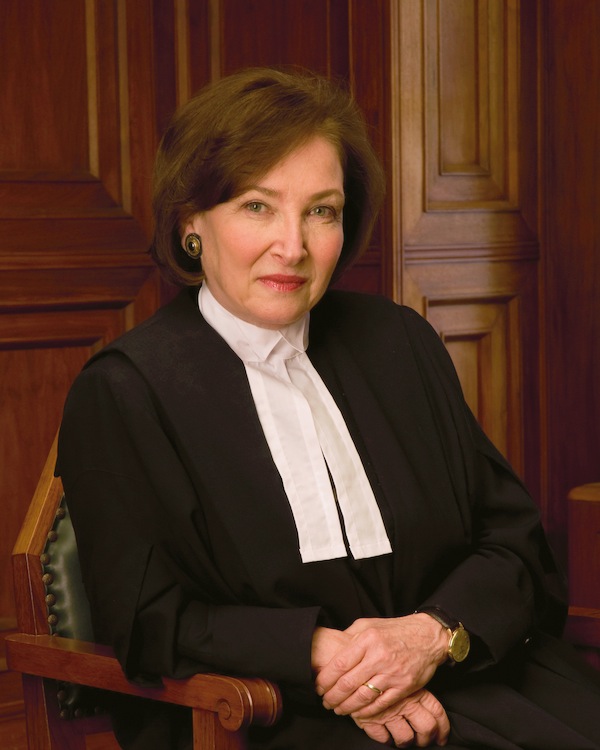
On Dec. 9, the Honourable Rosalie Silberman Abella, a justice of the Supreme Court of Canada, delivered the inaugural Elie Wiesel Lectureship in Human Rights. (photo by Philippe Landreville)

The Honourable Rosalie Silberman Abella, a justice of the Supreme Court of Canada, last week delivered an emotional, scathing indictment of the world’s failures to live up to the promise of post-Holocaust human rights protections.

Abella, a daughter of Holocaust survivors who herself was born in a displaced persons camp in Germany, in 1946, delivered the inaugural Elie Wiesel Lectureship in Human Rights. She spoke Dec. 9 on the 72nd anniversary of the United Nations’ adoption of the Convention on the Prevention and Punishment of the Crime of Genocide and the day before the 72nd anniversary of the adoption of the Universal Declaration of Human Rights. The promise of those documents – and the justice represented by the Nuremberg trials of Nazi war criminals – has been betrayed and ignored, she said.

“These were the powerful legal symbols of a world shamefully chastened,” Abella said in the streamed virtual presentation. “But although Nuremberg represented a sincere commitment to justice, it was a commitment all too fleeting.”

As the West’s triumph over fascism gave way to conflict with communism, Germany transformed in the diplomatic imagination from an enemy conquered to a potential ally to be wooed, she said. Britain issued a communiqué to all Commonwealth countries to abandon prosecutions of Nazi war criminals.

“The past was tucked away and the moral comfort of the Nuremberg trials gave way to the moral expedient of the Cold War,” Abella said.

As the fight against communism eclipsed the fight for justice over past crimes, expedience led Western countries to welcome Nazi scientists and others to contribute to the military-industrial strategy – even as Jewish victims of Nazism, like Abella and her parents, sat stateless in DP camps.

To Abella, Nuremberg represented an acknowledgement of the failure of Western democracies to respond when they should have and could have.

“And so, the vitriolic language and venal rights abuses unrestrained by anyone’s conscience anywhere in or out of Germany turned into the ultimate rights abuse: genocide,” she said.

Some justice did in fact emerge in the aftermath of Nuremberg and remarkable progress has been made in some quarters, she said. “But we still have not learned the most important lesson of all – to try to prevent the abuses in the first place. All over the world, in the name of religion, domestic sovereignty, national interest, economic exigency or sheer arrogance, men, women and children are being slaughtered, abused, imprisoned, terrorized and exploited with impunity.… No national abuser seems to worry whether there will be a Nuremberg trial later because usually there isn’t. And, in any event, by the time there is, all the damage that was sought to be done has been done.”

Abella reflected on the preoccupation among jurists with the rule of law, noting that the atrocities of the Nazi era all took place legally under German laws. She said we should be focused on “the rule of justice, not just the rule of law.”

Itemizing the myriad genocides that have occurred since 1945, including ones happening now, Abella decried a lack of global will to confront atrocities before they occur.

“Clearly what remains elusive is our willingness as an international community to protect humanity from injustice,” she said, launching a broadside against the failures of the United Nations.

“It can hardly be said to have been the avatar of human rights we hoped it would be when it was created,” she said. “We changed the world’s institutions and laws after World War II because they had lost their legitimacy and integrity. Are we there again? Not so much because our human rights laws need changing, but because a good argument can be made that our existing global institutions, and especially the UN’s deliberative role, are playing fast and loose with their legitimacy and our integrity.”

She acknowledged the successes of some UN agencies, such as UNICEF, but lamented the body’s failures to meet its core objectives.

“The UN had four objectives: to protect future generations from war, to guard human rights, to foster universal justice and to promote social progress,” she said. “Since then, 40 million people have died as a result of conflicts all over the world. The UN eventually reacted in Libya and wagged its finger at Syria, but I waited in vain to wait to hear what it had to say about Iran, Venezuela and China, for example. Isn’t that magisterial silence a thunderous answer to those who say things would be a lot worse without the UN? Worse how? I know it’s all we have but does that mean it’s the best we can do? Nations debate, people die. Nations dissemble, people die. Nations defy, people die. We need more than the words and laws of justice. We need justice.”

Abella acknowledged the need to address climate change but suggested a moral climate crisis is upon us.

“We have to worry not only about how the climate is changing the world but how the moral climate is creating an atmosphere polluted by bombastic anti-intellectualism, sanctimonious incivility and a moral free-for-all,” she said. “Everyone is talking and no one is listening. We are rolling back hard-fought human rights for minorities, immigrants, refugees, workers and women.

Abella approached global justice through the eyes of a single family. Her parents were married in Poland on Sept. 3, 1939, the day the Nazis rolled over the border and as the Second World War began. Her parents spent four years in concentration camps. The brother she never knew was murdered at the age of two-and-a-half. The only survivors of her extended family were her parents and one grandmother.

“My life started in a country where there had been no democracy, no rights, no justice,” she said, struggling to maintain her composure. “No one with this history does not feel lucky to be alive and free. No one with this history takes anything for granted and no one with this history does not feel that those of us who are alive have a duty to wear our identities with pride and to promise our children that we will do everything humanly possible to keep the world safer for them than it was for their grandparents, a world where all children regardless of race, colour, religion or gender can wear their identities with dignity, with pride and in peace.”

Her own existence is a statement of the resilience of human hopefulness, she said.

“In an act that seems to me to be almost incomprehensible in its breathtaking optimism, my parents and thousands of other survivors transcended the inhumanity they had experienced and decided to have more children,” she said. “I think it was a way to fix their hearts and prove to themselves and the world that their spirits were not broken.”

Abella dedicated her lecture not only to Elie Wiesel, the late Nobel Peace Prize laureate, but also to Irwin Cotler, who introduced her prior to her presentation and who Abella called Wiesel’s “spiritual heir.”

Cotler, a former Canadian justice minister, is the founder and chair of the Raoul Wallenberg Centre for Human Rights, which sponsored the lecture along with faculties of law at McGill University and the Université de Montréal, the Lord Reading Law Society and the International Bar Association’s Human Rights Institute.

Cotler, who last month was appointed Canada’s special envoy on preserving Holocaust remembrance and combating antisemitism, noted that Abella was the youngest person ever appointed to the Canadian judiciary, at age 29.

“She was the first refugee ever appointed to the judiciary and she was the first Jewish woman ever appointed to the Supreme Court of Canada,” Cotler said, noting that he was the justice minister who nominated her to the highest court. “She has been a remarkable trailblazer. A quintessential Renaissance jurist, public intellectual, educator and judge.”

Among Abella’s recognitions, Cotler noted, are 39 honorary doctorates.

To watch the lecture, click here.

Honouring history amid virus

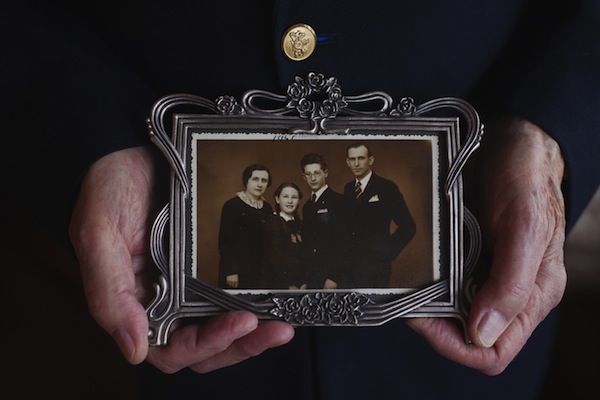
Leslie Vértes shares a family photograph. Vértes is one of the survivors featured in the Montreal Holocaust Museum exhibit Witnesses to History, Keepers of Memory. (photo from Montreal Holocaust Museum)

Collective memory has always played an important role in Jewish life and traditions. For thousands of years, Jews have celebrated holidays, mourned loss and memorialized history together as a people. And, most often, we have done so in person.

We say Kaddish as a community, celebrate a bris among a gathering of peers and family and come together every year to retell over dinner the story of the exodus of the Jewish people from ancient Egypt. The 20th-century philosopher and historian Isaiah Berlin noted, “All Jews who are at all conscious of their identity as Jews are steeped in history.” The late Lord Rabbi Jonathan Sacks expressed it another way: “Memory for Jews is a religious obligation.”

This past year has presented huge challenges for those institutions that strive to educate the public about history in general and, specifically, the Holocaust. During the pandemic, many museums and educational centres have been forced to choose alternative venues to connect with their members and the larger community. On Yom Hashoah and Kristallnacht, organizations across the world turned to recordings and interactive discussions in their effort to remind people that the Shoah’s messages remain relevant, even if their institution’s doors were temporarily closed.

Finding ways to continue that education and connection on a daily basis has required some creative thinking, said Sarah Fogg, who serves as the head of marketing, communications and PR for the Montreal Holocaust Museum. The museum, which was founded by Holocaust survivors, had been planning to launch a special photographic exhibit this year, highlighting the lives and wartime experiences of 30 survivors from the Montreal area.

“[The exhibit] was something that we had dreamt of for a really long time,” said Fogg. The museum had planned to narrate each of the stories visually using a triptych of personal images and the sharing of an artifact that the survivors had preserved: a father’s cap that he was required to wear at Auschwitz, a woman’s prayer book, an irreplaceable but tattered passport to freedom. But how could such stories be presented in the midst of a pandemic?

“The pandemic completely forced us to change, to rethink, to overhaul the plan we had for the exhibit,” said Fogg, who admitted there was a sense of urgency to the exhibit’s launch. Some of the speakers are now in their 90s and have already retired as volunteers. Plus, 2020 marked the 75th anniversary of the liberation of the concentration camps (and the 41st anniversary of the museum’s founding). This year, 2020, was the ideal time to launch the exhibit.

photo - Leslie Vértes
Leslie Vértes (photo from Montreal Holocaust Museum)

“[The online presentation] is the result of many brainstorming sessions where we discussed … how we could present this exhibit in a way that is different to other portrait exhibits that have happened around the world,” said Fogg. “And so, the ‘triptych’ as we have been calling it, the three photos, was really the result of wanting to showcase more than one portrait of the survivor and really wanting to showcase their uniqueness and their personalities.”

Fogg said it was in the middle of one of the photography sessions that the staff suddenly realized what was needed to translate this photographic essay to an online presentation. It was the survivors’ own accounts of why their personal artifacts held irreplaceable significance. It was also the story of how they had survived and how it had transformed them, once they began their new lives in Canada.

“So often when we talk about the stories of Holocaust survivors, the narrative tends to end when they leave Europe,” Fogg said. “But there is so much more to talk about.” Many of the survivors, who were children or young adults when they arrived in Montreal, went on to raise a family. All became volunteer speakers through the museum and other organizations in order to educate people about the Holocaust. Some became published authors and teachers. All, Fogg said, became inspiring leaders of their community.

photo - Margaret Newman Kaufman with her wedding photograph
Margaret Newman Kaufman with her wedding photograph. (photo from Montreal Holocaust Museum)

“If I had to summarize what the lesson or the inspiration would be for viewers, it’s resilience. I mean, not only are they incredible survivors who escaped the Holocaust, but they come to Canada, they build new lives, they start careers, they make families and they find happiness again. They are this embodiment of resilience.”

Taken on their own, the artifacts tell dozens of unique and often heart-rending stories about the Holocaust. But they are also testimony to the survivors’ remarkable ability to draw meaning, purpose and even beauty from the darkest of memories. Sarah Engelhard’s black-and-white snapshot tells the story of her first Passover in Canada. Ted Bolgar’s touching account gives renewed significance to friendship and the value of a precious tea set. Marguerite Elias Quddus’s last memory of her father, as he was arrested, is embodied in a bitter-sweet tale about his forgotten eyeglasses.

photo - Margaret Newman Kaufman displays her wedding rings
Margaret Newman Kaufman displays her wedding rings. (photo from Montreal Holocaust Museum)

Following the Second World War, Montreal became a second home for thousands of Holocaust survivors, some who saw it as a temporary port of refuge, and many who stayed to make it their home. The museum was opened in 1979 by members of the Association of Survivors of Nazi Oppression as a means to educating the public about the dangers of antisemitism and racism. More than four decades after its founding, the museum’s legacy still continues to be relevant, Fogg said. And, like the testimonies and artifacts that illumine these stories, the message it carries is an intensely human and important one.

“You know, we’re not talking about numbers or figures, we’re talking about Ted, Leslie, Liselotte and Daisy. These are real people that we love and care about and they are real people whose families and lives were torn apart by the Holocaust,” said Fogg. “And so, I think we can make a parallel to situations today, where real people are continuing to be impacted and devastated by genocide.

“I think what’s beautiful about the exhibit and working with survivors is that they are real people. What better way to understand history and especially difficult, complex and painful history than to hear it from such wonderful and caring and generous individuals,” she said. “They are the best educators and we are so lucky to learn from them, and we’re so lucky that they wanted to be a part of this exhibit.”

The museum’s effort to reach virtual audiences during the pandemic does appear to be working. Fogg said that, since its launch in September, the exhibit has not only been seen by viewers around the world, but has won three international awards for its visual presentation and design. The pandemic may have temporarily limited the world’s physical ability to connect, but it hasn’t stopped innovation or the heartfelt effort to care about others.

To see the Montreal Holocaust Museum’s exhibit, Witness to History, Keepers of Memory, visit witnessestohistory.museeholocauste.ca.

***

Montreal Jewish history in brief

The first Jews in the Montreal area were Sephardim serving in a British regiment. One was Aaron Hart, whose son would later be elected to the legislature to represent the Trois-Rivières area.

By the early 19th century, Ashkenazim from Eastern Europe had begun to trickle in and, by the early 20th century, more than 7,000 Jews had made their way to Montreal, most fleeing antisemitism in the Russian Empire and Europe. Many would arrive to find that prejudice and discriminatory policies weren’t exclusive to distant geography. The election of Ezekiel Hart to the legislature would later inspire a resolution to ban Jews from serving in office. It take another 60 years before a law would be enacted that would give Jews in Lower Canada the right to self-representation.

By the 1930s, Montreal’s Jewish population had increased to 60,000, making it the largest Jewish hub in the country. Many worked in the growing garment industry or owned stores and restaurants in the city. A smaller number moved to the country to become farmers and use skills they brought with them from the old country.

Distrust toward Jews and the growing number of Jewish refugees looking desperately for a new home before and after the Holocaust made immigration to Canada virtually impossible in the early 1940s. It took the efforts of organizations like the Canadian Jewish Congress to push for changes to immigration laws and open doors to refugee families. By the early 1950s, another 9,000 Jewish refugees eventually made their way to Montreal’s port. By the 1970s, those numbers had swelled again, reaching close to 120,000.

Today Montreal’s Jewish community is much smaller, for many reasons, including out-migration from the 1970s to 1990s. But the early Jewish pioneers, those who arrived in Montreal in the 18th and 19th centuries, are not only credited with building new businesses and opportunities for a growing city, but for planting the seeds for Canada’s diverse Jewish community.

Jan Lees articles and blog posts have been published in B’nai B’rith Magazine, Voices of Conservative and Masorti Judaism, Times of Israel, as well as a number of business, environmental and travel publications. Her blog can be found at multiculturaljew.polestarpassages.com.

Father-son campaign leaders

Jonathon Leipsic is chair of the Jewish Federation of Greater Vancouver’s annual campaign, and his father, Peter Leipsic, is co-chair of the annual campaign of the Jewish Federation of Winnipeg. (photo from Leipsics)

Father and son, Peter Leipsic and Jonathon Leipsic, are chairing the Jewish Federation annual campaigns in their respective hometowns. Peter is co-chair, with Neil Duboff, of the Winnipeg fundraising effort, while Jonathon is in his third consecutive year of leading the fundraising here in Vancouver.

For Peter, “growing up, helping others was something that just got ingrained in you. You see somebody in trouble, you reach down and help them. My father served in Europe and following in his steps I went to Israel as a volunteer, in the ’67 war. It was just an automatic.

“I remember being at our synagogue and … on the cover of Time Magazine, I guess May of ’67 … there was a picture of 800 Syrian tanks, 600 Egyptian and Iraqi…. It made Israel look like they were going to be toast. At the synagogue, they were asking for money from all the members and I remember the cheques being torn up and being returned to people … saying, that, ‘No, we’re not interested in this. We’re interested in a cheque that hurts. Don’t give us your $1,000…. We want $10,000.’

“When I saw that,” said Peter, “I was probably 21. I think that just sort of instilled in me how to look out for the underdog. People would make fun of me for handing out money to people on the street and I’d say to them, ‘Where are you sleeping tonight? Are you having a shower or not?’”

Peter has been raising money for the Combined Jewish Appeal (CJA) for more than 50 years now, and he has learned that, with some people, giving is automatic, one doesn’t even need to ask. “In the end, we all end up in the same place. Eventually, I don’t know where the cemeteries are in Vancouver, but, in Winnipeg, they’re in the North End – we’re all going to end up there, and you ain’t taking it with you!”

The Leipsics do their best to help out beyond the Jewish community, as well. Peter established a scholarship program at Winnipeg’s Gordon Bell High School, where applicants are judged, not according to scholastic achievements, but on how much of a mensch they are. This past year, there were nine recipients – the highest number yet. “They sent the bios on these people, and, they were just gut-wrenching,” said Peter. “After reading the bios, I said, ‘OK. Can I add another $1,000?’ And, of course, I sent [the list] to Jonathon, too. Well, I raised it to $6,000 and Jonathon doubled it, up to, I think, $11,000. So, instead of them getting $400 per person, they each were given $1,018. And Jonathon, of course, explained to them the significance of 18 in Jewish life. To me, I’m tickled … to actually be able to see somebody’s face, and how I changed that face – taking a massive weight off of them.”

While both Peter and Jonathon are calling on people to help, they each have their own unique styles, with Peter being more direct and Jonathon having a more diplomatic approach.

“I probably burned a couple of bridges,” said Peter of his method. “When you know that somebody has the ability and you tried to explain to them the need, yet they back off and they back off … and, at some point, they say, ‘Do you want me to hang up on you now?’ Some people just don’t get it.”

Even in times such as these, some people, like the Leipsics, are downplaying the negative aspects and focusing on the needed work at hand.

“I mentioned in my campaign opening address that we, the Jewish people, certainly have known challenges greater than COVID,” said Jonathon. “While the challenges are profound, I always like to remind people that, even though, in the last 1,000 years, the challenges were seemingly insurmountable, we overcame and moved from strength to strength by never forgetting our call from Sinai and the centrality of community and Klal Yisroel. I think that COVID has been an eye-opener for people of my generation and younger. It has to start at home, I think.”

Jonathon said that he has really learned from his father’s commitment and that it has set the tone. “We’re taught in our homes and taught through Torah … we have to make community a priority, and my father has always done that,” said Jonathon. “Whether he does it by giving more, giving his time and whatever we were in the position to be able to do, he made those decisions up front – not after all our spending was done, rather at the beginning. ‘First things first,’ as they say. He showed me the way to a life of tzedakah, commitment and meaning…. To be in the same position with him, I think, is actually really, really special.”

Having had the benefit of helping fundraise in Winnipeg, Jonathon understands the different challenges that exist in Vancouver. “We have a bigger community, but it’s spread out,” he noted. “And, as a result, the binding of the community is less tight than it was when our community was more closely tied to Oak Street [in the past, and in] the North End of Winnipeg.”

Learning from both campaigns, Jonathon said, “We work together and do what we can. At the end of the day, food security and access to safe housing is becoming more and more challenging. And then, the isolation with COVID, obviously, is really profound with the elderly and those who can’t get out…. I can imagine, when it’s raining all winter or cold, the social isolation will become even more profound … the potential [effects] it can have on them, but also, their sense of community. I think, more than ever, these sorts of community initiatives are essential.”

“If you want Jewish life to continue,” Peter added, “you must reach down and support the people that are in need. You never know who the next leaders of your community are going to be. A lot of people that have received help had nowhere else to turn, and they may turn out to be your future leaders.”

As far as both Leipsics are concerned, Judaism is defined by the talmudic words, Klal Yisroel areivim zeh bah zeh (all of Israel is a guarantor for one another).

Rebeca Kuropatwa is a Winnipeg freelance writer.

Women in labour force

Pamela Jeffery, founder of the Prosperity Project. (screenshot)

Pamela Jeffery, the driving force behind the Prosperity Project, led an Oct. 7 webinar entitled When Women Succeed, We all Prosper – Don’t Let COVID-19 Hold Us Back, which was part of a National Council of Jewish Women of Canada series on women and justice.

Launched on May 21 of this year, the Prosperity Project hopes to ensure that gains made by women in the workplace and elsewhere are not set back permanently by the pandemic. In July, a Royal Bank of Canada report showed that women’s participation in the labour force had decreased to its lowest level in 30 years. Women, according to RBC, have been disproportionately affected by the overall decline in work hours since March, and this has been exacerbated by the household and childcare responsibilities for which women take on a greater share than men, particularly when children are not learning in school.

“We all know that the women’s movement is unfinished,” said Jeffery. “This is why our leadership is necessary – no matter what our age or our gender. It is up to all of us to ensure that men and women have equal opportunity, which is at the heart of the Prosperity Project.”

She stressed, “There is a clear focus on making sure that the progress made over the last 60 years on gender equality is not rolled back. That is why the Prosperity Project exists.”

Jeffery spoke of three essential themes to advancing the movement: resourcefulness, relationships and risk. “Each of us has the power to bring an idea forward. We can take a calculated risk and draw on our resourcefulness and relationships to make things happen,” she said.

The Prosperity Project has several initiatives it hopes will safeguard the progress by women in the past few decades and propel it further. Among them is a “matching initiative” for nonprofit organizations whose mission is geared towards helping women with training, employment pathways, crisis counseling and mental and physical health. The initiative introduces women and men in the private sector with specific skill sets to the staff and existing boards of these nonprofits for extended volunteer assignments.

Jeffery pointed out the importance of role models and mentors for women. “A good mentor pushes someone outside of their comfort zone. Women are less likely to have mentors than men, which can explain our different career trajectories,” she said.

The Prosperity Project also plans to research and share practical solutions that will provide insights to employers and policy-makers on how to improve gender equality. Furthermore, it will enable women to learn from one another, to increase their employment income and well-being.

Jeffery cited a 2017 study by McKinsey & Co., reporting the overall societal benefits of advancing women’s equality. By addressing this issue, McKinsey found that Canada could “add $150 billion in incremental GDP in 2026 or see a 0.6% increase of annual GDP growth.”

The Prosperity Project also plans to create a modern-day Rosie the Riveter campaign, inspired by the iconic image used in advertising materials to encourage women to do factory work during the Second World War. The modern-day objective is to increase the labour force participation rate of women and, at the same time, encourage partners to share household responsibilities equally and motivate employers to bolster advancement opportunities and achieve gender parity at all levels of an enterprise.

The Prosperity Project has thus far brought on board 62 diverse female leaders from across the country, such as Enterprise Canada chief executive officer Barbara Fox, Sleep Country co-founder Christine Magee and former B.C. premier Christy Clark.

Jeffery’s own biography is one of enterprise, determination and success. An MBA graduate from Western University, in Ontario, she is the founder of the Women’s Executive Network and Canadian Board Diversity Council. She has served on the board of numerous organizations and has been a frequent contributor to the Globe and Mail and National Post.

“I am optimistic about the situation we find ourselves in, in 2020. I remind myself of how far we have come,” she said. “Back in 2003, six percent of FP500 board seats were held by women. Now, it is over 25%. I am confident we are going to be able to work together to make sure that COVID-19 does not bring us back.”

The webinar was serendipitously scheduled for an hour before the American vice-presidential debate between Kamala Harris and Mike Pence.

“We are doing quite a lot, but there is so much more to be done,” Jeffery concluded.

For more information, visit canadianprosperityproject.ca.

Sam Margolis has written for the Globe and Mail, the National Post, UPI and MSNBC.

Do we care about being fair?

In its decision on Uber Technologies Inc. v. David Heller, the Supreme Court of Canada determined that the freedom of contract is not so absolute in its technical application as to undermine its purpose of allowing people to craft their own destinies. (photo from wikipedia)

Does fairness play a role in how we interpret and apply law? After all, doesn’t a person have the right to make bad decisions?

The Torah gives us the written law, similar to legislation, and the Talmud gives us the oral law and commentary, similar to the doctrines and jurisprudence of common law.

So, are we to interpret and apply law strictly, even if it seems unjust? Is there authority to temper the interpretation of law based on the circumstances? The Talmud tells us, yes. In June, the Supreme Court of Canada agreed.

Every businessperson knows that it’s a good idea to get an agreement in writing. We use written agreements to make a record of what the parties have agreed is their shared vision of their business relationship. Part of that shared vision might include agreeing that certain rights ordinarily afforded by the law of the land won’t apply to this relationship. The right to give up a right is central to the freedom of contract.

The freedom of contract is based on the idea that a person knows what’s best for them and wouldn’t agree to something if the bargain weren’t to their liking. The law doesn’t protect you from your own bad decisions, but it is supposed to protect you from bad decisions that you didn’t make freely.

In June of this year, the Supreme Court of Canada decided the case of Uber Technologies Inc. v. David Heller. Heller was an Uber food delivery driver. As such, he signed a standard agreement with Uber – the kind of agreement that is a “take it or leave it” proposition. Very few people read such contracts and, even if they do take the time to read and understand them, they don’t have the opportunity to create the “shared vision” that the freedom of contract is supposed to protect.

One of the terms of the Uber contract was that any dispute would be dealt with through a mediation and arbitration process in the Netherlands, rather than through the court system in Canada. Doing so would require up-front fees of $14,500 US, not including the cost of lawyers and travel. Heller’s annual earnings from Uber are between $20,000 and $30,000 Cdn. In other words, it would cost at least half of his annual earnings just to file his dispute, let alone pursue it.

The Supreme Court of Canada found in Heller’s favour.

If this had been a freely negotiated contract, Heller would have made a bad decision, but it would have been his decision to make and thus enforceable. However, it was clear to the court that Uber put this clause into the contract to make sure their drivers simply could not bring any dispute against them.

The court could have said that, according to the strict letter of the law, Heller agreed to the contract and is, therefore, bound by it. It doesn’t matter if you now find unfair a contract that you freely agreed to.

Instead, the court said the law in its strictest form is not always applicable, and we must determine whether it is inhumane to apply it strictly or whether circumstances demand we temper it. The court found that, rather than providing an alternative means to justice (i.e. arbitration), Uber imposed an unreasonable barrier to justice; they found a way to make sure that their drivers could not access justice no matter the merit of their complaint.

Many of us are familiar with the first three verses of parshat Shoftim in Devarim (Deuteronomy 16:18-16:20). First, a system of judges is established. Second, the judges are commanded to judge fairly on the merits of the cases. The third verse contains one of the most well-known phrases in the Torah: “Justice, justice shall you pursue.”

Why is the third verse there, and why does it use the word “justice” twice? The second verse has commanded the judges to follow the law without prejudice. Why then tell us to pursue justice? Isn’t that implicit in the establishment of a rule-of-law justice system? And what is “justice, justice” as opposed to “justice”?

In Chapter 2 of tractate Avot in the Mishnah, we are told, “warm thyself by the fire of the sages, but beware of their glowing coals, lest thou be burnt, for their bite is the bite of a fox, and their sting is the sting of a scorpion, and their hiss is the hiss of a serpent, and all their utterances are like coals of fire.”

At the distance where coals keep you warm, you can learn. At this distance, you can also see the coals in the context of providing warmth. If you are close enough that they can bite, sting and hiss, you lose sight of their purpose (warmth) and will be burnt. This applies to law.

Chapter 1 of Avot provides three interpretations of law’s purpose in the olam, world – olam also means the universe and everything in it.

Verse 2 of Chapter 1 says that the world stands on Torah (law), work (the practice of law) and kindness.

Verse 12 directs us to love peace, to pursue peace and to love all creatures bringing them closer to the Torah (law).

Verse 18 tells us that the world stands on justice, truth and peace.

The inclusion of kindness and peace alongside law tells us not to get so close to the coals that we forget their purpose is warmth.

“Justice, justice” is not only law, but law with purpose. Law without purpose may wear a badge of justice, but it is not truly just. Law used for the purpose of subverting justice is not just.

The court determined, in the Uber decision, that the freedom of contract is not so absolute in its technical application as to undermine its purpose of allowing people to craft their own destinies. In this case, Uber’s contract precisely contradicted that purpose: Uber imposed a contract that expressly denied Heller the right to craft his own destiny without his freely given consent.

Jeremy Costin is a business and estates lawyer practising in Vancouver. He sits on the board of directors and the governance committee of the Vancouver Holocaust Education Centre, and is a frequent guest instructor at the Law Society of British Columbia.

What if critical illness strikes?

(photo from flickr)

We all wonder and fear what would happen if we were diagnosed with one of many critical illnesses or suffered a heart attack or stroke.

You work hard to achieve personal and financial goals during your lifetime. Your plan is working and you have accumulated savings and investments, using tax-efficient investment strategies such as your registered retirement savings plan (RRSP). If you have to sell investments prematurely or stop investing in order to manage recovery costs, your future plans may never recover. So what should you do?

The survival rate of these critical illnesses has risen over the years and we are now most likely going to survive “the big one.” In Canada, these are the statistics: 63% likelihood of surviving at least five years after a cancer diagnosis, 90% will survive a heart attack, and there is an 80% survival rate after a stroke and hospitalization.

Here’s the problem

The issue is that there are significant costs associated with the treatment and recovery from such an illness. There can be large medical bills that are not covered by our various healthcare plans. In Canada, many will want to pursue treatments offered by private clinics at home or abroad, which can be extremely costly.

In addition to these costs, we often neglect to consider the other realities that people face, such as not being able to work. The most obvious is the loss of income suffered when one cannot work or run the family business or professional practice for an extended period of time. This might also affect the income of the spouse and other family members, those who are needed to provide home care.

What are the options?

To deal with the unexpected costs and loss of family income there are really two choices:

  1. One may choose to self-insure, meaning that one accepts the risks and has put money aside to cover the eventuality, or
  2. One may purchase critical illness insurance, which provides a lump sum after one is diagnosed with one of the critical illnesses covered in the policy.

The options in more detail

Removing the costs and lost income from one’s financial plan is a considerable setback to the financial plan. The projected retirement income is suddenly reduced and, for most people, it will never be made up. The impact is even greater if one is forced to withdraw from RRSP accounts, as these amounts are fully taxable as income.

As an example, if one needed to cover $100,000 of costs and had to withdraw it from a RRSP account, at a marginal tax rate of 50%, the person would have to withdraw $200,000 of savings intended for retirement.

The eventual impact on one’s projected retirement must be considered carefully, taking into account the income tax issues based on the source of funds, plus the loss of compounding that will no longer be enjoyed on the growth of those funds from the time of the critical illness until the time one planned to retire.

Suffice it to say, the decision to self-insure needs to be taken very seriously. Unfortunately, there are statistics that reaffirm the risks of falling ill with a critical illness are significant.

Critical illness insurance is sometimes referred to as “new insurance,” as it is a newer solution than traditional life insurance. In the past, before the many medical advancements we have enjoyed, life insurance was the solution because it was more rare to survive the illnesses.

Critical illness policies are designed to pay out a lump sum, say $100,000, typically 30 days after the diagnosis. The illnesses are defined and one can purchase a basic plan that covers heart, stroke and cancer, or the more comprehensive plans that have up to 25 covered conditions and include long-term-care insurance as well.

As of the end of 2019, one major life insurance company reported the following statistics:

  • It has paid out $520 million on 5,360 claims. In 2019, 67% were for cancer, 13% for heart attack, four percent for strokes and the remainder for coronary bypass, multiple sclerosis and other illnesses. The average age of claimants was 53 for women and 55 for men.

The lump sums paid out are used to cover medical costs, replace lost income, retire debt such as loans and mortgages, cover salaries within a business and often pay for time off and bucket list-type vacations.

There are programs available where, if one has been fortunate enough to not have made a claim, in other words, not have fallen ill with a critical illness, the policy can be canceled and all the premiums refunded. The only cost, in that case, is the time value of money on the premiums, as 100% is refunded.

It is even possible to model such a plan where one uses funds earmarked for a RRSP contribution to cover the premiums. This is more effective than one might first think, as the refund of premiums is tax-free.

The first step is to identify and understand the risks to one’s retirement plan. The second step is to consult a qualified professional to consider what protection works best for you.

Philip Levinson, CPA, CA, is an associate at ZLC Financial, a boutique financial services firm that has served the Vancouver community for more than 70 years. Each individual’s needs are unique and warrant a customized solution. Should you have any questions about the information in this article, he can be reached at 604-688-7208 or plevinson@zlc.net.

***

Sources: Manulife Insurance – Critical Illness: Asset Protection: Keep Your Retirement Savings for the Future, and Critical Illness: Retirement Protection Handbook.

Disclaimer: This information is designed to educate and inform you of strategies and products currently available. The views (including any recommendations) expressed in this commentary are those of the author alone and are not necessarily those of ZLC Financial. This information is not to be construed as investment advice. It is for educational or information purposes only. It is not intended to provide legal, taxation or account advice; as each situation is different, please seek advice based on your specific circumstance. This commentary is not in any respect to be construed as an offer to sell or the solicitation of an offer to buy any securities.

Jewish diversity exists

Rivka Campbell, a co-founder of Jews of Colour Canada, speaks at a school event. (photo from JOCC)

The spirit of openness and inclusion that many Jewish organizations express in their literature and social media posts is frequently not felt by Jews of colour, according to several members of the community.

Jews of colour, who are said to represent about 12% of the overall Jewish community, constitute a broad spectrum of people, including those of African, Middle Eastern, East Indian, Asian, Indigenous and Latin American descent, yet they are vastly underrepresented in congregation attendance, on organizational boards and throughout the community as a whole.

Rivka Campbell, a co-founder of Jews of Colour Canada (JOCC), says the unwelcoming feeling happens immediately upon entering a Jewish institution. She refers to it as the “question or questions” that are asked: Do you know this is a synagogue? What made you decide to visit? When did you convert?

“These are not the sorts of questions that most Jews who attend a synagogue or other places associated with Judaism have to answer, and it is really none of anybody’s business,” Campbell told the Independent.

In a recent Jews of colour webinar run by Moishe House Montreal, participants relayed numerous negative and often disturbing experiences, some of which caused them to distance themselves from Jewish circles.

“I have withdrawn from synagogue life and gone into online mode,” Deryck Glodon, Campbell’s JOCC co-founder, stated. “I don’t want to be in a position where people make you feel uncomfortable or unwelcome. People don’t know that Jewish diversity exists.”

Another participant mentioned a rabbi who once told him to choose between being black and being Jewish. Yet another recalled several untoward remarks made in Jewish settings about Filipino people, which happened to be part of this person’s heritage.

“It’s driving many Jews of colour away from any involvement within the broader community,” noted Campbell, who is executive director for Beit Rayim, a Conservative synagogue and school in Richmond Hill, Ont.

Campbell, the sole Canadian recipient of the Union of Reform Judaism’s JewV’Nation inaugural fellowship – a leadership development program – has had numerous encounters with misconceptions. She is often asked if she is Ethiopian. Once, at a Kiddush, she had to explain to someone that being a person of colour does not correspond to a fondness for fried foods.

A noticeable thread during the Moishe House webinar was the wide disparity between the progressive causes supported by Jewish leaders and the experiences of people of colour within the community.

Many Jews of colour feel that, despite some good intentions by Jewish organizations, there are always those moments when they have to prove who they are, when they just want to be, Campbell explained. The hope, she said, is that, one day, Jews of colour won’t have to spell out what Jewish diversity is.

“Rabbi Abraham Joshua Heschel’s solidarity with Dr. Martin Luther King happened 55 years ago – we need to do something now and not rest on our progressive laurels,” she said. “Nor should we forget that Rabbi Heschel was not universally praised from within the Jewish establishment for his civil rights stand.”

As for what clergy and lay leaders can do, Campbell pointed to the resources found on Union of Reform Judaism website regarding diversity, equity and inclusion for all members of the community.

For the broader community, she said, “It is not a big deal to be welcoming. Treat me the same as anyone else. You have to see me as a Jew first. ‘Shabbat Shalom’ should flow off the tongue as easily with me as anyone else.”

She continued, “Our diversity as Jews of colour adds to the diversity of Judaism. This can be turned into a very positive thing.”

On this hopeful note, in 2017, Campbell started work on a documentary that shares several stories of people from various backgrounds within the Jewish community and is designed to show the richness therein. Its objective is “to discuss how we are starting to embrace our differences and how we can do a better job of celebrating our diversity.”

Campbell’s first involvement with Jews of colour groups began at the time social media was gaining momentum. After locating ones on Facebook, she found their focus to be American-centric. In 2012, she started her own Facebook group, A Minority Within a Minority: Jews of Colour, a Canadian-focused group.

The need to move beyond Facebook ensued and, together with Glodon, she started a website and reached out to “people in the real world to have gatherings and lunches.”

“The aim was to have an in-person connection, to do things like teaching, research and advocacy,” said Campbell. The group was incorporated as a nonprofit and, at some point, she would like it to be a charitable organization.

JOCC hopes to expand its presence outside of Ontario and Quebec, and would like to have more exposure in British Columbia. Campbell spoke at Beth Tikvah

in July.

For more information about Jews of Colour Canada, visit jewsofcolour.ca or their Facebook page, facebook.com/joc.canada.


Sam Margolis has written for the Globe and Mail, the National Post, UPI and MSNBC.

Working to advance equality

Akilah Allen-Silverstein, a co-founder, with Sara Yacobi-Harris and Daisy Moriyama, of No Silence on Race. (photo from NSR)

Amid a global reckoning around race, a group of Canadian Jews of colour is calling on the community to advance inclusivity and racial equity in Jewish spaces. And rather than generalized good wishes for more equality, No Silence on Race has created nine pillars to guide community organizations through a comprehensive process.

The group emerged at the end of June, when founder Sara Yacobi-Harris and co-founders Akilah Allen-Silverstein and Daisy Moriyama released a letter to the community introducing their work and their nine pillars.

“We are Black Jews and non-Black Jews of colour,” the letter said. “We are Jewish community board members, educators and leaders. We write from a place of love for our Jewish identities and community, while also grappling with the cultural erasure, exclusion and structural racism that we experience in Jewish spaces. Nevertheless, we are compelled to be in Jewish community because it is who we are.”

They began by sending the letter to agency leaders and posting it on Jewish social media and discussion platforms. Organizations circulated it further and began to request meetings.

“We are working to make a change in the culture, recognizing that the Jewish community is multifaceted in identity and making sure there is an awareness and an education around the diversity of the Jewish community,” Allen-Silverstein told the Independent in a recent interview.

In addition to asking individuals and organizations to sign their open letter, the group is asking community agencies to issue statements of their own and commit to the nine pillars.

The nine pillars guide agencies through developing allyship and educational approaches around race, as well as relationship-building. They move from more general approaches to applied processes such as hiring an equity consultant and developing inclusive employment and recruitment policies; creating leadership strategies for Jews of colour in the organization and amplifying their voices. The process is anticipated to evolve over three- to five-year periods. The entire text is easily accessible online at nosilenceonrace.ca.

“We are asking every organization to make a public statement, but, within this public statement, it’s not just about solidarity or signaling that you’re with us or you feel the same,” said Allen-Silverstein. “Our pillars are intentional in that the first three are ‘free’ and we’re very cognizant that it’s COVID right now and a lot of these organizations are just working to keep the lights on. But the first three pillars –allyship and education and relationship-building – these are things that will mostly be individual work. The organization can help facilitate by sending out reading lists, book lists, articles to give people the context, because, if you just run ahead and skip to steps four, five, six, you’re trying to create proposals or rules and guidelines without the context of the education to understand where the issues are, what people of colour have faced for years and their experiences within the Jewish community, and we are not going to be putting together any policies that actually make sense or help.”

No Silence on Race is cautious to express that, in employment and recruitment, the group wants to avoid tokenizing. “Tangible efforts could include mentorship programs for Jews of colour to be groomed for leadership positions,” she said. “We realize that takes time but that should just be done intentionally.”

Working to amplify the voices of Jews of colour, Allen-Silverstein added, means not just expecting Jews of colour to come and share what “for some of us can be very painful and exhausting, to do this for free constantly.”

Allen-Silverstein, a financial planner, is the daughter of an Ashkenazi father from London, Ont., and a mother from St. Kitts in the Caribbean. Jews of colour, she said, can come from intermarriage, but the broad category also includes Sephardim, Mizrahim, Ethiopians “and others who have always been Jews of colour,” she said.

Acknowledging and condemning antisemitic remarks and actions that have come from some prominent African-American athletes, artists and religious figures, as well as some incidents within the Black Lives Matter movement, Allen-Silverstein said the incidents speak to a communication problem.

“It just shows the breakdown between both communities,” she said. “I think, if you look historically, the similarities and the oppression that both communities have faced, we should be allies more than any other two groups. It’s sad. All we can do is honestly be that person who tries to explain it to both sides and that generally happens.”

Amid the hundreds of chapters of the Black Lives Matters movement, she acknowledged, there are some who have expressed extreme ideas. Allen-Silverstein sees two approaches in response.

“Sometimes, it’s noise and we really have to ignore that. One person speaking out and saying something stupid doesn’t mean that everybody else feels that way, and I think we need to be careful not to do that,” she said. The other step is to get to the root of the matter – “Let’s figure out where they’re getting this terrible message,” she said.

There has been forward movement in the fight for racial equality, as well as some backsliding, over many decades. Like others working for racial justice, Allen-Silverstein looks at the current moment with cautious optimism.

“It is inspiring that people are really listening and seem really genuinely interested to move forward, to acknowledge past things that have been done, whether it’s unconscious or consciously as well,” she said, adding that there appear to be more people engaging in the issue. “We are seeing, too, many things that make it very obvious that there was an element of people within the community who just considered these issues not theirs and not something they needed to participate in. That, for us, wasn’t acceptable as people who obviously walk both lines, being both members of that community and the Jewish community.”