Two new scholarships

In an effort to lighten the financial challenges presented by the growing costs of higher education, Hillel International announced in November that it is launching two annual scholarships for students attending college anywhere in the United States and Canada. The two merit-based scholarships will total $4,000 US (roughly $5,200 Cdn) each and are available to any student who identifies as Jewish. The deadline for applications is March 15.

The Handeli First-Year Scholarship will be awarded annually to graduating high school students who demonstrate a record of leadership and volunteerism and are preparing to enter a four-year college or university. Students currently on a gap-year program are also eligible to apply.

The Hillel Campus Leadership Award, meanwhile, will be presented to full-time college students in their freshmen, sophomore or junior year who exhibit exceptional leadership skills and are pursuing a degree at an accredited school.

“Thanks to the estate of a wonderful donor, David Handeli, we were able to create the two new scholarship opportunities. Four students will receive awards this year, and we’ve already received more than 200 applications since the application went live in November and more than 1,000 applications have been started. Our hope is to expand these scholarships down the road, since we will have way more demand than supply,” Etan Harmalech, Hillel International’s vice-president of marketing, told the Independent.

For both scholarships, applicants must have a grade point average (GPA) of 2.5 or above to be considered. A full list of eligibility requirements can be found on the Hillel International website, hillel.org/college-guide/hillel-scholarships/eligibility-requirements-and-faqs. The applications for the respective scholarships can be also be found on the site, at hillel.org/college-guide/hillel-scholarships.

Like their counterparts throughout North America, Jewish college students and their families have had to contend with ever-mounting educational expenses, the increase in which over the past 20 years has exceeded the rise in household income.

The daunting cost in the United States, for example, was cited in a recent report by the College Board, an American nonprofit whose goal is to expand access to higher education. The report noted that the annual tuition for a college student had increased by more than 25% in the past decade for both private and public institutions. In several states, the cost for a year’s tuition competes with average income.

The average Canadian undergraduate pays close to $7,000 a year in tuition. Surveys conducted by Macleans in 2017 and 2018, however, found that the average cost of post-secondary education – with all of its expenses, such as rent, tuition and food, included – came in at just under $20,000 per year, with the commensurate level of debt rising with each additional year of study.

In British Columbia, students are confronted with one more challenge: finding affordable lodging near campus in an overheated housing market, an obstacle that is further exacerbated by the scarcity of available units, often leading to crowded living conditions or dwellings located far from the schools students attend.

“I am happy to see that these scholarships incentivize student involvement in Jewish life on campus. Hillels are a hub for Jewish life and often act as the last gas station before students head off into the working world,” said Sam Heller, the executive director of Hillel BC. “If we don’t get to them in college, there are fewer opportunities for Jewish young adults to engage with the community in an easy way and we may not see them until they start to have families and so on.”

Founded in 1923 at the University of Illinois Urbana-Champaign, Hillel is the largest international Jewish student organization, with representation at more than 550 colleges and universities around the world. In British Columbia, a Hillel presence can be found at University of British Columbia, Simon Fraser University, University of Victoria, Langara College, Quest University Canada, Kwantlen Polytechnic University and Emily Carr University of Art and Design.

All applications will be reviewed by Hillel’s scholarship committee following the March 15 deadline. The recipients of the scholarships will be chosen and announced on May 1.

Students looking for more scholarship opportunities should visit Hillel’s Jewish Scholarship Portal (hillel.org/college-guide/hillel-scholarships/jewish-scholarships), which contains information on several hundred scholarships available to Jewish students.

Sam Margolis has written for the Globe and Mail, the National Post, UPI and MSNBC.

Providing care and support

Jamie Kinaschuk helps caregivers in various ways. (photo from Jamie Kinaschuk)

“When somebody faces a situation of becoming a caregiver, they can embrace it and see it as a sense of purpose for the person they’re caring for, or they can resent having to do it,” Jamie Kinaschuk, a social worker with A & O (Age and Opportunity) Inc. in Winnipeg, told the Independent.

“When you embrace it, you can feel that the tables have turned – from the time my parents looked after me to, now, me looking after them – and you can see this as something you want to do, are proud to do. That makes it easier.

“On the other hand, you can have a child or a spouse who’s just not ready and doesn’t want that responsibility. They may have been designated by other family members.”

In some situations, said Kinaschuk, the ultimate caregiver is the closest in physical proximity to the family member needing care and, as such, other family members expect them to carry the load of caring, not taking into account that the caregiver has their own life, family, job and/or other commitments.

Being a caregiver takes a toll in many ways, including that their life has to be put on hold to a certain extent.

“Somebody might become a caregiver with some resentment … or, maybe, the relationship between the caregiver and the recipient hasn’t been the greatest and it just happens that they live together,” said Kinaschuk. Regardless of the circumstances, “there is an impact on you physically, mentally, emotionally and financially.”

The care given varies by recipient. For some people, minimal help is needed – things like cooking, house cleaning or doing laundry and shopping. For others, assistance could be needed in bathing or grooming, getting dressed or using the toilet. Often, needs change over time and a caregiver is left to find ways to fill the new requirements of the person for whom they are caring. As a caregiver, one must learn to adapt.

“Maybe they have to locate a different doctor for a different health issue that has arisen,” said Kinaschuk. “Maybe they have to apply for home care, to locate medical supplies or transportation. Maybe it’s come to a point where they can no longer transport them, so they need something like Handy Transit.

“Sometimes what adds to the difficulty of being a caregiver is, if you’re a male caregiver, having to do the personal care if you’re caring for your mom. That could be a struggle – dressing, bathing and toileting.”

Ideally, caregivers will have their own support system, people who can provide some relief. Staying healthy is the most important thing a caregiver can do, not just for themselves but also to not become a further burden on the family.

Kinaschuk, who started his career with Winnipeg’s Jewish Child and Family Service in 2000, runs a caregivers support group.

“In my group,” he said, “we see a lot of caregivers struggling to access resources or, because they don’t have any other supports, they’re really struggling with the situation. There are times where, I’ll give you an example, a caregiver is struggling because their sibling doesn’t understand what they’re going through; they don’t know how difficult it is. That other sibling may say, ‘You can deal with it’ and ‘That’s not a problem.’”

Kinaschuk recommends having a heart-to-heart conversation with the other siblings or relatives to inform them about what’s going on. If a conversation is not an option, a letter can work wonders in getting the message across. “This way, they can read it and hopefully not rip it up, and then read it again,” said Kinaschuk. “And maybe they’ll realize that, ‘Yeah, my brother or sister is going through a lot. I better start supporting them.’”

One of the concerns is that a caregiver may take their frustrations out on the care recipient. Good communication with other family members and their support diminishes this risk, as does attending a caregiver support group. When possible, a talk about boundaries could be beneficial for all involved.

“Both the caregiver and the recipient need to realize that there are boundaries,” said Kinaschuk. “They both have boundaries.” Caregivers, he said, have to be honest with themselves and the recipient – be up front about the fact that they can only do so much.

“The recipient needs to realize that the caregiver needs time. They can’t be demanding 24/7 care,” he said. “They have to be respectful, to respect each other. If the recipient is too over-demanding, it drains the caregiver.”

If all involved can embrace the situation and find the positives, such as having an increased sense of purpose, then, being a caregiver can be an uplifting, life-changing experience.

“From the support group perspective, it’s all about empowering,” said Kinaschuk. “When people attend the support group, first of all, that’s where you see that you’re not alone – you see that other people are experiencing similar emotional, physical and mental situations.”

In his sessions, Kinaschuk asks that people not give advice, but rather share their experiences, in the hope that others can take what information they need to find a solution that fits them. At some meetings, he invites professionals – from the regional health authority and groups specializing in Alzheimer’s and palliative care, among others – to teach the group about different aspects of providing care.

Rebeca Kuropatwa is a Winnipeg freelance writer.

Teaching in new ways

Prof. Ira Robinson of Concordia University’s Institute for Canadian Jewish Studies teaches a wide range of students about the Holocaust and antisemitism. (photo from Ira Robinson)

Ira Robinson is the director of Concordia University’s Institute for Canadian Jewish Studies and a professor of Judaic studies in the department of religions and cultures. A strong believer that an educator shouldn’t teach the same course in the same way year after year, he is always looking for new ways to reach students of all ages.

Born in Boston, Mass., Robinson moved to Montreal with his wife, Sandra, 40 years ago.

“I came to Canada because Concordia offered me a job, and I landed in the right place at the right time,” he told the Independent. “Academics don’t always have a complete choice of where they are going to settle. I came to Montreal and Montreal has a large and interesting Jewish community and a tremendously interesting bilingual culture.”

Though Robinson had never envisioned writing a book about antisemitism or the Holocaust, he did so, publishing A History of Antisemitism in Canada in 2015.

Robinson was trained by students of the late Salo Baron, a Polish-American historian, who once said, “If you want to understand the totality of Jewish history, you have to take into consideration that the pogroms and the massacres take only an infinitesimal amount of time, even though they wreak great havoc.”

According to Robinson, “Ninety-nine percent of the time, we’re dealing with normal life…. Baron and his students decided to look at the Jews as they had lived and not as they had died. That was the lesson that I took.”

For Robinson, this meant he would have to determine his own take on the history of antisemitism in Canada and, hence, “I came out with the book.”

Robinson starts many of his courses by telling students that there is nothing he is going to teach them that is not completely denied by somebody, somewhere. With this message, he is stressing that what he is about to teach is his perspective on what took place.

In looking at the history of antisemitism in Canada, for example, Robinson tried to contextualize the reasons Jews were looked at as guests in the 1920 and 1930s in Canada.

“What I did in this book is create a continuous narrative on antisemitism in Canada from the 18th century through to the present,” he explained. “There have been many very good studies on various aspects of antisemitism in Canada, the most famous of which is [Irving] Abella’s and [Harold] Troper’s None is Too Many. This academic book uniquely made a difference in the political discourse of Canada. Now, whenever anyone debates a refugee issue in Canada, the phrase, ‘None is too many,’ is sure to come into the discourse or debate at some point. That was a great success, but the book only concentrates on the 1920s to the 1940s, and mainly focuses on the Canadian federal government.”

Since the research for Robinson’s book was completed in 2014, antisemitism has increased, he said. For that reason, he decided to find ways to teach about the problem to younger children, kids in grades 4 to 6.

“It presents a challenge, because I have to begin with who they [antisemites] are and where they are,” said Robinson. “And so, I started by talking with them [the kids] about bullying, because bullying, as you understand, is something that kids know about and people talk to them about it.

“If you see somebody bullying somebody else, what are you supposed to do? If you can intervene, you should intervene. If you need to call somebody in a position of authority, you call somebody…. So, I said, ‘imagine that there are kids and you can bully them and nobody is going to stop you. And imagine that, if somebody goes to a person of authority, they will just say, ‘Good for you!’”

Robinson took it a step further, creating a PowerPoint presentation focusing on the wearing of the yellow Jewish star that was imposed upon Jews.

“I showed first a picture of a girl’s dress with the yellow star shown on it – just the dress, nobody in it,” he said. “Then, the next thing I showed was a little girl in a dress with the yellow star. When I changed the slide from just the girl’s dress with the yellow star to the little girl in the dress with a yellow star, I could hear a slight gasp among the students. So, there are ways – you have to talk to the people you have in front of you.”

Robinson gave this presentation in a public school and, as far he knows, there were no Jewish students in the classroom. “I am used to talking to a wide range of people,” he said. “And, in my university classes, for instance, I do expect Jews to enrol, and they do. But, I also expect Muslims and Christians to enrol, and they do, and everybody else, too.”

In Robinson’s view, the challenge of finding ways to disseminate the information effectively is always a worthwhile exercise.

“There are lots of people involved in Holocaust education and I think a lot of them are spending a lot of effort introducing and assisting in educating about the Holocaust in public school systems. The problem, as always, is not lack of good will,” he said, “but that the schools are under great pressure from a whole bunch of different directions. What should our children study? And the mega trend, not merely in public schools, but also in universities, is moving away from the social sciences and humanities, and focusing on other subjects.”

As far as teaching methods regarding the Holocaust and antisemitism, Robinson said, “I think I am able to speak with more depth, because you can’t teach the same course in the same way for decades. You have to develop a scholarly understanding as the field develops and, so, my teaching is informed by my reading and my reading continues to inform me.

“And my power is that I am able to direct students to certain books, certain articles and certain films that I think will help them develop their sense of things. But, before I can even do that, before I can guide anybody, I have to find the things myself, first and foremost.”

Rebeca Kuropatwa is a Winnipeg freelance writer.

A book about Operation Ezra

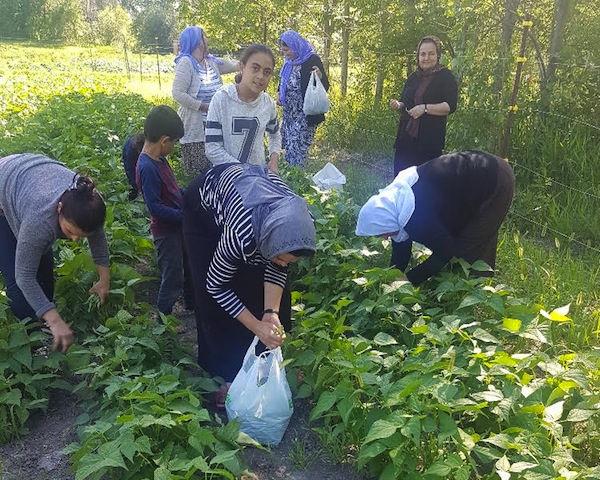
Operation Ezra in Winnipeg has expanded to include farming and selling local produce. (photo from Operation Ezra)

When the Operation Ezra committee in Winnipeg decided to produce a book about the efforts of Yazidi-Winnipegger Nafiya Naso and Operation Ezra, the local Yazidi community was very excited about the idea, about passing down their story in writing to future generations, as their tradition is largely oral.

Operation Ezra: Winnipeg’s Jewish Community-Led Interfaith Response to Survivors of the Yazidi Genocide was launched on Sept. 24 at the JCC Berney Theatre. The event included a few words from the author, Chana Thau, as well as from Operation Ezra (OE) leaders, and a panel discussion. The 71-page paperback includes photographs, interviews and various facts about the Yazidis and how OE came to be, among other things.

“When I first held the book in my hands,” said Naso, “it felt really special and I felt really proud of everything we had accomplished. Having it all in one text to give to people in the community and outside the community, to show what a small group of individuals was able to accomplish in the span of four-odd years, I’m very proud of it.”

Belle Jarniewski, director of the Jewish Heritage Centre of Western Canada (JHCWC), who has been involved in OE since its inception, said it was a grant from the Jewish Foundation of Manitoba that allowed the book to be published.

“By the time the book was written, there was so much more that we had done, but we thought it would be a nice way to let more people know about this wonderful multifaith initiative,” said Jarniewski.

Each of the families that OE brought to Winnipeg was given a book, including the most recent new-to-Canada family of 10, who had arrived just before the book launch.

Apart from OE’s ongoing efforts to bring more refugees to safety in Winnipeg, the endeavour has been helpful in settling the families already there. Both Nafiya and her sister, Jamileh, were invited to separate events in Europe over the summer to share the story of OE and some insight as to why it is so successful.

“We don’t really know if Operation Ezra can really be done anywhere else,” said Nafiya Naso. “Just because the community here is so welcoming and open, and it would be ideal if every city and every country in the world was like this … realistically, it’s not. Within the larger spectrum of the refugee crisis, a lot of people have very negative perceptions of refugees, without knowing the different types and layers of what refugees are, who they are, and things like that. So, even for us, education was a huge piece – letting people know who the Yazidis are and what’s happening.”

A group of individuals in Germany has been eager to incorporate some of the OE approaches. Naso said one of the main things that has made a huge difference is that OE is multifaith. She suggested that people wanting to undertake similar initiatives start by reaching out to faith-based communities and local businesses to find out who might want to become involved.

One of the more recent aspects of OE that has caught the attention of other communities around the world has been the farming project that started up two summers ago on a small plot of land.

“We had one of our volunteers whose father was a farmer with a lot of land, a potato farm, so some of the community went and helped out and got huge bags of potatoes after, and we had media coverage of it,” said Naso.

“The pastor from Charleswood United Church connected us to the owner of Shelmerdine Garden Centre,” she added. “He donated about five acres of land this summer and the community was harvesting it and they were able to sell some of the leftover produce and make money, and that money then came back into the community.

“This is not only a way for them to work and be involved in the community, but it’s also very therapeutic, especially for the women who have gone through the brunt of what ISIS committed and is continuing to commit.”

The land is located just outside of Winnipeg’s city limits. The families worked together and carpooled there to grow and harvest the produce and sell the excess at Shelmerdine, the Rady Jewish Community Centre and Charleswood United.

“Almost all of our families have vehicles, so everyone will go pick up a couple people, and that’s how we transport everyone,” said Naso. “A couple of times, too, we’ve used a bus, bringing the whole community out there – the kids and everyone – renting a bus or two to get everyone out there.”

“This has been just such a wonderful experience for them,” Jarniewski said, “because this is what most of them already knew, what most of them did in Iraq. Not only have they grown food for themselves, but they have been selling the produce. So, this has been a very positive project and we hope to expand it more next year. They will be able to feed the Yazidi community all winter with the kinds of vegetables you can put into cold storage, like beets and potatoes.

“Now, it’s an exponential growth. They really grew all kinds of things. I would see them here, at the Rady, when they were selling celery, beets, onions, zucchini, you name it … even mint and basil.”

Operation Ezra: Winnipeg’s Jewish Community-Led Interfaith Response to Survivors of the Yazidi Genocide explains the background of the Yazidis, a monotheistic religious minority in northern Iraq that was displaced and persecuted by the Islamic State group in 2014. It also goes into the efforts of the Jewish community to lobby the federal government to bring Yazidis to Canada and to resettle families in Winnipeg via private sponsorship. Sales of the book ($10 each) support the ongoing Operation Ezra efforts – it can be ordered from Jewish Child and Family Service Winnipeg by calling 204-477-7430.

Rebeca Kuropatwa is a Winnipeg freelance writer.

Interfaith peace efforts

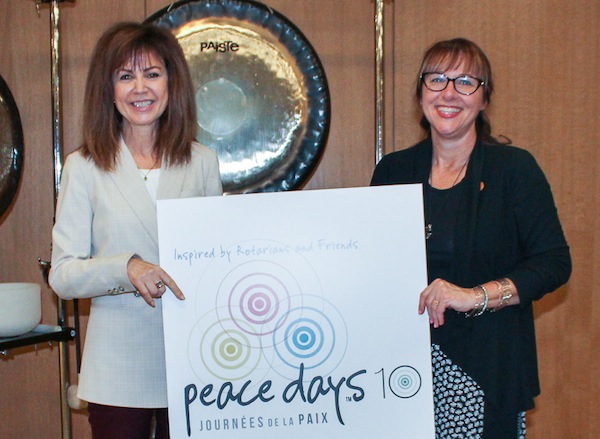
Belle Jarniewski, president of the Manitoba Multifaith Council, left, and Christine Baronins, public affairs director for the Church of Jesus Christ of Latter-day Saints. (photo by Miriam Nucum / CJCLDS)

Earlier this fall, the annual Meditation for Peace took place at St. Boniface Cathedral in Winnipeg. Led by a group that is part of the Archdiocese of St. Boniface, the silent meditation was part of Peace Days this year and open to the general community.

Peace Days, which are organized by the Rotary Club and others, have existed for a number of years and there are all kinds of different events that take place, focusing on different segments of the population.

“Originally, a group of planners associated with the Archdiocese of St. Boniface came up with the plan and wanted to include it as part of the Peace Days lineup,” said Belle Jarniewski, president of the Manitoba Multifaith Council and executive director of the Jewish Heritage Centre of Western Canada, about the Meditation for Peace. The archdiocese group wanted to bring the Manitoba Multifaith Council into the event in order “to have representatives from all the different faith communities bringing prayers for peace as part of the event, and to take part in the water ceremony.”

The aim is to schedule the meditation not too far into the year, so that it could be held outdoors. “But, the last couple years, the weather brought us indoors,” said Jarniewski.

Despite being held on the night of the provincial election, Sept. 10, some 130 people showed up – people of different faiths, backgrounds, ages and genders. The event began with an introduction by the archbishop of the cathedral.

“He did a little introduction and presented tobacco to an indigenous elder, who also provided an introduction,” said Jarniewski. “We went into a 15-minute silent meditation with a gong player. There were a few circular gongs there, so everyone was invited to close their eyes, relax and meditate to the sound of the gongs. Then, we proceeded to the prayers.

“Then, I called up the representatives from I think it was 10 different faith communities, with each one presenting a prayer from their tradition. Sometimes, it was just something that they themselves composed and sometimes it was something like, for example, from the Jewish community, Dr. Ruth Ashrafi, who read out Oseh Shalom [A Prayer for Peace] and translated it.

“Then, after each person presented their prayer, they took a small glass of water and poured it into a larger recipient, symbolizing the unity of all humans and all traditions.”

Jarniewski heard from several attendees that they learned of the event from an article in the Winnipeg Free Press, by the newspaper’s faith reporter, John Longhurst.

For her part, Jarniewski said, “What I do is I reach out to my board members and I ask them if either they or someone they could designate from their community could take part in it. Often, they will designate someone else.”

The Manitoba Multifaith Council, which started up more than 50 years ago, began as an Ecumenical Christian group, which later broadened to include Jewish representation. “Eventually, it really broadened to include people of many different faiths,” said Jarniewski. Currently, there are two Jewish board members.

“It’s also important to know that some of the people on the board actually represent their communities. For instance, we have a Roman Catholic priest who represents the Winnipeg Archdiocese and we have Greg Barrett, who represents the St. Boniface Archdiocese. But, for the rest of us … we are members of those communities, but we’d never claim to represent the community, because that wouldn’t make sense.”

When Jarniewski first joined, Jewish Child and Family Service’s Al Benarroch was on the board. Now, Ashrafi heads up the education committee.

“I’ve been president,” said Jarniewski. “This is my second term. JCFS is a community member of the organization and are particularly involved. They have a representative on the spiritual health committee, which is involved with the spiritual health of chaplains in hospitals, care homes, etc. There are various committees, like spiritual health, justice and corrections, and education and community relations.”

Rebeca Kuropatwa is a Winnipeg freelance writer.

Vancouverite’s novel on trail

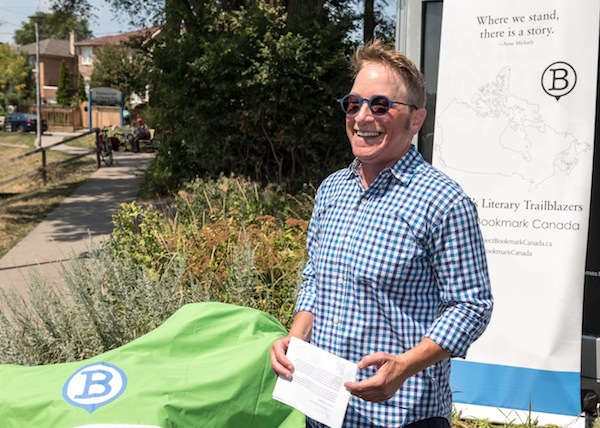
Vancouver writer Aren X. Tulchinsky at the Aug. 16 unveiling in Toronto of Project Bookmark Canada’s plaque honouring his novel, The Five Books of Moses Lapinsky. (photo by Lisa Sakulensky)

The Canadian Literary Trail has a new bookmark – one honouring The Five Books of Moses Lapinsky by Vancouver writer Aren X. Tulchinsky. The 25th such plaque to be erected by Project Bookmark Canada across the country, the unveiling took place Aug. 16 in Dominico Field at Barton Avenue and Christie Street in Toronto. Tulchinsky took part in the ceremony.

“Last October, I received a phone call from Laurie Murphy, executive director of Project Bookmark Canada, letting me know my historical novel The Five Books of Moses Lapinsky was nominated for a bookmark,” Tulchinsky told the Independent. They chose to unveil the plaque on Aug. 16 because it is the day on which the 1933 riot in Christie Pits took place.

Surprised and thrilled to hear that Project Bookmark Canada and the City of Toronto would be erecting the plaque in honour of his book, Tulchinsky said, “I was particularly struck by the timing, when, right now, we are all being called upon to make sure that dark chapters of our history do not repeat themselves.”

He explained, “My novel is about a fictional Jewish Russian immigrant family, living in the Kensington Market neighbourhood in the 1930s and ’40s. The main character, Sonny Lapinsky, is a Jewish boxer. He is 9-years-old … when the riot in Christie Pits occurs and, on that night, he discovers he has boxing talent and goes on to become a professional boxer. That same night, tragedy strikes the Lapinsky family.

“Many Canadians are not familiar with the 1933 riot, which involved 15,000 people and is the largest race riot ever to occur in Canada. A group of British- and German-Canadian young men, members of the Swastika Club, set off the riot when they unfurled a huge, black and white swastika flag in Christie Pits during a packed amateur league baseball game on a hot August night. The Project Bookmark plaque in Christie Pits will bring greater awareness to this piece of Canadian history and, of course, to my novel.”

Project Bookmark Canada was founded by writer Miranda Hill in 2007, with the first plaque being unveiled in 2009 – for Michael Ondaatje’s In the Skin of a Lion, at the Bloor Street Viaduct in Toronto. There are bookmarks from British Columbia to Newfoundland. Vancouverites have easy access to Bookmark No. 12, which commemorates Wayson Coy’s The Jade Peony, at the southeast corner of Pender Street and Gore Avenue in Chinatown.

“Visitors are encouraged to read their way across Canada, online and in person,” said Project Bookmark board of directors president Hughena Matheson in the press release about Tulchinsky’s honour. “A launching place for conversation, collaboration and learning, the bookmarks provide a unique reading experience and a deeper understanding of the country and its people.”

“I think Project Bookmark Canada is an important organization,” said Tulchinsky. “Their goal is to get people to read Canadian books. It is vital to celebrate our unique Canadian history and, sadly, our country is constantly in the shadow of the U.S., with American books filling our bookshelves. With the loss of small independent bookstores across the country who used to promote Canadian authors, and with people buying books online from huge American corporations, many excellent Canadian books go unnoticed. As a Canadian and as a writer, I applaud the work Project Bookmark Canada is doing to bring Canadian stories to the forefront.”

photo - The Five Books of Moses Lapinsky bookmark text
The Five Books of Moses Lapinsky bookmark text. (photo by Don Oravec)

At the Aug. 16 unveiling, Tulchinsky read the excerpt of his novel – published under the name Karen X. Tulchinsky – that appears on the plaque. “It is the moment when, in 1933, the Swastika Club unfurled a huge swastika flag at the ninth inning of an amateur league baseball game in the park. All summer, the Swastika Club had been bullying Jews on the beaches of Toronto. On this day, they upped the ante and brought their antisemitism to the west side of town, which was mostly Jewish and Italian immigrants. After a summer of being kicked off the beaches, young Jewish men fought back. And, interestingly, the Italian men in the park joined the Jews in fighting against the Swastika Club and their allies, in what became the largest race riot ever to occur on Canadian soil.”

“Our past president, Don Oravec, spoke at the unveiling and said the novel was on his radar as a potential bookmark,” Project Bookmark’s Murphy told the Independent of how The Five Books of Moses Lapinsky was selected. “When Daniel Gelfant made an official submission to us to consider the book and its variety of Toronto settings as potential bookmarks, the wheels were set in motion. The board’s national bookmark advisory committee reviewed the proposal and approved it for development. Councilor Joe Cressy made a motion to the City of Toronto to provide funding in support of a bookmark for the Christie Pits ball field, on the anniversary of the riots in 1933. It was approved, and subsequently developed. Additional funds were raised by individual donors attending a bookmark fundraiser on Aug. 15, complete with a boxing demonstration by the author and the Toronto Newsgirls Boxing Club at Jazz Bistro.”

When he first started writing the novel, Tulchinsky, who was born in Toronto, said it “was loosely based on stories my grandfather had told me about his escape from Russia before the Second World War and his early days in Toronto, where his first home in Canada was in the Kensington Market area.

“When I started researching the Jewish community in 1930s Toronto, I discovered the riot that pitted young Jewish men and their Italian allies against the Swastika Club and their gentile allies…. As a Canadian Jew, I knew immediately that I would tell my story against this backdrop, an important piece of our history that had not yet been told in fiction. So, I created a fictional family, with four sons, all of whom get involved in the riot in different ways. On the night of the riots, one of the brothers is permanently injured in a way that shatters the family, especially the main character, Sonny, whose guilt over what happened to his brother causes a rift between him and his father, that sends the family into turmoil.

The Five Books of Moses Lapinsky, which takes place … when Hitler first came to power in Germany, and continues through the Second World War years, is about antisemitism in Canada,” he said. “It’s about how hatred only leads to more hatred and violence. At the risk of sounding like the Vancouverite I am, I believe the only cure for hate is love. Sadly, history tends to repeat itself and, today, in 2019, we are seeing a rise in hate crimes in Europe, the U.S. and here in Canada against Jews, Muslims, South American migrants and the LGBTQ community. We are witnessing the president of the United States taking children away from their asylum-seeking parents and imprisoning them in what can only be called concentration camps. The themes in my novel, sadly, are just as relevant today as ever. I hope people see the parallels in the fascism that swept the world in the 1930s with what is happening today. I just keep hoping that humans will find a better way forward that does not repeat the mistakes of our past.”

And Tulchinsky continues to examine that past.

“I am currently working on a new novel, set in 1930s Berlin, in which I follow fictional characters (Jewish and non-Jewish) as Hitler first comes to power. In the story,” he said, “we watch as the Jewish characters are systematically stripped of their civil rights, then their livelihoods and, eventually, their lives. For my research, I have read hundreds of books on the Holocaust and the rise of the Nazis in the 1930s and I can tell you there are many policies the Trump administration is pursuing in the U.S. that are taken directly from Hitler’s playbook. In the current climate, with antisemitism, racism and homophobia on the rise, I feel particularly driven to finish and publish this new novel.”

To find out more about the Canadian Literary Trail, visit projectbookmarkcanada.ca.

Election date remains

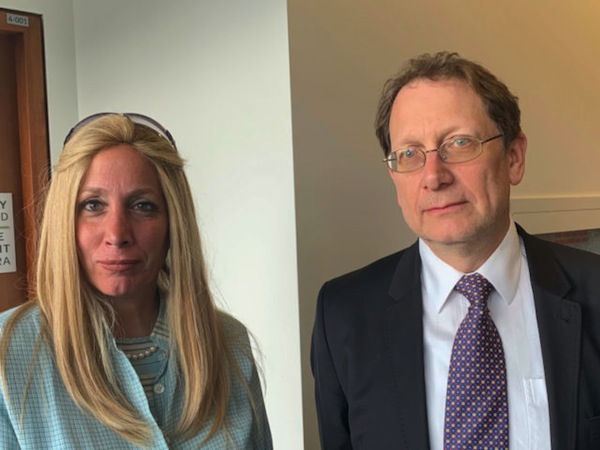
Conservative candidate Chani Aryeh-Bain, left, and activist Ira Walfish at Federal Court in Toronto on July 16. (photo by Ron Csillag/CJN)

Last month, Elections Canada announced that it will not recommend that the date of the next federal election be changed, despite pressure to do so because it clashes with the Jewish holiday of Shemini Atzeret.

Moving the date “is not in the public interest,” Chief Electoral Officer Stéphane Perrault said in a statement on July 29. Only a few days earlier, the Federal Court of Canada ordered Perrault to reconsider his earlier refusal to move the date of the election – Oct. 21 – after it heard from observant Jews who pointed out that they cannot drive, campaign or vote on a holy day.

Lawyers for Chani Aryeh-Bain, the Conservative candidate in the Toronto riding of Eglinton-Lawrence, and Ira Walfish, an activist and voter who lives in the York Centre riding, had argued before the court that Perrault’s refusal to move the date to Oct. 28 was unreasonable and that they, along with 75,000 other Orthodox Jews in Canada, faced discrimination under the Charter of Rights and Freedoms. The court gave Perrault a deadline of Aug. 1 to strike a balance between election laws and the rights of Orthodox Jews to vote and campaign. He was not empowered to move the date himself, but could recommend that cabinet do so.

However, “after having carefully considered the impact of holding the election on Oct. 21 on the ability of observant Jews to participate in the electoral process, and having balanced that with my mandate to ensure accessible voting opportunities for all Canadians, I conclude that it would not be advisable to change the date of the election at this late stage,” Perrault stated. It was “not a decision that I make lightly, but with a view to providing the broadest possible range of accessible voting services to the population at large.”

In a written statement to the CJN, Aryeh-Bain, who had argued that, as an observant candidate she was prevented from getting out the vote on election day, said she was “extremely disappointed” with Perrault’s decision.

“We do not believe he balanced the democratic and religious rights of Jewish voters and candidates,” she said. “He has 85 days to prepare for this election – almost triple the amount of time than he has to prepare for a snap election. Why Perrault has dug his heels in is mystifying to me.”

Perrault acknowledged that, in the case of Aryeh-Bain, the effect of not moving the election date “is very significant.” He conceded that “no arrangement can be made that would truly allow her to meet her religious obligations and compete on equal terms with non-observant candidates.”

At a press conference at B’nai Brith Canada’s offices on the day of the decision, Walfish said, “We are obviously very disappointed. We do not agree that the [chief electoral officer] balanced the relevant interests in his further decision to not move the election.”

Walfish said that Orthodox Jewish-Canadians “will not participate in this election on an equal footing with other Canadians, not by design or choice, but because their conscience prevents them from doing so.”

Aryeh-Bain and David Tordjman, an observant Conservative candidate in Montreal, “are both seriously disadvantaged with an election on Oct. 21,” said Walfish.

In an 11-page statement, Perrault referenced a detailed “action plan for observant Jewish community voting,” which was launched in April. The statement noted that the Orthodox Jewish population is primarily located in urban areas in 36 of the 338 federal ridings. It said that those ridings range from one to 13.4% Jewish, according to the 2016 census, “which makes it possible to design local solutions … to ensure that Elections Canada’s services are targeted and responsive to local needs.”

Perrault took note of the argument presented in court that the four days of advance polls, from Oct. 12-15, reduce the ability of religiously observant Jews to cast ballots because they coincide with Shabbat and Sukkot. However, Perrault pointed out that there are many days during the election period in which observant Jews can vote, including by mail-in ballot, at an Elections Canada kiosk, or at one of roughly 115 post-secondary campuses from Oct. 5-9.

Moving the election date “will not remove all of the barriers that Jewish electors face in voting this election cycle,” Perrault stated. And if the date were moved, “the new dates for the advanced polls will also overlap with Jewish holidays,” he said. “There is no such thing as a perfect election day, especially in a country as diverse as Canada.”

Michael Mostyn, B’nai Brith’s chief executive officer, said Perrault’s decision was “just as wrong” as his initial refusal to move the date. He said Perrault’s admission that observant candidates cannot compete equally with non-observant ones is “a red line” for B’nai Brith. But Elections Canada has “run out the clock” because of the Aug. 1 deadline for setting an election date, he noted.

Mostyn called on “every Canadian Jew who is capable of doing so [to] cast a ballot via advanced polls or special ballots” and on Jewish voters to ask candidates whether they support changes to elections laws, to ensure that voting does not fall on a Jewish holiday again.

The Centre for Israel and Jewish Affairs (CIJA), on the other hand, said it “respects” Perrault’s decision.

“While mindful of the inconvenience that some will experience and the clear disadvantages faced by a religiously observant candidate, we trust that those challenges can and will be mitigated by the measures put into place by Elections Canada,” said CIJA chief executive officer Shimon Koffler Fogel in a statement.

CIJA said it, too, will focus on changing election dates, which have been fixed since 2007, so they no longer clash with Jewish holidays.

Perrault said he is “committed to continuing to work with the Jewish community to maximize voting options within the existing calendar in ways that are convenient and consistent with their religious beliefs.”

– For more national Jewish news, visit cjnews.com

Billinkoff runs in record time

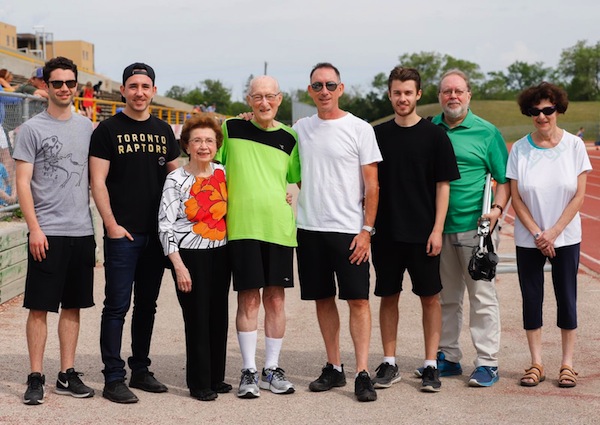
With Lou Billinkoff, fourth from the left, are, from left to right, his grandson Asher, grandson Jordan, wife Ruth, son Errol, grandson Mitchell, son Lorne and daughter-in-law Marilyn. (photo from Lou Billinkoff)

Growing up in Winnipeg’s North End, Lou Billinkoff, 96, was never into sports, though, in his 20s, he did enjoy going for a jog once in awhile. Today, he is one of the fastest short-distance runners in his age group.

“I used to do some running but I never thought of it as competitive,” Billinkoff told the Independent. “I just ran for the pleasure of it when I was younger.”

Billinkoff worked as an engineer with Winnipeg Hydro (now called Manitoba Hydro) for 40 years, designing power lines. When he was well into retirement, at the age of 89, he had a heart attack.

“When I was recovering, the doctor suggested I take some rehab physical therapy at a centre they have here, a program specially suited for people recovering from heart attacks,” said Billinkoff. “Part of the program is to walk on a track. I did that for maybe a year and, when I recalled how much pleasure I got when I ran earlier in life, I thought I’d just try it out and see what I still could do.”

The first time Billinkoff tried, he could only run 40 metres but, more importantly, he liked it. Two days later, he ran 45 metres, and kept on adding distance with each try. Eventually, he was running well over 100 metres and loving it. So, he decided to set up a training program and reached the point at which he could run 100 metres 10 times in one session – a feat he refers to as “running a kilometre.”

“I did that for about two years,” said Billinkoff. “After that, I found it was getting too hard, so I went down to five times 100. Gradually, I found this too was getting too hard, so this past year or two, I’ve been running 50 metres.

“When I was running the 100 metres, my son, Errol, clocked me and said, ‘You know, you’re running in championship speed rankings?’ This was a surprise to me. Errol suggested I get into competition. I wasn’t really interested to pursue it, but Errol entered me into a competition here and, the first time I ran, I ran quite well.”

Nowadays, Billinkoff runs 50 metres three times per workout session at the Reh-Fit Centre, where he goes three times a week. While he ran outdoors when he was younger, he feels that, at his age, it is wiser to run at the centre.

“Going outside has limitations,” he said. “The weather is not always good. You can fall and break your neck and nobody would see you. It’s not a good idea to be running outside.”

Once Billinkoff hit the competitive circuit, he began sending his running times to Athletics Canada.

“The way the rankings work is that age groups go in five-year periods,” he explained. “So, when I started out, I was in the age group of 90-94. They call that the M90. Now that I’m 96, for the last year and this year, I’m in the M95 group, which is 95 to 99.

“In the M90 group, I had the fastest time in Canada, at 29.73 seconds. And, in the M95 group, in the 50-metre record, my time indoors was 14.58 seconds; a good speed. Later, I ran the outdoor in 15.68 seconds, and I had strong wind against me. It took me a second longer and I attribute that to the wind.”

In most races, Billinkoff has been the only runner in his age category, often running with people half his age.

“There are so few people my age running that you very seldom – unless you live in New York or Chicago – get more than three or four people running in my age group,” said Billinkoff. “I don’t think it’s worth the effort for me to spend several days of discomfort and hardship [traveling] to run for a couple of seconds. They have a Canadian registry where all the Canadians who are competitors send in their results and they set up their rankings. Then, they send it to a world organization that sets up the rankings throughout the world.”

A few years ago, Billinkoff hired a coach for a few months. “He gave me some tips about getting away fast from the start,” said Billinkoff. “And he explained that running is just as much psychological as it is physical. He helped me, psychologically, to have confidence, and that’s very important.”

For now, Billinkoff is keeping up with his training, hoping to compete again next summer. He will continue to do so, he said, “as long as I’m able, and I get pleasure out of it.”

Rebeca Kuropatwa is a Winnipeg freelance writer.

Safe spaces, diverse voices

Bradley West and Shayna Plaut (photos from conference organizers)

As part of Winnipeg Pride Week in May, local organizers put on the first-ever Queer and Faithful Conference.

A grassroots event created to give voice to LGBTQ2+ people of colour and their experiences with faith and spirituality, the conference featured two panel discussions with opportunity for informal roundtable discussions. The keynote speaker at the May 25-26 conference at Robert A. Steen Community Centre was writer, facilitator and performer Jenna Tenn Yuk. She spoke about exploring identity and the intersections of race, queerness and faith through personal storytelling, spoken word poetry and facilitation; encouraging interfaith conversations around intersectionality, privilege, social location and other aspects; creating safer spaces for LGBTQ2+ people of colour in faith-based environments; and ensuring safe spaces to ask questions and explore the issues as a community.

Bradley West, who has been involved with Winnipeg’s queer community for more than 20 years, and Shayna Plaut, a former Vancouverite who now lives in Winnipeg, were part of the conference’s Jewish panel.

“I think the conference came about because there were people who had been talking about the importance of keeping their faith, while also celebrating their gender and sexual diversity, and there were some people who were finding that to be a little difficult,” West told the Independent.

Explaining that it was an uncomfortable topic for many people in the broader queer community, he said, “In fact, one of the members said, on Saturday, that, ‘because faith rejected us so soundly, we have rejected faith.’ We need to create a safe space where we can come together and have these conversations – where people from the various faith communities and also from the queer community can come together in a mutual space.”

While such conversations have been going on for some time, typically led by faith leaders and queer community organizers, the aim of the recent conference was to offer a more personal approach.

“The organizers wanted to have voices of the people who are more marginalized in our community, because of their skin tone, or religion, or spirituality, or faith,” said West. “They wanted to make sure it wasn’t just centred around white voices; white, Christian voices….. Oftentimes, when we are having conversations about faith in this Canadian landscape, we default to the dominant voice which, in our historical context, is Christian.

“So, they definitely had a lot of Christians who were there and who were involved, but, in terms of the planning and the panel speakers, and in terms of how they wanted people to think, was thinking of how we might be able to create an open dialogue with each other … to be able to, first, honour our own faith journey, but then also to understand the faith journey of others, especially when that faith journey is very different from our own.”

According to conference organizers, 70 to 80 people attended over the two-day period, with attendees coming from Winnipeg, as well as from surrounding areas, such as Morden, Selkirk, Steinbach and Portage La Prairie.

“From what I experienced, everyone … was approaching it with a spirit of reflection,” said West. “They were definitely gently challenged by the speakers to reflect on their own personal participation in terms of do you really believe your faith is the only faith or the true faith … and does that subtly reinforce this idea that those who are different are ‘less than’?”

The speakers, he continued, “were gently challenging people to think about how we interact – not only with the different denominations in our faith, but everyone of Abrahamic faiths, with different strings of denominations, and also those outside of some of the faiths … different groups practising different versions of the larger faith. Sometimes, we have a tendency to think that our journey and our view is the view that is shared by everyone in our faith … and so, there were those gentle reminders to reflect on that. Overall, as a participant, I would say there was a sense of a call to self-reflection, and there wasn’t any resistance in terms of the intent to self-reflect, for sure.”

For West, one thing that struck a chord was that, even though he was in a room full of strangers at the beginning of the event, everyone got to know one another very quickly. “I think it was very much about, yes, we have differences, but we also have commonalities and, as we move forward, we need to look at both … have a bifocal lens in honouring our differences – not minimizing or whitewashing, or asking us to abandon our differences in order to get along … just focusing on our similarities. We’re going to honour that and work together, and look at how we’ll create spaces and places within our own lives. And then maybe, by extension, our own communities will allow more of these dialogues.

“The gathering had the flavour of us coming together and having these conversations, and continuing to do so outside of this space,” he said. “That core that comes from great changers, like [Mahatma] Gandhi, talking about that idea of, if you want to change something, first, change yourself, because, wherever you go, there you are. If you change yourself, you’ll automatically change the spaces you go into, because you are no longer the same person.”

Plaut’s faith has changed over the years. Born into a Chassidic home in the United States, her family decided to follow Conservative Judaism when she was 5.

“The joke I like to say is, I’m queer, I’m Jewish, I’m a mom, I have seven tattoos, 13 earrings, and I keep a modicum of kosher,” said Plaut. “I teach at the University of Winnipeg and work in the field of human rights and journalism.”

When asked to help organize the conference, Plaut jumped at the chance. She took on the role of food coordinator and ensured all the food was vegetarian, so that everyone could eat, regardless of their religious or dietary restrictions. She also took it upon herself to make sure that not only the Abrahamic faiths were represented, but also Hindu or Sikh, by reaching out to some of her students.

“Folks would use their own experiences and explore some of the strengths that they found within their faith and also some of tensions,” said Plaut about the conference. She said that some people feel like they have to choose, in terms of their identities – religious, cultural and sexual – and that the conference encouraged an exploration of various faiths’ strengths and limitations in terms of guiding people, and what it means to find acceptance within a faith.

The conference attracted a range of attendees.

“Many of the folks who came, not all, but a good proportion, may not have identified as being queer themselves,” said Plaut. “Many of them were grandparents, actually, or parents who wanted to know how to better support their children or grandchildren. They wanted to learn.”

While organizers worked hard to share with and connect people, they left it up to the participants whether to exchange their contact information with one another. Some attendees expressed interest in continuing the conversation beyond the conference and organizers are working on determining the next steps. Many of the participants joined the nearly 50,000 marchers at the Winnipeg Pride Parade, which took place June 1.

“It was amazing, our biggest Pride ever in terms of participants in the parade,” said Plaut. “There were over 112 organizations that registered either floats or walking groups.”

Rebeca Kuropatwa is a Winnipeg freelance writer.

Inspired by a fellow activist

Katie Delay, left, and Sunny Enkin Lewis are co-presidents of Grant Park High School’s Students for Social Justice. (photo from Sunny Enkin Lewis)

Earlier this year, Winnipeg Grade 12 student Sunny Enkin Lewis won first prize for her age group in A&E network’s contest Lives That Make a Difference. The contest receives hundreds of submissions from all over Canada.

“The prompt [for the contest] is along the lines of, ‘Write an essay about someone who has made a significant contribution to Canada in 2018,’” Enkin Lewis told the Independent. “So, I wrote about Autumn Peltier, who – I believe she’s 15 now, around there – is an indigenous water keeper. She’s an activist for clean water in indigenous communities in Canada. She’s spoken at the UN, she’s spoken to Prime Minister Justin Trudeau. So, she’s done a lot of amazing activism.”

Peltier is Anishinaabe and is from the Wikwemikong First Nation on Manitoulin Island in northern Ontario.

“I chose her for a couple reasons,” said Enkin Lewis, who was born in Toronto, but has lived in Winnipeg for the past 10 years. “First of all, I think her cause is really important in Canada. I’ve always been really upset with Canadian society and government, because we tend to look at ourselves as pretty flawless in terms of human rights. And, it is true that the quality of life for Canadians, overall, is really good. Yet, there are people, a lot of people, who don’t have the most basic of their needs met – water and shelter … and I think she has brought more awareness to that.”

In her essay, Enkin Lewis points out that Peltier not only stands up fearlessly for this cause, but that she does so from a unique worldview as an Anishinaabe person.

“She thinks of water as deserving of rights,” said Enkin Lewis. “That’s not something we would generally think of and I think it’s a really strong statement – that someone can stand up and speak of things in a way that contrasts the common logic of general Western ideas. I think that helps validate indigenous worldviews in a Western context a little more. Also, I was just inspired by her, as a young woman. I think it’s so important that young people’s voices are heard and that’s how I believe change will happen the fastest – if young people are given a platform and are accepted and respected – and she really embodies that.”

As for as why Enkin Lewis’s essay may have been chosen, she said, “I think my choice of person was really relevant in Canada today, especially since, now, I think, there’s a big focus on indigenous rights, and I think it was maybe a bit refreshing to see someone like that. I haven’t read the other people’s essays, and they didn’t tell me why mine was specifically chosen … just that they thought it stood out.”

Growing up, Enkin Lewis learned that “a big thing in Judaism is valuing life over everything, and knowing the value of human life. And, I think a big part of Judaism is also just respect for people and … everyone should have a good quality of life.

“The fact that, here, in Canada, there are people who don’t have their basic needs met, I think that’s not OK in Judaism. I think it’s important for other cultures to listen to each other, just as I think it’s important for Christian people to listen to Jewish people. And, I think it’s important for Jewish people to listen to indigenous perspectives. As a European Jew, I’m not native to this land … and it’s important to respect the people who are the caretakers of this land and who have been for thousands of years.”

Last year, Enkin Lewis led the organizing of a social justice conference at Grant Park High School, which, in turn, led to the development of a student social justice club at Grant Park. Enkin Lewis and co-president Katie Delay created the club and, because they and the teacher involved in helping to form the group will have left the school by the start of the next school year, Enkin Lewis hopes the younger members will pick up the ball.

“I think our club is very student-centred, very much about what we care about right now, and it gives me and other people an opportunity to get involved in a safe and constructive way,” she said.

As Grant Park has many newcomer Yazidi students, events organized by the club have been focused on building community awareness of the Yazidi situation.

“We did a drive for school supplies for underprivileged students in Winnipeg, and the biggest thing we’ve done is organize a coffeehouse and a couple other events for Yazidis with the help of a local organization called Operation Ezra. We had a bake sale where we sold traditional Yazidi foods, a Yazidi dance class to educate people about the culture, etc. I find that people are not really aware of what’s happening to the Yazidi people.

“We had a coffeehouse in the evening and invited community members, students, parents, anyone to come. There were student performers and a speaker talking about what’s happening, and a Yazidi performer.”

Enkin Lewis’s essay win comes with a $3,000 cheque for her and a $1,000 cheque for her school. She plans to follow her family’s Jewish custom of donating a portion of everything they earn. “I haven’t narrowed it down to a specific organization yet,” she said, “but I’m going to donate it basically to her [Peltier’s] cause – water in indigenous communities. Other than that, I will probably put it toward my education.”

Rebeca Kuropatwa is a Winnipeg freelance writer.