Working to save our oceans

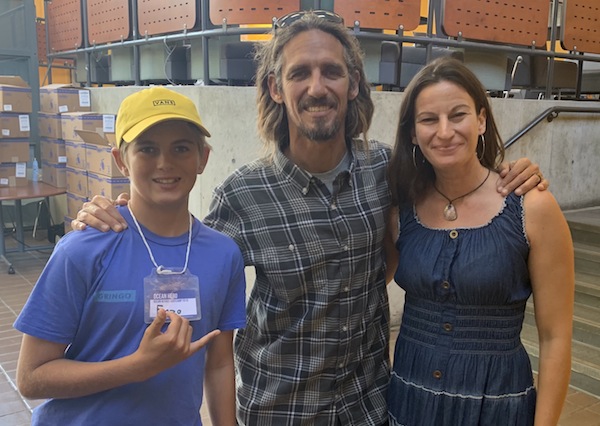
Chatting surf, water refill stations and plastic pollution at Ocean Heroes Bootcamp, left to right: Enzo Ackermann (Ocean Hero), Rob Machado (professional surfer/environmentalist) and Sondra Weiss (art educator). (photo from Sondra Weiss, Founder, Lost Art of Love Letters)

Organized and led by Captain Planet Foundation and Lonely Whale, Vancouver’s Ocean Heroes Bootcamp has a singular purpose – finding ways to save our oceans from plastic pollution.

One of the bootcamp presenters is Sondra Weiss. She offers participants a unique way to inspire action.

Having grown up in Connecticut, close enough to the ocean to fall in love with it, Weiss then went to the University of California. After graduating, she took an art museum educator position, a role she maintained for about two decades. Eventually, however, her love for the ocean drew her to start up the Lost Art of Love Letters.

“I launched this project about four years ago, thinking the world needs more love,” Weiss told the Independent. “As I listen to the news, or my students, or people in the world committing suicide, I just thought that love is a great antidote for everything happening in the world.”

Weiss lives in Santa Barbara, Calif., and was asked to come to Vancouver last year to help with the Ocean Heroes Bootcamp.

“Last year was the second year that they did Ocean Heroes, when I was in Vancouver,” said Weiss. “It brings together 250 local and international youth activists between the ages of 11 and 18, from 20 countries and 24 U.S. states, and the idea is to collaborate worldwide to fight plastic pollution.”

Based out of the University of British Columbia dorms and hosted by Ocean Wise and the Vancouver Aquarium, the next bootcamp is scheduled for June 26-29, though that may change depending on the progress made dealing with the COVID-19 pandemic. Weiss is to lead a part of it called Love Letters to the Sea.

“It is an art-integrative letter-writing project that promotes positive changes for the ocean,” said Weiss. “So, rather than feeling overwhelmed by environmental issues, community members can take action and promote innovation by using their voices to drive policy solutions.

photo - A lot of the letters are sent out to local businesses, council members and political figures to say either thank you for the work they do for the ocean environment, or to ask them to make changes
A lot of the letters are sent out to local businesses, council members and political figures to say either thank you for the work they do for the ocean environment, or to ask them to make changes. (photo from Sondra Weiss, Founder, Lost Art of Love Letters)

“Participants take pen to paper and brush to paint to express their sentiments, their solutions, for ocean love. And, a lot of the letters are sent out to local businesses, council members and political figures to say either thank you for the work they do for the ocean environment, or to ask them to make changes.”

Last year’s focus was on eliminating single-use plastic bottles. Participants were tasked with developing ideas to help the community achieve this goal.

“As mentors in bootcamp, in general, we come up with ideas and have the youth collaborate, come up with campaigns and talk to experts in different fields, figuring out how to create the most change, being creative and positive the whole time,” said Weiss.

Each Ocean Heroes Bootcamp draws many different people from all around the world, she said, including youth who have created changes in their community or on a wider scale.

“There are experts leading panels, workshops and group activities … and Love Letters to the Sea, my personal activity, is more artistic-based,” she said. “So, there are writing prompts for writing, but there are also images to inspire art. There are watercolours, crayons and coloured pencils for campers to express themselves in various ways.”

While there are age gaps, some of the younger kids have inspired more change than some of the older ones. Regardless of age, all are passionate about the issues and put any age-related ego aside to learn from and with one another, said Weiss.

“One of the beautiful things is that youth from all around the world are working together toward the one topic – and the topic is plastic pollution, what plastic pollution and consumerism is doing to affect the planet as a whole,” she said.

Weiss hopes that the letters “help motivate the people doing good work and also helps the community to remain civically engaged … and be part of society, knowing we can make change and, as an educator, working with youth shows them to use their voice for change.

“We can use that same thing – the letter writing, it has been tried and true throughout the years. When someone wants to try and make a decree, the people will use a letter. Or, to really express something to a friend going through a hard time, or a family member, a lot of times, we’ll take pen to paper and write it down. It’s a great way to slow down. We live in such a fast-paced society. We need to slow down and really think about what’s in our hearts.”

Still, Weiss is well aware of the power of technology when well-used. She has worked with Jack Johnson’s band to create a song written by middle school kids who wrote love letters to the sea.

“They took lines from the letters, which became lyrics for a song,” said Weiss. “Letters are personal, but the way to reach the masses is through music and video. And, we created it into love letters, which are strong and powerful.”

Some of the lyrics produced include: “Water can’t be broken, but we can make her cry / Going to write a love letter to the ocean, let her know we are always going to try.”

“It was phenomenal that the students got to express themselves and sing it out,” said Weiss. “They wrote the notes and the music, and then we went into a recording studio and recorded a different version.

photo - Love Letters to the Sea works to create positive changes for the ocean and environment
Love Letters to the Sea works to create positive changes for the ocean and environment. (photo from Sondra Weiss, Founder, Lost Art of Love Letters)

“Letter writing is such a great way to get ideas onto paper and out of your mind and heart. The next stage is to bring music and video to a larger global audience.”

Weiss sees artistic letters as a gateway to reaching people on a different level, touching people’s minds in a different way to promote change.

“Images or music definitely help ignite that,” said Weiss. “For me, when you are talking to them and you see the light in their eyes go up, you see them drawn into the conversation.

“So, what does it takes to ignite someone to care? That’s what I ask at the bootcamp. I ask the youth if they are going to write an organization and ask them to limit their plastic packaging. And I ask them what they think would get them to consider the financial cost … and think more about the overall cost, the environmental cost. We learn so much from the kids and they inspire us as much as we inspire them – and the relationships maintain year-round.”

While Ocean Heroes Bootcamp is free to attend for accepted youth and their chaperones, including room and board, there is a $100 reservation fee and travel costs that may be waived via scholarship. All applications to attend the bootcamp are reviewed by Captain Planet Foundation and Lonely Whale. Qualified candidates are contacted by the Ocean Heroes headquarters team to complete registration.

The Ocean Heroes HQ team accepts a maximum of 300 youth leaders each bootcamp. Each attendee is paired up with a team of squad leaders, peers who guide them through the program and ensure they have the tools, support and information they need to graduate from the camp with a successful campaign plan to eliminate plastic pollution. For more information, visit oceanheroes.blue.

Rebeca Kuropatwa is a Winnipeg freelance writer.

Baking under quarantine

These “quarantini” cookies were baked by Lynne Altow and her aunt, Alexandra Altow. When Queen’s University closed earlier this month, Lynne stayed at her uncle David and aunt Alexandra’s house in Toronto on her way home to Vancouver, where her parents, Lisa and Andrew Altow, and grandparents, Bill and Debby Altow, live. Debby shared this photo with the Independent.

Supporting gender diversity

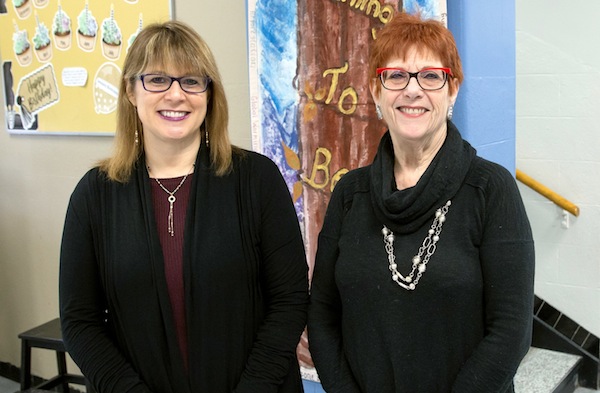
Ara Morris, principal of Brock Corydon School, left, and Naomi Finkelstein, co-founder of Parents Family Friends of Transgender Individuals. (photo from Morris and Finkelstein)

The Winnipeg School Division recently assembled a panel to discuss ways to best support trans and gender diverse children and youth, especially in school settings.

Ara Morris, principal of Brock Corydon School, was invited to sit on the Jan. 22 panel, which took place at Prince Charles Education Resource Centre. “Our school has been very active in talking about gender,” said Morris. “We’ve been making changes to our school as a result of having children in our school who are transgender. We want all of our students, all of our families, to feel included, important, and as equal members of our community and so, to do that, sometimes we have to reflect on the different ways that we are speaking, the different language that we are using.

“We know that many times children identify themselves in all different ways,” she said. “We want to be respectful of that. We have had a lot of professional development for our teachers and that has included programs from the Rainbow Resource Centre,” which offers support, counseling and educational programs for LGBTQ2S+ individuals and allies.

Brock Corydon has invited the parent of a transgender student to speak with school staff, and teachers have led sessions among themselves, as well as having had other teachers come to share how they work on being inclusive in the classroom.

“Our school division has a policy and it was updated in June 2018 for diversity and equity,” said Morris. “With all the research that our school division has been doing, I’d be surprised if other school divisions weren’t doing the same.”

Morris has received many phone calls from other principals asking for suggestions, and she works with parents to identify any needs, such as the need for a gender-neutral bathroom, which the school now has.

Even though full-time staff has been educated on the topic, part-time or causal staff also need to be informed about the proper way for teachers to speak at the school, including the use of gender-neutral language.

Naomi Finkelstein, a retired teacher and the mother of a trans child, was also on the event panel. Finkelstein was dealing with the situation 13 years ago and recalled having tried to find proper supports, which were lacking. She started a support group with another parent, called Parents Family Friends of Transgender Individuals (PFFOTI).

“I had a daughter and, when she was about 20 and a half, she came out and shared that she was transgender,” said Finkelstein. “I knew that this was something I was going to have to get support for, so I went to the Rainbow Resource Centre.”

PFFOTI started out with the two founding members and is now providing support to 170 parents. “Of course, that many do not come to all the meetings and, really, what happens is people kind of grandfather out. Their children are older now, they’ve made their transitions … maybe some have had surgery and they don’t feel the need to attend anymore. We’re always getting new people,” said Finkelstein.

“Our group is specifically for parents,” she continued, “because there are some parents who have just found out and they need the support. And there are always Kleenex boxes on the table. For some parents, it is a real shock.

“I was shocked, too, but I did my crying at home in the shower, which was really very good. There was something, I don’t know why, it was almost like being in a womb, feeling protected in there…. We want the parents to be able to share their fears and concerns; you can’t do that if a child is there.”

Over the years, Finkelstein has developed a list of do’s and don’ts for parents who suspect that their child might be trans.

The do’s list includes respecting your child’s identity and following your child’s lead and listening to them about what trans is all about. Each child is different and there’s no right way to be trans. As Finkelstein pointed out, “some go on hormones, some don’t, and some just dress in what they consider the gender’s clothing.”

The list encourages parents and others to learn about the difference between sex and gender – gender is a social construction, whereas sex is biological.

PFFOTI advises parents to start by helping and educating themselves so they can better help their child. “This involves reading and coming to support groups,” said Finkelstein. “And parents need to take into account if there are other siblings. There can be issues for the other siblings, and they need to be educated, too.”

If the children are minors, parents need to take the lead in setting up doctors’ appointments, buying appropriate clothing, getting haircuts, etc.

“Truly, the key to success is offering the kids your unconditional support,” said Finkelstein. “One of the support groups online, their motto was, ‘Fake it until you make it.’ But, we also talk about what parents need to do within the school system and that they need to advocate for their children. Although the human rights law says that they have rights, not all school divisions are on board. Winnipeg [School Division] 1 is totally on board and they have a process. We need parents to take part in the process and get the school to take part in the process.

“And a critical thing is bathroom talk,” she said. “You have to talk to your child before you go to the administration, so you’re both on the same page as to what the child wants to do. Some schools now have non-gender-specific bathrooms, which is great. I wish every school would have one.

“And then they have to talk to the administration about what their rights are. They should know those rights before they go in.”

Setting up a safe person at the school, with the help of administration, who the child can go to, someone who affirms their identity, if they are having problems, is also important, as is talking about the school’s anti-bullying policy and how that is handled.

“Past the age of 12 and up, you’re also dealing with all these hormones that rage through the child’s body,” said Finkelstein. “So, some kids are going to have to get on blockers to prevent their periods and their breasts from developing, and stuff like that.”

Parents and others must understand that a child’s identification as trans is not likely a passing phase. Although some children identify as trans and later change their mind, that is uncommon. So, do your best to avoid calling your child by their previous name, said Finkelstein.

Parents “really have to make an effort not to misgender,” she said. “Misgendering kind of denies their existence as a person, and that’s a big negative. But, as a parent, if you screw up, you just apologize. I think kids are very understanding about that. As long as you don’t deliberately misgender a child, they are open to the fact that, you’ve had them for 13, or 18, or 20 years, and, yeah, that other name is going to come out. It takes you awhile to reformat.”

Another PFFOTI recommendation is to never out your child – let them do it when they are ready.

“Statistics have proven that, [even] with children who are trans who get support from their parents and their family … four percent commit suicide,” said Finkelstein. “The statistics are much higher – about 45% – for those who do not get support. This past summer, we lost four kids (three in Winnipeg and one who had moved to Vancouver).”

Finkelstein regularly checks in with her son to talk about his mental health and to assure him she accepts him as he is.

Rebeca Kuropatwa is a Winnipeg freelance writer.

Desert not a wasteland

Monument Valley in Utah. (photo from CBC Radio)

Having always lived in and around rainforest, CBC Vancouver’s Matthew Lazin-Ryder said the desert is a place he still struggles to fully understand.

“The desert has always seemed to be an imaginary place,” said Lazin-Ryder, contributing producer of the radio-documentary What Happens in the Desert. “My only contact with the desert has been in movies, storybooks, religious metaphors and things like that. The closest I have ever gotten to the real desert is having spent a little time in New Mexico, but, even then, I don’t think I was in true, scientific desert. My impression of what the desert was in my imagination was different than reality.

“One thing I wasn’t prepared for in my time in New Mexico was how cold it got at night, because it can get really cold. The imaginary desert in my mind was always hot – nights are sweltering, empty spaces, desolation.”

photo - Matthew Lazin-Ryder, contributing producer of the CBC radio-documentary What Happens in the Desert
Matthew Lazin-Ryder, contributing producer of the CBC radio-documentary What Happens in the Desert. (photo from CBC Radio)

In the radio documentary, which is an episode of the CBC Radio show Ideas, Lazin-Ryder explores various perceptions of the desert, stemming from culture, such as movies, novels and poetry, which often only portray one aspect of the landscape.

“An example we use in the documentary is Monument Valley in Utah, which, if you’ve seen a western film, it’s in so many movies,” Lazin-Ryder, who is a member of the Jewish community, told the Independent. “So, Monument Valley is that part of Utah, with red sand and rock, with these big towers of rock jutting out of the middle of the desert. John Ford, legendary western director, shot over 10 movies there at Monument Valley and lots of other classic western movies have used the backdrop of this valley as the setting.”

However, while it may seem that many films are shot in Monument Valley, most are actually shot in less-known locations in states like Texas, California and Arizona.

“It’s never specifically that this movie or story is taking place in Monument Valley,” said Lazin-Ryder. “It just becomes a symbol of the desert, which is a stand-in for an alien place, an exotic place, a place that you’ve never been to.”

From a religious perspective, the experts Lazin-Ryder interviews often speak of duality, where the desert is both a place where God is absent and where God is felt the strongest.

“The desert, in the Old Testament, is a place of deep spirituality and is also, for the Israelites, the place where they encounter God, where God travels with them,” he explained. “In the Christian New Testament and Christian culture later on, the desert becomes a place, not of exile and separation from God, but a place you go to escape civilization and to connect with God. Simultaneously, it’s a place where there are dangers … and the devil lives there and there are poisonous creatures, and it’s a place of death, wasteland and absence of God. But, at the same time, the desert is the place, both for the Israelites and early Christians, a place to go to connect with God.

“In a sense,” he said, “the desert, through its absence, represents God, because you can’t fully describe God – you can’t fully describe absence. The desert represents this strange relationship that we have with God, in a religious metaphor – at the same time that God is everything, God is nothing, and indescribable.”

In the documentary, Lazin-Ryder talks about the way the desert is portrayed in science-related and apocalyptic movies – movies that portray the future world as a desert; that climate change, if it continues apace, will leave the whole earth a desert.

“The seas will dry up, the forests will die and everything will be desert waste … which is not particularly an ecologically valid prediction … but, it’s a helpful metaphor for people to think about the dangers of climate change,” he said.

“The other thing is that, when talking about climate change and things like switching to less carbon-intensive energy, the desert becomes a very easy thing for people to say … ‘Hey! You know what would be great? Let’s just put a whole bunch of solar panels and windmills and stuff in the desert, because that’s empty land and it gets a lot of sun.’ You can Google it – there are all kinds of plans that people have pushed, to put acres and acres of solar panels in the Mojave Desert, the Sonoran Desert or the Sahara Desert.

“It’s this kind of a science-fiction idea that, hey, we have these empty spaces on the earth – let’s absolutely fill them with solar panels and windmills. But, the problem with that is – it comes from this thinking about deserts as though they are empty, ownerless places, absent of life. And, the problem is that that’s not true. Deserts are full of life, of plants and of animals that have adapted in interesting ways. And, we also don’t quite understand the place that deserts have in the broader ecosystem, in terms of the carbon cycle.”

While we hear in the news about desertification, in actuality only some deserts may get bigger and others drier, he said. Very few reports talk about the fact that some deserts may get wetter and, in a sense, shrink.

Desert systems are intricate and delicate and we, as humans, often only notice a change when it is already too late. Lazin-Ryder gave the example of the Joshua trees in the Mojave Desert that are dying, and the efforts to preserve them.

“Those kinds of problems are expected to increase as climate change goes on,” he said. But, talking about the desert as merely land available to fix the problems that we have created, “neglects the fact that they are not absent, marginal places. They actually have a place in the world. Deserts are a natural thing that should exist on the earth,” he said. “And there will be increasing pressures to put things in the desert, to put people in the desert, to grow food in the desert – despite the fact that they are as important and as under threat as places like the rainforests and wetlands that we’re trying to preserve. So, on one hand, we’re afraid the future might become desert, but, on the other hand, we may want to think about how to preserve the deserts we already have, as there are many threats to the desert.”

Lazin-Ryder hopes listeners of the documentary will gain a better grasp of the nuances of the desert. For most people in the West, he said, “interaction with the desert is in an imaginary sense … either in religious texts, fiction or movies.” The show tries to get people to consider “what those metaphors and symbols do to our thinking – not just about the desert, but of all the natural world; in what places are worth preserving, celebrating, and what places we think of as marginal, empty, dead or inherently bad.

“We get lots of stories told to us all the time, about what parts of the earth are good or bad,” he said. “I think, ultimately, beyond whether we’re talking about deserts, dry land or wet land, my ultimate hope is that it helps people think about the stories that we tell ourselves about the natural world, versus trying to gain an understanding about how the natural world actually works.”

To listen to What Happens in the Desert, visit cbc.ca/radio/podcasts/documentaries/the-best-of-ideas.

Rebeca Kuropatwa is a Winnipeg freelance writer.

Treating children’s asthma

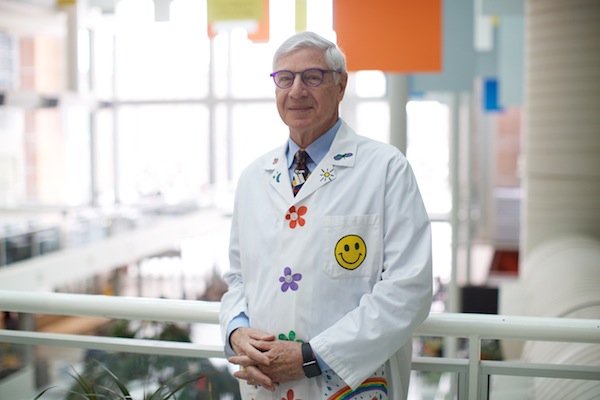
Dr. Allan Becker has devoted much of his life’s work to the study of asthma and how it affects children who have it. (photo from Allan Becker)

As Jewish community member Dr. Allan Becker was starting his career as a general practitioner, his daughter was diagnosed with asthma. As a result, he has devoted much of his life’s work to the study of the condition.

“My interest really started when my oldest daughter began having a wheezing episode at about two years of age,” Becker told the Independent. “It was pretty obvious that this was an infection – something we call bronchiolitis, which is fairly common in young children.”

Becker was working in Dauphin, Man., at the time of his daughter’s diagnosis, in the 1970s, and was beginning to see more and more kids with asthma coming into the emergency room.

“Since 1980, when I returned to academics, I’ve been trying to understand why the epidemic started – what the developmental origins of asthma and allergies are,” said Becker, who is now based in Winnipeg. “And, really, they’re the canary in the coal mine when you think about the increase in chronic diseases.

“Asthma is by far the most common chronic disease in children and it’s the earliest to start,” he said, “but we’re seeing parallel increases of other chronic diseases, like diabetes, inflammatory bowel diseases, various forms of arthritis, and others.”

Over the course of a five-decade career, so far, Becker has seen chronic diseases become more prominent. And, while the reasons for this change remain elusive, it seems clear that it involves genes and the environment.

In the early 1990s, Becker and Vancouver-based Dr. Moira Chan-Yeung embarked on a study of ways to potentially prevent the development of asthma.

“Think about the environment in terms of things we breathe and eat … and things like pets in the home, like tobacco smoke exposure, like pollution, like bad nutrition, Western-style diets, etc.,” said Becker. “We started a multifaceted prevention of asthma program in 1994.”

While that study did not reap substantial results, it did eventually lead to a current study examining the environmental impact on expectant mothers in all areas, including the benefits of decreasing stress, which Becker feels may be the most important factor.

Information about the study, called Canadian Healthy Infant Longitudinal Development (CHILD), can be found at childstudy.ca.

“CHILD started in 2008 and is an observation study, because we don’t believe we know enough to prevent the disease as yet,” said Becker. “We’re now seeing the children at 8 and 9 years of age, and we’re looking way more broadly at the environment. We’re looking at stress very specifically, both for parents and children.

“We’re looking much more in terms of diet, but also at the microbiota, the bacteria and other organisms that live in us, with us and on us, and which are likely extremely important – maybe critical – in helping to shape children’s immune responses in early life.”

According to Becker, there are more bacteria in our gut than there are cells in our body, and microbiota are now being considered as the cause of and potential cure for all sorts of illnesses.

One of the biggest hurdles is trying to determine if a young child who is wheezing has asthma and should be treated as such, or if the child has a respiratory infection that causes wheezing. Becker said part of the problem is how to more accurately define wheezing, which is described as a whistling noise coming from the chest.

“The key thing is that it’s not just the whistling noise in the chest,” said Becker. “It’s also that tugging in, particularly tugging in under the ribs, with the tummy pulling in when breathing. That’s a very good indication that those airways are narrowed and that the child has to work hard at moving air, particularly moving air both in and out. That’s what we teach our trainees to work on with the families they see.

“And, obviously, any time a child is distressed – if they’re looking distressed, particularly if there’s a change in colour of the lips – those are urgent issues. And, some children have such severe narrowing of the airways that you don’t hear wheezing, because they’re not moving enough air, but they will be struggling to breathe. You’ll see them pulling in their tummy and you’ll see their shoulders heaving,” he said. “And you’ll often see toddlers and older kids with their hands braced on their knees, hunched forward, trying to get air in. That type of tripoding is really a worrisome sign, as is a change in lip colour – that’s an emergency. Those children need to be brought to emergency quickly.”

If it gets to the point that the child is given inhalers, Becker pointed out that blue puffers are for particularly bad episodes, while orange or red puffers are for management.

For a bad episode, he said, two inhales from the blue puffer should be taken. “An inhalation and a bit of a pause, and then a second puff and inhalation … in many cases, that will be enough to help control things,” said Becker. “If it doesn’t help make things better, then, in five to10 minutes, it should be repeated. If the child is still distressed, that’s an indication they need to be brought to a hospital.”

The blue puffer should not be used for asthma management, he warned, as the body will develop resistance to it. So, if the controller medications are not providing enough control, he said parents should talk to the doctor who prescribed the puffer to determine a solution.

“If people are needing to use the blue puffer on an ongoing basis, even once or twice a week, week after week, that’s really telling you that you don’t have control of what’s going on and is very worrisome,” said Becker. “There should never be a death from asthma. But, sadly, every year there are some. And, these deaths are – rather surprisingly – not necessarily in kids with the most severe, persistent asthma; they’re in kids who are thought to have mild asthma. But, in fact, when you look at it, if you are using the blue puffer and need to get a new one every month or two, that’s a big red flag … needing to use the blue puffer in the middle of the night, that’s a big red flag. Nighttime symptoms are really a worry – those are kids who need to be seen and properly assessed and, in most cases, they need to be using controller medication.”

Becker is proud of having led the development of a national certification for asthma educators in Canada – Canada was the first country to provide this type of certification.

“We have a children’s allergy and asthma education centre in Winnipeg attached to our children’s hospital,” he said. “It’s one of the only real free-standing ones in North America. The website is asthma-education.com.”

Rebeca Kuropatwa is a Winnipeg freelance writer.

Camp helps lift spirits

A moment of levity during the taking of Justine and Stewart Silver’s wedding photos. (photo from Justin Silver)

The late Stewart Silver was born and raised in Montreal. He had worked as a standup comedian, and moved to Toronto in hopes of furthering his career. Justine Silver grew up in a Houston suburb. In late 1990, she followed her sister, who had moved to Toronto, and, there, she joined Jewish online dating site Jdate. So had Stewart.

“There was a thing where you had to describe your perfect date,” recalled Justine. “Profile after profile included long romantic dinners and were all gushy and gross … but his said, ‘Yeah, after we grab a drink, we step out of the restaurant and trip over a big bag of money.’ I was like, ‘Oh my gosh … that’s the perfect date!”

The couple took their time getting to know each other and, after a year and a half, got married.

To all appearances, Stewart was a healthy 44-year-old. He had biked up hills in Christie Pits Park the day before he had a fatal heart attack while the couple was having a conversation on Nov. 16, 2011.

Left shocked and widowed, Justine embarked on a healing path, including taking a hiatus from her event-planning business.

“It’s been quite some time since then and there’s been grief bursts,” said Silver. “In the early days, there was a lot of therapy and some peer support groups. Then, I found Camp Widow and have been to a few of those. I was pleased it wasn’t at all associated with any religion and was welcoming…. There was one in Tampa, and so a couple of widow friends that I had met up with, here, in Toronto, in a peer support group for young people who’d lost their spouses under the age of 55 … decided to make a whole trip of it. We went to the beach, museum, and then to Camp Widow. It’s a very transformational experience when you feel that you’re surrounded by people who understand the topsy-turvy world that you’re starting to barely understand yourself.”

The first camp Silver went to, in Tampa, was in the spring of 2018. Then, in November 2018 and November 2019, she attended the camps in Toronto. She and her friends have already signed up for the next November 2020 camp in Toronto.

While it’s called a “camp,” the weekend is more like a conference, with people coming together for sessions on various topics.

“One of the neat things I like at Camp Widow is that the name tags, everyone has one, but there are a couple features to it,” said Silver. “One of them, there’s a ribbon at the bottom. For example, in my work as an event planner, if you’re a presenter, your ribbon will say ‘presenter,’ or, if you’re on the organizing committee, it will say ‘organizing committee’ or ‘volunteer.’

“But, these [also] have the number of years ago that your loss occurred. So, for me, that was six years. So, let’s say it’s a teal ribbon. All of a sudden, you notice the six-year people … and there’s a bond, because you’re in a different place than, say, the six-month people. Everyone is compassionate to everyone else, but it’s just a really interesting way to bond with people.”

As far as the camp schedule, there are some group meals, as well as meals on your own. There are various types of sessions offered.

“There are tracks, like for people who are five years out, one year, or one to five,” said Silver. “I can’t remember the exact breakdown, but you can decide to go to everything along a certain track, or you can decide in the moment what you’ll do, which sessions you’ll go to. Then, there are some networking evening events, different ways of getting to know people.”

One is designed like speed-dating, but not for that purpose. You get the chance to talk to someone for a certain amount of time, and then you move on to the next person and chat with them. “It’s really interesting to see where the commonalities fall,” said Silver.

On Saturday night, there is a banquet with a theme and people dress up – some participants may not have gone out since their loss. After dinner, each person says the name of their loved one out loud, while some 200 others quietly listen. Then, there is a dance, which gives the opportunity to destress and socialize. The DJ doesn’t play any music that could potentially trigger anyone’s grief, like slow songs.

At the camp, there are people from their mid-20s to people in their 70s and 80s; people from all religions, cultures and political leanings.

For Silver, Camp Widow “creates community and support amongst widows and widowers…. Sometimes, when you’ve lost someone, it can be very isolating, which can be in different and unexpected ways. I wouldn’t say never, but it doesn’t go away. The intensity definitely lessens and you find new ways to live with grief. And there are plenty of people who, we say, are ‘re-partnered.’ When you’ve been widowed and then you meet someone else and you have a boyfriend/girlfriend, wife/husband or partner, we say you’re ‘re-partnered,’ because we don’t think that means you’re not still widowed.”

The camp provides tools and connections that widows and widowers may not otherwise find on their own.

“I feel camaraderie in sharing my story and being heard, or hearing someone else’s story and being helpful to them,” said Silver. “At this past Camp Widow, I did an art thing. I can do crafty things OK, but I’m not really an artist. But, one of the workshops I went to was all about healing through art and it was just a whole different facet. We all had paint and they set it up so well…. We had a white piece of paper and I got white paint and I painted a white heart. Then, I put a line through it – a squiggly line, like it was broken – and you could barely see it … like you couldn’t see that my husband had a heart problem…. Then, everyone shared in the room what theirs was about. When you do that, it’s like opening up a wound, and then the scar heals better next time.”

Six months ago – eight years into her healing journey – Silver and her older sister, Eileen Jadd, who is a social worker, started the charity Good Grief Bereavement Healing Services.

“We have a roster of counselors in different parts of Toronto for bereaved people,” said Silver. “We’re also offering workshops on eye movement desensitization, which is a thing for trauma victims. It really helps you compartmentalize the trauma, so you can talk about it without being retraumatized. So, we’re doing a workshop on that.

“We’re starting a group on sibling loss and, eventually, will have a physical building. We want to have a centre, so people who’ve lost someone, it’s like a snap of the fingers and they’ll know where to go. When you know there’s an accident, you know to dial 911. We want it to be, ‘Wow, you’re in need, you’ve lost someone, and you know exactly where to go.

“I think widows and widowers need their person’s name to be said. People are so afraid of saying it, because they don’t want to bring it up in fear. But, they want their names to be said, so that’s a big part of it. I happen to talk about Stewart all the time, but a lot of people don’t have those opportunities in their own lives.”

In addition to talking about him when memories arise, Silver said, “Every year, I go to shul and I say his name and a prayer for him, and commemorate it that way. I remind people that we got married in that synagogue, and I remind people that he was a person that existed and stood in that space with me, and that his influence is still there. Just because he’s not standing next to me in that moment … he’s still there. In those ways, we talk about him.”

Camp Widow is put on by Soaring Spirits International. For more information, visit soaringspirits.org, campwidow.org, widowedresilience.org and goodgriefhealing.ca.

Rebeca Kuropatwa is a Winnipeg freelance writer.

From Soviet to Nazi rule

Aileen Friesen has researched how Mennonites living the area of current-day Ukraine reacted to the Nazis. (photo from Aileen Friesen)

An event titled Jews, Mennonites and the Holocaust took place in Winnipeg at the Rady Jewish Community Centre a few months ago. Organized by the Jewish Heritage Centre of Western Canada, it featured Mennonite historians Aileen Friesen, executive director of the D.F. Plett Historical Research Foundation, and Hans Werner, a retired University of Winnipeg professor, who discussed Russian Mennonite reaction as the Nazis invaded Russia during the Second World War.

“I am from a Mennonite background,” said Friesen in a post-event interview with the Independent. “That is, on both sides of my family – one side came to Canada in the 1870s, with the migration of Mennonites from the Russian Empire during that time, and the other part of my family came to Canada in the 1920s, with the migration from the Soviet Union.”

The Nov. 5 discussion focused on the area that comprises current-day Ukraine, which, during the time of the Nazi invasion, was occupied by what was then the Soviet Union. Mennonites who were in the region at that time were not of German heritage, but they spoke German and were viewed by the Nazis as allies. As well, the Russians expected that these Mennonites would be sympathetic to Germany and did what they could to relocate them to eastern Russia prior to the Nazi invasion.

“The way we think of this nation’s state … is just not what it is in the 18th century,” said Friesen. “It’s a very multi-ethnic space in which we have a lot of German speakers, and we talk about the Polish-Lithuanian commonwealth as a very multi-ethnic territory.

“We don’t have the concentration camps – we have a lot of mass shootings that are going to take place in this territory. So, Mennonites are living in a space that becomes under Soviet control, and they live under Stalinism. And then, it will become occupied by German forces, and then they will be living under German occupation.”

As the Nazis invaded, they were looking for people from the local population with German affiliation to integrate into the administrative system, while targeting the Jewish population – to have them register, to wear the Star of David and to separate them from other sections of the population.

According to Friesen, many Mennonites looked at the Nazis as liberators from the Stalinist occupation, which oppressed the Mennonite community in the area and enforced an atheistic existence. The responses of other Mennonites to the Nazi treatment of Jews were mixed: some responded in horror, but most remained silent.

“Sometimes, they say in memoirs that they said something to the German occupying forces, that they can’t do this,” said Friesen. “But, this is a time when people have been demoralized by Stalinism and have learned to keep their mouths shut…. But you will see that some people are very upset about what’s happening to the Jewish population…. Where there is a mix of Mennonites and Jews, there is also some intermarriage, so there were people who felt a great affiliation with their Jewish neighbours and felt very upset about this.

“My topic, specifically, focuses on a segment of the Mennonite population that joined into the secret police (SS), the local police, and are, therefore, implicated in the massacres that took place, as the local police were participants in these massacres.” Friesen said there were “Ukrainians, Mennonites and other types of ethnic Germans in the Ukrainian local police.”

As the Nazis invaded, they ranked the population, placing the Mennonites higher than the Ukrainian/Russian population, as they were considered by the Nazis to be Volksdeutsche (German folk). This allowed Mennonites access to more resources and they were better treated.

Before the Nazis invaded, she said, Mennonites and Jews “occupied a space together.” For example, “in Chortitza, there was a synagogue and there was also a Russian Orthodox church, and a Mennonite church that was in operation before the Soviets took power. It’s a space in which people organized and interacted with each other and, yet, these forces that get imposed upon them, there’s a reaction from within the local community that, in the case of the Mennonites, I don’t think that was a response that served them … at least some people … bought into these ideas that the Germans brought into this territory. It dovetails with some of the ideas they had of their own suffering under the Soviet regime and they accepted the dehumanization and sometimes participated in the dehumanization of others, which is really a sad story.”

Friesen encouraged readers to watch the event video on YouTube.

“There were some interesting questions and responses from the audience,” said Friesen. “We had a good turn out, from both the Mennonite and the Jewish communities, discussing these very difficult issues. I think the lectures online will give you a much better background to this story than I’ve been able to share.”

Rebeca Kuropatwa is a Winnipeg freelance writer.

Drawing more women to tech

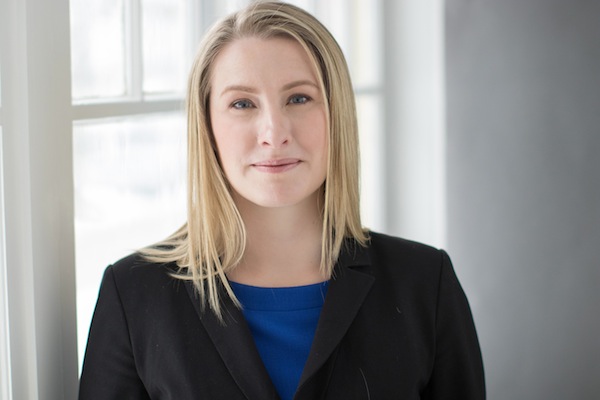
Jodi Kovitz, founder and chief executive officer of #movethedial. (photo by photagonist.ca)

What began as Jodi Kovitz’s personal desire to increase the technology industry’s minimal efforts to attract women leaders is now a broad movement – #movethedial.

Kovitz was born in Calgary and moved to Toronto with her mom when she was 5, while her dad remained in Calgary. Growing up, Kovitz’s role models included her grandmother, Dr. Muriel Kovitz, who served as the first female chancellor of the University of Calgary, and who today lives in Vancouver.

“I had a very loving home and was always pushed and encouraged to be true to myself, be creative and build things,” said Kovitz. “I started my first business when I was 16, which was a greeting card company. I have always pursued entrepreneurship throughout my career, in various forms.”

After graduating from the University of Western Ontario’s Ivey Business School, in London, Ont., Kovitz worked at a consulting firm over the summer. Her mentor there advised that she do something more entrepreneurial, so Kovitz joined a tech start-up.

“I ended up meeting an amazing woman leader in banking after a couple of years,” she said. “Even though I really enjoyed myself and was getting a lot out of it … I left the start-up and went to join her at the bank, where I learned a ton about leadership. I was working specifically in HR [human resources] and leadership development.”

After going to law school and a brief stint working as a lawyer, Kovitz became the chief executive officer of the nonprofit Peerscale, a peer-to-peer group for tech CEOs.

“Peerscale is when I started #movethedial, which very much started as a passion project while I was in my other role,” said Kovitz. “But, it soon became so large that it called me to create it in a formal sense and to move into it full-time.”

Since then, #movethedial has become a global movement and a social enterprise, working to advance the participation and leadership of women in technology.

“While there’s work we need to do over the long term,” Kovitz told the Independent, “we need to ask what we can do now to better engage, include and advance either women in the ecosystem in the moment, as well as those that are just graduating, even just considering going into STEM [science, technology, engineering and math]…. It’s a multifaceted approach.”

The kick off of #movethedial in 2017 was to be a cosy 30-person event posted on social media – 1,000 people came.

Kovitz asked attendees who wanted to help. Fifty people responded, she said, “and we did a whole bunch of initial pilots and experiments. After a year, there was just so much passion and excitement that I was very fortunate to be approached by someone I’ve been friends with for a long time, who cared deeply about this mission and offered to back me … so I could start and create the vision I had … and that I wouldn’t be as afraid to take the risk as a 40-year-old single mother starting something as a full-time job. He was there, supporting me, and partnered with me in many ways, in terms of his advice and experience in building a very large-scale, global, billion-dollar business, as well as tactically helping me through things and scaling the organization.”

The organization #movethedial works with tech companies to attract and recruit women – all people who identify as women, just not people born as women – as well as advance, engage and retain women in their companies. It also works with community groups on a platform called #movethedial stories, showcasing the experiences of women technology leaders around the world.

“We’ve touched thousands of people that way,” said Kovitz. “We have an annual global summit. Last year, we had 2,802 people at our summit in Toronto, where we’d brought speakers in from around the world, and we connected our audience to one another in a really profound, magical way…. We’re creating what the future of #movethedial can look like, thinking through youth and how we can really impact … the ecosystem … and create a different future.

“What really drives me is that we can’t actually build technology solutions for everyone in the population [without including everyone in the population]. And, by the way, everything is tech, right? Banks, taxis, food … everything is tech. We can’t design solutions relevant to the masses if we don’t have representation from our population at our design leadership and governance tables. We just can’t build solutions that work for all the people.

“The urgency for me is around AI (artificial intelligence). It’s really starting to dominate how we use technology. Everything is going to, if it doesn’t already have an algorithm … and AI is taught. If all humans that teach and create AI are men, these machines will develop different patterns of behaviour and algorithms. My fear, and there’s a lot of research to back this up, is that we will build our human biases right into the solutions and algorithms, and we will never be able to undo it. For me, the urgency to create teams that reflect the population is to ensure that we don’t put our bias in forever.”

For more information, visit movethedial.com.

Rebeca Kuropatwa is a Winnipeg freelance writer.

Addiction a risk for all

Left to right: Lisa, Jacob and Richard Hillman. (photo from Lisa Hillman)

“I had a fairly demanding and public position in the health system. I was president of our hospital foundation, had a very large board of about 25 people and a staff of about a dozen people. We were raising a lot of money to build a new hospital campus at the time, and so I was very public and very out and about. And, my fear was, as sick as it is to say today, that, if somebody would find out that my son had a drug problem, what would that say about me? What kind of mother could I be? What kind of person was I if I had a son who was using illicit drugs?” Lisa Hillman, author of Secret No More: A True Story of Hope for Parents with an Addicted Child, told the Independent.

“That was my feeling at the time,” she said. “I was not at all prepared to have addiction in my household. I was both ashamed and terrified at the same time.”

Hillman and her now-sober son, Jacob, shared their story at a Jewish Child and Family Service (JCFS) event at Congregation Shaarey Zedek in Winnipeg late last year.

Lisa and Richard raised their family in Annapolis, Md. Jacob was in high school when they found out he was using drugs. With almost 40 years of experience in the healthcare industry and being the healthcare decision-maker for the family, Lisa was determined to help Jacob overcome his addiction, while also keeping it a secret.

Like many others, however, she learned the hard way, after a couple of years, that this was not something she could fix. Although she held out hope that Jacob’s use of drugs was just a normal coming-of-age rite of passage, like trying cigarettes or alcohol, and that he would return to being the high-achieving person she knew him to be, that is not what happened.

“At first, we had him evaluated,” said Hillman. “I asked him if he would see a psychologist. He said ‘yes.’ He had bi-weekly meetings with a psychologist. At one point, my son gave me permission to talk to him – Jacob asked me, ‘If he tells you I’m alright, will you get off my back?’ And, I said, ‘sure.’

“This was when he was still in his senior year of high school. I visited with the psychologist, who said to me, ‘I told your son to smoke a little less.’”

Jacob was arrested during a holiday week after graduation, and the situation became more serious. As the family worked to get Jacob help, he resisted it, as addicts often do.

“The question I always get is, ‘How do you get them to accept treatment if they don’t want it?’” said Hillman. “I wish I had an answer for that. What we did with our son is finally say to him, ‘Jacob, you have a choice. You can continue to use, but you can’t live under our roof, or Dad and I will pay for inpatient treatment.’ Fortunately, he accepted inpatient treatment.

“Keep in mind, I’m very blessed,” she added. “I had some insurance and other resources. We were able to afford to send him someplace, which I know a lot of families can’t afford to do. I’m very, very lucky.”

The Hillmans found a place in Maryland, because Jacob did not want to leave the state. The place seemed to be very lovely and spiritual. They were hopeful he would get better there. But, after 12 days, the Hillmans visited their son and Lisa knew he had been using. Sure enough, the next day, Jacob’s counselor asked them to come pick Jacob up, that Jacob could no longer stay there.

“We brought him home to Annapolis,” Lisa Hillman said. “He entered the addiction treatment centre inpatient [program] that is part of my health system, where I was then and am still today, on the board. So, my drive for anonymity in this situation was about to crumble. The counselor my son was seeing said to me, ‘You have to tell somebody at work.’ So, I told my boss, the CEO of the hospital, and he was very empathetic and extremely understanding.”

Jacob went in for two weeks, after which the counselors suggested the Hillmans allow him to go to Florida for continued treatment, where he could live in a sober living house and continue to get outpatient treatment.

“The day he left, the counselor said to me, ‘Your son is going to have his program. What are you going to do for yourself?’” said Hillman. “My immediate reaction was that the counselor must have had 10 hits too many, because I didn’t have an addiction. I wasn’t the sick one, my son was the sick one. And yet, I realized I was crying all the time, I was obsessed with where he was and I couldn’t go to sleep at night until I knew he was home.

“I was isolated, I was depressed,” she said. “I wasn’t sharing anything with family and friends. So, I tried Al-Anon. And, from my very first time, I realized I’d [found] a home. These people understood me and were going through the same thing. I wasn’t alone anymore. I had people around me who got it and who were going through the same thing. Meanwhile, my son was in Florida and was getting better.”

Midway through that first year, Jacob had a minor relapse and told his parents about it over the phone. In that conversation, his mother said to him, “Jacob, we love you. Thank you for being honest and telling us. Please take care of yourself. You’re the only one who can.’ And Jacob replied, “Mom, thank you. That’s exactly what I needed to hear.”

Hillman recalled, “Pre-Al-Anon, I would have been on the phone screaming at him, angry. Fast-forward another six months, and he has another much more serious situation. We were told, ‘Your son needs detox.’ He was using heroin IV, a horrible scenario. So, we were asked to pay for a third inpatient treatment centre.

“I remember clearly asking the counselor, ‘How many times do we have to pay for this?’ And he said, ‘Tell your son that this is the last time.’ So, we did and, at the time, we did mean it, really. This was the last time we’d pay for him to have inpatient treatment.”

Although Hillman cannot say for sure that this ultimatum is what did it, Jacob stayed there for 100 days. After that, he moved, got a job and stayed for six months in a sober house. He kept the job for several years and eventually moved into an apartment. He has been active in AA ever since and has been clean for almost eight years.

Hillman has continued going to Al-Anon. She asked her husband to come with her and try it out at least once. They went to a different meeting than she had been going to. “We walked into the room and there were two couples who we know really well,” she said. “Both of them had children with similar problems and we had no idea. We’ve been going to that same meeting now for almost nine years, every Thursday night.

“That first meeting was a huge relief,” she said. “I couldn’t speak at the first meeting. I couldn’t open my mouth, with lips quivering as I cried. They let me cry. Other people at that meeting cried. And I heard a phrase that night, that I think really guided me: ‘Detach with love’ – meaning you have permission to detach from your loved one’s problems, that you’re not responsible for them, that you can’t fix their problems, but that you still love them.”

Hillman realized, over time, that Jacob would have to find his own way and that she couldn’t enable him by sending money or paying for things for him. “But, we never stopped loving him the whole way, the whole time,” she said.

image - Secret No More book coverAs she healed, Hillman felt the desire to write a book about her experiences. She asked her son for permission to publish it.

“The reason for writing it was, I knew there were other families in hiding and ashamed, and that shame and fear just makes it worse,” she said. “It makes it worse for you if you love someone in addiction, and it doesn’t help the person with addiction. The whole purpose in writing this was to help particularly other moms and dads and sisters and brothers and boyfriends and aunts and uncles and grandfathers who I knew were sort of in hiding and had secrets and weren’t sharing – giving them hope that they can do it, too.

“Don’t hide,” she stressed. “Find professional help for yourself. My message is not to those with addiction, it’s to those who love people with addiction. My son says, ‘Mom, remind people that this is your story. Not mine.’

“If you have somebody in your life that is using or drinking, please go get help for yourself,” she said. “If one person in the family can get healthy and understand addiction, boundaries, and how to take care of themselves, then it will affect the rest of the family.

“That’s what happened in our family. I got stronger, my husband got stronger. Jacob saw that we were trying to understand him, that we were trying to get ourselves right again. He was getting better and we had a common language.”

Hillman said, “I think people who recover from an addiction and somehow live every day clean and healthy, year after year after year, to me, they are the most amazing, profound people. My son has become just an astonishingly profound young man and I’m very, very proud of him.

“I think that Judaism hasn’t helped us here today,” she added. “I think it’s getting better, but, looking back on it, part of my shame was that this doesn’t happen to Jews. We’re smart, educated, driven, are achievers, we don’t have addiction – but that’s not true.”

The Nov. 25 event with the Hillmans was sponsored by the JCFS and Gray Academy of Jewish Education. Panelists included an addictions physician, a therapist and an Addictions Foundation of Manitoba consultant on youth.

“Recovery is individual. There is no single treatment that works for everyone. There is no easy fix, like there is no single cause. It’s a combination of factors,” said Ivy Kopstein of the JCFS. “As a community, we need to end stigma and judgment, and replace it with compassion and understanding so we have no need for secrets anymore.”

Rebeca Kuropatwa is a Winnipeg freelance writer.

Youth feed homeless people

Youth from Temple Beth Ora and Gathering Angels in Edmonton help out at Boyle Street Community Services shelter. (photo from Rabbi Gila Caine)

In Edmonton, Rabbi Gila Caine and Muslim leader Nesrine Merhi-Tarrabain have combined forces to serve their local community.

Caine is spiritual leader of Temple Beth Ora, a Reform synagogue in Edmonton with nearly 100 families, which celebrated its 40th anniversary last year. Merhi-Tarrabain is director of Gathering Angels, which runs an educational centre that teaches Muslim girls Islamic values.

Caine grew up in Jerusalem and moved with her husband, Ariel, and their two young children to Edmonton more than two years ago to lead Temple Beth Ora. Their kids attend the local Talmud Torah school.

Growing up, Caine learned early on, and more so in her early teens, to always be looking for ways to strengthen and help community. She wanted to bring that same mindset – of taking responsibility for your local community – to b’nai mitzvah-age kids at her Edmonton congregation.

“We’ve wanted to go out of the classroom and do stuff outside for a few years now,” Caine told the Independent in a recent interview. “And then, through another connection I have, with Salaam Shalom group, I asked one of them if perhaps they have somebody in their community that does stuff with kids … and that maybe we could do stuff together.

“I thought that would be really cool if we could get the b’nai mitzvah kids to go out and do stuff in the community, but with other youth of a different faith group,” she said.

Caine was connected with Merhi-Tarrabain. After some effort and time, the synagogue and educational centre managed to get together on a Saturday in November, preparing and serving both breakfast and lunch at Boyle Street Community Services shelter.

“We brought food with us, had her girls, my kids, and some parent volunteers working in two shifts there that day – working together, preparing sandwiches, cooking,” said Caine. “It was actually funny to see – it was more the parents that were connecting and talking … [while] the kids were basically doing their work quietly. But, the parents got into really nice conversations with each other and they served the food. And everybody from both sides came away feeling that we should do this again.”

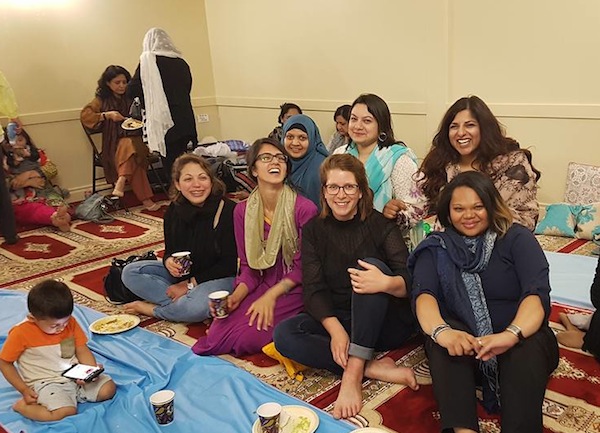
photo - The interfaith initiative at Boyle Street Community Services was led by Nesrine Merhi-Tarrabain, third from the left, and Rabbi Gila Caine, second from the right
The interfaith initiative at Boyle Street Community Services was led by Nesrine Merhi-Tarrabain, third from the left, and Rabbi Gila Caine, second from the right. (photo from Rabbi Gila Caine)

Caine is hoping to make serving the community a tradition at Temple Beth Ora, possibly with Gathering Angels again, as well as with other groups.

When thinking of the best activity to launch the b’nai mitzvah community service initiative, Caine chose this particular one – preparing and serving food – as she knew from experience that many of the kids really enjoy dealing with food service, having seen them help out at the shul.

“Some of these kids are b’nai mitzvah kids and they want to volunteer again,” said Caine. So, the youth group counselors “will sit with them and talk to them about what they want to do. This is the next step,” she said.

After the November project, there was another food-related volunteering opportunity for the kids last year. They joined the Edmonton Jewish community as a whole to prepare a Christmas meal for another shelter. “They really wanted to take part in that,” said Caine. “And now we will see what they will come up with next.”

According to Caine, having Merhi-Tarrabain at the Boyle Street Community Services kitchen was beneficial for several reasons, including that she had volunteered there with the girls in the past and had experience. That meant Merhi-Tarrabain could offer tips about what food to bring and how to best help in the food’s preparation and serving.

“Now, some of the parents who were there, they want to initiate more of these things,” said Caine. “And now, we have a better idea of how to do that.”

Both faith groups understand that more such gatherings are necessary before the youth can make lasting connections.

Caine said her synagogue is trying to create a project with another Muslim youth centre in Edmonton and also with one of the city’s churches. “We’re trying to create a program,” she said, “where they will have meetings, talk and learn and do stuff together … hopefully resulting in some real connection-making.”

Rebeca Kuropatwa is a Winnipeg freelance writer.