“Extraordinary” jug found

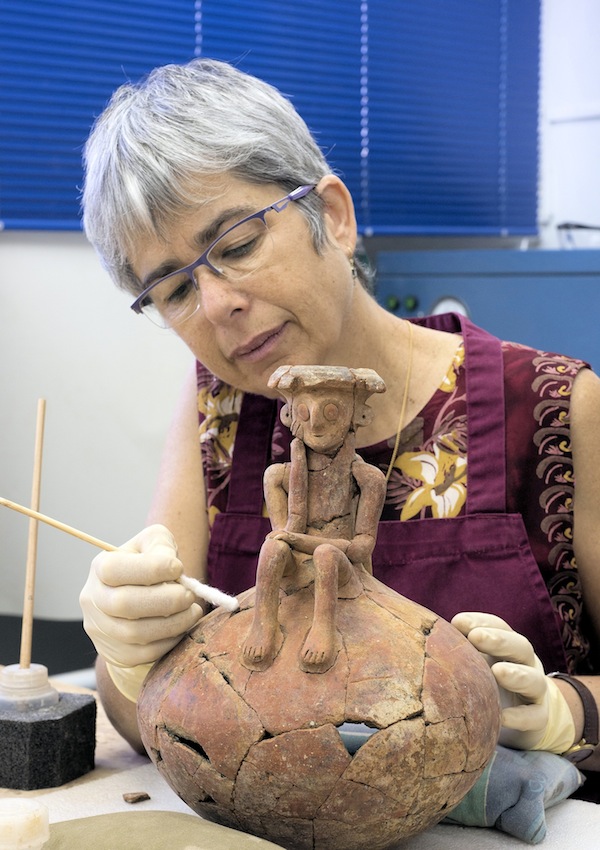
(photo from Israel Antiquities Authority via Ashernet)

Described by Israel Antiquities Authority (IAA) archeologists as “extraordinary,” a jug estimated to be some 3,800 years old – seen here being restored in an IAA laboratory – was found by high school students taking part in a Land of Israel and Archeology matriculation stream excavation. This excavation is part of a new training course offered by IAA and the Ministry of Education, which seeks to connect the students with the past and help prepare the archeologists of the future. The jug, which is from the Middle Bronze Age, was found in Yehud (near Ben-Gurion International Airport) at a site being examined prior to planned construction of residential buildings. Also found, in addition to the jug, were items such as daggers, arrowheads, an axe head, other vessels, a churn for making butter, sheep bones and what are very likely the bones of a donkey.

The Entebbe rescue

Sasson (Sassy) Reuven serving in the Golan Heights. (photo from Sassy Reuven via Chabad of Richmond)

On Nov. 9, more than 200 members of the community packed into the Executive Inn in Richmond to attend a lecture by retired Israel Defence Forces commander Sasson (Sassy) Reuven, who held the audience spellbound for 90 minutes as he recounted his participation in the 1976 Operation Entebbe.

Reuven, an Israeli from Be’er Sheva, relocated to California after completing his military service, heading up security for El Al before opening a construction development company in Calabasas. As the recession hit, he found work scarce and confided his financial woes to a new friend, the Chabad rabbi in Calabasas. Somehow, it came up in conversation that Reuven had been an elite commander in the IDF and was one of the soldiers sent to rescue hostages taken in the Entebbe hijacking. Before he knew it, Reuven had agreed to give a talk to his community, and that talk jumpstarted his public speaking career, taking him all over the world to recount his memories of Entebbe.

photo - Retired Israel Defence Forces commander Sassy Reuven spoke in Richmond on Nov. 9 about Operation Entebbe
Retired Israel Defence Forces commander Sassy Reuven spoke in Richmond on Nov. 9 about Operation Entebbe. (photo from Sassy Reuven via Chabad of Richmond)

Earlier this month, he stopped in Richmond to deliver a talk sponsored by the Jewish Federation of Greater Vancouver, Chabad of Richmond and Richmond Jewish Day School. Then he was headed to Vancouver Island, Spokane, Wash., and South Africa for more speaking engagements.

The hijacking began on Air France Flight 139, which, on June 27, 1976, was en route from Tel Aviv to Paris via Athens. In Athens, four terrorists boarded the plane and forced the pilot, Michael Bacos, to divert the plane to Benghazi to refuel. Seven hours later, the plane left for Entebbe, arriving at 4 a.m.

“Israel had a good diplomatic relationship with Uganda from 1965,” Reuven explained. That changed in 1972, when President Idi Amin came to Israel, saw the IDF’s jet fighter planes and declared he wanted them for his own air force, “so he could destroy Tanzania.” The diplomatic visit did not go well and, over the course of it, Amin had a psychotic episode and spent time in hospital, Reuven said. When he returned to Uganda, Amin persisted in his demand for the fighter jets, but Israel, a friend of Tanzania, denied his request. When the hijackers requested the cooperation of Amin’s army so they could negotiate for the release of the hostages from Entebbe, the president complied.

Over the two days that followed, the hijackers separated Jews and Israelis from the other passengers. They set their ransom price and threatened to start killing Jewish hostages by July 1 if their demands weren’t met. Later, they extended the deadline to July 4, giving the IDF much-needed time to plan its heroic rescue.

The mood in Israel was very sombre at the time, Reuven recalled. “The entire country was still in mourning after the Yom Kippur War. When we learned we’d be flying to Entebbe to bring the hostages back, our commander told us we needed to bring them back alive – no fatalities and no injuries. We were going to bring the country’s morale back up.”

Asked if he felt ready to embark on such a mission, Reuven said he’d been in training for two years solid prior to the rescue. “The only time we stopped training was for Shabbat,” he reflected. “When I was selected to be part of this mission, I felt like the luckiest person alive, that this was my core existence as a Jewish soldier.”

The hours before he and the other soldiers boarded a Hercules C-130 aircraft and took off for Entebbe were long. Reuven recalled waiting beneath the eucalyptus trees at an army camp where the soldiers were fed hardboiled eggs, pita and mud-like coffee, and given very little information about their upcoming mission. When they finally took to the air, there were four Hercules C-130s and two Boeing 707s, containing a flying hospital and a flying command centre. The soldiers numbered 212 and included pilots, flight engineers, doctors, paramedics, refueling technicians, psychologists and intelligence personnel. Space was so tight on the flight that Reuven was wedged between the wall of the plane and an old black Mercedes-Benz that the IDF had brought along so that its soldiers could masquerade as officials in the Ugandan government if necessary.

At one point in his lecture, Reuven donned a white cap fitted with an elastic beneath his chin. “When we disembarked from the planes, we were wearing hats just like these,” he said. The IDF knew the airport would be in pitch darkness when its rescue mission arrived at 11 p.m. and the white hats were a way for the soldiers to recognize and see one another easily.

The rescue mission soldiers had various tasks. Some, like Yonatan Netanyahu, were sent to Entebbe’s old terminal building, where the hostages were being held. Reuven was instructed to go to the new terminal building. He recalled how the Ugandan soldiers knew something was going on and started raining bullets on the IDF rescuers as they ran towards the terminal buildings. Netanyahu was shot by one of those bullets and died minutes later at the scene.

In total, the rescue mission took 90 minutes and, by 12:30 a.m., the seven hijackers were dead and the hostages were loaded into an aircraft and en route to safety. The mission returned with fewer casualties than had been expected. Among the IDF soldiers, one had died and four were injured. Six hostages had been injured and four had been killed, including 19-year-old French-Israeli Jean Jacques Mimouni. When the IDF had arrived in the terminal building, they’d shouted to the hostages to lie down. Mimouni was so excited to see them, he jumped up and tried to embrace them. Mistaking him for a hijacker, the IDF shot him dead.

While he didn’t spend much time detailing the rescue scene, Reuven said he felt elated as he flew back to Tel Nof in Israel. “I felt like the long arm of the Israeli army was such a great arm that we’d go take care of any Jew, anywhere, in dire straits.”

Lauren Kramer, an award-winning writer and editor, lives in Richmond. To read her work online, visit laurenkramer.net.

Seminar on law and justice

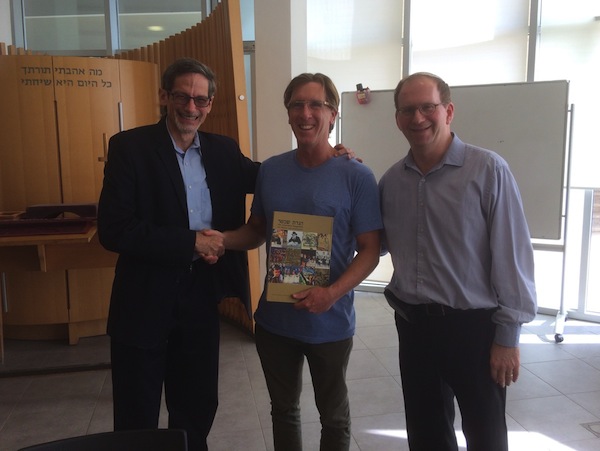
Congregation Beth Israel Rabbi Jonathan Infeld, right, and Howard Mickelson, QC, receive the Schechter Haggadah from the president of the Schechter Institute, Prof. David Golinkin, at the Schechter Institute of Jewish Studies in Jerusalem. (photo by Linda Price)

A group of 20 lawyers and judges from Canada visited Israel for a five-day Law and Justice seminar at the Schechter Institute of Jewish Studies in Jerusalem. Meeting with some of their Israeli counterparts, participants immersed themselves in the topics of Maintaining Security, Rule of Law, Democracy and the Jewish Way of Life.

Mission delegates participated in a reception at the Rooftop Restaurant, Mamilla Hotel, followed by a talk by the Hon. Justice Dalia Dorner, former Israeli Supreme Court justice. Mission delegates, several of whom are not Jewish, heard Dorner’s explanation of the special character of Israel, which is both a Jewish and democratic state. She said, “Israel must unite both of these values. Indeed, certain Jewish values are very compatible with democracy. Furthermore, the founding fathers of Israel chose freedom, justice and peace as the basic values upon which the state is founded, and no one can change this.”

The next day, the jurists met with Justice Elyakim Rubinstein, vice-president of Israel’s Supreme Court and former attorney general. They also toured the award-winning building. Rubinstein explained the uniqueness of Israel’s Supreme Court and how it differs from those of other Western countries. He also discussed topical issues such as the appointment of Supreme Court justices and the proposed Regulation Law.

Afterwards, delegates traveled to the Ministry of Justice in East Jerusalem and met with Israel State Attorney Shai Nitzan, who spoke about the difficulties of safeguarding human rights during times of war and insecurity.

photo - Members of the group at the Neve Schechter in Tel Aviv
Members of the group at the Neve Schechter in Tel Aviv. (photo by Linda Price)

On the Thursday, Ambassador Efraim Halevy, the ninth director of Mossad, who was born in England, gave a talk on the interrelationship between Israel, the United States and Russia, and each country’s interest in the Middle East. Halevy said, “Israel cannot be destroyed” and that “Iran never was and cannot be an existential threat to the state of Israel. There is no state or entity that represents an existential threat to the state of Israel.”

On Friday afternoon, delegates visited the Neve Schechter Centre for Jewish Culture in Neve Zedek, Tel Aviv, and heard several lectures. Prof. Gideon Sapir from the faculty of law, Bar-Ilan University, and a candidate for the position of Supreme Court justice, gave a lecture explaining the issues of Israel’s “blue laws.” He noted the quandary of employing workers on the Sabbath in Israel and creative legal solutions to this dilemma, which counterbalances two values: one Jewish – the right to a day of rest; and the other democratic – the basic right to freedom of employment.

The mission was the initiative of Rabbi Jonathan Infeld of Vancouver’s Congregation Beth Israel and one of his congregants, attorney Howard A. Mickelson, QC. A group of Jewish and non-Jewish lawyers meets regularly in Vancouver, in a Law and Learn program for lawyers that deals with contemporary issues in civil law, bringing in guest lecturers. A Jewish law component is added to each session by Infeld.

Because of Infeld’s long-term connection to the Schechter Institute of Jewish Studies, Schechter was chosen to lead the mission and to implement the study program. The mission’s goal was to enable a group of Canadian leaders to study, up close, the social, military and political issues facing Israel as a democratic and Jewish state, both from a general legal and a specific Jewish legal/religious standpoint.

Cancer research breakthrough

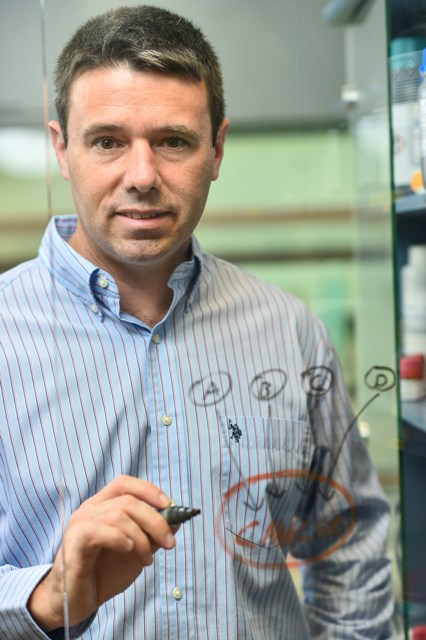
Assistant Professor Avi Schroeder of the Technion faculty of chemical engineering and the Technion Integrated Cancer Centre. (photo by Ashernet)

Technion researchers in Haifa have developed a new technology for determining the suitability of specific anticancer drugs to a specific patient – before treatment begins. The study, just published in Nature Communications, was led by Assistant Professor Avi Schroeder of the Technion faculty of chemical engineering and the Technion Integrated Cancer Centre. The researchers packed miniscule quantities of anticancer drugs, as well as placebo packages (which contained no drugs), inside dedicated nanoparticles they developed, which have the ability to flow in the bloodstream to the tumor. Attached synthetic DNA sequences served as barcode readers of the activity in the cancer cells. After 48 hours, a biopsy was taken and the anticancer drugs were found mainly in dead cancer cells – that is, they had killed them – while the placebos were found mainly in live cells – that is, they had not killed the cells. A comparison between various anticancer drugs also found differences in effectiveness.

Making a life in Israel

Emily Rose and Aviv Eisenstat in the Israel Defence Forces’ officer’s training school in 2008. (photo from Emily Rose)

When Emily Rose, 28, moved to Israel almost 10 years ago, her plan was to serve in the Israel Defence Forces and then return to Winnipeg. It didn’t happen quite as planned.

Rose was born in Odessa, Tex., and grew up in Winnipeg. Taking a similar road as many Jewish kids in the city, Rose studied at Gray Academy of Jewish Education (GAJE).

“The Winnipeg Jewish community is truly saturated with role models for social justice and it had a major impact on me growing up,” said Rose. “I grew up watching my aunt, Faye Rosenberg, who works for our Jewish community, help bring hundreds of Jews to Winnipeg from Argentina, where they suffered from antisemitism, and watching my best friend’s dad work tirelessly in court to help victims of residential schools receive compensation from the government.

“Winnipeg is an incredibly Zionist and supportive community,” she added. “The longer I am away, the more I appreciate what a wonderful community it really is.”

When Rose was 14, she went to Israel on a Jewish Federation of Winnipeg Partnership 2000 (or Gesher Chai) trip, which sent 10 high school students from GAJE to their sister school, Danziger, in Kiryat Shmona.

She fell in love with the city and the people. “My host family had three sisters and I was thrilled because, up until then, I only had big brothers. And, I remember writing to my mom, ‘Now I have three sisters!’ on the first night. I realized at that point that all my new friends in Israel would be going to the army soon and I remember thinking I had the responsibility to do that as well.”

This is what led Rose to move to Israel at the age of 18, starting with a mechina (a pre-military program) in her first year there.

She lived in Sde Boker in southern Israel and volunteered as an English teacher’s aide in an unrecognized Bedouin village. “Can you think of anything more polar opposite to a very cold Winnipeg, Man., than the middle of the Negev Desert?” she quipped.

“Your first year in Israel is always the most challenging, I think. There were a lot of tears. I was the only foreigner in the program, so I had to learn Hebrew very quickly. But, the program itself was also very intense, because we had classes every day and political tours and hikes every month.”

Something Rose was especially thrilled about in Israel was getting to sleep outside. As a child, she eagerly anticipated going to summer camp for canoe trips and sleeping under the stars.

“When you see the stars in the Negev, you really think it’s got to be the best seat in the house,” said Rose. “And, that first year, my roommate used to wonder why I’d always drag my sleeping bag out of our room to sleep outside.”

The next year, Rose joined the IDF as a lone soldier and served as a combat fitness officer. She recalled that some of her trainees used to call her “M&M,” as she was “hard on the outside, but sweet on the inside (and very small).”

She added, “My first job was training infantry soldiers on a combat training base where I worked with a unique battalion of Druze soldiers. The soldiers I worked with spoke Arabic. This really sparked my interest in the language, which is why I studied Modern Standard Arabic (MSA) in school.”

Today, Rose serves in reserve duty in Jerusalem’s Homefront Command. Her job is to communicate with the civilian population in Jerusalem during times of emergency.

A few years after her IDF service, Rose volunteered at the Michael Levin Centre for Lone Soldiers, which helps soldiers before, during and after their service. At the centre, the first thing she was asked to do was to tell those thinking about joining the IDF “don’t.”

Rose explained, “If we couldn’t convince them not to, then we’d help them as much as we possibly could. Nobody told me not to join the IDF, but also no one would have been able to convince me not to. And, the day I joined, I remember I wasn’t nervous – I just knew it was the right decision.

“I also didn’t plan on staying. I thought I’d serve for two years and then return to Canada. Here I am, almost 10 years later.”

After the army, Rose took Middle Eastern studies (along with MSA) at Hebrew University of Jerusalem. She still lives in Jerusalem, where she recently started writing for the Times of Israel.

Just prior to that, she was an editor at Israel National News, where, she said, she mostly wrote the breaking news but also covered longer form stories. “A few weeks ago,” she said, “I broke a story with exclusive footage of a former Australian minister who got caught in a firefight clash between Kurdish forces and ISIS in Iraq.

“The plight of the Kurdish people is an issue that is very close to my heart. I jumped at the chance to write about it. I’m also so proud to say I come from Winnipeg, [as] our Jewish community sponsors Operation Ezra, bringing Yazidi refugees safely to Canada.”

When on leave from the army a few years back, Rose returned to GAJE to speak to the students. When she visited Winnipeg this past summer, some community women stopped to say hello to her and her mom. “One of them told me that her grandson was going to be a lone solider, an IDF paratrooper, this fall … and she said that I’d spoken to him when he was in high school,” said Rose. “That was very nice, like coming full circle.”

Currently, Rose is working on a short story collection, a novel and three plays.

Her first play was presented at the JCC Berney Theatre in Winnipeg in 2006, the year she graduated high school. Called Radyo, it is about a group of high school kids in Kiryat Shmona who run their local high school radio station during the Second Intifada.

“The second play is a children’s musical I wrote called Don’t Touch the Glutch, which was performed as a part of the Next Wave of Musicals Festival in Montreal and then at the Centaur Theatre children’s series in 2013. It’s about a boy who gets lost in the zoo on a school field trip and discovers that the zoo has a whole host of strange creatures that only come out at night. My brother wrote the music and lyrics and I wrote the book. The show has an anti-bullying theme, because it’s a topic we both feel very strongly about.”

When asked about her feelings about Israel, Rose quoted Rabbi Abraham Isaac Kook: “The truly righteous do not complain about evil, but rather add justice; they do not complain about heresy, but rather add faith; they do not complain about ignorance, but rather add wisdom.”

She added, “Israel is in everything I write, in some form or another, and, though I may not always succeed, I try my best to contribute justice, faith and wisdom with my words.

“For now, I love reporting the news as it happens. Israelis, and those who care about Israel, want to stay informed and I feel privileged to be working with a team that is very committed to keeping our readers updated at all times.”

Rebeca Kuropatwa is a Winnipeg freelance writer.

Ancient coins found

A 1,200-year-old gold coin fonud at Kfar Kama. (photo by Israel Antiquities Authority via Ashernet)

Two teenage students from the lower Galilee, Dor Yogev and Ella Dicks, who were participating in an Israel Antiquities Authority dig in nearby Kfar Kama, found some ancient coins. Included in the find was a 1,200-year-old gold coin inscribed in Arabic and mentioning the name of Muhammad and monotheism. The find shows that the people who lived at the location were there at the early Islamic period in the 7th and 8th centuries. The location of the dig, Kfar Kama, is the home of the Circassian community. The Circassians are a Sunni Muslim community closely allied with Israel; they participate fully in Israeli life, including their young men serving in the Israel Defence Forces.

Women mentoring women

Woman2Woman co-founders, from left, Efrat Dayagi, Keren Herscovici and Noya Lempert. (photo from Woman2Woman via israel21c.org)

Israeli actress Gal Gadot may be Wonder Woman on the big screen but Keren Herscovici, Noya Lempert and Efrat Dayagi – the initiators of a program for advancing women in prominent positions in their careers – are the true wonder women of Israel. They started Woman2Woman to help young women in top decision-making positions advance in their careers (in all fields) with some guidance from mentors who have already been there and succeeded.

“A number of times in my life, I’ve felt that I’m really in need of a mentor, and that’s what our initiative is geared toward, answering this need,” said Dayagi, a lawyer. “You can’t just cold-call someone and say, ‘So-and-so told me to call you for advice.’ I’ve sought something like this program and I would have loved a connection like this with a mentor.”

Herscovici, Lempert and Dayagi say theirs is different from other female empowerment initiatives because they don’t see women as underdogs.

“We’re not coming from the stereotypical place where women need help because they are in a lower place,” said Lempert, a doctoral student in clinical psychology. “We’re coming from a place where women have a ton of potential and we want to help them take that potential as far as possible; not from weakness but from a place of strength.”

“Ideally, there shouldn’t be a glass ceiling but, in reality, there is. The ceiling still exists. So, as long as it is there, we need to talk about it,” the women said, finishing off one another’s sentences.

Herscovici, Lempert and Dayagi are graduates of Unit 8200, the Israel Defence Forces’ signal intelligence division, known for producing an unprecedented number of startup entrepreneurs, as well as alumni with problem-solving, leadership and top managerial skills. They saw that, although women comprise half the soldiers in the unit, as 8200 alumni progress in their civilian careers, fewer women are staying in the lead. Since each member of the trio is moving full steam ahead on her individual career path, they wanted to know why other women – including those who were officers in the army – were stalling before reaching their destination.

They said they found that even the most talented woman can stumble on self-planted obstacles.

“There are many factors that can hold a woman back – family, society, discrimination – but we found one of the main reasons is they don’t believe in themselves,” said Dayagi. “There are many women who have amazing potential but feel their womanhood is stopping them from reaching the top of their game. If we know that we have the potential to succeed – and not belittle ourselves with, ‘But I’m a mom’ or ‘I’m a woman,’ or compare ourselves to men by saying, ‘Well, I’m a woman, I won’t get that position’ – then there’s no reason not to succeed.”

“We want to take the young women who are just setting out and to make sure that they continue on the path of leadership and success. We connect them with women who have already progressed a long way,” added Herscovici, a master’s student in operations research.

The program matches a young woman at the beginning of her career with a mentor in a senior position in her chosen field of expertise and sets up one-on-one sessions and group meetings.

The first four-month mentorship program, which concluded in August, accepted 20 of the 80 23-to-33-year-old applicants coming out of Unit 8200. Among the many volunteer mentors were former Treasury director-general Yael Andorn, manager of Kodak Israel Einav Aharoni-Yones and global head of human resources at Amdocs Karmit Shilo. The second program will be open to all success-minded women, not just those who have served in Unit 8200.

“We’re not aiming to change the world – we want to change how women see themselves and their worth,” said Dayagi. “We want women to embrace the idea that they can succeed in any industry.”

Herscovici said the programs are part of a bigger overall goal. “Our mission is to have an influence on the future,” she said. “We are among the few to offer personal, woman-to-woman mentors. We also have a variety of careers, not just high-tech and not just entrepreneurship, but different fields such as financing, law, science and others. We want to create a professional network of women mentors.”

Israel21C is a nonprofit educational foundation with a mission to focus media and public attention on the 21st-century Israel that exists beyond the conflict. For more, or to donate, visit israel21c.org.

New Safdie-designed campus

Israel Antiquities Authority’s new 36,000-square-metre, three-level National Campus for Archeology of Israel, designed by architect Moshe Safdie to descend like excavation strata, is still under construction. (photo by Ardon Bar Hama, Israel Antiquities Authority, via Ashernet)

Located on Museum Hill in Giv’at Ram between the Israel Museum and the Bible Lands Museum in Jerusalem, the facility will allow the public to see some of the tens of thousands of archeological items presently being held in store rooms and to watch, through windows, conservation being carried out on a variety of national treasures. Twenty-six donors, together with a significant contribution from the state, made it possible to go ahead with the $105 million project, which is expected to be complete in about a year’s time.


Canadian tributes to Peres

The Nobel Peace Prize laureates for 1994 in Oslo, from left to right: Palestinian Liberation Organization chairman Yasser Arafat, Israeli foreign minister Shimon Peres and Israeli prime minister Yitzhak Rabin. (photo by Saar Yaacov, GPO)

A towering figure, one among the founding generation of Israelis, Shimon Peres served as president, prime minister and in various key cabinet posts. He died Sept. 28 at the age of 93. Canadians joined in the international chorus of leaders mourning his death.

“Every so often, our lives are graced by the presence of truly remarkable individuals. They teach us invaluable lessons about compassion, fairness and generosity. They give us innumerable memories and a life of service that changes societies for the better,” said Gov. Gen. David Johnston.

“Shimon Peres meant so much to Israel, to Jewish people in Canada and around the world, and to the friendship between our nations. He called Canada an extraordinary friend during his state visit to our country in 2012, and I remember quite clearly the impression he left on me as a socially conscious man, driven by his love of Israel,” Johnston stated. “Though he is no longer with us, I hope that the legacy he left – as former president and prime minister of Israel and as a Nobel Peace Prize recipient – will let us strive for a better, more peaceful world. He will be missed and remembered by all those whose lives he has touched.”

Prime Minister Justin Trudeau issued a statement saying, “Shimon Peres was, above all, a man of peace and a man dedicated to the well-being of the Jewish people.

“Over the course of his long and distinguished life, Mr. Peres made enormous contributions to the founding and building of the state of Israel. He was devoted to promoting understanding between his country and its neighbors, and shared a Nobel Peace Prize for his efforts to create peace in the Middle East.

“Mr. Peres was an internationally respected statesman and a great friend to Canada. He visited our country often, and helped build relations that remain strong to this day.

“On behalf of all Canadians, Sophie and I offer our deepest condolences to the family and friends of Mr. Peres – and to the people of Israel. His legacy as a tireless advocate for peace will not be forgotten.”

Rona Ambrose, leader of the Official Opposition Conservative party, stated, “Few have accomplished more for the advancement of Israel and the Jewish people than Shimon Peres. His legacy spanned more than six decades in public service and as a political figure. He was a man who was the architect of Israel’s robust defence strategy, and someone who also won the Nobel Peace Prize in an attempt to find peace with the Palestinian people.

“Israel today is a steadfast ally to the West and all those who cherish democracy and pluralism. Israel’s strength is due in no small part to Shimon Peres and his foresight in advocating for peace while ensuring the nation he loved had the means to protect itself and its citizens in a turbulent world.

“Shimon Peres’ relationship with Canada was strong and lasting. In the 1950s, he visited Canada to secure assistance for the fledgling state. This soon cemented the special relationship between Canada and Israel, and he paid tribute to Canada on his 2012 visit when he said Canada is ‘an extraordinary friend’ and ‘never indifferent, never neutral.’”

Businessperson and former diplomat Arie Raif knew Peres well. He considered the Israeli leader his mentor and first met him as a teenager in the Israeli Knesset. Peres was a visionary, an elegant individual who never lost the common touch, who felt just as home with cooks and workers as with prime ministers and diplomats, he said.

Raif recalled an incident as a youth, when Peres visited the staff at the Knesset before Passover. He greeted them all with a warm embrace and wished them a happy holiday. Raif was able to meet the future prime minister, president and cabinet minister because his mother was the sous-chef in the Knesset at the time. Later, he would go on to work with Peres, and he opened the Canadian Peres Centre for Peace Foundation in Toronto.

Peres’ like will never be found again in Israel, Raif said. He possessed unique qualities that can’t be duplicated. As someone born in Europe, he brought something to Israel that the do-it-quick Israelis are lacking – a long-term vision for the country and the region.

Raif credited Peres with promoting peace and convincing his colleague, then-Israeli prime minister Yitzhak Rabin, to agree to the Oslo accords and shake Palestinian leader Yasser Arafat’s hand. That was something Rabin resisted for a long time.

Raif noted that, while a committed advocate for peace, in his earlier years, Peres played a key role in ensuring Israel possessed the means for its defence. In the 1950s, as director of the Ministry of Defence, “he made sure Israeli security forces got the best available weaponry and, according to the foreign press, he was the one who negotiated with the French for unconventional weapons” – Israel’s nuclear plant.

Canadian Jewish organizations also paid tribute to Peres.

“President Shimon Peres was a visionary, statesman, philanthropist and a giant of Israeli life whose private and professional accomplishments over seven decades read like the history of the modern state of Israel,” said David Cape, chair of the Centre for Israel and Jewish Affairs. “As a strong proponent of conflict resolution who earned a Nobel Prize for his efforts, Peres embodied the timeless aspiration of the Israeli people for a future in which their children will live in peace and security.”

“Shimon Peres was a vital force in shaping Israel,” said Julia Berger Reitman, chair of Jewish Federations of Canada-United Israel Appeal. “His contributions in the political and security fields are unparalleled. He was one of modern Israel’s defining figures.”

Friends of the Simon Wiesenthal Centre issued a statement offering its condolences and JSpaceCanada, a progressive Zionist organization, issued a statement saying it “mourns the passing of Shimon Peres, a source of optimism and inspiration for Israel and for the worldwide Jewish community…. He is mourned not only by Israel’s allies throughout the world but also by members in the Palestinian leadership who seek real peace.”

Meanwhile, Montreal MP Anthony Housefather addressed Parliament, noting that, “rarely does a man embody a country, but Shimon Peres was indeed such a man. He was a part of every bit of Israeli history, big or small, since before the nation was founded.

“Israel and the rest of the world lost an exceptional human being … a great statesman who dedicated his life to promoting peace and dialogue. He was a source of inspiration to many people all over the globe, myself included. Through his enduring commitment to the principles of justice and human dignity, he always worked in the best interest of his people.”

Also addressing Parliament, Toronto MP Michael Levitt said, “the international community has lost a giant.

“Shimon Peres was a peace builder, a public servant who embodied the boundless energy, optimism and desire of Israelis to seek peace in a region fraught with immense challenges.

“In his 66 years in public life, President Peres dedicated himself to fostering peace between Israelis and Palestinians, as exemplified in his leadership role in forging the Oslo accords.

“President Peres’ contributions extend far beyond peace and diplomacy. He was a driving force for innovation, inspiring Israelis to dream and think big. Unquestionably, his influence contributed in no small part to the rise of the ‘start-up nation.’… Israelis have lost a founding father, but his legacy will continue to shine.”

– A longer version of this article and more national Jewish news can be found at cjnews.com

A physical, emotional hike

Arlene Doyle, right, was joined for part of her adventure by her friend, Jennifer Williamson. (photo from Arlene Doyle)

In early February, Arlene Doyle, a 53-year-old massage therapist and writer based in Ottawa and Perth, Ont., set off on the Israeli National Trail, the Shvil, as it is called in Hebrew. She shared some of the highlights of her at-times grueling 10-week hike at a Jewish National Fund of Ottawa-hosted event on July 14.

Beginning at the Gulf of Aqaba in Eilat, the Shvil runs northwardly through the length of Israel to Dan, near the Lebanese border. The trail, which is approximately 1,000 kilometres (620 miles), opened to hikers in 1995.

In the description of herself on her website, theflipsideoffifty.com, Arlene says she is someone who likes adventures. For those of us who have known her personally for nearly 30 years, that description is an enormous understatement. Arlene is an experienced hiker, with Kilimanjaro, Everest base camp, parts of the Peruvian Andes, several mountain ranges in Greece, Mount McKinley in Alaska and up and down the Grand Canyon to her credit. She has also biked from Vancouver to Mexico along the U.S. West Coast.

No stranger to challenges, the Shvil appealed to Arlene because it met four specific criteria: the trail was more than 500 miles, parts of it were remote, she could expect it to be warm most of the time, and Israel was a place to which she had not yet traveled.

It also obliged her one constraint. In addition to her work as a massage therapist, writer and mother of three young adults, Arlene is a fledgling blueberry farmer. She needed to be home by mid-April to nurture her hundreds of blueberry plants as they entered their second year of growth.

Arlene was joined for part of her adventure by a friend, Jennifer Williamson.

photo - Jennifer Williamson climbs up a ladder after she and hiking partner Arlene Doyle had to trek through a pool of water
Jennifer Williamson climbs up a ladder after she and hiking partner Arlene Doyle had to trek through a pool of water. (photo from Arlene Doyle)

The Shvil was designed to be walked from the northern part of the country towards the south. Walking from the north, hikers have the opportunity to acclimatize to the trail and be in their best physical shape as they approach its most challenging parts. Since Arlene and Jen started their hike in early February, when northern Israel can be chilly, they decided to walk from the south to the north, in order to enjoy warmer temperatures at the outset of the hike. They paid a price for that decision.

Carrying 45-pound backpacks with all of their camping and survival gear, they met windy, wet weather, cold evenings and mornings in the desert, difficulties caching water – which meant having to carry enough water and food for three days – steep ascents which, for hours, snaked up, down and around mountains, and difficulties even finding the trail markers – orange, blue and white stripes placed on rocks at varying frequencies. Their challenges also included literally having to swim across pools of water of unknown depth only to have a sheer vertical rock waiting on the other side. And then there was the isolation – they hiked for seven days from Eilat to beyond Timna Park and the Solomon Pillars without meeting another soul. In Arlene’s words, “it was strenuous, beautiful and sometimes treacherous, and the quiet solitude of the desert felt blissful.”

Once they reached Arad, a city located on the border of the Negev and Judean deserts, they were far enough north to start enjoying Israeli hospitality. There, Jen’s enflamed knees were diagnosed as acute tendinitis, no doubt brought on by the heft of her pack, and prescribed a 10-day rest, which she took at a guest house. Arlene continued north on her own and her blogs provide exquisite detail about her experiences in and around Arad, Masada, Meitar and Sansana.

photo - When Jennifer Williamson was diagnosed with acute tendinitis in her knees, she took her prescribed rest at a guest house in Arad
When Jennifer Williamson was diagnosed with acute tendinitis in her knees, she took her prescribed rest at a guest house in Arad. (photo from Arlene Doyle)

It was in Sansana where Arlene met her first “Trail Angel” – Israelis who feel passionately about their country and open their homes to hikers along the Shvil, providing beds, showers and other amenities out of pure generosity. After staying with several Trail Angel families, Arlene remarked, in her most diplomatic fashion, that she had gained an appreciation of the many complex issues around which Israelis have equally complex and diverse opinions.

After a few days of travel on her own, Arlene realized that she, too, had some bodily damage to repair. She had significantly strained both her Achilles tendons. Communicating via cellphones, she and Jen decided to nurse their mutual injuries with an unplanned three-day “spa retreat” at the Dead Sea, camping on an empty beach facing the Jordanian mountains. A lack of “sweet” water in which to bathe their salt-crusted bodies and clothing and the fact that their food supply had run out, put them back on the Shvil, hiking towards Jerusalem.

Their few days in Jerusalem proved to be one of the highlights of the trip. Arlene remarked on how deeply moved she was by all she experienced in the Old City. Having been raised in a religious milieu – her parents were Mormon missionaries – she had a deep appreciation for the various interpretations, traditions and teachings of the many unique stones, domes, walls and temples throughout Jerusalem.

The richness of this experience was much enhanced when she cashed in on a generous gift from one of her Ottawa clients – an overnight stay at the King David Hotel. She and Jen arrived looking like ragamuffins, and left feeling very pampered by the luxuries the gift afforded them and by how wonderfully they had been treated. When hotel staff heard that these women were walking the Shvil, Arlene feels that they were accorded an extra measure of respect and kindness.

After Jerusalem and before Jen returned to Canada, they rented a car to visit some of the key sites in Israel not on the Shvil. The added bonus was that being off their feet gave their knees and ankles more recovery time. They headed to the Golan Heights, passing the Mount of Beatitudes, Merlon Golan and, finally, the Nimrod fortresses, which date from 1270 CE.

With Jen in the air, Arlene returned to the Shvil. Her path took her through Caesarea, where she slept within the famous ruins. Workmen woke her with water and cookies and advice to be careful, as snakes would soon be coming out from under the rocks to sun themselves.

photo - One of the markers along the Israel National Trail
One of the markers along the Israel National Trail. (photo from Arlene Doyle)

In Zikhron Ya’acov, she enjoyed an impromptu concert in the park before heading to the home of another Trail Angel. After returning yet again to the Sea of Galilee, she made her way to the Nahal Me’arot Nature Reserve and to the one spot on earth where skeletons from both Neanderthal and Homo Sapiens have been found together.

It was during these solitary days on the trail that Arlene’s personal reflections on her experience came into focus. Her first reflection was around Trail Angels. “The degree of caring here for other people’s well-being feels unique,” she said. “The love of homeland feels unique. Hiking the trail is both praised and supported.”

A second reflection was around loss. One of the stopping points on the trail is a small house near Sansana, where a young Israeli died while hiking. The parents of the hiker created this house as a memorial to their son. Arlene talked about how significant a tribute that was and how it sharpened her own awareness of how, in life, “nothing stays the same; we all have to adapt to losses.”

At the end of her presentation, Arlene expressed very poignantly what many of us in the audience wanted to know.

“Solitary walking for days, you find out things about yourself,” she said. “We all have a load to carry. Walking alone, the weight and onus of your emotional cross rests squarely on your own shoulders. You come face-to-face with the sticks and bones of your personality and the measure of your mettle.”

Judging by the questions posed by her audience, Arlene’s experience whet the appetite of many to have the opportunity to measure their mettle.

Karen Ginsberg is an Ottawa-based travel writer who hopes to walk a flat part of the Shvil on an upcoming trip to Israel and meet a Trail Angel or two.