How trees adapt to conditions

The Weizmann Tree Lab, left to right: Dr. Tamir Klein, Ido Rog, Yael Wagner, Omri Lapidot and Shacham Magidish. (screenshot from wis-wander.weizmann.ac.il)

While studying trees during his postdoctoral fellowship, Dr. Tamir Klein made such a startling discovery that his research supervisor at the University of Basel at first declared that it must have been a mistake. In the forest, trees are known to compete for resources such as light and nutrients, but Klein found that the same trees also engage in sharing: he showed that carbon molecules taken up by the canopies of mature spruce trees were passed through the soil in large quantities to neighbouring beech, larch and pine. As he reported in Science in 2016, the carbon was being transferred via “underground highways” formed by overlapping networks of root fungi.

“Neighbouring trees interact with one another in complex ways,” said Klein. “Of course, there is a great deal of competition among them, but they also form communities, sorts of ‘guilds,’ within which individual trees share valuable resources. In fact, trees belonging to a ‘guild’ usually do much better than those that don’t.”

In his new lab in the Weizmann Institute’s plant and environmental sciences department, Klein follows up on these findings to investigate tree ecophysiology: how the tree functions in its ecosystem.

“Studies on ‘underground’ tree collaboration may reveal which tree species get along well, and this may help determine which trees should be planted next to one another,” he said. “Our studies have additional relevance to forestry and agriculture because we elaborate on the mechanisms of growth and drought resistance of different tree species.”

Only five percent of Israel’s land is covered by forest, but the country nonetheless offers unique advantages for forest research: its hot, dry climate provides an opportunity for investigating how trees adapt to drought and stress. Many trees common to Israel are already resistant to drought; understanding the mechanisms that allow them to live with little rain may help develop varieties of lemons, almonds, olives and other tree crops that can grow in even drier areas.

image - A micro-computer tomography scan of a Jerusalem pine branch, performed after a dry spell, reveals large amounts of air (blue) filling the water channels
A micro-computer tomography scan of a Jerusalem pine branch, performed after a dry spell, reveals large amounts of air (blue) filling the water channels. (image from wis-wander.weizmann.ac.il)

Projects in Klein’s lab aim to clarify how trees manage their water and carbon budgets – both separately and as a forest community. In one study, the team focuses on emboli: tiny air bubbles that form inside the tree’s water channels during drought. When drought persists, the emboli can kill a tree, much like blood vessel clots that can cause a fatal heart attack in a human being. After injecting fluids into tree branches at different pressures, Klein and his students analyze the emboli in the minutest detail, using micro-computed tomography.

In Weizmann’s greenhouses, Klein’s team members experiment with seedlings of pine, cypress, carob and other trees commonly found in Israel. The researchers make use of advanced technologies, including nuclear magnetic resonance imaging, to study hydraulic conductivity in trees and a special lamp-equipped belowground camera to study the growth of tree roots in the soil.

When conducting field studies on their research plot near Beit Shemesh, Klein and his students hug trees – not to have a spiritual experience, but to follow a tree’s growth by encircling the trunk with a measuring tape. In parallel, they apply laser isotope analysis and analytical chemistry techniques to trace carbon metabolism in individual trees, and they investigate carbon transfer among trees via different types of fungal “highways.” The scientists also employ thermal imaging, which enables remote temperature measurements, to study the rate of evaporation in the foliage.

These studies will help predict how future climate changes, including global warming and the rise in greenhouse gases, may affect forests. In one set of experiments, for example, Klein will double the concentration of CO2 to mimic the atmospheric conditions that may emerge on earth as a result of pollution. Klein hasn’t owned a car in 10 years, so as not to contribute to CO2 emissions, but he warns against jumping to conclusions when it comes to the impact of increased CO2 on tree biology. “Higher CO2 concentrations don’t help trees grow faster – contrary to the hopes of industrialists – but, surprisingly, recent research suggests they might render the trees more resistant to drought-induced stress. This doesn’t mean it’s OK to carry on with CO2 pollution, but it does mean that we need to deepen our understanding of its effects on trees in general and on agricultural tree crops in particular.”

Klein is the incumbent of the Edith and Nathan Goldenberg Career Development Chair. His research is supported by Nella and Leon Y. Benoziyo; and Norman Reiser. More on Weizmann Institute research can be found at wis-wander.weizmann.ac.il.

Challenging an established idea

(image from wis-wander.weizmann.ac.il)

The formation of the moon has remained something of a puzzle. A leading theory proposes a cataclysmic impact involving a Mars-sized object and a young earth. But there are some inconsistencies with this scenario. A new study at the Weizmann Institute of Science, based on hundreds of simulations run on a computer cluster, suggests that a more plausible chain of events might involve a number of run-ins with smaller objects. This would have produced smaller moonlets that would have eventually coalesced into the single moon we have today. The research appeared this month in Nature Geoscience.

Research student Raluca Rufu and Prof. Oded Aharonson of the Weizmann Institute’s earth and planetary sciences department point out that the accepted explanations for the formation of our moon rely on highly specific initial conditions – for example, a collision with an object of a particular size traveling at a defined velocity and hitting the earth at a specific angle. Furthermore, in a typical impact, different proportions of that object would have ended up in the earth and the moon, leaving a detectable difference between the bodies, but various chemical analyses of the moon’s makeup, taken from samples returned by astronauts, reveal that it is nearly identical to that of the earth. In other words, there is no trace of the large body that supposedly hit the earth, and the theories, say the researchers, turn out to be improbable.

Rufu and Aharonson, together with Dr. Hagai Perets of the Technion–Israel Institute of Technology, asked whether a number of smaller collisions might better explain what happened several billion years ago, when the solar system was taking shape. Such smaller bodies would have been more prevalent in the system, and thus collisions with smaller objects would have been more likely. Small, high-velocity collisions could also mine more material from the earth than a single, large one. In addition, explained Aharonson, if a number of different bodies collided with the earth over a period of millions of years, their different chemical signatures – for example, ratios of oxygen-16 to its heavier cousins, oxygen-17 and -18 – might even out, masking the traces of the various collisions.

The collisions – with small planets one-tenth the mass of the earth to space rocks the size of the moon, a hundredth the mass of the earth – would have sent clouds of rubble, melt and vapour into orbit around the early earth. These, according to the simulations the scientists created, would have cooled and agglomerated into small moonlets that, in time, could have merged into one.

To test this scenario, the group ran around 800 impact simulations on the Weizmann Institute of Science’s Chemfarm cluster, which has more than 5,000 processor cores.

“The new scenario does not require finely tuned initial conditions,” said Rufu, “and, if the smaller moonlets, as we think, were drawn into the same orbit, they could have merged over millions of years.”

“We are now running further simulations to try to understand how the smaller moonlets produced in these simulations might have coalesced to form our moon,” added Aharonson.

Aharonson’s research is supported by the Benoziyo Endowment Fund for the Advancement of Science; the Helen Kimmel Centre for Planetary Science, which he heads; the Minerva Centre for Life under Extreme Planetary Conditions, which he heads; the J & R Centre for Scientific Research; and the Adolf and Mary Mil Foundation.

For more on the research being conducted at the Weizmann Institute, visit wis-wander.weizmann.ac.il.

Hoping to revive Dead Sea

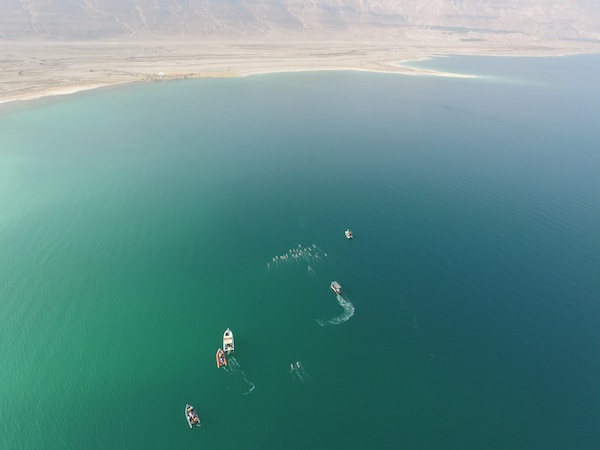
Twenty-five swimmers from around the world crossed the Dead Sea on Nov. 15. (photo from EcoPeace)

On Nov. 15, some two dozen swimmers made the seven-hour trek across the Dead Sea, starting from the Jordanian side and swimming to the Israeli.

The demise of the Dead Sea is not news. According to the group EcoPeace Middle East – a Jordanian, Palestinian, Israeli environmental peace-building organization – the sea has receded by 25 metres in the last three decades and has lost a third of its surface area. Yet, hope remains.

The recent event’s initiator and a participant swimmer, Oded Rahav, stated in an EcoPeace press release, “If it’s possible to do the impossible, like swimming across the Dead Sea, then it’s possible to save the Dead Sea. We are not just interested in raising awareness, but creating real action to benefit the Dead Sea.”

Co-sponsoring the event with EcoPeace was Tamar Regional Council in Israel.

“A group of Israeli swimmers approached EcoPeace last spring with an idea to do a first-ever event – to swim across it [the Dead Sea]!” said Mira Edelstein, project coordinator of EcoPeace’s Jordan River Rehabilitation and Save the Dead Sea projects. “Not only were they looking for an idea to follow their previous success in topping a Guinness record – swimming from Cyprus to Israel – they also sought a way to raise awareness about the need to save the Dead Sea.

“They, naturally, turned to EcoPeace, as we’re the only regional environmental organization in the Middle East working on the issue of the rehabilitation of the River Jordan, which is in direct correlation with saving the Dead Sea. We gladly took on co-organizing the event and worked hard to make it happen, especially in getting permission from the Jordanian army to ‘sail’ across the border in the middle of the sea, starting from the Jordanian side.”

photo - The Dead Sea swim team
The Dead Sea swim team. (photo from EcoPeace)

There were 25 swimmers from all over the world who participated, including from Israel, Palestine, South Africa, New Zealand, Greece, Spain and Denmark. They had to swim with a full-face snorkeling mask because of the water’s extreme salinity and they also had to adapt their swimming style because of the water’s high density. It was a life-risking venture and the swimmers were accompanied by a medical team, as EcoPeace notes in the press release: “A drop in the eye causes severe irritation, and chance swallowing of its water can be fatal if not treated immediately.”

The event generated an unprecedented amount of media attention and EcoPeace hopes this will help its ongoing efforts to get local decision-makers to take action on the issue.

“We’re also being approached by several other organizations to do other cross-border events – bicycle event, music event, art event, etc. – and we’ll review all of them to see which is more feasible and which will give us the best results,” said Edelstein, who was born and raised in New York and made aliyah in 1993. She now lives in Gan Yavne, which is near Ashdod. She joined EcoPeace in 2004.

“Personally, as an environmentalist but also a general nature lover, the Dead Sea is such a pearl of nature with so many unique qualities found nowhere else on this earth, that it would be a tragedy to lose it,” she told the Independent. “This is a man-made catastrophe and we must work as hard as possible to reverse it.”

Edelstein explained that the threats to the Dead Sea are coming from two directions.

“First is from the north,” she said. “Historically, the main inflow to the Dead Sea has been the Lower Jordan River. And, with the diversion of more than 95% of the Jordan River’s water by Israel, Jordan and Syria, leaving a meagre five percent to reach the Dead Sea … no wonder the Dead Sea is shrinking – by more than a metre a year.

“EcoPeace is working extremely hard to rehabilitate the Lower Jordan River back to at least a third of its historic flow, not only for the river’s own integrity – this is the holy Jordan River! – but we’re doing this for the Dead Sea as well.

“Second is from the south – from both Israeli and Jordanian mineral industries. These industries are using the most simple, antiquated, water-intensive technology to harvest minerals from the Dead Sea: evaporation. Unfortunately, both industries have no incentive to change their extraction technology, because they do not pay a penny for the amount of water they use.”

EcoPeace is working to change this; however, discussions about extracting minerals using systems based on desalination technologies (reverse osmosis) have come to a standstill, as they cost money, while evaporation is free.

“They claim they are studying them (these technologies), but have concluded that they’re very expensive,” said Edelstein. “Our point is exactly that – that until they will be forced to pay for the amount of water they use, any kind of change will be expensive.”

With the Israeli mineral industry’s contract with the state on its last leg, Edelstein is hopeful that a new contract will include putting a price on the Dead Sea’s water.

“EcoPeace is working very hard to get a bill passed through the Israeli parliament wherein the Dead Sea Works [part of the company ICL Fertilizers] will need to pay for the amount of water they use,” she added.

“Both of these actions together, that EcoPeace is working on, will help stabilize the Dead Sea. The Dead Sea will not yet be completely saved or restored, but we understand we first need to halt its destruction and [then] to work on stabilizing it.”

While there was a plan to draw water from the Red Sea to the Dead Sea, the original mega-project, which the World Bank was studying for more than a decade, has been deemed unfeasible. The present-day Red Sea-Dead Sea canal project “is different than the original one,” said Edelstein. “This project is based on a water swap between Israel and Jordan, which also includes a component for Palestinians to get more water from Israel.”

With both the Jordanian and Israeli governments working closely, mainly on furthering the canal project, EcoPeace applauds the joint efforts, but does not see the project as the solution.

“I do believe that the Dead Sea is high on the public agenda,” said Edelstein. “It’s not difficult to find information on the issue. Our website is being upgraded and we’ll soon have updated information to share, but recent news articles are a good place to begin.”

For more information about EcoPeace, which was formerly called Friends of the Earth Middle East, its Dead Sea and other projects, visit foeme.org.

Rebeca Kuropatwa is a Winnipeg freelance writer.

A world leader in care

The World Health Organization has recognized Israel’s medical rescue teams and Israel Defence Forces’ field hospital as Type 3, the highest ranking for any foreign medical rescue team and field hospital in the world. (photo from United Hatzalah)

On Nov. 28, the World Health Organization (WHO) began a three-day meeting in Hong Kong, during which they recognized Israel’s medical rescue teams and Israel Defence Forces’ field hospital as Type 3, the highest ranking for any foreign medical rescue team and field hospital in the world. Israeli Deputy Minister of Foreign Affairs Tzipi Hotovely attended on behalf of Israel.

United Hatzalah, Israel’s national volunteer emergency medical services organization, and the Israelife Foundation, a conglomerate of Israel-based rescue organizations that respond to disasters worldwide, welcomed the award.

“We want to praise and thank all of the dedicated volunteers, staff and soldiers in all of the rescue services throughout the country. Their dedication and selfless acts of kindness in saving lives at home and abroad are officially being recognized on the world stage and, due to their efforts, Israel has become a world leader,” said Dov Maisel, United Hatzalah vice-president of international operations.

With the ceremony, Israel became the 17th foreign medical team to be classified by WHO, and it currently boasts the highest ranking. The process to achieve the ranking took nearly a year of in-depth reviews to ensure that Israel’s field hospitals met all of the criteria.

Besides the simple value of recognition, the Type 3 classification will also have some real ramifications. The classification ensures that Israeli rescue and medical teams will be the first allowed on the scene of future disasters regardless of where they happen and it will further cement Israel’s position as a world leader in emergency medicine.

Israel is not only the only Type 3 medical response team in the world, it is also the only one to be recognized by WHO that comprises a “military component” in the form of the IDF field hospital. Some aspects of the classification deal with the ethics of emergency care, and having a military branch receive the Type 3 classification highlights the ethical standing of that body.

The person behind the WHO classification system is Dr. Ian Norton, a specialist in emergency medicine and former head of his native Australia’s emergency response team. Norton developed the WHO system – which ranks foreign medical teams into Type 1, Type 2 and Type 3 – in 2013.

The different types refer to the number of patients that can be treated and the level of difficulty of the procedures that can be offered by a medical response team. Even with the high standards, Israel’s field hospital surpasses the requirements, offering more medical care than is required to be classified as Type 3. For example, the Times of Israel reported that a Type 3 field hospital needs 40 inpatient beds, whereas Israel’s has 86, and a Type 3 ranking requires the hospital to have two operating rooms, whereas Israel’s has four. Israel also qualified for the Type 3 category by employing teams that offer additional “specialized care,” such as burn units, dialysis units, obstetrics and gynecology teams, and reconstructive plastic surgery units. The IDF field hospital also received accolades for its abilities to provide exemplary levels of plastic surgery, and obstetrics and gynecology care. These latter qualifications establish the team as a “Type 3 plus.”

In addition to the field hospital, Israel was praised for the work done by its volunteer evacuation and emergency response teams, such as United Hatzalah, Zaka and Israelife. These teams of volunteer responders have conducted search and rescue operations and provided emergency medical services in disasters all over the world. Most recently, United Hatzalah sent Maisel, an emergency paramedic, to be a medical liaison and consultant as part of the Jet911 multinational response team that responded to the destruction caused by Hurricane Matthew in Haiti in October.

Other disasters to which the IDF field hospital and Israel medical response teams have responded include the earthquake in Turkey in 1999, the earthquake in Haiti in 2010, the typhoon in the Philippines in 2013 and the devastating earthquake that shook Nepal in 2015.

To see a recent interview with Maisel on this topic, visit i24news.tv/en/tv/replay/the-lineup/x53qmiz.

Keeping the weight off

(image from wis-wander.weizmann.ac.il)

Following a successful diet, many people are dismayed to find their weight rebounding – an all-too-common phenomenon termed “recurrent” or “yo-yo” obesity. Worse still, the vast majority of recurrently obese individuals not only rebound to their pre-dieting weight but also gain more weight with each dieting cycle. During each round of dieting-and-weight-regain, their proportion of body fat increases, and so does the risk of developing the manifestations of metabolic syndrome, including adult-onset diabetes, fatty liver and other obesity-related diseases.

As recently reported in Nature, researchers at the Weizmann Institute of Science have shown in mice that intestinal microbes – collectively termed the gut microbiome – play an unexpectedly important role in exacerbated post-dieting weight gain, and that this common phenomenon may in the future be prevented or treated by altering the composition or function of the microbiome.

The study was performed by research teams headed by Dr. Eran Elinav of the immunology department and Prof. Eran Segal of the computer science and applied mathematics department. The researchers found that, after a cycle of gaining and losing weight, all the mice’s body systems fully reverted to normal – except the microbiome. For about six months after losing weight, post-obese mice retained an abnormal “obese” microbiome.

“We’ve shown in obese mice that, following successful dieting and weight loss, the microbiome retains a ‘memory’ of previous obesity,” said Elinav. “This persistent microbiome accelerated the regaining of weight when the mice were put back on a high-calorie diet or ate regular food in excessive amounts.”

Segal elaborated: “By conducting a detailed functional analysis of the microbiome, we’ve developed potential therapeutic approaches to alleviating its impact on weight regain.”

The study was led by Christoph Thaiss, a PhD student in Elinav’s lab. Thaiss collaborated with master’s student Shlomik Itav of Elinav’s lab, Daphna Rothschild, a PhD student of Segal’s lab, as well as with other scientists from Weizmann and elsewhere.

In a series of experiments, the scientists demonstrated that the makeup of the “obese” microbiome was a major driver of accelerated post-dieting weight gain. For example, when the researchers depleted the intestinal microbes in mice by giving them broad-spectrum antibiotics, the exaggerated post-diet weight gain was eliminated. In another experiment, when intestinal microbes from mice with a history of obesity were introduced into germ-free mice – which, by definition, carry no microbiome of their own – their weight gain was accelerated upon feeding with a high-calorie diet, compared to germ-free mice that had received an implant of intestinal microbes from mice with no history of weight gain.

Next, the scientists developed a machine-learning algorithm, based on hundreds of individualized microbiome parameters, which successfully and accurately predicted the rate of weight regain in each mouse, based on the characteristics of its microbiome after weight gain and successful dieting. Furthermore, by combining genomic and metabolic approaches, they then identified two molecules driving the impact of the microbiome on regaining weight. These molecules – belonging to the class of organic chemicals called flavonoids that are obtained through eating certain vegetables – are rapidly degraded by the “post-dieting” microbiome, so that the levels of these molecules in post-dieting mice are significantly lower than those in mice with no history of obesity. The researchers found that under normal circumstances, these two flavonoids promote energy expenditure during fat metabolism. Low levels of these flavonoids in weight cycling prevented this fat-derived energy release, causing the post-dieting mice to accumulate extra fat when they were returned to a high-calorie diet.

Finally, the researchers used these insights to develop new proof-of-concept treatments for recurrent obesity. First, they implanted formerly obese mice with gut microbes from mice that had never been obese. This fecal microbiome transplantation erased the “memory” of obesity in these mice when they were re-exposed to a high-calorie diet, preventing excessive recurrent obesity.

Next, the scientists used an approach that is likely to be more unobjectionable to humans: they supplemented post-dieting mice with flavonoids added to their drinking water. This brought their flavonoid levels, and thus their energy expenditure, back to normal levels. As a result, even on return to a high-calorie diet, the mice did not experience accelerated weight gain.

“We call this approach ‘post-biotic’ intervention,” Segal said. “In contrast to probiotics, which introduce helpful microbes into the intestines, we are not introducing the microbes themselves but substances affected by the microbiome, which might prove to be more safe and effective.”

Recurrent obesity is an epidemic. “Obesity affects nearly half of the world’s adult population, and predisposes people to common life-risking complications such as adult-onset diabetes and heart disease,” said Elinav. “If the results of our mouse studies are found to be applicable to humans, they may help diagnose and treat recurrent obesity and this, in turn, may help alleviate the obesity epidemic.”

Also taking part in the study were Mariska Meijer, Maayan Levy, Claudia Moresi, Lenka Dohnalova, Sofia Braverman, Shachar Rozin, Dr. Mally Dori-Bachash and staff scientist Hagit Shapiro of the immunology department, staff scientists Drs. Yael Kuperman and Inbal Biton, and Prof. Alon Harmelin of the veterinary resources department, and Dr. Sergey Malitsky and Prof. Asaph Aharoni of the plant and environmental sciences department – all of the Weizmann Institute – as well as Prof. Arieh Gertler of the Hebrew University of Jerusalem and Prof. Zamir Halpern of the Tel-Aviv Sourasky Medical Centre.

Help from Muslim neighbors

Moriah Congregation’s prayer books were among items destroyed in the Haifa fires. (photo from masorti.org)

The Masorti Foundation for Conservative Judaism in Israel put out an international call for donations to help Moriah Congregation rebuild from the ashes after the recent week-long wildfires that raged across Israel. But it was two small, local initiatives that put the damaged synagogue into the headlines.

On Nov. 30, a group of worshippers from all faiths attended a special prayer service for the new Hebrew month of Kislev and to show support for the rebuilding of the community. A local member posted Facebook photos of the service. One of the photos showed 20 saplings donated by a man from Baqa al-Gharbiyye, an Arab city in the Haifa district, as a gift to replace the trees in the courtyard that had been burned in the fires.

And he wasn’t the only one bearing gifts.

Two Muslim tradesmen from Umm al-Fahm, another Arab town in the Haifa district, also came to the service and were greeted with great applause for their contribution of wood panels to the synagogue.

Moriah Congregation – the oldest Conservative synagogue in Israel – suffered extensive damage in the fires. The whole second floor and roof of the building were destroyed, including their beit midrash, all of their books, their education wing and their youth club.

At first, the Moriah community turned to a Jewish carpenter for help. He agreed to work pro-bono but asked that the synagogue pay for the wood. He went to get a price quote from wood suppliers Walid abu-Ahmed and Ziad Yunis. When they heard that the previous tables were destroyed in the fires that devastated 13 neighborhoods in Haifa, they chose to donate enough wood for 10 tables.

“I had tears in my eyes when I heard what was happening,” Rabbi Dov Hiyon, who heads the Moriah community, told Ynet news. “It was so emotional to hear that Muslims were asking to donate to a Jewish synagogue. I’ve invited them to evening prayers to personally thank them.”

“I decided to help and not receive any payment,” abu-Ahmed told the Hebrew daily news site. “Jews and Arabs live together in Haifa, and there is no discrimination. We must continue with this coexistence and promote peace.”

Israel21C is a nonprofit educational foundation with a mission to focus media and public attention on the 21st-century Israel that exists beyond the conflict. For more, or to donate, visit israel21c.org.

Beef versus legumes

If the entire population of the United States changed their diet from a beef-heavy plan to one based on chicken, it would be possible to feed 120 to 140 million more people with the same resources. (photo from wis-wander.weizmann.ac.il)

How much does a steak really cost? Or chicken nuggets, or a plate of hummus? New research by Prof. Ron Milo and Alon Shepon of the plant and environmental sciences department of the Weizmann Institute of Science, together with Prof. Gideon Eshel of Bard College in New York, took a look at the figures – including the environmental costs – of the different foods we eat. The research appeared in Environmental Research Letters.

The data for the study came from figures for cattle and poultry growing and consumption in the United States. To compare, the researchers calculated the nutritional value of each – usable calories and protein – versus the environmental cost. The latter included the use of land for fodder or grazing and the emission of greenhouse gases in both growing the food and in growing the animals themselves.

Chickens, according to the study, produce much more edible meat per kilogram of feed consumed, and they produce their meat faster than cattle, meaning more can be grown on the same amount of land. For every 100 calories and 100 grams of protein fed to beef cattle, the consumer ends up with around three calories and three grams of protein. For poultry, that figure is about 13 calories and 21 grams of protein.

The researchers then asked what would happen if the entire population of the United States were persuaded to change their diet from a beef-heavy plan to one based on chicken. Their answer: it would be possible to feed 40% more people – 120 to 140 million more people – with the same resources.

What would happen if the same population was persuaded to adopt an entirely plant-based diet? That is, instead of using land to grow cow or chicken feed and then eating the animals, to use that land to grow nutritional crops – mainly legumes, including peanuts, soya, garbanzos and lentils. These can supply all of a person’s nutritional requirements, except vitamin B12, which can be obtained from nutritional yeast.

A separate study, published in Environmental Science and Technology – “Environmentally optimal, nutritionally aware beef replacement plant-based diets,” by Milo, Shepon, Gidon Eshel and Elad Noor – suggests that an extra 190 million people could eat off the same environmental resources in this way.

“If we changed our diet, we would change the environmental price we pay, with every meal,” said Shepon. “Eating a plant-based diet can both meet our nutritional requirements and save on land use, as well as the release of greenhouse gases into the atmosphere and excess nitrogen from fertilizers into the water supply. These are real costs that we all bear, especially when people eat beef.”

Milo’s research is supported by the Leona M. and Harry B. Helmsley Charitable Trust; Dana and Yossie Hollander, Israel; and the Larson Charitable Foundation. Milo is the incumbent of the Charles and Louise Gartner Professorial Chair.

For more on the research being conducted at the Weizmann Institute, visit wis-wander.weizmann.ac.il.

Fires take a huge toll

Prime Minister Binyamin Netanyahu examines arson damage in Beit Meir. (photo from Ashernet)

photo - Latrun forest fire
Latrun forest fire. (photo from Ashernet)

Last week’s wave of fires across northern and central Israel is estimated to have caused, so far, some half a billion shekels in damage, and total projections are higher. Several thousand homes have been either destroyed completely, or partially destroyed in the infernos.

In many cases, the fires have been set deliberately. Drones equipped with UV detection equipment filmed several instances of arsonists setting fire to brushwood around the Jerusalem region and in the north near Haifa, and several suspects have been arrested. Matters have been made worse by the fact that the winter rains have not yet started and the forests are very dry. Also, the temperatures have been higher than usual in most parts of the country.

photo - Prime Minister Binyamin Netanyahu talks with firefighters from Croatia, who came to assist in putting out the fires in northern and central Israel
Prime Minister Binyamin Netanyahu talks with firefighters from Croatia, who came to assist in putting out the fires in northern and central Israel. (photo by Kobi Gideon / GPO via Ashernet)

Several countries, including the United States, Greece, Croatia, Cyprus and Turkey, have sent fire-fighting aircraft to Israel to assist in getting the fires under control. The Palestinian Authority also sent firefighters to assist the Israeli teams to control the infernos.

On Nov. 27, Prime Minister Binyamin Netanyahu toured one of the worst-affected areas, just west of Jerusalem, in Beit Meir. The prime minister saw at least 10 homes that had been destroyed and many others showing serious fire damage, making even those uninhabitable.

JNF Canada has started an emergency campaign, every dollar of which will go to rehabilitation and clean-up efforts. For more information, visit jnf.ca or call 604-257-5155.

A visit to Mount Herzl

On Mount Herzl is a memorial to the more than 4,000 Ethiopian Jews who died attempting to reach Israel. (photo by Deborah Rubin Fields)

The 29th of the Hebrew month of Cheshvan – this year, it fell on Nov. 30 – is a day of celebration for the Israeli Ethiopian community and a national Israeli holiday. Late in the afternoon, thousands of people gather in Talpiot (southern Jerusalem) on the Haas Promenade for Sigd, the day marking the acceptance of the Torah, and celebrating their history and culture.

photo - The memorial to Ethiopian Jews is multifaceted
The memorial to Ethiopian Jews is multifaceted. (photo by Deborah Rubin Fields)

Despite the enormous loss of life and the discrimination faced by Israelis of Ethiopian descent, Sigd still is, in part, a prayer to make it possible to reach Israel. The Knesset legislated the Sigd Law in 2008, which made 29 Cheshvan a national holiday. The Knesset also legislated 28 Iyar (the Hebrew month that falls roughly in May) as the memorial day for community members who died making the journey to Israel. And, the year prior, in 2007, the Israeli Ministry of Immigration and Absorption in cooperation with the World Zionist Organization and the Israeli Defence Ministry unveiled a memorial to the more than 4,000 Ethiopian Jews who died attempting to reach Israel. Located on Mount Herzl, this stirring monument gives official recognition to the community’s largely unknown suffering. Until it was commemorated, the only existing monument stood in southern Jerusalem, at Kibbutz Ramat Rachel.

Starting at the end of 1979 and continuing for some four years, the Ethiopian Jewish community uprooted itself en masse to fulfil its dream of coming to Israel. It was both a physically exhausting and mentally terrifying journey. In Ethiopia’s forests and Sudan’s deserts, thousands were robbed, beaten, raped and even murdered. If there are graves for the fallen, they are far away from Eretz Yisrael.

The Mount Herzl memorial reminds visitors not just of the Ethiopian villages, but of an entire life left behind. Explanations are mounted in Amharic, Hebrew and English. In Hebrew, eight panels dramatically narrate 1) the exodus from Ethiopia from a boy’s perspective, 2) the events along the way, as explained by the group’s head, 3) life in Sudanese refugee camps, from a mother’s recollections, and 4) the actual departure for Israel, as related by the kes, or religious head of the community.

To learn more about Ethiopian Jews’ journey to reach Israel, Baruch’s Odyssey: An Ethiopian Jew’s Struggle to Save His People by Baruch Tegegne, as told to Phyllis Schwartzman Pinchuk, and the children’s book The Storyteller’s Beads by Jane Kurtz are recommended reads. As for movies, there are Mekonen: The Journey of an African Jew, directed by Rivka Shore; Live and Become, directed by Radu Mihaileanu; Zrubavel, directed by Shmuel Beru; and Yiftach’s Daughter, directed by Einat Kapach.

Deborah Rubin Fields is an Israel-based features writer. She is also the author of Take a Peek Inside: A Child’s Guide to Radiology Exams, published in English, Hebrew and Arabic.