“Settlement” versus “Ariel”

Avi Zimmerman chose for Talk17 a format that would allow a speaker to share their stories and views uninterrupted. (photo from Avi Zimmerman)

There is a range of strong opinions when it comes to Jewish community development east of the Green Line. Many around the world refer to these Israeli communities as “settlements.” But, to Avi Zimmerman of the Ariel Foundation and many Israelis, Ariel is something else.

Zimmerman was born and raised in West Orange, N.J. He made aliyah in 1995 and served in the Israel Defence Forces. After earning a degree in occupational therapy at the Hebrew University and then working in the field for four years, he and his wife decided to move to Ariel. There, Zimmerman started up an aliyah program.

“I was then asked to run the Ariel Foundation, which is what I’ve been doing for the last eight years or so,” Zimmerman told the Independent. “The foundation is not only for raising funds for city projects, it also provides accurate information about the city of Ariel to an international public.”

Ariel will celebrate its 40th anniversary in 2018. Established on Aug. 17, 1978, with 40 families, it is now a city of close to 20,000 residents, plus an additional 15,000 students studying at Ariel University.

Geographically, Ariel is east of Tel Aviv, past the Green Line. Given what he – and others – see as misinformation being spread about Jewish communities east of the Green Line, Zimmerman decided to share stories from the people actually living in the area and how local people feel about various issues.

To do this, Zimmerman copied a format that has worked very well for TED Talks on YouTube, and created Talk17.

“Our lives are not lived through a conflict lens, fortunately, nor are those of our Palestinian neighbours,” he explained. “Those elements possibly do exist. It’s not that they don’t exist. But, they are not the primary theme of the way life is lived here.

“If people are interested in what goes on here, I think it’s only fair to the international community to provide more accurate information – not in terms of stats or facts, although that’s part of it … [but] beyond that, in terms of the voices from the region.

“The concept is, instead of talking about us in a well-intentioned yet disenfranchising way, just listen to us and hear what we have to say.”

Zimmerman chose the TED Talk format because it is not confrontational, as are debates and as can be panel discussions. The format allows a presenter to tell their whole story without interruption.

“We want to give authentic voices an opportunity and a fair platform, so there’s no debate, no winners and losers, no questions and answers,” he explained. “There’s no objective right or wrong to that. It’s authentic…. I think, ultimately, people are interested in the breadth and depth of the story.

“There are a lot of people who like to live in what they are calling echo chambers … in a world where everybody says what they like to hear, and they de-friend you if you say something else. A lot of the world is just moving in that direction. But they are not our target audience. If you already know everything, we can’t convince you otherwise. You’re going to turn off the video when you hear something you don’t like and that will be the end of it. My target audience is authentic people. They actually care and are willing to listen to new ideas they’re not familiar with.”

image - The crowdfunding page clearly lays out the principles behind Talk17
The crowdfunding page clearly lays out the principles behind Talk17. (image from generosity.com)

While an 18-minute video is hard for some people to get through, Zimmerman has been finding that, organically, Talk17 has been successful by having speakers who are on the frontlines of change-making. He gave as an example an exchange he’d had just before his interview with the Jewish Independent – an artist had happened upon Talk17’s Facebook page and was very excited about the concept. The artist runs an organization that uses the arts as a form of intercultural dialogue and they and Zimmerman are now working on plans for an arts-themed program, including an exhibition, at the end of April.

“It was just a preliminary conversation today,” said Zimmerman. “But, the thing is, these are the kinds of people who can help us open new doors.”

Since starting Talk17, 90% of the views, as it happens, have been from Arab-speaking, self-identified Palestinians, said Zimmerman. “We’re reaching across the aisle,” he said. “There’s something very real to this.”

While Palestinians, Israelis and Canadians are open to listening to talks in languages other than English, Zimmerman has found that Americans are less willing to do so. Because of this, he has decided to stick with English for Talk17.

“We automatically limit ourselves to English-speakers,” he said. “They don’t have to be native English-speakers. We try to get a fair balance of Arab and Palestinian voices among the Jewish and Israeli voices. We try to get a fair balance of women and men.

“We try to find people that have a unique story … so, it’s not just a personal story, but there’s a new concept to it. If you follow the first videos we’ve been launching, you’ll see each story is very different. We’re also trying to work on themes, events with themes.”

He said an upcoming theme will be diplomatic options for the future. “For 50 years,” he said, “we’ve heard about the two-state solution, we’ve heard about it since the 1947 Partition Plan. But, the point is, it’s not going anywhere. So, people are saying that, if not that, then what? So, we want to examine that.”

Zimmerman hopes that, by the end of the process, he will have been able to create a video archive that people can access to deepen and broaden the conversation about the region, so they can realize there is more to the story than they thought from just reading a short article or hearing a news clip.

Zimmerman also hopes that, in the future, visitors to Israel will be more willing to venture out of Tel Aviv and Jerusalem, and will come visit Ariel to experience firsthand the beauty of the region and its people.

“We all need to remember that, regardless of the terms of the deal that one day will hopefully be reached between Israel and the Palestinians, and regardless of where the lines will be drawn, Jews and Arabs will be neighbours forever,” said Zimmerman. “With that in mind, we need to figure out how to work with them directly, and we’d appreciate it if the world would allow us to do so, by appreciating the dynamics between us … by having this window into our interactions.

“However, the objective of Talk17 is not for me to have a better relationship with my Palestinian neighbour. That’s an added value … something we do anyway. We don’t need Talk17 for me to meet with my friend on Wednesday. We need Talk17 for the relationship between the Israelis and the international community, and the Palestinians and the international community.”

In addition to the Talk17 YouTube channel, there is a crowdfunding effort in progress for the talks, at generosity.com/community-fundraising/talk17-change-the-israel-conversation–2.

Rebeca Kuropatwa is a Winnipeg freelance writer.


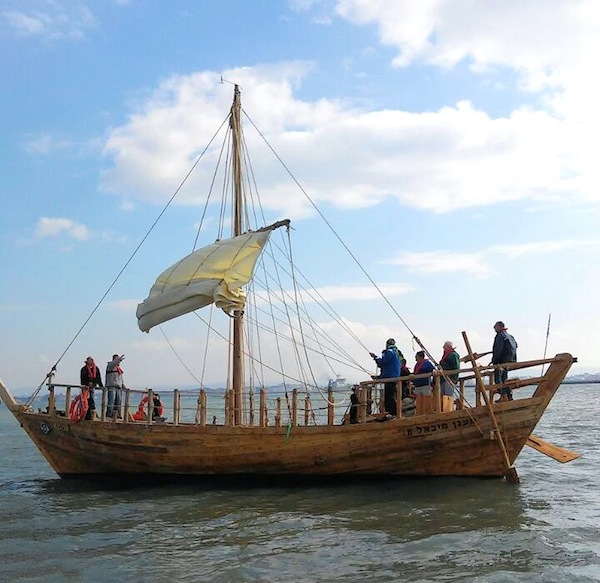
Ma’agan Michael sets sail

(photo from Haifa University via Ashernet)

The replica of the Ma’agan Michael ship took its first voyage on March 17, near where the original vessel was discovered in 1985 by Ami Eshel, a member of Kibbutz Ma’agan Michael, some 70 metres from the kibbutz. Organized by the University of Haifa and the Israel Antiquities Authority, the replica has been built over the past two years, using the same materials and methods as 2,500 years ago. The ship was removed from the water in 1988, and is on display at the university’s Hecht Museum. Most of it had been covered in sand, so the keel, numerous wooden plates, 14 crossbars and the base of the mast were all preserved, offering researchers rare insight into the method used to construct the ship. In addition, a carpenter’s toolbox was found, which sparked the dream of building a replica using the same methods as the original shipwrights. After two year’s work, the project was completed and the replica was taken to Israel Shipyards and then to Kishon Harbour. Prof. Yaacov Kahanov, the leading spirit behind the project, passed away just before the work was finished. (Edgar Asher)

Fundraising with food

Israeli business owner and chef Yair Yosefi helped spearhead a fundraiser for Syrian refugees. (photo from Yair Yosefi)

A Tel Aviv restaurateur and bar owner wanted to do something about the dire situation of Syrian refugees, so he turned to what he knows best – food.

Yair Yosefi is the owner of Nahalat Binyamin restaurant Brut and bar Extra Brut. Thinking about how he might be able to help, Yosefi connected with his friend Ronit Vered, who is a food journalist. Together, the two created Kitchen Without Borders, which raises awareness of the plight of and funds for Syrian refugees.

“When you see what’s happening on the other side of the border, we have to do something,” Yosefi told the Jewish Independent. “We don’t have enough power. We aren’t politicians. We thought, if we have to do something, we will cook.”

Although Yosefi said he would gladly go to Syria to cook, his Israeli passport doesn’t allow him to do so. “It was a dream of mine to go to Haleb,” he said. “When I was living in France, I had friends from there … very interesting cuisine. But, having an Israeli passport, it’s impossible. Syrians can go into Israel, but Israelis can’t go into Syria…. So, we just decided we’d do what we can.”

They have raised funds by selling Syrian-inspired dishes at their restaurants and by getting other restaurants to join in the fundraising efforts.

Yosefi started Brut and Extra Brut with partners two-and-a-half years ago, soon after he returned to Israel from Paris, where he had been living and working for 10 years. He is now married and has a four-year-old daughter.

Of the restaurant, Yosefi said, “I’m co-chefing with my best friend, Omar Ben-Gal. I’ve been cooking for the last 20 years, since I was 20. We were born and raised in Tel Aviv. It’s the heart for Israel, heart of cultural life in Israel.”

Being the father of a young child, Yosefi feels especially concerned with the situation women and children are facing in Syria. With his friends in the restaurant industry, he wanted to help, but the question was how.

“Every restaurant decided on a dish – either one inspired by Syrian cuisine or, if that wasn’t possible, like with Thai or French restaurants, they’d choose a signature dish,” said Yosefi. “All the revenue from this, which ran for a few weeks, went to a foundation called Karam, based in the U.S. and created by ex-Syrians. Karam uses donations to help, especially, kids … education…. It’s very important.

“We forget, because of the war, they haven’t gone to school or kindergarten … so they’re helping the women and the kid refugees with basic things like food, tents, clean water, education … everything.”

Restaurants throughout Israel joined in the effort to raise the funds, many in Tel Aviv, as well as some Arab and Palestinian restaurants, from large restaurant chains to small mom-and-pop operations, said Yosefi.

About how much was raised through the project, which ran Jan. 15-31, Yosefi explained that he and the other organizers decided ahead of time that every restaurant would donate directly to the foundation. “We trust each other, so we’re not even asking,” he said. “We decided not to count the money. Everybody gave what they made. I know it was quite an important amount … but, most important, it was an issue that was spoken about in Israel and the money obviously helped them – the refugees.

“From the Karam Foundation, we’ve heard two things. First, that it was a nice amount. And, secondly, that it was very heart-warming … [that] people from [across] the border, Israelis, chefs and bakers, gave money.”

As for the Israeli customers enjoying this special cuisine, Yosefi said, “People came and were looking for a certain dish from each restaurant devoted to the cause. It was very, very nice actually. It’s very nice when you go out, eat and drink, and you know that the dish means you’re donating money. Patrons are very generous.”

At Brut, they decided to make a spin-off dish, called Duhul Safadi, the recipe for which they were given by a Palestinian friend from Nazareth, though they called the dish A Night in Halab. Slow (overnight) oven-cooked lamb served on foraged vegetables cooked in yogurt, Yosefi described it as “our take on the Palestinian-Syrian dish.”

Brut chose this particular recipe because the ingredients are locally sourced, something they put an emphasis on with all their food.

Looking ahead for other ways to help, Yosefi said, “We’re going to do something, but we don’t know what yet. We want to see the reaction first.”

In September, Yosefi and his team will be going on the road for a few events in the United States, with stops in Charleston, Nashville and New York. They have been invited to Tokyo this April to do a pop-up booth.

“We’d love to bring our cuisine to Vancouver,” said Yosefi. “It would be fun. We’ll bring our knives and you bring your Canadian whisky. It could be a good match.”

Rebeca Kuropatwa is a Winnipeg freelance writer.


IDF orphans tree plant

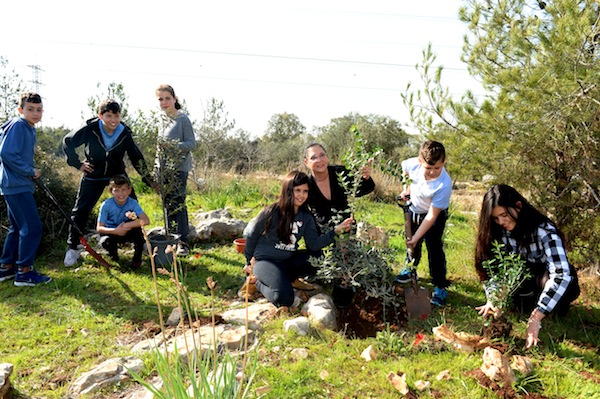
Orphans from the IDF Widows and Orphans organization plant olive trees in the Givat Koah forest along with Tami Shelach, IDFWO chair, herself an IDF widow. (photo from IMP Group Ltd.)

Eleven-year-old Maya Keidar lost her father, Lt.-Col. Dolev Keidar, in Operation Protective Edge in Gaza in 2014. But, on Tu b’Shevat this year, she was smiling as she helped plant some olive trees with other orphans in the Givat Koah forest near Rosh HaAyin in Israel – a site where many trees had been devastated by the recent forest fires. The initiative was organized by the Israel Defence Forces Widows and Orphans organization.

“It’s fun to spend time outdoors, with nature, and even more fun to do it with the friends from IDFWO,” said Maya.

Eliyah Asulin, 10, and her sister Ophir, 14, were part of the group. The Asulin sisters’ father, policeman Sgt. Maj. Shlomi Asulin, was stabbed and killed in 2011 when chasing after car thieves in 2011. Also participating were Jonathan Zilbershlag, 7, and his older brother Ido, 11, who were digging hard to break ground with a spade. Helping them was 8-year-old Yaron Berkovic. While they worked, the children tried to protect as much of the native Israeli flowers that had grown within the past week among the trees in the forest.

“These children’s fathers implanted the values of sacrifice and love of Israel in all of us,” said Tami Shelach, chair of IDFWO, herself an IDF widow. “Now, we must take the values they’ve modeled and continue maintaining them. It’s our fervent hope and wish that these orphans will, indeed, see new beginnings sprout from the darkness.”

The olive tree was chosen as a symbol of peace and hope. And, added 11-year-old Michael Zacharia – whose father, Sgt. Maj. Gil Zacharia, collapsed while his reserve unit was training in 2015 – “It’s a tree with strong roots, so it’ll live for a long time.”

IDFWO is the only nonprofit organization recognized by the State of Israel to work with widows and orphans of the IDF and Israel’s security forces. They care for approximately 8,000 widows and orphans every year through recreational events, programming, retreats, b’nai mitzvah trips, etc. For more information, visit idfwo.org/eng.

Israel’s first whisky distillery

Tours and tastings of Milk and Honey distillery can be booked on certain days. (photo by Ariel Fields)

Is a Bronfman family saga about to begin again? While it has a ways to go before reaching the heights of the once-mighty Seagram empire, Milk and Honey, Israel’s first whisky distillery, may one day have the last laugh. In the meantime, its young investors and workers seem to be having a good time.

I was raised to believe Jews don’t drink anything stronger than wine or the occasional beer. There were, of course, notable unexplained exceptions, as on Shabbat and holidays, when men drank schnapps or Slivovitz at the synagogue’s kiddush. My tasting and tour of Milk and Honey has forced me to change my thinking.

About four years ago, a small group of friends, all Israeli high-techies and entrepreneurs, got together to create Israel’s first whisky distillery. While it is a bit hard for me to comprehend people actually “dreaming” about starting a whisky business, don’t we attribute Herzl to saying, in 1902, “If you will it, it is no dream; and if you do not will it, a dream it is and a dream it will stay”? And this group did pick a pretty Zionist name for its company.

Located in south Tel Aviv, about a 15-minute walk from Old Jaffa, the physical plant is less than a half-block long. The building is basically divided into two sections, the liquor-making facility and the visitors centre. One section looks out on the other from a full-length no-secrets-here glass divider. Six people currently work at Milk and Honey.

As a newbie to whisky-making, I did not know that basically just three ingredients go into single malt whisky: malting barley, water and yeast. Milk and Honey uses Israeli-sourced water. The barley is imported from England’s Muntons company and then mashed at Milk and Honey. The rest of the process – the fermentation, distillation and maturing – also take place on-site.

Milk and Honey has an Israeli-made fermentation tank. One of its two stills is new, but the other was constructed in 1983. It has a capacity of 9,000 litres. To my way of thinking, copper would give the whisky a funny taste, but our guide said they purposely built the still from copper, in order to give the whisky a more delicate taste.

The whisky maturation room has an elaborate alarm system, especially against fires, as the whisky is stored in combustible, wooden barrels.

In big whisky-producing countries such as the United States, Ireland, Scotland and Japan, single malt whisky needs to sit in its cask (barrel) for three years. While lots of people complain about Tel Aviv’s high humidity and temperatures, these factors might ultimately be advantageous to this type of business. Estimates are that the heat and humidity will speed up Milk and Honey’s whisky maturation process, making it two to 2.5 times faster than the above countries’ products.

Still, it will be awhile before Milk and Honey single malt whisky is sold en masse in bottles. The company does plan, however, to market some kind of limited series, which will be periodically released over the next three years.

In the meantime, Milk and Honey has started selling a few types of other liquor, including one called New Make and another called Levantine Gin.

As its name implies, the New Make does not go through barrel aging; its chief use is apparently for cocktail-making. The Levantine Gin is noteworthy for its Middle East quality – it is made with za’atar, a Middle East plant with a thyme-like taste, and other botanicals purchased locally at Tel Aviv’s Levinsky Shuk (Market). While not mentioned by our in-house guide, the use of za’atar ties this liquor to ancient Jewish roots (no pun intended). Za’atar (or “eizov,” in Hebrew) is mentioned in the Torah: in Exodus, Leviticus and Numbers, and references are also made in Kings I and Psalms. Moreover, although he did not prescribe za’atar specifically for hangovers, 12th-century philosopher, astronomer and physician Maimonides (aka Rambam) prescribed za’atar for headaches.

Impressively, these two products have already won awards. Just the day before I visited Milk and Honey, the Levantine Gin had won a gold medal and the New Make a silver at the 2016 Terravino Mediterranean International Wine and Spirit Challenge. Not a bad start for a new company.

All of Milk and Honey’s liquor is certified kosher. Tours and tastings are available on Tuesdays, Thursdays and Fridays by prior arrangement. See mh-distillery.com/visit-our-distillery.

Deborah Rubin Fields is an Israel-based features writer. She is also the author of Take a Peek Inside: A Child’s Guide to Radiology Exams, published in English, Hebrew and Arabic.

Goodbye, airport

An Arkia plane lands at Eilat Airport. (photo from Ashernet)

Ever since 1949, Eilat Airport has been an important link between the resort city of Eilat on the Red Sea and the busy central part of Israel. However, it is due to close later this year when the newly constructed Ramon Airport opens some 20 kilometres north of Eilat. The land that the Eilat Airport currently occupies will be used to build a new city centre consisting of hotels, shops and a residential area, as well as a new rail terminal.

Conner’s brief escape

Ramat Gan Safari Park taking Conner back to the zoo. (photo from Ashernet)

photo - Conner, before his foray into the world outside the park
Conner, before his foray into the world outside the park. (photo from Ashernet)

Conner, a 17-year-old capuchin monkey from Ramat Gan Safari Park, escaped the park earlier this month and set off on a foray into the outside world. Staff from the zoo scoured the immediate area around the zoo and eventually captured him, unharmed, after about a week. Peanut traps were set all around the area where Conner was thought to be hiding and, sure enough, Conner fell for the bait. None the worse for his adventure, Conner, after being checked by the safari park’s vets, was returned to his enclosure and was last seen telling his fellow capuchins what it is like on the other side of the safari park wall.

Inspiring Jewish connection

The recent Toronto Jewish Women’s Renaissance Project group in front of the Western Wall in Jerusalem. (photo from Nicole Pollak)

In its flagship program, Momentum, the Jewish Women’s Renaissance Project (JWRP) provides Jewish women and men, typically mothers and fathers, with a free journey throughout Israel (airfare is not included).

The trips – the women’s and men’s trips are separate – are designed for people who are not shomer Shabbat (Shabbat observant). As well, 90% of participants must have children at home under the age of 18, and participants must be physically and emotionally healthy.

Rebbetzin Lori Palatnik founded JWRP in 2008. Since then, it has become an international initiative bringing thousands of women and hundreds of men to Israel each year from 19 different countries.

“The goal is that the women have 10 incredible, uplifting, inspirational days together … and then go home and bring that back to their families and communities,” said Toby Bernstein of the Chabad Romano Centre in Richmond Hill, Ont.

Bernstein led a group of women on the program in December 2016, noting, “We decided to do this trip to encourage some of the women in our community to be more connected to Judaism.”

Bernstein took with her 10 women, “women who come to synagogue services, a couple Hebrew school moms [and] a couple preschool moms.”

These women joined 250 others from the United States, Canada, Russia, Greece and England.

“It was an inspirational trip, because there were classes every day [about] what it means to be a Jewish mom, a Jewish wife, to be a Jew altogether … what’s the purpose of life,” said Bernstein. “It got a lot of people thinking, so it was inspirational. Even me, who grew up with all of this, grew from [the trip] and gained new insight, new inspiration…. It was beautiful to see the women growing and taking it all in.”

One of the participants was Nicole Pollak, a business owner in Toronto along with her husband, Aaron; the couple has a 3-year-old, Sydney.

Pollak went on the trip with both of her sisters after her younger sister, Melissa Jacks, who sends her children to the Chabad Romano Centre, was invited to join by Bernstein.

“My sister came to me and said that Chabad Romano is going to be running a JWRP trip and asked if me and our older sister, Allyson Theodorou, were interested in going,” said Pollak. “We applied, and all three of us went on this trip together.

photo - Left to right, sisters Allyson Theodorou, Nicole Pollak and Melissa Jacks during a tour of the Old City, outside Jaffa Gate
Left to right, sisters Allyson Theodorou, Nicole Pollak and Melissa Jacks during a tour of the Old City, outside Jaffa Gate. (photo by Megan Epstein)

“We thought it would be an amazing experience to do this together, and to learn more about Judaism and Israel,” she said. “And I, personally, have been studying with a rabbi for about eight years. So, I really liked the idea that it was an educational trip to teach us more and give us more insight into Judaism and the religion, and thought it was a good opportunity to get some Jewish inspiration.”

Before leaving, Pollak had to do what she could to ready her daughter for her absence. “From an emotional standpoint, preparing my daughter that I was going to be away for that amount of time was very difficult for a 3-year-old,” said Pollak. “I don’t think she has a concept of time – 10 days, for her, could be 10 hours, 10 minutes or 10 weeks … [so it was hard to tell] her that I’m going away and what that means and that I’ll be calling her every day. Preparing for the trip on my end, it was not really that difficult. It was just a matter of packing and organizing.”

Pollak’s husband was very supportive of her going on the trip. When Pollak became anxious about leaving, it was her husband who helped push her through it.

“There were a couple of times where I contemplated whether I was even going to go. I thought it was going to be too stressful for the family for me to be gone,” said Pollak. “My husband was the one who said, ‘I support you whether you want to go or if you don’t want to go, but I’d be very disappointed if you didn’t go. I think that would teach our daughter we don’t do things because we’re afraid, instead of showing her to do what we want – to learn, to have an adventure or explore life. He was pushing me to go because he thought it would be an incredible opportunity to go to Israel, learn and spend that time with my sisters.”

From the moment Pollak arrived at the airport, she could feel the camaraderie of the women traveling, all with similar feelings about leaving home, and she began focusing on the trip and getting as much out of it as she could.

Each day of the program in Israel involved one or two discussions, lectures, lessons and classes, sightseeing and tours, and the opportunity to see something cultural or religious in the region. For Pollak, the learning was the best part of the experience.

“One of the things we learned was that there are three major mitzvot for a Jewish woman: lighting Shabbat candles, making challah and going to the mikvah,” she explained. “We had the opportunity to light Shabbat candles and to participate in a challah-making class. And, on our visit to Tzfat, we visited a mikvah and had a tour.

“One of the things they talked about is, if you’re a secular Jewish woman and you don’t have a lot of religion in your life, you should start with lighting Shabbat candles. My older sister, Allyson, had never lit Shabbat candles in her house in her whole life and she’s been married 18 years. In Israel, she bought Shabbat candles and, last Friday night was the first time ever she lit them in her house. That’s pretty amazing.”

As for challah-making, the sisters have committed to getting together sometimes on Friday nights and making challah for Shabbat. As for the mikvah mitzvah, Pollak plans to investigate it more before deciding whether she wants to make it a part of her life.

With respect to the sightseeing, visiting the Kotel was a major highlight for Pollak, especially after having had a class about prayer before going in a spot overlooking the wall.

“I heard a lot of people saying … they don’t know how to pray, they don’t know what that means,” said Pollak. “People will often go to the wall and pray for world peace or for their entire family to be happy or healthy. They pray for these big things because they think that, when you talk to G-d, that’s what you ask for – big things.

“Something they emphasized in that class was that praying is not about just big things, it’s about little things, too; it’s that we should pray about everything. You can pray that you want your little son Johnny to do well on his math test. You can pray that you hope that your daughter wins that award, or that next week your haircut is going to be great. The message was, pray for what’s important to you.”

photo - Nicole Pollak at Eretz Bereshit, overlooking the Judean Desert
Nicole Pollak at Eretz Bereshit, overlooking the Judean Desert. (photo by Allyson Theodorou)

Another class that hit home for Pollak was one about judgment and perspective. In it, a story was shared that she has been telling people ever since. It was about a little girl who is standing in the kitchen with her mom, holding two bright red apples, one in each hand.

“She says to her mother, ‘Mommy, do you want one of my apples?’” said Pollak. “The mother says, ‘Yes, I do.’ So, the little girl proceeds to take a bite of one apple and then takes another bite from the other apple. The mother stops and thinks to herself, ‘Oh, you little brat.’ Then, the little girl puts her hand out to her mother and says, ‘Here, Mom. This one is sweeter.’

“That story really hit home and depicted that we judge based on what we see and not on what really is. I realized that it’s easy for us to judge based on what we think is happening. That story took me through the trip and really made me stop in my tracks every time I looked at someone or if I heard a story and judged what was going on with that person.”

Once back in Toronto, Pollak thanked G-d for the life that she has. She also discovered that her husband, mother-in-law and friends really stepped up and looked after her life while she was away. Her husband, she said, “appreciated me more, just like I appreciated him more when I came back.”

As a result of the trip, Pollak has decided to find ways to live her life with more intention and more appreciation for her marriage, focusing on the positive things in her life, as well as understanding the responsibilities of being a Jewish woman in one’s home.

“I think coming back made me realize that I have a responsibility bigger than I thought from a spiritual standpoint and that I’m going to live and work to do more of that,” she said.

A Vancouver JWRP group is being formed under the auspices of Vancouver Torah Learning Centre for a July 17-24 trip to Israel. For more information, contact Devorah Brody via e-mail at devorahbrody@gmail.com or visit jwrp.org.

Rebeca Kuropatwa is a Winnipeg freelance writer.

Opinions from the streets

Corey Gil-Shuster has split his time between Canada and Israel for 28 years now. (photo from Corey Gil-Shuster)

Corey Gil-Shuster is an Ottawa-born and -raised Jew who spends a great deal of his time and energy asking people their opinions regarding the Middle East conflict – and doing so on camera. He has his own channel on YouTube, called the Ask Project.

Gil-Shuster has spent the last 28 years splitting his time between Ottawa and different places in Israel. He first went to the Jewish state in the 1990s for a study-abroad program at Tel-Aviv University.

At the time, Gil-Shuster said he was just happy to find “a good, safe place to travel and then, from there, to travel to other places. Then, when I was here in Israel, actually I didn’t like it very much. It was very different than I expected. I found it too chaotic…. It took me about six months to get used to it. Once I did, I started to fall in love with the place.”

In 1995, Gil-Shuster met his now-husband, Yaron. The couple later adopted a child.

Gil-Shuster said he has found Israelis to be fairly open to discussing homosexuality, and noted a level of acceptance or openness that he has not found in Canada. Even strangers in Israel have felt very comfortable asking him questions about being gay, and he has used the opportunity to educate them about the topic. On more than one occasion, once that initial question has been broached, people have invited him over for dinner to ascertain how they can move to Canada, make a good living and buy a big house.

“I found Israel refreshing,” said Gil-Shuster. “I kind of enjoyed that, because it put me in control as opposed to the opposite – at least the early 1990s in Canada – being gay with straight people in control of whether you’re accepted.”

As he acclimated to Israeli society, Gil-Shuster found himself getting into debates about how Israelis really feel about the situation in the Middle East.

“I thought, well, I have a video camera, so why don’t I just go out my front door and ask random people on the streets to answer some questions?” he told the Independent.

What Gil-Shuster initially found was that, while people had their opinions, they were not interested in asking questions themselves or in listening.

“All these people are either pro-Israel or pro-Palestinian, and they are sure they know everything about Israel,” he said. “But, nobody could come up with a question to either confirm their ideas or give the opposite of what they think. Finally, somebody said something about how Israelis won’t accept a one-state solution. Great, I’ll take that and ask that as a question. I asked neighbours, the guy who sells me fruit and veggies, and another grocery store guy.”

Gil-Shuster had to do on-the-spot translation of the comments from the street interviews. “I would translate as they were speaking Hebrew,” he said. “I put it together. I had seven or eight people and I put it in a film. I learned to edit, but I didn’t cut anything out, and I put it on YouTube.”

In no time at all, Gil-Shuster understood the power in simply letting people share their views – “how much power that can have to go against what mainstream media puts out, whether that’s Canadian, American, Israeli or Palestinian. Every country’s media has a certain narrative they want to say. They have a story they’re trying to sell to their people, and they have to frame the conflict within that.”

To make his videos more objective, Gil-Shuster started to venture further than his backyard in Tel Aviv. He began traveling the country asking people for their opinions. Regardless of what they said, he made a point of not cutting or editing the videos – even if racist or horrible comments were made that didn’t conform to his views.

That doesn’t mean he keeps silent, however. He allows himself the right to make sarcastic comments as he feels the need, noting, “It keeps me more interested. I try to make it very objective … I try to figure out, as much as possible, where they’re coming from. If their question is, ‘Why don’t you all just get along,’ I’ll reply quite naively insofar as what my follow-up questions are … thinking that’s kind of where they’re coming from.”

Gil-Shuster has been doing this for the past four years, with a growing following that comprises a mix of pro-Israel and pro-Palestinian fans and many others in between. He provides a variety of views and topics to keep people watching.

When he has to travel for work, doctor appointments or other reasons, he brings his camera along, stopping to speak with people along the way. Jerusalem and Haifa are a couple of his favourite places to do this, as he is more likely to encounter both Israelis and Palestinians.

In general, he has found Palestinians to be more open to talking, though some are fearful and only want to be interviewed if he will agree to conceal their face. Typically, in these situations, he works with a translator.

“When I first started out, my hope was to use these videos as a forum for creating peace in some way, to create a dialogue between Israelis and Palestinians,” he said. “For me, it’s about understanding. But, quickly, I realized that very few Israelis and Palestinians are interested in having a dialogue – at least, not in a public way.”

Some people get mad at Gil-Shuster, feeling he is doing something purposefully against one group or another. In contrast, he gets a lot of messages from people in the Middle East saying, “Thank you for showing me a different side of the conflict. I always had a feeling I was being lied to.”

“These are the emails I like the most,” he said. “You don’t have to like what somebody says, but I’m hoping they’re humanized as a group.”

When asked about how the project has changed his views, Gil-Shuster said he no longer thinks peace is possible.

“Israelis are tough-talking, but are willing to compromise to a certain degree. Palestinians are very open to other people in some ways, but, it’s very black and white for them. It’s all … the land was stolen by foreigners who shouldn’t be there, and that there’s no solution until they leave. Maybe someday they’ll get a leader who’ll be brave enough to tell them what reality is, but they don’t have those kinds of leaders. They always deal with Israel … [with the view that] for now, we can benefit from it, but it’s all ours, so we will get it back someday.”

To date, Gil-Shuster has created more than 500 videos. They can be found at youtube.com/user/coreygilshuster, and he encourages viewers to suggest questions.

Rebeca Kuropatwa is a Winnipeg freelance writer.

Trying to prevent child abuse

The Haruv Children’s Campus at Hebrew University of Jerusalem at Mount Scopus is the first-ever global centre combining research and treatment of child abuse. (photo by Dror Sithakol from facebook.com/schustermanfamilyfoundation)

The first-ever global centre combining research and treatment of child abuse opened Jan. 9 at Hebrew University of Jerusalem at Mount Scopus. The Haruv Children’s Campus brings together for the first time, in one location, a comprehensive array of services for abused and neglected children, including emergency treatment, therapeutic facilities and child advocacy assistance.

Haruv campus houses seven organizations working on all aspects of identifying, diagnosing and treating children, allowing for increased cooperation and coordination. It is also home to a world-class research centre and training services for a wide range of professionals.

This multi-disciplinary campus provides a holistic, child-centred approach to treating, studying and addressing the global issue of child abuse and creates new opportunities for collaboration between institutes and organizations in Israel and around the world. Partnering with the new campus are Hebrew University and the Hadassah Medical Centre.

“Child abuse and neglect occurs in all sectors of society and has a destructive impact on growth and development,” said Prof. Asher Ben-Arieh, director of the Haruv Institute. “We are striving to create the first-ever comprehensive research and treatment centre for maltreated children, based on the widely admired university hospital model. The campus will attract top researchers, professionals and students from Israel and abroad, creating opportunities to affect real change for at-risk children.”

According to the World Health Organization, every fourth child worldwide is a victim of child abuse. Within Israel, about 400,000 youth are considered at-risk for child abuse. In 2015, there were an estimated 44,000 new cases of child abuse reported, with every third Israeli child suffering some form of neglect, 11% involving sexual abuse and 20% involving children with special needs. The problem is so acute that child services workers routinely deal with unmanageable levels of caseloads.

photo - Haruv campus at Hebrew U is based on university research model
Haruv campus at Hebrew U is based on university research model. (photo by Dror Sithakol from facebook.com/schustermanfamilyfoundation)

The Mount Scopus campus was chosen for its strategic location and general accessibility. The site also offers proximity to the ultra-Orthodox and Arab communities, which predominate in nearby residential areas, and the centre will bring a culturally sensitive approach to its work with these populations.

Leading the initiative is the Haruv Institute, with the support of the Charles and Lynn Schusterman Family Foundation, Joint Distribution Committee-Israel, the Ministry of Welfare and Social Affairs, the National Insurance Institute and the Jerusalem Municipality Welfare Services.

The campus will house several organizations devoted to dealing with child abuse, including the Schusterman Emergency Centre, the Beit Lynn Child Protection Centre, the Israel National Council for the Child, the Centre for Treatment of Sexually Abused Children, the Israel Medical Stimulation Centre, the Municipal Child Welfare Centre and the Goshen Program for Comprehensive Child Health.

“Ever since its founding in 2007, Haruv has served as a beacon of hope and a source of strength for victims of child abuse and their families. It has been a forceful advocate for those least able to defend themselves, and it has trained thousands of professionals responsible for preventing and treating abuse and neglect,” said Lynn Schusterman, founder and co-chair of the Schusterman Family Foundation. “The opening of the Haruv Children’s Campus ushers in the next phase of this critically important mission and is a striking example of how Haruv has grown to become an international centre of excellence in its field. We are proud to have partnered with others to make the new centre a reality and look forward to continuing to help Haruv establish itself as the preeminent organization in the prevention and treatment of child abuse and neglect.”

The planning and design of the campus reflects its emphasis on addressing the needs of children and families. Throughout the campus, calming elements have been introduced, such as water, pastoral greenery and play areas created from natural materials. The interior spaces have colourful playrooms, work areas that provide privacy, and a school and kindergarten for children at the emergency centre.

“The opening of the Haruv Campus for Children in Jerusalem is not just a major step in the treatment and prevention of child abuse and neglect in Israel and beyond. It champions a holistic approach ensuring critical players in this field can learn from and inform each other’s success, something we understand full well from our own work in Israel,” said David Schizer, chief executive officer the American Jewish Joint Distribution Committee. “We’re proud of our partnership with the Haruv Institute and the Schusterman Family Foundation to once again foster innovation of new program models to support Israel’s most vulnerable and of the larger effort to provide a safer and brighter future for children and families who will benefit from the one-of-a kind Haruv campus.”