Skip to content
  • Home
  • Subscribe / donate
  • Events calendar
  • News
    • Local
    • National
    • Israel
    • World
    • עניין בחדשות
      A roundup of news in Canada and further afield, in Hebrew.
  • Opinion
    • From the JI
    • Op-Ed
  • Arts & Culture
    • Performing Arts
    • Music
    • Books
    • Visual Arts
    • TV & Film
  • Life
    • Celebrating the Holidays
    • Travel
    • The Daily Snooze
      Cartoons by Jacob Samuel
    • Mystery Photo
      Help the JI and JMABC fill in the gaps in our archives.
  • Community Links
    • Organizations, Etc.
    • Other News Sources & Blogs
    • Business Directory
  • FAQ
  • JI Chai Celebration
  • JI@88! video

Recent Posts

  • Story of Israel’s north
  • Sheltering in train stations
  • Teach critical thinking
  • Learning to bridge divides
  • Supporting Iranian community
  • Art dismantles systems
  • Beth Tikvah celebrates 50th
  • What is Jewish music?
  • Celebrate joy of music
  • Women share experiences 
  • Raising funds for Survivors
  • Call for digital literacy
  • The hidden hand of hate
  • Tarot as spiritual ritual
  • Students create fancy meal
  • Encouraging young voices
  • Rose’s Angels delivers
  • Living life to its fullest
  • Drawing on his roots
  • Panama City welcoming
  • Pesach cleaning
  • On the wings of griffon vultures
  • Vast recipe & story collection
  • A word, please …
  • מארק קרני לא ממתין לטראמפ
  • On war and antisemitism
  • Jews shine in Canucks colours
  • Moment of opportunity
  • Shooting response
  • BC budget fails seniors
  • Ritual is what makes life holy
  • Dogs help war veterans live again
  • Remain vital and outspoken
  • An urgent play to see
  • Pop-up exhibit popular
  • An invite to join JWest

Archives

Follow @JewishIndie
image - The CJN - Visit Us Banner - 300x600 - 101625

Author: Jodie Shupac CJN

How LGBTQ inclusive are Toronto shuls?

How LGBTQ inclusive are Toronto shuls?

Created in 1984, Holy Blossom Temple’s “rainbow chuppah” was inspired by imagery from the story of Noah’s Ark. (photo from cjnews.com)

Had they gotten engaged one year later, Orrin Wolpert and his husband, Mitchell Marcus, would have been married by the rabbi at the downtown Toronto synagogue to which they now belong, the First Narayever Congregation.

The traditional egalitarian synagogue changed its policy on allowing same-sex weddings in June 2009, 10 months after the couple planned their ceremony. At the time, Wolpert and Marcus were involved with the Narayever, but weren’t members, unwilling to belong to a shul that disallowed gay weddings. They asked a Reform rabbi they both knew to officiate at their August 2009 wedding, and subsequently joined Narayever in accordance with the synagogue’s new stance.

“I feel really strongly about the shul,” said Wolpert, who comes from a traditional background. “It’s an amazing community of passionate Jews who are very traditional in their practice yet very inclusive in their approach … the membership is very intellectual, very socially progressive … we feel totally included there.”

Wolpert worked on the Narayever’s board for two years, ran its social action committee, helped draft the language on its website and attends services with his husband and their two-year-old twins about once a month. The congregation honored them with an aufruf prior to their wedding, a brit milah for their son and a simchat bat for their daughter.

Wolpert and Marcus’ sense of total acceptance by their synagogue is not anomalous, but neither is it the norm.

Given the traditional Jewish view that homosexual sex is biblically prohibited, the issue continues to be sensitive for many synagogues and, in some cases, one that requires an overhaul of entrenched values.

Over the past decade or so, as Canadian legislation and large swathes of public opinion have come to recognize the rights of homosexual couples to marry and access attendant legal benefits, Canadian synagogues across denominations have been confronted with the expectation to assert where they stand on LGBTQ inclusion. Given the traditional Jewish view that homosexual sex is biblically prohibited, the issue continues to be sensitive for many synagogues and, in some cases, one that requires an overhaul of entrenched values.

And it’s not just the question of whether to allow same-sex marriage. Synagogues and rabbis across the board are increasingly establishing – both formally and informally – positions on their overall approaches to including LGBTQ congregants in matters such as ritual participation, educational programming and use of language.

While levels of acceptance vary widely among synagogues and rabbis – even within the bounds of a given denomination – there appears to be a general shift toward emphasizing practical inclusion of LGBTQ congregants above rigid adherence to biblical text. Reform, Reconstructionist and progressive, non-denominational synagogues across North America have generally embraced LGBTQ members as equal participants, both by officiating at same-sex weddings and offering full involvement in ritual and executive proceedings.

In 1999, the Central Conference of American Rabbis, the principal association of Reform rabbis in Canada and the United States, green-lighted same-sex marriages, but left the decision whether to officiate at them up to individual rabbis. For some Reform leaders, therefore, change has been more gradual.

This past April, Rabbi Yael Splansky became senior rabbi at Toronto’s Reform Holy Blossom Temple and the first rabbi in the synagogue’s history to perform same-sex weddings. “For years here [as an associate or assistant rabbi], I wouldn’t, out of respect for my senior colleagues, officiate at same-sex weddings,” she said.

Splansky explained that Holy Blossom has long supported the LGBTQ community in other ways. The shul is an ongoing sponsor of Jewish LGBTQ group Kulanu’s Pride Parade float and it supported gay Jewish men afflicted by AIDS in the 1980s and early 1990s.

While gay marriage itself remains a sticking point for a lot of rabbis, there are many who nonetheless view the welcoming of LGBTQ Jews as both an ethical and practical imperative.

The drawing of lines around “acceptable” and “unacceptable” forms of inclusion continues to be quite common among synagogues. While gay marriage itself remains a sticking point for a lot of rabbis, there are many who nonetheless view the welcoming of LGBTQ Jews as both an ethical and practical imperative.

“If someone with an interest, commitment or curiosity about Jewish life knocks on our doors, we’ve got to let them in,” Splansky said. “Some [rabbis] do it with full pleasure, while others do it grudgingly, but everyone’s got to do it … just looking at the numbers, we can’t afford to lose anybody.”

Her comment is in reference to the 2013 Pew report on American Jewry, a survey that indicates rising rates of secularism and intermarriage. Perhaps for this reason as well, the Modern Orthodox world has also seen a shift toward shelving views on homosexuality as sin and ushering LGBTQ Jews into the fold.

In 2010, close to 200 Orthodox rabbis signed a statement of principles regarding homosexual Jews. Drafted by Rabbi Nathaniel Helfgot, a member of one of the largest organizations of Orthodox rabbis, the Rabbinical Council of America, it affirms that although same-sex unions are “antithetical to Jewish law,” individuals with “homosexual inclinations should be treated with the care and concern appropriate to all human beings,” including acceptance in synagogues. It further acknowledges that homosexual Jews in the Orthodox community often face serious emotional and psychological challenges and that, especially among teenagers, the risk of suicide is greater.

Rabbi Aaron Levy, a Modern Orthodox rabbi at Makom, a non-denominational, grassroots Jewish community congregation in downtown Toronto, won’t perform gay marriages, but he said Makom is “a very queer-inclusive community,” with a number of active LGBTQ members. Last summer, Makom held a Shabbaton to honor the upcoming same-sex wedding of two members, which included an aufruf and learnings on queer issues and Judaism.

“Nature provides a minority of people whose sexuality is different, and halachah has to, at some point … come up with a credible response.”

“In terms of where I am vis-a-vis my own approach to traditional Jewish law and my understanding of where the Orthodox community is in grappling with LGBTQ issues … I don’t think I can perform a gay wedding,” said Levy. Still, he noted, “Nature provides a minority of people whose sexuality is different, and halachah has to, at some point … come up with a credible response…. Even if communities aren’t thinking as much about queer issues on the level of possible reinterpretations of halachah, they’re thinking about the social dynamic of becoming more welcoming.”

Boston-based Rabbi Steve Greenberg has garnered recognition for being the only known, openly gay Orthodox rabbi. Author of Wrestling with God and Men: Homosexuality in the Jewish Tradition and executive director of Eshel, an American organization that functions as a national support network for LGBTQ Orthodox Jews who wish to remain committed to tradition, he has performed a same-sex, halachically observant wedding for a Toronto couple and will officiate at another one in Toronto in August.

“ … it’s premature to expect the Orthodox world to sanctify or celebrate what most in it still believe is a prohibition…. I think it’s sufficient to have Orthodox rabbis support a same-sex couple’s Jewish life once they’re married.”

“I do it because, being gay myself, I feel a responsibility for young people, that there should be some way to commit in a fashion that’s real and that your family can celebrate,” Greenberg explained. “But I think it’s a mistake to presently expect [other] Orthodox rabbis to do this … it’s premature to expect the Orthodox world to sanctify or celebrate what most in it still believe is a prohibition…. I think it’s sufficient to have Orthodox rabbis support a same-sex couple’s Jewish life once they’re married.”

Greenberg emphasized that Orthodox rabbis have a responsibility not to dismiss LGBTQ individuals by telling them to pursue a heterosexual marriage or to opt for a life of celibacy. Such responses, can, particularly for young people, cause extremely harmful outcomes, such as depression, self-harm or substance abuse, he said.

“This cannot be a process by which we throw arguments at each other. We need to take a human read of what it is to discover oneself to be gay, lesbian or transsexual and figure out if the community can find ways – either within halachic norms or within a sense of responsibility to shift them – to make way for people who aren’t choosing their sexual or gender identity, but living it.” He suggested that Orthodox rabbis can instead say things such as, “God is merciful. There are 612 mitzvot you can still try to do to the best of your ability … join my shul.”

Aviva Goldberg is the ritual leader at Shir Libeynu, an unaffiliated, inclusive congregation that formed in the late 1990s in Toronto as a place for LGBTQ Jews to worship comfortably. Raised in a Modern Orthodox home, she turned to Reconstructionist Judaism as an adult and came out as a lesbian at age 38 (she’s now 65). Goldberg recalled how, two decades ago, even at a Reconstructionist synagogue, she and her partner weren’t allowed to come up for an aliyah together to mark their anniversary. While great strides have been made, she said, the community still has a way to go overall.

“I’ve heard some rabbis say, ‘Anyone can come to our shul.’ Sure, but do you talk about issues affecting LGBTQ members? Do any of your liturgies relate to them? Do you perform same-sex weddings? The answer is, of course, ‘No.’ It’s more like, ‘You can come to our shul, but leave your life behind.’”

“Toronto’s Jewish community is generally very conservative…. I’ve heard some rabbis say, ‘Anyone can come to our shul.’ Sure, but do you talk about issues affecting LGBTQ members? Do any of your liturgies relate to them? Do you perform same-sex weddings? The answer is, of course, ‘No.’ It’s more like, ‘You can come to our shul, but leave your life behind.’”

For some LGBTQ Jews, this perception sparks a rejection of “mainstream” synagogues in favor of wholly inclusive, non-denominational congregations like Shir Libeynu. For others, like Wolpert, a more traditional synagogue that accepts LGBTQ congregants, but doesn’t strictly define itself as a “gay shul” holds greater appeal.

“My gay identity is only one part of me,” he said. “The rest of me also has to be satisfied by my religious home.”

– For more national Jewish news, visit cjnews.com.

Format ImagePosted on June 27, 2014June 25, 2014Author Jodie Shupac CJNCategories NationalTags Aaron Levy, Aviva Goldberg, Central Conference of American Rabbis, Eshel, First Narayever, Holy Blossom, LGBTQ, Makom, Orrin Wolpert, Rabbinical Council of America, Shir Libeynu, Steve Greenberg, Yael Splansky
Take a day drive to Port Moody

Take a day drive to Port Moody

When driving in the area, be careful, as deer sometimes meander across the roads. (photo by Lauren Kramer)

I’ve lived in Vancouver for just 14 years, so I know I’ve just barely begun to discover all the beauty in the Lower Mainland and beyond. But recently, when I suggested to friends who’d lived in the city all their lives that they join us in Port Moody, their response stunned me. “What’s there?” they asked. It occurred to me then that though I’ve been taking the (close-to) hour-long drive to Belcarra every year I’ve called British Columbia home, for many, even locals, it remains one of the Lower Mainland’s best-kept secrets.

Be warned: the beauty doesn’t start until Barnet Highway, when you leave the congestion of Vancouver and Burnaby behind and enter a landscape of lush forests and ocean vistas. The trees tower on both sides of the highway as you turn onto Port Moody’s Ioco Road and any residue of stress is replaced by a clear sense of joie de vivre, or what I like to call “B.C. moments,” those rare times of year when you sigh in wonder at the sheer exquisiteness of this province and say to yourself, “This is why I live here.”

The curvaceous Ioco Road is home to some of Port Moody’s most luxurious homes, many of them nestling the sloping hillside and prefaced by rolling lawns, manicured flowerbeds and, for those perched overlooking the ocean, private docks. Between the acreages are forested sections with wildflowers and towering trees aplenty. With our car’s sunroof open, we saw eagles glide gently in the blue skies above us, the sun warm on our shoulders.

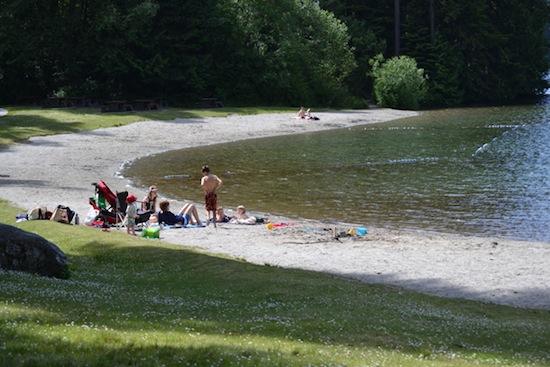
One of my favorite summer destinations in this area is the Village of Anmore, a semi-rural residential community that’s home to White Pine Beach on Sasamat Lake. The lake’s sandy beach and warm waters are a perfect playground for kids building sandcastles, athletic swimmers and those who want nothing more than to drift away on an inflatable mattress and soak up the sunshine. The air is filled with the delighted shrieks of children playing in the shallows as families grill their meals on portable gas barbeques, the smells lingering in the air. Our sandwiches didn’t seem quite so tempting!

You have to be organized if you’re headed to White Pine Beach and, in my house, that means preparing the night before for the day ahead, packing picnic baskets, shopping for food, and ensuring that towels, swimsuits and beach paraphernalia are ready for an early departure. On weekends, the parking lot fills up by 9:30 a.m., and those spots are coveted. Once they’re all occupied, the gate on Sunnyside Road closes to vehicular traffic and access to the lake requires a long walk. Still, it’s well worth it to have a rejuvenating day on the lake that reminds you how good it is to be alive.

photo - The options are numerous at White Pine Beach: you can rest and absorb the serenity, take a swim or or build a sandcastle
The options are numerous at White Pine Beach: you can rest and absorb the serenity, take a swim or or build a sandcastle. (photo by Lauren Kramer)

If you’re keen to kayak, canoe or challenge yourself to a long hike, continue north up Sunnyside Road until you reach the glacial waters of Buntzen Lake, a larger body of water surrounded by numerous hiking trails. The Buntzen Lake Trail, an eight-kilometre route that circles the lake, is a glorious walk through the shady forest and one of the shorter hiking paths in the area. The massive lake offers an off-leash canine beach, a large grassy picnic area shaded by towering hemlocks, a swimming beach and a dock from which kids can learn to fish – a skill they’ll be able to use every summer. For $45 you can rent a kayak for a full day from Anmore Grocery ($60 for a canoe, 604-469-9928) and, if you’ve not stocked up on provisions, call ahead to order croissants, muffins and/or sandwiches.

After a day on the beach, it felt glorious to drive around Port Moody, soaking up its views. As we careened along Bedwell Bay Road, we admired the mansions, envious of their ocean views. While at the Belcarra picnic area, Burrard Inlet glimmered before us, a rocky beach begging to be explored at low tide, preferably with ice cream in hand.

Sure, we got lost on those winding roads, but that was all part of this glorious day drive. At one point, we slowed for two deer that cautiously picked their way across the road right in front of us, posing cooperatively for photos before they disappeared into the forest. The road clear, we headed back into Port Moody, stopping at Suter Brook Village to replenish on smoothies and healthy snacks. Then, we reluctantly traded the wonderfully rural ambience in Port Moody for the road construction, stoplights and heavy traffic of Burnaby and Vancouver, knowing one thing for certain: we’d be back for sure this summer.

For maps and information on Belcarra Regional Park, which encompasses Belcarra, Anmore and Port Moody, call 604-520-6442 or visit metrovancouver.org.

Lauren Kramer, an award-winning writer and editor, lives in Richmond, B.C. To read her work online, visit laurenkramer.net.

Format ImagePosted on June 27, 2014August 18, 2014Author Lauren KramerCategories TravelTags Buntzen Lake, Port Moody, Sasamat Lake, Suter Brook Village, White Pine Beach

UNESCO finally runs “Holy Land” exhibit

Canadian participants in a meeting earlier this month with French President François Hollande came away impressed with the French leader’s sincerity and determination to address the terrorism and antisemitism that has France’s Jews on edge.

Avi Benlolo, president and chief executive officer of the Friends of the Simon Wiesenthal Centre, and Member of Parliament and former justice minister Irwin Cotler said Hollande was empathetic to the concerns of the country’s Jews and was forthright in discussing the threat posed by French-born jihadists returning from Syria.

“Hollande spoke about the barbaric attack on the Jewish museum in Belgium” and about the protection of Jewish schools, synagogues and other community buildings, Cotler said in a telephone interview from Jerusalem.

Cotler and Benlolo were part of a 20-member delegation assembled by the Los Angeles-based

Simon Wiesenthal Centre, which met with Hollande prior to officially inaugurating an historic exhibition at UNESCO’s Paris offices. The exhibit, mounted by historian Robert Wistrich, is titled, People, Book, Land: The 3,500-Year Relationship of the Jewish People to the Holy Land.

The exhibit was sponsored by the Simon Wiesenthal Centre along with the governments of Canada, Israel, the United States and Montenegro, and it launched this month after pressure from Arab countries forced its cancellation in January.

Benlolo said the reception by French officials and Hollande at the Élysée Palace was warm and welcoming. The delegates were anxious to express their concerns about the attack on the Jewish Museum in Brussels by a French gunman, who killed four people.

“Hollande believes there are more than 1,000 French nationals who went to fight in Syria and joined radical groups,” Benlolo said. Three hundred remain. Many came back and he’s concerned about their radicalization and if they will take action against the Jewish community.

Mehdi Nemmouche, the man accused in the Brussels attack, is believed to have spent 2013 fighting with Islamic radicals in Syria.

Hollande assured the delegates that he is working closely with intelligence and security services to track returning jihadists and to ensure the safety of the country’s Jews.

“I believe Hollande was very sincere,” Benlolo said. “The Jewish community received substantial grants to secure their schools and synagogues,” he added.

Cotler, who has visited France three times in the last six months, said, “People spoke well of Hollande and his genuineness, his commitment to combat antisemitism, to bring perpetrators of antisemitism to justice and his appreciation of jihadist acts as threatening to French Jews and France alike. He took the position that it’s a joint struggle, a part of the protection of French democracy and all of France.”

During the meeting, Rabbi Marvin Hier, dean and founder of the Wiesenthal Centre, told the president, “We meet at a pivotal time in history, when the Jewish community and France’s democratic values are under unprecedented attack by the forces of extremism both from the far right and from extreme Islamist purveyors of religious intolerance and murder.”

He applauded Hollande and his predecessor, president Nicolas Sarkozy, for denouncing an earlier terrorist attack in Toulouse that claimed the life of a rabbi and four children, but he lamented the failure of Muslim religious leaders to condemn the attacks.

Meanwhile, Cotler was effusive in his description of the Wistrich exhibit, which he called “historic.”

“It is a remarkable dramatization of history and heritage, of people, book, land, memory and state,” said Cotler.

In 24 panels, the exhibit traces Jewish history back to the patriarch Abraham, through Moses, King David and all the way through to the struggle for Soviet Jewry, the birth of Zionism and the reconstitution of the state of Israel.

The nine-day exhibit had been scheduled to open last January. Pressure from 22 Arab countries, who argued it would prejudice the peace process, prompted UNESCO to cancel it.

Responding to that decision, Hier stated, “It is ironic that, while the Arab League was trying to kill this exhibition and all the attention was focused on Paris, the UN headquarters in New York [was] hosting an exhibit entitled, Palestine, based entirely on the Arab narrative, which was not criticized as an interference with Secretary [John] Kerry’s mission.”

Following public criticism from Canadian Foreign Minister John Baird and U.S. envoy Samantha Power, the exhibit was rescheduled to open early this month, but with the name Israel removed from the title and replaced with “Holy Land.” UNESCO also required the removal of an image of the Dead Sea Scrolls, which had been part of the initial exhibit prepared by Wistrich, a professor of European and Jewish history at the Hebrew University in Jerusalem.

– For more national Jewish news, visit cjnews.com.
Posted on June 27, 2014June 25, 2014Author Paul Lungen CJNCategories WorldTags Avi Benlolo, Francois Hollande, Irwin Cotler, Marvin Hier, Robert Wistrich, Simon Wiesenthal Centre, UNESCO

Israeli company builds floating desalination plants for Japan

Environmentalists usually agree that making fresh water from brackish (salty) water is a last resort. Building desalination plants requires millions of dollars in technology, and it’s costly to produce potable water – both in terms of energy to run the plants and the environmental pollution the factories emit.

The Israeli company IDE Technologies – already planning the biggest desalination plant in the United States – is pushing the borders in this domain closer to sustainability in Japan, where it is working to produce floating desalination plants.

The new approach will breathe new life into Japan’s stagnant shipbuilding business and help the Japanese fulfil short-term freshwater needs, according to Bloomberg News.

Udi Tirosh, a business development director at IDE, told the business media outlet, “Floating plants will not replace the land-built ones, but floating plants can become an alternative that does not saddle a country with the burden of maintenance once local water tables improve.” This could be welcome news in parched regions of the United States, like California, which is experiencing an historic drought.

Read more at israel21c.org.


Posted on June 27, 2014June 25, 2014Author Karin Kloosterman ISRAEL21cCategories WorldTags desalination, IDE Technologies, Udi Tirosh

Palestinian prof. resigns after Auschwitz trip

The Palestinian professor who touched off a maelstrom of controversy by taking a group of students to visit the Auschwitz-Birkenau death camps in Poland is now at odds with his former employer after the school accepted his resignation.

Dr. Mohammed S. Dajani Daoudi, who headed the American studies department and served as chief librarian at Al-Quds University, stirred up controversy among Palestinians who felt the March trip was inappropriate. Although the participants were all students at Al-Quds, Dajani said that the trip itself was under the aegis of Wasatia, the nongovernmental organization that he heads whose goal is to “promote a culture of moderation and reconciliation between the Israeli people and the Palestinian people.” But when the trip became a public issue, criticism was leveled at the school and the professor. Dajani said he received threats and the employee and student unions, to which he did not belong, formally banned him from membership. On May 18, Dajani submitted his resignation from Al-Quds University.

Incoming university president Imad Abukishek said he was surprised by the resignation, given the lengths he said the school went to on Dajani’s behalf. “We thought he noticed what we did for him and that he would respect what we did for him,” Abukishek said, citing two university-assigned security guards hired to protect Dajani and the school’s attempt to confront the unions to demand the rescinding of the ban issued against the professor.

Dajani, however, said he saw the university’s response in a different light. In his letter of resignation addressed to outgoing university president Sari Nusseibeh, Dajani charged that as a result of the fallout from the Auschwitz trip, “the educational environment on this campus for teaching and learning is not available at your university, which makes it difficult to practise my mission to educate and practise academic freedom.”

In a statement, the administration strongly disagreed, citing the school’s efforts to “act promptly and effectively to deal with the actions” of the two unions and the hiring of the bodyguards. The administration insisted that Al-Quds did all it could do “to deal with the repercussions of his visit,” and did so even though it “was being made to deal with ‘an external activity carried out by Prof. Dajani in his private capacity as the CEO of an independent NGO, which he runs [that] … had nothing to do with the university.’” The statement added that the school did all it could “to ensure that individuals, including Prof. Dajani, had the right to express their views freely, and to act freely within the confines of the law, without fear of intimidations or threats.”

Read more at themedialine.org.

Posted on June 27, 2014June 25, 2014Author Abdullah H. Erakat TMLCategories WorldTags Al-Quds University, Auschwitz-Birkenau, Dajani, Imad Abukishek, Mohammed S. Dajani Daoudi, Sari Nusseibeh
Taking the classroom to the world

Taking the classroom to the world

Left to right are Shoshana Burton, Fred Miller and Jessie Claudio. (photo by Shula Klinger)

School curriculum can seem abstract, separate from the “real” world for which it is intended to prepare our children. What can a teacher do to bring the world into her classroom? She can take the classroom into the world.

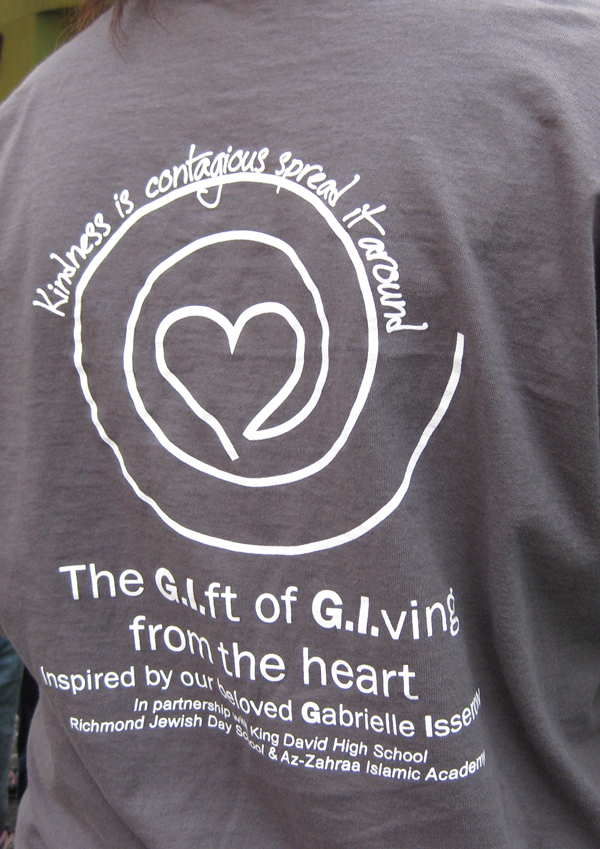
This is what teacher Shoshana Burton, now of Richmond Jewish Day School, has been doing for many years. Random Acts of Kindness, or RAC (Random Acts of Chesed), week began at King David High School after the sudden death in 2010 of alumna Gabrielle Isserow z’l. Known for her tremendous kindness, it was an apt way to ease the students’ grief. Explained Burton, “RAC week transformed the students’ overwhelming sense of loss into a creative expression of chesed. It revealed a yearning for a network of support and action.”

The project gained momentum and the weeklong celebration of kindness has become “a yearlong process that grows every year, involving students, families and the wider Jewish community.”

photo - Random Acts of Chesed T-shirt
Random Acts of Chesed was inspired by the life of Gabrielle Isserow z’l. (photo by Shula Klinger)

Working at RJDS for the 2013-14 academic year, Burton wanted to add a new dimension to the project. She approached Richmond’s nearby Az-Zahraa Islamic Academy. It was a perfect match, as their principal explains on the school’s website, “Education goes well beyond the classroom door.”

Az-Zahraa teacher Jessie Claudio came on board with no hesitation and, over the last few months, the students have formed some powerful new connections. According to Burton, “We had to pull RJDS and AZIA students away from each other when it was time to go back to school!”

The new program was named Abraham’s Tent because the prophet Abraham – revered in both Islam and Judaism – was known for his generous hospitality.

In February of this year, Burton and Claudio took their students on an unusual field trip: to the centre of the Downtown Eastside, to Main and Hastings. There, they spent five days delivering sandwiches they had made, with food donated by Save-On-Foods at Ironwood, Richmond. They also handed out warm clothes.

According to RJDS parent Kathy Rabinovitch-Marliss, this trip challenged the students to leave their comfort zone and set aside any apprehensions or thoughts of judgment. She counseled her daughter, Hannah, to remember that every homeless man is “someone’s father, or someone’s son.”

Among the recipients of the group’s kindness was Fred Miller, 58, caught by a CBC camera as he observed, “If Muslim and Jewish kids can live together, why can’t the rest of the world live together?”

These words inspired the RAC students to find out more. With the help of CBC, they managed to find Miller downtown. They invited him to speak at RJDS, which ended with a massive group hug. On the RJDS blog, principal Abba Brodt describes Miller’s “unflinching” honesty as he answered the students’ questions with stories from his life. Having struggled with addiction for many years, Miller’s experiences made a change from the usual Grade 7 fare, such as The Outsiders. Brodt said the discussion covered, “spiritual strength, faith, addiction, poverty, broken family bonds and deep loneliness.” The students were “spellbound,” he added.

Abraham’s Tent gained recognition with a $3,000 award in a worldwide competition hosted by Random Acts, a nonprofit whose goal is to inspire acts of kindness. But it’s not just about the prize, of course. Claudio and Burton agree that the learning outcomes here go far beyond the regular curriculum. Said Claudio, it has been an excellent opportunity to “bring the textbook to life.” The best way to learn something, she said, is through the emotions.

And, when the students start to form their own opinions about the Jewish-Muslim conflict, Burton hopes that these friendships will remind them to be “tolerant and open-minded.”

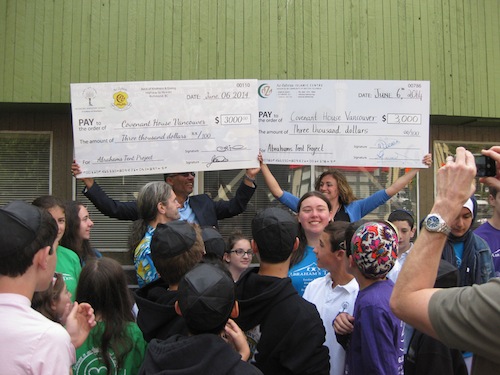
Rather than keeping the $3,000 award for their own schools, the RJDS and Az-Zahraa students chose to give the money to Covenant House in Vancouver, a shelter for at-risk youth.

Mohamed A. Dewji, vice-president of the Az-Zahraa Islamic Centre, challenged British Columbia’s Shia Muslim community to match the $3,000 award – and they came through. Dewji hopes to spur other communities into action. “We’re challenging every church, every mosque, every temple to join us,” he said.

photo - Holding the cheques are Mohamed Dewji, vice-president of the Az-Zahraa Islamic Centre, and Jessica Harman, development officer at Covenant House
Holding the cheques are Mohamed Dewji, vice-president of the Az-Zahraa Islamic Centre, and Jessica Harman, development officer at Covenant House. (photo by Shula Klinger)

On Friday, June 7, the student group delivered both $3,000 cheques to Covenant House. They also brought boxes of shoes for the residents. George Clarke, manager of Save-On-Foods at Ironwood, Richmond, brought a gift basket packed with necessities for Miller. The atmosphere was jubilant. Jessica Harman, development officer at Covenant House, described her contact with the RAC students as “marvelous.” She added that their donations “are providing love and support to one youth in the crisis shelter for the entire month of June.”

A soft-spoken and articulate man, Miller told the Independent, “It doesn’t end here. I want to work with youth now.” Having already published a set of his stories, he is honing his craft in a journalism class.

Ruby Ravvin, a Grade 7 RJDS student, described Miller as “awesome!” He then ruffled her hair.

The students have created a binder full of cards to help brighten Miller’s day when he feels lonely. In a letter, Breanne Miller (RJDS, Grade 7, no relation to Fred Miller) speaks of inspiration, wisdom and not taking the good things in life for granted. “You have opened my eyes,” she wrote. “You inspired all of us.”

Prior to her involvement in RAC, student Hannah Marliss had never had a conversation with a homeless person, nor did she have any close Muslim friends. Now, she said, “We’re hoping to invite the Az-Zahraa students to our grad. We’ve started something together!”

She described the change she has experienced in her own life. “Life’s not about technology, iPads and iPhones. They’re just things,” she said. “It’s about family, people you have connections with.”

On a scale of one to 10, the RAC experience was “definitely a 10,” said Hannah. Her mother agreed: “This was the highlight of Hannah’s elementary school life. It has changed all of our lives,” said Rabinovitch-Marliss.

Omid Gha, a counselor at Az-Zahraa, summed up the experience with a quote from Aristotle: “Educating the mind without educating the heart is no education at all.”

Shula Klinger is a freelance writer living in North Vancouver.

Format ImagePosted on June 20, 2014June 18, 2014Author Shula KlingerCategories LocalTags Abraham’s Tent, Az-Zahraa Islamic Academy, Az-Zahraa Islamic Centre, AZIA, Covenant House, Gabrielle Isserow, Jessie Claudio, King David High School, Random Acts of Chesed, Random Acts of Kindness, Richmond Jewish Day School, RJDS, Save-On-Foods at Ironwood, Shoshana Burton
Much new at Hillel BC

Much new at Hillel BC

Rabbi Philip Bregman (photo from students.ubc.ca)

Rabbi Philip Bregman is a longstanding leader in the Jewish community. He served as senior rabbi at Temple Sholom for 33 years and is still connected with the congregation as rabbi emeritus. He is co-founder of the Rabbinical Association of Vancouver, maintains an active role on the University of British Columbia chaplaincy and serves as co-chair for Vancouver’s Jewish-Christian Dialogue group. He joined Vancouver Hillel Foundation during its transition period and is now the executive director of the organization, which officially became Hillel BC Society last month.

Hillel has been a centre for Jewish life on campus at UBC since 1947. Bregman would like to expand on its foundation, diversifying the programming and making it more available to young Jewish adults throughout the Lower Mainland.

The purpose of Hillel BC Society, explained Bregman, “is to help facilitate the growth of young Jewish souls and minds, socially, mentally, gastronomically, intellectually, politically. To understand what does it mean for you to be a Jew in the world today…. We are trying to grow young Jewish adults and start from wherever they are starting and give them a sense that this is a home, this is a safe space and, for some, a continuation of their Jewish journey and, for others, a beginning of their Jewish journey.”

As in most Jewish homes, food plays an integral role at Hillel BC. Noting that Hillel provides “some of the best food in the city in terms of good, nutritional, tasty, delicious food, kosher food,” Bregman said, “A lot of our programs operate around food as a way of getting individuals into the building. Then, once we have them in the building, we have other programs to offer them as well. For example, a barbeque may very well be the thing that brings the individual into the building, but we also may happen to have a faculty member here from Jewish studies who will be teaching Talmud” or, “on Friday mornings, come for the most phenomenal shakshuka, but what comes with the shakshuka is also a discussion about Israel, social, political, religious discussions.”

Hillel BC’s reach extends beyond the Jewish community of UBC. “We do a lot of collaboration,” said Bregman. “We have done collaboration with the synagogues, we have done collaboration with the Vancouver Holocaust Education Centre, we do collaborations with CIJA, the Centre for Israel and Jewish Affairs, and so we are giving educational opportunities…. We teach Hebrew, we have Judaism 101 courses, and we have the opportunity to engage in dialogue programs with different Muslim student associations, with the Pakistani student association … aboriginal student organizations on campus and various Christian groups, as well.”

Hillel offers many students leadership opportunities because a lot of programming comes “from a collaboration between the programs’ staff and the Hillelniks, so some things are initiated by us and some things are initiated by the students themselves.”

Young Jewish adults at Hillel BC have the opportunity to get “involved in tikkun olam, in helping to repair the world…. We make peanut butter and jam [sandwiches] with the Ismaili Students’ Association. The sandwiches get taken down to the Downtown Eastside.” There are also various clothing drives or food bank drives, he said. Additionally, Hillel offers many students leadership opportunities because a lot of programming comes “from a collaboration between the programs’ staff and the Hillelniks, so some things are initiated by us and some things are initiated by the students themselves.”

Bregman is moving Hillel towards more diverse programming and events, “so a person can come into this building and see we are involved with a multiplicity of ideas.” This approach is reflected in the organization’s recent rebranding. “We are no longer Vancouver Hillel Foundation, we are Hillel BC Society and this came from the staff,” Bregman explained. “The idea of being Vancouver Hillel was too centrist and too isolating…. [It] makes no sense when one of our places we are dealing with is Burnaby or one of the places we are dealing with is Victoria and wherever else that I hope to open up in the next little while.”

Hillel BC is working to engage young Jewish adults in new ways because “the old paradigm of how to deal with things doesn’t hold anymore … you cannot depend on Jewish identity if you are only planting two trees, [focusing only on] Israel and [the] Holocaust. Are they important? Of course, they are. But so is social integration and Jewish identity in terms of what it means today, and so is asking, ‘How do I live in this world?’… So, the challenges are to provide the opportunities to individuals to see Hillel as a springboard for many other things.”

“Our major issue is around funding, it is around finance. There is a statement in the Talmud, ‘Ein kemach, ein Torah.’ Without wheat, referring to the substance, the money, if there is no money, there is no Torah and, if there is no Torah, there is no money….”

Bregman said, “Our challenges are not in the areas of programming, and I’m pleased to say not in the areas of staffing. I have an absolutely magnificent staff.” He said, “Our major issue is around funding, it is around finance. There is a statement in the Talmud, ‘Ein kemach, ein Torah.’ Without wheat, referring to the substance, the money, if there is no money, there is no Torah and, if there is no Torah, there is no money…. We are providing the Torah, the programming,” but “what we need, of course, is the financial means to continue this and that’s the greatest challenge.”

Bregman is positive about the future of Hillel BC Society. “This year, my first year, I came in and we were serving three campuses. We now serve five because I opened up Langara and I opened up Emily Carr,” he said. “Now, I’m looking to see what else needs to be opened up in the Lower Mainland, where we think there is some type of Jewish presence, because what has happened at Langara and Emily Carr has been tremendously successful.”

He emphasized, “I want Hillel there as a torchbearer and as an or l’goyim, a light unto the nations, to let people know that when you come into Hillel, you have a multiplicity of opportunities to meet all sorts of individuals, politicians, social activists, philosophers, individuals with unbelievably great hearts and souls.”

Zach Sagorin is a Vancouver freelance writer. He is on the board of the Jewish Students’ Association.

Format ImagePosted on June 20, 2014June 18, 2014Author Zach SagorinCategories LocalTags Hillel BC, Rabbi Philip Bregman

What to do in Iraq?

Extremists have taken over much of Iraq, spreading medieval theology using modern weaponry, leaving hundreds of corpses and severed heads in their wake. The Islamic State of Iraq and Syria, or ISIS, has been disowned by the umbrella that spawned it, al-Qaeda. ISIS is said to be more extreme and more anti-American than al-Qaeda. Extremism seems to have taken an even more extreme turn.

The ostensibly democratic government in Iraq that resulted from the American intervention there ended up being dominated by Iraqi Shi’ites, which is part of the reason the Sunni extremists of ISIS have been met with, if not a hero’s welcome in parts of Iraq, at least with little resistance. The lack of resistance is partially due to the propensity of American-trained Iraqi soldiers and police to drop their weapons and flee in the face of ISIS, which observers say is a reaction to a lack of commitment to the ideals of democratic government – a product of the failure of the government to live up to the hopes of the post-Saddam Hussein era. It is also a reflection of just how brutal ISIS has been in its onslaught.

While the capital city of Baghdad was not under immediate threat by ISIS (as of press time this week) Iraq as a country seems effectively inoperative. All of the effort, lives, injuries and expense of the American and allied intervention there may prove to have been for naught. The new reality is far from clear, but all appearances suggest things are worse than ever.

So desperate is the situation that Iran may be our new ally in the conflict. The Shi’ite extremists who run Iran have come to the aid of the American-installed, Shi’ite-dominated government in Baghdad, sending Iranian Revolutionary Guards to help fight the Sunni ISIS. U.S. Senator Lindsey Graham, a leading hawk who no one accuses of being soft on Tehran, accommodates the new bedfellow by comparing the situation with the West’s alliance with Stalin during the Second World War.

A wild-eyed optimist might even see this bizarre situation as a backdoor route to a new entente with the heretofore-implacable Iran. Were this catastrophe to have a silver lining of bridging the chasm between Iran and the West, it would be based on our mutual interest in an intra-Muslim sectarian conflict – and it is hard to see how anything good could come from our getting mired in something like that. In fact, the engagement of Western forces in Middle Eastern and Asian situations we really do not well understand may be the greatest lesson of this entire mess. The determination of George W. Bush for “regime change” in Iraq (something his father had, in hindsight, the wisdom to stop short of) unleashed a firestorm of consequences. Saddam was a murderous tyrant, but the current situation presents for Iraqis all the horrors of his dictatorship and more – plus unprecedented instability for the entire region.

Where we go from here is something the administration of U.S. President Barack Obama and other allied leaders are pondering now. And they may be as baffled as the rest of us. Given the West’s past failures in the region, it is hard to be hopeful.

Posted on June 20, 2014June 18, 2014Author The Editorial BoardCategories From the JITags al-Qaeda, Barack Obama, George W. Bush, Iraq, ISIS, Saddam Hussein
Emanu-El’s Avodah helps broader Victoria community

Emanu-El’s Avodah helps broader Victoria community

Avodah volunteer Daryl Levine makes latkes for last year’s latke lunch during Chanukah. (photo by Penny Tennenhouse)

Before 2003, Rabbi Harry Brechner of Congregation Emanu-El in Victoria had focused mostly on religious services and education. But that year, an Israeli mentor he’d known 15 years earlier paid him a surprise visit in a dream.

“I hadn’t thought about him in many years,” said Brechner, “but he came to me vividly and asked me what the real work was that I was doing. He told me I needed to go and serve, and that’s when I determined we need to devote our congregation’s energy to social action.”

Brechner wrote about his dream in his newsletter to synagogue members, hoping it would inspire the formation of a group of volunteers. It did. A social action group came together under the name Avodah, meaning work or service. Their goal was to put three main beliefs into action: to love thy neighbor as thyself, to repair the world and to commit to acts of loving kindness.

“Avodah is at the heart of being a holy congregation. There’s no being without doing and, through acts of loving kindness, we repair the world and transform our spiritual lives,” said Brechner.

Their first goal was to find out how the group could be of useful, meaningful service. They approached local organizations, such as Our Place Society and Cool Aid, to find out what they needed and one immediate answer was socks. It turned out there was a dire shortage of clean socks among the homeless. Thus, the Sock Project began.

Michael Bloomfield, a founding Avodah member, called Abe Lipson, chief executive officer of McGregor Socks Canada (a part of McGregor Industries), a Toronto-based sock designer and distributor. “I’m wearing your socks,” he told Lipson. “And the Island’s poor and homeless need your help.”

The first shipment arrived in 2005, and Bloomfield and his team fully expected it to be a one-time donation. They were wrong; a great relationship had started. Another shipment arrived in 2006 and every year that followed. To date, Avodah has worked with 27 organizations across the community to distribute some 54,000 pairs of socks.

At McGregor Socks, Lipson said the world stands on three pillars: the study of Torah, avodah and gemilut hasadim, or good deeds. “We make socks, which have a direct linkage to helping people stay warm,” he reflected. “So, socks we’re able to give. What we’re doing is actually quite small in comparison to the effort made by wonderful people who are helping the needy.”

The success of the Sock Project led to other efforts. The group began holding monthly birthday parties at Laurel House and Our Place Society, which provides assistance for the homeless, hungry and hurting. Every third Thursday, its members arrive with five buckets of ice cream and slab cakes, providing live music and birthday cards for those who have celebrated a birthday that month. “We’ve put on over 80 birthday parties, and there are usually a couple hundred people there,” said Penny Tennenhouse, Avodah’s chairperson. Avodah contributes to the Our Place annual Christmas party, and monthly to Laurel House.

Avodah also has initiated a partnership with the YMCA Outreach Van and Out of the Rain Youth Night Shelter, providing hot meals for those in need. In 2010, they expanded their involvement, opening the synagogue’s doors so that youth could sleep in the synagogue’s social hall on cold nights between October and April, as well. The meal program has become a weekly event and the synagogue has offered a warm night’s sleep for about 20 youth each week.

“We’ve tried to partner members with things they love doing,” said Tennenhouse. “In this case, we have wonderful cooks in our community who make marvelous casseroles and nutritious food for the children, and they love doing it.”

Another project, started in 2009, is a rent-supplement program to help families who are going through a crisis. Five years ago, Avodah began collaborating with the Burnside Gorge Community Association by aiding one family with $120 per month. Today, Avodah is assisting three families with their rent, providing $360 a month. As of May 2014, Avodah had contributed $19,320 for 161 rent subsidies.

“We’re trying to help with food, clothing and shelter,” said Tennenhouse, “but we also want to do what we can to help reduce poverty.” Avodah is a member of Faith in Action, an inter-faith group united by mutual concern for the poor and vulnerable in British Columbia, and dedicated to encouraging governments and community groups to address the root causes of poverty in the province.

Avodah has received many requests to help other community groups implement their own social action initiatives. To this end, it has created a presentation (available at congregationemanuel.ca/avodah.html) that outlines the work Avodah members have performed and offers a 10-step program for organizing, delivering and sustaining a community social action program.

“We want to help others to help their neighbors in need, too,” said Brechner. Avodah has brought a lot of pride to Congregation Emanu-El, he reflected. “We have a reputation of being small but mighty, of being a shining example in Victoria of what you can do when you’re determined.”

Lauren Kramer, an award-winning writer and editor, lives in Richmond, B.C. To read her work online, visit laurenkramer.net.

Format ImagePosted on June 20, 2014June 18, 2014Author Lauren KramerCategories LifeTags Abe Lipson, avodah, Emanu-El, gemilut hasadim, loving kindness, McGregor Socks, Michael Bloomfield, Penny Tennenhouse, Rabbi Harry Brechner

Bringing Judaism into the public sphere

A 28-year-old struggling writer walks up to a checkout counter at Whole Foods. “Where is the Torah study?” he asks. “Oh, the class with the rabbi? That’s in the back, near the nuts.”

The clerk wasn’t being pejorative – the Torah study really is in the back, near the bulk bins of nuts and trail mix. I should know: I’m the nut teaching Torah in the store every Wednesday.

In my 20-plus years as a Jewish educator, I never dreamt I’d be teaching Torah in a supermarket. But, then again, I’m pretty sure the two dozen or so students who regularly participate in the class never thought they’d be studying Jewish text each week, let alone doing so surrounded by organic Swiss chard.

There is nothing new in all this. When the Israelites returned from Babylonian exile in 537 BCE and rebuilt the Temple, Ezra the Scribe noticed that the people were too busy with the pressures of the day to make time for Judaism. On Mondays and Thursdays – the two busiest market days – Ezra stood in the street and read Torah out loud to a people who had all but forgotten their own story. From this seminal moment sprang the practice of reading the Torah on Mondays and Thursdays that continues in synagogues to this day.

Millennia later, public space Judaism is again an emerging trend. I began my own work in this field as a congregational rabbi at Temple Judea in Tarzana, Calif., inspired by Rabbi Kerry Olitzky’s teaching: “In a place where you can be Jewish anywhere, we should grasp the opportunity to be Jewish everywhere.”

Torah study at Whole Foods expanded to a host of Jewish events. On Sukkot, our youth group built a sukkah on Whole Foods’ outdoor patio, a banner explained the structure. We nurtured a mutually beneficial relationship with the store manager and staff, and the store sponsored food and activities at temple events. A year later, the relationship had solidified to the point that the store manager invited our congregation to lead a menorah lighting at Chanukah time. At that moment, I knew that we’d not only engaged Jews beyond our shul’s walls; we had changed the public face of Judaism in our community.

For Jewish communities like Vancouver that lack great Jewish population density, public space Judaism is a bit like online dating: if you want to meet someone, you need to let people know you’re looking.

Afterwards, the room was electric with everyone talking about how wonderful it was to connect with a larger Jewish community while on vacation and brainstorming how we might do this again.

How do we accomplish this? My colleague at Temple Sholom, Rabbi Carey Brown, teaches a Talmud class for millennials in a coffee shop once a month; I teach a text-based Jewish current events discussion at lunchtime in an office boardroom. Ringing in the 2014 year, we led a Shabbat service and Havdalah at Whistler Blackcomb. More than 60 people came to the dinner and service, about 45 to Havdalah. Afterwards, the room was electric with everyone talking about how wonderful it was to connect with a larger Jewish community while on vacation and brainstorming how we might do this again. A few local Jewish families asked if we could help educate their remote community. We now have plans to bring Hebrew school and family education to them.

When the rain and snow subside and the sun shines on Vancouver’s beaches, our congregation leads relaxing, open Shabbat services on the beach. We unfurl a banner and post signs welcoming all who wish to join us. And, like at Whole Foods, they come – Jews and “Jew curious.”

Howard Schultz, the man who developed Starbucks Coffee’s identity, famously explained his business model as trying to create a “third place” between work and home where people could gather and feel they belonged. For generations, the synagogue was that third place for Jews.

Like most rabbis, I have tried everything short of standing on my head to get people into my shul for prayer or study. While many come, some regularly, many others don’t or won’t. We can bring synagogue to them. We can meet in a third place of our own creation, filling it with meaning and a measure of Yiddishkeit.

One group in particular was easy to find but hard to reach: Jewish men. They were everywhere in our larger community, but not at synagogue. I asked a socially connected man in my Los Angeles congregation to host a Guys’ Night with the Rabbi in his home. I suggested he invite anyone he wanted and encourage guys to bring a friend.

To my surprise, 23 guys showed up. When we asked them why, they answered, “Because you asked.” Note that the “you” was not me, but the guy they respected and liked who had invited them to his home. Again, it was all about relationships.

We began that “Guys Night” with a simple but powerful exercise – introduce yourself without saying what you do for a living. Men so often define themselves by what they do, how they provide for their families. Our group would only work, we realized, if we could retrain ourselves to change this damaging, isolating pattern that is related to male competitiveness. We would have to see other men as brothers, each one with good things to give and to receive.

We established ground rules about confidentiality and cross talk. In the first months, we discussed Why Do We Work So Hard?; What Kind of Fathers We Had, What Kind of Fathers We Are; Being a Husband: How Has Your Partner Influenced the Way You Think?; Power and the Male Identity.

I always prepared a contemporary text and a Jewish text to help guide our talks, but soon we needed no more than a trigger to get started. The group of about 60 regulars has now met for eight years. Our annual retreat attracts more than 100 and there’s also an annual Community Men’s Seder, based on a Men of Reform Judaism model, that a core group of guys lead for friends and colleagues, which is growing every year. And many of the men who were once absent from synagogue life are now present.

Public space Judaism has taught me that, even in the congregational context, I need to reach out to members. If I wait for them to come to me, they might never come.

Public space Judaism has taught me that, even in the congregational context, I need to reach out to members. If I wait for them to come to me, they might never come. On my first day at Temple Sholom, for example, I was handed the Kaddish list for the coming Shabbat. I didn’t know any of the names, so I started calling members who were observing yahrzeits. Introducing myself, I explained that it would be my first time reading the name of their loved one. Could they tell me a little bit about the deceased, so I had a context for their memory as I read the name on Shabbat?

One by one, congregants told me their stories. They remembered things about their parents, spouses and siblings they hadn’t thought of in years. Tears flowed on both ends of the conversation. When the mourners came to synagogue that week to recite Kaddish, it was easier for them to walk into the place that had been made unfamiliar because of the change of rabbis, and easier for me to stand before them. We were no longer strangers.

Many of those talks also led to my visiting members’ homes or meeting them for coffee to hear their stories. Whenever possible, I set those meetings away from my office. Like Ezra the Scribe, I feel I need to engage the people in their space, not mine.

Yes, public space Judaism is a blind date, and that takes a bit of chutzpah. It begins with the sukkah, the phone call, the get-together at Whole Foods near the nut department. More often than we think, it leads to a relationship – a relationship with other Jews and with our Jewish selves that endures.

Rabbi Dan Moskovitz is senior rabbi at Temple Sholom and co-author of The MRJ Men’s Seder Haggadah (MRJ Press 2007). You can follow him on twitter @rabbidanmosk. A longer version of this article was originally published in Reform Judaism Magazine.

Posted on June 20, 2014June 18, 2014Author Rabbi Dan MoskovitzCategories Op-EdTags Howard Schultz, Men of Reform Judaism, public space Judaism, Rabbi Carey Brown, Rabbi Kerry Olitzky, Starbucks, Temple Judea, Temple Sholom, Whole Foods

Posts pagination

Previous page Page 1 … Page 639 Page 640 Page 641 … Page 661 Next page
Proudly powered by WordPress