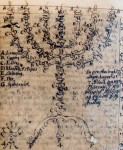
Fray Juan Ricci (1600-1681), sketch of the menorah as described in Exodus, undated. The number of lights on the chanukiyah – eight – is a break with the traditional seven-branched menorah. (photo by Ellen Prokop via commons.wikimedia.org)
The Festival of Lights is unique. We celebrate it for eight days, when most other Jewish festivals and holy days last one or two days or, at the most, seven. The number of lights – eight – is also a break with the traditional seven-branched menorah, which was rekindled in the Temple after the victory over the Syrian-Greeks. We also add a special prayer, “Al Hanissim,” whereby we thank G-d for the deliverance from our enemies:
“Thou didst deliver the strong into the hands of the weak; the many into the hands of the few; the wicked into the hands of the righteous; and the arrogant into the hands of those who occupied themselves with Thy Torah.”
At each morning service, we relate biblical accounts of the dedication of the altar at the time of Moses, and the gifts brought by the 12 princes of Israel. We are comforted, as a small nation against today’s sea of evil, by the words: “Not by might, not by power, but by My spirit, says the Lord of Hosts.” (Zechariah 4:6)
Even though the Temple was destroyed in 70 CE, it did not affect celebrating Chanukah because it is centred mainly on the home. In the third century CE, when our enemies launched their persecution of the Jewish people, when kindling Chanukah lights was forbidden, as often happens, this later awakened special esteem for the rite. It became a sanctification of G-d’s name, with special blessings.
Light has great significance in Judaism. Even during the plague of darkness in Egypt, we are told “all the children of Israel had light in their dwellings.” (Exodus 10:23) Although Chanukah imposes minimum religious restrictions, we are required to kindle the lights, stating that this commemorates “the miracle, deliverance, deeds of powers of salvation” wrought by the Almighty at this season. We are instructed not to use the lights for any utilitarian purpose – they are only to be seen. We pray to be placed “on the side of light” and the mystical book of Zohar promises “a palace of light that opens only to him who occupies himself with the light of Torah.”
Why did it take the priests eight days to prepare more olive oil for the Temple menorah? The 25th of Kislev marked the peak of the winter olive harvest season. The Maccabees’ hometown of Modiin lay in the heart of the country’s richest olive-growing region. They could have quickly picked the olives, prepared the oil and rushed it to the Temple in Jerusalem, a day’s walk away.
The explanation is that the special oil required for the menorah was clear oil of beaten olives (Shemot 27:20). It was a two-part operation: first, the beating and, then, the resulting mash was piled into flat fibre baskets and weighted to squeeze out the oil. It was not extracted by pressure, but allowed to seep out drop by drop. This process took much longer, producing an oil free of sediment and impurities, which burned a clear flame.
The date of Chanukah is related to the winter solstice, when the longest night of the year gives way to a gradual increase in the length of each day. When the Greeks first desecrated the Temple, they offered sacrifices to Zeus on the solstice. Upon the Temple’s liberation, three years later, the Jews renewed their service to G-d on the anniversary of the day it had been desecrated, as a gesture of defiance.
The Festival of Lights takes on special meaning at this time of darkness. In Israel, we see daily stabbings, shootings, car rammings and murders of Jews. But, no matter how dark the days of intolerance and racism worldwide, Chanukah has special meaning. The miracle is not just the supernatural one of the flask of oil. It is that beacon of light, the passion of man that transcends the momentary and the opportune. The Chanukah lights, like the Jewish people, refuse to be extinguished.
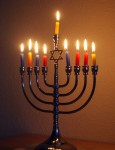
The schools of Hillel and Shammai debated how the chanukiyah’s candles should be lit. (photo by Gil-Dekel via commons.wikimedia.org)
The following is an excerpt from the Chanukah chapter of Inside Time: A Chassidic Perspective on the Jewish Calendar, published by the Meaningful Life Centre.
***
“The School of Shammai says: on the first day, one lights eight lights; from here on, one progressively decreases. The School of Hillel says: on the first day, one lights a single light; from here on, one progressively increases.” (Talmud, Shabbat 21b)
Visit, or simply pass by, a Jewish home on any of the eight evenings of Chanukah, and there will be the lights burning in the doorway or window proclaiming the celebration of the Chanukah miracle to the street and to the world at large. They will also be proclaiming which night of Chanukah it is. On each of the eight nights of Chanukah, a different number of flames is kindled, expressing that night’s particular place in the festival. On the first night of Chanukah, there will be one flame illuminating the street; on the second night, two flames, and so on.
Actually, the Talmud records two opinions on how each Chanukah night should identify itself and radiate its unique light into the world. This was one of the halachic issues debated by the two great academies of Torah law, the School of Shammai and the School of Hillel. The sages of Hillel held that the Chanukah lights should increase in number each night, in the familiar ascending order. The sages of Shammai, however, were of the opinion that eight flames should be lit on the first night, seven on the second, and so on, in descending number, until the eighth night of Chanukah, when a single flame should be lit.
The Talmud explains that the sages of Shammai saw the Chanukah lights as representing the “upcoming days” of the festival – the number of days still awaiting realization. Thus, the number of lights decreases with each passing night, as another of Chanukah’s days is “expended.” On the first night, we have eight full days of Chanukah ahead of us; on the second night, seven days remain, and so on. The sages of Hillel, on the other hand, see the lights as representing Chanukah’s “outgoing days,” so that the ascending number of flames reflects the accumulation of actualized milestones in our eight-day quest for light.
In practice, we follow the opinion of the Hillel school, and an ascending number of lights chronicle the progress of the festival. This is even alluded to in the very name of the festival: the Hebrew word Chanukah forms an acronym of the sentence “chet neirot vehalachah k’veit Hillel” (“eight lights, and the law follows the School of Hillel”).
Our acceptance of Hillel’s perspective on Chanukah is also expressed by the name traditionally given to the eighth day of Chanukah – the only day of the festival to be distinguished by a name of its own – Zot Chanukah.
The name Zot Chanukah is based on a phrase from that day’s Torah reading, and literally means, “This is Chanukah.” This is in keeping with the Hillelian vision of Chanukah, in which the final day of Chanukah – the day on which all eight days of light have been actualized – marks the climax of the festival. Only on the eighth day can we say, “This is Chanukah. Now we ‘have’ the entire Chanukah.” (From the Shammaian perspective, the first day of Chanukah would be Zot Chanukah.)
What is the basis for these two visions of Chanukah? And why is the view of the School of Hillel so decisively embraced, to the extent that it is implicit in the very name Chanukah, and in the name given to its culminating day?
The debate
There are two primary ways in which one might view something: a) in light of its potential, or b) by its actual, manifest state. We might say of a certain person: “He has tremendous potential, but his actual performance is poor.” The same can be said of a business venture, a relationship, an experience, or anything else. Or, we might say: “There’s potential for disaster here, but it can be contained and prevented from actualizing.”
Some of us are potential-oriented, which means that we would admire the person, invest in the venture, stick it out with the relationship and treasure the experience – depending upon its potential. Some of us are more actual-oriented, viewing things in terms of their actual, tactual impact upon our reality.
This is a recurring theme in many of the disputes between the schools of Shammai and Hillel. For example, the sages of Shammai consider the moment of the Exodus to have been the eve of Nissan 15, when the people of Israel were free to leave Egypt, while the sages of Hillel place the moment at midday of the following day, when the Jews actually exited Egypt’s physical borders. In another debate, the sages of Shammai consider a fish susceptible to ritual impurity from the moment the fisherman pulls his catch out of the water, since at this point the fish has been removed from the environment in which it might possibly live; the sages of Hillel disagree, contending that as long as the fish is actually alive (though its potential for continued life has been destroyed), it is immune to contamination, as are all other living plants and animals.
This is also the basis of their differing perspectives on Chanukah. The School of Shammai, which views things in terms of their potential, sees the first day of Chanukah, with its potential for eight days of light, as the point in which all eight days are “there.” After one day has “gone by” and passed from potential into actuality, there are left only seven days in their most meaningful form – the potential form. The sages of Hillel, on the other hand, see the actual state as the more significant. To them, the eighth day of Chanukah, when all eight dimensions of the festival have been actualized, is when the festival is at its fullest and most “real.”
G-d’s reality
We are creatures of the actual. We cannot live on potential nourishment, or be emotionally satisfied by potential relationships. On the whole, we judge people by their actual conduct, as opposed to their potential to behave a certain way. Reality, to us, is what is, not what might be.
This is largely due to the fact that we are physical beings. It is a most telling idiosyncrasy of our language that “immaterial” means “insignificant”: if we cannot touch it or see it, it’s not real to us. Also, because of our finite and limited nature, we possess potentials that we will never actualize because we haven’t enough energy, resources or willpower to carry them out, or simply because we won’t live long enough to do so. So, the existence of a potential or possibility for something is not enough, for how do we know that it will amount to anything? Indeed, we often judge a thing’s potential by the actual: if this much has been actualized, this “proves” that there is potential worthy of regard.
Envision, however, a being who is neither physical nor finite; a being not limited by space, time or any other framework. In such a being, potential does not lack actualization, as everything is “as good as done.” On the contrary: potential is the purest and most perfect form of every reality – the essence of the thing, as it transcends the limitations and imperfections imposed upon it when it is translated into physical actuality.
For G-d, then, the potential is a higher form of being than the actual. This is why we say that, for G-d, the creation of the world did not constitute an “achievement” or even a “change” in His reality. The potential for creation existed in Him all along, and nothing was “added” by its translation into actuality. It is only we, the created, who gained anything from the actual creation of the world.
So, when the sages of Shammai and Hillel debate the question of which is more significant from the perspective of Torah law, the actual or the potential, they are addressing the more basic question: Whose Torah is it – ours or G-d’s? When Torah law enjoins us to commemorate the Exodus, when it legislates the laws of ritual impurity or when it commands us to kindle the Chanukah lights, does it regard these phenomena from the perspective of its divine author, in whom the potential is the ideal state, or from the perspective of its human constituency, who equate real with actual?
The Torah
Whose Torah is it, ours or G-d’s? Both Shammai and Hillel would agree that it is both.
The Torah is the wisdom and will of G-d. But, as we proclaim in the blessing recited each morning over the Torah, G-d has given us His Torah, for He has delegated to mortal man the authority to interpret it and apply it. Thus, G-d did not communicate His will to us in the form of a detailed manifesto and a codified list of instructions. Instead, He communicated a relatively short (79,976-word) Written Torah (the Five Books of Moses), together with the Oral Torah – a set of guidelines by which the Written Torah is to be interpreted, decoded, extrapolated and applied to the myriad possibilities conjured up by the human experience.
So, while the entire body of legal, homiletic, philosophical and mystical teaching we know as Torah is implicit within the Written Torah, G-d designated the human mind and life as the tools that unlock the many layers of meaning and instruction contained within its every word.
The Torah is thus a partnership of the human and the divine, where a kernel of divine wisdom germinates in the human mind, gaining depth, breadth and definition, and is actualized in the physicality of human life. In this partnership, our human finiteness and subjectivity become instruments of the divine truth, joining with it to create the ultimate expression of divine immanence in our world – the Torah.
Which is the more dominant element of Torah, divine revelation or human cognition? Which defines its essence? What is Torah – G-d’s vision of reality or man’s endeavor to make his world a home for G-d? At times, the Torah indicates the one; at times, the other. We have the rule that “The words of Torah are not susceptible to contamination.” A person who is in a state of ritual impurity (tum’ah) is forbidden to enter the Holy Temple; but there is no prohibition for him to study Torah. Why is he forbidden to enter a holy place but permitted to think and speak holy words? Because the Torah is not only holy (i.e., an object subservient to G-d and receptive to His presence) – it is divine. It is G-d’s word, and the divine cannot be compromised by any impurity.
On the other hand, another law states that, “A teacher of Torah who wishes to forgive an insult to his honor can forgive it.” This is in contrast to a king who, if insulted, has no right to forgive the insult, and has no recourse but to punish the one who insulted him. For a king’s honor is not his personal possession, but something that derives from his role as the sovereign of his people; one who insults the king insults the nation, and this is an insult that not even the king has the authority to forgive. Yet does not one who insults a Torah scholar insult the Torah? How does the scholar have the right to forgive the Torah’s insult? The explanation given is that “the Torah is his.” He who studies Torah acquires it as his own; G-d’s wisdom becomes his wisdom.
Whose Torah is it – ours or G-d’s? Both descriptions are valid; both are part of the Torah’s own self-perception. In certain laws and circumstances, we find the divinity of Torah emphasized; in others, its human proprietorship.
Thus, in a number of laws, the schools of Shammai and Hillel debate which definition of Torah is the predominant one. The sages of Shammai believe that in these particular applications of Torah law, the divinity of the Torah predominates. The Torah’s perspective is synonymous with G-d’s perspective, meaning that the potential of a thing is its primary truth. The sages of Hillel see these laws as belonging to the “human” aspect of Torah, so that the Torah’s vision of reality is the human, actual-based perspective.
The human festival
In the great majority of disputes between the sages of Shammai and Hillel, the final halachic ruling follows the opinion of the School of Hillel. Halachah is the application of Torah to day-to-day life. In this area of Torah, it is the human element which predominates; here, reality is defined in terms of the actual and tactual, rather than the potential.
But nowhere is the supremacy of the Hillelian view more emphasized than in the debate on Chanukah, where the very name of the festival, and the name given to its final day, proclaim that “the law follows the School of Hillel.” For Chanukah is the festival that, more than any other, underscores the human dynamic in Torah.
As noted above, the Torah consists of two parts: a) the divinely dictated words of the Written Torah; b) the Oral Torah, also communicated by G-d, but delegated to man. In the Oral Torah, G-d provides the guidelines and principles, while human beings follow these guidelines and apply these principles to derive and express the divine will.
The Oral Torah has two basic functions: to interpret the Written Torah and to legislate the necessary laws, ordinances and customs required to preserve the Torah and Jewish life through the generations.
Most of the festivals are explicitly ordained in the Written Torah. This is not to say that there is no “human element” involved in the biblically ordained festivals: the Oral Torah is still required to clarify each festival’s laws and observances. For example, the Written Torah commands us to dwell in a sukkah and take the “four kinds” on Sukkot, but the Oral Torah is needed to interpret the oblique biblical allusions that tell us how a sukkah is to be constructed and which plant species are to be taken. Still, the festivals themselves were instituted by direct divine revelation.
There are two festivals, however, that are rabbinical institutions: Purim and Chanukah. These belong to the second function of the Oral Torah – to institute laws and observances that derive not from a verse in the Written Torah, but which arise out of the historical experience of the people of Israel.
These, too, are Torah, for they were enacted in accordance with the principles revealed at Sinai. Before reading the Megillah on Purim or kindling the Chanukah lights, we say: “Blessed are You, G-d … Who has sanctified us with His commandments and commanded us to read the Megillah,” or “… to kindle the Chanukah lamp.” G-d is commanding us to observe these mitzvot, for it is He who granted the leaders of each generation the mandate to institute laws, ordinances and festivals. Yet, in these festivals, it is the human aspect of the Torah which predominates, while the divine aspect is more subdued.
Of the two rabbinical festivals, Chanukah is even more “human” than Purim. Purim was instituted during the era of prophecy, when G-d still communed directly with the greatest individuals of the generation. The story of Purim was written down and incorporated within the Holy Scriptures that are appended to the Written Torah. Thus, while Purim is technically an Oral Torah festival, it is closely related to the Written Torah.
Chanukah, however, occurred several hundred years later, when prophecy had ceased and the canon of the 24 books of the Tanach (Bible) had been closed. It thus belongs wholly to the Oral Torah – to the predominantly human aspect of the partnership. So, Chanukah is the environment in which the Hillelian perspective on Torah – Torah as it relates to our tactual experience of the world in which we live – reigns supreme.
Rabbi Yanki Tauberis the author of the new three-volume setInside Time: A Chassidic Perspective on the Jewish Calendar, which provides a comprehensive overview of the Jewish concept of time and the Jewish calendar. A promotional video can be found at youtube.com/watch?v=4PClRJGofFw. Tauber is also the author of Beyond the Letter of the Law, Once Upon a Chassid and The Inside Story.
Naomi Brounstein, left, and Vivi Mann working on Ten Gav. (photo by Hindy Lederman via Israel21c.org)
In the Israeli port city of Ashdod, two families with blind babies were eager to take courses at the country’s sole training centre for parents of vision-impaired infants. But the centre is in Petah Tikva, a three-bus journey from Ashdod, and these families did not have cars. How could they get the specialized guidance they needed?
Their municipal social worker appealed to a new nonprofit, Ten Gav, a crowdfunding site for relatively small needs identified by Israeli social workers and vetted by the two volunteer founders. Following a successful campaign, a van was hired to transport the families to and from the training sessions.
The funding needs presented on Ten Gav never exceed $1,500, and every dollar donated goes directly to the chosen campaign, so even a small contribution counts large. Since December 2014, Ten Gav has fully funded 80 projects, among them a refrigerator for a destitute family, beds for new immigrants, an air conditioner for the bedroom of a child with cerebral palsy and a washing machine for an elderly woman.
The founders, Ra’anana residents Vivi Mann and Naomi Brounstein, are professional women with a soft spot for charitable endeavors. They wanted to find a worthwhile project they could start and run together. Mann is a management consultant and Brounstein – who is from Ontario – has degrees in law and social work.
“Vivi and I looked for challenges that needed to be faced, and we developed this model for the Israeli market based on similar sites operating in America,” Brounstein told Israel21c.
They began Ten Gav as an online crowdfunding platform to match donors with modest needs in Israel that cannot be funded by the state or existing charities. “We are very careful not to present stories where another organization can easily provide what is needed,” said Brounstein.
With startup capital from supporters including Joseph Gitler, founder and head of the Leket Israel national food bank, they began making contact with municipal social workers across Israel.
They weren’t quite ready to launch when the 2014 summer conflict with Hamas escalated into Operation Protective Edge, but a Canadian friend of Brounstein’s wanted to make an immediate donation to families affected by the rocket fire, and asked if she could do so through Ten Gav.
“So, we built our first site using Wix, as Vivi ran around to communities in the south to find needs from social workers,” said Brounstein. “Sderot social workers deal with a lot of elderly residents, and we filled a number of requests for air conditioners and washing machines. This was not a directly war-related need but, in times of uncertainty and insecurity, any help you give goes a long way in making people feel they are supported by others.”
After the ceasefire in late August, the women took Ten Gav offline until they truly felt ready to launch at the end of the year.
“Ten Gav is all about empowering donors to select the cases their money will go to, and empowering the recipient,” said Mann.
Many of the cases brought to their attention by social workers don’t fall under the rubric of traditional charity. For example, a social worker in one city thought that joining an afterschool soccer program would help two boys in therapy to release their aggression in a fun and disciplined manner, and that they would benefit from being part of a team. Since their parents could not afford the fee, Ten Gav raised it and the boys were able to join.
The two founders say they are impressed by the sensitivity and creativity of the welfare authorities they meet in each municipality. “They see things in homes that you and I do not see,” said Brounstein.
Sharon Friedman, a social worker in the Department of Youth at Risk of Jerusalem, describes Ten Gav’s assistance as “oxygen to breathe” for some of her clients. Among requests her office has submitted and that have been successfully crowdfunded are piano lessons for a girl whose family could not afford them, a ping-pong table for a child with social difficulties, an afterschool program for a child from a single-parent home and a computer to enable a woman to work from home.
Cheques are made out to the service providers and handed over by the social workers. All administrative costs are covered separately by grants from supporters such as the U.S.-based Good People Fund.
“We are looking to expand slowly so we can control the types of cases and level of due diligence we can do so our donors can always be confident their money is going to the right place,” said Brounstein.
Mann explained that the name Ten Gav was chosen for a few reasons. The expression loosely translates to “watch my back” and portrays the idea of helping out rather than handing over cash. “Everybody gives something and gets connected to a personal story, knowing their money won’t get lost in a big pool.”
Abigail Klein Leichmanis a writer and associate editor at Israel21c. Prior to moving to Israel in 2007, she was a specialty writer and copy editor at a daily newspaper in New Jersey and has freelanced for a variety of newspapers and periodicals since 1984. Israel21c is a nonprofit educational foundation with a mission to focus media and public attention on the 21st-century Israel that exists beyond the conflict. For more, or to donate, visit israel21c.org.
Reb Cantor and Rabbi Yohon Abrahms paused at the top of the hill to watch the sun spread its warm red rays in a growing embrace across the Black Forest. (photo by Rainer Lück via commons.wikimedia.org)
It was an ordinary Chanukah in the village of Chelm, which was strange. Depending on who you talk to, Chelm is called a village of fools or of wise people, and there’s always something going wrong. This year, however … it was quiet.
Chanukah was neither early nor late. The weather was good – not too cold and not too hot. There was enough food so no one was hungry, and the lands surrounding Chelm were at peace; the Cossacks were far away. And, for once, no one got into an argument over whether the Americans should spell the holiday with an “H” or a “Ch.”
On the first night of Chanukah, families gathered and lit their candles according to the traditions of Hillel or Shammai, depending on whether they felt like building up to a big finish or starting off bright and getting more relaxed as each day passed.
“Something is going to happen,” worried Reb Cantor the merchant, as he huffed and puffed his way up Sunrise Hill for his morning exercise with Rabbi Yohon Abrahms, the schoolteacher.
“Something always happens,” said the young rabbi.
“Something bad,” said Reb Cantor. “It’s too quiet.”
“Not when you’re breathing so hard,” said Rabbi Yohon Abrahms.
They paused at the top of the hill to watch the sun spread its warm red rays in a growing embrace across the Black Forest.
“I’m still concerned,” said Reb Cantor.
“You wouldn’t be you if you weren’t,” said the young rabbi.
“I’ll race you to Mrs. Chaipul’s restaurant.”
“But you always win!” said Reb Cantor.
It was too late. The young rabbi was already running, and the fat merchant had no choice but to trundle after, hoping that he wouldn’t trip, fall and roll down the hill like a barrel.
By the time Reb Cantor caught up, Rabbi Abrahms was busy playing a friendly game with Joseph Katz, a well-known dreidel shark. Instead of wagering raisins on who would win, everyone was betting about how many coffee cups and teacups Joseph could rebound a dreidel off before landing on whatever letter he chose.
“Watch this,” Joseph said with a twinkle. He twirled a square top onto the table, where it ricocheted back and forth, striking five mugs and three cups before flying up, hovering over Rabbi Kibbitz’s plate of latkes, and then splashing down into the rabbi’s apple sauce.
“Nun!” said Joseph. “I win.” (In Chelm, foolish as it is, they say it takes nun to win.)
“You always do,” said Rabbi Kibbitz, who fished out the dreidel and wiped it off with a napkin before returning it to the young man.
“Sorry about that,” Joseph said.
Rabbi Kibbitz shrugged. “I’ve always felt that apple sauce is more of a garnish than a necessity.”
“How can you eat those latkes?” whispered Reb Stein, the baker. “I know you love your wife, but….”
Mrs. Chaipul, the rabbi’s wife (she kept her own name, which is another story) was listening from the kitchen to see how her husband would answer.
As the owner of the only kosher restaurant in Chelm, she was known as a miracle worker in the kitchen, with the exception of her lead-sinker matzah balls and her notoriously lethal latkes.
She knew, as did everyone in Chelm, that she had something of a culinary blind spot when it came to potato pancakes. She’d solved the problem at the annual Chanukah party by enlisting the help of Mrs. Rosen and her daughters, but her husband insisted that she still make her old recipe for him.
Rabbi Kibbitz smiled. “First of all, my stomach is protected by my belief in God.”
Everyone in the restaurant rolled their eyes.
“Secondly, it’s a question of scale,” he said. “When she cooks a small batch just for me, they’re quite good.”
“Really?” Reb Stein said.
“Would you like a taste?” the rabbi said, raising a piece on his fork.
“No, no, no, no!” Reb Stein said, hastily backing away. “I have work to do today.”
Even Reb Cantor, who had caught his breath by then, joined in as Reb Stein fled from the restaurant ahead of a wave of laughter.
Every night for seven more nights, candles were lit and the stories of the Maccabees were told. Songs were sung, dreidels spun, and latkes and doughnuts were fried.
More and more families were following the Schlemiel’s tradition of giving Chanukah presents to each other, but it wasn’t to excess. No one fought over whose present was best or biggest. And everyone remembered to give a little extra gelt to Rabbi Abrahms the schoolteacher to honor his contribution to their children’s lives.
On the last night it snowed, but everyone was home safe. They looked out their windows at the falling flakes, glad of their walls and roofs, and warmed themselves in front of their fires. And, as the candles finally burned down, the children were tucked into bed beneath comforters and blankets with a final goodnight kiss.
It was an ordinary Chanukah in the village of Chelm.
For once, nothing bad happened and nothing went wrong.
And that in itself was a miracle.
The End.
Mark Binder is the author of the award-winning Life in Chelm series, which includes A Chanukah Present, The Brothers Schlemiel and Matzah Mishugas. His latest book is Cinderella Spinderella. A professional storyteller, he regularly performs at synagogues, Jewish community centres and the National Yiddish Book Centre.
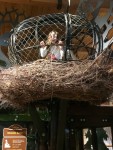
At the Hands On Children’s Museu, children learn many things, including just how large a bald eagle’s nest is. (photo by Lauren Kramer)
Most small Jewish communities decrease in size over the summer, but not Olympia, Wash. The city’s Jewish population swells by up to 600 as youth from all over the Pacific Northwest and as far afield as Las Vegas converge by bus and plane on Camp Solomon Schechter, a Jewish camp founded 60 years ago.
I ventured to Olympia, a five-hour drive from Vancouver, on a stormy, grey Friday in November, looking for a weekend away from home. Camp Schechter’s sunny season was well behind us and any leisure activities were going to be determinedly indoors. Still, I witnessed a city of 48,000 with a lively, active Jewish community, two synagogues and a Chabad presence.
We stayed in the downtown core and were thrilled to attend Friday night services at Temple Beth Hatfiloh, a Reconstructionist synagogue housed in a beautiful building on 8th Avenue downtown. The rabbi was out of town and the service, led by lay leaders and attended by locals and a good turnout of comparative religions students, was filled with song. Afterwards, at the Oneg in the dining area, I learned that the building had once been home to the Church of Christian Science and was purchased, renovated and converted into a synagogue 12 years ago. Walk the sanctuary, with its high ceilings, elegant aron hakodesh and stained glass windows and you’d never know it started its life as a place of worship for another faith.
Temple Beth Hatfiloh, a Reconstructionist synagogue housed in a beautiful building on 8th Avenue downtown. (photo by Lauren Kramer)
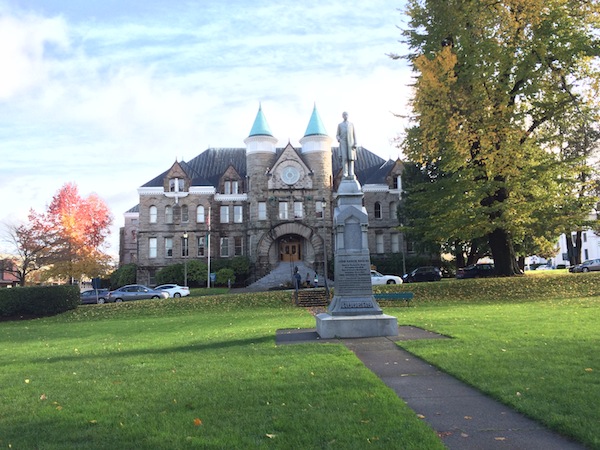
Olympia is a stately, historic city filled with soaring examples of Greco-Roman-style architecture and irresistibly browsable bookstores, galleries and boutiques. Washington’s version of Victoria, it spreads in an elegant square on either side of Budd Inlet, its beautiful state buildings on a bluff over the ocean and its 278-foot capitol dome visible from most everywhere. There are daily tours of the capitol dome and we gladly joined one led by Ed Smith, a 30-year history teacher whose father had once served in the legislature. He primed our small group on the ornate granite, European marble, carved masonry and more than 300 Tiffany lights and chandeliers that decorate the palatial interior. It’s an impressive place and one that certainly lends gravity to Washington’s history and the business of lawmaking.
It was less than fascinating for a 6-year-old, though, which is why our next stop was the very antidote: the Hands On Children’s Museum of Olympia. These days, almost every city has a generic children’s museum – but this one is far from generic. “Our goal was to only feature exhibits from the Pacific Northwest, things children might see in their own back yards,” said Jillian Henze, communications manager for the 28,000-square-foot museum. Best suited for the 3-to-8-year-old crowd, this innovative space delves into the farm to fork eating experience, the Puget Sound waterway, the forest and the lifecycle of water. Children learn how currents flow, how large a bald eagle’s nest really is, how water and wind pressure work, how to build a house and where food comes from. My daughter Maya had to be dragged out of the museum at closing time.
We left Olympia the next day for Grand Mound, 20 minutes away and home to Great Wolf Lodge, Washington’s equivalent to Disneyland. The massive indoor waterpark is a kids’ paradise, with waterslides that sweep riders on circuitous watery journeys, a large wave pool and two well-designed water play structures – one for toddlers and the other for kids 7 and younger. There’s easily enough entertainment in the waterpark alone for a half-day. But, once you dry off, there’s more to do in the rest of the resort. Around us kids were running about with wands, pointing them at treasure chests and learning their way around a game that lasts four to six hours and occupies them for the duration of their stay. Great Wolf is a hedonistic kids’ experience from which parents emerge looking flushed and exhausted from the combination of heat, chlorine and noise. By contrast, their kids come out starry-eyed and determined to return.
We took the long road back to Olympia on Old Highway 99 to get a glimpse of Tenino, a sleepy city with a fascinating history. I was anxious to learn about Tenino’s sandstone legacy, which dates back to 1888 with the discovery of a large deposit of sandstone – a valuable commodity in the pre-concrete era. In the four decades that followed, Tenino quarries supplied sandstone for buildings in San Francisco and Vancouver, B.C., among other places. The quarries closed in the late 1920s but one of them, the Tenino Stone Company Quarry, was deliberately flooded with water from natural springs by the City of Tenino. It became a 95-foot-deep swimming pool with terraced walls that bear evidence of its history. Unfortunately, most of that history remained an enigma because the doors of the Tenino Depot Museum, usually open on the weekends, were shuttered when we were in town. That’s the problem with sleepy cities, particularly in November. They tend to go into a long hibernation.
Lauren Kramer, an award-winning writer and editor, lives in Richmond, B.C. To read her work online, visit laurenkramer.net.
The Hands On Children’s Museum is open daily until 5 p.m. and admission is usually $10.95 US, but is free on the first Friday evening of every month from 5-9 p.m.: hocm.org or 1-360-956-0818
Free tours of the Washington State Legislative Building run every hour on the hour from 10 a.m.-3 p.m. weekdays; 11 a.m.-3 p.m. on weekends
You have to stay to play at Great Wolf Lodge, where accommodation starts around $210/night for a family of four to six people, and includes water park passes: greatwolf.com or 1-866-798-9653
In the winter, the Yellow Submarine hosts a collection of shows, many of them jazz, as part of the International Music Showcase. (photo from itraveljerusalem.com)
This article was written several months before the daily terrorist attacks began against Israel. While tourists may be understandably hesitant to visit Israel right now, the country needs support, and a visit is one of the tangible ways in which to give that support. (Editor)
***
Jerusalem may be better known for its religious and historical context than its music scene but, below the surface, a burgeoning jazz scene featuring some of the best musicians in the country delivers a steady diet of under-the-radar concerts in Jerusalem that frequently wow unassuming tourists and locals alike.
“A lot of the best jazz musicians for a couple of generations have come out of Jerusalem,” commented Steve Peskoff, a jazz musician who has lived in Jerusalem for 30 years and teaches jazz guitar and music workshops at the Jerusalem Academy of Music and Dance. “This is the only school in the country granting a degree [in jazz] at the college level,” said the former New Yorker.
Ask around town about jazz, and you’ll typically hear about three mainstays of the scene that are constantly providing a platform for local and international jazz musicians to put their considerable talents on display for the patrons of the Holy City – Birman, Barood and the Yellow Submarine.
If you’re just visiting Jerusalem and don’t have time to wait around for concert dates, then Birman Musical Bistro is your most likely destination.
The popular “musical bistro” located just off the bustling Ben Yehuda Pedestrian street hosts local musicians every day for free-of-charge live concerts. Jazz is the music of choice at least four nights of the week, and the bistro boasts the atmosphere of an old-school music club, with a clientele made up of local musicians, students and music-lovers eager to take advantage of the live music and tasty, yet reasonably priced, food and drinks.
Jerusalem-born Dan Birron opened Birman’s about 10 years ago with live music every night, four of which are usually reserved for jazz, including the Saturday night jam session.
“All musicians in Jerusalem, especially jazz, know my place,” said Birron, who also takes the stage himself on some nights to serenade the crowd with his styles on the accordion. “I’m totally booked for months.”
The performers at Birman are a mixed bag of some of the city’s most established jazz musicians and the younger crop starting out after finishing the army or graduating from the Academy of Music. The city’s jazz scene is “very interesting, with many very talented musicians,” Birron said. “The best ones are coming to my place.”
Not far away from Birman in the picturesque Feingold Courtyard, Barood Bar and Restaurant is one of the most talked-about jazz institutions in the city. Owner Daniela Lerer remembers as a young child hearing jazz and feeling that it spoke to her more than any other genre. It would be another 30 years before she opened Barood in 1995 but, ever since, jazz records have dominated the background music at Barood. These days, you can regularly catch live shows on Saturday afternoons or evenings – in the courtyard during the summer and in the restaurant when the cold weather comes.
After working as a TV producer and at other jobs, she said, “I knew for sure I would have jazz in my bar and restaurant. I began to play jazz here all the time, then I started to bring [other] musicians.”
For many years, well-known American saxophonist Arnie Lawrence, who moved to Israel in 1997, played at Barood once a week until he died in 2005. For the past year, Israeli saxophonist Albert Piamenta, has been playing at Barood one Saturday every month, while other local musicians perform two to three times a month. You won’t find a lot of promotion for the concerts, but most of the hotels in the area keep up to date with Barood’s schedule.
While the jazz community in Jerusalem is relatively small, Lerer has nothing but praise for the local musicians, students at the academy and the small but growing scene. “Jerusalem is very open to jazz now,” she said. “The scene is growing and the young people are really good.”
In addition to the music, Barood also boasts a unique Sephardi kitchen with a Greek influence, where Lerer’s son is chef, featuring pastelicos, a special meat pie made by Lerer, as well as appetizers, salads, main courses, vegetarian dishes, stuffed vegetables, and desserts, all from her Sephardi background.
No list of Jerusalem music institutions would be complete without the Yellow Submarine, one of Jerusalem’s première music venues. For the past seven years, it has offered free weekly jazz concerts.
The weekly night dedicated to jazz is designed to give local musicians the opportunity to be heard, said manager Yaron Mohar, a talented musician, as well as being a sound technician and the director of the School of Engineering and an instructor in the music education department. He explained that the Yellow Submarine is more than just a venue – it is a multidisciplinary music centre, where musicians can rehearse, record and attend programs and performances. It also offers aspiring musicians in high school the chance to earn credits toward graduation through Yellow Submarine courses.
The Yellow Submarine is where you are most likely to catch international jazz acts. Recently, it hosted Austrian jazz guitarist and songwriter Wolfgang Muthspiel and Swedish cellist/bassist Svante Henryson as part of the Israel Festival. In the winter, the Yellow Submarine hosts a collection of shows, many of them jazz, as part of the International Music Showcase.
Within Jerusalem’s community of young, aspiring musicians, there is certainly an appreciation that bodes well for the future.
Ami, a 17-year-old, attends a high school that offers a music major. Beginning in ninth grade, the program concentrates on jazz.
“Jazz is a language,” said Ami, a second-generation pianist. “I’ve been in the program three years but I’ve only actually learned what it means to be part of a jazz community now.”
Ami’s father has a doctorate in music and had a musical career in the United States before he moved to Israel, where he plays jazz piano on a freelance basis at weddings and other venues – and, not surprisingly, frequents jazz nights at Birman.
Sybil Kaplanis a journalist, foreign correspondent, lecturer, food writer and book reviewer who lives in Jerusalem. She also does the restaurant features for janglo.net and leads weekly walks in English in Jerusalem’s market. A longer version of this article was originally published on itraveljerusalem.com.
Teachers at CHW Hadassim with the new computers. (photo by Amir Alon)
Last month, the Athena Fund announced that three Israeli youth villages – CHW Hadassim Children and Youth Village, Mosenson Youth Village and Ayelet Hashachar Youth Village for Girls – have joined the Laptop Computer for Every Teacher in Israel program. The program provides laptops and 120 hours of professional training to teachers across Israel, with the aim of empowering teachers and improving student learning.
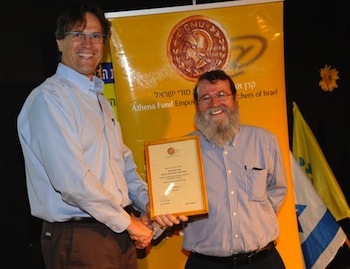
Uri Ben-Ari, president and founder of Athena Fund, left, and Zeev Twito, director of WIZO Hadassim. (photo by Amir Alon)
Athena’s Laptop for Every Teacher in Israel program has so far distributed laptops to more than 11,000 teachers in 939 schools and kindergartens in 430 towns, cities and small communities in regional councils, together with professional training courses. The laptop distribution is made possible by contributions from Athena Fund’s various partners, including United Jewish Appeal, Bank Massad, the Israel Teachers Union’s Fund for Professional Advancement, WIZO, local authorities and others.
CHW Hadassim is located north of Tel Aviv and has 1,300 students. It is one the largest youth villages in Israel. Local area students attend the school, in addition to 200 from difficult or new immigrant backgrounds, who reside in campus dormitories.
Hadassim High School offers a full academic course of study in preparation for university. The youth village also provides a wide range of specialized studies tailored to the interests and needs of outstanding students, as well as those who are experiencing scholastic difficulties. Among the subjects offered are criminology, natural sciences, agriculture, horse breeding, therapeutic horse riding, art and sculpture, and photography. There is also a musical group called Ethiopian Sun, which performs all over Israel.
Mosenson Youth Village is in Hod Hasharon, north of Tel Aviv, with more than 800 students, nearly 130 of whom come to study in Israel from North America and countries around the world. The youth village consists of a high school and a boarding school where about 220 students live. The high school is known for many special programs, including one in agro-ecology that deals with environmental issues; a sports program that is ranked in the top five in Israel; a film and communication class; and an excellence class that studies science subjects such as math, chemistry, physics and biology at the highest levels.
Ayelet Hashachar, located on the Golan Heights, is a religious boarding high school, where about 100 girls live and study. In addition to standard subjects such as math, English, history and science, students also have an opportunity to focus on special subjects, such as communications, film and agriculture. The girls also attend a variety of enrichment classes, including nutrition, consumerism, the environment and art.
“The impact of computer use on the quality of teaching and learning in classrooms that participate in the Laptop for Every Teacher in Israel program can be clearly seen,” said Uri Ben-Ari, president and founder of Athena Fund. “Athena’s approach is to bring teachers to the digital world in which their students live. The fund believes that the computer and the accompanying training will help teachers cope with the information revolution and become mentors highly appreciated by their students.”
Musical memorials to the Holocaust tread on sensitive ground. On one hand, they perform a crucial function for humanity’s collective memory. On the other hand, there is significant risk of belittling the topic in the name of artistic expression. Two composers who have successfully navigated the risky waters of this endeavor to produce musically significant works with dignity and veneration are Charles Davidson and Sheila Silver. Released by the Milken Archive of Jewish Music earlier this year, Out of the Whirlwind: Musical Reflections of the Holocaust gives both works their rightful place in the archive’s pantheon of music of the American Jewish experience (milkenarchive.org/volumes/view/19).
Davidson’s I Never Saw Another Butterfly cantata is based on the 1960s publication (of the same name) of poems written by children interned at Terezin, a ruse camp set up by the Nazis to throw off the scent of those who suspected the mass murder of Jews under Hitler’s reign. Though it was simply a waypoint en route to the Auschwitz death camp, Terezin depicted a scenario where prisoners enjoyed relative freedom and produced significant artistic output.
Davidson’s tribute to the child poets comprises nine poem-settings for children’s choir and piano, performed here by the San Francisco Girls Chorus. From touching beauty to foreboding, despair and all points in between, his composition gives unique expression to the range of emotions contained in the poems while conveying its own identity as a work of art. I Never Saw Another Butterfly has been performed more than 2,500 times, including in 1991 at Terezin, in the presence of former Czech president Václav Havel.
Silver’s string trio To the Spirit Unconquered was inspired by the writings of Italian poet and Holocaust survivor Primo Levi. Silver uses a variety of techniques to convey different aspects of the concentration camp experience described in Levi’s writings: fear, through dark string tremolos and crashing, dissonant piano chords; memory, through floating piano lines and swooning strings; barbarism, through quick, syncopated rhythms, staccato stabs, and angular melodies; transcendence, through the soaring melodies of the final movement. In a 1998 interview with the archive (milkenarchive.org/videos/view/112), Silver claimed To the Spirit Unconquered as her most successful piece, stating that it had been widely performed and won over audiences skeptical of modern music. In her own words, it is “about the ability of the human spirit to transcend the most devastating of circumstances, to survive and to bear witness.”
Though both of these works can be appreciated on their artistic merits alone, their grounding in the maxim to never forget imbues them with an inescapable urgency. They command listeners of all faiths and backgrounds to approach them with undivided attention.
Ben-Gurion University Prof. Iris Shai, principal investigator of the CArdiovaSCulAr Diabetes and Ethanol (CASCADE) trial. (photo by Dani Machlis/BGU)
A glass of red wine every night may help people with type 2 diabetes manage their cholesterol and cardiac health, according to new findings from a two-year randomized controlled trial (RCT) led by researchers at Ben-Gurion University of the Negev (BGU). Additionally, both red and white wine can improve sugar control, depending on alcohol metabolism genetic profiling.
In this first long-term alcohol study, recently published in Annals of Internal Medicine, the researchers aimed to assess the effects and safety of initiating moderate alcohol consumption in diabetics, and sought to determine whether the type of wine matters. People with diabetes are more susceptible to developing cardiovascular diseases than the general population and have lower levels of “good” cholesterol. Despite the enormous contribution of observational studies, clinical recommendations for moderate alcohol consumption remain controversial, particularly for people with diabetes, due to lack of long-term RCTs, which are the “holy grail” of evidence-based medicine.
“Red wine was found to be superior in improving overall metabolic profiles, mainly by modestly improving the lipid profile, by increasing good (HDL) cholesterol and apolipoprotein A1 (one of the major constituents of HDL cholesterol), while decreasing the ratio between total cholesterol and HDL cholesterol,” the researchers explained.
The researchers concluded that “initiating moderate wine intake, especially red wine, among well-controlled diabetics, as part of a healthy diet, is apparently safe, and modestly decreases cardio-metabolic risk. The differential genetic effects that were found may assist in identifying diabetic patients in whom moderate wine consumption may induce greater clinical benefit.”
The researchers also found that only the slow alcohol-metabolizers who drank wine achieved an improvement in blood sugar control, while fast alcohol-metabolizers (with much faster blood alcohol clearance) did not benefit from the ethanol’s glucose control effect. Approximately one in five participants was found to be a fast alcohol-metabolizer, identified through ADH enzyme genetic variants tests.
Wine of either type (red or white) did not effect change in blood pressure, liver function tests, adiposity or adverse events/symptoms. However, sleep quality was significantly improved in both wine groups, compared with the water control group. All comparisons were adjusted for changes in clinical, medical and drug therapy parameters occurring among patients during the years of the study.
The two-year CArdiovaSCulAr Diabetes and Ethanol (CASCADE) randomized controlled intervention trial was performed on 224 controlled diabetes patients (aged 45 to 75), who generally abstained from alcohol. They gradually initiated moderate wine consumption, as part of a healthy diet platform, and not before driving. The trial completed with an unprecedented adherence rate of 87% after two years.
According to BGU Prof. Iris Shai, principal investigator of the CASCADE trial, and a member of the department of public health in the faculty of health sciences, “The differences found between red and white wine were opposed to our original hypothesis that the beneficial effects of wine are mediated predominantly by the alcohol. Approximately 150 millilitres of the dry red or white wines tested contained about 17 grams ethanol and 120 kilocalories, but the red wine had sevenfold higher levels of total phenols and four- to 13-fold higher levels of the specific resveratrol group compounds than the white wine. The genetic interactions suggest that ethanol plays an important role in glucose metabolism, while red wine’s effects additionally involve non-alcoholic constituents. Yet, any clinical implication of the CASCADE findings should be taken with caution with careful medical follow-up.”
The study was performed in collaboration with Prof. Meir Stampfer from Harvard University and with colleagues from University of Leipzig, Germany, and Karolinska Institute, Sweden.
In the new study that followed the research group’s three-month alcohol pilot RCT findings (Shai I., et al, Diabetes Care, 2007), the patients were randomized into three equal groups according to whether they consumed a five-ounce serving (150 millilitre) of mineral water, white wine or red wine with dinner every night for two years. Wine and mineral water were provided free of charge for the purposes of the study. Compliance with alcohol intake was tightly monitored, with patients returning their empty wine bottles and receiving their new supplies. All groups followed a non-calorie-restricted Mediterranean diet (following the group’s previous two-year dietary RCT findings; Shai I., et al, New England Journal of Medicine, 2008). Adherence was monitored using several validated assessment tools.
During the study, subjects underwent an array of comprehensive medical tests, including continuous monitoring of changes in blood pressure, heart rate and blood glucose levels, and follow-up for the dynamic of atherosclerosis and fat by ultrasound and MRI tests.
Locations of different opsins on the human sperm, viewed under a microscope, are revealed by labeling with a fluorescent antibody (bright yellow). (photo from wis-wander.weizmann.ac.il)
In their journey to the egg, sperm “feel” the heat of the fallopian tube and “taste” the chemical signals of the ova. But, a new Weizmann Institute study published in Scientific Reports shows that sperm actually make use of sensors that have mainly been known to belong to the visual system.
If a sperm, about 46 microns (thousandths of a millimetre) long, were the size of a human being, it would swim several kilometres to reach its destination. Thus, sperm need to be guided by various cues. In earlier studies, Weizmann Institute’s Prof. Michael Eisenbach and his team discovered two of these guidance mechanisms – heat-sensing and chemical cues. The heat attraction works across the longer range: the site of the fertilization is warmer than the spot at the entrance to the fallopian tube where the sperm pause for maturation, and this temperature difference points them in the direction of the egg. When they get closer to the egg, they pick up its chemical signals.
“As in all important processes in nature, the sperm rely on more than one mechanism in their navigation, so that if one breaks down, others can provide a back-up,” Eisenbach said.
The heat sensitivity of sperm is extremely high. From a distance equivalent to the length of one sperm cell, they can sense differences in temperature as miniscule as 0.0006 of a degree Celsius, less than one thousandth of a degree. This sensitivity enables them to be guided by a very gradual increase in temperature on the way to the fertilization site.
In the new study, Eisenbach’s team – Dr. Serafín Pérez-Cerezales, Dr. Sergii Boryshpolets, Oshri Afanzar, Dr. Reinat Nevo and Vladimir Kiss of the biological chemistry department and Dr. Alexander Brandis of biological services – set out to discover exactly how sperm sense the heat. The scientists examined a particular category of receptors that, based on their previous studies, were thought to be involved in conveying signals to the sperm. Within this category, they zeroed in on a family of proteins called opsins.
Opsins are best known for their role in an entirely different sphere: the visual system. One major protein in this family, called rhodopsin, serves as a photoreceptor in the cells of the retina. Studies by other researchers working with fruit fly larvae had found this protein involved in responding to heat, hinting that this could also be the case in sperm.
The Weizmann scientists found that several proteins in the opsin family of receptors were present on the surface of mouse and human sperm. Each opsin had its own distribution pattern on the sperm, and each apparently made a contribution, through its own set of signals, to heat sensing. When the researchers blocked the signals from these opsins, the sperm failed to swim from a cooler to a warmer chamber.
These findings may explain the enigmatic presence of opsins in organs that are not exposed to light, including the lungs and the liver. They suggest that the mammalian opsins may be performing heat-sensing functions in these parts of the body.