
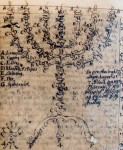
Fray Juan Ricci (1600-1681), sketch of the menorah as described in Exodus, undated. The number of lights on the chanukiyah – eight – is a break with the traditional seven-branched menorah. (photo by Ellen Prokop via commons.wikimedia.org)
The Festival of Lights is unique. We celebrate it for eight days, when most other Jewish festivals and holy days last one or two days or, at the most, seven. The number of lights – eight – is also a break with the traditional seven-branched menorah, which was rekindled in the Temple after the victory over the Syrian-Greeks. We also add a special prayer, “Al Hanissim,” whereby we thank G-d for the deliverance from our enemies:
“Thou didst deliver the strong into the hands of the weak; the many into the hands of the few; the wicked into the hands of the righteous; and the arrogant into the hands of those who occupied themselves with Thy Torah.”
At each morning service, we relate biblical accounts of the dedication of the altar at the time of Moses, and the gifts brought by the 12 princes of Israel. We are comforted, as a small nation against today’s sea of evil, by the words: “Not by might, not by power, but by My spirit, says the Lord of Hosts.” (Zechariah 4:6)
Even though the Temple was destroyed in 70 CE, it did not affect celebrating Chanukah because it is centred mainly on the home. In the third century CE, when our enemies launched their persecution of the Jewish people, when kindling Chanukah lights was forbidden, as often happens, this later awakened special esteem for the rite. It became a sanctification of G-d’s name, with special blessings.
Light has great significance in Judaism. Even during the plague of darkness in Egypt, we are told “all the children of Israel had light in their dwellings.” (Exodus 10:23) Although Chanukah imposes minimum religious restrictions, we are required to kindle the lights, stating that this commemorates “the miracle, deliverance, deeds of powers of salvation” wrought by the Almighty at this season. We are instructed not to use the lights for any utilitarian purpose – they are only to be seen. We pray to be placed “on the side of light” and the mystical book of Zohar promises “a palace of light that opens only to him who occupies himself with the light of Torah.”
Why did it take the priests eight days to prepare more olive oil for the Temple menorah? The 25th of Kislev marked the peak of the winter olive harvest season. The Maccabees’ hometown of Modiin lay in the heart of the country’s richest olive-growing region. They could have quickly picked the olives, prepared the oil and rushed it to the Temple in Jerusalem, a day’s walk away.
The explanation is that the special oil required for the menorah was clear oil of beaten olives (Shemot 27:20). It was a two-part operation: first, the beating and, then, the resulting mash was piled into flat fibre baskets and weighted to squeeze out the oil. It was not extracted by pressure, but allowed to seep out drop by drop. This process took much longer, producing an oil free of sediment and impurities, which burned a clear flame.
The date of Chanukah is related to the winter solstice, when the longest night of the year gives way to a gradual increase in the length of each day. When the Greeks first desecrated the Temple, they offered sacrifices to Zeus on the solstice. Upon the Temple’s liberation, three years later, the Jews renewed their service to G-d on the anniversary of the day it had been desecrated, as a gesture of defiance.
The Festival of Lights takes on special meaning at this time of darkness. In Israel, we see daily stabbings, shootings, car rammings and murders of Jews. But, no matter how dark the days of intolerance and racism worldwide, Chanukah has special meaning. The miracle is not just the supernatural one of the flask of oil. It is that beacon of light, the passion of man that transcends the momentary and the opportune. The Chanukah lights, like the Jewish people, refuse to be extinguished.
Dvora Waysman is the author of 13 books. She can be contacted at ways@netvision.net.il or through her blog dvorawaysman.com.