

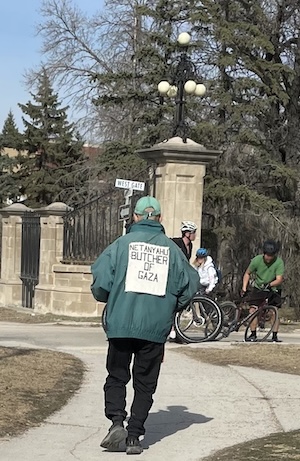
 Recently, my kids walked home from high school late because of their games club, which meets once a week. On their way, they saw a man on the sidewalk, coming from a pedestrian trail. He wore a sign on his back that read, “Netanyahu, Butcher of Gaza.” They hung back, took photos and alerted me when they got home.
Here’s a good reason to give Jewish teens access to cellphones. I used the “Find My” app to watch them walk home. They used the phone to document this. We found this signage offensive and upsetting, but it hadn’t been an emergency incident, so they didn’t use their phones to call 911.
I reported this incident to B’nai Brith Canada, who suggested also filing a police report. Over dinner, we discussed the sign. Was this antisemitism or just free speech, when using the IHRA definition of antisemitism? Is the test for this, “Would anyone reasonably use this kind of language about other countries’ publicly elected officials?” The answer for us was, “Well, yes.” We don’t approve of it, but, in 2022, we heard all this as part of the truckers’ convoy that came through Winnipeg. They parked (and honked) at the provincial legislature, close enough to our home so we saw their signs and hateful rhetoric.
I Googled the phrase on the man’s sign. Turkey’s President Recep Tayyip Erdogan started using this phrase in November 2023. It’s been used repeatedly in the last 2.5 years of the Gaza conflict. Knowing a phrase’s “origin story” doesn’t make it less virulent. It still didn’t feel OK. Something can be legal, but also shameful, wrong or antisocial, bad behaviour.
As a family, we debated whether we should do a police report. In Winnipeg, it’s not that easy to report something like this. There’s an online form, but it specifically rejects claims due to hate crimes or speech. In situations like this, there is calling 911 to report it or going downtown to the only police station that takes these reports. We chose to leave this one up to B’nai Brith, but the situation remained fresh and upsetting.
First, there’s the debate over whether something hateful and harmful is illegal or immediately dangerous. Our city’s police service is overburdened. Everyone in Winnipeg has heard of someone who has called the cops and been told that, unless the situation was life threatening, no police would show up. This means that squatters without life-threatening weapons aren’t immediately tossed out of vacant homes – but then the homes catch on fire. In one awful case, a panicked teen, trying to protect his grandmother, called the police during a home invasion. He was killed before the police arrived. This horrific incident puts our hate-signage sighting in perspective.
Second, though, is the question of whether we (Jewish people) or teens walking home from school deserve to feel safe. This man wasn’t walking in front of a consulate or legislature in protest. He was near multiple schools, a library, a synagogue, several churches, a hospital and a care home. If bubble legislation existed in Canada or in Winnipeg, it would have been possible to report this and expect a police response. As things stand, it didn’t seem forthcoming.
This incident reminded me of a conversation I had at Kiddush lunch at synagogue. A Jewish family at our table insisted, in alarm, that Bill C-9 (the one for federal bubble legislation) would interfere with their right to free speech. I asked how often they wrote for the press or how this risked interference with their current modes of protest. I asked if they felt that their right to protest was in jeopardy. When I Googled them later, I found that they don’t write widely. Their names don’t appear in the news regarding protests. Their right to free speech or protest was likely not being threatened in any way. It seems they had fallen prey to misinformation. At the table, I brought up multiple incidents that our children face as they leave a public school and walk home past our congregation.
When a protester is outside the synagogue just after school lets out, the police say that it’s public space. The protest is allowed, even though the signage blocks the sidewalk. Kids walking by are exposed to potential hate speech, and normalizing hate speech or graffiti can lead to acts of violence. This kind of protest first happened about two years ago, but, this spring, the signage on a man’s jacket left us in the same quandary.
Well-intentioned allies have asked, “Do you feel safe?” or “What can I do?”
The answer to the first question is, “no.” There are a lot of reasons for that. For one thing, I’d like my kids to be able to walk home without feeling threatened or having to dodge protesters or shoot photos.
I regularly encounter non-Jewish Canadians who ask the second question. I try to help them learn more about the issues, so they feel ready to be “upstanders” rather than just “bystanders.” Calling the police, paying privately for huge amounts of security or shielding children from hateful protest shouldn’t be something Jewish Canadians navigate alone. We’re less than 1% of the Canadian population. It’s necessary to educate and mobilize allies to help.
Political “free speech” can be legal and still hateful. A society that speaks up can make change, even if the offender isn’t arrested. Education happens when we say, out loud, that some behaviours are shameful and un-Canadian. Bad behaviour affects all of us. It’s time to find adults willing to speak up. If somebody wants Jews to feel safe in Canada, then the status quo is not what they want either.
Joanne Seiff has written regularly for the Winnipeg Free Press and various Jewish publications. She is the author of three books, including From the Outside In: Jewish Post Columns 2015-2016, a collection of essays available for digital download or as a paperback from Amazon. Check her out on Instagram @yrnspinner or at joanneseiff.blogspot.com.



