Teen wins for speech

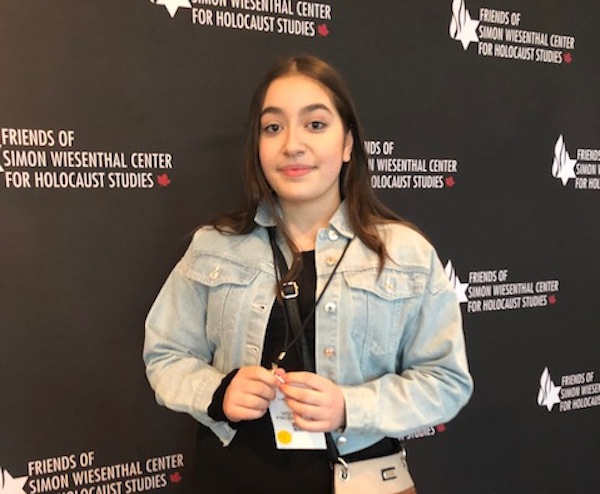
Deema Abdel Hafeez placed third in the Friends of Simon Wiesenthal Centre for Holocaust Studies’ annual speech contest. (photo from Janet Lee Elementary School)

Every year, the Friends of Simon Wiesenthal Centre for Holocaust Studies puts out a call to Ontario students in grades 6 to 8 to submit a speech reflecting on a quote of Holocaust survivor Simon Wiesenthal, z”l. This year, the quote selected was, “I believe in the good in people,” and students were encouraged to think about how to make the world a better place.

Deema Abdel Hafeez, a Grade 8 student at Janet Lee Elementary School in Hamilton, Ont., entered the contest, the first round of which was in February. Hafeez comes from a Palestinian family who moved to Canada 20 years ago.

“When I heard the quote, I didn’t want to just base it on the good in people … unicorns, rainbows,” Hafeez told the Independent. “I, more so, attacked the quote. I was like, you cannot believe in the automatic good in people, because it takes time to find the good in people.

“I wrote about my Islamophobic experiences. I was saying that you have to define the word ‘good’ to believe in the good in people. And, you have to become the good yourself before you can assume the good in other people.”

Hafeez shared that, while her school is pluralistic, with students of many different faiths, racism still very much exists.

“All the racist slurs and things like that, that’s how I attacked the quote,” said Hafeez. “I talked about how my family can’t go out without [experiencing it] … how my mom is being told to go back to her own country, or how anyone wearing religious clothing … is attacked in social standing … and how things are at a disadvantage for people like us. Obviously, it’s not as bad as it used to be, but, as a world, we need to try to change more.”

Hafeez said one of her Muslim neighbours had been badly beaten, to the point that he had almost died, just because he is a Muslim.

In the classroom, Hafeez has witnessed hate. “People mention jokes on social media and like things like that, and they talk about different colours of skin as if following a stereotype… and it’s, like, you’re funny, but you’re not … it’s just rude.”

When asked about how her parents felt about her entering the competition, Hafeez said she had entered without their knowledge. “It wasn’t because they wouldn’t have allowed me to,” she said. “But, I kind of just entered without telling anyone. At home, we talk about the Palestine-Israel conflict a lot, because we have a lot of family in Palestine. We can’t hate a whole group of people, because that’s hypocritical and we’re nice people … so, we don’t hate Israeli people. I have a lot of Israeli friends and I’m Palestinian. It’s cool, because, I feel like, with the Palestinian-Israeli conflict, there’s a way we can live in harmony, both nations living in the same land.”

Hafeez is a member of the school group Making a Difference.

“We do a lot of fundraisers and things like that,” she said. “I volunteer my time while making projects for my school and having the whole school getting involved in these projects. That’s how … I think I’ve become ‘the good,’ in my opinion. I find good as not seeing other people as objects and not labeling them and things like that … becoming the good is more mental to me. You can’t judge anyone. You can’t say, this person is good or bad. You can define yourself and, if you believe you’re doing the best you can at being good … if everyone did that in the world, then we’d live in a better place.”

Hafeez said she watches the news a lot and feels there is far too much violence that results from people judging others.

“I’m not talking about politics,” she said. “If everyone just stopped judging other people based on their religion, colour, sexual orientation … if everyone just focused on themselves, then our world wouldn’t be as hateful a place as it is right now.”

Hafeez practised her speech with her eight siblings.

“I feel like the hardest part for me was just managing my time and how I was supposed to practise my speech, and do all the things for my speech while I also have school, sports, classes … that was the hardest part,” said Hafeez. “The speech itself came easy for me. It is my own thoughts and is everything I’d thought about before. I stayed up late at night thinking these thoughts. I already knew what I wanted to say, so, on the stage, I wouldn’t be reading off a paper. I’d be talking about what I’ve been thinking about.”

The practise paid off. Hafeez was among 10 students chosen to attend a workshop and have their speeches taped as part of the semifinals on March 3 at the Friends of Simon Wiesenthal Centre in North York, a suburb of Toronto. A panel of judges then selected five students for the finals on March 28 at the Toronto Centre for the Arts. Hafeez placed third, winning an iPad.

Hafeez and her school have sent the Simon Wiesenthal Centre a grant application in the hope of organizing a peace summit, incorporating some anti-Islamophobic and anti-discrimination workshops for area schools.

Hafeez is already thinking about what types of activities she would like to undertake in high school, next year, such as starting up a group for change.

“I feel like, when I do that, I’ll be introduced to everything else I can do at my high school,” she said. “I have a lot of siblings, know a lot of teachers. I feel like it won’t be hard, to use my voice to reach people in high school.”

Meanwhile, Hafeez will find good use for her new iPad.

Rebeca Kuropatwa is a Winnipeg freelance writer.
Defending a neo-Nazi

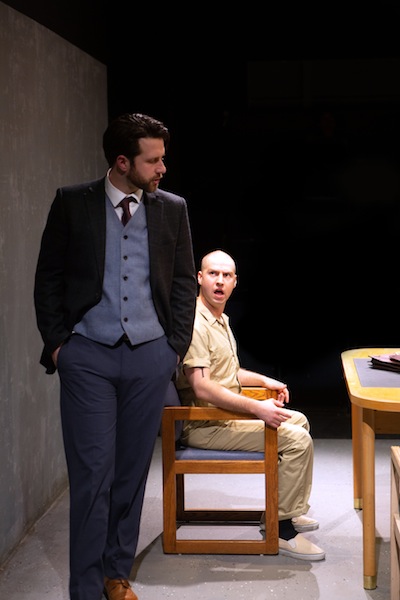
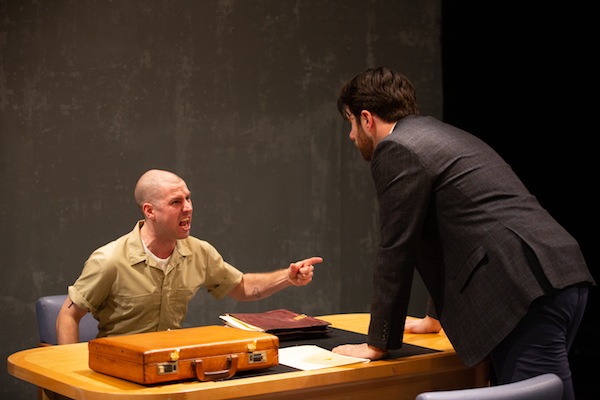
Kenton Klassen, left, and John Voth co-star in Pacific Theatre’s production of Cherry Docs. (photo by Dylan Hamm)

I often wonder, as a lawyer and the child of a Holocaust survivor, if I would be able to defend a skinhead charged with a racist crime. Can a person shut off their emotions and take on a case that is at odds with their moral compass?

This is the premise of Cherry Docs, a two-hander playing at the Pacific Theatre until April 28. Playwright David Gow penned the piece in 1998 as a response, in part, to the homophobic attack by a group of skinheads on his university friend and, in part, to his Jewish Belgian family’s Holocaust experiences.

“I wanted to explore and come to terms with my own anger at seeing young people dressed as Nazis and adopting Nazi thinking 50 years after the end of a war that killed so many millions,” Gow told the Jewish Independent. “Now, 70-odd years later, we seem to have more neo-Nazis than ever before. It looks far, far worse today than in 1998, when someone could (and did) say with a straight face, are you sure this is a problem? It was not good in 1998. Now, of course, it is a problem of epic, international proportions.”

Cherry Docs has been produced globally, including a long run in Germany, where, said Gow, “the critical reception … was extremely detailed, extremely well-written, unlike anything we see in North America, even from, say, the New York Times, in terms of depth and breadth of commentary and analysis. The play ran for something like seven years in rep in Berlin. Two distinct productions have been done in Tel Aviv over the years, and maybe two in Jerusalem.”

As well, he added, “productions in Poland ran for 13 years. One Polish production went to Beijing for an international theatre festival and, there, it played with Chinese subtitles, so, an English Canadian play in Polish and Chinese, in China.”

The success of the play and its international acclaim led Gow to adapt the story for the big screen. Its cinematic debut came in 2006, as Steel Toes. It won several awards on the film festival circuit.

In the two-actor play, which features John Voth as Danny Dunkelman and Kenton Klassen as Mike Downey in the Pacific Theatre production, Danny is a Jewish legal aid lawyer who has been assigned the task of defending Mike Downey, a 20ish, tattooed skinhead, who is charged with murder in the stomping death of a Pakistani fast food worker in a back alley in downtown Toronto. The play’s title represents Mike’s pride and joy, his steel-toed, cherry red Doc Marten combat boots, which he is wearing when he commits his hate-motivated crime. The rationale for Mike’s unprovoked, drunken attack is his perception of the decline and fall of white male supremacy as brought on by what he sees as unchecked immigration, reverse discrimination for employment opportunities and a ZOG (Zionist occupation government) conspiracy of the Jewish elite.

Mike has been indoctrinated into the white racist youth movement and recites antisemitic clichés with ease and conviction. He is a proud foot soldier for the Aryan resistance movement. He goads Danny on by saying, “In an ideal world, I would see you eliminated, but I need you. I know you will do a good job for me, as you are a Jewish liberal thinker, a humanist, who believes in checks and balances in the system.”

Mike insists that he be tried for his crime, which he admits – although he says he did not intend to kill the victim – as an individual. “Try me,” he says, “not the skinhead ideology.”

Danny aggressively challenges high school-dropout Mike to formulate a convincing defence strategy, taking him through “the eye of a needle” in an effort to make him stand up and be accountable for his actions.

photo - John Voth, left, and Kenton Klassen co-star in Pacific Theatre’s production of Cherry Docs
John Voth, left, and Kenton Klassen co-star in Pacific Theatre’s production of Cherry Docs. (photo by Dylan Hamm)

The two travel their own paths of discovery through the seven months of legal proceedings. Mike’s journey leads him to a path of redemption, while Danny struggles. Danny must confront not only his violent dislike for his client, but his own racism; in doing so, he explores his Judaism and its tenets of atonement and forgiveness.

The biblical names of the characters Daniel (in the lions’ den) and Michael (the archangel) suggest an allegory, “A battle from above played out here,” said Gow. As the story unfolds, we see the impact that two ideologically opposite humans can have on each other, and that Danny is no saint and Mike no devil.

All of the action takes place in the prison, where Mike is being held in administrative segregation. The style – alternating monologues from the protagonists followed by intense bouts of verbal sparring – and the sparse set (two chairs and a table) are appropriately stark for the subject matter and the intimate theatre space. The costumes also are uncomplicated – Mike’s prison jumpsuit and Danny’s business attire. Subtle lighting and sound cues complete the atmosphere.

Klassen is superb in his portrayal of Mike. At the opening night reception, he shared with the Independent that he had prepared for the role by talking to a reformed neo-Nazi skinhead, which gave him insight into his character. While Voth is solid as the defence attorney, he is not as engaging as Klassen.

Two particular scenes bear mention. In one, the two actors stand at opposite ends of the stage, just breathing and looking at each other with no words spoken – the silence is more powerful than any dialogue. In the second, Mike sits alone on the stage, repeatedly opening and closing a lighter, his face mirrored in the glow of the flame – again, the silence says it all. Kudos to director Richard Wolfe for bringing all the parts of this production together into a riveting whole.

As for another reason why audiences should come to see the play, Gow said, “It is highly entertaining, and that is why it has attracted tens of thousands of audience members. The best-known actor associated with the play has said, ‘It will recalibrate your soul.’ I am not sure about that, but certainly thought-provoking, I believe … not an average play, in any case.”

Cherry Docs is, indeed, a thought-provoking play, whose themes remain timely and relevant. It is difficult to perform and a brave choice for Cave Canem Productions and Pacific Theatre – it is both a visceral and intellectual experience, suitable for older teens and up, as it contains mature subject matter, violence and profanity. For tickets, call 604-731-5518 or visit pacifictheatre.org.

Tova Kornfeld is a Vancouver freelance writer and lawyer.

Monitoring online hate

On Monday, Facebook eliminated many extremist pages from its platform, including several Canadian pages, such as those of extremist groups Soldiers of Odin, the Canadian Nationalist Front and Aryan Strikeforce, as well as individuals like white supremacists Faith Goldy and Kevin Goudreau.

Some anti-racist activists say it’s a good start, but only the tip of the iceberg. They also assert that occasional purges of hate content will not address the larger issue in the absence of clear, enforceable standards by social media giants like Twitter and Facebook, which also owns Instagram.

Relatedly, the Centre for Israel and Jewish Affairs has launched a campaign, #notonmyfeed, which is intended, according to the accompanying website, “to stop online hate from becoming real-world violence.” (See jewishindependent.ca/cija-fights-online-hate.) CIJA cited social media posts by the murderers in the Pittsburgh synagogue and the Christchurch mosque killings as cause for governments to move on the issue.

“In both cases, the perpetrator used social media to spread their heinous, hateful agenda,” according to the website notonmyfeed.ca. “From white supremacists to ISIS, it is increasingly clear that online hate and radicalization can fuel and foreshadow offline violence.”

The House of Commons justice committee – as if they are not busy enough with the SNC-Lavalin affair – is launching a study on the issue. The intent, according to CIJA, is to develop a national strategy around online hate.

A national strategy confronting hatred, whether online or offline, seems like a positive development if it helps track problematic people and ideas in order to prevent future violence.

The benefits of a crackdown on online hatred are obvious: by making it more difficult for hateful ideas to reach large, mainstream audiences, moves like those by Facebook are a positive step. Groups that use social media to recruit individuals into hate movements may be hobbled by such policies. Although there are plenty of forums online where they can continue their efforts, hate groups may not have as easy and accessible a reach if policies are put in place to monitor and censor such groups and their messages.

Of course, some of the extremists are crowing about being banned.

“Our enemies are weak and terrified,” Goldy tweeted (because she is not banned from that platform). “They forget most revolutions were waged before social media!”

True enough. But if we make Goldy’s job harder, it’s a good thing.

However, while there are potential positive outcomes, we should not be blind to the potential unintended consequences of such a move.

If the murderers of Pittsburgh and Christchurch had given hints on social media of their intent, isn’t the larger issue here that those threats went unchecked and, therefore, the perpetrators were allowed to complete their mission of mass murder without intervention? Do we really want to eliminate forums in which we can track and identify potential terrorists? If we ban them from these platforms, are we forcing them underground into places where we cannot police them?

Presumably, police and intelligence agencies know where to find the online warrens of hatemongers and can monitor those venues almost as easily as they could Facebook or Twitter, while ensuring that members of the public who are innocently surfing the web do not stumble upon violent hate messaging in seemingly innocuous places. Even so, given that, as CIJA points out, the Pittsburgh and Christchurch killers left a trail on social media and still managed to execute their terrible plans, it suggests we’re not doing a stellar job on this front even when the warning signs are on the world’s largest sharing platforms. So, how much better are we to expect things to be when we force them into the darker crevasses of the online world?

This issue is confounding in part because the internet is, by definition, anarchic and largely beyond the control of all but the most authoritarian governments. As a result, governments and even social media behemoths like Facebook can do only so much to control what is shared through the web writ large.

Leaving aside issues of free expression (which differ across jurisdictions in ways that social media do not), there are practical considerations that we hope elected officials, law enforcement and social media corporations themselves consider when addressing online hate.

As governments do begin to take the issue seriously and consider interventions in the interest of public safety (including, especially, the safety of the most commonly targeted identifiable groups), we trust that a balance will be struck between eradicating violently hateful messaging, on the one hand, and, on the other, not harming law enforcement’s ability to do their job by pushing these ideas into clandestine sectors where they can neither be monitored nor challenged. Finding that balance should be the key to formulating public policy on this urgent issue.

Together on path to freedom

Passover is coming! As we prepare, we think of what it means to be enslaved and to be free. Some seders focus on human rights. Others read and discuss Jewish texts about how to understand the holiday. Every year, we re-examine not only how good the foods are, but the ideas around slavery and redemption.

At one of my first Jewish events in Winnipeg, 10 years ago, I heard racist comments about indigenous Canadians. I was really upset by the incident. I was so uncomfortable that I still remember the experience in detail, even though I’ve forgotten a lot of other things over time.

I recently attended some of the lectures in an extremely worthwhile series put on by Westworth United Church called Interfaith Dialogue on Truth and Reconciliation. Each year, in the springtime during Lent, this church offers some of the best adult education programming I’ve ever attended and they welcome the entire community. The topics are thoughtful but, even more important, participants come ready to wrestle with hard intellectual and emotional ideas. I was introduced to it because Dr. Ruth Ashrafi has been a speaker as part of this programming more than once, and I’m hooked.

This year, the series was held in four different locations throughout the community, including Congregation Etz Chayim, Westworth United Church, as well as at one of the mosques and at a Buddhist Temple. It was so well attended that it filled the pews – wherever it was held.

Each session, a religious leader spoke, but he or she spoke at the lectern of a different congregation. Dr. Shahina Siddiqui spoke at Etz Chayim. Ashrafi spoke at Westworth United. It was powerful to see people of different faiths take to different pulpits. These leaders spoke, in the context of their religious traditions, on their status as Canadians or newcomers to a place with a heavy past of racism toward and discrimination and neglect of its indigenous people.

The most shattering part of the series was to hear from indigenous elders. I only attended two of the events, and heard Theodore Fontaine and Chickadee Richard speak. I cried while I listened to them. Their powerful personal, political and religious stories shook me.

These were bright, strong leaders with absolutely valid points about how they and their communities have been affected and mistreated by Canadian law and society. Their beliefs and prayers – about caring for Mother Earth, about protecting water and guarding the lives of those they love – are no different than those of other religious traditions in Canada. Yet, there are still indigenous communities who are forced to live in terrible conditions, without access to clean water and without adequate education or health care. How can people of faith accept this dichotomy? How is it that the first people in Canada don’t have access to the basic human rights that most of the rest of us enjoy?

After each set of lectures, we were sorted into random discussion groups. In the first event, we were asked to imagine what it might have been like to experience residential school and how we felt we would have reacted. What would that have been like?

All around me, I heard older Canadians mention how they didn’t know, and that their history classes didn’t teach them what had happened. They struggled with this part of Canadian history. It’s a denial that seemed familiar from German accounts of the Second World War, when people said “they didn’t know” what was happening to the Jewish people in their communities.

I could see many parallels between the stories Theodore Fontaine told, of “going to the moon” and escaping the abuse by disassociating and going somewhere else in his mind, and the novel The Painted Bird, by Jerzy Kosinski, which describes the horrors experienced by a Jewish child during the Holocaust. Trauma causes us (humans) to do many of the same things, even if our religious and ethnic identities differ.

Many of us know that the trauma of the Holocaust doesn’t go away in one or two generations. Those indigenous Canadians who were sent away from their families to residential schools, where they were abused, fed poorly and otherwise mistreated – their trauma has affected their families for generations. Jerzy Kosinski dealt with his childhood Holocaust trauma through substance abuse and, eventually, suicide. It’s no wonder that many indigenous survivors do the same.

Passover is a time of year, like the High Holidays, where we throw off wrongs and bitterness in the hope of embracing new growth and change. We can throw off the bondage of old biases or ideas that have enslaved us. Prejudice against indigenous people, their traditions and the burden of past abuses needs to be addressed – by all of us.

At the end of the lecture series, the facilitators asked variants of this question: “What will you do in the next year to address reconciliation, promote diversity and inclusion, and to make change?” My commitment was to be brave in speaking out about these issues.

Now, I’m turning over the question to you. What will you do, as a person of faith, to make change? Start by reading the 94 recommendations of the Truth and Reconciliation Call to Action. Write to your politicians to protect the water, the earth and the peoples who came to Canada first. Go to a powwow or a reconciliation discussion. Look others, no matter who they are, in the eye and greet them with loving kindness. In short – do more. It’s the Jewish thing to do.

Remember – we were slaves in the land of Egypt and now we’re free. Free to step up, speak up and help others along the path to equal rights, respect and freedom.

Joanne Seiff has written regularly for CBC Manitoba and various Jewish publications. She is the author of three books, including From the Outside In: Jewish Post Columns 2015-2016, a collection of essays available for digital download or as a paperback from Amazon. See more about her at joanneseiff.blogspot.com.

CIJA fights online hate

“We were saddened, horrified and deeply angered by the murderous terrorist attack in Christchurch, which was clearly motivated by hatred of Muslims that was at least in part fomented online,” Martin Sampson of the Centre for Israel and Jewish Affairs (CIJA) told the Independent. “This is another disturbing example of how terrorists and mass murderers make use of social media – both before and after attacks – to spread their heinous message.”

On Friday, March 15, 50 Muslims were murdered by a white nationalist terrorist at two mosques in Christchurch, New Zealand. On Oct. 27, 2018, 11 Jews were murdered at Tree of Life Synagogue in Pittsburgh, Penn. Both perpetrators had been active in spreading hatred online. In the case of Tree of Life Synagogue, the shooter had written a post announcing his intentions hours before the attack.

“This issue has been of interest to us for some time,” said Sampson. “We included it as a core federal priority in our Federal Issues Guide, which was released in September of 2018. The horrific shooting at the Tree of Life Synagogue in late October, and the fact that the assailant had been highly active in promoting antisemitism on social media – it is reported that he posted more than 700 antisemitic messages online in the nine months or so prior to the attack – underscored the urgency of the issue and the need to increase awareness about the connection between online hate and offline violence. This is why we launched notonmyfeed.ca.”

The goal of CIJA’s #notonmyfeed campaign is to reduce the spread of online hate speech. “In any democratic society that values freedom and individual rights, no right is absolute,” said Sampson. “Striking a reasonable balance between preserving free speech and protecting Canadians from those who systematically demonize and slander entire communities is a challenging, complex task, but not an impossible one.”

CIJA is calling for a comprehensive response that addresses hate in a variety of forms, not just antisemitism, he said. “We can preserve free speech while protecting Canadians from those who deliberately promote hostility – and even glorify violence – against entire communities.”

Sampson said there is a direct link between online hate speech and violence. “In countless cases – such as in the case of individuals who have been radicalized to participate in terrorism or hate crimes – online propaganda has been a significant factor,” he said. “This is a complex issue. Understanding it and developing tools to counter it is why we are calling on the government of Canada to take the lead by launching a national strategy to tackle online hate, working in partnership with social media platforms and internet service providers.”

Some people contend that, if online hate speech foreshadows offline violence, there may be some value in monitoring it, rather than forcing it underground. As well, if kicked off one social platform, those inciting hatred can just move to another one.

“In cases of ignorance, inappropriate statements or offhand comments that are bigoted, counter-speech is clearly the best response, and these types of online behaviours are not the focus of our calls for a national strategy to tackle online hate. In cases of propaganda being systematically produced by extremists – particularly when it includes the glorification of violence – allowing it to continue can in some cases pose significant risks to public safety,” said Sampson about these concerns. “Moreover, allowing such behaviour to take place on social media platforms often violates the basic terms and conditions of those sites. Social media platforms should enforce their own existing policies.”

The movement to boycott, divest from and sanction Israel over its treatment of Palestinians is controversial, with some seeing it as a legitimate tactic opposing human rights abuses and others seeing it as a form of discrimination rooted in antisemitism. “It is neither the focus of our policy position on online hate, nor can I perceive any scenario in which BDS would be implicated or affected by a national strategy to tackle online hate,” said Sampson, when asked whether BDS was one of the intended targets of CIJA’s campaign. “To be clear – we strongly oppose BDS and work to expose and counter the real agenda of the BDS movement, but that is a very separate challenge and completely distinct from our call for a national strategy to combat online hate.”

Asked if CIJA has any plans for addressing hate speech in the Jewish community itself, Sampson said, “Our position on online hate is that a national strategy should address hate in a variety of forms, not just antisemitism. This is why we have mobilized a coalition of communities, including the Muslim community, to join us in this effort. We believe every online account should be held to the same standard, regardless of the identity of the person who runs the account. When it comes to the Jewish community, we strive to set an example in how we manage our social media accounts, allowing debate and diverse opinions in the comments section of our posts, while having a zero tolerance policy toward bigotry and hateful comments.”

Matthew Gindin is a freelance journalist, writer and lecturer. He is Pacific correspondent for the CJN, writes regularly for the Forward, Tricycle and the Wisdom Daily, and has been published in Sojourners, Religion Dispatches and elsewhere. He can be found on Medium and Twitter.

Condolences, friendship

The mass murder of Muslims in two New Zealand mosques last week is a tragedy that transcends words. But, of course, humans being what we are, we need to struggle to try to understand this sort of evil. As a natural consequence, billions of words have been shared, some thoughtful and empathetic, others attempting to score political points off the misery.

No amount of words can turn back time and prevent the horror. Our only way forward is to share our deepest condolences with Muslims in our communities and worldwide, while striving for a better world.

Empathy should be a natural response to Jewish communities in North America, as we can so easily put ourselves in the positions of our Muslim neighbours. In some ways, Muslim British Columbians must be feeling something similar to those feelings experienced by Jewish people after the murder of six people in a Pittsburgh synagogue less than five months ago.

Again, there is no way to turn back time and change history. Lives taken cannot be brought back. But, when faced with an act of such grievous hatred and violence, from which it seems nothing good could ever emerge, there are things we can do to ease the grief and remind survivors and others affected that the world is not defined by the acts of one, or a few, terrible people.

After that act of terror in Pittsburgh in October, many of us experienced feelings of isolation, the sorrowful kinship of being part of a targeted community, the comprehension of how interchangeable we may be with the victims in the eyes of murderous haters. These feelings were eased in small but meaningful ways by acts of understanding and sympathy. Synagogues, day schools, Jewish community centres and Jewish individuals all over the world received notes and other gestures of solidarity and sympathy. A “solidarity Shabbat” that took place the following week saw congregations throughout North America swell with non-Jewish friends who were moved to demonstrate support and friendship.

Likewise, members of the Jewish community and many diverse members of the broader British Columbia community came together at a number of vigils and events in recent days, trying to alleviate the isolation and feelings of being targeted that our Muslim neighbours must be experiencing.

Part of the shock of the attack, which killed 50 people, is that it happened in a place so unaccustomed to hatred and violence of this magnitude. For many Canadians, the murders brought back memories not only of the Pittsburgh attack, which is so fresh in our minds, but also of the Quebec City terror attack of two years ago, when six Muslims were murdered and 19 others injured during a similarly motivated hate crime. Whatever self-image Canadians have as a peaceable people was challenged by that act. Likewise, New Zealanders, who, despite being a world away from us, share much of our colonial and post-colonial history and a common parliamentary foundation, must be coming to terms with the reality that they are not at a remove from the world’s worst ideas and people.

In an era when everyone’s reactions to every event, however monumental or insignificant, can be broadcast to the world through social media, we have seen responses that are beautiful and others that are inappropriate. An Australian senator famously blamed the victims.

Each of us can make a small difference by sending a message to our Muslim neighbours – whether we know them or not. Google “Vancouver (or Richmond or Surrey or wherever you live) mosque” and send kind thoughts to the congregation. Reach out to Muslim friends and let them know that the feelings they are having are understandable.

But there is one other thing. As noted, this is not a time for politicizing. So try to accept this suggestion as it is intended, as a humanitarian, rather than a political, statement: when a community of people is attacked, people of goodwill need to stand with that particular community and, for a moment or whatever length of time seems respectful, avoid universalizing the tragedy.

When elected officials or other well-intentioned people declare that “an attack on Group X is an attack on all of us,” it diminishes the experiences of the targeted group. When Jews were murdered in Pittsburgh, people needed to express (and Jewish people needed to hear) condemnations of antisemitism and words of support. Today, we need to face Islamophobia and white supremacy. We need to express (and Muslim people need to hear) words of support and condemnations of anti-Muslim violence.

There is a time for universal messages of solidarity and unity. In the aftermath of a catastrophe specifically targeting an identifiable group, we need to deal in specifics.

Mary Kitagawa’s civil courage

Mary Kitagawa was honoured with the Wallenberg-Sugihara Civil Courage Award on Jan. 20. (photo by Pat Johnson)

At a convocation ceremony at the University of British Columbia in 2012, a group of graduates stood out from the rest. Twenty-one elderly Japanese-Canadians, ranging in age from 89 to 96, were awarded honorary degrees in recognition of an historic injustice that had taken place 70 years earlier.

In the winter of early 1942, right after Japan’s attack on Pearl Harbour, the Government of Canada ordered all Japanese-Canadians to be relocated from the coast. This included students at UBC. For the next seven decades, the injustice went unrectified and largely unrecognized by the university until Mary Kitagawa, a community leader whose own family history was ruptured by the events of the war years, took up the cause. It was her tenacity that led the university to acknowledge and make some amends for its complicity in the injustice. It awarded honorary degrees to 96 students – most of them posthumously.

For this achievement, and others, Kitagawa was honoured with the Wallenberg-Sugihara Civil Courage Award on Sunday afternoon, Jan. 20. This was the 14th annual Vancouver commemoration of Raoul Wallenberg Day, which, since 2015, has coincided with the presentation of the Civil Courage Award.

In her remarks upon receiving the award, Kitagawa reflected on the social conditions that permitted the internment of Canadians of Japanese descent.

“This happened because those in power in Canada at that time forgot that this was a democratic country, sending her men and women to war to preserve our freedom,” she told a packed auditorium at the H.R. MacMillan Space Centre. “The excuse they used for incarcerating us was that we were a security risk. However, if you read all the newspaper headlines of the 1930s and ’40s, you will find that the B.C. politicians’ hatred of Japanese-Canadians was deep and abiding. They wanted to ethnically cleanse this one small group of people from the province.”

Kitagawa said that, at a January 1942 meeting in Ottawa to address “the Japanese problem,” a B.C. representative declared, “The bombing of Pearl Harbour was a heaven-sent gift to the people of British Columbia to rid B.C. of Japanese economic menace forevermore.”

“My family was swept away from our home in this storm of hatred,” Kitagawa said. From their home on Salt Spring Island, the family was transported to Hastings Park, in East Vancouver, which served as an assembly point for dispersal to the interior of the province.

“Our journey through incarceration was brutal and dehumanizing,” she said. The family was separated from her father for six months and they feared the very worst. Eventually, the family was reunited, but they were moved from place to place around the interior of British Columbia and in Alberta a dozen times during seven years of incarceration.

When the War Measures Act, under which the internment was justified, ceased its effect at the end of the war, Parliament passed successive “emergency” laws to permit the continued incarceration through 1947, and it was April 1949 before Japanese-Canadians were granted freedom of movement and permitted to return to the coast. Her father and mother, aged 55 and 50 respectively, took the family back to Salt Spring and began all over again.

“It wasn’t just the material things that they lost,” Kitagawa reflected. “They lost the dream for the future they had planned, their community, their opportunities, education for their children, their friends, their youth, their culture, language and heirlooms. But never – they never lost their pride nor their dignity.… My parents believed in forgiveness. Like Nelson Mandela, they believed that forgiveness liberates the soul. They refused to look back in anger. Instead, they chose to continue to move forward with the same resolve that helped them to survive their terrible experience.”

In 2006, Kitagawa read in the Vancouver Sun that a federal building on Burrard Street in Vancouver was being named to honour Howard Charles Green, a longtime Conservative member of Parliament from Vancouver and a leading advocate of Japanese-Canadian internment. “Immediately, I knew that I had to have that name erased from that building. To me, no person who helped destroy my parents’ dream and made them suffer so grievously was going to be so honoured.”

With help from a quickly mobilized group of activists and sympathetic media coverage, Kitagawa successfully had Green’s name stripped from the building, which was renamed in honour of Douglas Jung, another Conservative MP, but the first MP of Chinese-Canadian heritage.

Kitagawa also led an initiative that saw Hastings Park declared an historic site related to the internment.

In her talk on Sunday, Kitagawa emotionally credited an “unsung hero,” her husband Tosh, who, among other efforts he played in supporting Kitagawa’s activism, spearheaded the reprinting of the 1942 UBC yearbook to include information about the internment and biographies of the students affected. It was also through his persistence that they were able to track down the 23 living students and the families of those who had passed away.

The Civil Courage Award is presented by the Wallenberg-Sugihara Civil Courage Society, which was formed by members of the Swedish and Jewish communities in Vancouver.

Raoul Wallenberg was a Swedish architect, businessman, diplomat and humanitarian who became Sweden’s special envoy to Hungary in the summer of 1944, several months after the Nazi deportation of Hungarian Jews had begun. He issued protective passports and sheltered people in buildings that were declared to be Swedish territory, saving tens of thousands of Jews. He was taken into Soviet captivity on Jan. 17, 1945, and was never seen again.

Chiune Sugihara was a Japanese diplomat who served as the vice-consul in Lithuania during the Second World War. Acting in direct violation of his orders at great risk to himself and his family, he issued transit visas that allowed approximately 6,000 Jewish people from Poland and from Lithuania to escape probable death.

The award presentation was followed by a screening of the 1995 film The War Between Us, which dramatizes the events of the Japanese-Canadian experience through the lives of a single family.

Councilor Pete Fry, Vancouver’s deputy mayor, read a proclamation from the city. Consular officials from Sweden and Japan were in attendance.

Airing, rejecting bad ideas

Hundreds of thousands of women and allies marched in cities all over North America Saturday, bringing people from across the spectrum together to stand for equality and justice. It was the third annual network of women’s marches that sprang out of the shock and alarm after the election of U.S. President Donald Trump.

To ensure that the nearly spontaneous eruption of resistance to the direction of American (and world) politics was more than lightning in a bottle, a movement was solidified in the form of Women’s March Inc. This body, led by a small group of activists who quickly gained international fame and recognition, not only came to helm one of the most remarkable new grassroots movements in American history, they also became central figures in the cadre of leftist, socialist and progressive political activists that is loosely defined as “the resistance.”

Unfortunately – or, perhaps, fortunately, for reasons we’ll explain – the small group of Women’s March leaders has recently been beset by controversy. In a book-length analysis last month, Tablet magazine reconstructed accounts of the earliest hours of the march movement – including the marginalization of Jewish women who were there at the start and the assertion, apparently made in one of the earliest meetings, that “white Jews” were partly responsible for “white supremacy.”

Additionally, some of the leaders of Women’s March Inc. are associated with Louis Farrakhan, head of the Nation of Islam and an unrepentant Jew-hater and Hitler admirer who last month capped a career of antisemitic rhetoric by declaring Jews “satanic.” Tamika Mallory, one of the most visible faces of the march movement, has referred to Farrakhan as “the GOAT” – the greatest of all time.

These developments led march organizers in various cities to disassociate their marches from Women’s March Inc. While some figures tried to patch over or reconcile divergences within the movement, such efforts were undermined by top leaders, including Mallory, who appeared on national TV the Monday before Saturday’s marches. She defended her position on Israel and Palestine. She declared “the Palestinians are native to the land,” and that “there are people who have a number of sort of ideologies around why the Jewish people feel this should be their land. I’m not Jewish. So for me to speak to that is not fair.” She’s not Palestinian, either, her interviewer noted, yet she had no qualms defending Palestinians’ right to national self-determination.

At a time when another organization might aim for conciliation, Women’s March Inc. leaders seemed to double down on their troubles. In her keynote speech to the march in Washington Saturday, Linda Sarsour, another leading figure, expressed support for the BDS movement. While she had, earlier, finally rejected Farrakhan’s antisemitism and homophobia, her decision to use her limited time on stage to focus on BDS – an issue peripheral at best to the women’s movement – suggests she is not finished enflaming tensions with Jewish people.

Notably, attendance was down at rallies across the continent, including here in Vancouver. There could be a range of explanations – Trump-fatigue, weather – but certainly some Jewish and non-Jewish women were motivated to stay away because of the association of march leaders with bad ideas.

Within the loose affiliation of “resistance” figures, several of the individuals elected to the U.S. Congress in November’s midterm elections have made themselves known for statements about Israel and Palestine. One of the freshmen, Rep. Ilhan Omar, a Democrat from Minnesota, came under criticism for a 2012 social media post in which she wrote: “Israel has hypnotized the world, may Allah awaken the people and help them see the evil doings of Israel.” She has since said that she didn’t understand the implications in her choice of words.

Another new legislator, Rashida Tlaib, Democrat of Michigan, made her entry into Washington known by displaying a map of the world with a Post-it note with the word “Palestine” covering Israel.

These examples – and there are more – are disheartening. That these ideas have moved from the recesses of crackpot online discussion forums and into Congress, into one of the most significant grassroots organizations and, apparently, into a significant swath of the Democratic party, is certainly concerning. But there is a silver lining: it also allows us to openly confront the trend and, perhaps, to gain allies in opposing it.

When we talk about the need to shine light on dark crevices of bigotry, this is exactly what we mean. Social media has, for better or worse, allowed anyone with any views to broadcast them. In the chaotic network of the internet, there is no practical, central force for contesting bigotry and other bad ideas. When those ideas and expressions seep into institutions like Women’s March Inc., Congress or, even more noticeably, the U.K. Labour party, this presents an opportunity unavailable elsewhere. It is a chance to bring these issues out in the open and contest them in the light of day. Among other things, it forces people with power and influence to make a choice.

Among those who made choices in recent weeks – the choice to withdraw as sponsors of Women’s March Inc. – are prominent individuals and organizations, including the Democratic National Committee, the Southern Poverty Law Centre, the women’s political action group EMILY’s List, the LGBTQ advocacy group Human Rights Campaign, the pro-choice organization NARAL, the Centre for American Progress, and Amnesty International.

This is the kind of unified voice we need: a concerted rejection of antisemitism or Jew-baiting or Israel-bashing that has emerged as a force in important places.

Hate crimes in Canada spike

(image from Statistics Canada)

Crimes against identifiable groups in Canada have spiked sharply, according to the latest data from Statistics Canada on police-reported hate crimes. Jews and Jewish institutions were the foremost targeted group, but hate crimes against Muslims comprised the largest increase.

Across Canada, there were 2,073 police-reported hate crimes in 2017, an increase of 664 incidents over the previous year. Almost half of all hate crimes were reported in Ontario. In British Columbia, 255 hate crimes were reported to police, including 68 that targeted Jews, 36 incidents against black people, 19 against Muslims and 18 crimes based on sexual orientation. Reported hate crimes against the Muslim, black, Arab or West Asian and LGBTQ+ communities all increased nationwide.

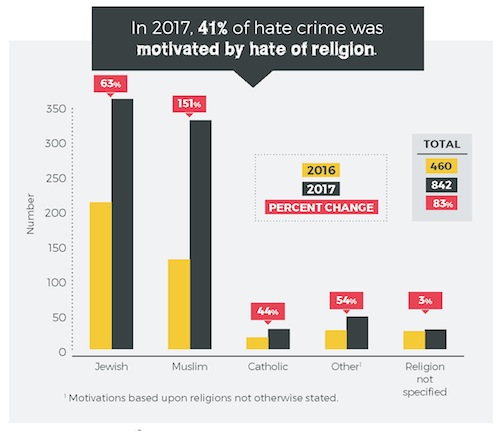
Across the country, hate crimes against the Jewish community rose by 63% between 2016 and 2017 – from 221 incidents to 360 – and the Jewish community remained the most frequently targeted group in both absolute and per capita terms, the report stated. Hate crimes against the Muslim community increased 151% between those years, from 139 police-reported incidents in 2016 to 349 in 2017.

In one of few comparatively bright spots in the report, violent incidents decreased as a proportion of all hate crimes, accounting for 38% of reported hate crimes in 2017, down from 44% in 2016. But this proportional decline is tempered by the raw numbers. The actual number of violent hate crimes increased 25% but decreased as a proportion of hate crimes overall only because the number of non-violent crimes increased that much more – non-violent offences like mischief and public incitement of hatred increased 64%.

Of the 360 police-reported crimes against Jews or Jewish institutions across Canada in 2017, 209 of those were in Ontario and 49 in Quebec – making British Columbia not only the second province in raw numbers of anti-Jewish attacks, but almost tying Ontario on a per capita basis and surpassing all other provinces by far.

Hate crimes in Canada have been creeping upward relatively slowly since 2014, according to Statistics Canada, but 2017 saw a leap of 47% over the previous year. Most of the crimes involved hate-related property crimes, such as graffiti and vandalism.

Despite the large increase in 2017, however, hate crimes still represent a very small proportion of overall crime – about 0.1% of the more than 1.9 million non-traffic crimes reported by police services in 2017. That said, a 2014 Statistics Canada study, General Social Survey on Canadians’ Safety (Victimization), in which Canadians self-reported incidents of perceived hate crimes, indicated that two-thirds of such incidents were not reported to police, suggesting that the numbers in the hate crimes reports might underestimate actual incidents substantially.

image - Hate crimes versus religious groups, 2016 and 2017
(image from Statistics Canada)

“Police-reported hate crimes refer to criminal incidents that, upon investigation by police, are found to have been motivated by hatred toward an identifiable group,” explains StatsCan. “An incident may be against a person or property and may target race, colour, national or ethnic origin, religion, sexual orientation, gender identity or expression, language, sex, age, mental or physical disability, among other factors. In addition, there are four specific offences listed as hate propaganda offences or hate crimes in the Criminal Code of Canada: advocating genocide, public incitement of hatred, wilful promotion of hatred, and mischief motivated by hate in relation to property used by an identifiable group.”

Hate crimes against Muslims, particularly in Quebec, contributed significantly to the overall spike in 2017 reported incidents. Hate crimes in that province increased 50% over the previous year, with incidents targeting Muslims almost tripling to 117 reports in 2017 from 41 the previous year. Perhaps most disconcertingly, the biggest spike in anti-Muslim incidents in Quebec occurred in the month following the mass shooting at the Islamic Cultural Centre of Quebec, where six Muslim men were murdered in a shooting rampage on Jan. 29, 2017.

In response to the statistics, which were released Nov. 29, the Centre for Israel and Jewish Affairs called on the federal government to take a three-pronged approach to hate-motivated crime and related matters.

“In the wake of this report, we are reiterating our call on the Government of Canada to take three key steps to combat hate,” Shimon Koffler Fogel, chief executive officer of CIJA, said in a statement. “First, we are grateful that the prime minister announced he will enhance the Security Infrastructure Program. We urge the government to expand it to cover training costs, especially given that emergency training saved lives during the Pittsburgh synagogue attack. Second, we need a national strategy to combat online hate. Experience shows that vicious rhetoric online can fuel and foreshadow violence offline. Third, the federal government should strengthen the capacity of law enforcement to combat hate crime. This should include enhancing legal tools to deal with hate speech and supporting the creation of local hate crime units where they are lacking.”

Each one, and all one

The news is not good. Hate crimes are up almost everywhere in the world one cares to look. A Statistics Canada report on police-reported hate crimes in Canada erases whatever smug superiority Canadians may have been feeling when watching rampant racism south of the border, at least some of which seems a result of the licence granted by a president who flirts with the most incendiary elements in U.S. society. The number of hate crimes reported to Canadian police in 2017 far outstripped the number in 2016 (see story, page 1) – and the actual number of hate-motivated incidents may be up to three times larger than the number reported to police.

Similarly terrible phenomena are taking place across Europe, where xenophobic and racist rhetoric is manifesting into violence against Jews, Muslims, Roma, asylum-seekers from Africa and Asia and, really, anyone who does not fit an escalating nationalist and populist consensus.

The lines are not all clear, either. The perpetrators and the victims can, at times, overlap. In online posts, email threads and private conversations, we witness members of our own community attributing motives to entire groups of people, and spreading hatred based on religious or racial identities. Likewise, messages of anti-Jewish hatred are common in online locations addressing the Israeli-Arab conflict, often including antisemitic comments from members of victimized minority groups.

The range of hate-motivated incidents addressed in the Statistics Canada report varies – most are non-violent and involve graffiti or crimes against property. But, when they are violent, they strike with a precision that aims at the emotional, as well as physical, vulnerabilities of the victims. In three of the most horrific hate crimes of recent years, assailants struck in the very places where people should expect safety – in the spiritual sanctuary of Emanuel African Methodist Episcopal Church, in Charleston, S.C., where nine African-Americans were murdered by a white supremacist on June 17, 2015; at the Islamic Cultural Centre of Quebec City, a mosque, where six people were murdered by an Islamophobic killer on Jan. 29, 2017; and at the Tree of Life synagogue in Pittsburgh, where 11 were murdered during Shabbat services this past Oct. 27.

The idea that people should be safe in a place of religious observance seems to be precisely the reasoning behind such attacks. But there is another form of violent crime that seems oddly excluded from this discussion.

Thursday (Dec. 6) marked the 29th anniversary of the mass murder at the École Polytechnique, in Montreal, where 14 women were killed by a man with deep-rooted hatred against women. A commemoration took place at the Vancouver Art Gallery, in recognition of the annual National Day of Remembrance and Action on Violence Against Women, with empty shoes representing the 545 women who have been murdered in British Columbia between 1997 and 2015 (the last year for which reliable statistics are available).

These victims include some of Canada’s murdered indigenous women, women working in vulnerable situations and women who were murdered because they were women and members of another marginalized group. Others were murdered by their domestic partners. In probably all of these cases, issues of differential power (of various forms) and attitudes about the value of women’s lives, factored into their fates. They are victims of gender-based violence.

It seems strange that, in a discussion about hate-motivated crimes, we exclude an entire gender, whose experience with violence is as prevalent, or more so, than that of other identifiable groups.

This is not an attempt to detract from one or another group’s experience with violence to emphasize something else; it is more an attempt to emphasize that every life should be respected and that membership in an identifiable group often diminishes that respect in the eyes of perpetrators.

But neither should the universal idea – every life is sacred and every individual deserves respect – detract from the more particular issue at hand. Every life is sacred and every individual is deserving of respect, but membership in particular groups can disproportionately impact on one’s experience with violence and discrimination. So, while we should be always conscious of the universal, we should likewise militate against the particular bigotries and prejudices that lead to disproportionate victimization of identifiable groups. In Canada and around the world right now, humankind could benefit from more emphasis on both the universal and the particular.