Danger in remaining silent

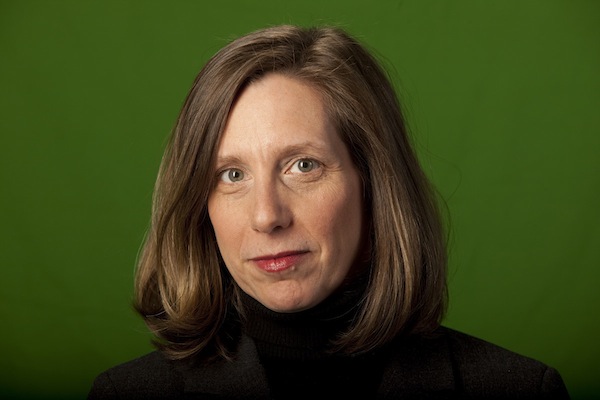
Marsha Lederman (photo by John Lehmann/Globe and Mail)

A few years ago, Marsha Lederman went with her mother, two sisters and a cousin on the adult portion of the March of the Living, which included a walk between the two main camps of the Auschwitz-Birkenau complex.

“The march from Auschwitz to Birkenau was somber and sorrowful, but it was also so empowering,” she recalled at the annual High Holidays Cemetery Service at Schara Tzedeck Cemetery in New Westminster Oct. 6. “We were marching with a statement to the world and a comforting message to the souls whose lives had ended so brutally on those grounds: ‘We are here, we are still living, we are multiplying, we remember you.’”

The family group proceeded to Radom, the town outside Warsaw where Lederman’s mother had grown up. The man who lived in the apartment where she had lived allowed them in and Lederman’s mother recounted her family’s years there.

“It was joyous,” Lederman said. “We were still on a high when we visited the memorial for the Radom Jews killed in the Holocaust. As I recall, it was in a fairly large square and seemed a little neglected. We were looking at this lonely memorial, the five of us women, when a group of, I would say, teenage boys began chanting something nearby. I don’t speak Polish, so I couldn’t understand what they were saying. But I did understand one thing: ‘Auschwitz-Birkenau.’ I don’t think they were offering their condolences.”

She reflected on the way she responded in that moment.

“We hurried away and said nothing. It was a safe thing to do, for sure. But, if that happened to me today, I would not walk away. I am done with walking away. Would I have put us in danger if I had turned around and confronted those boys? Maybe. But I know now that the real danger is in remaining silent.”

Lederman is the Vancouver-based Western arts correspondent for the Globe and Mail. Her father was born in Lodz, Poland, on erev Yom Kippur 1919. Her mother was born in Radom, Poland, in 1925. All four of their parents were killed in gas chambers at Auschwitz and Treblinka, as was Lederman’s father’s sister and little brother, and her mother’s little brother.

Lederman’s parents met in Germany after liberation and had one daughter there before moving to Canada, where they had two more daughters.

Lederman reflected on recent antisemitic incidents in North America and Europe, as well as her own encounters with antisemitism and racism, including a harrowing verbal attack on an Asian woman on the Skytrain at rush-hour, an incident in which Lederman was the only person to intervene.

“We have a duty to speak up,” she said. “We have a responsibility. This is our inheritance. I never had a bubbe or zadie to hug me or spoil me on my birthday or cook chicken soup for me. There’s nothing in my home that was theirs. I did not receive a single heirloom. But I did receive an inheritance – a duty to protect others from hate…. That is my inheritance and that is their legacy. Enough. Never again.”

She recalled being stunned during an interview with famed Vancouver photographer Fred Herzog, who died last month. Chatting after the main interview, Lederman asked the German-Canadian if he had experienced anti-German sentiment when he arrived here after the war. He launched into a discourse on the “so-called Holocaust” and said Jews died in the camps mostly because of lice and because Allied bombings prevented food from getting to them. Lederman agonized over whether to expose the admired photographer, eventually writing the story, for which she has been subjected to a range of criticism.

“Well, I have had enough,” she said. “And I’m going to fight to tell those stories and expose antisemitism and Holocaust denial and racism. I am not going to be quiet anymore. I think of all that was lost in the gas chambers; all the lives, of course, but also all the potential. With those millions of lives extinguished, what was lost with them? Poems were never written, beautiful artworks that were never painted, the cure for cancer, for Parkinson’s, the answer to the climate crisis?

“It was not just the people who were murdered that the world lost. It was all of their descendants and all of their descendants and all of that potential.… I talk about this because of what this leaves on our shoulders. I interviewed a Nisga’a poet, Jordan Abel, and he used a term to describe himself that I have adopted. He calls himself an intergenerational survivor of residential schools, which makes me an intergenerational survivor of Auschwitz. I do not take this lightly. With my parents’ survival came a hefty responsibility on me and on all of us who are descendants.”

At the service, Jack Micner, who led the ceremony and is also a member of the second generation, outlined a litany of antisemitic incidents and comments in Europe and North America in recent weeks.

“I suspect that those of our parents resting here in this cemetery would be furious to see what’s going on across the world,” he said. “We have to continue doing the type of work that VHEC [Vancouver Holocaust Education Centre] is doing in as many ways as we can think … it falls on us, because nobody’s going to do it for us.”

Rabbi Shlomo Estrin reflected on the loss of Chassidic communities during the Holocaust. Cantor Yaacov Orzech chanted El Maleh Rachamim.

Names were read of community members who have passed since the last High Holidays and a moment of silence was observed for the six million.

The Mourner’s Kaddish was recited by Jeremy Berger, a grandson of a Holocaust survivor. After the service ended, the Mourner’s Kaddish was also recited at the Holocaust Memorial in the cemetery.

The annual event is presented by the Vancouver Holocaust Education Centre with Congregation Schara Tzedeck and the Jewish War Veterans, and with support from the Jewish Community Foundation of Greater Vancouver.
Canada is not immune

Maxime Bernier’s performance at the federal leaders debate Monday night may have been unimpressive, and at times badgering, but no doubt some ears pricked up at his assertion that he is the only party leader whose position on immigration stands apart. True enough. He calls for about 150,000 immigrants annually, half the number now admitted.

The People’s Party leader was challenged at the get-go by a debate moderator who raised Bernier’s past comments about “extreme multiculturalism” and his use of the words “ghettos” and “tribes” to describe new Canadians.

Bernier will be lucky to win his own seat in Quebec and his actions in the debate probably didn’t win him a groundswell of supporters anywhere else. But the emphasis on immigration was notable. Slashing immigration in half, which could have detrimental impacts on the economy and growth of the country, would represent a huge number of people refused entry to Canada. But it’s not really about the numbers. It was the underlying message. Bernier was signaling to potential supporters that immigration is generally undesirable, with all the attendant impulses that message is intended to convey.

Hours before the debate, an Angus Reid Institute poll indicated that Canadians are split on the issue – and leaning in the direction of less immigration and tougher treatment for asylum-seekers. Forty percent of respondents said Canada takes in too many refugees, while 13% said we accept too few.

Bernier may not be the best messenger for the anti-immigration idea, but it is clear that there is a constituency in Canada for a politics that is exclusionary and plays on discriminatory tropes. All the main political parties are admirably standing firm against this impulse, for now. But it is worth keeping a close eye on this trend and reminding ourselves regularly that Canada is not immune from xenophobia.

Compassion over hate

Tony McAleer, who helped found the organization Life After Hate, spoke at Congregation Beth Tikvah last month, along with fellow Life After Hate member Brad Galloway. (photo by Pat Johnson)

A former leader in Canada’s far-right white nationalist movements says targets of white supremacist extremism should not be expected to “hug a Nazi.” But, as difficult as it may be, seeing the humanity in everyone and finding compassion for people who lack compassion may be key to reducing the problem of racist extremism.

Tony McAleer was a member of the so-called White Aryan Resistance and his early embrace of technology and the internet helped propel that movement into the digital age. He later helped found the organization Life After Hate and now works with others who want to leave the neo-Nazi movement. He shared his personal history at Beth Tikvah synagogue, in Richmond, on Sept. 8. He has also spoken at other synagogues and venues in recent weeks.

“While we condemn the activities, while we condemn the ideology, we don’t condemn the human being,” McAleer said of his organization’s strategy. “It’s coming from that place of compassion.… The hardest thing to do in the world is to have compassion for people who don’t have compassion. We do that as harm reduction – hurt people hurt people, and we can bring them back from that place of hurt so they don’t do it anymore.”

McAleer grew up in a stable, comfortable Dunbar home, which contradicts some stereotypes, he said. He attended private Catholic school but lost respect for authority figures when he caught his father with a woman who was not McAleer’s mother.

“Can anyone remember the day when God fell off the pedestal?” he asked. His grades fell, his behaviour deteriorated and he was regularly sent to the principal’s office for canings.

“When I look back on it, I don’t think that I’ve ever felt more powerless than I did in that office time after time after time after time,” he said. “It didn’t make my grades go up. I continued to tune out.… I went from listening to Elton John and Queen to the Clash and the Sex Pistols. I was angry and the music I listened to was angry. It eventually led me down the road into the punk scene and later into the skinhead scene. And, in the skinhead scene, I found an outlet for my anger.”

Ideology is secondary, at best, as an attractant to racist groups, he said.

“What we find in the young men and women who are drawn to these movements is there’s an underlying rage, underlying vulnerability that makes the ideology so seductive,” he said. “I want to be very clear here. I’m not for a minute blaming anything I did on my childhood. Everything I did I chose to do and I take accountability for that and I always will. I work for Life After Hate, do things like this to pay back for that.”

He shares the story of his early life as an explanation, not as a justification, he said.

“What I found in the movement, what I found from being a skinhead – I found a sense of power, a sense of purpose, a sense of meaning,” McAleer said. “I got power when I felt powerless. I got attention when I felt invisible and I got brotherhood, camaraderie and acceptance when I felt unlovable.… Those are the vulnerabilities that make the ideologies so seductive. If you have those in a healthy way, the ideology doesn’t make sense to you. But, for somebody craving those things, the ideology becomes something powerful, a false seduction.”

When he was 21 years old, McAleer’s girlfriend gave birth to a baby girl.

“For the first time, I connected to another human being. Up until that point, I was completely cut off from my heart, I was completely dehumanized,” he said. “I believe that the level to which we dehumanize other human beings is a mirror reflection of how internally disconnected and dehumanized that we are.”

That began the transformation. He had a son months later and was soon a single father being assisted by his mother who, he said, “never gave up on me.”

“It’s safe to love a child,” he said. “They see the magnificence in us when we can’t see it ourselves when we look in the mirror…. The more I can connect to my humanity, the more I can connect to the rest of humanity. I couldn’t connect to the rest of humanity because I couldn’t connect to myself.”

Though he was heavily involved in antisemitism, it wasn’t about Jews, he said.

“I was projecting my crap and I had a vehicle to project it onto – the Jewish people – and that’s what I did.”

The compassion Life After Hate promotes must be accompanied by healthy boundaries and consequences, he said.

“It doesn’t mean we let people off the hook. It doesn’t mean we don’t hold people accountable,” he said. “We do hold them accountable. It’s like tough love. But we need to see the humanity, even in someone whose heart is filled with hate. I don’t think we can afford to dehumanize anybody regardless of how inhuman their behaviour. I believe that nobody is irredeemable. It’s tough work.”

Brad Galloway, who is also a member of Life After Hate, joined McAleer at the event. Also a former white supremacist, Galloway is now completing a degree in the school of criminology and criminal justice at the University of the Fraser Valley. He researches extremism and participates in interventions with members of hate groups to help them leave the movements.

Galloway too came from a middle- to upper-class home. After a fairly typical adolescence and a period of struggling to find his identity, he ran into a childhood friend who was involved in the white power movement.

“I was looking for an identity,” said Galloway. “I was looking for something to belong to, something that I can call my own. He gave me the chance. We’ll give you brotherhood, we’ll back you up, we’ll be there for you … some sort of pseudo-support network which never, never came to fruition. They never provided any of those things for me.”

photo - Brad Galloway
Brad Galloway (photo by Pat Johnson)

Like McAleer, it was fatherhood that made Galloway realize his extremism was putting his family at risk.

He also reflects on compassion he received from police and others during his time in the far-right.

“Why do these people care about me?” he wondered, adding that he began to recognize that individuals who were kindest to him were often members of the very cultural groups he demonized. After a gang brawl where Galloway was nearly killed, he saw compassion in action.

“I ended up in a hospital and I’m lying on the table and a doctor walks in and he’s an Orthodox Jew. I’m lying there with a swastika shirt on, blood all over me, thinking this guy should not help me. I do not deserve to be helped at all right now…. I felt like I was a terrible person and I didn’t feel I deserved this person’s time,” said Galloway. “He did not mention anything about me. He just did his job as a doctor and provided me exactly what I needed. That moment made me start to think about all these different times when minority communities had been good to me.”

Since the racist rally in Charlottesville, Va., in 2017, Life After Hate has been inundated with requests for help. About 300 new cases have opened, about half of which are people trying to leave the movement, the other half family seeking help to extricate their loved ones.

Cpl. Anthony Statham, one of two members of the RCMP’s B.C. Hate Crimes Unit also spoke, outlining the legal strategies employed to fight extremism.

McAleer’s book, The Cure for Hate: A Former White Supremacist’s Journey from Violent Extremism to Radical Compassion has just been released by Arsenal Pulp Press.

Focus on online hate

Kasari Govender, British Columbia’s human rights commissioner. (photo from Wosk Centre)

Hate in British Columbia, in Canada and globally is on the rise. In 2017, there were 255 police-reported hate crimes in British Columbia, an increase of 55% from just two years earlier. In 2018, Metro Vancouver had the highest rate of hate crimes reported to police in any of Canada’s three largest metropolitan areas, most based on the victim’s ethnicity or religion, with a smaller but significant number based on sexual orientation.

These alarming statistics, and others, provided a framework and urgency for an event Sept. 12 at Simon Fraser University’s Morris J. Wosk Centre for Dialogue in downtown Vancouver. The event, titled From Hate to Hope in a Digital Age, is envisioned as the inaugural annual Simces and Rabkin Family Dialogue on Human Rights.

Contextualizing the discussion, Shauna Sylvester, executive director of the Wosk Centre for Dialogue, cited the results of a report undertaken by her organization. These indicate that one in three Canadians believes Canadian-born citizens should have greater say in government than those born outside the country. One-quarter of Canadians say we have too many protections for minorities and one in four also believes we have too many protections for religious freedom.

Keynote speaker at the forum was Kasari Govender, in just her second week on the job as British Columbia’s human rights commissioner. She is the first to hold this role in the province since that office was closed in 2002.

“In my view, there is a strong connection between hateful speech and hateful violence, both on an individual and a systemic level,” she said, citing racist manifestoes sometimes posted online by perpetrators in advance of a mass killing. She said it is necessary to trace the path from speech to violence.

A common theme of recent mass murderers is anti-immigration sentiment, sometimes emphasizing the “purity of the nation, whether that nation is Canada, New Zealand, the U.S. or another,” she said, adding that many of the attacks around the world that have been linked to white nationalism correspond to discourse in mainstream political debates over immigration and public policy.

The worst antisemitic mass murder in United States history, the attack on Tree of Life synagogue in Pittsburgh in 2018, happened while U.S. President Donald Trump and others were promoting fears of the so-called “migrant caravan” coming from Central America. Part of that conversation, Govender said, “was somehow blaming the Jews for this migrant caravan, drawing a connection in the public discourse, and then there was the shooting.”

Boris Johnson, now prime minister of the United Kingdom, compared women who wear burqas to bank robbers, which led, Govender said, to an increase in acts of hate against Muslim women in the United Kingdom.

Online hate is a particular product of technologies that have emerged in recent decades, she said. “The anonymity, reach and immediacy afforded by the internet escalates the problem beyond what we’ve seen before,” she said. “The internet is a very effective tool for fomenting hate from belief to action, from hateful words to violent actions.”

While forcing social media platforms to police hate speech might be criticized as an infringement of free expression, she said, the opposite is true. Regulating platforms to shut down violent rhetoric actually improves access to freedom of expression for many, as people of colour, women and others are being silenced online by racism and misogyny, she said.

Participants at the Wosk Centre offered a wide range of perspectives.

Evan Balgord, executive director of the Canadian Anti-Hate Network, outlined the approach his agency takes in confronting online hatred.

“Legal [action] would be our last recourse against a hate group or a hate propagandist,” he noted, saying that their first response is to “try to hold somebody socially accountable.” That means, if the person is anonymous, exposing them. If the person is not anonymous, this might mean bringing their posts to the attention of their employers, family and friends.

“Those might provide checks on their behaviour,” he said, adding, “We’re not really trying to reform people here, we’re just trying to stop the spread of hate propaganda.”

For those who do not respond to social accountability, Balgord said, Canada’s laws are insufficient. Application of the Criminal Code’s section that deals with the wilful promotion of hate and distribution of hate propaganda is unwieldy.

“We did use to have a better recourse,” he said. “It was Section 13 of the Canadian Human Rights Act. It would allow a private individual to essentially file a complaint, which would be vetted by the Canadian Human Rights Commission and, if found credible, would go to the tribunal. They could order a cease-and-desist order against that individual and up to a $5,000 fine.” If, at that point, the individual failed to comply, they would be in contravention of a court order and could face jail.

“We really want to see something like Section 13 come back,” he said.

Several speakers agreed that social media platforms need to do more policing of hate speech. Some countries have laws that force social media companies to address hate material on their platforms within certain timeframes or face serious fines.

Social media platforms, Balgord said, may already be in contravention of Canada’s existing laws against discrimination in the provision of a commercial service, because women, people of colour, LGBTQ+ people and other members of targeted groups are exposed to abuse, harassment and death threats that could drive them off the platform.

Rabbi Dr. Laura Duhan-Kaplan, director of inter-religious studies at the Vancouver School of Theology, noted that government budgets are limited but that education can take place everywhere – and that everyone is an educator. Early childhood is crucial, she said.

“What children do together, the songs they sing, the books they read, all of that becomes the building blocks of the way they think,” she said. “All of us who interact with children have an opportunity to begin to teach values of respecting difference, helping others, nonviolence.… One week of summer camp with friends on a theme of diversity, peace, public service – these are experiences that stay with teens and we really, really bring them into young adulthood in a different way.”

A speaker from the audience, a counselor and educator, noted that inequality, including economic inequality and poverty, makes people susceptible to fear and that can become a foundation for hate.

Another speaker contended that there is, in effect, no such thing as race.

“I think it’s very problematic to use the term race as if it’s a reality,” he said. “There is such a thing as racism but not really race. If you look at the majority of anthropologists, geneticists and so on, they say that we have much, much more in common with each other [than differences].… Even using terms like black and white to refer to people reinforces racism. We never call people yellow anymore, because that’s racist. We need to come up with a new language that doesn’t emphasize unreal differences and that are respectful to everybody.”

Lorene Oikawa, president of the National Association of Japanese Canadians, contended that sharing one another’s stories is an effective means to education.

“People really don’t know the stories,” she said. “For sure, there are some people who do, but they don’t know the [extent of the] harm that was done and the intergenerational trauma.”

She applied lessons of the past to current events. “In 2019, Japanese-Americans, Japanese-Canadians are horrified by some of the hateful rhetoric we’re hearing [that] could be lifted from 1942,” she said. “If people knew their history, more people would be going, ‘Wait a minute. What we did back in 1942 was wrong. Why are we saying the same things about people from [other] countries, putting people in camps, separating families, separating children from their families?’ All that stuff happened to Japanese-Americans, Japanese-Canadians and it’s being repeated today.”

She added: “We feel it’s our duty that what happened to our community must never happen to another community again.”

Clint Curle, senior advisor to the president of the Canadian Museum for Human Rights, agreed that education is pivotal.

“Is there a lesson, an experience, we can give children especially that will make them resistant to hate speech and resistant to hateful violence?” asked Curle. He compared hatred to a communicable disease.

“If this was polio, what would we do? If this was polio, we would do what we did, which is vaccinate. The way vaccinations work is you get children and you give them just enough of something close to the disease [so] that they develop an internal resistance to it, so, when they encounter the disease, there is something within them that says, no. So, when they encounter hate, they’ll know.”

With more than 1.5 million visitors to the museum since it opened five years ago, Curle said what resonates, especially with young people, is exactly what Oikawa suggested.

“The thing that seems to work best is storytelling across social boundaries,” he said.

Zena Simces, a health and social service policy consultant and a former Pacific region chair of the now-defunct Canadian Jewish Congress, conceived of the annual event with her husband, Dr. Simon Rabkin.

“We felt that we wanted to enhance an understanding of human rights in our community and to create an opportunity for dialogue on human rights issues,” Simces said. “Our aim is to select current and relevant themes each year and to invite experts and community leaders and community members to advance and generate positive action.”

Rabkin, a cardiologist, professor of medicine at the University of British Columbia and president of the medical staff at Vancouver General Hospital, added: “The dialogue this evening … is seeking to enhance our understanding and knowledge of how this increase in hate and its consequences can be addressed from legal, social media and community perspectives.”

Vancouverite’s novel on trail

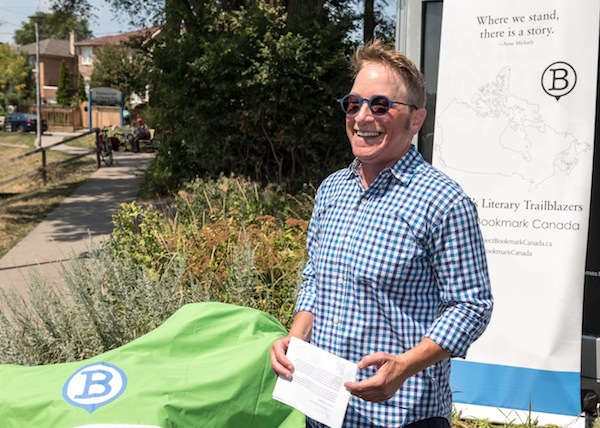
Vancouver writer Aren X. Tulchinsky at the Aug. 16 unveiling in Toronto of Project Bookmark Canada’s plaque honouring his novel, The Five Books of Moses Lapinsky. (photo by Lisa Sakulensky)

The Canadian Literary Trail has a new bookmark – one honouring The Five Books of Moses Lapinsky by Vancouver writer Aren X. Tulchinsky. The 25th such plaque to be erected by Project Bookmark Canada across the country, the unveiling took place Aug. 16 in Dominico Field at Barton Avenue and Christie Street in Toronto. Tulchinsky took part in the ceremony.

“Last October, I received a phone call from Laurie Murphy, executive director of Project Bookmark Canada, letting me know my historical novel The Five Books of Moses Lapinsky was nominated for a bookmark,” Tulchinsky told the Independent. They chose to unveil the plaque on Aug. 16 because it is the day on which the 1933 riot in Christie Pits took place.

Surprised and thrilled to hear that Project Bookmark Canada and the City of Toronto would be erecting the plaque in honour of his book, Tulchinsky said, “I was particularly struck by the timing, when, right now, we are all being called upon to make sure that dark chapters of our history do not repeat themselves.”

He explained, “My novel is about a fictional Jewish Russian immigrant family, living in the Kensington Market neighbourhood in the 1930s and ’40s. The main character, Sonny Lapinsky, is a Jewish boxer. He is 9-years-old … when the riot in Christie Pits occurs and, on that night, he discovers he has boxing talent and goes on to become a professional boxer. That same night, tragedy strikes the Lapinsky family.

“Many Canadians are not familiar with the 1933 riot, which involved 15,000 people and is the largest race riot ever to occur in Canada. A group of British- and German-Canadian young men, members of the Swastika Club, set off the riot when they unfurled a huge, black and white swastika flag in Christie Pits during a packed amateur league baseball game on a hot August night. The Project Bookmark plaque in Christie Pits will bring greater awareness to this piece of Canadian history and, of course, to my novel.”

Project Bookmark Canada was founded by writer Miranda Hill in 2007, with the first plaque being unveiled in 2009 – for Michael Ondaatje’s In the Skin of a Lion, at the Bloor Street Viaduct in Toronto. There are bookmarks from British Columbia to Newfoundland. Vancouverites have easy access to Bookmark No. 12, which commemorates Wayson Coy’s The Jade Peony, at the southeast corner of Pender Street and Gore Avenue in Chinatown.

“Visitors are encouraged to read their way across Canada, online and in person,” said Project Bookmark board of directors president Hughena Matheson in the press release about Tulchinsky’s honour. “A launching place for conversation, collaboration and learning, the bookmarks provide a unique reading experience and a deeper understanding of the country and its people.”

“I think Project Bookmark Canada is an important organization,” said Tulchinsky. “Their goal is to get people to read Canadian books. It is vital to celebrate our unique Canadian history and, sadly, our country is constantly in the shadow of the U.S., with American books filling our bookshelves. With the loss of small independent bookstores across the country who used to promote Canadian authors, and with people buying books online from huge American corporations, many excellent Canadian books go unnoticed. As a Canadian and as a writer, I applaud the work Project Bookmark Canada is doing to bring Canadian stories to the forefront.”

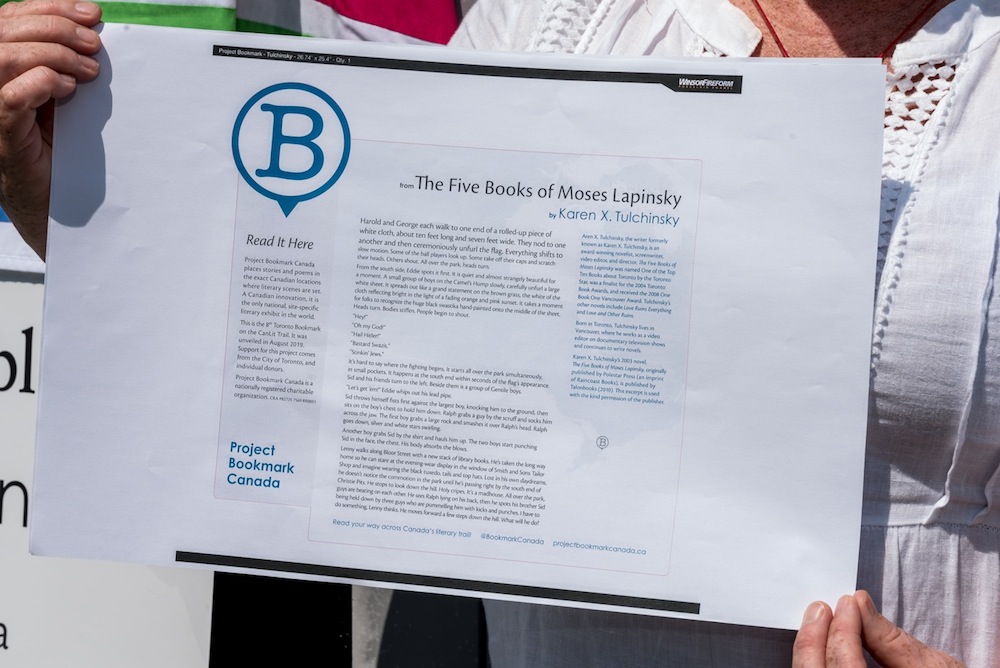
photo - The Five Books of Moses Lapinsky bookmark text
The Five Books of Moses Lapinsky bookmark text. (photo by Don Oravec)

At the Aug. 16 unveiling, Tulchinsky read the excerpt of his novel – published under the name Karen X. Tulchinsky – that appears on the plaque. “It is the moment when, in 1933, the Swastika Club unfurled a huge swastika flag at the ninth inning of an amateur league baseball game in the park. All summer, the Swastika Club had been bullying Jews on the beaches of Toronto. On this day, they upped the ante and brought their antisemitism to the west side of town, which was mostly Jewish and Italian immigrants. After a summer of being kicked off the beaches, young Jewish men fought back. And, interestingly, the Italian men in the park joined the Jews in fighting against the Swastika Club and their allies, in what became the largest race riot ever to occur on Canadian soil.”

“Our past president, Don Oravec, spoke at the unveiling and said the novel was on his radar as a potential bookmark,” Project Bookmark’s Murphy told the Independent of how The Five Books of Moses Lapinsky was selected. “When Daniel Gelfant made an official submission to us to consider the book and its variety of Toronto settings as potential bookmarks, the wheels were set in motion. The board’s national bookmark advisory committee reviewed the proposal and approved it for development. Councilor Joe Cressy made a motion to the City of Toronto to provide funding in support of a bookmark for the Christie Pits ball field, on the anniversary of the riots in 1933. It was approved, and subsequently developed. Additional funds were raised by individual donors attending a bookmark fundraiser on Aug. 15, complete with a boxing demonstration by the author and the Toronto Newsgirls Boxing Club at Jazz Bistro.”

When he first started writing the novel, Tulchinsky, who was born in Toronto, said it “was loosely based on stories my grandfather had told me about his escape from Russia before the Second World War and his early days in Toronto, where his first home in Canada was in the Kensington Market area.

“When I started researching the Jewish community in 1930s Toronto, I discovered the riot that pitted young Jewish men and their Italian allies against the Swastika Club and their gentile allies…. As a Canadian Jew, I knew immediately that I would tell my story against this backdrop, an important piece of our history that had not yet been told in fiction. So, I created a fictional family, with four sons, all of whom get involved in the riot in different ways. On the night of the riots, one of the brothers is permanently injured in a way that shatters the family, especially the main character, Sonny, whose guilt over what happened to his brother causes a rift between him and his father, that sends the family into turmoil.

The Five Books of Moses Lapinsky, which takes place … when Hitler first came to power in Germany, and continues through the Second World War years, is about antisemitism in Canada,” he said. “It’s about how hatred only leads to more hatred and violence. At the risk of sounding like the Vancouverite I am, I believe the only cure for hate is love. Sadly, history tends to repeat itself and, today, in 2019, we are seeing a rise in hate crimes in Europe, the U.S. and here in Canada against Jews, Muslims, South American migrants and the LGBTQ community. We are witnessing the president of the United States taking children away from their asylum-seeking parents and imprisoning them in what can only be called concentration camps. The themes in my novel, sadly, are just as relevant today as ever. I hope people see the parallels in the fascism that swept the world in the 1930s with what is happening today. I just keep hoping that humans will find a better way forward that does not repeat the mistakes of our past.”

And Tulchinsky continues to examine that past.

“I am currently working on a new novel, set in 1930s Berlin, in which I follow fictional characters (Jewish and non-Jewish) as Hitler first comes to power. In the story,” he said, “we watch as the Jewish characters are systematically stripped of their civil rights, then their livelihoods and, eventually, their lives. For my research, I have read hundreds of books on the Holocaust and the rise of the Nazis in the 1930s and I can tell you there are many policies the Trump administration is pursuing in the U.S. that are taken directly from Hitler’s playbook. In the current climate, with antisemitism, racism and homophobia on the rise, I feel particularly driven to finish and publish this new novel.”

To find out more about the Canadian Literary Trail, visit projectbookmarkcanada.ca.

Self-image to be tested

It was all decorum and politeness at an election forum Sunday sponsored by the Centre for Israel and Jewish Affairs and SUCCESS, the United Chinese Community Enrichment Services Society.

The comparative decorousness of the event – although interrupted at one point by an impassioned outburst related to the mistreatment of indigenous peoples – will likely be an anomaly as the neck-and-neck campaign proceeds. Desperate measures will likely be employed as Liberals and Conservatives battle for a majority – and as New Democrats and Greens spar in what seems destined to be a down-ticket race of its own.

And all of this is playing out against the potentially upending news that the People’s Party of Canada’s Maxime Bernier has been admitted to the national debates on Oct. 7 and 10 organized by the official Leaders’ Debate Commission.

The new party – started by the breakaway former Conservative from Quebec – has attracted a range of malcontents, including extremists of various sorts being involved in or peripheral to his party. While the four “mainstream” parties have all tread relatively lightly around super-charged racial issues, Bernier – and perhaps less predictably, his fellow 337 candidates across the country – seems prone to exploit and exacerbate racial divisions.

On this and many other issues that will form the meat and potatoes of the rest of the campaign, Canadians will now hear the perspective of Canada’s answer to the populism that has taken root in the United States, Europe and elsewhere. The degree to which these ideas and Bernier’s rhetoric catches on will tell us much about our country and ourselves. Canadians have liked to imagine that we are immune to the phenomenon of xenophobia that seems to be gaining ground globally. But, then, we haven’t had, in recent history, a chance to vote for a party that represents such ideas.

One of the things that has been notable during the aftermath of Prime Minister Justin Trudeau’s recently revealed repeated donning of deeply problematic costumes, including blackface/brownface, is what seems like a divergence between the official voices and the unofficial voices.

Elected officials utter pieties about respect for diversity. Representatives of multicultural and anti-racism organizations speak of challenges and opportunities. Yet, in radio call-in programs and online comments – those voices of “ordinary” people – the responses seem quite different. Many complain that the blackface controversy is all a sideshow that diminishes focus on issues like the economy and the environment. Others suggest a tempest in a teapot or political correctness run amok.

In a few days, Canadians will get our first look at all the party leaders side by side, including Andrew Scheer and Jagmeet Singh, who remain somewhat unknown quantities, and Bernier, who will bring some genuinely outside-the-establishment perspectives to the debate. How far Bernier pushes the envelope – and how Canadians respond to his ideas – will tell us just how accurate our self-perception as an open, tolerant society really is.

Roll out welcome mat

Bill 21, Quebec’s law that forbids most public employees from displaying any religious symbols like a turban, a Magen David or a hijab, may become an issue in the federal election. On CBC Radio’s political program The House last weekend, MPs representing the Liberal, Conservative and New Democratic parties all took effectively the same position: the law is discriminatory but provinces have the right to proclaim their own laws and, what’s more, the Constitution’s notwithstanding clause means Quebec can pretty much do whatever it wants.

There is a political calculation in all this, of course. Many Quebeckers support this law and any federal party needs to appeal to a chunk of these voters in order to succeed in the province during next month’s vote. As a result, party leaders are mostly making the right noises about this discriminatory law, while hoping to move on to the next topic ASAP.

With federal leaders basically throwing up their hands on the issue, which calls into question the most fundamental rights of Canadians of all religions, what can be done?

One individual interviewed on the program is a teacher who is Sikh. Her choice was to move from Quebec to British Columbia, where she could continue her chosen profession without diminishing her religious beliefs, which include wearing a turban.

If federal leaders will not act forcefully, perhaps leaders in the provinces outside Quebec can do something. Throughout history, Canada has been enriched by refugees and immigrants who sought freedom and opportunity – our gains roughly equating the loss to their places of origin. Why not apply the same principle to inter-provincial relations?

Perhaps provinces like British Columbia should roll out the welcome mat for teachers, school administrators, wildlife officers, Crown prosecutors and other civil servants from Quebec who no longer feel welcome there. Actively recruiting these experienced professional people of different cultures and religions would strengthen our communities and send a message to Quebec that cultural difference is an asset, not a liability.

In the absence of forceful federal leadership on this front, it would be encouraging to see provincial governments stepping up where they can.

Racism must be curbed

In a world where Israel is accused of being an “apartheid state” and Zionism is equated with racism, it is understandable that we would recoil from accusations of actual racism in Israel, but we can’t afford to do so.

On June 30, 18-year-old Solomon Tekah was shot and killed by a police officer in Haifa. He is one of at least four Ethiopian-Israelis killed by police in recent years, while another seven deaths were cited as suicide or as being the result of uncertain causes after police encounters, according to community leaders. Reports of police brutality against the black community are alarming and suggest a systemic problem.

Supporters of Israel on social media like to celebrate Muslims, Druze and other minorities who reach the pinnacles of Israeli society, and so we should. But we should not restrain our criticism of serious racial injustice in that country just because of what outsiders might think. There have been struggles in Israel not only between Jews and Arabs, but around the treatment of and inequalities experienced by Sephardim and Mizrahim, Bedouins, Ethiopians and others. There are also legitimate concerns around the treatment of African asylum-seekers, concentrated in south Tel Aviv, who have been neglected and used as political footballs by politicians.

The New York Times Sunday compared the growing awareness of police brutality, as well as more casual racism, to the Black Lives Matter movement in the United States. In addition to the most visible cases – police killings – the article also includes examples of pervasive prejudices, such as the Ethiopian-born head of a social services agency who was offered housecleaning work by strangers on the street, as but one example. Interestingly, even though one arm of the Israeli government coordinated the airlift of 14,000 Ethiopian Jews in 1991, another arm insisted on second, symbolic circumcisions for the men, whose Judaism was apparently legitimate enough for the Law of Return but somehow not legitimate enough for the state-sanctioned arbiters of religious identity.

It is particularly disheartening when one compares the racism experienced by Ethiopian-Israelis with the hopefulness this community carried with them to Israel. One individual said that arriving in Israel after journeying for two months was “like touching the moon.”

“Is this the Israel we dreamed of?” Zion Getahun remarked. “It’s a question I ask.”

In light of recent events, the minister for internal security, Gilad Erdan, is setting up a new unit “to fight expressions of racism wherever they exist,” to ensure that force is used by police responsibly and that “over-policing” – in which Ethiopian-Israelis say they feel like they are treated like automatic suspects – is brought to heel.

The parallels are notable with the situation in the United States, where African-Americans experience disproportionate brutality and deaths at the hands of police officers. Also similar are the fears of parents, like the mother who worries about the coming time when her now-11-year-old son will want to go out by himself.

What is notable in the Times article, which seems well presented and fair, is that, unlike African-Americans in the United States, Ethiopian-Israelis do not have nearly the same level of community leadership or representation in government and other places of power. They are a small minority of 150,000, lacking the established community organizations that African-Americans have built over generations.

This means that, more even than in the United States, and more than in Canada, where non-indigenous Canadians have begun to speak up on behalf of the rights of indigenous peoples here and to address the wrongs that have been perpetrated, the moral obligation falls even more heavily on people who do not belong to the affected communities to right these wrongs.

In Israel, there is a need to encourage and support communal leadership among Ethiopian-Israelis while simultaneously speaking out on their behalf when they experience discrimination. As supporters of Israel and as people who are proud of the many achievements of the Jewish state in creating an enviable society nearly from scratch in an historical blink of an eye, we, too, have a voice.

Express concerns to Israeli family and friends, send support to the myriad organizations that build connections across Israel’s many divides and, while we’re at it, consider whether we can improve our own attitudes about and treatment of people who are different from us.

Intolerance is growing

A recent study indicates that Americans are increasingly tolerant of the idea that businesses should be able to refuse service to customers based on the customer’s identity.

Of those polled, 19% said that a business should be able to refuse to serve Jews, an increase from 12% the last time the question was asked five years earlier. Twenty-two percent believe that Muslims could be legally denied services, 24% said atheists should be able to be turned away and slightly fewer than one in three believe that gay, lesbian or transgender people could be denied service. Fifteen percent of respondents said that a business should have the right to refuse to serve African-Americans, an increase from 10% in 2014. Most notable is that these numbers have increased over the past five years. For example, the number of people who said gays or lesbians could be denied service almost doubled, to 30% from 16%. (The question did not include Muslims five years ago.)

The issue has come to a head on a couple of occasions, such as when bakeries have refused to provide cakes for same-sex weddings. But it is the increase in the feelings of exclusion that have grown over the past half-decade that indicate we are not in a period of unfettered progress in our acceptance of diversity.

Some economists would suggest that the market should decide the matter – a business that turns away customers may have more trouble surviving, or it may benefit from an increase in like-minded clients, but that is of concern only to its owner. Others would say, if a baker doesn’t want to bake your wedding cake because they are prejudiced against your sexual orientation, why on earth would you want to patronize them? Of course, the principle of equality goes beyond economics. Court decisions in Canada and the United States have indicated that the law will not tolerate the refusal of service to identifiable groups by a business or service that otherwise is available to the general public.

There are nuances to the discussion, though.

This year, the White Rock Pride Society claimed discrimination after the Star of the Sea Catholic church refused to rent a venue to the LGBTQ organization. Here is where things get a little more complicated. A Catholic individual – or a Muslim, or a Jew or anyone – operating a business aimed at the general public does not have the right to discriminate based on a customer’s identity. But a church – or a synagogue or a mosque – is not on par with a business that is open to the public. One has to wonder about the motivation of a gay organization approaching a Catholic church to rent space, which seems like a bit of a set-up for a discrimination complaint. But the larger issue here is that religious organizations should certainly have the right to determine who can use its facilities. Imagine, for example, an overtly antisemitic organization asking to rent space in a Jewish community centre. There is a substantial difference, of course, between one’s beliefs (being anti-Zionist or even antisemitic is a choice) as opposed to an immutable characteristic of one’s personality, such as sexual orientation.

The issue is at once simple and complex. Businesses are not individuals with human rights. They are entities created under laws and they must adhere to the laws and norms of the jurisdiction in which they operate. We might be thankful to know that, if a particular pizza maker or café owner holds antisemitic views, we can choose not to patronize them. This is an entirely different scenario than the flip side of that coin, in which a business refuses to serve Jews.

There has been a lot of commentary in recent years that the American president and others in high-profile positions have given permission to people to air their prejudices openly. A study like this is welcome because it puts quantifiable numbers to the perception of growing intolerance. This is a wake-up call to those who would ignore the warning signs of our current era of discontent. The evidence has arrived. Now, what are we going to do about it?

The will of “the people”

The deed is finally done. For years, Quebec politicians have been talking about secularism, or laïcité, proposing a range of actions to ban the presence of visible religious symbols among government employees. On Sunday, following a weekend of almost round-the-clock debate, the Coalition Avenir Québec majority in the National Assembly passed Bill 21. The law bans symbols such as the crucifix, turban, hijab and kippah for provincial employees in positions of authority, such as judges, police, prosecutors, court clerks and schoolteachers.

The bill was met with lamentations and anger from the opposition. Catherine Dorion, a member of the National Assembly representing the left-wing party Québec solidaire spoke powerfully in favour of individual liberty and the right to exhibit religious identity.

“Each person in this room who will vote for Bill 21 will bear the responsibility for this first great breach in the dike we had proudly erected to protect the fundamental rights of all Quebecers,” she said.

The vote came a day after a similarly contentious debate on another bill, which addresses the province’s agreement with the federal government over immigration to Quebec. On the one hand, the bill aims to ensure that immigration reflects the province’s labour requirements, which is justifiable. On the other hand, the bill also permits the creation of a “values test” that new Quebecers would have to pass before admission to permanent residency. A test of this nature is one thing in theory – extreme examples like female genital mutilation are raised as justifications – but it is something else in practice.

Government measures to adjudicate an individual’s beliefs is a recipe for disaster. Certainly we would like to see people with hateful or violent attitudes toward particular cultural groups prevented from entering the country, or rehabilitated if they are already here. There are programs and policies in Canada to address this problem and they should be strengthened. But applying what amounts to a form of prior restraint on the ideas and beliefs of new Canadians by a government with limited respect for civil liberties crosses a perilous line.

The religious symbols law parallels the immigration law in its flouting of civil liberties, but diverges importantly in a number of ways. It applies to people who are already Canadian (for the most part, at least), which is a more grievous affront than putting up barriers for non-citizens.

In responding to criticism, Quebec Premier François Legault declared: “Someone once said, beware of those who say they like the people but do not listen to what the people want.”

This language reflects a populism we have seen in Europe as well as North America, but which has been thankfully rare in this country. The idea that governments should do whatever “the people” want invites a tyranny of the majority that is almost destined to trample on individual rights, especially the rights of members of minority communities. It bears stating that, in Quebec, in order to deliver the will of the people, the assembly had to clip the wings of democracy not once but twice, invoking closure on debate on both bills and, in the case of Bill 21, promising to use the Canadian Constitution’s Notwithstanding Clause to override what even the government of Quebec acknowledges is a unconstitutional infringement on individual rights.

We are seeing flare-ups elsewhere in Canada of how some of “the people” would like to see public policy progress. On the same busy weekend, a rally in downtown Vancouver against transgender rights and opposing the province’s progressive sexual education agenda turned nasty (if the mission of the event wasn’t nasty enough) when counter-protesters showed up to confront them. At the rally were the Soldiers of Odin, a far-right group, people wearing yellow vests, the symbol of an amorphous movement that began in France and has attracted extremists, and at least one leading member of the People’s Party of Canada, a new populist party that seems determined to stoke a range of fears and prejudices in the lead-up to the federal election this fall.

Violence also erupted last weekend at a pride parade in Hamilton, Ont., when protesters showed up at the celebration. A local politician laid blame for the violence, which included punching and choking, on “far-right evangelicals” who he said were “just there to sucker-punch people.”

All of this is to say that Canada is not immune to extremism or even politically motivated violence. There is, of course, an important line between the violence in Hamilton and the laws that were rammed through Quebec’s legislature. Violence deserves universal condemnation while passionate disagreements over politics – even laws we see as repressive and excessive – are justifiable and welcome. Still, these incidents all reflect different approaches to “othering” – the idea that “we” are under threat from “them.”

What is encouraging is hearing the voices of those forced to defend the values of inclusion and respect for diversity. There was eloquence on the opposition side of Quebec’s National Assembly last weekend and, in response to the altercations in Hamilton and Vancouver, admirable recommitment by many to the values that we genuinely hope will represent the Canada we hope to create. This is also a reminder to speak up, so that when politicians say they are doing what “the people” want, what they mean is the will of people who pursue inclusion, acceptance and diversity.