Redefining antisemitism

An Illinois congressional district leans so heavily Democratic that no serious figures contested the Republican nomination for this fall’s midterm elections. As a result, an avowed Nazi has become the official Republican standard bearer in the suburban Chicago area.

The issue is not that he stands a hope of winning. He doesn’t. The critical test is the degree of unanimity with which the mainstream body politic of the United States comes together to condemn the candidate and reject the normalization of his positions. So far, results are tepid.

Some GOP figures are advising voters not to cast a ballot in the race, which seems like bad advice in a democracy. Others are saying, simply, “Don’t vote for the Nazi,” without suggesting voters support the Democrat. When asked if he was urging Republicans to support the Democrat in the district, Illinois Governor Bruce Rauner simply said, “No.”

We have been seeing far too many examples of Americans putting party over country and humanity recently. President Donald Trump has been able to get away with his worst excesses only through the support of a Republican Congress.

Nevertheless, for whatever limits partisanship puts on bulwarks to bad things, most Americans agree Nazism is bad and should be condemned.

A more ambivalent reaction is taking place in the United Kingdom. The British Labour party has been embroiled for some time in a very serious internal conflict around antisemitism. Senior party figures, including MPs, have uttered (or expressed on social media) things that any “woke” person would recognize as founded on antisemitic premises. In some cases – including in a “closed” Facebook discussion group of which party leader Jeremy Corbyn was a part – the most medieval and unequivocal stereotypes, accusations, conspiracies and Jew-hatred have gone unchallenged.

Members of the party have been kicked out after being subjected to internal party investigations for antisemitic rhetoric. But some have been allowed back in and others have been let off without any censure, even after expressing what the most casual observers would recognize as unacceptable attitudes toward a minority group.

A reckoning has been coming. So, in an effort to set some ground rules, a party committee adopted a definition of antisemitism last week that will serve as the measuring stick in upcoming investigations around whether party figures have or have not engaged in antisemitic rhetoric or behaviour.

The party based their new rules on the standards created by the International Holocaust Remembrance Alliance (IHRA) – criteria that have attained a degree of consensus as perhaps the most conclusive definition we can hope to develop for something as amorphous as antisemitism. The guidelines have been adopted by governments and quasi-governmental agencies worldwide, including Britain’s, but the Labour party thought the guidelines could use some improvements – and so they made their own tidy edits.

The Labour party’s red pen took out references that assign antisemitic intent to the equation of Zionism with Nazism. They deleted the parts where the IHRA says that antisemitism includes accusing Jewish people of being more loyal to Israel than their home country. Under the new Labour party rules, it’s OK to say that Israel’s very existence is racist. Holding Israel to a higher standard than any other countries is also fine with the party.

In short, the Labour party retrofitted the definition of antisemitism to comport with the attitudes and actions of their members, instead of forcing their members to adhere to international standards that reject antisemitism.

The new rules also put the onus on the victims to prove intent, which is almost unprovable. In effect, a Labour member can say whatever they wish – “ZioNazi” is a favourite, it seems – as long as they declare that their intent was not antisemitic. For whatever else this represents, it is a betrayal of a core tenet of the global progressive movement: that those who experience discrimination are the ones who get to define it.

As disturbing as the antisemitism crisis in U.K. Labour is – especially as Theresa May’s Conservative cabinet is imploding and a new election could come any day – it is an important moment for addressing left-wing antisemitism throughout the West.

It is one of the first formal, structured discussions we have seen in Western countries around the issue of defining, identifying and censuring antisemitism within mainstream political discourse. It is not a good thing that it is necessary, but it is good that the necessary discussion is taking place.

Of course, this could go (at least) two ways. Labour could experience a backlash over their efforts to redefine antisemitism to their political benefit, realize that they are far outside acceptable discourse and undertake a genuine correction. Alternatively, they could stick with their highly problematic definition of antisemitism, leave their substantial problem of institutional anti-Jewish bias in place and still win the next U.K election. In which case, they will have moved the goalposts of acceptable discourse in dangerous new directions, with implications that go far beyond Britain.

Neighbourly relations

The lineups at local border crossings to the United States over the Canada Day long weekend suggest rhetoric about Canadians avoiding visits to our neighbour have been largely overblown. We may be repulsed by the Trump administration’s treatment of would-be refugees, especially children, but cheap gas, cheese and milk – as well as the plethora of delights at Trader Joe’s – mean many of us just can’t stay away.

Ironically, it is partly because our dairy products are so expensive – because of our supply management system – that the U.S. president is raging at Canada in the first place and why we amped up our tariffs July 1 in a trade war Trump launched.

At the same time, most of us know that our immediate neighbours are much like ourselves. The places we are most likely to drive to – Bellingham, Seattle and smaller centres dotting the American Pacific coast – are inhabited by some of the most liberal voters in that country. These are not places where Trump bumper stickers or MAGA caps are widely prevalent.

Likewise, if we jump on a plane, the destinations we choose tend to be similar in attitudes: the beaches, amusement parks or golf resorts of Southern California, the wine country of Northern California, oases in Arizona that are likely to have as many Albertans as native-born Arizonans. Punishing businesses in these locations because their president has xenophobic views doesn’t seem particularly sensible.

On the other hand, we might have more reticence about stepping out of these familiar spots. We might rethink road-tripping across the country; that generations-tested means of memorable family bonding, backseat battles and boredom. Almost anyone who has traveled through rural America returns with stories of salt-of-the-earth kindness and folksy friendliness. Yet, knowing that some counties in the most picturesque parts of the United States voted for Trump – and still support him by huge margins – one might be forgiven for looking askance at the family in the next booth at the roadside diner. What is behind the smiles and extroverted affability that can turn so mean in the ballot box and when responding to public opinion polls about immigrants and minorities?

Leaving aside whether we would feel personally comfortable in some locations, there is the larger issue of whether Canadians should boycott American products. On social media this week, you can find suggested product choices that make it easier to buy Canadian instead. It’s a matter of individual choice whether this is a productive use of energy, but, if it makes people feel better and helps the Canadian economy in a time of challenge, it seems like a fine enough gesture.

It is notable, though, to compare the nascent cross-border boycott to the BDS movement against Israel. Admittedly, the U.S.-Canada clash is mere weeks old, while the Israeli-Arab conflict has been in high gear for seven decades, giving sides more time to organize. But, while a significant number of Canadians seem to think that a boycott of Israeli products, ideas and people is a legitimate tactic, it is doubtful that a similarly organized movement will coalesce around the idea of boycotting Americans.

Some BDS supporters have maintained that their boycott targets Israeli “policies,” although the founder of the movement, Omar Barghouti, has no qualms about his position that Israel should cease to exist as a Jewish state. In any event, how bad would American “policies” need to become before BDS advocates devoted their substantial energies to boycotting U.S. products? Certainly we are unlikely to see a Canadian consensus that suggests a total economic, cultural, academic and social boycott of America, as the BDS movement promotes with Israel. It would be impossible, of course, given the interconnectedness of our countries, but the question remains: Why do some take the hard line with Israel but not with other countries?

Indeed, consider the approach held by most people, even those who are likely to support BDS: with North Korea, Iran and anyone else with whom we have not insubstantial differences, the consensus approach is engage, mediate, negotiate. It’s the approach we are pursuing with the United States on one hand, while retaliating with tariffs on the other. Yet, when it comes to Israel, in economic matters, academic interactions, sporting competitions and every level of human interface, a sizeable group demands that we make Israel an international pariah, isolate it in every way, exclude it from the global community. What can that possibly be about?

Tracking down haters

Israel’s Ministry of the Diaspora recently announced what it calls the most advanced system of its kind in the world to track antisemitic content on social media.

The Anti-Semitism Cyber Monitoring System, or ACMS, can find relevant posts that are antisemitic (using the definition devised by the International Holocaust Remembrance Alliance) on Facebook and Twitter in English, French, German, Arabic. It can see who posted and shared the comments. Other languages and social media platforms are expected to be added to the system as it progresses.

In a month-long trial run, the system identified 409,000 antisemitic posts by 30,000 individuals. Whether the system can or cannot catch every instance of antisemitism online is less significant than the fact that it is a tool to identify trends. In the trial, the system identified the world’s “most antisemitic cities” as Santiago, Chile; Dnipro, Ukraine; and Bucharest, Romania. Western cities that topped the online antisemitism list were Paris and London.

This is relevant research. It would be useful to know where Vancouver or Canada falls in such a ranking. That kind of information could help our community work with governments and other agencies to address the topic and devote resources to education and countering hatred.

But information is power. And power can corrupt. There is a difference between accumulating information that is (or can be) anonymized to allow for research into the topic. It is also fair to use such a system to identify individuals who should be reported to authorities for investigation for potential contravention of hate laws or for exhibiting potential for violence. But the words from Israel’s Diaspora Affairs Ministry Naftali Bennett were not reassuring. According to the Times of Israel, Bennett said the system would expose online antisemites “for all to see.”

“The time has come to put a mirror in front of our haters and expose the ugly face of modern antisemitism,” Bennett went on. “From now on, we’ll know who every antisemitic inciter is.”

Anyone who has spent time online and confronted the sorts of nastiness that exists there might find a sort of satisfaction at the idea that some of the people who are purveying the worst Jew-hatred will no longer get off scot-free. But let’s take a step back.

It is one thing for an intelligence agency – or a responsible nongovernmental organization such as the Southern Poverty Law Centre – to accumulate information like this for the purposes of research, monitoring dangers and notifying appropriate authorities. It would be quite another if, as Bennett seems to suggest, a government (or other agency) were to make public an online database of people who express offensive or racist comments online.

There is a website called Canary Mission, which, according to its self-definition, “documents people and groups that promote hatred of the USA, Israel and Jews on North American college campuses.”

The site is a compendium of individuals who have made comments online or been seen at events of various types and includes links to their LinkedIn, Facebook, Twitter and other social media pages.

Some of the comments Canary Mission has assembled are indeed disturbing. “I swear if [a] Jew gets within 5 feet from me at the protest and says a word, straight murder,” one person wrote. “Ima kill a jew in a month,” wrote another.

There is also no doubt that, among these people, most of whom are university students, are some who have been drawn into anti-Israel movements and have made, as many of us do, occasional untoward comments on social media. It may be fine to call these comments out, but it is not acceptable to assemble in one place a group of people who vary widely – from those who should be reported to authorities for posing a danger to society to some who are probably legitimately attempting to make a peaceful political statement, however misguided we may think that message is.

This approach encourages vigilantism. It is the sort of tactic that has been used in the past by anti-abortion terrorists who have murdered or attempted to murder healthcare providers, including one right here in Vancouver who was shot through a window in his home.

Consider – and there is absolutely no reason to view this as far-fetched – that a website was set up to aggregate information about you, your parents, your children and anyone else you know who has traveled to Israel, donated to Zionist causes or attended pro-Israel events. There are a lot of irrational people in the world and a project like this could help them act out in potentially catastrophic ways.

Again, there is value and importance in accumulating this information. It should be shared with relevant authorities, including the universities, police, FBI, CSIS and so forth. But we should not be encouraging the public dissemination of this material. It is an extremely hazardous game.


Confront racism

On Remembrance Day, pro-Nazi posters were discovered at War Memorial Gym on the University of British Columbia campus. The posters depicted Nazi soldiers with the words “Lest we forget / The true heroes of WWII.”

This incident followed the discovery earlier in the week of antisemitic drawings on a chalkboard in the forestry faculty. Rabbi Philip Bregman, executive director of Hillel BC, sent an email to the community thanking the Forestry Undergraduate Society for making a clear statement of solidarity. While this is the good news, he wrote, there is also bad news. Students are reporting that the latest incidents are a “tip of the iceberg” of similar expressions and depictions that go unreported.

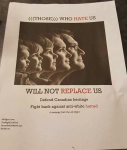
Earlier this month, white supremacist and antisemitic posters also appeared at the University of Victoria. “(((Those))) who hate us / Will not replace us,” read a poster. The use of triple parentheses is a method used online to identify Jews. The fear of white people being “replaced” by non-white people is a recurring theme in the white supremacist movement.

These incidents are local iterations of a larger and obviously deeply troubling phenomenon occurring worldwide. In part a response to the movement of refugees from Syria and elsewhere in the Middle East and North Africa, far-right groups in Europe have grown significantly in recent years. This is evident in the horrifying rally of an estimated 60,000 neo-Nazis, hyper-nationalists and racists in Warsaw, Poland, last weekend. And it is underscored by the neutrality or even affirming noises from those in positions of power at the sight of ralliers carrying signs urging “Clean blood,” “Pray for an Islamic holocaust” and “Jews out of Poland.”

Poland’s governing Law and Justice Party has informal connections with some of the extremist groups that organized Saturday’s rally. Poland’s foreign ministry, on the one hand, condemned the xenophobic, antisemitic and racist messaging, but, on the other hand, called the event “a great celebration of Poles.” The country’s interior minister called the rallying extremists “a beautiful sight.”

This sort of equivocation from leaders is perhaps as worrying, or more so, than the rallying mobs themselves. While the past year has seen numerous European far-right parties fail to live up to expectations in elections, their strength is nevertheless very concerning.

On the subject of elections … off-year elections in the United States last week delivered a strong rebuke to the U.S. president. Although polls indicate that 36% of American voters would vote for him again, no president in the history of polling has been this unpopular this early in his mandate. This is, perhaps, a sign that most Americans are turning against the divisiveness and xenophobia that this president advances.

Encouraging as that may be, possibly (wishfully) portending his defeat in 2020, the damage he is doing to the civil fabric of the country is incalculable. It is saddening to see the president of the United States overtly promote racism against Mexicans and people from Muslim-majority countries, threatening one group with a wall and the other with a travel ban that has been repeatedly deemed unconstitutional by the courts. Among his supporters are openly racist and white supremacist activists.

All of this is to say that the world is experiencing a time of extremism. Rather than throw up our hands in despair, this is a time to rededicate ourselves to the values that motivate us, the values for which Canadian and other Allied soldiers fought.

The posters at B.C. universities should be enough to sweep away any complacency we may have about our shores being free from this sort of racist ideology. This is a good thing. Canadians have a right to be proud of our comparatively decent record of multicultural harmony, but smugness is a blinder that can allow us to ignore very real undercurrents. We must be vigilant in calling out evil ideology when we see it at home and abroad.

More racist activities

(photo from Anti-Racist Action UVic/Facebook)

On Nov. 9, the anniversary of Kristallnacht, a swastika and “Heil Hitler” were found written on a hallway blackboard in the University of British Columbia Forest Sciences Centre. The antisemitic graffiti was first reported to Hillel BC, who then contacted security.

This was one of several racist incidents that have occurred on B.C. campuses and across Canada in recent months, including pro-Nazi posters found at UBC on Remembrance Day. On Halloween night and in the days following, posters reading, “It’s okay to be white,” appeared on several Canadian university campuses, apparently based on instructions from a post which Vice Canada traced to the anonymous online forum 4Chan, a hub for the alt-right.

During the same week, antisemitic posters found at the University of Victoria read, “Those who hate us will not replace us. Defend Canadian heritage. Fight back against anti-white hatred. A message from the alt-right.” The word “those” was placed in triple parenthesis, a way of identifying Jews. When the posters were taken down, moderators of Anti-racist Action UVic Facebook page and others reportedly received a backlash of hateful messages online.

The election of Donald Trump one year ago this month is widely perceived as a triumph for the tangle of white supremacists, antisemites, misogynists, racists and ethno-nationalists who have come to be called the “alt-right.” In Kill All Normies, a book about the genesis of the group, journalist Angela Nagle describes an online world where cynicism, irony and absurd in-joke humour have combined with racism and misogyny to produce a “taboo-breaking anti-PC style” that has come to characterize the alt-right. Since then, the movement has tapped into latent racism and xenophobia, bolstered by the rise of people like Richard Spencer and Milo Yiannopoulos.

Not everyone is happy with the use of the term “alt-right.” Given their white supremacist beliefs, “alt-right” is somewhat innocuous. The Associated Press avoids the term because its editors think it downplays the movement’s racist goals.

Long before the 2016 election, the alt-right was gathering strength and allies. Trump granted the racists among his supporters visibility, lowering the social costs of bigotry and inspiring these supporters with a hope that their vision of “white identitarianism” could come to rule America once again. This has emboldened them and brought them out of the shadows.

In the days following the election of Trump, Canada saw a spate of vandalism, hate speech and pamphleteering directed against Jews and other minorities. As in the United States, this did not come to Canada overnight. In 2015, the CBC temporarily closed all online comments on stories featuring First Nations people because of the “staggering number of hateful and vitriolic comments” posted. In August 2016, the premier of Saskatchewan was forced to issue a plea for an end to hate speech following the second-degree murder of an aboriginal man on a farm. As a result, his own Facebook page was flooded with racist messages.

The posters at UVic were discovered by an anti-racist group on campus organized by Tyson Strandlund, who said the increasing activities of the alt-right in the public sphere are what led to his group’s creation in September. Strandlund said there has been heightened concern on campus since last summer, when an art installation meant to inspire conversations about resistance to racism was instead extensively defaced with racist slurs and had to be dismantled. He mentioned a meeting that was to take place in the Student Union Building on Nov. 15, for students and others to discuss anti-racist strategies.

David Blades, president of the Jewish Federation of Victoria and Vancouver Island, said they are “keeping close tabs” on the alt-right movement. “We have a good sense of who these people are,” he told the Independent. “What’s increasing is their public activity, not their numbers, which have remained pretty stable for years.

“Nevertheless,” he warned, “we have to be vigilant because they are also recruiting. There is no question that there is latent racism in Canadian society and it can be tapped into. My concern is that this was not isolated to the University of Victoria, this also happened at the University of Alberta and elsewhere. It was a coordinated national event. That’s my concern as Federation president. This is a shift in the overall organization of this group.”

Blades said he is “really happy with the response of UVic” and that there are plans in the works for “five days of activism against racism.”

“In some ways,” he said, “these incidents have been more effective at inspiring the opposite of what they intended: an increase in anti-racist activism.”

Matthew Gindin is a freelance journalist, writer and lecturer. He writes regularly for the Forward and All That Is Interesting, and has been published in Religion Dispatches, Situate Magazine, Tikkun and elsewhere. He can be found on Medium and Twitter.

Jewish groups’ M-103 advice

Left to right, MP David Sweet, MP Michael Levitt, CIJA chief executive officer Shimon Koffler Fogel, MP Scott Reid and MP David Anderson pose for a photo during the House of Commons Standing Committee on Canadian Heritage hearings on M-103 on Oct. 18. (photo from CIJA)

Jewish groups were in Ottawa on Oct. 18 to testify in front of the House of Commons Standing Committee on Canadian Heritage, which will make policy recommendations on M-103, a motion that condemns “Islamophobia and all forms of systemic racism and religious discrimination.”

Leaders of the Centre for Israel and Jewish Affairs (CIJA) and B’nai Brith Canada drew on the Jewish community’s experience with fighting antisemitism in their recommendations on how to maximize the motion’s efficacy.

In his testimony, CIJA chief executive officer Shimon Koffler Fogel pointed to statistics that showed Jews are the most targeted religious minority in the country.

“Nationally, there were 54 hate crimes targeting Jews per 100,000 individuals in 2015. While this number is relatively consistent with previous years, there was an increase in hate incidents targeting other minority communities, including the Muslim community. In fact, Muslims were the next most targeted group, with 15 incidents per 100,000 individuals,” Fogel said. “I mention these numbers not to showcase Jewish victimhood, but rather to demonstrate the very real experience our community has in grappling with the issues this committee is studying.”

B’nai Brith Canada chief executive officer Michael Mostyn recommended that the motion be constructed so that it will be “embraced broadly by all Canadians” and by “communities that are the targets of racism and discrimination, including Canadian Jews, who continue to be the target of antisemitism.”

Mostyn said the bill must not diminish “the threat to Canadians of all faith communities who face racism and religious discrimination and it must not suggest that one form of racism or religious discrimination is more threatening, or of greater priority, than another.”

Among Fogel’s recommendations was that the committee work to improve on the collection and publication of hate crime data, as it currently varies widely by police department.

He said statistics from the Greater Toronto Area – including Peel Region, Toronto and York Region – are readily available, “but even with these three neighbouring jurisdictions, each report provides different information, making direct comparisons sometimes difficult.”

He added that there are cities, such as Montreal, that don’t release data about which identifiable groups are being targeted, leaving policymakers with incomplete information.

Fogel said it’s important to properly define hate, as we “can’t effectively fight bigotry and hatred without precisely defining it. The term ‘Islamophobia’ has been defined in multiple ways, some effective and some problematic. Unfortunately, it has become a lightning rod for controversy, distracting from other important issues at hand.”

Fogel used the Islamic Heritage Month Guidebook, which was issued by the Toronto District School Board earlier this month and contains a definition of Islamophobia that includes “dislike toward Islamic politics or culture,” as an example.

“Muslims can be protected from hate without restricting critique of Islamist political ideologies,” Fogel said.

Mostyn agreed that the committee should “exercise great care in any definition of Islamophobia” because, if the definition is vague or imprecise, it can be “hijacked and only inflame tensions between and among faith communities in Canada.”

Mostyn said an imbalance can create “the impression that Canadian Muslims are the only victims of hate crimes. We are just as concerned with the source of hate crimes targeting Canadian Jews from within radical elements of the Muslim community.”

Fogel also recommended that greater and more consistent enforcement of existing laws is needed. “Recently, the attorney general of Quebec decided not to lay charges in a case of an imam in Montreal who had called for the murder of Jews. Quebec’s attorney general also declined to pursue a second charge of genocide promotion. This decision sent a message that someone can call for the death of an entire group of people without consequence,” he said, adding that the federal government should train police and prosecutors to better enforce the existing Criminal Code hate speech provisions and provide resources for the development of more local hate crime units.

In his testimony, David Matas, B’nai Brith Canada’s senior legal counsel, argued that some fear of radical Islam is rational.

“Adherents to some components of Islam preach hatred and terrorism, incite to hatred and terrorism and engage in hate-motivated acts and terrorist crimes,” Matas said. “What the committee, we suggest, can usefully do is propose criteria, with illustrative examples, which can guide those directly involved in the combat against the threat and acts of hatred and terror coming from Islamic radicals.”

Matas called on the committee to “focus both on those victimized by Islamophobia and on the incitement and acts of hatred and terrorism, which come from within elements of the Islamic community.”

In his remarks, Fogel also referred to the passing of Bill C-305 – a private member’s bill that would expand penalties for hate crimes against schools and community centres associated with identifiable groups – which had its third reading on Oct. 18.

“CIJA has long advocated for the changes contained in Bill C-305,” Fogel said. “C-305 is a clear example of how elected officials can work together, in a non-partisan spirit, to make a practical difference in protecting vulnerable minorities.”

CIJA chair David Cape said, “CIJA remains grateful for the tireless efforts of MP Chandra Arya, who has committed his time and energy to strengthening hate crime protections. As we celebrate Canada’s 150th anniversary, we’re reminded that the safety of at-risk communities is essential for a healthy, vibrant country. Criminals who target Jews or other minorities don’t distinguish between houses of worship, community centres and schools – neither should the law.”

– For more national Jewish news, visit cjnews.com

Writing Lives begins anew

This academic year marks the second session of Writing Lives, a two-semester project at Langara College, coordinated by instructor Dr. Rachel Mines. Writing Lives is a partnership between Langara, the Vancouver Holocaust Education Centre and the Azrieli Foundation.

This fall, students are learning about the Holocaust by studying literary and historical texts. They are using the resources of the Isaac Waldman Jewish Public Library to help them write detailed research projects on prewar Jewish communities in Europe. In January, students will begin interviewing local Holocaust survivors and then write the survivors’ memoirs on the basis of the interviews. Students are keeping journals of their personal reflections on their experiences as Writing Lives participants. Many students used their first journal entry to reflect on how the course material is changing their perceptions of current events. Here are some excerpts.

I have learned that a racist interaction between a person of colour and a white person is not only between those two specific people. In that interaction is embedded an entire history of racism. A racist society supports white and racist ideology in a way that has historically privileged white people and embeds power in a racist interaction. The social conditions in a racist society psychologically prime the person of colour to strategize in certain ways during interactions they may perceive as dangerous.

Similarly (I realize now), Jews were emotionally and psychologically primed by their history of using appeasement as a successful, non-violent form of survival-as-resistance. This history surely psychologically primed the German oppressors to see the Jews as appropriate targets for their unprecedented scapegoating and the ensuing genocide.

This is one of the few times so far that a concept I have learned as an undergrad is beginning to take hold in my mind, tangibly changing the way I think and interpret information. I am learning to more broadly apply what I have learned about oppression and resistance. My evolving thought process gives me hope that I will in my life have a greater understanding of such dynamics and that I will contribute to the effort to understand, influence and mitigate, or even transform, dynamics between people of power and vulnerable populations.

– April Curry

Learning about the origins of Nazi Germany, the slow and steady rise to power of Hitler and his party, and the various influences that led to the Holocaust has been enlightening, in a troubling way, of course. One of the scariest eye-openers about what I have learned recently is just how human this chain of events was. A hurt and angry nation was ready to find anything and anyone to take their frustrations out on. It’s scary how this chain of events makes sense in retrospect. Yet it’s also disturbing how little thought I gave to this chain of events; they were things that happened, so I left it at that. But there is so much insight to be gained from reading into this history. Learning the history of the Holocaust and the build-up to it has given me a sense of awareness. I feel much more enlightened thanks to learning this history.

– Clayton Dott

There has been much focus on Hitler’s personal pathology (his lack of self-esteem, sense of being an outsider, etc.) to explain his primal role in the Holocaust. Problematically, this view assumes that Hitler’s racist system of values and beliefs arose outside of the environment he lived in. It is clear, however, that antisemitism, a racist ideology, existed long before his time. Furthermore, restricting the discourse to individual pathology denies the connection between Nazi violence and antisemitism, as though “lone wolves,” driven by individual malice, had committed the crimes. For example, the claim that “without Hitler, no Holocaust” denies the incessant influence of historical antisemitism and other dominant ideologies, such as Aryan supremacy and nationalism. Moreover, placing an emphasis on personal characteristics fails to take into account structural oppression. Fascist and authoritarian leaders may be charismatic, but the popular support they garner relies heavily on their ability to create a sociopolitical framework that allows for organized and systematic coercion and manufacture of consent, achieved by subjecting people to and satiating them with dogmatic education and media propaganda.

– Marc Perez

As the class explored the factors that contributed to the prejudice and antisemitism that led to the Holocaust, I was confronted with the reality of the deep and painful cost that the fear of disconnection and abandonment has on our society. Research has shown that the human need for belonging, connection and community is in fact one of the precipitating causes of racism. It is strange and uncomfortable to step away from my generally positive understanding of connection and find that belonging can be built on the loyalty earned by excluding others. In fact, the act of ostracizing and dehumanizing others can help form a shared identity and sense of belonging.

In what ways do I meet my own needs for belonging when I fail to speak up after a racist joke is told or someone is scolded for not speaking English to their own peer group in the line at Starbucks? We have to ask ourselves, what does it mean when people like myself, with so much social privilege, fail to disrupt these sorts of racist attacks? In this way, am I not complicit in the propagation of intolerance and social isolation in my own community?

– L. Ann Thomas

Merkel’s election win

Angela Merkel was returned for a fourth term as Germany’s chancellor on Sunday, defeating her main Social Democrat opponent, as well as a seemingly global surge toward populism. However, while she succeeded, her vote share declined – and the footnote of the election turns out to be the bigger story.

The far-right Alternative for Germany (AfD) party came third, taking about 13% of the vote and entering parliament for the first time. The result was as good as any polls had predicted, meaning that some people who voted for them probably didn’t feel comfortable sharing their voting intentions with pollsters. The party was formed just four years ago, amid an anti-immigrant and anti-refugee backlash in response to Merkel’s liberal approach to the crisis caused by the Syrian civil war. In response, Merkel reined in her liberal approach somewhat, possibly saving her party from defeat. Just a few months ago, Merkel’s reelection appeared to be in doubt.

The success of Merkel’s conservative bloc is a sign that, when push comes to shove, German voters trust her steady hand at a time when the European Union and the world is in upheaval. While immigration remained a central issue in the election, its potentially negative impact on Merkel’s chances may have been blunted by the overarching desire for stable government.

In the face of Brexit and various economic crises in EU member states over recent years, Merkel emerged as the unequivocal leader of the vision of European unity. German voters endorsed her overall approach. But the emergence of AfD is worrying, though not surprising. Extremist parties have been burgeoning all over Europe – and extremism is flourishing in the United States. It would have been stunning if Germany completely avoided this trend.

For their part, the Social Democrats had been in a governing agreement with Merkel’s conservatives and, as is often the case in such scenarios, found themselves at a disadvantage in differentiating themselves from the incumbent government when putting their case to voters. They may choose to rebuild their party from the opposition side, rather than form another coalition with Merkel. However, if they choose to cooperate with the conservatives, that will put the third-party AfD in the enviable position of official opposition. This would give the radical right grouping even greater prominence than their 13% vote share would seem to justify.

“We will change this country,” declared Alexander Gauland, a co-leader of the AfD, on Sunday night. These are eerie words coming from the leadership of a group that promises a return to traditional German “volk” values, glorifies the Nazis and has been accused of racism and antisemitism.

The extremists will have an unprecedented platform (at least in the postwar era) in German politics and, even lacking legislative power, will be able to give voice to ideas that have largely been taboo in the German body politic for the past 70 years.

Yet, we should not allow the dark lining to obliterate the silver cloud. The election secured a stable, reliable and moderate direction for Germany that is good for Europe, the world and, not incidentally, Israel.

In its manifesto, Merkel’s party acknowledged a “special responsibility of Germany toward Israel” and earlier equated the BDS (boycott, divestment and sanction) movement with the Nazi campaign to boycott Jewish businesses. Under Merkel’s leadership, Germany has continued and strengthened its very close alliance with the Jewish state. The German government has been a bulwark, to the extent that a single government can be, against the anti-Israel movements at the EU and the United Nations.

In election after election in Europe over the past year, worst-case scenarios have been avoided. Extremist parties have made inroads, but generally less than anticipated. The AfD’s relative success may be seen as a protest vote, in which case we may be seeing its zenith. In any case, Germans will now get a clear view of what the party stands for – and will have the opportunity to stand up in opposition to the divisive and xenophobic policies the AfD promotes.

How we memorialize the past

The most recent racist conflagration in the United States was ignited, ostensibly, by the removal (or threatened removal) of Confederate commemorative statues and plaques. We say ostensibly because it seemed some people were just itching for a fight and this issue popped up.

Each community, or each society, must determine who and what it commemorates. It is understandable that African-Americans, among others, would be offended by statues and other historical monuments that adulate those who defended slavery in the U.S. Civil War. Those who decry their removal as an “erasing of history” seem to be unfamiliar with the concept of libraries and museums, which are among the foremost repositories of history. Remembering history is different from venerating it. For example, a statue of Confederate General Robert E. Lee in front of a courthouse is an affront to equality before the law. The same statue in a museum could provide an opportunity for reflection and discussion.

Outside Budapest is a curious outdoor museum featuring dozens of statues and monuments from the communist era. It is a kitschy museum but it invites guests to ponder the propaganda of earlier eras, even admire some of it from a perspective of artwork, but it is decidedly not a place of veneration. It is a clear statement that such works, if they are to be publicly displayed, should be positioned in a way that does not esteem the ideas that inspired them, but instead invites observers to reflect on their meanings and the often catastrophic outcomes of their ideologies.

Similarly, the preservation of Auschwitz and other places of Nazi terror was not done in honour of that terrible time and the evil that defined it, but for the opposite reason: to ensure that future generations face the reality of that history and to inspire people to seek a better future. Context is crucial.

While Americans battle their demons, some Canadians have taken issue with our history and how it is commemorated. The government of Sir John A. MacDonald, Canada’s first prime minister, was responsible for implementing the residential schools system, a past with which most Canadians are only now beginning to grapple. Last month, the Ontario elementary teachers’ union said MacDonald’s name should be stripped from the nine schools in that province that are named for him. By that logic, we would eliminate his visage from our $10 bills and remove his statues and other likenesses from our public spaces.

Should we? Well, if Canadians had a thoroughgoing national discussion on the subject and a consensus clearly emerged that what was bad about MacDonald outweighs that which was good, then yes. But we should not jump in willy-nilly, thoughtlessly applying the values of today upon people of the past. To be clear: the residential schools system was an atrocity and a national disgrace; we know this now. How we attempt to rehabilitate our country and make amends for this awful history is a discussion in which we are immersed. The veneration of figures who were party to that history invites a legitimate and thoughtful reconsideration – neither those whose knee-jerk reaction is to tear down statues, nor those who reflexively balk at the very idea, are exhibiting the sort of approach we need. Ontario’s elementary school teachers, for example, may have missed the mark. If ever there were a teaching opportunity, it would be to engage young Canadians in critical thinking about why their school is named for the first prime minister, why some people think that’s problematic, and how empathy toward minorities is key to a better future.

But we should be careful in determining the measuring stick we apply. In considering the legacies of any public figure who lived more than a couple of decades ago, we would be hard-pressed to find one who would measure up to today’s standards on the rights and roles of Canadian indigenous peoples, Jews, women, gay people, or really any minorities. One might even argue: Who are we to judge? Are we assuming this generation has reached the moral summit of civilization? The state of the world today suggests we have much left to do to advance tikkun olam. Future generations will not likely give us any great kudos for perfecting humanity.

In the end, we cannot fathom how our descendants will view us and our behaviours. If, as now seems tragically inevitable, human-created climate change wreaks havoc on our world, future generations may look at our car driving, energy consumption and jet vacations as the direct cause and remove the names and likenesses of even the best of our generation from their schools and public squares.

By all means, we should consciously consider representations of our past and whether they are appropriate or inappropriate for our times. It is a discussion worth having, but we should have that discussion before we go racing around tearing down monuments and renaming schools.


Progress on anti-racist front

An estimated 4,000 to 5,000 people showed up at Vancouver City Hall Aug. 19 to protest a planned racist rally. (photo by Cynthia Ramsay)

A week after the tragedy in Charlottesville, Va., British Columbians faced the prospect of a clash between racist, anti-immigrant and neo-Nazi activists and their opponents.

An estimated 4,000 to 5,000 people showed up at Vancouver City Hall Aug. 19 to protest a planned racist rally. Among those at the counter-rally were members of the Jewish community, including several wearing kippot and at least one draped in an Israeli flag.

For those in attendance, it was an odd and strangely uplifting time. As it turned out, most attendees never came in contact with those they came to protest. Many left the event thinking that the other side never showed up. For all intents, they didn’t. Apparently, a couple of extremists appeared at one point but their voices were quickly drowned out. The counter-rally turned out to be the main event.

Since the sound system at the gathering was terrible, most of the crowd couldn’t hear the words of the pro-diversity speakers. For the record, the event was organized by an ad hoc group and the speakers included Vancouver Mayor Gregor Robertson, Ravi Kahlon, the parliamentary secretary for sport and multiculturalism in the new B.C. government, several indigenous representatives and people from a range of faith and multicultural organizations, including Independent Jewish Voices. (Anyone complaining that their own particular views were not represented on the official roster of speakers should bear in mind that we are all free to organize our own rallies, as this ad hoc group did, and those who organize such events are free to invite whoever they like to speak.)

There were concerns by some that the sort of anti-Zionist (and arguably antisemitic) undertones that pervaded some “progressive” events in the United States recently might pop up here, but there appeared to be nothing of the sort. One speaker – one of the few who could be heard, because she led the group in a boisterous chant – specifically identified Jews as brothers and sisters. It was reassuring and welcome.

The crowd was wonderfully diverse, including people of apparently every culture, religion and identity, milling about enjoying witty and positive handmade signs and running into old and new friends. It is probably safe to say that those who attended left feeling encouraged by the show of solidarity in the face of hatred, while social media responses suggest those who did not attend believe the crowd of thousands made the province and the country proud.

A similar event – on an even grander scale – was taking place at roughly the same time in Boston, with roughly as positive an outcome. Elsewhere in America, however, wildfires of hatred fanned by winds directly from the West Wing of the White House continued to spread, with one incident of particular concern to Jews.

Richard Spencer, one of the emerging leaders of white supremacism in the United States, told an Israeli TV interviewer that his “white nationalism” is essentially the same as Zionism.

Jonathan A. Greenblatt, head of the Anti-Defamation League, writing online at the Forward, summarized the stupidity of this comparison.

“Richard Spencer’s movement is based on hate, racism, negativity and exclusion,” wrote Greenblatt. “Zionism, the national liberation movement of the Jewish people in the Jews’ historic homeland, is based on providing for equal opportunity for the Jewish people, like others, to have sovereignty in their land while still fully protecting the rights of minorities who live within Israel. At its core, Zionism is a positive movement and is not intended to be ‘against’ anyone.”

Of course, as Churchill said, a lie gets halfway around the world before the truth has a chance to get its pants on. The equation of Zionism with racism is an idea we have been battling for four decades. Originating from the Muslim bloc at the United Nations, it has been happily incorporated by many organizations of the left.

But things are changing quickly. In just the past week, while the U.S. president has effectively endorsed the Charlottesville racists (or, at the very least, equivocated between good and evil), a new urgency has emerged among anti-racist advocates.

Sometimes, something good comes out of something terrible and, as we said last week in this space, Charlottesville may be a turning point.

In another example, the March for Racial Justice – potentially one of the most significant such rallies in recent U.S. history – has been scheduled for Washington, D.C., on Yom Kippur. The sadness, disappointment and anger expressed by Jews over this timing resulted in what appears to be a deeply heartfelt, apologetic and, honestly, beautiful response from organizers, including the observation: “Our mistake highlights the need for our communities to form stronger relationships.”

This incident is a reminder, much needed, perhaps, not to write off potential allies. We are experiencing an unprecedented lack of moral leadership from what was once deemed the leadership of the free world. That moral vacuum will be filled. As the battle for space in this time of change proceeds, we must continue to make the case for our place in a multicultural society and for Israel’s place in the world.