Skip to content
  • Home
  • Subscribe / donate
  • Events calendar
  • News
    • Local
    • National
    • Israel
    • World
    • עניין בחדשות
      A roundup of news in Canada and further afield, in Hebrew.
  • Opinion
    • From the JI
    • Op-Ed
  • Arts & Culture
    • Performing Arts
    • Music
    • Books
    • Visual Arts
    • TV & Film
  • Life
    • Celebrating the Holidays
    • Travel
    • The Daily Snooze
      Cartoons by Jacob Samuel
    • Mystery Photo
      Help the JI and JMABC fill in the gaps in our archives.
  • Community Links
    • Organizations, Etc.
    • Other News Sources & Blogs
    • Business Directory
  • FAQ
  • JI Chai Celebration
  • JI@88! video

Recent Posts

  • האלימות בישראל מורגשת בהרבה מגזרים
  • טראמפ עוזר דווקא לנושא הפלסטיני
  • New rabbi settles into post
  • A light for the nations
  • Killed for being Jewish 
  • The complexities of identity
  • Jews in time of trauma
  • What should governments do?
  • Annie will warm your heart
  • Best of the film fest online
  • Guitar Night at Massey
  • Partners in the telling of stories
  • Four Peretz pillars honoured
  • History as a foundation
  • Music can comfort us
  • New chapter for JFS
  • The value(s) of Jewish camp
  • Chance led to great decision
  • From the JI archives … camp
  • עשרים ואחת שנים להגעתי לונקובר
  • Eby touts government record
  • Keep lighting candles
  • Facing a complex situation
  • Unique interview show a hit
  • See Annie at Gateway
  • Explorations of light
  • Help with the legal aspects
  • Stories create impact
  • Different faiths gather
  • Advocating for girls’ rights
  • An oral song tradition
  • Genealogy tools and tips
  • Jew-hatred is centuries old
  • Aiding medical research
  • Connecting Jews to Judaism
  • Beacon of light in heart of city

Archives

Follow @JewishIndie
image - The CJN - Visit Us Banner - 300x600 - 101625

Tag: Peretz Centre

Champion of Jewish folklore

Janie Respitz’s fascination with Yiddish, its history and its role in Jewish culture grew naturally. “My grandparents spoke Yiddish at home,” she said in an interview with the Independent from her home in Montreal. “I knew Yiddish songs and expressions. I went to a Jewish school through elementary and high school and the more I learned about Yiddish, the more I loved it. By university, I took it quite seriously.”

photo - Janie Respitz
Janie Respitz (photo from Janie Respitz)

She immersed herself in the language, digging out the stories and songs, their roots and their creators. After finishing a master’s in Jewish studies, she dedicated her life to teaching others what she loves best: aspects of Jewish culture, including Yiddish literature and traditional music.

Like Yiddish, the musical part of her identity grew organically, from a hobby to a second career. “I always liked music,” she said. “I never set out to be a professional singer but I liked to sing and play my guitar. When I was a teenager, my grandma once invited me to sing some Yiddish songs for a group of her friends. They liked it. Some of them invited me to sing for their friends and so on. It just happened.”

Forty years have passed since that modest beginning. Now, Respitz performs professionally, and people enjoy her concerts across Canada and abroad. “I never look for engagements,” she said. “They find me. I performed in New York, South America, Israel and, of course, everywhere in Canada.”

Yiddish language, Jewish culture and traditional music go hand in hand in all her presentations, encompassing academia and stage. She is a champion of Jewish folklore.

Any venue is good, as long as there is interest, she said, be it an auditorium at McGill University or a seniors seminar at a small community centre. She often incorporates songs into her lectures and workshops and sometimes even brings her guitar to her university classes. “I would come to give a lecture, and then people would ask me to sing,” she explained.

“I like teaching culture and history through songs. For example, if I give a lecture about a Jewish lifecycle, there are songs for every occasion, for weddings and babies, joyful and sad. You don’t have to understand every word in Yiddish to appreciate these songs.”

She said she realizes that Yiddish and the cultural milieu associated with it are things of the past, like Latin, but that doesn’t diminish her enthusiasm. “Of course, Yiddish will never become a spoken tongue again. It was a language of Eastern European Jews for hundreds of years, but that era ended with the Holocaust. Now, it serves those who want to know about our heritage.”

The revival of interest in Yiddish has been going on in Europe and America for awhile. “Among my students are people of all ages and demographics,” she said of the public’s interest in the language. “People want to learn Yiddish for various reasons: out of curiosity, to preserve the memory of their grandparents, to learn history. Some non-Jewish people also want to learn it. And why not? Some Jewish people want to study Chinese. Why not the opposite? I know one Japanese man who wants to translate Sholem Aleichem into Japanese; he studied Yiddish. Students from such diverse backgrounds make for a dynamic learning environment.”

Respitz endeavors to make every lecture and new course as engaging as possible for students, no matter their background. Spurred by her inquisitive nature, she conducts research about Jewish traditions, the history of people and places and, of course, Yiddish songs. “I try to find out who wrote them, when, why, where. The biographies of the poets and musicians. Who survived? Who perished in the Holocaust? If we don’t preserve those songs and poems now, they might disappear forever.”

At times, an entirely new course springs from her research. “I have a course on Russian Yiddish culture after the revolution. They had so many wonderful poets there.” She even speaks a bit of Russian. “To study Eastern European Jews, you almost have to know Russian.” Her sprinkling of Russian helped her when she traveled to Russia in 1981 on a trip organized by Canadian Jewish Congress.

“A group of us went to help the Russian Jewish refuseniks,” she recalled. “We talked to them about everything Jewish, celebrated Rosh Hashana together, sang and danced. Some of them knew English, others could speak Yiddish or Hebrew, which they learned secretly. It was forbidden by their government then. I know Yiddish and Hebrew, English, of course, plus my rudimentary Russian. We could communicate very well. It was such fun. Unfortunately, we had to cut our trip short. There were some troubles with the KGB, so we had to return home a few days earlier than expected.”

Even though she never visited Russia again, she often helps Russian Jewish immigrants in Montreal. “I introduce them to the Jewish culture through the community centre, and it’s very gratifying. They want to know everything – from holidays to traditional food – and it wasn’t always possible in Russia.”

Another country with deep Jewish roots is Poland, and Respitz recently returned from a journey there. “I went to Poland as an educator with a mission from Montreal’s CJA. My role was to bring the elements of 1,000 years of Jewish history in Poland to life.”

She visited several cities during the trip. “It was a thrill to stand in front of ohel Peretz [the tomb of Yitskhok Leybush Peretz, known as I.L. Peretz] at the Okapowa Cemetery in Warsaw and talk about this great writer and tell one of his stories. Playing my guitar and singing, while our group danced in the historic, beautifully restored Lancut Synagogue, was a true testament to the fact that we are still here. Particularly moving for me was to stand in front of the home of great Yiddish folk poet Mordecai Gebirtig in Krakow and sing his songs. It was truly an unforgettable experience.”

As she is an ardent partisan of everything Jewish, it’s no surprise she participates in KlezKanada, the Montreal annual festival of Jewish arts and music. KlezKanada’s goal is “to foster Jewish cultural and artistic creativity worldwide as both an ethnic heritage and a constantly evolving contemporary culture and identity.” Respitz’s songs and her magnetic presentations fit perfectly into such an atmosphere.

Vancouver Jewish community member Celia Brauer met Respitz at KlezKanada and was impressed. Brauer told the Independent, “Every year, for the last five years, I’ve gone to KlezKanada. I grew up in Montreal, speaking Yiddish. Yiddish is a rich language from our past. It gives us a taste of what was, a glimpse into the world that existed before. The trips to the festival felt like good shots of my ancestral culture. In the last two years, Janie taught a workshop there. I went to her workshops. She is very charismatic, has great knowledge of Yiddish and Jewish culture, music, writers. Nothing like that has ever been presented in Vancouver, and I thought that many people from our community might be interested in her stories. I wanted to bring her here.”

Brauer contacted the Peretz Centre for Secular Jewish Culture and the Jewish Community Centre of Greater Vancouver and, together, they made Respitz’s visit possible.

Respitz will be in Vancouver on June 4, 5 and 7 with presentations at the Peretz Centre and the JCCGV. For tickets, visit janierespitz.wordpress.com.

Olga Livshin is a Vancouver freelance writer. She can be reached at [email protected].

Posted on May 29, 2015May 27, 2015Author Olga LivshinCategories MusicTags Janie Respitz, JCCGV, KlezKanada, Peretz Centre, Yiddish
Peretz Centre opens gallery

Peretz Centre opens gallery

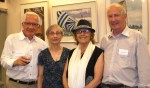
Left to right: Simon Bonettemaker, Hinda Avery, Claire Cohen and Colin Nicol-Smith. (photo by Olga Livshin)

“We decided we’ll be the Peretz Painters,” said Colin Nicol-Smith, one of the collaborators of the inaugural art show that opened on July 16 at the new art gallery in the Peretz Centre for Secular Jewish Culture. The other “Peretz Painters” include Claire Cohen, Hinda Avery and Simon Bonettemaker.

Nicol-Smith knows both Avery and Cohen through the Peretz Centre, and Bonettemaker was his long-term business partner in their engineering consulting firm. In an interview with the Independent, Nicol-Smith said that the idea for the show and the gallery first came up after a conversation with Avery.

“She said that the lounge would be an ideal place for an art gallery. I agreed and put it in front of the board – I’m a member. The board agreed, too. So, I contacted the others, and we decided we would be the first to exhibit here.” The plan is for an annual summer show at the gallery. “All other months of the year the lounge is too busy,” Nicol-Smith explained.

The stories of the four Peretz Painters are as different as their art.

Cohen is a professional artist. She has a bachelor’s degree in fine art and a master’s in art therapy. Her paintings feature the theme of music. The instruments in the paintings blend and dance with other forms, producing multiple and complex associations. Architecture and flowers, people and history mesh with musical nuances – a string, an elegant cello neck, a snippet of notes – as lines and shapes flow into each other. The paintings vibrate with color. They are festive, celebrating the artist’s love of classical music. “Classical music is part of my life. I always listen to it when I paint,” said Cohen.

Art makes her whole and happy, and that’s why she went into art therapy. “I wanted to give more meaning to my art, help others with it,” explained Cohen, who has worked with private clients and addicted teenagers. “I tried to help them focus on expressing themselves through art. Addiction stopped them from feeling, but art is a tricky way to help one to open up. Talking about themselves is hard for them. But, through art, they can.”

According to Cohen, art helps all of us deal with problems, with voids in our lives, and Avery can testify to the therapeutic effect of art in her own life. A former academic who taught at the University of British Columbia, she has been painting full time since she retired. Her artistic journey started after a trip to Europe in search of her family roots.

“Many women in my family, the Rosen family, were murdered by the Nazis because they were Jews. No records exist, but I needed to know them, so I started painting them.” At first, she used old family albums and war photographs to produce her paintings. Her compositions resembled real life and were imbued with sadness, reflecting the Holocaust.

“I depicted the murdered women as grim resistance fighters, but it felt constrained. I wanted to distance myself from the sombre historical reality, wanted the women to win. My latest paintings are like giant graphic novels. The women transitioned into gun-slinging folks. They mock the Nazis. They are not victims anymore, not intimidated. I wanted to confront atrocities with my absurd revenge fantasy.”

The show has two Avery paintings on display. One is a giant panel of “Rosen Women,” dressed in bright yoga tank tops and fitted cropped pants in neon colors, laughing and brandishing their weapons at Hitler. The second is a small, black and white caricature of Hitler. The pathetic little man depicted doesn’t stand a chance against the droll defiance of the Rosen heroines. The artist’s humor keeps her family alive long after they perished in the Holocaust.

Nicol-Smith is another retiree who found an artistic second wind. “I always drew,” he said. “But, as a consulting engineer, my drawings were technical. After I retired 16 years ago, I wanted to paint. I studied painting for two years at Langara.”

He paints from photographs, his own or those taken by others. One of his best paintings, of a Vancouver beach, is based on a photo taken by his grandfather in the 1900s. Unfortunately, it is not in the exhibit. “My wife likes it so much she refused to allow me to sell it,” he said. “My series of paintings on display at the show, ‘Four Significant Figures,’ is comprised of four male images. I’m interested in the topic of a male body.”

Unlike Nicol-Smith, who retired to paint, his former partner, Bonettemaker, hasn’t retired yet. “I’m an architectural technologist, semi-retired,” he said. “I have been painting watercolors for years. As an artist, I’m self-taught, but my paintings are close to architectural designs, very realistic, with distinctive details: landscapes, seascapes, still life.”

Sharp lines and quiet, subdued colors characterize his artwork. His Vancouver streets and shores, totem poles and sailing boats blend reality with fantasy. “I combine photos and imagination in my paintings, sometimes use elements from several different sources in one picture.” All of his paintings are from the 1990s. He hasn’t painted in awhile. “I’m thinking about retiring,” he said. “Then I’ll have more time to paint.”

The Peretz Painters exhibit runs until Aug 13.

Olga Livshin is a Vancouver freelance writer. She can be reached at [email protected].

Format ImagePosted on July 25, 2014July 23, 2014Author Olga LivshinCategories Visual ArtsTags Claire Cohen, Colin Nicol-Smith, Hinda Avery, Peretz Centre, Simon Bonettemaker

Posts pagination

Previous page Page 1 Page 2 Page 3
Proudly powered by WordPress