

For more cartoons, visit thedailysnooze.com.
Shalom Sesame for Chanukah
Available Oct. 14, SISU is re-releasing the 12 episodes of the 2010-11 season of Shalom Sesame in a new six-DVD thin-pack gift box. Included in the re-release is a bonus DVD featuring two episodes from the classic Shalom Sesame series, “Jerusalem” and “People of Israel” (originally released in the early 1990s). In addition, the DVD set includes a free 30-day trial download of the first episode.

Join lovable, furry Grover and celebrity host Anneliese van der Pol (That’s So Raven, Broadway’s Beauty and the Beast) as they travel to Israel in this 12-part award-winning series co-produced by Sesame Workshop, the nonprofit organization behind Sesame Street, and Israel’s Channel HOP! Designed to help bring the vitality of Jewish culture and tradition, as well as the diversity of Israeli life, to American children and their families, each 30-minute, live-action and animated DVD focuses on storylines drawn from Jewish cultural traditions, highlighting lessons on Hebrew letters and words, unique sites in Israel and Jewish values.
In addition to van der Pol, the series features guest appearances by top name talent, including Jake Gyllenhaal, Debra Messing, Matisyahu, Eva Longoria, Christina Applegate, Greg Kinnear, Debi Mazar and others. The programs’ chronological order mirrors the Jewish calendar, beginning with an introduction to Israel and Hebrew, and ending with a program on mitzvot and a concluding trip to Israel.
Each title in the set contains two episodes and includes extra video segments. Shalom Sesame has been awarded a CINE Golden Eagle Award (2011), a Hugo Television Award Certificate of Merit (2011) and a Dr. Toy Best Pick Award (2010). Learn more about Shalom Sesame at shalomsesame.org, view previews and clips on youtube.com/shalomsesame and visit facebook.com/ShalomSesame. To order DVDs, visit sisuent.com.
Beth Israel comes home
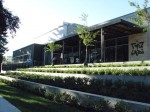
The new LEED Gold-equivalent synagogue now faces 28th Avenue. (photo by Jan Lee)
The energy was palpable last Sunday, Sept. 14, as congregants from Vancouver’s oldest Conservative synagogue gathered outside the Jewish Community Centre of Greater Vancouver. Everything was ready for the procession. The ark, which had been rolled out of its temporary home in JCCGV’s senior centre sat nearby, housing the synagogue’s three Torahs. Congregants were dressed in their best sun hats, and everyone had their walking shoes on.
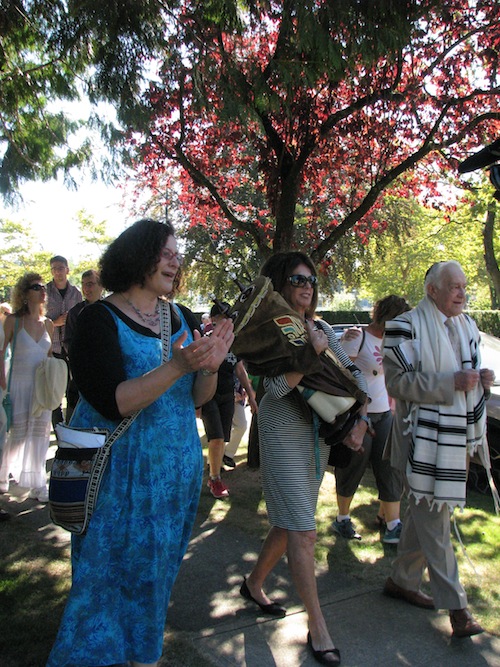
Even Vancouver’s weather was cooperating, with warm temperatures set for the unprecedented celebration. The members of Congregation Beth Israel, who had trepidatiously turned their synagogue over to architects and builders almost two years ago, were ready to return home.
A little more than a kilometre away, a new building sat in the final stages of construction, with a new address and a sweeping landscaped entrance facing the quieter side street. The makeover, which had been more than a decade in planning, was coming to fruition.
For the congregation’s 630-plus families, its upgrade represents more than the loving reconstruction of a 1940s landmark. As BI president Peter Lutsky lightheartedly said, the makeover is BI’s latest stage in “re-jew-venation,” a process that has been a part of the synagogue’s life and identity since the 1970s, when the first major retrofit took place to accommodate an aging building and a burgeoning membership. And it’s a process, said Lutsky, that has built itself upon the congregation’s belief that more than 80 years after its founding, it can still transform itself to meet new needs and new perspectives of what makes a Conservative Jewish community.
For today’s BI community, said Rabbi Jonathan Infeld, that concept is embodied by its inclusiveness; a divergence from the synagogue’s earlier image when elevators were added “as an afterthought,” where the bima towered high above the congregants and families had to decide between the responsibilities of child-minding and the desire to attend services.
Those elements have now been factored into the synagogue’s structure. “We have a play-and-pray space right next to the sanctuary so that young families will be able to have their children playing in a room that is right next to the sanctuary,” said Infeld.
It’s a vision that keeps pace with today’s Canadian concepts of inclusiveness as well, in which mobility needs don’t restrict one’s ability to participate in community. All areas are physically accessible, including the bima, which is set low to the ground.
“This is certainly part of our consciousness: making sure everyone feels welcome and is able to enter and utilize the building is certainly important,” Infeld explained.
Getting to this point, however, has taken much more than planning. It’s taken constant fundraising, almost all of which has been raised within the BI community.
“We’ve raised over $16 million from our Beth Israel community,” much of which was done, said Lutsky, through the strength and dedication of its fundraisers, who applied themselves round the clock for years to raising the necessary capital for each stage of the reconstruction. He likened each gradual success to completing “another link in the chain” of progress.

Lutsky credited Gary Averbach, who spearheaded the capital campaign, and Shannon Etkin, the synagogue’s executive director, for the far-sightedness that allowed the congregation to raise the funds and, at the same time, meet the opening deadline on time, with a Torah procession and a gala dinner to follow.
Later, Etkin told the Jewish Independent that the day went on without a hitch, with some 400 people at the opening, and a sold-out 500-seat dinner.
“We hope that’s a good portrayal of things to come for BI in the future and all other events we have here,” said Etkin, who added that the greatest gratification was seeing “the surprise on the faces of our members who couldn’t believe this new synagogue was actually here.”
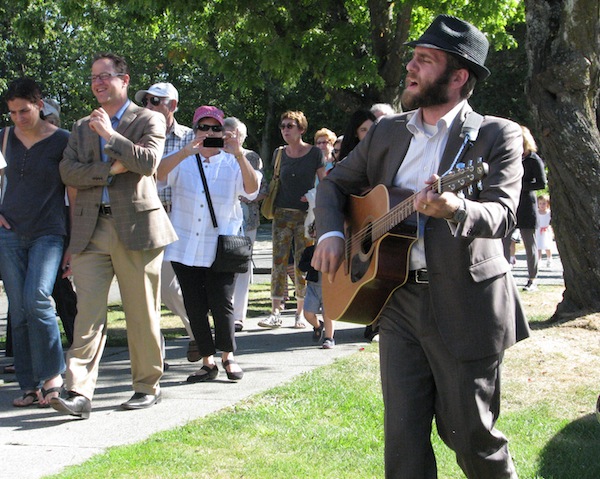
Cantor Lawrence Szenes-Strauss said that, from his perspective, the greatest takeaway from the opening was the engagement he saw on people’s faces as they accompanied the Torahs the last block and a half to the shul. Due to the distance from the JCCGV, the Torahs were accompanied to two vehicles in the JCCGV parking lot, and then escorted by car to the corner of Willow and 28th, where the community reunited and joined in song the rest of the way to the shul.
“It was fun,” he said. “People were excited. [They] were dancing all the way up there; it’s the way it ought to be.” He said he hoped the excitement that he saw would carry forth into future events as the community settled into its new surroundings.
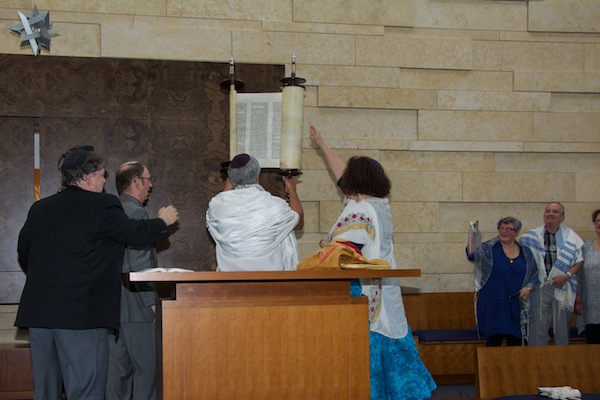
“I think what we saw there was a hint of how Simchat Torah could be, for example,” added Szenes-Strauss, who was optimistic that the move would encourage more turnout. “If we treat the chaggim, and even Shabbat, with that much anticipation, then we can boost our already high energy levels to a new point. And I think we’re going to have a natural boost now that we’re here.”
Infeld said that amid the festivities, it was important to remember the point of this reconstruction, which was to provide a home and a place for the community to come together, to celebrate, to grow, but always with the cognizance that “building is the container of the spirit” that embodies Judaism. “Ultimately, we are more concerned about the soul of the synagogue; that is why we exist,” he said. “And we are delighted to have a physical building that will facilitate all of the important and hard work we are doing, all the programming and building of community…. Ultimately, whatever the building is, wherever we are, Congregation Beth Israel is dedicated to bringing Jews closer to God, Torah and Israel. That is our primary existence, [and] we must not lose sight of this.”
Jan Lee’s articles have been published in B’nai B’rith Magazine, thedailyrabbi.com and Voices of Conservative and Masorti Judaism. She also writes on sustainable business practices for TriplePundit.com. Her blog can be found at multiculturaljew.polestarpassages.com.
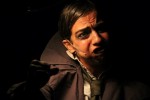
Butt Kapinski – not your children’s clown
Deanna Fleysher as private eye Butt Kapinski. (photo from Deanna Fleysher)
Think you’re going to go sit and watch Butt Kapinski at the Cultch next month? Think again. You’re going to be an integral part of the show.
An award-winning hit at last year’s Vancouver Fringe Festival, Deanna Fleysher is returning to Vancouver with her alter ego, Elmer Fudd-meets-Philip Marlowe private eye Butt Kapinski. It is funny, raunchy, unpredictable humor that involves the audience. In her expert hands, they become a crime boss, a femme fatale, a prostitute, all participating in the telling of a unique-every-time murder mystery.
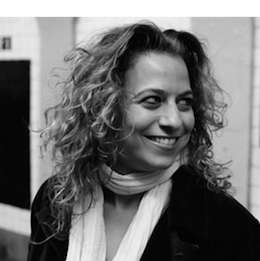
“We humans crave that feeling of spontaneity, of witnessing and being part of something that has never happened quite this way before and will never happen quite this way again,” Fleysher told the Independent about her preferred type of performance.
“I am convinced that theatre will become increasingly interactive, as theatre practitioners realize that the best way to entice people to put on pants and leave their homes is to include them in the experience somehow. We can’t let flat screens and underwear win the war!”
Fleysher is on the front lines, so to speak, having made interactive theatre a focus of her career. In addition to performing as a clown, in improv and in other capacities, Fleysher is a teacher, writer and director. Among the interactive and clown/bouffon shows she has created or co-created is the erotic production Foreplay, which ran for a year at the People’s Improv Theatre in New York City, as well as at the Chicago Improv Festival, and she created, produced and performed in Kill Me Loudly: A Clown Noir, and directed and co-wrote Red Bastard. She started the Naked Comedy Lab, in which participants learn how to perform interactive comedy and clown/bouffon, and she teaches labs in Los Angeles and around North America.
“My parents are both creative people, although they did not pursue the arts specifically,” shared Fleysher about her background. “Nonetheless, I was in theatre classes from probably 6 years old onwards. My sister is also a performing artist and teacher, specializing in Middle Eastern dance. So, two nice Jewish people ended up with a belly dancer and a clown for children. So it goes.”
Butt Kapinski, however, is not for children. The character is described as a “noir-loving, gender-troubled little fellow-gal who wears a trench coat and a streetlight strapped to his/her back and goes into crowds and solves mysteries.” He/she has appeared in previous Fleysher creations.
“I found Butt Kapinski on a street corner in the East Village, but also, Butt has been with me my whole life,” explained Fleysher about his/her origins. “I used to have many speech impediments as a child, so speaking that way is very natural for me. Also, I am a huge film noir buff, a lover of Raymond Chandler novels and spontaneous poetry and trench coats. Butt is just me without my ‘Normal Disguise.’
“I used to wear a nose, partly because I was worried about being too ‘pretty’ or ‘normal’ (or, hell, ‘feminine’) without it. But Butt is quite different than the me everyone sees, and losing the nose [that Butt used to sport] was the best choice I could have made.
“The streetlight that I wear came into the act once I decided to go solo. What I wanted was a true interactive experience with the audience, but I do not like when performers bring people up on stage. My light lets me take the show right into the audience, where everyone can stay comfortable, and still be a part of things.”
Asked about what attracts her to Kapinski, to the private-eye genre in general, Fleysher responded, “I have always delighted in the dark side. Butt allows me to share that delight with others, to make a community ritual out of a usually private kind of fetish for the sicker shit in life.”
In a 2012 interview with LAFF! (Ladies Are Funny Festival), Fleysher is quoted as saying she once heard Fran Lebowitz say, “Every Jewish woman wants to be a private eye.” About that comment, Fleysher explained to the Independent, “My mother found the first guy I ever slow danced with on JDate. How did she even remember his name? I went steady with him at sleep-away camp for about a week, and she found out all about who he is now … you know … just in case. That is a kind of sleuthing I tip my hat to.
“Fran Lebowitz was introducing some mystery/crime fiction writers at a reading in N.Y. many years ago, when she said, ‘Every Jewish woman wants to be a private eye.’ In that moment, my mother’s passionate curiosity was united with my noir world.”
Fleysher has always been a writer/actor at heart. “I was always more interested in creating my own theatre rather than reading/interpreting someone else’s words,” she said. “It’s not my thing to sell hand soap or be Battered Wife #3 in a cop drama. All of this means that I’d much rather be poor and creatively empowered than poor and at the mercy of casting agents.”
As for her interest in physical comedy/theatre versus more “serious” fare, Fleysher said, “My first theatre teacher was a clown, and I think I always had a strong bent toward comedy. Of course, the root of comedy is despair – so you get two for the price of one!”
Butt Kapinski is at the Cultch from Sept. 30-Oct. 11. For tickets, visit tickets.thecultch.com.

Hundreds attend Met protest of Klinghoffer opera
Demonstrators protest the New York Metropolitan Opera’s production of The Death of Klinghoffer on Monday. (photo by Amelia Katzen via jns.org)
Several hundred protesters gathered at New York’s Lincoln Centre on Monday to protest the opening night of the New York Metropolitan Opera’s production of The Death of Klinghoffer.
The opera depicts a 1985 cruise ship hijacking by members of the Palestine Liberation Front (PLF) and the killing of disabled Jewish-American passenger Leon Klinghoffer. Critics of the 1991 John Adams opera say that it promotes antisemitism and glorifies terrorism.
At the rally, protesters held signs reading “Klinghoffer Opera: Propaganda Masquerading as Art” and “The Met Opera Glorifies Terrorism.”
High-ranking New York politicians – including former New York governor George Pataki, former U.S. attorney general Michael Mukasey, U.S. Rep. Eliot Engel (D-NY) and New York State Assemblyman Dov Hikind – joined the protesters.
Additionally, several Jewish and Christian organizations, such as the Zionist Organization of America, the Simon Wiesenthal Centre, the Catholic League and the Christians’ Israel Public Action Campaign, co-sponsored and attended the rally.
The protesters read a letter that was written by Judea Pearl, the father of Daniel Pearl, the Wall Street Journal journalist who was executed by terrorists in 2002. “We do not stage operas for rapists and we do not compose symphonies for penetrating the minds of ISIS (Islamic State) executioners,” the letter reads.
“This antisemitic opera viciously falsifies history to malign and incite hatred against Israel and the Jewish people. The opera is a disgrace and should be canceled immediately,” said Morton Klein, national president of the ZOA, in a statement.

Amy Herzog’s 4000 Miles offers 4,000 laughs
Nathan Barrett and Nicola Cavendish in Amy Herzog’s 4000 Miles. (photo by David Cooper)
I can be quite nervous going to see a play that relies on only one or two main actors to carry the production, particularly when those one or two have most of the dialogue, and the action takes place in only one room for the entire performance.
But my concern is never that great when Nicola Cavendish is one of the two involved because I know I will laugh out loud, stifle tears and otherwise experience a full, rich range of emotions. I was not disappointed when I caught Cavendish in Amy Herzog’s 4000 Miles.
In this starring role, Cavendish plays 91-year-old Vera whose grandson Leo (Nathan Barrett) comes to stay with her after a cross-continent bike trip during which his best friend died.
Leo has come to stay with his grandmother due to lack of cash, being estranged from his mother and in an uncertain position with his girlfriend.
At first Leo appears to be the clichéd lost soul – not entirely the self-absorbed persona you expect to find in a 21-year-old – who brings to Vera a companionship the older woman is missing. The reunion is filled with laughs right off the top as Vera’s hearing problems cause havoc in the communication.
Vera herself is savvy, but tough, and pulls no punches when giving her opinion.
“You smell terrible and I wouldn’t be surprised if you have lice,” she says to Leo in one of the first lines of the play.
The relationship starts with Leo showing warmth to an uncomfortable Vera, who’s more used to complaining all the time than accepting someone’s love; and it’s quickly revealed that
Vera really only wants what’s best for her grandson, like a good night’s sleep.
Vera shows interest in Leo’s recent trip as well, albeit on the weird side, asking Leo if he ever met a sexual crackpot wanting favors in exchange for giving Leo a place to stay.
The two soon start talking about family, and Vera admits she also has a dysfunctional relationship with Leo’s mother: “I always end up telling her what a disappointment she was to her father,” Vera sighs. “I don’t mean to, but I do.”
It’s not long before Leo’s “one-day visit” turns into a lengthy stay and the well-meaning free spirit starts acting like a freeloader, even bringing one-night stands over to the apartment.
Vera, for her part, turns into a crotchety micro-manager who’s defensive and fearful. She starts to lecture Leo on responsibility, and doesn’t hesitate to show an angry frustrated side when she feels her space is being infringed upon.
In one brilliantly funny scene, Leo’s girlfriend comes over and drops her bag in the middle of the living room. Walking by the bag, Vera nonchalantly gives it a kick and, with surprising results, sends it flying a good 10 feet back to the front door – eliciting laughs and applause from the audience.
Vera’s progressive loss of memory, while a bane for her (“I hate not being able to find the right words”), is also a source for comedic enjoyment in the play, especially when she and Leo smoke pot together.
“Your father never did anything for me in bed,” she says, mistakenly referencing her daughter. “Neither of my husbands did.”
“Were my parents in love?”
Leo asks during this baring of stoned souls.
“Which ones were your parents?” Vera dopily responds.
While this play is not likely to offer deep insights that will turn your world around and cause you to run out to reconcile with every estranged member of your family, it is a warm, wonderfully written snapshot of two somewhat lost people who come together with love and humor.
4000 Miles ran Off-Broadway in 2011 and again in 2012, and was a finalist for the 2013 Pulitzer Prize for drama. It shows at the Arts Club Stanley Theatre until Oct. 12. Visit artsclub.com.
Baila Lazarus is a Vancouver-based writer, painter and photographer. Her work can be seen at orchiddesigns.net.
Time to parade your views with pride
With our own civic and municipal elections in British Columbia weeks away, it may seem odd to take time to consider the impending civic vote in Toronto. Of course, the entire world has devoted some of its attention to Toronto politics this year, the guffaws and ridicule turning to sympathy now that incumbent Mayor Rob Ford has been diagnosed with a serious and rare cancer. This latest twist in the saga provides a needed insight into society’s divergent responses to some health crises – like a large malignant growth – versus mental health crises, of which the mayor has probably demonstrated multiple symptoms, yet which gathered little to no sympathy, only punchlines and ridicule.
All that is for another time. In the first candidates’ forum post-Rob Ford (his brother, councilor Doug Ford, has taken his place on the ballot), front-running candidate John Tory told the audience at a largely Jewish forum that he would vote against funding for the city’s massive Pride Parade if the anti-Israel group Queers Against Israeli Apartheid (QAIA) were allowed to participate.
Unlike Mayor Ford, both the candidates Tory and Olivia Chow have marched in the parade and express support for it. But Tory reportedly elicited huge applause by promising to withhold the approximately $160,000 the city grants to the parade if the anti-Israel group were allowed to participate.
Understandably organizers of the parade have balked at political intervention that would limit participation to certain condoned groups. It was not long ago that, rather than marching in the parade with their supporters, public officials were condemning the parade as an inappropriate, hedonistic bacchanal on the streets of the city.
As Jews and as Zionists, our gut is with those cheering in the audience. QAIA is a fringe of extremists who undermine gay rights in the Middle East by delegitimizing its only oasis of legal and social freedoms. And the use of the word apartheid to describe Israel is plain wrong.
There is a more fundamental value at play here, however. It is basic free expression. As we saw recently, the Vancouver Queer Film Festival experienced controversy over a Jewish community ad that included the Israeli flag. In this case, it is the gay community that is soiled by its association with repression of open discourse – while VQFF accepted the ad in question, they treated its revenue differently, donating it to another organization. The festival is currently reviewing its ad policy. Our advice to them: we shouldn’t give in to those who seek to suppress free expression; all sides should be heard.
And it’s the same for Toronto Pride. There could hardly be, in a democracy, a better opportunity outside of the voting booth to register one’s opinion than a parade. Rather than applaud censorship, opponents of QAIA should attend the 2015 parade, enjoy the show, wait for the QAIA contingent, peaceably let their opinions be known with a creative sign or a catchy cheer.
Don’t make QAIA martyrs to free expression by preventing them from participating. Show them that the public rejects their worldview.
Siegel wins travel-writing award for article in JI
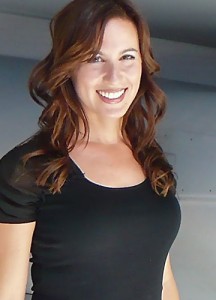
Masada Siegel, a journalist and media personality known as “The Fun Girl Correspondent,” has won silver in the Personal Comment category of the 2014 Lowell Thomas Travel Journalism Competition. The award, sponsored by the Society of American Travel Writers Foundation, is given “for outstanding print, online and multimedia works and for travel photography and both audio and video broadcast.” Faculty members of the University of North Carolina-Chapel Hill School of Journalism and Mass Communication judge the competition.
Siegel was recognized for her article “World Opens Up Solo,” published by the Jewish Independent.
The gold for Personal Comment went to Tony Perrottet, “Rich Tourist, Poor Tourist,” published by the New York Times; the bronze to Sean Carlson, “The Reach of a Single Village,” in the Irish Times; and an honorable mention to Christopher Solomon, “A Case for Getting Far, Far Away,” the New York Times.
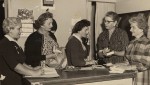
Mystery photo … Sept. 26/14
Women with thrift sale goods, National Council of Jewish Women, 1960. (photo from JWB fonds; JMABC L.13961)
If you know someone in this photo, please help the JI fill the gaps of its predecessor’s (the Jewish Western Bulletin’s) collection at the Jewish Museum and Archives of B.C. by contacting [email protected].
Time for dynamic on-campus discourse on Israel/Palestine
With September upon us and the Gaza war behind us, university students may be facing Israel-on-campus discourse this semester with some extra trepidation. I often hear Jewish parents wondering about how we can best prepare our kids to “face” Israel opponents on campus. As a past active Jewish undergraduate student myself and now as a professor who specializes in the topic of Israel/Palestine, here are some of my thoughts about the best way to approach the topic of Israel on campus.
Critical thinking above all else. In today’s political climate, no one is served by advancing talking points rather than asking tough questions and truly listening. Jewish students should not have to see themselves as ambassadors of the Jewish state. Israel has its own cadre of hasbarah professionals. As a place to create intelligent and productive global citizens, the role of university is to help students absorb information and apply conceptual reasoning in a critically engaged way. Jewish students should not have to leave their critical faculties at the door on the subject of Israel, nor should they have to consider the classroom environment – with its natural predilection for analyzing multiple sides of a problem – as hermetically sealed from the rest of the campus, where more informal discussion and occasional activism takes place.
Put aside the labels. Students would be forgiven for believing that they must adopt a label like “pro-Israel” or “pro-Palestine” either before arriving on campus or while there. But, as I consistently try to show my students, those terms mean little. To some, being pro-Israel means supporting the settler enterprise. To others, it means spurring Israel to make peace with the Palestinian Authority. Similarly, being pro-Palestine may mean supporting Hamas’ war effort, just as it might mean supporting Mahmoud Abbas’ attempt to reach a peace agreement with the Israeli government. By assuming a monolithic stance, students mentally close out possibilities. Students who care about the region must take time to consider what is best for the individuals and nations living there.
Focus on the “why” questions. While the out-of-classroom campus climate can unfortunately tend towards the “blame game,” where activists point fingers at one side or another, students would be best served by focusing on the “why” questions. Analyzing why each set of political actors takes the actions they do is ultimately the best thing students can do to deepen their understanding of the region and perhaps to ultimately be in a position to help bring about desired outcomes. Importantly, addressing the “why” questions is not the same as providing moral justifications. “Why does Hamas shoot rockets?” could be addressed by an array of possible answers, all of which should be put on the table and evaluated using the best knowledge we have, before making gut assumptions. Focusing on these explanatory questions can also help to further dialogue with people whose instinctual political allegiances may be different.
Practice empathy. Moving from the “why” questions to the “what should be” questions is best done through a position of empathy. Understanding the narratives, experiences, and emotional and material reality of each “side” is essential to prescribing political outcomes that will stick. Just as demanding that Israel give up its Jewish identity is going to be a non-starter, so too is not recognizing that no people is going to accept living under occupation in perpetuity.
Start early. Finally, it’s all good and fine to hope that our community’s Jewish students are primed for Israel engagement on campus, but the kind of critical engagement that enables students to deploy all their intellectual and cultural tools must start early. Our community needs to ensure that spoken Hebrew instruction in our day and supplementary schools is a priority, thus paving the way for our students to engage with Israel and Israelis in a more intimate and nuanced way whether via social media or, ideally, in person. Similarly, our elementary and high schools should ensure that wide-ranging discussion on Israel and the Israeli-Palestinian relationship is encouraged, and that groupthink is avoided. An informed and critically engaged citizen will be one who can contribute most potently – and that is ultimately good for Jewish continuity, to boot.
Mira Sucharov is an associate professor of political science at Carleton University. She blogs at Haaretz and the Jewish Daily Forward. This article was originally published in the Ottawa Jewish Bulletin.