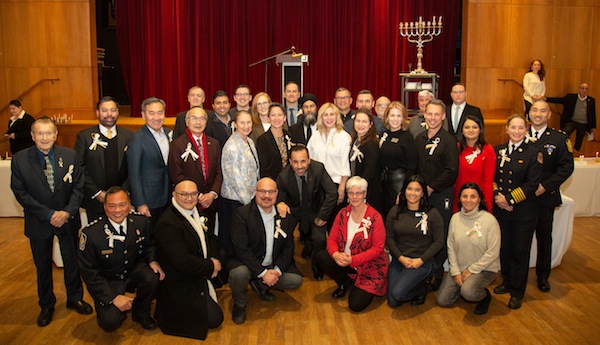
IHRA definition adopted

On Nov. 16, Vancouver city council became the latest Canadian jurisdiction to adopt or commit to using the International Holocaust Remembrance Alliance (IHRA) working definition of antisemitism.

The decision received support from organized Jewish community representatives, including both the Jewish Federation of Greater Vancouver and the Centre for Israel and Jewish Affairs (CIJA).

“Defining antisemitism is an essential step towards recognizing its manifestations and being able to counteract it,” said Shimon Koffler Fogel, president and chief executive officer, Centre for Israel and Jewish Affairs. “Today’s adoption of the IHRA definition of antisemitism by Mayor Ken Sim and Vancouver city council is a clear stand against the rise in acts of hatred against members of the Jewish community.”

Developed by IHRA’s Committee on Antisemitism and Holocaust Denial, the IHRA working definition of antisemitism is grounded in the research of the international experts on antisemitism and the Holocaust. It is supported by the United Nations, the European Union and 30 countries, including the United States and Canada.

“History has repeatedly shown, what begins as hatred of Jews never ends as hatred of Jews. Canadians must stand united with the Jewish community in the fight against antisemitism,” said Fogel. “The decision made by Vancouver city council today is a victory for all who stand against hate – no matter which group is the immediate target.”

“Today, Mayor Sim and the vast majority of Vancouver city council sent a strong message that antisemitism has no place in society,” said Ezra Shanken, chief executive officer, Jewish Federation of Greater Vancouver. “To combat antisemitism effectively, it must first be defined. The IHRA definition will help the people of Vancouver identify and combat antisemitism in all its forms. The rise of antisemitic hate crimes across the country has meant that fighting antisemitism must be a priority for all Vancouverites and Canadians, not just members of the Jewish community.”

Councilor Sarah Kirby-Yung introduced the motion to adopt the IHRA definition.

“Nobody should have to live in fear because of who they are. It was an honour to bring this motion forward to adopt the IHRA working definition of antisemitism,” she said. “We stand united with Vancouver’s Jewish community in the ongoing fight against antisemitism and the troubling rise of hate incidents in our city.

“The best means to combat hate is through education, and the IHRA definition can help foster a deeper level of understanding,” she said. “Education is more powerful than any punitive actions could ever be.”

“We are proud to stand with the Jewish community both in Vancouver and around the world,” said Sim. “Antisemitism has no place in our city, and today we take an important step towards building a more inclusive and safe society for all.”

In his weekly email message Nov. 18, Shanken wrote, “In 2019, when the IHRA working definition of antisemitism was first brought before council [by Kirby-Yung], thousands of you wrote letters and signed up to speak in favour of the motion. From community members and leaders to elected officials, clergy, partners agencies, and more, your words were powerful and you were heard by this council – even if your letter was from 2019.”

Shanken highlighted the work of several community leaders: Nico Slobinsky, senior director of CIJA-Pacific Region; Geoffrey Druker, chair of CIJA’s local partnership council; Candace Kwinter, board chair of the Jewish Federation of Greater Vancouver; Lana Marks Pulver, chair of the Federation annual campaign; Nina Krieger, executive director of the Vancouver Holocaust Education Centre (who has been a member of the Canadian delegation to the IHRA since 2012); and Corrine Zimmerman, president of VHEC.

Learn more about the IHRA definition at holocaustremembrance.com.

– Courtesy CIJA and Jewish Federation of Greater Vancouver

Opposition to IHRA definition

Independent Jewish Voices Canada posted an open letter to Vancouver Mayor Ken Sim on their website before the Nov. 16 city council vote, expressing concern over the intention to endorse the International Holocaust Remembrance Alliance definition of antisemitism.

While applauding council’s intention to fight antisemitism, Neil Naiman, chair, IJV Canada, Vancouver chapter, wrote, “We are of the view, however, that the IHRA definition serves to deflect attention from real antisemitism by focusing on criticisms of Israel. It does so by adding to the basic definition of antisemitism what it deems to be 11 ‘examples’ of antisemitism – seven of which relate to Israel.

“The existence of these examples and the focus on defending Israel have led IJV and a host of other organizations to oppose the IHRA definition. These include the B.C. Civil Liberties Association, the Union of B.C. Indian Chiefs, the Canadian Association of University Teachers, 40 faculty associations, the Jewish Faculty Network, and many others. More than 650 Jewish academics across the country having signed a petition urging the rejection of the IHRA.”

The letter states, “The IHRA definition raises issues which have been debated in the Jewish community for more than 100 years, issues about which there is no community consensus. For example, many of IJV’s members join with Palestinians and others in condemning Israel as a ‘racist endeavour’ (to use one of the IHRA examples). The basis for this charge is that 750,000 Palestinians were expelled when Israel was founded, that it subjugates the inhabitants of the Occupied Palestinian Territories under military rule and subjects Palestinian citizens of Israel to second class status. The IHRA definition would deem these IJV members to be ‘antisemitic.’ By adopting the IHRA definition Vancouver council will be condemning some of its citizens as racists and antisemites based on their legitimate political views of the situation in Israel-Palestine. This would be unconscionable.”

For the full letter, visit ijvcanada.org/no-ihra-vancouver.

Dealing with addiction

Rabbi Allan Finkel of Winnipeg’s Temple Shalom spoke about addiction in the Jewish community and Jewish-based recovery during a Nov. 6 Zoom presentation organized by Kolot Mayim Reform Temple in Victoria.

The talk was the first of Kolot Mayim’s 2022/23 lecture series entitled Hineini: Answering the Call to Heal the World. It widened the definition of addictions to go beyond those that are substance-based to include dozens that are behavioural. Finkel also explored new research on the causes of addiction, particularly childhood trauma.

“My name is Allan and I am an addict,” he began. “This was a huge hineini, when I first said ‘here I am.’ This was my declaration 13 years ago. At that time, hineini meant here I am at the bottom of a drug addiction, I am broken and I am open to an unknown path that might lead to recovery.”

That path, starting at Narcotics Anonymous, would take him on a spiritual journey, reconnecting him with his Judaism and leading him to become a rabbi.

For his rabbinical program, Finkel wrote his thesis on addictions in the Jewish community. “I was curious to know what we might learn as rabbis, and how we can carry our journey forward in terms of serving our congregations,” he said. “It is a mental health issue, and there wasn’t very much known about it…. And there are certain issues, particularly within the Jewish community, that made it a topic that I wanted to explore.”

Finkel discussed a 1962 study of the Jewish community in the United States that tried to find out what percentage of the Jewish community was addicted to drugs and/or alcohol. The answer was zero, compared to a 10% addiction rate in the overall population. Clearly, the study indicated a denial within the Jewish community that Jews can also be addicts. A 1995 study in the United Kingdom produced similar results.

Beginning in the early 2000s, research began to demonstrate that, to understand addictions, one needed to look beyond substances and towards behavioural addictions, which can encompass many areas: shopping, food, internet and gambling, among them. More recently: cellphone use, online gaming and video gaming.

From this standpoint, the number of people demonstrating addictive behaviour reaches 47%, according to studies Finkel cited, though he suggested the number is likely far higher. A commonality among people with addictive behaviours is the inability to stop, no matter what harm it does to those around them and to themselves.

Returning to the denial of addiction in the Jewish community, Finkel proposed that one cause is the long-standing fear of shame, which could be triggered by an admission of a problem at a synagogue, Jewish school or other institution. Looking at areas of the Torah, such as the story of Noah, he explained, one sees that “the Jewish denial of addiction is social and cultural, it is not religious in orientation.”

Within the past decade, there has been a broader consensus within Jewish institutions that addiction is not a moral failing, but instead can be caused by the same factors that result in other mood and psychological disorders.

Using the work of Vancouver physician Dr. Gabor Maté, Finkel noted that all addictive behaviour can be traced to something that happened when a person was very young. “Not everyone who was traumatized becomes an addict, but every addict was traumatized.”

One conclusion Finkel draws is the need to destigmatize the word “addiction.” He stressed that an addiction, as stated in the American Psychiatric Association’s 2013 manual on mental disorders, is a means of coping no different from any other mental health disease.

A second takeaway is that adults and not children bear much of the responsibility for addictions; in other words, no child ever dreams of becoming an addict. Children do not have the rational skills to take on and cope in a non-destructive way with trauma that happens to them.

Further, Finkel argued that real recovery is not simply about stopping addictive behaviour, but about going back to one’s past and taking care of the fears and resentments of childhood, as well as the habits that build up over a lifetime.

Finkel told the audience that it has been more than 10 years after his last relapse. He said the rewards of recovery have been immense and have brought incredible relationships with his children, himself and life.

Finkel is an outspoken advocate for interfaith engagement and for the building of strong bridges and partnerships across all denominations within the Jewish community. He currently chairs the Winnipeg Council of Rabbis.

A video of Finkel’s lecture is posted at kolotmayimreformtemple.com.

Sam Margolis has written for the Globe and Mail, the National Post, UPI and MSNBC.

*******

Some resources

Rabbi Allan Finkel provided this list of resources for those experiencing addiction and those close to them:

  • Crisis and suicide line: 1-800-784-2433
  • Jewish Addiction Community Service (JACS) Vancouver 778-882-2994
  • Mental health support: 310-6789 (no area code required)
  • Umbrella Society: support, outreach, recovery, counseling, groups, harm reduction and education, umbrellasociety.ca
  • Our Jewish Recovery: Facebook group, with 16 active Jewish recovery meetings and classes, virtual retreats, individual and group coaching, led by Rabbi Ilan Glazer
  • Rabbi Mark Borovitz, Finding Recovery and Yourself in Torah: A Daily Spiritual Path to Wholeness
  • Rabbi Kerry Olitzky and Dr. Stuart Copans, Twelve Jewish Steps to Recovery, and other of Olitzky’s books, including with co-authors
  • Rabbi Paul Steinberg, Recovery and Jewish Spirituality: Reclaiming Hope, Courage and Wholeness
  • Rabbi Shais Taub, God of our Understanding: Jewish Spirituality and Recovery

– SM

Community milestones … CEMA awards & GGBooks

A scene from Mary Magdalene in Conversation with Lilian Broca, produced by Adelina Suvagau. Lilian Broca works as Mary Magdalene, portrayed by Adriana Villi, stands to her side. (image from marymagdaleneresurrected.com)

The Canadian Ethnic Media Association (CEMA) recently announced the winners of its 44th Annual Awards for Journalistic Excellence. CEMA asked Canada’s ethnic media to enter their best work, and they did. An independent panel of multilingual media experts screened all submissions and the winners present a national showcase of Canada’s best ethnocultural journalism from Vancouver to Halifax.

There were various categories of work for which the winners were recognized. In the documentary category, Adelina Suvagau of Vancouver was awarded for her work as producer of Mary Magdalene in Conversation with Lilian Broca.

Vancouver mosaics artist Lilian Broca, “in spiritual alliance with the biblical figure Mary Magdalene weaves a wondrous, animated and engaging tale recounting her long and arduous creative journey,” notes the film’s website, marymagdaleneresurrected.com. The director notes that the film is a cinéma vérité dialogue between Broca and the artist’s subject, Mary Magdalene: “In the director’s concept for this documentary film, Mary Magdalene travels from her ancient time to the present in order to meet with the artist in her Vancouver studio. The spiritual connection and personal bond between them, apparent in all mosaics in the series, is based on Lilian Broca’s personal journal and her research on Mary Magdalene’s varied representations over the centuries in art and in biblical literature.”(For more on Broca’s Mary Magdalene Resurrected series, see jewishindependent.ca/brocas-latest-mosaics.)

* * *

photo - Sheila Heti’s Pure Colour won a 2022 Governor General’s Literary Award for English-language fiction
Sheila Heti’s Pure Colour won a 2022 Governor General’s Literary Award for English-language fiction. (photo by Margaux Williamson)

On Nov. 16, the Canada Council for the Arts revealed the 2022 winners of the Governor General’s Literary Awards (GGBooks). Among the 14 best books published in Canada between Aug. 1, 2021, and July 31, 2022, were Pure Colour by Sheila Heti (Penguin Random House Canada) in the English-language fiction category and, in the translation (from French to English) category History of the Jews in Quebec, the translation by Judith Weisz Woodsworth (University of Ottawa Press) of Histoire des Juifs du Québec by Pierre Anctil.

“We are living in a turbulent social climate, marked by struggles against inequalities,” said Simon Brault, director and chief executive officer, Canada Council for the Arts, in the press release. “We are confronted daily with many complex phenomena that are more worrisome than ever, including misogyny, gender-based violence, colonialism, racism, the search for identity, and mental health. These are but some of the contemporary themes that are explored by these brilliant GGBooks winners. Once again, I invite you to celebrate the immense talent of these authors and to take a look at these invigorating works that challenge, redefine and question moral and social norms.”

photo - Judith Weisz Woodsworth (below) was honoured for her translation into English of Histoire des Juifs du Québec by Pierre Anctil. (photo by Egan/Dufour)
Judith Weisz Woodsworth (below) was honoured for her translation into English of Histoire des Juifs du Québec by Pierre Anctil. (photo by Egan/Dufour)

The GGBooks winners were selected by peer assessment committees that followed a rigorous process to choose them from among the 70 finalists in seven categories, in both English and French. Each writer, translator or illustrator whose book is selected as winner receives a $25,000 prize. Publishers receive $3,000 to promote the winning book; finalists receive $1,000 each.

For a list of all the winners, visit canadacouncil.ca/press.

Studying with Masa

Vancouverite Jack Scher is a student at Tel Aviv University’s Porter School of Environmental Studies. (photo from Masa Canada)

Born in the United Kingdom, Jack Scher grew up in the south of France from the age of 6 till he was 13, far away from any Jewish community. Now, he is surrounded by community – and living like a local, while studying in Israel with Masa Israel Journey.

After moving to Vancouver, Scher attended St. George’s and received an athletic scholarship to play rugby. Following high school, he followed a traditional British path by taking a gap year, and went on to play rugby in New Zealand. While there, he went on a Canadian delegation Birthright trip to Israel.

“That was the first time I saw with my own eyes the soldiers and Yad Vashem, and it was also the first time where 30 other Jews from Canada surrounded me,” he recalled. “To meet young Jews from Vancouver, Montreal and Toronto; it was unbelievable.”

It was then that he knew he wanted to return to Israel and live there.

Last year, when he was in his final stretch of a bachelor of arts at the University of British Columbia, Scher shortlisted top schools for master’s programs in England, Canada and the United States. Then, his father, a board member at Congregation Schara Tzedeck, read about Masa opportunities in a synagogue eblast.

Upon hearing about Masa Israel Journey – a joint initiative of the Israeli government and the Jewish Agency that aims to cultivate Jewish connectedness through long-term, immersive programs in Israel – the rugby player registered to study abroad at Tel Aviv University.

Scher’s life story is a unique one. However, his Masa Israel Journey experience is similar to that of thousands: taking the risk of a new opportunity and growing both personally and professionally while connecting to Jewish identity and Israel.

In the short time that Scher has been in Israel, he has connected to a community and already feels like he belongs. “I’m not just studying,” he said. ‘Through Masa, I get to attend social events and see Israel in a real way. I am living here like a local.

“The Porter School is where I have my environmental studies [classes], and the building is a world-class building in terms of sustainability…. It is the first building that is LEED certified in Israel,” he continued. “The entrance to the building is facing west, the wind comes off the sea and goes through the building. The shape is cool, the air comes in where the building is wider, and then the air spins and goes up. The building thins as it goes up, which means that the building does not require air conditioning or light[ing] because of the windows. All the pipes are facing the sun and get heated that way, and that is how the building receives heat as well. There is a rooftop garden and patio.”

The message Scher wants to impart to his peers is this: take the risk, inquire about your options, including Masa, which offers a range of programs lasting from a few months to a year – volunteering, studying, career development and teaching.

Follow @masacanada for a weekly dose of what life is like on the ground in Israel for Canadians.

– Courtesy Masa Canada

Building community bridges – memorial for genocide of Lithuanian Jews

Lithuania’s ambassador to Canada, Darius Skusevičius, greets participants in pre-recorded video. (photo from Lithuanian Community of BC)

As a young teen growing up in Vancouver in the 1960s, I used to be puzzled by Remembrance Day. We were given red poppies at school to honour the soldiers who served Canada during the First and Second World Wars. But I knew my parents had also experienced war, and their families – my grandmothers, aunts, uncles, cousins, even my half-brother and stepsister – had been horribly murdered. Why were there no red poppies for them and the six million others who had died in the Holocaust? Where were their memorial parades, their wreaths?

In Vancouver’s Peretz School, which I attended a couple of afternoons a week to learn about Jewish culture, we commemorated Yom Hashoah, which was established by the Israeli government in 1959. Our commemoration was a small event, important to staff, students and families, but ignored by Canadian society in general. It was not until 2005, when the United Nations General Assembly established Jan. 27 as International Holocaust Remembrance Day, that non-Jews as well as Jews began to join in collective memorialization – or so I thought until quite recently.

In 1994, the Lithuanian Parliament established Sept. 23 as National Memorial Day for the Genocide of Lithuanian Jews. Every Sept. 23, the anniversary of the liquidation of the Vilna (Vilnius) Ghetto, commemorative activities are held at Lithuanian memorial sites, in schools and in other educational institutions. Government institutions, with the support and involvement of local Jewish communities and survivors’ groups, shape the content of these activities, and Jewish and non-Jewish Lithuanians regularly participate in them.

A few years ago, I joined the Lithuanian Community of British Columbia (LCBC), where I currently serve on the board of directors. This year, on Sept. 22, with the support of the Vancouver Holocaust Education Centre (VHEC) and generous volunteers from Lithuanian and Jewish communities, LCBC and its partners, National Memorial Day for the Genocide of Lithuanian Jews was commemorated. The event, which took place at the Peretz Centre for Secular Jewish Culture in Vancouver, was held for the first time in Canada.

Participants were welcomed by Algis Jaugelis, president of the LCBC, followed by opening remarks by Nina Krieger, the executive director of the VHEC. The ambassador of Lithuania to Canada, Darius Skusevičius, kindly provided a recorded welcome to the event, followed by a written statement from Christopher Juras, the honorary consul of Lithuania in Vancouver.

LCBC member and historian Dr. Gene Homel presented an overview of Jewish life in Lithuania from the 1300s to the present day. I gave an illustrated presentation on the Jewish community in my father’s ancestral town in Lithuania, using photos and information found in my research.

photo - Rachel Mines characterizes the lives of the Jewish residents of Skuodas, Lithuania
Rachel Mines characterizes the lives of the Jewish residents of Skuodas, Lithuania. (photo from Lithuanian Community of BC)

Helen Mintz, a Yiddish translator, read a selection from one of her translations of Abraham Karpinowitz’s short stories. Karpinowitz, the son of a theatrical family in Vilna, survived the Holocaust and later wrote several volumes of stories memorializing prewar Jewish life in Vilna.

The ceremony ended with the singing of the “Partisans’ Song” / “Zog Nit Keynmol,” written by Hirsh Glick in the Vilna Ghetto, which was followed by a recording of Glick’s words translated into Lithuanian and read by high school student Giedrius Galvanauskas under the auspices of Eli Rabinowitz’s We Are Here! international educational project.

photo - The ceremony ended with the singing of “Zog Nit Keynmol.” Left to right are Celia Brauer, Alan LeFevre, Victor Neuman and Kathryn Palmer. At the piano is Cathrine Conings
The ceremony ended with the singing of “Zog Nit Keynmol.” Left to right are Celia Brauer, Alan LeFevre, Victor Neuman and Kathryn Palmer. At the piano is Cathrine Conings. (photo from Lithuanian Community of BC)

Lithuanian and non-Lithuanian participants found the remembrance ceremony both educational and emotional, and emphasized the importance of dialogue and reconciliation. According to Jaugelis, it was “an important and moving event, an opening of doors and minds, with great potential for future intercultural and bridge-building events.” Andrea Berneckas, another LCBC director, wrote, “It was such a privilege to be part of this solemn, yet beautiful and hopeful event. I look forward to being part of the Lithuanian community’s strengthening of ties by the sharing of stories and experiences.”

“I look forward to more opportunities to bring the communities together,” said Krieger. And Celia Brauer, a local Yiddishist whose parents survived the Holocaust in Latvia and Poland, summed up the general feeling: “We are far away from the original homeland, yet this event brought people closer together – which is incredibly important.”

National Memorial Day for the Genocide of Lithuanian Jews is now on LCBC’s yearly calendar of events and the next memorial will take place in September 2023.

More information about the Lithuanian Community of British Columbia can be found at lithuaniansofbc.com.

Rachel Mines, the daughter of Holocaust survivors, was born and raised in Vancouver. As a child, she attended classes at the Peretz School (now the Peretz Centre for Secular Jewish Culture) and served on Peretz’s board of directors 2015-2016. Mines, whose Lithuanian citizenship was reinstated in 2022, now serves on the board of directors of the Lithuanian Community of British Columbia.

RJDS’s new early ed program

Richmond Jewish Day School preschool children gather for Shabbat celebration, with Sara Solomon assisting. (photo from RJDS)

Sara Solomon, Richmond Jewish Day School’s new program director for early education, knows firsthand the importance of a community-centred Jewish day school. She can remember making the daily half-hour bus ride each way from Richmond to Vancouver to attend the nearest Jewish elementary school. It wasn’t until 1992, when RJDS opened its doors, that she could attend school closer to home. But it isn’t sentimentality that has drawn her back to RJDS. It is the school’s novel and forward approach to teaching elementary education.

“[RJDS’s] family-centred culture of the school and the progressive approach to education … aligned with my own values,” said Solomon, who graduated from Langara College in 2010 with a diploma in early childhood education and a certificate in special needs. She said the school’s focus on innovative teaching methods for individualized education aligns with her own practice of “emergent curriculum” – a teaching method that supports the belief that children excel when they are permitted to learn at their own speed and according to their own strengths, interests and abilities – was a deciding factor when it came to applying for the position.

RJDS offers two preschool programs: Gan Alef, for infants and toddlers (0-3 years old) and Gan Bet, for children ages 3-5. For both, the school employs what RJDS principal Sabrina Bhojani refers to as a “constructivist play-based approach” to education. Instead of using teacher-led lessons and activities, educators use curiosity and inspiration to nurture the child’s development. “This provides opportunities, experiences and materials that are responsive to children’s interests and passions,” said Bhojani.

photo - Richmond Jewish Day School principal Sabrina Bhojani
Richmond Jewish Day School principal Sabrina Bhojani. (photo from RJDS)

Although the children are usually in group settings, individuality of expression is encouraged. “We also weave Judaic concepts and history through storytelling; language and traditions are experienced through holiday celebrations and Hebrew songs,” Bhojani explained.

“We try to incorporate [the curriculum] in as natural a way as possible without it seeming like we’re inputting information,” Solomon added. The curriculum often uses Jewish holidays to inspire exploration of colours, themes and Hebrew words. “For Sukkot, [we had] a picture of a sukkah and there was a discussion about what the sukkah is, how it’s used,” she said by way of example.

The school also had a small sukkah outside that the students could visit. “The younger children were given some natural materials the teachers collected from outside,” along with some paints. “The older group were given the leaves or needles from an evergreen tree for the roof, some popsicle sticks and a few other things. There was no expectation for it to look like a sukkah,” Solomon explained, noting that the kids weren’t given specific exercises or told to decorate the structure. But the materials were provided for creative expression and exploration that eventually led to decorating the sukkah.

Bhojani said the new RJDS-run early education centre was created to overcome several challenges facing the Richmond Jewish community. The first was to expand access to early childhood education, an urgent need that is being felt throughout the Metro Vancouver area and beyond.

According to Bhojani, infant-toddler spaces are in high demand across British Columbia. “In the last few years, the number of childcare spaces has simply not been enough to meet the needs of families. This has been a province-wide issue, but it has been far worse for families in Richmond, particularly those families seeking a place they could be assured that their Jewish children could express themselves in an authentic manner.” At the moment, she said, “RJDS Early Learning Centre is the only Jewish child care in the Lower Mainland that accepts child under 18 months old.”

The new centre will support continuity of education for children throughout the elementary school experience.

photo - Sara Solomon when she was in sixth grade at RJDS. Solomon was one of the school’s first graduates
Sara Solomon when she was in sixth grade at RJDS. Solomon was one of the school’s first graduates. (photo from Sara Solomon)

Bhojani said the previous preschool was run by an independent contractor that rented space from RJDS, but its curriculum wasn’t synchronized with what was being taught in the upper grades. “[Being] that it was a third-party organization, we had no authority or oversight in the daycare’s programming,” she said. With the demand for childcare spaces, the former preschool also wasn’t able to guarantee availability for families that wanted to enrol all of their children at RJDS for preschool through Grade 7 attendance.

“We realized quickly we needed our own licensed facility,” and one that fit with the new lesson plans, Bhojani said. “Soon after, we made a commitment to building our own learning centre in order to be able to better serve our community.” That included renovating parts of the school.

The improvements were paid for by two local grants, one of which was specifically tailored to increasing the number of childcare spaces in British Columbia. The B.C. New Spaces fund, offered through the provincial government, helped cover the cost of structural renovations in the preschool area.

The second grant came from the Jewish Community Foundation, which provides unrestricted grants for a wide variety of community needs. While the school did not disclose the amounts they received from each grant, Solomon said the two grants allowed them to make targeted upgrades in time for the 2022/23 school year.

“So far, we have been able to repaint the building, put in all new flooring, upgrade the lighting, and the next steps are going to be some plumbing upgrades,” Solomon said.

The school will still have some further additions to make, such as a new washer and dryer, a sink in one of the classrooms and some improvements in the outdoor play space. Solomon said she is hoping the school will be able to develop an engaging play area, where classes can be held outdoors, too. “We have the most beautiful property here,” she said. “We are on farmland and we are really hoping that we can incorporate that into our outdoor play space.”

Bhojani said the school’s new early education program director comes with the life experience and drive that will help make the new preschool a real success. “As an original RJDS graduate, current school parent and former board member, Sara Solomon has an unparalleled dedication and commitment to our school,” said Bhojani. “She, along with a highly qualified and experienced staff, in the short time that we have been open, have created beautiful spaces in which children feel nurtured and loved.”

Jan Lee is an award-winning editorial writer whose articles and op-eds have been published in B’nai B’rith Magazine, Voices of Conservative and Masorti Judaism and Baltimore Jewish Times, as well as a number of business, environmental and travel publications. Her blog can be found at multiculturaljew.polestarpassages.com.

Petitioning for change

Richmond educator Alisa Magnan is petitioning Richmond city council to create, adopt and publish a truth and reconciliation policy. (photo from Alisa Magnan)

On Sept. 30, the National Day for Truth and Reconciliation, Richmond educator and Jewish community member Alisa Magnan hoped to attend a commemoration event in her home city – but couldn’t find one. Instead, she went into Vancouver for a special naming ceremony, where Trutch Street was renamed Musqueam View Street.

“[Former] Vancouver Mayor Kennedy Stewart spoke about being a settler himself, and about wanting to do more for reconciliation,” she recalled. “On the City of Vancouver’s website, they have a whole policy and framework for reconciliation, but the City of Richmond’s website has nothing, and even their history starts with settlers in 1860. There’s almost no mention of Musqueam except that they came to Richmond to work in the cannery!”

Magnan, a teacher at Spul’u’kwuks Elementary in Richmond for the past 10 years, initiated a petition with her co-worker, Katherine Myers, that she plans to present at a Richmond city council meeting on Nov. 21. The petition requests that Richmond city council adopt a truth and reconciliation policy that includes signage around historically significant places like the midden at Spul’u’kwuks Elementary, a commemorative event in the city for the annual National Day for Truth and Reconciliation, and a policy on the city’s website that shows what Richmond is doing.

Last month, Magnan attended the all-candidates meeting in Steveston, where she asked Richmond Mayor Malcolm Brodie what he did on the National Day for Truth and Reconciliation. She said Brodie’s response was that he had worked on his campaign.

Magnan also reached out to Richmond city councilor Carol Day to ask why there was no land acknowledgment made prior to council meetings. Day responded that the city is in litigation with both the Cowichan and Musqueam First Nations and that, until it has been resolved, making the land declaration would compromise the city’s legal position. Particularly with the litigation with the Cowichan tribe, Day wrote, “it’s very, very serious, affecting private land that regular people own, land owned by the Port of Vancouver and city-owned land. The court case is groundbreaking and, if the Cowichan win, it will set a precedent for the entire country.”

The Richmond School Board has been very proactive on truth and reconciliation, said Magnan, doing land acknowledgment and scheduling professional development days where educators learn about truth and reconciliation and pass that onto their students. “Our kids are learning about this but not their parents,” she noted. “One parent commented that there was so much negative being taught about the residential schools. ‘Aren’t there any positives?’ the parent wondered.

“In order for Indigenous voices to be heard, you have to know what they’re going through. People need to be educated without having to go searching for it,” Magnan said. “Our goal for the petition is to encourage the City of Richmond to create a truth and reconciliation policy that’s public, so we can see what’s being done, or at least to show they’re working towards it. We want to be proud of what Richmond’s doing, not embarrassed that there’s no ceremony on the National Day for Truth and Reconciliation.”

To sign the petition, go to change.org/t-r-policy.

Lauren Kramer, an award-winning writer and editor, lives in Richmond. To read her work online, visit laurenkramer.net.

New cantor welcomed

Left to right: Cantor Josh Breitzer, Cantor Shani Cohen, Rabbi Kylynn Cohen, Prof. Joyce Rosenzweig and Cantor Lianna Mendelson at Shani Cohen’s installation as cantor at Temple Sholom the weekend of Oct. 28-29. (photo from facebook.com/templesholom.ca)

Temple Sholom officially installed Cantor Shani Cohen, the first ordained cantor to serve the congregation, on the Oct. 28-29 Shabbat weekend, with services and music throughout to mark the occasion.

Always passionate about music and Judaism, Cohen found a path that combined her interests – and talents – while studying for a master’s of music in vocal performance and pedagogy at the University of Houston in the mid-2010s. There, she started working for Congregation Shma Koleinu.

“Rabbi Scott Hausman-Weiss saw something in me, and invited me to lead High Holy Day services with him. He knew that I would become a cantor before I did. Once I started leading services, I looked into becoming a cantor and what that would mean,” Cohen told the Independent. “What I discovered was that being a Reform cantor encompasses so many different skills: you get to lead the congregation in prayer, teach b’nai mitzvah, introduce new music, and lead lifecycles for the community.”

photo - Cantor Shani Cohen
Cantor Shani Cohen (photo from Shani Cohen)

Following her studies in Houston, Cohen enrolled at Hebrew Union College and embarked on a five-year cantorial program, which comprised a first year of study in Jerusalem, followed by four years in New York. “I got to work with the most incredible, groundbreaking cantors and rabbis of our generation, and enter into a diverse community of Jewish clergy around the world,” she said. “The training for cantors centres on Jewish music and liturgy, but many of our courses are in conjunction with the rabbinic students, including pastoral care, Bible, Jewish history and philosophy, and lifecycles.”

As a student, she presented recitals every year on different topics, such as Shabbat, High Holy Days, and Jewish composers. In her final year, she wrote a thesis and presented a recital on the same topic – her research delved into the collaboration between rabbis and cantors, looking into the history of these roles and the way clergy teams function in Reform congregations today.

Cohen was influenced by the cantors of the early to mid-20th century, which is often referred to as the cantorial “golden age.” These cantors included such names as Yossele Rosenblatt, Moshe Koussevitzky, Leibele Waldman and Moishe Oysher.

“I love how they brought their full voices to every piece, whether they were leading services or performing on the concert stage. I am also greatly inspired by the incredible teachers that I had at the Hebrew Union College Debbie Friedman School of Sacred Music (DFSSM), including Chazzan Israel Goldstein, z”l, who I got to work with as my coach my second year.”

Two of Cohen’s mentors, Prof. Joyce Rosenzweig and Cantor Josh Breitzer, were in attendance at her October installation, offering both words and music. Cohen worked with Breitzer as an intern at Congregation Beth Elohim in Brooklyn, where she got “to see firsthand his ability to weave together traditional and contemporary musical styles in an authentic, cantorial way.”

She said, “I too strive to bring the breadth and depth of Jewish music into my cantorial work, showing our community that both new and old music has a place in our synagogues. I think this is what cantors are called to do in order for us to keep this art form alive.”

Cohen delights in both the variety of her job and its interpersonal nature, noting that no two days are alike. “I could go from teaching students and leading prayer with our religious school one day, to officiating a wedding or going to visit one of our home-bound congregants the next,” she said. “Each facet of my work feels meaningful, especially being there for people when they are feeling vulnerable: when someone loses a loved one, gets bad news, or even the excitement and anxiety of preparing for their child’s b’nai mitzvah.”

A native of the Bay Area, Cohen attended the University of Puget Sound in Tacoma, Wash., where she studied music and psychology. “I love being close to the water and, when the sun comes out, you appreciate it so much more because so much of the year is dark and rainy,” she said. “It was definitely a big contrast from where I grew up, but I felt a strong connection to this part of the continent when I was an undergraduate student, and am so grateful to be able to live here now.”

Cohen and her wife Rabbi Kylynn Cohen moved here with their black Lab mix, Trouble.

“The addition of Cantor Cohen to Temple Sholom’s clergy team is a milestone for our growing congregation, having grown from 600 households in 2013 to nearly 950 households just nine years later,” said Rabbi Dan Moskovitz, senior rabbi at Temple Sholom. “Cantor Cohen adds a depth of pastoral skills and Jewish knowledge to her outstanding musical and cantorial abilities.

“She stands upon the shoulders of lay cantorial soloists Arthur Guttman and Naomi Taussig, who together set the tone and tenor for generations of Vancouver Jewish families,” he said.

“It is an honour and a privilege to be part of the Temple Sholom clergy team,” said Cohen, who brings the team to three, joining Moskovitz and Rabbi Carey Brown. “And I am grateful to get to do this work every day.”

Sam Margolis has written for the Globe and Mail, the National Post, UPI and MSNBC.

Racism talk versus action

When George Floyd was murdered by a Minneapolis police officer in 2020, it reawakened awareness about police violence and institutional racism in the United States and beyond. Nearly three years later, many of the anti-racist pledges made during that time remain unfulfilled.

“Do you know that most of those commitments have not been met and there is no accountability for not doing this?” said June Francis, special advisor to the president of Simon Fraser University on anti-racism, director of the Institute for Diaspora Research and Engagement, co-founder of the Black Caucus at SFU and an associate professor in the Beedie School of Business. “Companies said they were going to do X,Y and Z, research shows they’re not doing it. Accountability is everything. If we don’t see change and there are no repercussions … then we get tired, society goes back.”

Francis was speaking Nov. 3 at an event titled From Talk to Action: Challenging Racism in Canada Today. The panel discussion, at Robson Square, was presented by the Simces & Rabkin Family Dialogue on Human Rights in partnership with the Canadian Museum for Human Rights and Equitas, an international human rights education organization.

Francis aimed a particularly sharp critique at academic institutions.

“When students arrive at a university, they are being groomed to become racist people,” she said. “I say this honestly because what they are taught is any ideas worth knowing emanate out of white supremacists. White ideas are the enlightened [ones], the primitive becomes us, our art is considered primitive, our work is always denigrated. It’s only recently that Indigenous knowledge has become a thing, only because we’ve totally destroyed the planet and now we’ve suddenly awakened and, even then, we have a certain category of it as being nonscientific. Universities are founded on these ideas that are meant to create this idea that some people are superior to others and we perpetuate this every day. Then we go on to only fund research that does that. We go on to promote people who do that research. We go on to insist that our students who dare to challenge the system don’t graduate unless they do what we tell them to do.”

Annecia Thomas, who joined Francis on the panel, was mobilized to action in the aftermath of Floyd’s murder, as well as when students at her Kamloops high school made light of the murder in an online post. She was afraid to speak up, she said.

“But, I think, through this fear I gained another fear – that was not speaking up,” she said. “Without speaking up, it would just continue.”

Also on the panel was Daniel Panneton, director of allyship and community engagement at the Friends of Simon Wiesenthal Centre for Holocaust Studies. He addressed online hate and how it can transmute into real-world violence, citing the case of Dylan Roof, the South Carolina man who was radicalized online and, in 2015, murdered nine people in an African-American church.

Concerns about free speech rights, which are sometimes invoked to defend racist, misogynistic or otherwise bullying behaviours online are specious, he argued. These actions effectively deter members of historically marginalized communities from running for public office and participating in the public sphere, he said.

“The tolerance of hate and threatening speech in our society threatens the free-speech rights of vulnerable communities,” said Panneton.

The panel was moderated by Niigaan Sinclair, an Anishinaabe man who is head of the department of Indigenous studies at the University of Manitoba and is a frequent commentator in national media.

“I grew up as a refugee, but I didn’t know it,” he said, referring to Canadian governments who forced his ancestors off their lands. “In every other country of the world, that would be called ethnic cleansing, but in Canada they call it progress.”

He said the ultimate goal of racism is to erase its own history.

“The outcome of violence is always silence, not to talk about it, to make sure that it happens in perpetuity and that it’s somehow legal and justified,” said Sinclair.

Zena Simces and Dr. Simon Rabkin, who launched the annual series four years ago, spoke of their motivations.

“We established the dialogue on human rights because we saw a void in Vancouver with respect to a dedicated program on human rights for everyone in the community, for all groups,” said Simces, a consultant in health, social policy and education and a former leader in the now-defunct Canadian Jewish Congress.

“To combat racism, we first need to understand it, think about the background and understand the history,” said Rabkin, a professor at the University of British Columbia medical school who has provided health care to underserviced areas in northern Canada and in Kenya. “Talk and reflection is not enough, it won’t move us forward. We need a vision of the future in order to provide a guidepost and a goal to aim towards.”