A Pesach like never before

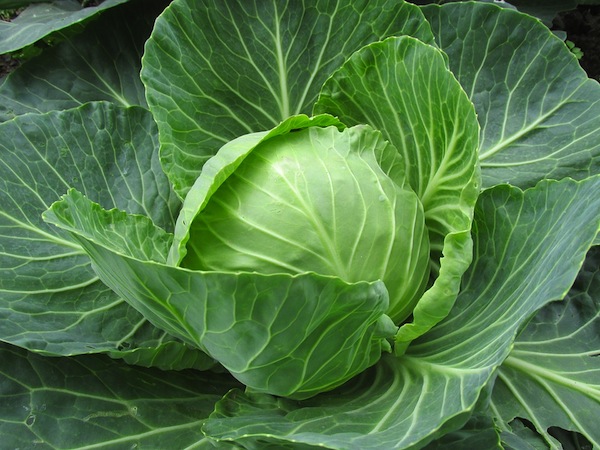
Cabbage matzah never tasted so … good? (photo from pixabay.com)

Have you ever eaten cabbage matzah? Probably not. But, in Chelm, the village of fools, they still talk about it….

Many winters ago, to battle an outburst of influenza, the villagers of Chelm used all their chickens and most of their vegetables to feed their sick neighbours in Smyrna a healing chicken soup. The Smyrnans got better, but, in Chelm, all that was left was cabbage.

Because of this food shortage, the Chelmener ate cabbage for breakfast, lunch and dinner. Mrs. Chaipul in her restaurant served cabbage porridge, cabbage stew, cabbage stuffed with cabbage, cabbage brisket (don’t ask) and cabbage cake for dessert.

No one was happy. The children whined, teenagers complained, fathers groused and mothers growled and snapped. Only Doodle the orphan, who had an unfathomable love of cabbage, enjoyed the food. But, he quickly learned to keep his appreciation to himself.

Reb Cantor the merchant had hoped for a delivery, but supplies were not expected to arrive until after Passover.

One morning, there was a timid knock on the door to Rabbi Kibbitz’s study.

“Go away!” The learned man was cranky from excessive consumption of cabbage.

Rabbi Abrahms nudged Reb Stein the baker into the room. “We’ve come up with a solution.”

“Rye bread?” Rabbi Kibbitz’s eyes gleamed hungrily. “Challah? Babke? Strudel?”

“Stop it! No!” Reb Stein cried. “You’re making me hungry. I have invented cabbage matzah.”

The wise rabbi stared at his friend the baker. “That sounds horrible.”

“It is,” Reb Stein admitted.

“But it’s kosher for Passover!” explained Rabbi Abrahms, the mashgiach responsible for everything kosher.

“No one is going to want it.” The poor baker was near tears.

“Bake it anyway,” sighed Rabbi Kibbitz. “I’ll pay for it out of the discretionary fund.”

Reb Stein nodded glumly and returned to his bakery.

The weather was fine that year, so the villagers planned the community seder to be outdoors in the round village square.

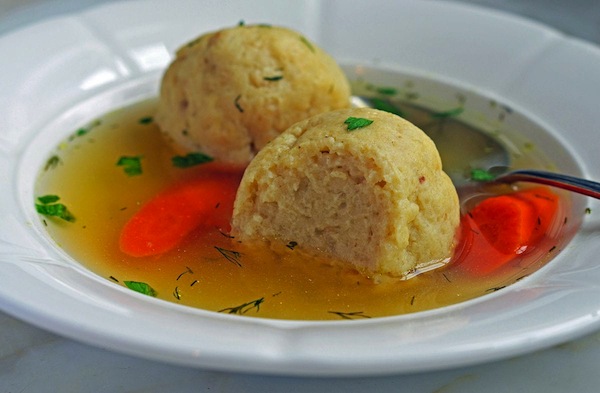
“The menu is a marvel,” Mrs. Chaipul sarcastically explained to Rabbi Kibbitz. “Cabbage ball soup, chopped cabbage liver, poached cabbage, braised cabbage, cabbage charoses and, of course, Reb Stein’s cabbage matzah for the afikomen.”

Rabbi Kibbitz suppressed a wave of nausea. “At least we’ll be outside, so we won’t smell it.”

Aside from young Doodle, no one was looking forward to Passover.

On erev Pesach, everyone trudged to the round village square to commemorate the Exodus from Egypt. With a sigh and a blessing, the service began.

The wine flowed. Reb Cantor the merchant had opened a locked cellar and rolled five barrels of “I don’t know what vintage it is, but it’s not cabbage” to the round square.

“This is truly the bread of affliction,” Rabbi Kibbitz said as the thick brassica afikomen snapped with a resonating crack!

Reb Stein looked doleful.

At last, after the Hamotzi, everyone tasted the so-called matzah.

It was revolting. Not only was the greenish cabbage matzah bitter and sour and cabbage-flavoured, it was dry and stuck to the roof of your mouth and your teeth like grout on tile.

Everyone quickly mumbled another blessing, and gulped down another cup of wine.

Through his tears, Reb Stein the baker, who was a craftsman at heart, began to laugh. His laughter spread around the table. It grew loud. It grew raucous.

Young Doodle took the opportunity to jump up onto a table and bang his glass with a spoon.

Quickly the laughter died down. Such behaviour in the middle of a seder had never been seen! Fortunately, Doodle had taken off his shoes and wore clean socks because Mrs. Kimmelman never would have forgiven him for getting dirty footprints on her best tablecloth.

Doodle began, “I know that you all hate cabbage!”

There were cheers and boos and applause.

“But,” he continued, “I look around and see my whole community gathered together and I can’t help but think how grateful I am. We have our health. We have our homes. We have one another to support us.”

It is rare for the villagers of Chelm (or indeed any gathering of Jews at mealtime) to fall quiet, but a hush spread.

“We are blessed that we live in peace and freedom, and are not enslaved.”

Now there was nodding and shouts of, “Amen!”

“Raise a glass with me,” Doodle said.

All glasses were held high.

“For this cabbage that we eat tonight,” Doodle said, “represents the hope that, one day, all women, all men, all people will be freed from oppression and slavery.”

“And freed from more cabbage!” heckled Adam and Abraham Schlemiel together.

“May we all live in peace!” shouted Rabbi Kibbitz, who had gotten completely caught up in the moment.

Then, with a rousing “Mazel tov!” the villagers of Chelm toasted, drank and ate with gusto.

The next morning, Rabbi Kibbitz realized something as he talked with Mrs. Chaipul.

“Actually, that was one of the best seders ever. And the food.…” The wise old man looked around the restaurant to make sure no one else was listening. “The food was delicious.”

The wise old woman smiled, thought about it, nodded and asked, “So, shall I order some cabbage matzah for next year?”

“No,” laughed the rabbi. “Never again!”

Mark Binder is the author of The Misadventures of Rabbi Kibbitz and Mrs. Chaipul, Matzah Misugas, and many other “Life in Chelm” stories. Visit his website at markbinderbooks.com.

* * *

Reb Stein’s Kroyt Matzah

  • Grind one large dried cabbage very fine.
  • Stir in just enough water, so it forms a gruel-like slurry.
  • No salt. No yeast!
  • Spread it thickly with a trowel on a baking sheet.
  • Bake in a really hot oven until crisp but not black.
  • Serve with cabbage butter, chopped cabbage livers (don’t ask) and cabbage jam.
  • Enjoy with friends and family.

Pyramids on the Mind

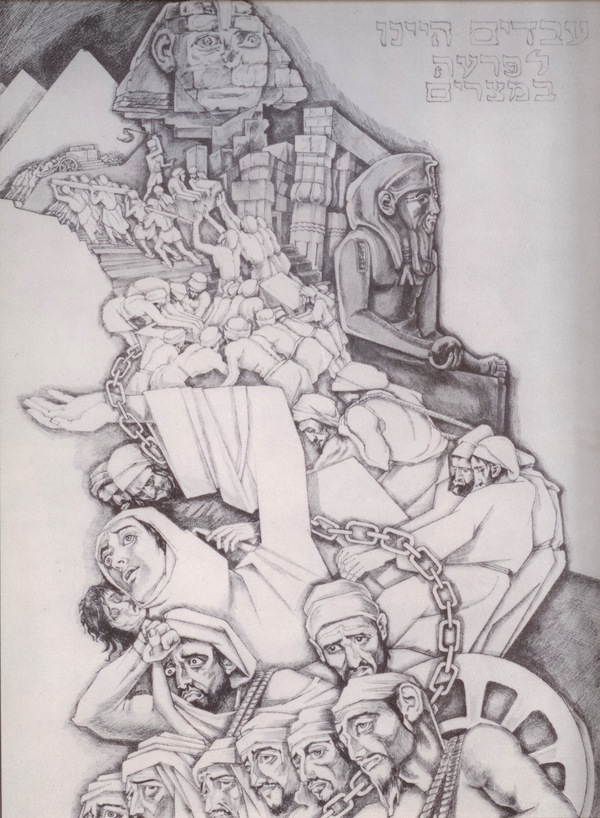
An image from the author’s 1941 Passover Haggadah by Saul Raskin.

Although they are not specifically mentioned in either the Haggadah or in the Torah, Egyptian pyramids have come to be associated with the Pesach story. That many modern Haggadot include illustrations of the pyramids points to how these structures play a key role in our collective memory.

At the Pesach seder, we say, “tze u l’mad,” “go out and learn.” In A Haggadah Happening, Rabbi Shlomo Riskin explains the idea as, “make sure your learning accompanies you wherever you go.” So what better way is there to appreciate the Hebrew slaves’ hardships than to visually present them by tangible symbols, such as the items on the seder plate, as well as the Four Sons, songs like “Ehad Mi Yodaya” (“Who Knows One”) and, of course, the pyramids?

But what specifically drew the Haggadah compilers to the pyramids? First of all, for a period of time, the Hebrews did live in Egypt. Thus, in Exodus, Chapter 5, we read about their involvement in Egyptian construction, where they are portrayed primarily as Egyptian brick-makers, not as builders: “‘Ye shall no more give the people straw to make brick, as heretofore. Let them go and gather straw for themselves.’ And the taskmasters of the people went out, and their officers, and they spoke to the people, saying: ‘Thus saith Pharaoh: “I will not give you straw.”’ So the people were scattered abroad throughout all the land of Egypt to gather stubble for straw. And the taskmasters were urgent, saying: ‘Fulfil your work, your daily task, as when there was straw.’”

Archeologists maintain that, in antiquity, Egyptian homes were constructed from mud bricks. Pyramids, however, were reportedly built of quarried, hewn stone and mud bricks. So, the more persuasive answer as to why modern Jews include pyramids in their Haggadot seems to be the pyramids’ sheer durability. That there are extant pyramids carries tremendous weight when retelling the story of the Hebrews’ time in Egypt – it connects us to our past.

Furthermore, that pyramids are still viewable is not a chance happening, apparently. According to freelance science writer Dr. Craig Freudenrich, the pharaohs built the pyramids knowing that the pyramid, with its square base and four equilateral triangular sides, is “the most structurally stable shape for projects involving large amounts of stone or masonry.”

Moreover, Donald Redford, a professor at Penn State University, reports that the ancient Egyptians probably chose that distinctive form for their pharaohs’ tombs because of their solar religion. The Egyptian sun god Ra, considered the father of all pharaohs, was said to have created himself from a pyramid-shaped mound of earth before creating all the other gods. The pyramid’s shape is thought to have symbolized the sun’s rays.

The shape of the pyramids was carefully chosen to reflect underlying aspects of divine unity. The pyramid has four faces: three faces to the heavens and one face to the earth. Architecture-by-astronomy was common in the ancient world, says archeoastronomer Giulio Magli. The Great Pyramid of Giza, for example, is aligned with amazing precision along the compass points, which would have required the use of the stars as reference points.

Three pyramids were built at Giza, and many smaller pyramids were constructed around the Nile Valley. The tallest of the Great Pyramids reaches nearly 500 feet into the sky and spans an area greater than 13 acres.

What is truly startling is that, with no connection to Egypt, other ancient cultures built pyramids in such far away places as Latin America and in what is, today, southern Illinois, in the United States. Like the ancient Egyptians, these other cultures understood the power and sway the pyramid structure had over the general population. According to history.com editors: “The Americas actually contain more pyramid structures than the rest of the planet combined. Civilizations like the Olmec, Maya, Aztec and Inca all built pyramids to house their deities, as well as to bury their kings. In many of their great city-states, temple-pyramids formed the centre of public life and were the site of holy rituals, including human sacrifice.”

While Egyptian pyramids are closely connected to the sun, Peruvian pyramids were considered to be replicas of mountains; they were thought to possess all the powers the mountains themselves possessed.

Twenty minutes away from St. Louis, Mo., are the remains of the United States’ first high-rises. They are more than 850 years old, constructed by the Cahokia Indians of Illinois. At 5,000 square feet, the house of the great chief or high priest (or another type of leader, since we really don’t know) was the most impressive of all the buildings. From the flat top of this colossus, with a footprint of 14 acres, it is larger at its base than the Great Pyramid of Khufu, Egypt’s largest.

So important is the pyramid as a symbol that it was used on the U.S. one dollar bill. According to the bill’s designer, the pyramid was used because it “signifies strength and duration … a new order of the ages.”

According to Bill Ellis, a professor emeritus of American studies at Penn State, “The pyramid was seen as the kind of human structure that lasted out the ages.” He said America’s Founding Fathers wanted the country to last as long as the pyramid – though the pyramid didn’t show up on the dollar bill until 1935, when Franklin Delano Roosevelt’s administration added them. “New order” is printed in Latin, under the pyramid, and historians say this refers to the birth of a new country and FDR liked the way it synced with his New Deal program.

Whether, in fact, the Hebrew slaves actually built the Egyptian pyramids is of secondary importance, as so many freedom struggles have been based on the tale that the Hebrews had to construct these mammoth buildings until they fled the slavery of Egypt.

Deborah Rubin Fields is an Israel-based features writer. She is also the author of Take a Peek Inside: A Child’s Guide to Radiology Exams, published in English, Hebrew and Arabic.

When we unmask matzah

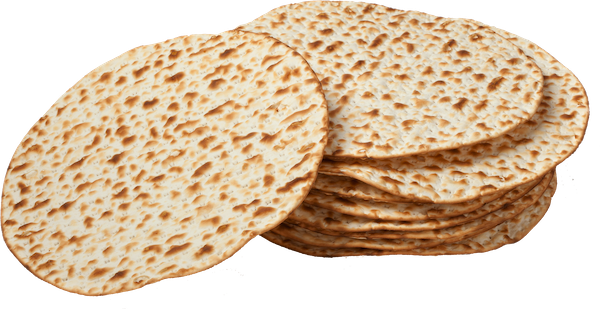
(photo from pngkey.com)

Imagine that you are sitting at your kitchen table, sewing masks for your family so that you can go outside. There are no more masks left in stock in any store near you so you are left to make them on your own. Suddenly, as you attach a button to the fabric, you hear loud shouting outside. You run to your door and cautiously peek out to see what has caused all the uproar.

You are confronted by an extraordinary sight: people are filling the streets, singing, dancing and embracing. You put on your unfinished mask and venture a little closer, but still six feet away, and ask one of the revelers what happened. She replies: “They found a cure for coronavirus. It is going to be available immediately. Everyone who is sick will immediately recover, and a vaccine will protect the rest of us.”

You stuff your half-finished mask into your pocket and join the revelry, rejoicing that the coronavirus nightmare has come to an end.

When you come back into your home the next day, you carefully place your mask on the mantel. In later years, when visitors ask why you have a piece of fabric with one button and a rubber band featured prominently in your living room, you tell them your story of how you found out that you were saved from the coronavirus pandemic, and how the fear and anxiety completely dissolved. Every time you look at that piece of fabric, you remember that your situation can change in an instant, that fear and loss can be replaced by comfort and hope.

This story may seem like wishful thinking, but it is the story we tell at our seder every Passover. Our ancestors were slaves, oppressed and fearful. They suffered and thought their suffering would never end. And then everything changed.

We recite at the seder: “This matzah – why do we eat it? To remind ourselves that, even before the dough of our ancestors in Egypt had time to rise and become leavened, the King of Kings, the Holy One Blessed be He, was revealed and redeemed them.” In less than the time it would take to bake a loaf of bread, our ancestors’ lives were totally transformed. The mightiest empire in the world was defeated by the slaves’ G-d. They became free people, about to leave their land of oppression for their own land. The bread that they had started baking in captivity became the bread that they would always associate with their liberation.

We can relate to this experience of life-altering moments in our personal lives. Think of a moment when you received a phone call or met someone and your life immediately changed. Sometimes, yes, the phone call or encounter brought sorrow or pain. But, sometimes, it brought new opportunities for joy or freedom that you never expected, and your life was never the same. Maybe, the day after despairing you would ever find a soulmate, you met the person with whom you would spend the rest of your life. Or perhaps you were at a professional crossroads and an opportunity came your way out of the blue.

Of course, the mask sitting on your mantel is not a simple thing to contemplate. It invites much more than joy. Your thoughts are so complex when you look at it. On one hand, it symbolizes recovery and deliverance and, sometimes, when asked about it, you tell about the magical moment when you learned that a cure had been found. But, other times, you recall the dark days of the virus, the many people we lost, the overwhelmed emergency rooms, our crumbled illusions that our technological competence could protect us from epidemic.

The matzah, too, is complex. The Talmud, in Pesachim, suggests that matzah is called lechem oni because it is bread that invites much discussion: “lechem she’onim alav devarim harbeh,” “bread about which we answer many things.” There is so much to say about it because it brings up so many conflicting thoughts and emotions. It reminds us of our slavery in Egypt, when we had no control over what happened to us or to the people we loved. And it also reminds us that our lives can turn around in an instant, in less than the space of time that it takes for dough to rise. It is at once both liberating and deeply unsettling. It gives us hope and it frightens us. It forces us to acknowledge that we have but an illusion of control.

At our Pesach seder, we model to the next generation how to respond to a world that is beyond our control. We try to create structure and order (seder). We acknowledge our vulnerability (“ha lachma anya” – “this is the bread of our affliction”). We help others in need, feeding them and including them at our table (“kol difchin yetei veyechol” – “all who are in need, come eat with us”).

We fight against oppression (the episode of the five rabbis in Bnei Brak). We express gratitude for all the good we have in our lives (“Dayenu”). We delve deeply into these questions and reaffirm the possibility of redemption (“and, even if we are all wise, it is still incumbent upon us to tell the story”) and share our wisdom with our children (“vehigadeta l’vincha” – “and you shall tell your children”).

We commit ourselves to building a redeemed world (“l’shana haba’ah beyerushalayim” – “next year in Jerusalem”). And, as we eat our matzah, we acknowledge with faith and humility, that we never know what will come next.

Aliza Sperling teaches Talmud at the Yeshivat Maharat/Yeshiva Chovevei Torah Beit Midrash Program and directs Svivah’s HerTorah, an inclusive and open women’s learning community. She serves as a Shalom Hartman Institute research fellow and a Wexner faculty member, and articles by Sperling and other institute scholars can be found at shalomhartman.org. This article was originally published on blogs.timesofisrael.com.

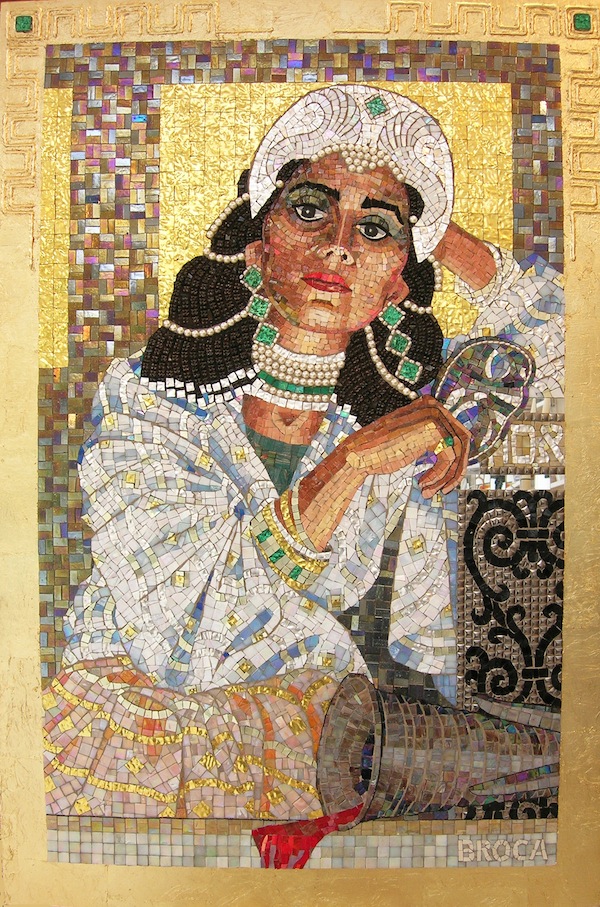
Happy Purim!

“Queen Esther Revealing Her True Identity” by Lilian Broca.

“Queen Esther Revealing Her True Identity” by Lilian Broca
“Queen Esther Revealing Her True Identity” by Lilian Broca.

“Queen Esther Revealing Her True Identity” is the last mosaic of artist Lilian Broca’s Queen Esther Mosaics Series in chronological order. A mature and confident Queen Esther in her most expensive and beautiful attire is removing the mask – the symbol of her secret identity – revealing an intelligent and self-assured leader. On the table, a rhyton (Persian gold or silver drinking vessel) is knocked over, spilling its red wine contents; the wine symbolizing the spilled blood of the Hebrew people as planned by Haman. The plotted genocide is now averted, however, through Queen Esther’s disclosure to her husband, King Ahasuerus, of Haman’s evil design. In this mosaic, Broca notes that it is her intention to “iconize” Queen Esther as a paragon of supreme leadership, loyalty, wisdom and vision. In a patriarchal society, this unique female figure succeeded in bringing peace through accommodation, cooperation and negotiation. Her hero status enables her to become a role model for all women, then and now.

For more information on Broca and her art, visit lilianbroca.com.

Fruits for the holiday

The holiday of Chamisha Asar b’Shevat or Tu b’Shevat is not mentioned in the Torah but makes its first appearance in the Talmud, where it is called Rosh Hashanah l’Ilan (New Year of the Tree).

Jewish literature of the sixth to 11th centuries identifies Tu b’Shevat as the day on which the fate of the trees and fruit is decided. The holiday gets its name from when it occurs. “Tu” is an acronym for the Hebrew letter tet, which in the Hebrew system of counting is nine, and the letter vav, which is six, thus adding up to 15, the day on which the holiday falls in the month of Shevat.

The date was chosen when the rabbinic schools of Hillel and Shammai (from the time of the Second Temple) argued about the dates. Hillel said it fell on the 15th of Shevat; Shammai said it began on the first. Hillel’s opinion prevailed because it was thought that, by the later date, the winter rains in Israel were almost over.

Tu b’Shevat links Jews to the land of Eretz Yisrael. In the time of the Second Temple, on the 15th of Shevat, Jewish farmers would estimate their obligatory tithes for tax collectors, as well as other contributions that Jewish law required. In effect, Tu b’Shevat was the beginning of the new fiscal year.

Part of the celebration is a seder with certain foods.

In her book The Jewish Holiday Cookbook, Gloria Kaufer Greene mentions that the drinking of four cups of wine at the seder symbolizes the changing of seasons. She suggests that the first cup is chilled, dry, white wine, to symbolize winter. The second cup of wine is pale, perhaps a rosé, and signifies spring and the early thaw. The third cup of wine is deeply coloured, like a dark rose, and represents the late spring and the blossoming trees. The fourth cup of wine is rich and red and stands for the fertility of summer.

In between drinking, one eats fruit in order of “ascending spirituality.” After the first cup of wine, one eats fruit with inedible coverings, like almonds, avocado, banana or melon, to represent the body covering the soul. After the second cup, one eats fruit with pits, such as plum, prune, date, apricot, olive or carob, to symbolize the heart being protected. After the third cup of wine, one eats fruit that can be eaten in its entirety, such as berry, apple, pear or fig, because they are closest to the pure spiritual creation.

In Encyclopedia of Jewish Food, the late Rabbi Gil Marks lists different ethnic dishes for the holiday, including borleves, Hungarian wine soup; salata latsheen, Moroccan orange salad; dimlama, Bulgarian vegetable and fruit stew; savo, Bukharian baked rice and fruit; gersht un shveml, Ashkenazi barley with mushrooms, fruit strudels and fruit kugels; and schnitzelkloese, German fried dumplings with fruit. Food customs associated with Tu b’Shevat are fruits and nuts connected to Eretz Yisrael, such as the seven species mentioned in Deuteronomy 8:7-8 – barley, wheat, figs, dates, grapes, olives and pomegranates.

Here are a couple of my fruit recipes. The first is one that a friend gave me about 40 years ago.

CREAMY FRUIT SALAD
6-8 servings

2-3 cut up apples
1-2 peeled, cut-up oranges
2-3 cut-up bananas
1/4 cup coconut
1/4 cup chopped nuts
3/8 cup sour cream or 3/4 cup lemon yogurt
1 1/2 tbsp sugar or whipped cream
1/8 cup orange juice
3/8 cup vanilla yogurt
raisins (optional)

Combine apples, orange and bananas in a bowl. Add coconut and nuts. Combine sour cream or lemon yogurt, sugar or whipped cream, orange juice and vanilla yogurt. Pour over fruit and refrigerate.

I have altered this recipe at times and use pareve whipping cream to make it pareve, leaving out the sour cream/yogurt.

HOT SPICED FRUIT
4 servings

6 peaches, pears or apricots, halved
1/2 cup red wine
2 tbsp sugar
dash cloves
1/8 tsp cinnamon
dash cardamom
3/4 tsp grated orange peel

Combine wine, sugar, cloves, cinnamon, cardamom and orange peel in a saucepan. Add fruit and cook 15-20 minutes. Drain and reserve liquid. Chill fruit. Serve with vanilla ice cream. Spoon sauce on top.

Sybil Kaplan is a journalist, lecturer, book reviewer and food writer in Jerusalem. She created and leads the weekly English-language Shuk Walks in Machane Yehuda, she has compiled and edited nine kosher cookbooks, and is the author of Witness to History: Ten Years as a Woman Journalist in Israel.

Variations on latke tradition

With all the oil used for frying Chanukah potato pancakes – otherwise known as latkes, in what we think is Yiddish, or as levivot in Hebrew – they may be considered an unhealthy food. Yet, each Chanukah, many of us, who are staunch-hearted and old-fashioned, spend time grating potatoes by hand, always accidentally suffering at least one scraped finger. The more modern among us risk coming out with liquid mush by using a food processor or blender.

Why do we keep making these little pancakes year after year? Why do we eat them for Chanukah in the first place? An old folk proverb says: “Chanukah latkes teach us that one cannot live by miracles alone.”

Jewish food writer and cookbook author Joan Nathan contends that the word latke is not in fact Yiddish but rather stems from “a Russian word, latka, and a pastry, from obsolete Russian, oladka, or flat cake of leavened wheat dough.” This, in turn, probably came from a Middle Greek word, eladion, or oil cake, stemming from elaion, meaning olive oil.

Potato pancakes seem to have originated among poor Eastern European Jews, but potatoes did not become a staple until the mid-19th century. John Cooper, in Eat and Be Satisfied: A Social History of Jewish Food, comments that Jews from Lithuania ate pancakes made from potato flour for Chanukah and had borrowed the idea from Ukrainians, who made a potato pancake dish with goose fat called kartoflani platske, which they ate for Christmas. Since Chanukah fell about the same time, and there were plenty of geese to provide goose fat or schmaltz, we could conclude that schmaltz became a substitute for oil. Jews living in the Pale of Settlement in the 17th century probably adapted it for Chanukah as a way to dress potatoes differently for the holiday. Cooper also states that many Eastern European Jews ate buckwheat latkes for Chanukah, while Polish Jews made placki, pancakes, from potato flour and fried them in oil.

Here are a few types of latkes that would be nice to serve during Chanukah.

ROMANIAN ZUCCHINI POTATO LATKES
(six to eight servings)

2 pounds zucchini, peeled and grated down to the seeds
2 large potatoes, grated
1 medium onion, grated
3 eggs
1 tsp vegetable oil (I use canola)
3/4 cup matzah meal (I use flour)
salt and pepper to taste
vegetable oil for frying

  1. Grate zucchini down to the seeds, discard the seeds and squeeze out the liquid.
  2. Peel potatoes and grate. Remove liquid.
  3. Grate onion and add to zucchini-potato mixture.
  4. Add eggs, oil and half a cup of matzah meal or flour. Add more if necessary.
  5. Season with salt and pepper.
  6. Heat oil in a frying pan. Spoon mixture into pan and brown on both sides.
  7. Serve hot with sour cream or applesauce. You can add carrots, parsley and dill.

TUNA LATKES
This recipe came from Starkist Tuna, with adaptations. It makes 16 latkes.

2 cans drained tuna
2 grated potatoes
1 chopped onion
2 eggs
2 tbsp breadcrumbs
3 tsp dry parsley flakes
3 tsp dry chives
salt and pepper to taste
2/3 cup flour
oil

dressing
1 cup sour cream
3 crushed garlic cloves
4 tbsp olive oil
6 tsp dry herbs such as chives, thyme or dill or mixed
1 tbsp sugar
salt to taste

  1. In a bowl or jar with a lid, mix sour cream, garlic, oil, herbs, sugar and salt. Refrigerate.
  2. Heat oil in a frying pan and fry onions until golden.
  3. Crumble tuna in a bowl. Add potatoes, onion, eggs, breadcrumbs, parsley, chives, salt and pepper.
  4. Place flour in a shallow plate. Form round patties and dip in flour. Add oil to frying pan. Fry patties until golden. Drain on paper towels.
  5. Serve on a platter with dressing on the side.

HERBED ZUCCHINI FETA LATKES
With a few changes, this recipe is from Food & Wine and is by Didem Senol, a chef from Istanbul, Turkey, who trained at the New York French Culinary Institute. It makes four to six servings.

4 medium grated zucchini
1 tbsp kosher salt
2 large eggs
1/2 cup flour
1/2 cup chopped dill
1/4 cup chopped parsley
1/2 cup crumbled feta cheese

sauce
1 seeded chopped, peeled cucumber
1 cup sour cream
salt and pepper to taste
vegetable oil

  1. Place zucchini in a colander, sprinkle with salt, toss and let stand five minutes. Squeeze out liquid and transfer to a bowl.
  2. Add eggs, flour, dill, parsley and feta. Refrigerate 10 minutes.
  3. Puree cucumber in food processor and transfer to a bowl. Stir in sour cream, salt and pepper.
  4. Preheat oven to 350°F. Heat oil in a frying pan and then, working in batches, drop tablespoons of batter into the hot oil and fry until brown and crisp. Transfer to a baking sheet and keep warm in oven.
  5. Serve with sour cream-cucumber sauce.

Sybil Kaplan is a journalist, lecturer, book reviewer and food writer in Jerusalem. She created and leads the weekly English-language Shuk Walks in Machane Yehuda, she has compiled and edited nine kosher cookbooks, and is the author of Witness to History: Ten Years as a Woman Journalist in Israel.

Festival of light & song

Chanukah lights on Agron Road in Jerusalem, 2012. (photo from Djampa)

History tends to repeat itself or, as Sholem Aleichem put it, The Wheel Makes a Turn. In this story, he wrote about Chanukah, depicting a proud Jew lighting the nine-branched candelabrum, celebrating this festival of dedication and liberation with warmth and affection. Later in the story, this same Jew, now old and infirm, is barely allowed to light the chanukiyah by his assimilated son, while his grandson is not even allowed to watch. The story ends when the grandson is an adult, and celebrates Chanukah with his friends to the dismay of his “modern” parents who cannot understand why their son has rejected their assimilation and returned to his Jewish roots.

Chanukah is one of Israel’s favourite festivals, widely celebrated even by secular Jews. Unlike in the Diaspora, it doesn’t have to compete with the glamour of Christmas, with its shopping frenzy, Santa Claus, carols and other Christian symbols of the holiday, which can be very seductive, even to Jews.

In Jerusalem during the Festival of Lights, you can see chanukiyot and their tiny, multi-coloured candles on almost every windowsill and, at sunset, you’ll hear voices from quivering childish soprano to deep baritone, all singing “Maoz Tzur” (“Rock of Ages”). There is a candlelighting ceremony, as well as free sufganiyot (jelly doughnuts), in my local supermarket every evening for the whole eight nights, and a giant menorah burns atop the Knesset and many public buildings and water tower reservoirs throughout the country. Gifts are exchanged, children receive Chanukah gelt, often in the form of chocolate coins, and dreidels, spinning tops inscribed with the first letters of the Hebrew words for the phrase: “A great miracle happened here.”

The Zionist movement has used Chanukah as a symbol and historical precedent of national survival. The Maccabi sports organization was named after the Maccabees, who are the stars of the holiday, and it holds the Maccabiah Games every four years, just like the Olympics.

The singing of “Maoz Tzur” is a feature of the holiday with mysterious origins. The only clue to its composer is the acrostic of the first five stanzas, spelling out the name “Mordecai”; such naming was a common practice at the time and one used in a lot of zemirot (Sabbath songs). Many scholars believe the composer to be Mordecai ben Isaac, who lived in Germany in the 13th century.

There is a Chabad saying: “Song opens a window to the secret places of the soul.” It is hard to define what makes music specifically Jewish, and many categories exist, including Chassidic, Yiddish, Yemenite, Moroccan, Kurdish, Israeli, secular, religious … the list comprises a broad range.

There is nothing in Jewish law against creating new tunes for hymns. The Gerer Rebbe once stated: “Were I blessed with a sweet voice, I would sing you new hymns and songs every day, for, with the daily rejuvenation of the world, new songs are created.”

Rebbe Nachman of Bratslav wrote: “How do you pray to the Lord? Come, I will show you a new way … not with words or sayings, but with song. We will sing and the Lord on high will understand us.”

When we sing “Maoz Tzur” as a family, grouped around the candles, there is harmony of a special kind. The harmony is not just in the song, but in the sanctity and affection that binds the family and gives it a foundation as solid as a rock.

In painful times for Israel, which has seen so much suffering and loss throughout its history, it brings a measure of comfort to be able to recite the traditional blessing: “Blessed art Thou, O Lord our G-d, King of the Universe, who has kept us in life and hast preserved us, and enabled us to reach this season.” This year, amid the pandemic, the blessing resonates even more deeply. Happy Chanukah!

Dvora Waysman is a Jerusalem-based author. She has written 14 books, including The Pomegranate Pendant, which was made into a movie, and her latest novella, Searching for Sarah. She can be contacted at dwaysman@gmail.com or through her blog dvorawaysman.com.

Celebrate helping & helpers

The Ninth Night of Hanukkah begins, appropriately enough, on the first night of the holiday…. Dad has brought pizza for dinner and Max and Rachel and their parents eat it among unopened and partially opened boxes in their new apartment. (image from book)

Change is a constant in our lives and things don’t always go as planned. Learning how to deal with the unexpected and to be able to ask for help and to be appreciative of it are all valuable lessons. And when such concepts can be literally illustrated and told in story form, they tend to stick better.

The Ninth Night of Hanukkah, written by Erica S. Perl and illustrated by Shahar Kober, is about home and helping, and takes its inspiration from the ninth candle on the chanukiyah, the shamash (Hebrew) or shammes (Yiddish), the helper candle. At the darkest time of the year, family, friends and community are the main lights that get us through and, especially amid the pandemic, a reminder of the love and support we have around us is particularly important.

image - The Ninth Night of Hanukkah book cover

The Ninth Night of Hanukkah begins, appropriately enough, on the first night of the holiday. But something is different. Dad has brought pizza for dinner and Max and Rachel and their parents eat it among unopened and partially opened boxes in their new apartment. Their cat looks on. “No menorah? No latkes?” the kids wonder. Mom assures them that, tomorrow, they’ll find the Chanukah supplies amid all their things.

On the second night, Max and Rachel make a menorah with some wood, nuts and bolts, paint and glue. Not only is their real menorah still missing but the candles can’t be found either, so the kids – with Mom’s permission – go off to borrow some candles from a neighbour, and Mrs. Mendez in 2C happily obliges.

Each night, the family makes do with the help of a different neighbour. Each night is nice, “but it didn’t feel quite like Hanukkah.”

Spoiler alert … eventually, the box with the family’s holiday stuff arrives – but too late. The delivery comes on Day 9. But Max and Rachel are not so easily deterred. They concoct a plan to celebrate the holiday and their neighbours. “And, best of all, it felt exactly like Hanukkah.”

Perl’s text has a rhythm. The repetition each night of how “it didn’t feel quite like Hanukkah” accents how hard it is to accept new situations. Yet the fact that the family makes each night special, shows that, despite what we might be thinking or feeling, we can act in ways that still celebrate life and all for which we are grateful.

The illustrations by Kober are colourful, with a retro feel, and have a lot of energy. Creative use of white space helps direct the action. And the two-page spreads have an expansive feel to them, like the reader is right there in the apartment with Max, Rachel and their family and new friends.

The book ends with a nice note from Perl about Chanukah and her family’s tradition, followed by a list of nine ideas of how to make your own “Shamash Night.”

A PJ Library book, which is also available from most any bookseller, The Ninth Night of Hanukkah lights all the right candles and would make a great holiday gift.