Fostering nature’s care

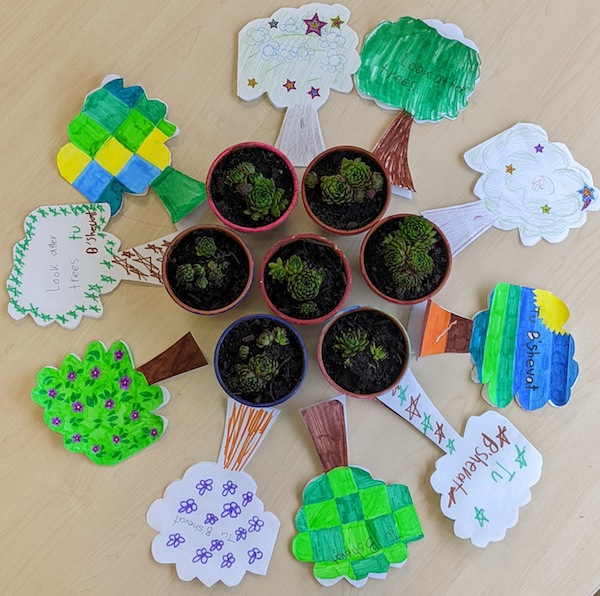
Richmond Jewish Day School held a week of activities revolving around Tu b’Shevat. (photo from RJDS)

Richmond Jewish Day School held a weeklong event celebrating the holiday of Tu b’Shevat, which fell this year on Jan. 17. Tu b’Shevat has developed into an ecological holiday that reminds us of humanity’s connection to the earth and to our role as caretakers of the environment.

photo - Students assisted in planting several fruit trees in the school garden, sponsored by the Jewish National Fund
Students assisted in planting several fruit trees in the school garden, sponsored by the Jewish National Fund. (photo from RJDS)

On the holiday Monday, each classroom performed a model Tu b’Shevat seder, a meal that partly mirrors the Passover seder and involves eating biblical foods native to the Holy Land and drinking four cups of wine or, in the students’ case, grape juice. Additionally, all of the students assisted in planting several fruit trees in the school garden, sponsored by the Jewish National Fund.

On the Tuesday of that week, students potted succulents from the garden to give away to seniors in the Richmond community. And, in the remainder of the week, classes planted parsley and other herbs for Passover, and assisted in a large-scale, school-wide garden clean-up.

When students are able to see the effort and care needed to grow plants, they develop a sense of ownership for these living organisms. Developing this awareness of how precious nature is can help children become better connected to their environment, learning to be strong community ambassadors and advocates in protecting the planet.

Judaism is not alone in advocating for environmental protection. From Buddhism to Christianity to Hinduism to Islam, various faiths acknowledge the need for environmental stewardship and their scriptures urge followers to be caretakers of the planet, looking after the natural earth and the organisms that live in it.

– Courtesy Richmond Jewish Day School

It’s that time of year

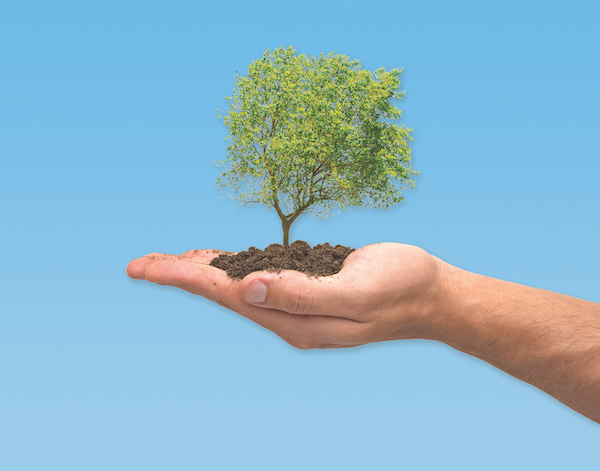
Tu b’Shevat is a popular day to go into the fields and plant saplings. (photo from usa.jnf.org)

‘In Israel, just before the Hebrew month of Shevat, the landscape begins to change. It has been winter; the fruit trees bare, their leafless, light grey branches silhouetted against dark clouds. Then, as Shevat is ushered in, they begin to bud, and reddish leaflets burst forth. Fields that have been covered with pale crocuses, white narcissus and cyclamens give way to red anemones, tulips and broom bushes starred with flowers. And the almond trees burst into blossom – the first harbinger of spring. It is at this time we celebrate Tu b’Shevat, the 15th of Shevat, which is known as the New Year of the Trees.

Tu b’Shevat, which falls this year on Jan. 17, is mentioned in the Mishnah as one of the four “natural” new years. The first of Nisan is the “new year for Jewish kings and seasonal feasts”: that is, for calculating the reigns of Israelite kings and determining the cycle of calendar festivals. The first of Elul is the new year “for tithing cattle” and the first of Tishri is the new year for calculating septennial cycles and 50-year jubilees.

The new year for the trees was moved from the first of Shevat to the 15th in accordance with the opinion of Rabbi Hillel (30 BCE – 10 CE), for it is then that the sap begins to rise with the full moon, in Israel’s fruit trees. The Babylonian and Jerusalem Talmuds also designate Tu b’Shevat as the date to calculate taxes on fruit: “You shall tithe all the yield of your seed, which comes forth from the field year by year.” (Deuteronomy 14:22)

During the days of winter, Israel’s fruit trees are dormant. It is wet and cold and, because of the low temperatures, the trees cannot absorb the nutrients from the soil. But, regarding the 15th of Shevat: “Till this day [the trees] live off the water of the past year; from this day on, they live off the water of this year.” (Jerusalem Talmud, Rosh Hashanah 1.2)

This date is the start of the fruit’s formation. Arabs also mark it, calling it “the second ember,” when fruit trees begin to absorb water. According to Arab folklore, there are three “embers,” which began as fire falling from the sky and changed to caterpillars. The first falls from the sky when the earth begins to warm up; the second when the warmth spreads. They follow this with a third “ember,” as summer begins.

Tu b’Shevat is one of Judaism’s popular celebrations that does not involve special synagogue services. It is a day when it is customary to eat the fruits of Israel: apples, almonds, carobs, figs, nuts and pomegranates. Many scholars stay up late on the eve of the holiday, reciting biblical passages dealing with fruits or the earth’s fertility. They read from Genesis how trees were created along with all the plants of the earth; from Leviticus, the Divine promise of abundance as a reward for keeping the commandments; and from Ezekiel 17, the parable of the spreading vine, symbolizing the people of Israel.

Kabbalists hold a special seder for Tu b’Shevat and they celebrate, not so much the new year of the trees, but the New Year of the Tree, meaning the Tree of Life, which is rich with mystical connotations. At the seder, they drink four cups of wine, beginning with white wine and ending with red, with the second cup a mixture more of white and the third more of red wine. It is rather like how the landscape changes from white (the pale narcissus and crocus) to red (anemones and tulips) as Tu b’Shevat approaches.

Tu b’Shevat is a popular day to go into the fields and plant saplings. Over the last several decades, Israeli schoolchildren have helped Keren Kayemeth, the Jewish National Fund, plant 130 million trees, many of them on Tu b’Shevat, and these evergreens have become the backbone of the reforestation program.

Tu b’Shevat affirms that the soil of Israel is holy. And the New Year of the Trees reminds us annually of the wonder of God’s creation.

Dvora Waysman is a Jerusalem-based author. She has written 14 books, including The Pomegranate Pendant, which was made into a movie, and her latest novella, Searching for Sarah. She can be contacted at dwaysman@gmail.com.

A Methuselah update

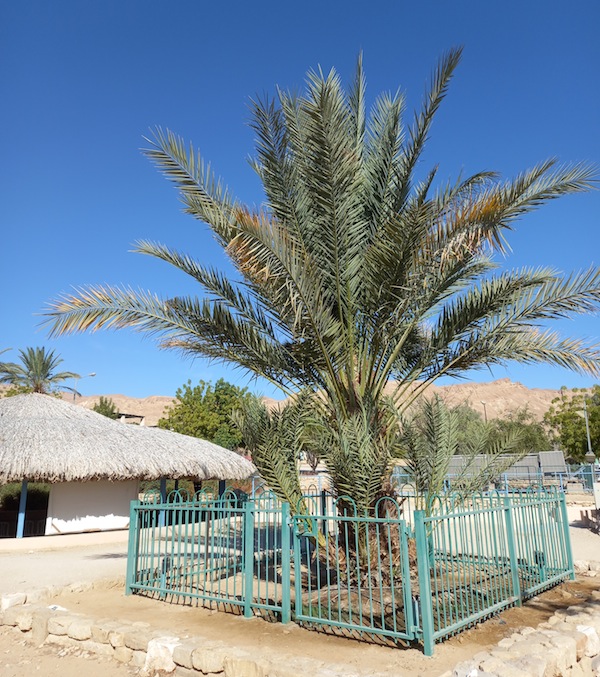
Methuselah’s roots go back to the time of Masada, and even earlier. (photo from Arava Institute)

For many years, in anticipation of Tu b’Shevat, I have written about a date palm tree in the Arava that fascinates me – Methuselah.

Methuselah’s relatively new beginnings can be attributed to London-born Dr. Sarah Sallon, director of the Louis Borick Natural Medicine Research Centre at Hadassah Medical Centre, and California-born botanist Dr. Elaine Solowey of the Arava Institute for Environmental Studies at Kibbutz Ketura.

According to Sallon, “in 2005, we were interested in rejuvenating lost flora of Eretz Yisrael. One of the lost flora is the Judaean date. I was discussing with some scientists about their work, trying to extract DNA from ancient seeds.”  Sallon asked, “If we had ancient seeds, why couldn’t we grow them?”

From 1963 to 1965, archeologists Yigal Yadin and Ehud Netzer excavated the fortress Masada, which was built by King Herod between 37 and 31 BCE and was home to almost a thousand zealots until the Romans breached the wall in 72 CE and found the bodies of the Jews who had lived there and killed themselves, rather than being taken as prisoners. At the site, Yadin and Netzer found date palm seeds, which were subsequently stored at Bar-Ilan University.

Sallon asked Netzer for a few seeds, and received five. She took them to Solowey, who took three of the 2,000-year-old seeds and planted them in January 2005. Other seeds were sent to the University of Zurich, in Switzerland, for radiocarbon dating. They were also tested to see if they had anti-bacterial, anti-viral, anti-cancer, anti-fungal, anti-malarial, anti-oxidant or other medicinal properties.

The date palm is one of the best medicinal trees. Domesticated more than 6,000 years ago, it can be male or female, and produces dates. Medicine of the date palm has been used for lung disease, colds, heart disease, hair growth and other things.

After eight weeks, in 2005, one seed successfully germinated and was named Methuselah, after the biblical person who was said to have lived 969 years.

Initially, the first leaves had white spots because of a lack of chlorophyll. At 15 months, the seedling was transferred to a larger pot. After 26 months, the plant showed normal development.

In 2011, when its exact location was being kept a secret, I was permitted to see a photograph of Methuselah. At the time, it was two metres high and in a “protected quarantine site,” due to its scientific and financial value.

In April 2011, a white flower appeared on the inner part of the tree, indicating that Methuselah was male. In 2017, there was hope for Methuselah to be bred with a female tree to produce the same date variety that was common in ancient Judea.

In December 2019, Solowey sent me an update on Methuselah – he had grown to four metres tall. Also during that year, Solowey had gotten six ancient date seeds from archeological sites: “Adam” from Masada; “Jonah,” “Uriel,” “Boaz” and “Judith” (or “Yehudit’) from Qumram; and “Hannah” from Wadi Makukh, a winter water channel in the Judean desert surrounded by high cliffs and containing a number of caves that were surveyed from 1986 to 1989.

Early that December, Methuselah was pollinated by Hannah and Solowey cultivated 111 semi-dry dates, “really nice, big, blondish, semi-dry dates from her with a honey aftertaste.”

In March 2020, Hannah flowered, and Solowey told me: “we are thinking of making a genetic line from Hannah.”

At the end of November 2021, Solowey wrote to me again. She said, “Well, we got 600 beautiful dates from Hannah (whose seed was 175 years older than Methuselah’s seed) this September. We planted Yehudit, another female, on Sukkot. We are considering tissue culture. I have two males still in the greenhouse.”

Sybil Kaplan is a journalist, lecturer, book reviewer and food writer in Jerusalem. She created and leads the weekly English-language Shuk Walks in Machane Yehuda, she has compiled and edited nine kosher cookbooks, and is the author of Witness to History: Ten Years as a Woman Journalist in Israel.

Festive candlelighting

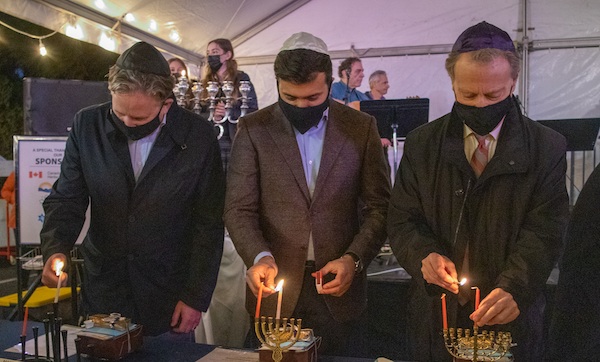
Left to right, Vancouver Mayor Kennedy Stewart,  MP Taleeb Noormohamed and MLA George Heyman light the chanukiyah. (photo by Jocelyne Hallé)

The Jewish Community Centre of Greater Vancouver (JCCGV), the Centre for Israel and Jewish Affairs (CIJA), and the Canadian Jewish Political Affairs Committee (CJPAC) welcomed elected officials representing all levels of government and political parties, as well as other distinguished guests, to light a candle on the first night of Chanukah, Nov. 28.

Member of Parliament Taleeb Noormohamed (Vancouver-Granville) spoke on behalf of the Government of Canada. Member of the Legislative Assembly George Heyman (Vancouver-Fairview) and MLA Melanie Mark (Vancouver-Mount Pleasant) were joined by MLA David Eby (Vancouver-Point Grey), and they presented remarks from the government of British Columbia, while MLA Michael Lee (Vancouver-Langara) spoke on behalf of the Official Opposition. Vancouver Mayor Kennedy Stewart also said a few words.

photo - Left to right: MLA George Heyman, Jewish Federation CEO Ezra Shanken, MLA David Eby and MLA Melanie Mark
Left to right: MLA George Heyman, Jewish Federation CEO Ezra Shanken, MLA David Eby and MLA Melanie Mark. (photo by Jocelyne Hallé)

JCCGV board chair Alvin Wasserman led the ceremony, with Rabbi Stephen Berger and two students from King David High School guiding the candlelighting. Vancouver klezmer band Tzimmes performed classic Chanukah music, with people of all ages singing and clapping along.

The celebration took place under one of the tents of the JCCGV Chanukah Market. A highlight was singing the blessings with each of the guests, many of whom were lighting a chanukiyah for the first time.

photo - Vancouver Park Board commissioner Tricia Barker, left, CIJA Pacific Region chair Geoffrey Druker and Vancouver city councilor Sarah Kirby-Yung
Vancouver Park Board commissioner Tricia Barker, left, CIJA Pacific Region chair Geoffrey Druker and Vancouver city councilor Sarah Kirby-Yung. (photo by Jocelyne Hallé)

The evening was geared around sharing the Chanukah experience with neighbours, bringing light to darkness and sharing Jewish customs. It was also a way to join together with others at the JCCGV, as it continues to plan for its redevelopment. Many of the leaders lighting candles with the Jewish community on Nov. 28 – both at the JCCGV and at the Lubavitch BC chanukiyah lighting in downtown Vancouver – share in the work and support of this community project.

Debbie Setton Tabenkin and the JCCGV programming and leadership teams created the Chanukah Market’s festive space and the JCCGV’s Chanukah programs were financially supported by a Canada Heritage grant. Many volunteers helped CIJA and CJPAC organize the candlelighting ceremony.

For more information, visit cija.ca, cjpac.ca and jccgv.com.

– Courtesy CIJA, CJPAC and JCCGV

Community lights shine

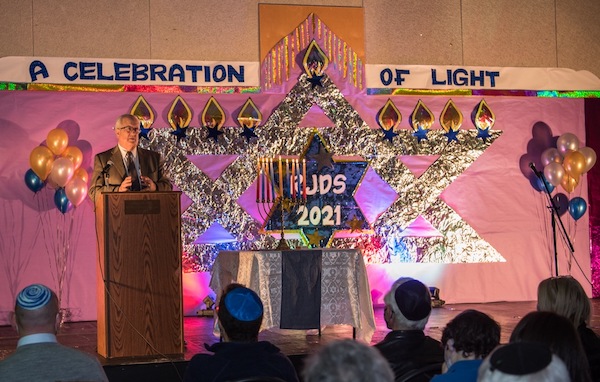
Richmond Mayor Malcolm Brodie speaks to those assembled at RJDS’s Celebration of Light event. (photo by Adele Lewin Photography)

Richmond Jewish Day School is on No. 5 Road, which has been named the “Highway to Heaven” because it is home to more than 30 places of worship, education and cultural practice. The temples, churches and religious schools all celebrate light during the winter season and RJDS’s Celebration of Light event celebrated the diversity within the school and throughout Richmond.

photo - Jewish Federation chief executive officer Ezra Shanken lights the chanukiyah
Jewish Federation chief executive officer Ezra Shanken lights the chanukiyah. (photo by Adele Lewin Photography)

On the last night of Chanukah, Dec. 5, RJDS hosted a night of coexistence, unity and light. After parking at the India Cultural Centre, folks aged 5 to 70 lined up at the entrance as the school gym filled with excitement. The night moved through hopeful speeches given by Ezra Shanken, chief executive officer of the Jewish Federation of Greater Vancouver; Rabbi Yechiel Baitelman of Chabad Richmond; Rabbi Susan Tendler from Beth Tikvah Congregation; Richmond Mayor Malcolm Brodie; and Richmond City Councilor Bill McNulty. The words “bridges,” “freedom,” “unity,” “light” and “together” echoed. Also in attendance were city councilors Andy Hobbs and Alexa Loo, showing their support.

photo - RJDS Choir sings
RJDS Choir sings. (photo by Adele Lewin Photography)

The RJDS Choir sang classic Chanukah songs, including a piece that called upon the audience to “celebrate our light,” and the school’s Israeli dancers showcased two Israeli dances.

photo - RJDS students perform an Israeli dance.
RJDS students perform an Israeli dance. (photo by Adele Lewin Photography)

The voices of RJDS’s neighbours were also heard. The school sent the question out to the community asking what “light” means to them during this holiday season. Each response had a different point of view, however, at the core, every answer reflected on hope, optimism, knowledge, community, compassion, joy, openness, anticipation and the goodness in humanity. Respondents included Navshina Savory from the Richmond School District, Umran Bhatti from the Ahmadiyya Muslim community, Balwant Sanghera from Gurdwara Nanak Niwas (and chair of the Highway to Heaven Association), Edward James Wong from St. Monica Parish Roman Catholic Church, Baha’i community representatives, and Russ Klein and Rabbi Stephen Berger from King David High School. They all had thoughtful insights and their participation was appreciated, as was that of everyone who spoke at, attended and otherwise contributed to this event.

On their way out, guests could help themselves to coffee, water and Chanukah delights like latkes, sufganiyot and other fried goods. The night ended with hearts filled with the warmth that unity, a strong community and good food on a cold winter night can bring.

– Courtesy RJDS

Chanukah Market at JCC

Chanukah treats will be plentiful at the JCC Chanukah Market. (photo from JCCGV)

Come celebrate the Festival of Lights on Nov. 28 at the first-ever Chanukah Market. From 11 a.m. to 5 p.m. that day, the parking lot at the Jewish Community Centre of Greater Vancouver will be transformed into a marketplace for all to enjoy.

Under large heated tents, visitors will be able to shop at arts and crafts vendors, peruse affordable art, seek out that perfect gift, enjoy live, all-ages entertainment and participate in family activities – or just soak up the ambiance and enjoy a nosh from one of the food vendors on site. The day’s festivities will culminate in the lighting of the first candle on the chanukiyah at sundown.

Performances will include the music of Tzimmes, singer/guitarist Anders Nerman, children’s entertainer Monika Schwartzman, the Vancouver Jewish Folk Choir, singer-songwriter Auto Jansz, the klezmer sounds of the Klezbians plus other bands and singers, dancers and surprises. Kids and their families will find lots of things to do, from playing on bouncy inflatables to joining in some hands-on art-making specially designed and delivered by the JCC early childhood department.

More than 20 vendors will be on tap to offer jewelry and other creative, useful and decorative items and chachkas. In addition, an 11-member arts and crafts group is presenting an exhibition and sale, offering items such as giclée prints, ceramics, woodwork, glass design, photographs and textiles.

Food trucks and vendors will offer Mediterranean and Mexican cuisines – and Chanukah treats, including latkes and sufganiyot.

The market is presented with the assistance of Canadian Heritage and admission is free with a donation to the Jewish Food Bank. For the full vendor list and more information, visit jccgv.com/chanukah-at-the-j.

– Courtesy Jewish Community Centre of Greater Vancouver

JQT’s 2021 Hanukkah Hotties

(image from JQT)

JQT Vancouver has a sizzling lineup of Hanukkah Hotties this year. Tune in to daily livestreams on Facebook with each Hanukkah Hottie, as they light their chanukiyah or share another tradition, and chitchat with JQT about their life, craft, activism and intersecting Jewish queer trans identities for the duration of the candles’ burning.

Hosted by Carmel Tanaka, founder and executive director of JQT Vancouver, who identifies as a queer, neurodivergent, Jewpanese woman of colour, the scheduled guests are:

Candle 1 (Nov. 28, 7 p.m.): Karen Newmoon, an Indigenous Jew-ish land dyke and subsistence farmer in Johnsons Landing, B.C.

Candle 2 (Nov. 29, 7 p.m.): Jersey Noah, a Jewish (Sephardi/Ashkenazi) transgender, autistic stoner in Oakland, Calif.

Candle 3 (Nov. 30, 7 p.m.): Adam W. McKinney / LaShawnah Tovah, a gay, Black, Native Jewish artist, and co-director of DNAWORKS in Fort Worth, Tex.

Candle 4 (Dec. 1, 1 p.m.****): Aviva Chernick, a queer, Jewish artist, and voice and meditation teacher in Toronto, Ont.

Candle 5 (Dec. 2, 7 p.m.): The Empress Mizrahi, a nonbinary/queer Persian Jewish Instagram content creator and activist in Los Angeles, Calif.

Candle 6 (Dec. 3, 7 p.m.): The Klezbians, a band of unruly, chutzpah-licious musicians from the Isle of Klezbos in Victoria.

Candle 7 (Dec. 4, 7 p.m.): Saul Freedman-Lawson and S. Bear Bergman. Freedman-Lawson is a student and illustrator in Toronto and Bergman is trans writer and educator from Toronto.

Shamash candle (Dec. 5, 9 a.m.): Tikva Wolf, a cartoonist in Asheville, N.C. (Cherokee territory).

Candle 8 (Dec. 5, 7 p.m.): Ari Fremder, a nonbinary, autistic, Latinx artist/animator and JQT Dream Team member in Vancouver.

During the livestream, closed captioning will be provided by Facebook’s AI bots, and JQT volunteers aim to post edited closed captioning videos on both Facebook and YouTube two to three days after each interview.

This series is supported by Creating Accessible Neighbourhoods (canbc.org), an organization that advocates for and educates about people with disabilities and/or chronic health conditions who have multiple intersecting identities.

For more on the participating artists and JQT, visit facebook.com/jqtvan.

**** NEW TIME!

– Courtesy  JQTVancouver

Brisket – a Jewish  tradition!

Brisket is the boneless meat on the lower chest of beef or veal. In traditional Jewish cooking, it is most often braised as a pot roast, especially as a holiday main course. For reasons of economics and kashrut, it was historically one of the more popular cuts of beef among Ashkenazi Jews.

Brisket is also the most popular cut for corned beef, which can be further spiced and smoked to make pastrami. In the 1900s, it appeared on Jewish deli menus, particularly in Texas, where the butchers, who emigrated from Germany and Czechoslovakia, had trouble selling the slow-cooking cut and created a way to dry smoke it and preserve it.

Brisket is one of the primal cuts of beef, though the precise definition of the cut differs internationally. The brisket muscles include the superficial and deep pectorals. As cattle do not have collarbones, these muscles support about 60% of the body weight of standing or moving cattle. This requires a significant amount of connective tissue, so the resulting meat must be cooked correctly to tenderize it.

The term brisket is derived from the Middle English brusket, which comes from the earlier Old Norse brjósk, meaning cartilage. The cut overlies the sternum, ribs and connecting cartilages.

Author and food writer Stephanie Pierson wrote an homage to this cut of beef: The Brisket Book:  Love Story with Recipes was published in 2011.

CRANBERRY-ONION CHANUKAH BRISKET
(This is Justin Chapple’s recipe from Food & Wine. It makes 8-10 servings.)

photo - Justin Chapple’s Cranberry-Onion Chanukah Brisket
Justin Chapple’s Cranberry-Onion Chanukah Brisket. (photo by Justin Walker)

8 cups fresh or thawed frozen cranberries
1 1/2 cups sugar
1 1/2-inch lemon peel strip
3 tbsp fresh lemon juice
salt and pepper to taste
2 1-ounce envelopes kosher pareve onion soup mix
1 7-pound trimmed beef brisket

The day before serving:

  1. Preheat oven to 325°F. Layer two sheets foil in a large roasting pan, letting foil hang over eight inches past each end. Repeat with two additional sheets of foil to form an X. Top with a sheet of parchment paper.
  2. In a saucepan, combine cranberries, sugar, lemon peel strip and lemon juice. Cook, crushing cranberries with a wooden spoon until mixture thickens, 10-14 minutes.
  3. Remove from heat and stir in onion soup mix. Let cool for 15 minutes.
  4. Spread a quarter of cranberry sauce on parchment. Place brisket fat side up. Spread remaining cranberry sauce over it, top with parchment and wrap foil around brisket. Place in oven for three to three-and-a-half hours. Uncover. Let cool one-and-a-half hours, then cover and refrigerate for at least eight hours.

The day of serving:

  1. Preheat oven to 325°F. Uncover brisket. Discard any fat. Scrape off cranberry sauce and place in a bowl.
  2. Slice brisket on carving board. Arrange in ovenproof dish. Spoon cranberry sauce over top, cover and bake 45 minutes to one hour.

BEER-BRAISED BRISKET WITH ROOT VEGETABLES
(This recipe comes from Ian Knauer, former Gourmet Magazine editor, chef, food writer and owner of the Farm Cooking School. It makes 4-6 servings.)

photo - Ian Knauer’s Beer-Braised Brisket with Root Vegetables
Ian Knauer’s Beer-Braised Brisket with Root Vegetables. (photo by Ian Knauer)

1 2.5-to-3-pound brisket
2 tbsp olive oil
1 chopped medium onion
5 ounces sliced shiitake mushroom tops
3 finely chopped garlic cloves
3 large sliced carrots
3 sliced parsnips
1 rutabaga, peeled and cut into wedges
12 ounces beer of your choice
2 tbsp Worcestershire sauce
2 cups chicken stock
2 tbsp flour
1 tbsp dill

  1. Heat oil in a pot. Sear the brisket three to four minutes, turn, and continue searing another three to four minutes. Transfer to a plate.
  2. Stir onion, mushrooms and garlic into pot. Cook, stirring occasionally, for six minutes. Place brisket and juices back in pot.
  3. Stir in carrots, parsnips, rutabaga, beer, Worcestershire sauce and stock. Cover and simmer six hours, until meat is tender.
  4. In the meantime, stir flour and two tablespoons cold water in a bowl then whisk into the pot. Simmer until sauce thickens, about 10 minutes. Place on plate, sprinkle with dill and slice.

Sybil Kaplan is a journalist, editor of nine kosher cookbooks (working on a 10th) and a food writer living in Jerusalem. She leads English-language Shuk Walks in Machane Yehuda.

Pumpkin, but not pies

Pumpkin spice snickerdoodles (photo by Greg Dupree, food styling Torie Cox, prop styling Christine Keel / Food & Wine)

November arrives and I think pumpkin. Here in Israel, the d’la’at is amazing. Whole, they are huge in size and weight, cream in colour, with stripes all around.

Pumpkins are a variety of winter squash that belongs to the Cucurbitaceae (or cucurbits) family. Melon, watermelon and cucumber also fall into this category. Technically, pumpkins are fruit but, since they are often eaten in savoury dishes, many people refer to them as vegetables. Just about every part of the pumpkin is edible, including the seeds, their shell, leaves and flowers. Pumpkins are a superfood and are high in iron, packed with vitamins and minerals, and considered natural antioxidants.

But, enough about that and on to some recipes. Forget pie, though, and try these treats for your holiday guests.

The first dessert is pumpkin spice snickerdoodles. I was unfamiliar with snickerdoodles until coming across this recipe by Kelly Fields. Probably German in origin, the name of these sugar cookies could be a corruption of the German word schneckennudel, but notice the word schnecken, popular in Jewish cooking. American cookbook author Joan Nathan tells us: “Schnecken – the word means snail in German – are made of a rich and sweet yeast dough enriched with egg, sour cream and butter. The dough is pressed out in a large rectangle shape, sprinkled with sugar, cinnamon, raisins and ground nuts, and rolled up like a jelly roll. Cut on the cross section, the roll is sliced, baked and served open-side up in small coiled rounds.” Here is my version made pareve with slight changes.

PUMPKIN SPICE SNICKERDOODLES
(Adapted from Food & Wine. Makes 20 cookies.)

1 3/4 cups sugar
2 tbsp cinnamon
1 1/2 tsp cardamom
1/2 tsp nutmeg
1/2 tsp cloves
2 3/4 cups flour
2 tsp cream of tartar
1 tsp baking soda
1 cup unsalted butter or pareve margarine
2 large eggs
1 1/2 tsp orange blossom water or 3/4 tsp orange extract
1 tsp vanilla

  1. Preheat oven to 350°F and line three baking sheets with parchment paper.
  2. In a bowl, stir together 1/4 cup sugar, cinnamon, cardamom, nutmeg and cloves.
  3. In another bowl, stir together flour, cream of tartar and baking soda.
  4. Beat margarine and 1 1/2 cups sugar until light and fluffy (four minutes). Add eggs one at a time, then orange extract and vanilla. Add flour in two additions.
  5. Shape dough into 20 balls. Roll balls in spice mixture until coated. Arrange on baking sheets. Bake for six to seven minutes, then switch pans onto different racks, and continue baking 10 minutes. Let cool.

BAKED PUMPKIN WEDGES

image - Pumpkin Happy book cover
Published in 1976, Pumpkin Happy recipes are still happy-making.

(While I found this recipe in a newspaper some 40 years ago, it comes from the 1976 cookbook Pumpkin Happy, written by Erik Knud-Hansen and illustrated by Andrea Grumbine. It makes 6 servings.)

1 4-pound pumpkin, cut into wedges, strings and seeds scraped out
1/2 to 3/4 cup pareve margarine
1/4 cup brown sugar or honey
1 tsp cinnamon

  1. Preheat oven to 350°F. Oil a glass baking dish.
  2. Make shallow cuts in each wedge.
  3. Melt margarine in a saucepan. Add sugar and cinnamon. Brush over wedges.
  4. Bake for 35 to 45 minutes, until tender.

PUMPKIN BUTTER

(This butter is great on toast with cream cheese, according to Kelsey Youngman, writing on Food & Wine’s website. This recipe makes 2 1/2 cups.)

1 3-pound pumpkin, stemmed, halved lengthwise and seeded
1 tbsp vegetable oil
1/4 cup apple cider
1/2 cup brown sugar
3 tbsp honey
1 tsp apple cider vinegar
3/4 tsp cinnamon
1/2 tsp ginger
1/4 tsp nutmeg
a pinch of cloves

  1. Preheat oven to 350°F and line a baking sheet with parchment paper.
  2. Brush cut sides of pumpkin halves with oil. Arrange cut side down and bake 50 minutes, or until tender.
  3. Scoop flesh into food processor. Discard shell. Add apple cider, process one minute. Add brown sugar, honey, apple cider vinegar, cinnamon, ginger, nutmeg and cloves. Process 20 seconds. Transfer to a saucepan.
  4. Bring to a simmer, stirring occasionally. Reduce heat and cook until mixture is reduced by one-third and turns slightly darker in colour, about 25 minutes.
  5. Remove from heat, cool and spoon into jars with lids. Store in refrigerator.

Sybil Kaplan is a journalist, editor of nine kosher cookbooks (working on a 10th) and a food writer living in Jerusalem. She leads English-language Shuk Walks in Machane Yehuda.

Making holiday doughnuts

Syrian doughnuts can be made with a hole, or not. And they are topped with lemon or another type of glaze or syrup, rather than having a jelly filling. (photo from vegankinda.wordpress.com)

One of the things I have enjoyed the most as a food writer is learning the different customs of Jews from around the world. When it comes to doughnuts, all the communities make a dough dessert fried in oil, but there are differences.

Dov Noy, who was an Israeli folklorist and ethnologist, related a Bukhharian fable, which says that the first sufganiya was a sweet given to Adam and Eve as compensation after their expulsion from the Garden of Eden. He says the word sufganiya comes from the Hebrew word sof (meaning end), gan (meaning garden) and Ya (meaning G-d). Thus, the word means, the end of G-d’s garden. According to Noy, this fable was created at the beginning of the 20th century, since sufganiya was a new Hebrew word coined by pioneers.

Some consider sufganiyot, which means sponge-like, to be reminiscent of the sweet, spongy cookies that have been popular along the Mediterranean since the time of the Maccabees. Hebrew dictionaries say the word actually comes from the Greek word sufgan, meaning puffed and fried.

A few months ago, I happened to stop at a vendor in Machane Yehuda, the Jewish market where I shop and lead weekly walks, to ask about a pastry he was selling. He told me it was shvinze. Many years ago, a neighbour had given me her mother’s receipt for shvinze and I share it with you here.

I’ve also included a recipe from another neighbour, who made a similar type of dessert that she learned from her mother, who came from Syria. And the third recipe is for traditional Israeli doughnuts that can be filled or left plain. Talia was 5-and-a-half years old when she gave me this recipe – today, she is the mother of four, a tour guide married to a photographer, and living in the scene of the Chanukah story, Modi’in.

MOROCCAN SHVINZE

1 2/3 tbsp yeast
1/4 cup lukewarm water
a pinch salt
4 cups flour
oil
honey or confectioners’ sugar

  1. Place yeast in a small bowl with water. Place flour in another bowl. After the yeast swells, add to the flour. Add salt, then knead into an elastic dough.
  2. Place oil in a deep pot. Wet hands, take a piece of dough and shape it into a circle. Punch a hole in the centre, then drop the dough into oil. Brown it on both sides. Drain on paper towels.
  3. Serve with honey or confectioners’ sugar.

SYRIAN ZINGOLE

 2 tsp yeast
a few spoons warm water
2 cups flour
1 1/2 cups water
oil

icing:
1 cup sugar
1 cup water
1 1/2 tbsp lemon juice

  1. Place yeast in a small bowl. Add a few spoons of warm water to dissolve.
  2. Place flour in another bowl. Add yeast and then more water to make a liquidy batter.
  3. Heat oil in a deep pot. Spoon batter into pan like pancakes. Fry until brown on both sides. Drain on paper towels.
  4. Combine sugar, water and lemon juice in a saucepan. Cook until sugar dissolves.
  5. Dip each pancake in sauce, then place on a serving platter.

TALIA’S SUFGANIYOT FOR JUNIOR COOKS

3 1/2 cups flour
1 1/2 cups plain yogurt
2 eggs
2 tbsp sugar
a pinch salt
1/2 tsp vanilla
oil

  1. In a mixing bowl, supervised by an adult, combine flour, yogurt, sugar and salt. Add eggs and vanilla and blend.
  2. Heat oil in a deep pot (with an adult’s help). Drop dough by tablespoon into oil. Fry until brown on both sides. Drain on paper towels.
  3. When cool to the touch, fill, using a tube or a large syringe, with your favourite jelly. Roll in confectioners’ sugar.

Sybil Kaplan is a journalist, editor of nine kosher cookbooks (working on a 10th) and a food writer living in Jerusalem. She leads English-language Shuk Walks in Machane Yehuda.