Chicken with a French twist

Chicken always makes for a nice holiday meal. For a special treat, however, try out these French kosher chicken entrees.

CHICKEN DIJON
(8 servings)

1/4 cup water or vegetable oil
1 tsp garlic powder
1/2 cup Dijon mustard
1 tsp dry Italian seasoning
8 boneless skinless chicken breast halves
lemon slices or fresh herbs

  1. Preheat oven to 375°F.
  2. In a plastic bag, combine mustard, water or oil, garlic powder and Italian seasoning. Add chicken and shake to coat.
  3. Place chicken in a baking pan. Bake for 20 minutes or until done.
  4. Garnish with lemon slices and fresh herbs.

CHICKEN LEGS COQ AU VIN
(I’ve adapted slightly Chef Eric Ripert’s recipe that was in Food & Wine. It makes 8 servings.)

16 chicken drumsticks
salt and pepper
6 tbsp flour
1/4 cup canola oil
1 cup finely chopped carrots
1 cup finely chopped onions
1 cup finely chopped celery
3 cups chopped mushrooms
4 thinly sliced garlic cloves
1 cup brandy
2 tbsp tomato paste
1 bottle dry red wine
2 cups chicken stock
4 thyme sprigs

  1. Heat oil in a large pot.
  2. Season chicken with salt and pepper and dust with 1/4 cup flour. Add chicken to pot and cook over high heat five minutes. Remove to a plate.
  3. Add carrots, onions, celery, mushrooms and garlic and cook five minutes.
  4. Add brandy and cook one minute. Stir in tomato paste and two tablespoons flour. Add wine, chicken stock and thyme and bring to a boil.
  5. Return chicken to pot, cover and simmer 1.5 hours. Remove chicken.
  6. Simmer sauce until reduced by half, about 10 minutes. Discard thyme. Return chicken to sauce and heat.

CHARDONNAY-BRAISED CHICKEN THIGHS
(I’ve made a few changes to cookbook author Grace Parisi’s recipe that was in Food & Wine. It makes 8 servings.)

4 tbsp unsalted margarine
4 tbsp olive oil
16 chicken thighs
salt and pepper to taste
1/2 cup flour
8 peeled, quartered shallots
2 pounds parsley root or parsnips, cut into 3-by-0.5-inch pieces
2 rosemary sprigs
2 cups Chardonnay or dry white wine
3 cups chicken soup

  1. Preheat oven to 425°F. Melt margarine in a large frying pan with oil.
  2. Season chicken with salt and pepper and dust with flour. Add to frying pan, skin side down and cook until brown, about six minutes. Place on a plate.
  3. Add shallots, parsley root or parsnips and rosemary and cook one minute.
  4. Add wine and cook three minutes or until reduced by half.
  5. Add chicken soup and bring to a boil.
  6. Place chicken skin side up in frying pan and place in oven. Braise 25 minutes or until cooked through.
  7. Broil chicken for three minutes. Return to stove and boil until sauce is thickened, about three minutes. Discard rosemary. Transfer to bowls and serve.

Sybil Kaplan is a Jerusalem-based journalist and author. She has edited/compiled nine kosher cookbooks and is a food writer for North American Jewish publications.

“Never again” still resonates?

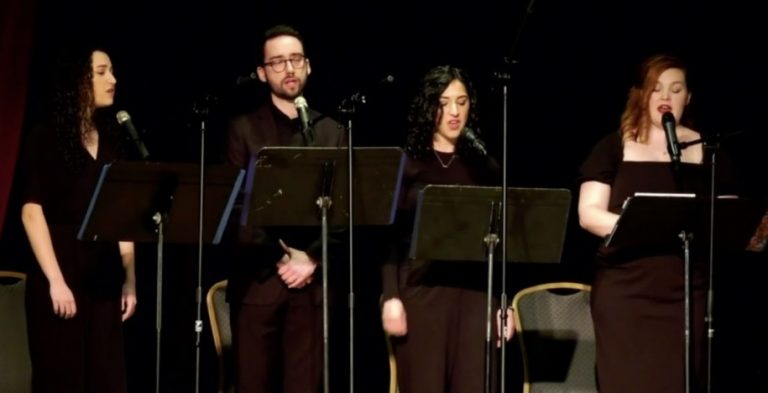
Left to right: Mia Givon, Lorenzo Tesler-Mabe, Kat Palmer and Erin Aberle-Palm. (screenshot from Kat Palmer)

Holocaust survivors and their descendants were joined by top elected officials and Jewish community leaders in a series of commemorations marking Yom Hashoah, Holocaust Remembrance Day, across Canada last week.

In Vancouver, community members gathered together at the Jewish Community Centre of Greater Vancouver April 27, while scores more watched remotely as the traditional in-person ceremony returned for the first time since the beginning of the pandemic.

Marcus Brandt, vice-president of the presenting organization, the Vancouver Holocaust Education Centre, welcomed guests and invited Holocaust survivors to light Yahrzeit candles.

“On Yom Hashoah, we join as a community to remember the six million Jews who perished in the Holocaust at the hands of Nazi Germany and its co-conspirators between 1933 and 1945,” he said. “It is also a day to pay tribute to the Jewish resistance that took place during the Holocaust.”

This year marks the 79th anniversary of the Warsaw Ghetto Uprising, which is the most notable of many acts of Jewish resistance to Nazism.

Marsha Lederman, a journalist who is the daughter of two Holocaust survivors, spoke of the importance of telling our stories.

“When I was growing up,” she said, “the Holocaust was everywhere and nowhere. As far back as I can remember, there were hints and references. My parents talked about things happening in camp. What was this camp? I knew it wasn’t like the summer camp that I went to. I knew a lot of their friends were also at these camps, but I didn’t know the details.”

At the age of 5, Marsha met a new friend whose home was filled with laughter and extended family.

“One day, when I came home from a visit at my friend’s house, I asked my mother what was really a simple, innocent question,” said Lederman. “She has grandparents, why don’t I? My poor mother. She was caught off guard and her answer was truly horrifying – at least as I remember it, because I know memory is very faulty. But, as I recall, she said I didn’t have grandparents because the Germans hated Jews and they killed them by making them take gas showers.”

This response raised more questions than answers for the young girl, not least of which was: “What did we do to make the Germans hate us so much and do they still hate us? It was a horrible introduction to the details of the tragedy of my family and it taught me another terrible lesson: be careful about asking questions because the answers could be murder.”

As a result, much of Lederman’s Holocaust education was gained “through osmosis, rather than sitting down and asking questions,” she said.

Her father died when Lederman was a young woman and, in a tragic turn of events, her mother died just as Lederman had bought a ticket to visit her in Florida, armed with a recorder to finally ask the questions she had hesitated to broach in earlier years.

“It’s taken me years to try to figure out what I could have learned in an afternoon at my mother’s kitchen table,” she said. “I have no way of knowing these things because I didn’t ask. We need to ask and we need to tell.”

Lederman explores these questions in a book being released this month, titled Kiss the Red Stairs: The Holocaust, Once Removed.

Amalia Boe-Fishman (née van Kreveld) was the featured survivor speaker at the Vancouver event. Born in the Netherlands, she was less than a year old when the Germans invaded her country. Her grandparents were soon transported to Auschwitz and murdered.

In what is an extremely rare phenomenon, Amalia, her parents and her brother all survived the war years because a Dutch Christian resistance fighter, Jan Spiekhout, and his family hid members of the de Leeuw family in a variety of hiding places over the course of years. Amalia’s mother even gave birth to another child in 1944. (That child, as well as Boe-Fishman’s oldest son, are both named Jan in honour of their rescuer.) Their survival was a statistical miracle. The Netherlands had among the lowest Jewish survival rate of any country during the Holocaust. Of 140,000 Dutch Jews in 1939, only 38,000 were alive in 1945.

Boe-Fishman recalled the day Canadian forces liberated the Netherlands – it was one of the only times in three years that she had set foot outdoors.

“It was strange and frightening outside and close to so many strangers,” she said. “The Canadian soldiers came rolling in on their tanks, handing out chocolates, everyone smiling, dancing, waving Dutch flags. Then I was told I could go home to my real family. But who were these strangers? I did not want to leave the family Spiekhout. They were my family. After all, I had not seen my real family for three years.”

In 1961, she traveled to Israel to meet members of her family who had made aliyah before the war and to reconnect with her Jewish identity. There, on the kibbutz she was staying, she met a Canadian, whom she married and they subsequently moved to Vancouver and had three children.

In 2009, Boe-Fishman and her three sons traveled to The Hague for the investiture of Jan Spiekhout and his late parents, Durk and Froukje Spiekhout, as Righteous Among the Nations by Yad Vashem.

“To be together with my children, my brother, and the grown children of the Spiekhout family, this was such a moving event in our lives,” she said.

As part of the Vancouver ceremony, Councilor Sarah Kirby-Yung read a proclamation from the City of Vancouver. Cantor Yaakov Orzech chanted El Moleh Rachamim. Lorenzo Tesler-Mabe, Mia Givon and Kat Palmer, members of the third generation, as well as Erin Aberle-Palm, sang and read poetry, accompanied by Vancouver Symphony Orchestra violinist Andrew James Brown and pianist Wendy Bross Stuart, who was also music director of the program.

The following day, a hybrid in-person and virtual event was held at the British Columbia legislature, featuring Premier John Horgan.

“On Yom Hashoah, we are challenged to ensure the words ‘never again’ are supported by action,” he said. “Over the past few years, there has been an increase in antisemitism in B.C., and the Jewish community is one of the most frequently targeted groups in police-reported hate crimes. That’s why our government will continue working to address racism and discrimination in all its forms.… Today, as we remember and honour those who were lost and those who survived, we must recommit to building a more just and inclusive province, where everyone is safe and the horrors of the past are never repeated.”

Michael Lee, member of the legislature for Vancouver-Langara, spoke on behalf of the B.C. Liberal caucus.

“Every year, we commemorate this day and remember the heroes and the Righteous Among Nations who stood up to oppose the most vile, hateful oppression,” Lee said. “We recognize the victims and survivors of the Holocaust, we make a solemn promise to never forget and never again allow such horrific actions to take place. This is a responsibility that we all must carry with us not only today but every day. It is a responsibility we must be better at upholding, as soldiers at this very moment commit war crimes once again in Europe. We have not done enough. Right here in Canada, we see another year of record rises in antisemitism. We have to do better.”

Lee called on the province to adopt the International Holocaust Remembrance Alliance Working Definition of Antisemitism.

MLA Adam Olsen represented the Green party.

“While time distances us from the horrific events, the memories and the stories remain steadfast in our mind and are carried and passed from one generation to the next,” said Olsen. “The Holocaust was an ultimate form of evil, persecution, oppression, genocide, complete disregard for human life, pushed to the most appalling degree…. The Holocaust is a stark reminder of the darkness, the wickedness, that can exist among us. However, it is also important to acknowledge that this is a story of strength, resilience and humanity and, to that, I raise my hands to all of the survivors, the Jewish community, that have ensured that the world knows and hears the stories. As difficult as it is to continue sharing them, we cannot stop hearing them or else we will fall victim to thinking that we have passed that now.”

Rabbi Harry Brechner of Congregation Emanu-El lamented the deaths of Holocaust survivors in the current war in Ukraine, “who died when they were cold, again, and hungry, again, and who died in the face of violence.”

“That never should happen and we all know that,” the rabbi said. “I don’t know how to make those big changes. I’m not a world leader. I’m the leader of a small congregation. But I think we are all leaders of our hearts and if each of us can make that difference, it’s got to have a huge ripple effect.”

Holocaust survivor Leo Vogel said that history records the end of the Holocaust in 1945. “But, for the people who lived through it and survived that horrible blight of human history, for them, 1945 is not when the Holocaust ended,” he said. “It continues to this very day to live in memories and nightmares and ongoing health problems.… The fascist attempt to eradicate the Jewish people must never be forgotten. The memory of the tortured and murdered cannot be shoveled underground as the Nazis did with the ashes. As children in the Holocaust, we were the youngest and, now, in our older years, we are at the tail end of those who can still bear witness.”

Vogel spoke of the unfathomable choice his parents made to hand him over, as a child, to a Christian family for hiding.

“Not long after that deeply painful decision to separate me from them, they were deported to Auschwitz and there they were murdered without ever knowing whether their desperate act to allow me to go into hiding saved my life,” he said. “I get cold chills when I think of the intense agony they went through in making their decision. It would have been their hope, I’m sure, that one day we would once again get together. That day never happened. Their pain must have been overwhelming. Many times, I have wondered what they said to each other and to me the night before they gave me away and, countless times, I have asked myself whether I would have had the strength to do an equal act when my children were young.”

In Ottawa, earlier on April 27, Prime Minister Justin Trudeau touted his government’s steps in fighting antisemitism, including the creation of a special envoy on preserving Holocaust remembrance and combating antisemitism, currently held by Irwin Cotler, and proposed legislation to make denying or diminishing the Holocaust a criminal offence.

“Earlier this year, our country and people around the world were shocked and dismayed to see Nazi imagery displayed in our nation’s capital,” the prime minister said, referring to trucker protests in Ottawa. “For the Jewish community, and for all communities, those images were deeply disturbing. Sadly, this wasn’t a standalone instance. Jewish people are encountering threats and violence more and more both online and in person. This troubling resurgence of antisemitism cannot and will not be ignored. The atrocities of the Holocaust cannot be buried in history.… We must make sure that ‘never again’ truly means never again.”

Shimon Koffler Fogel, chief executive officer of the Centre for Israel and Jewish Affairs, picked up on that theme, noting that the term “never again” was “born out of the Jewish experience but was always intended to be universal in its application.”

“How can we witness the atrocities visited on the Rohingya, the Uighurs or the Yazidi and claim the cry of ‘never again’ has meaning?” he asked. “How can we observe the unvarnished aggression against Ukraine and assert we have taken the lessons of the Holocaust to heart?”

He said he derives hope from the fact that Canada seems to have learned the lesson of the MS St. Louis, the ship filled with Jewish refugees that was turned away from Canada and other safe havens in 1939. Now, Canada is a place, he said, “where fleeing Syrian and Iraqi refugees can rebuild their lives, where Afghani women and girls can fulfil their dreams, where displaced, wartorn Ukrainians can find safe harbour.”

“I take great pride that Canada is so committed to Holocaust remembrance and education,” said Michael Levitt, president and chief executive officer of the Friends of the Simon Wiesenthal Centre, “A major reason is because of the survivors who, after suffering unthinkable adversity in Europe, rebuilt their shattered lives here, in our great country. Their strength, resilience and willingness to share their deeply personal and harrowing stories have been a gift and a source of inspiration to all Canadians.”

Dr. Agnes Klein, a Holocaust survivor, spoke of her family’s wartime experiences. Israel’s ambassador to Canada, Ronen Hoffman, commended Canada on adopting the International Holocaust Remembrance Alliance’s Working Definition of Antisemitism.

A day earlier, at another virtual commemoration from the Montreal Holocaust Museum, Holocaust survivor Max Smart told of his family’s harrowing Holocaust experiences.

Paul Hirschson, consul general of Israel in Montreal, compared the loss of Jewish life, with its incalculable loss of talent, in the Holocaust with the explosion of Jewish talent taking place in this century.

“Jewish talent lost was one of history’s greatest tragedies,” said the diplomat. “The talent emerging is perhaps the most exciting story of the 21st century…. Antisemitism is still widespread, also here in Canada. Montreal, where many survivors found a home, is no exception. We will defeat hate every time. Hatred will never again rob the world of Jewish talent.”

Celebrating Israel together

Israel’s Gilat Rapaport and the InJoy Band headline this year’s Yom Ha’atzmaut celebration on May 4 at the Vogue Theatre. (photo from injoyprod.com)

This year’s Yom Ha’atzmaut celebration on May 4 at the Vogue Theatre, headlined by Israel’s Gilat Rapaport and the InJoy Band, marks 20 years since the first large-scale community-wide event to celebrate Israel’s Independence Day was organized by the Jewish Federation of Greater Vancouver.

“Growing up in Vancouver, the community had occasional large Yom Ha’atzmaut events with Israeli performers and I have wonderful memories of attending them,” said Stephen Gaerber, who co-chaired that first major gathering. “I was incredibly impressed by a large event held to celebrate Israel’s 50th in 1998 at the Orpheum [which was chaired by Judy Mandleman]. It was 2001, the Second Intifada was raging, Camp David had resulted in failure and Israel was, as usual, being disparaged in the press. My friend, Rick Schreiber, had become the chair of the Federation’s Israel department, and I told him that I thought the community should be having large-scale events every year to celebrate Yom Ha’atzmaut and all that is wonderful about Israel. His response was, ‘OK, you chair it.’ That’s how I became chair for the 2002 Yom Ha’atzmaut celebration, first co-chairing with my wife, Shari, and then, starting in 2003, with my brother Allen.”

Of course, local groups celebrated Israel’s birthday in various ways prior to 2002, notably the now-defunct Canadian Zionist Federation (CZF). Bernard Pinsky was CZF chair in the late 1980s.

“In the 1980s,” said Pinsky, “CZF brought in big names from Israel for a Yom Ha’atzmaut concert, including top artists like Nomi Shemer, Chava Alberstein, and Haparvarim. The concert was held at the JCC and wasn’t always right on Yom Ha’atzmaut, it was when the artists were available. The venue meant that we could only sell about 400 tickets, and CZF did a lot of fundraising to cover costs.”

Geoffrey Druker, who still leads the community’s annual Yom Hazikaron (Israel’s Memorial Day) ceremony, said he was recruited by Pinsky to become involved in CZF and it was from Pinsky that Druker took over the role of local CZF chair in the early 1990s.

“We ran most Israel-related community programs,” said Druker, including Yom Ha’atzmaut, Yom Hazikaron, Walk with Israel (which took place on Jerusalem Day), the student public-speaking contest and other programs. When CZF closed nationally, Druker said he gathered past local leaders of the group to decide “whether to become an independent local organization or join Federation.”

The choice was to join the Israel desk at Federation, and Druker continued to chair many of the events, with most of the Yom Ha’atzmaut activities being held at the Jewish Community Centre of Greater Vancouver, he said.

“Federation didn’t have the funds for a large Yom Ha’atzmaut, and we couldn’t risk having a large celebration … while keeping the event tickets affordable to all,” said Druker. “So we ran smaller celebrations and with less-known artists.”

Affordability remained key when Federation, led by a committee put together by Stephen and Shari Gaerber, took over the event.

“Our goal wasn’t to just make it a concert, but a real community celebration,” said Stephen Gaerber. “We kept ticket prices very low so that everyone could afford to attend – and if they couldn’t afford even that, we made free tickets available through JFS [Jewish Family Services]. We invited all Jewish organizations in the city to add their names as Community Partners, and dozens did. We had children from Hebrew Academy, Talmud Torah and RJDS performing in addition to Israeli singer Danny Maseng.

image - The ad promoting the 2002 Yom Ha’atzmaut celebration
The ad promoting the 2002 Yom Ha’atzmaut celebration.

“We were given no budget (other than staff time) for the event from the Federation and I didn’t want one. I was determined that the Federation not take anything away from what they were allocating to local community agencies in order to make this event happen. We believed that the community would support the event and we were right. We raised the funds from generous donors, rented the Chan Centre and signed a contract with the performer. We put tickets on sale and we sold out all 1,200 seats very quickly. The event itself is a bit of a blur, but my most vivid memory is the joy people expressed to us at its conclusion.”

With that success behind them, the goal was to involve even more individuals and organizations in the celebrations.

“For years,” said Gaerber, “Jonathan and Heather Berkowitz wrote a piece for young community members to perform and we were fortunate to have Wendy Bross Stuart direct them. We later added the JCC’s children’s Israeli dance troupes to the program, sometimes joined with dancers from our partnership region in the Upper Galilee.

“Pam Wolfman took over chairing the event in 2014 and continued to tweak things to make sure everything is new and fresh and even better each year, including involving the entire community in the community song,” he said. “What hasn’t changed is the support from the community. To this day, other than staff time, the Federation has not had to give any funding at all towards putting on the event. The group of donors has grown over the years and that allows the event to continue to stay true to our initial vision – tickets are still affordable and many are available at no cost to those who need them – and the events continue to sell out.”

The annual celebration brings Israeli performers – from veteran musicians to up-and-coming singers and musical groups – to Vancouver on Yom Ha’atzmaut.

“For many,” said Gaerber, “it was their first time performing outside of Israel on Yom Ha’atzmaut, as they hesitate to leave the country for this important day. Without exception, they have all expressed how incredibly meaningful it was for them to experience the warmth of our community and its love for Israel. A number of our performers who would not have otherwise considered coming to Vancouver for Yom Ha’atzmaut have only done so because they have heard from other performers about their experience and our Jewish community.

“Despite our Jewish community’s relatively small size,” he said, “we have been told by Israeli diplomats that Vancouver’s Yom Ha’atzmaut celebration, always occurring actually on erev Yom Ha’atzmaut, is one of the largest celebrations of its kind taking place on that day outside of Israel.”

For tickets to this year’s event and a sneak peak at the program guide, go to jewishvancouver.com/yh2022.

About the 2022 JI Passover cover

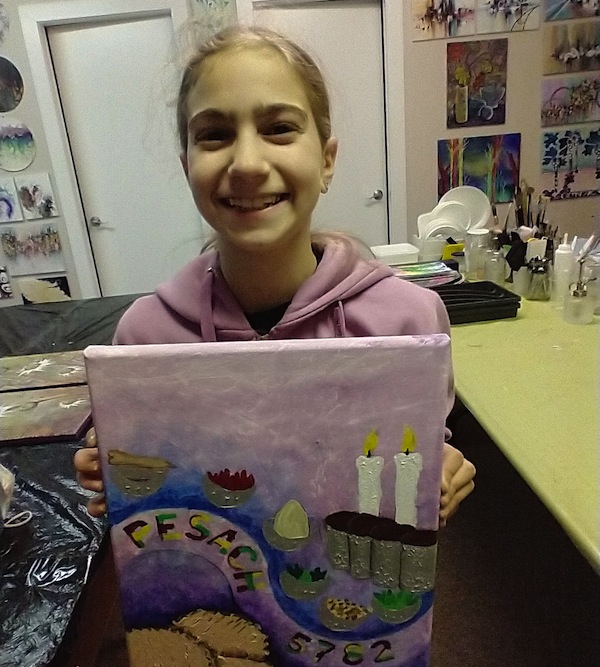
Liba Baitelman, the 2021 JI Chanukah Cover Art Contest winner, was commissioned to create this year’s cover of the Jewish Independent’s Passover issue. (photo by Merle Linde)

Liba Baitelman, daughter of Rabbi Yechiel and Chanie Baitelman, is a fun-loving, always religiously correct and mischievous 10-year-old. Her artistic talent and vision of a completed painting is not taught, it is spontaneous. She is so receptive to learning new techniques and this year’s Pesach cover showcases her skills.

When Liba started her Pesach painting with pencil sketches, she knew she wanted: two candles, four cups of wine, six seder plate symbols and three round shmura matzos. What worried her was her lack of drawing skills. To overcome this, she used templates throughout the design: margarine tub lids for the curves of the ribbons, flattened paper cups for the goblets, small plastic cups dipped into silver paint for the dishes, self-adhesive vinyl letters used for outlines and diligently painted with a very thin brush.

Her joy and pride with the completed painting should spearhead a lifelong hobby.

– Courtesy Merle Linde – Malka’s Studio

Different pharaoh, different story?

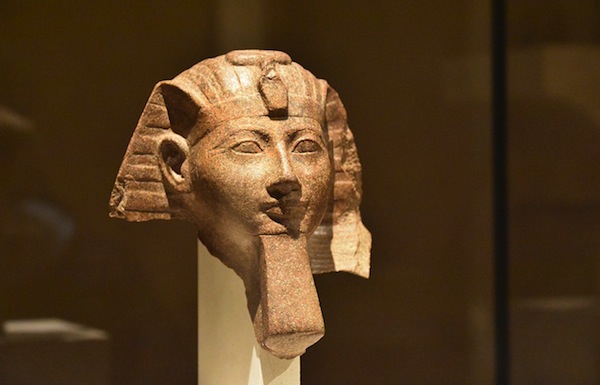
The head of Hatshepsut, in Pergamon Museum, Berlin, 2018. (photo by Richard Mortell, 2018)

As we all know from the Passover story, Pharaoh was one stubborn guy. On five occasions, Moses and Aaron tried to persuade Pharaoh to let the Hebrews go, but Pharaoh wouldn’t budge. In Exodus 7:13 and 7:22, Pharaoh hardens his heart in response to Moses’ pleading. Moreover, Pharaoh made his heart heavy in three other instances, as described in Exodus 8:11, 8:15 and 8:28. What would have happened if Moses and Aaron had come up against a female Pharaoh? Would the story have played out differently?

Let us begin by recalling that, if it hadn’t been for the curiosity and kindness of Pharaoh’s nameless daughter – though, in Judaism, she is later referred to as Thermuthis and even later as Bithiah – Moses would not have been rescued from his floating basket. The future leader of the Hebrew exodus from Egypt would not have lived, and the exodus would not have occurred as we know it.

There were at least six female rulers during the long period in which pharaohs ruled, and perhaps as many as 12. From what has been pieced together, these women sometimes had to disguise their female identity. Some adopted king titles, others exercised force to get their way.

Take Hatshepsut, for example, who was pharaoh of the New Kingdom, or Egyptian Empire, from circa 1479 BCE to 1458 BCE. She nominated herself and then filled the role of pharaoh by claiming her father (the earlier pharaoh) had wanted her to take over from him. Probably understanding that her position was tenuous – both by virtue of her sex and the unconventional way in which she had gained the throne – she reinvented herself. In visual art, she had herself portrayed as a male pharaoh, and ruled as such for more than 20 years. (See “The queen who would be king” at smithsonianmag.com.)

Initially depicted as a slim, graceful queen, within a few years, she changed her image to appear as a full-blown, flail-and-crook-wielding king, with the broad, bare chest of a man and the false beard typical of a male pharaoh. But Prof. Mary-Ann Pouls Wegner notes, however, in a 2015 article on toronto.com, that Hatshepsut’s statues have thin waists, “with nods to her female physique.”

Hatshepsut also took a new name, Maatkare, sometimes translated as truth (maat) is the soul (ka) of the sun god (Re). The key word here is maat, the ancient Egyptian expression for order and justice as established by the gods. Maintaining and perpetuating maat to ensure the prosperity and stability of the country required a legitimate pharaoh who could speak directly with the gods, which is something only pharaohs were said to have been able to do. By calling herself Maatkare, Hatshepsut was likely reassuring her people that they had a rightful ruler on the throne. She seemingly succeeded, as her 20-plus-year reign was a more or less peaceful time.

One important way pharaohs affirmed maat was by creating monuments, and Hatshepsut’s building projects were among the most ambitious of any pharaoh’s. She began with the erection of two 100-foot-tall obelisks at the great temple complex at Karnak. She likewise had important roads built. Still, her most ambitious project was her own memorial. At Deir el-Bahri, just across the Nile from Thebes, she erected an immense temple, used for special religious rites connected to the cult that would guarantee Hatsheput perpetual life after death. (See livescience.com/62614-hatshepsut.html.)

In life, Hatshepsut felt compelled to depict herself as a male ruler. In death, however, her true colours (pun intended) seem to surface. Exams conducted on her mummy reveal that, at the time of entombment, she was wearing black and red nail polish. Furthermore, according to sciencedaily.com, Michael Höveler-Müller, former curator of the Bonn University Egyptian Museum, reports that a filigree container bearing the queen’s name may have contained the remains of a special perfume, an incense mixture.

Nefertiti similarly hid her femininity, even though today she is the most visually reproduced ancient Egyptian female ruler. According to Prof. Kara Cooney, author of the book When Women Ruled the World: Six Queens of Egypt, Nefertiti cleaned up the mess that the men before her had made. She wasn’t interested in her own ambition, it seems, as she hid all evidence of having taken power, ruling alongside her husband. Yet, at the Karnak temples, there is twice as much Nefertiti artwork as there is of Akhenaten, her husband, who was king from about 1353 BCE to 1336 BCE. There are even scenes of her smiting enemies and decorating the throne with images of captives.

photo - The Nefertiti bust in Neues Museum, Berlin
The Nefertiti bust in Neues Museum, Berlin. (photo by Philip Pikart, 2009)

Despite her great power – she and her husband had pushed through a monotheistic form of pagan worship – Nefertiti disappears from all depictions after 12 years of rule. The reason for her disappearance is unknown. Some scholars believe she died, while others speculate she was elevated to the status of co-regent—equal in power to the pharaoh – and began to dress herself as a man. Other theories suggest she became known as Pharaoh Smenkhkare, ruling Egypt after her husband’s death, or that she was exiled when the worship of the deity Amen-Ra came back into vogue.

The Cleopatra clan sharply contrasts with the above two peacekeeping female pharaohs. In a December 2018 National Geographic interview about her book, Cooney explains that, when it comes to incest and violence, Cleopatra family members were no slouches. Cleopatra II (who ruled in the second century BCE) married her brother, but then they had a huge falling out and the brother/husband ended up dead. So, Cleopatra II married another brother. Her daughter, Cleopatra III, then ended up overthrowing and exiling her mother. Cleopatra III took up with her uncle, Cleopatra II’s brother, who sent Cleopatra II a package containing her own son, cut up into little bits, as a birthday present. Eventually, they all got back together for political reasons. (See nationalgeographic.com/culture/article/queens-egypt-pharaohs-nefertiti-cleopatra-book-talk.)

photo - Shown wearing a heavy wig, the queen also has a headband with a coiled uraeus serpent above her brow. Of the seven Ptolemaic queens named Cleopatra, this head may represent Cleopatra II or her daughter, Cleopatra III
Shown wearing a heavy wig, the queen also has a headband with a coiled uraeus serpent above her brow. Of the seven Ptolemaic queens named Cleopatra, this head may represent Cleopatra II or her daughter, Cleopatra III. (photo from Walters Art Museum)

It’s time to return to the question posed at the beginning of this article, about whether the exodus story would have turned out differently if there had been a female pharaoh in charge.

Rabbi Danya Ruttenberg, on myjewishlearning.com, analyzes the actions of the pharaoh Moses and Aaron encountered. She reminds us of what Rabbi Simon ben Lakish wrote about this pharaoh. In Exodus Rabbah, ben Lakish states, “Since G-d sent [the opportunity for repentance and doing the right thing] five times to him and he sent no notice, G-d then said, ‘You have stiffened your neck and hardened your heart on your own…. So it was that the heart of Pharaoh did not receive the words of G-d.’ In other words, Pharaoh sealed his own fate, for himself and his relationship with G-d.” Only at this point does G-d intervene by hardening Pharaoh’s heart, so that the plagues can end and the Hebrews can leave Egypt.

According to When Women Ruled the World author Cooney, the emotionality of female pharaohs is key. In that 2018 National Geographic interview, she says, “that ability to cry or feel someone else’s pain…. It is that emotionality that causes women to commit less violent acts, not want to wage war and be more nuanced in their decision-making. It is what pulls the hand away from the red button rather than slamming the fist down upon it. These women ruled in a way that kept the men around them safe and ensured their dynasties continued.”

There is the possibility then that, had Moses and Aaron encountered a female pharaoh, she might have concluded that all the pain and suffering from the plagues wasn’t worth it – neither for herself, personally, nor her Egyptian subjects. Perhaps without a big fuss, or at least with less of one, she would have let Moses lead the Jews out of Egypt.

Deborah Rubin Fields is an Israel-based features writer. She is also the author of Take a Peek Inside: A Child’s Guide to Radiology Exams, published in English, Hebrew and Arabic.

The Chiribim-Chiribom feud

Many years ago, in the village of Chelm, there were two families, the Chiribim and the Chiribom. They were enemies. They fought over everything. They fought over land, they fought over water, they fought over cows and horses and chickens. They fought over air.

The Chiribim and Chiribom didn’t talk to each other. They were stubborn. They didn’t look at each other.

In the synagogue and village hall, they would sit on opposite sides of the room and glare or shout or scream. Or spit. It was disgusting.

The feud had been going on for years, decades, perhaps centuries. No one knew where it began or how it had originated. What insult had provoked the first Chiribim to scorn the first Chiribom? It was long ago and long forgotten.

Sometimes the anger came to blows, but, fortunately, so far no one had been seriously injured or killed.

Rabbi Kibbitz, the oldest and wisest of leaders, was sick of it. He was tired of the malice, tired of the hatred, tired of the tension. He was tired of mopping spit off the floor of the synagogue.

So he decided to solve the problem. The Chiribim and Chiribom needed to come together to work out their differences. They were farmers, they worked the land. They were neighbours, living so close to each other but so far away.

The problem was that he couldn’t get them all in the same room without someone blowing up.

It had been pouring rain for most of the week of Passover, and everyone was cranky.

In those days, after a long rain, everyone in the village would go out into the woods to pick mushrooms. Mothers, fathers, grandmothers, grandfathers, aunts, uncles, cousins, brothers and sisters would all pack up their lunches, bring along empty baskets, and hunt for wild treasure. The youngsters would find dozens of kinds of fungi, and the elders would teach them which ones were tasty, which were revolting, and which might kill you.

During the rainstorm, Rabbi Kibbitz sent a note to the Chiribim, asking them to join him in the forest for lunch. He also sent a note to the Chiribom, asking them to join him for lunch in the same place, at the same time.

Early the next morning, the rabbi pulled on his boots, put a basket over his arm and plodded into the Black Forest. First, he would find the Chiribim and then the Chiribom. And then they would work it all out.

Unfortunately, he forgot his glasses, so he was having a hard time seeing where he was going.

Soon, he came upon a group of people.

“Chiribim?” he asked them.

They shook their heads. “Chiribom,” they answered.

Sighing, the rabbi continued his search.

He realized he should change his tactics. He would meet with the Chiribom first, and then the Chiribim.

Soon, he came upon another group of people. “Chiribom?” he asked them.

They shrugged, “Chiribim.”

“Hmm.” The rabbi wandered off, muttering, “Chiribim bom bim bom bim bom.”

Another group of people were asked, “Chiribom?” and they answered, “Chiribim.”

The next group were queried, “Chiribim?” and they replied “Chiribom.”

The rabbi was getting frustrated. “Ai Chiribiri biri bim bom bom! Ai Chiri biri biri bim bom bom!”

Back and forth the rabbi went racing through the forest. If he asked, “Chiribim?” they told him, “Chiribom.” If he asked “Chiribom?” they told him, “Chiribim.”

“Ai Chiri biri biri bim bom bom. Ai Chiri biri biri bom!”

image - “Chassidic Dance” by Zalman Kleinman, 1964
Until Rabbi Kibbitz decided to put an end to their feud, one could never have imagined the Chiribim and the Chiribom speaking, let alone dancing together. (“Chassidic Dance” by Zalman Kleinman, 1964)

The Chiribim and Chiribom were stubborn. They loved an argument, and neither group liked to be pinned down or admit to anything. Perhaps they were playing tricks on the rabbi. Perhaps they were just being obstinate.

“Bim!” the rabbi shouted.

“Bom!” they answered.

“Bom?” the rabbi yelped.

“Bim!” came a chorus.

“AAAGH! Bim bom bim bom bim bom!”

He began to twirl about.

He asked another group, “Bom?”

They answered, “Bim!”

The next had to be … “Bom?”

“Nu. Bim!”

“Impossible! Bim bom bim bom bim bom!”

The rabbi was running and twirling, almost dancing. “Ai Chiribiri biri bim bom bom.”

His hair was everywhere. His coat was open. “Ai Chiri biri biri bim bom bom. Ai Chiri biri biri bim bom bom. Ai Chiri biri biri bom.”

Well, the Chiribim and the Chiribom started laughing. They couldn’t help themselves. Their rabbi, this wise old man, was acting like a chicken with his head cut off, like a frog trying to escape a pack of curious boys, like a school teacher with a cube of ice dropped down his back. All the time he was muttering to himself like a crazy man, “Chiribimbombimbombimbom.”

They laughed and they grinned and they smiled, and then they looked up.

Across the forest they saw something that they had never seen before.

They saw each other smiling and laughing and grinning.

They looked and they realized that they all wore the same kind of clothes. They had the same kinds of shoes and hats and hair. They all held baskets full of mushrooms.

So the Chiribim and the Chiribom came together in the middle of the forest and shook hands, and they kissed cheeks, and they hugged.

And, of course, they had a Passover lunch.

Such a feast! Chopped liver on matzah with fresh-picked mushrooms. Beet salad. Brisket. And Mrs. Chaipul’s light-as-a-feather lemon meringue pie. So delicious!

When they were done eating and finished cleaning up, they lifted the poor rabbi up on their shoulders, because he was still too dizzy to walk, and all together they carried him back to the village of Chelm, singing: “Ai Chiri biri biri bim bom bom….”

From that day on, they were no longer known as the Chiribim or the Chiribom, but as the Chiribimbombimbombimbom…. Bim…. Bom.

“Ai Chiri biri biri bim bom bom.

“Ai Chiri biri biri bim bom bom.

“Ai Chiri biri biri bom….”

Izzy Abrahmson is a pen name for author and storyteller Mark Binder, who lives in Providence, R.I., and tours the world – virtually and in-person. Abrahmson’s Winter Blessings: Warm Stories from the Village was a National Jewish Book Awards finalist. This story about Chiribim and Chiribom is from his latest book in the Village Life Series, The Village Feasts: Ten Tasty Passover Stories, which is available on Amazon and at books2read.com. To listen to the audio version of this story, narrated by Binder, visit izzyabe.com.

Pesach sweets ’n’ side dishes

Cauliflower rice, ready to serve. (photo from cookingclassy.com)

With Passover approaching, the meal planning has begun. Looking into my Passover folder for something new to share, I found a few side dishes – and many desserts. I hope you are able to try some of them out, and that you enjoy the ones you do. Chag Pesach sameach!

CAULIFLOWER RICE
(From foodnetwork.com. Makes 4 servings.)

1 large cauliflower separated into 1-inch florets
3 tbsp olive oil
1 finely diced medium onion
1 tsp salt
2 tbsp finely chopped fresh parsley leaves
juice of half a lemon

  1. Trim cauliflower florets, cutting away as much stem as possible. In three batches, break up florets into a food processor and pulse until mixture resembles couscous.
  2. Heat oil in a large frying pan. Add onion and stir to coat. Continue cooking, stirring frequently, until onions are golden brown at the edges and have softened, about eight minutes.
  3. Add cauliflower and stir. Add salt and continue to cook and stir three to five minutes, until cauliflower has softened. Spoon into a large serving bowl. Garnish with parsley, sprinkle with lemon juice, salt to taste. Serve warm.

LEEK PATTIES
(From the Jerusalem Post, April 2015. Makes 12 servings.)

2.2 pounds leeks
1 large, peeled boiling potato
3 large beaten eggs
3 tbsp matzah meal
salt and pepper to taste
oil

  1. Wash leeks carefully, slicing then vertically to remove all the grit. Dice the white base and the palest green part of the leaves.
  2. Place water and salt in a saucepan and bring to a boil. Add leeks and cook for five minutes then drain.
  3. Place water in a saucepan and bring to a boil. Add potato and cook until it is soft. Drain.
  4. Place potato and leeks in a processor and blend. Add eggs, matzah meal, salt and pepper. Remove to a bowl and form into patties.
  5. Pour oil into a frying pan and heat. Spoon patties into the oil and fry until golden brown on each side. Drain on paper towels and serve immediately.

PASSOVER SQUASH PUDDING
(From Annice Grinberg. Makes 6 servings.)

2 pounds peeled summer squash
2 peeled carrots
1 1/2 cups matzah farfel or broken matzot
1/4 cup oil
3 eggs, separated
salt to taste

  1. Preheat oven to 350°F. Grease a casserole or baking dish.
  2. Heat oil in a frying pan. Add farfel or broken matzot and brown.
  3. Place squash and carrots in a saucepan with water, cook until soft. Drain and mash. Add farfel or browned matzot, salt and egg yolks.
  4. Beat whites in a bowl until stiff. Fold into vegetable mixture.
  5. Spoon into a greased casserole or baking dish and bake for one hour, until golden.

MOM’S CREAM PUFF BUNS
(Makes 9-12 servings.)

2/3 cup water
1/3 cup oil
1/4 tsp salt
1 tbsp sugar
3 eggs
1 cup matzah meal

  1. Preheat oven to 350°F. Spray a cookie sheet with Passover vegetable spray.
  2. Place water, oil, salt and sugar in a saucepan. Bring to a boil.
  3. Add matzah meal and one egg at a time. Blend well.
  4. Spoon dough in pieces on a cookie sheet. Bake for 30 minutes.
  5. When cool, cut a little off top of each. Fill with a favourite custard.

ALMOND CAKE WITH CITRUS SYRUP
(From Chef Peter Hoffman, in Food & Wine. Makes 6 servings.)

citrus syrup:
2 1/2 tbsp sugar
2 tbsp fresh lemon juice
finely grated zest of half a large lemon

cake:
1 1/2 tsp oil
1 tbsp matzah meal
1/2 cup sugar
1/2 cup ground almonds
1/4 cup finely chopped blanched almonds
finely grated zest of half a large lemon
4 eggs, separated
confectioners sugar (optional)

  1. Combine sugar, lemon juice and lemon zest with 1/4 cup water. Bring to a boil, stirring to dissolve sugar. Simmer over moderately low heat for two minutes. Remove from heat.
  2. Preheat oven to 325°F. Oil a springform pan bottom and sides, and line bottom with parchment paper. Oil the paper. Evenly coat bottom and sides with matzah meal. Refrigerate the pan.
  3. With a wooden spoon in a large bowl, mix sugar, almonds, lemon zest and egg yolks.
  4. In another bowl, whisk egg whites until stiff peaks form. Stir one-quarter into almond mixture. Gently fold in remaining egg whites in three additions.
  5. Pour mixture into prepared pan and bake on lowest shelf of oven for one hour or until cake tester inserted into the centre comes out dry. Cool for 10 minutes. Run a knife around the edge of the cake, remove pan sides and invert cake onto wire rack. Peel off parchment and let cake cool.
  6. Reheat and strain syrup. Transfer cake to a plate and prick all over with a fork. Pour syrup over cake and let sit at room temperature for at least three hours or overnight. Sift confectioners sugar over cake (optional).

MIRIAM’S PAREVE ICE CREAM

2 10-ounce packages frozen fruit, slightly thawed (strawberries work very well)
4 egg yolks
6 egg whites
1 cup sugar (if using frozen fruit with added sugar, decrease this amount)

  1. In a bowl, beat egg yolks. Add fruit.
  2. In a second bowl, beat egg whites until peaks are formed, gradually adding sugar.
  3. Gently add fruit and yolks to whites. Place in a container and freeze. Stir once or twice to keep fruit from settling to the bottom.

PASSOVER SORBET

4 cups strawberries or other fruit
1/2 cup sugar
1 tbsp lemon juice
1 egg white

  1. Place strawberries or fruit, sugar and lemon juice in a food processor and process until mixed. Place in a container.
  2. Whip egg white in a bowl. Add to fruit. Spoon into a container and freeze.

Sybil Kaplan is a journalist, author, editor/compiler of 10 kosher cookbooks and a food writer living in Jerusalem. She leads English-language Shuk Walks in Machane Yehuda and writes restaurant features for janglo.net.

The excitement of holidays

As meaningful and fun as most of the Jewish holidays are, there’s a lot of running around, cleaning, cooking and other preparation that generally goes into them. Three recently published children’s books – two about Passover and one on Shabbat – capture the joys of the holidays, and the craziness that can sometimes precede them.

Passover, Here I Come!, written by D.J. Steinberg and illustrated by Emanuel Wiemans was put out this year by Grosset & Dunlap. It’s a compilation of short poems, all related to Passover, from “Scrub-A-Dub-Dub!” preparations to “Bye-bye, Bread!” and “Hello, Matzoh!” it goes through pretty much every aspect, including the Passover story, what’s for dinner and the search for the afikomen.

“Made by Me!” is about making up the seder plate, and all the plate’s items and their symbols are noted alongside the illustration. For the poem “Our Magic Table,” the drawings and words again combine to wonderful effect. We see the tables from set-up to guest-filled, and the typesetting, leaving gaps between the letters forming the words “g r o w s   a n d    g  r  o  w  s,” communicate the truly magic nature of a Pesach table that does seem to fit an enormous number of people, when we’re lucky to have many friends and family join in our celebrations.

Steinberg’s verse and Wiemans’ drawings work well together, simultaneously entertaining and teaching. The basics of Passover are all covered in Passover, Here I Come! which even includes a recipe for Mom’s Matzoh Brei after the four-line poem “World’s Best Breakfast.”

A Persian Passover (Kalaniot Books) by Etan Basseri with illustrations by Rashin Kheiriyeh, also contains a recipe – for hallaq, which is Persian-style charoset. In addition, the end of the book features a brief description of Passover and what goes on the seder plate, a glossary of Persian and Hebrew words used in the story, and a couple of paragraphs on Jews in Persia, known today as Iran, though, notes Basseri, “the culture and main language of this region is still called ‘Persian.’”

image - A Persian Passover book cover

Set in Iran in the 1950s, A Persian Passover follows siblings Ezra and Roza, who are helping their family get ready for the holiday. Everyone is put to work and Roza is finally old to enough to accompany older brother Ezra to the synagogue, where families bring their own flour “to be mixed, rolled and baked into soft, delicious matzah.” Though older, Ezra is not necessarily wiser and he’s still a kid, with energy to burn. Not having learned from an earlier collision with a neighbour – as he ran a lap around the house, being timed by Roza – Ezra once again asks Roza to measure how fast he can run to the next street corner, freshly baked matzah in hand.

“But he didn’t see the rut in the road up ahead. ‘Oof!’ yelped Ezra as he tripped and fell. Splat! went the bag of matzah as it dropped into a puddle.

“‘The matzah!’ they exclaimed together.

“‘That was all the matzah we had for the week. Now it’s gone. What will we tell Mama and Baba?’ asked Roza.” (The glossary notes that baba means dad in Persian.)

Ezra and Roza set out to find replacement matzah before the seder starts, and we meet more of the neighbourhood folk. Hopefully, it won’t be too much of a spoiler to know that the kids succeed – not only receiving kindness, but also showing kindness to others along the way.

The last book that recently came out has to do with matzah, but not with Passover, which is why it’s included in this brief roundup even though it’s about Shabbat. Good for year-round reading, Bubbe and Bart’s Matzoh Ball Mayhem, written by Bonnie Grubman and illustrated by Deborah Melmon, was published by Seattle’s Intergalactic Afikoman last November. Created by two dog lovers, it begins, “This is Bubbe’s story. Believe me that it’s true. Her puppy loved each Friday night like Jewish puppies do.

image - Bubbe and Bart’s Matzoh Ball Mayhem book cover

“When Bubbe made her matzoh balls, Bart was at her feet, waiting for a ball to fall, and not some doggie treat.”

While Bart’s begging doesn’t achieve the desired result, he does get to eat all the matzah balls he’s able to catch. Bubbling away in the pot on the stove, the matzah balls grow so large that they blow off the lid and zoom all over the room. Not to be held back by “a better lid, and some very sticky tape,” the balls continue to fly. And we get to count them as they do. (Another spoiler alert: Bart gets to eat an awful lot of matzah.)

Eventually, with a little magic, calmness is restored and dog and house are cleaned up in time for Shabbat dinner with the family.

Bubbe and Bart’s Matzoh Ball Mayhem ends with a couple of paragraphs about Shabbat, “a very special day of the week,” and a short glossary.

PJ Library resources

One PJ Library holiday offering is Passover is Coming by Tracy Newman and Viviana Garofoli.

Long a trusted resource for Jewish families in more than 35 countries around the world who receive their free books each month, PJ Library offers fresh reading, audio stories and tasty treats for families celebrating Passover this year, April 15 to 23.

Hundreds of thousands of children are receiving new books this month, each providing a carefully curated selection of age-appropriate reading related to Passover. New this year, families will also receive a colourful illustrated “Matzah Mania” fold-out that includes recipes for homemade matzah, matzah trail mix, and matzah pizza lasagna, along with ideas for serving a seder grazing board. The keepsake fold-out includes culturally inclusive information about seder traditions, and the Four Questions of the seder, which are printed in English and Hebrew.

image - In Every Generation Haggadah cover English
PJ Library’s Haggadah is available in five languages, including English and French. As well, PJ Library has many other Passover resources, such as children’s books about the holiday.

In the PJ Library program, which was created by the Harold Grinspoon Foundation, families who sign up may receive free books for children from birth through age 8. For kids ages 9 and up, PJ Our Way allows kids to select and review books on their own each month.

In April, two new Passover-themed episodes of the PJ Library Presents podcast network will launch. These new podcasts bring Jewish traditions, culture, holidays and values to life through audio storytelling. On April 4, Kiddo Learns about Passover will be the latest Afternoons with Mimi audio story, and Humpty Dumpty and the Passover Feast will be the newest tale in the Beyond the Bookcase series. Families may listen to the award-winning podcasts on all major streaming sources, and more information is at pjlibrary.org/podcast.

image - image - In Every Generation Haggadah cover FrenchPJ Library has become one of the leading sources for family-friendly Haggadot, with its illustrated In Every Generation: A PJ Library Family Haggadah. Since 2018, the organization has shipped more than 675,000 individual Haggadot to more than 110,000 PJ Library families for free. (For non-subscribers, the printed Haggadah is available for purchase via Amazon.) PJ Library also offers a digital version that can be downloaded in five languages: English, Spanish, Portuguese, Russian and French. This Haggadah is filled with songs, blessings and explanations and is available as a free printable PDF from pjlibrary.org/haggadah.

This year, PJ Library has updated its Passover hub – pjlibrary.org/passover – with new book lists and dozens of fresh ideas and resources for families, including stories and songs, games, activities and recipes.

– Courtesy PJ Library

Baked treats for Purim

Maureen Abood’s verion of ma’amoul. (photo from maureenabood.com)

There are many different Purim foods around the world. In an article from several years ago on aish.com, Dr. Yvette Alt Miller gives recipes for a dozen lesser-known treats. Among them are kreplach, which she describes as a “hidden” food in that the filling is covered up by dough; therefore, it’s appropriate for Purim because of all the hidden aspects in the Purim story.

Other baked treats Miller suggests are French palmiers, to evoke the ears of Haman; Russian kulich, a long, sweet challah loaf, resembling ropes like those Haman wanted to use to hang Mordechai and on which he was hanged; Moroccan Purim bread, boyoja ungola di Purim, using hard-boiled eggs to represent Haman’s eyes; the Bulgarian pasta dish caveos di Aman (Haman’s hair); the Israeli orecchi di Aman (Haman’s twisted ears) and Persian nanbrangl (Haman’s fleas). For all the recipes, visit aish.com/purim_foods_around_the_world.

Here are three other recipes to try. Jews from Syria, Lebanon and Egypt make ma’amoul (which means filled) for Purim – the filling can be nuts (including, but not usually, almonds) or dried fruits, like dates or figs. I’ve also made poppy seed pound cake for the holiday, and my friend (cookbook author) Joan Nathan’s recipe for figs stuffed with walnuts.

MA’AMOUL
(makes 36 cookies)

filling:
1 cup finely chopped nuts (pistachio or walnuts)
1/4 cup sugar
1 tsp orange-blossom water
1 tsp water

dough:
3 cups white flour
1 cup unsalted butter or margarine, cut in pieces
2 tbsp water
1 tbsp orange-blossom water
confectioners’ sugar

  1. Preheat oven to 400°F.
  2. In a bowl, place flour. Cut in butter or margarine until mixture resembles coarse crumbs. Sprinkle orange-blossom water over dough. Stir and knead about three minutes.
  3. Form into 36 balls with a scant tablespoon for each ball. Hold each ball in your hand, make an indentation in the middle and work dough out to form a small cup about a quarter-inch thick.
  4. Combine nuts, sugar, orange blossom water and water for filling. Fill each ball with one teaspoon filling. Pinch dough, sealing in filling and molding the top to resemble a gumdrop. Using the tines of a fork, decorate the cookies.
  5. Place cookies one inch apart on ungreased cookie sheet. Bake 20 to 22 minutes until light brown around bottom edges and pointed tops.
  6. Before serving, cool and then sprinkle confectioners’ sugar on top.

POPPY SEED POUND CAKE

1/3 cup poppy seeds
1 cup milk
1 cup margarine
1 cup sugar
4 eggs, separated
1 tsp vanilla
1/2 tsp almond extract
2 1/2 cups flour
1 tsp baking soda
2 tsp baking powder
1/2 cup sugar
1 tbsp cinnamon

  1. Preheat oven to 350°F. Grease a tube pan.
  2. In a bowl, mix poppy seeds with milk and let sit five minutes.
  3. In a larger bowl, cream margarine, 3/4 cup sugar, egg yolks, vanilla and almond extract.
  4. In another bowl, combine flour, baking soda and baking powder. Add alternately to creamed mixture with poppy seeds and milk.
  5. In another bowl, beat egg whites then add 1/4 cup sugar. Carefully fold in to batter.
  6. Combine sugar and cinnamon in a small bowl.
  7. Pour half the batter into the greased tube pan, sprinkle with half the cinnamon sugar then pour in the rest of batter and top with the remainder of the cinnamon sugar. Bake for 55 to 60 minutes.

FIGS STUFFED WITH WALNUTS
(This recipe comes from Joan Nathan’s Jewish Holiday Kitchen. It makes 6 servings.)

12 dried figs
12 walnut halves
grated coconut (optional)

Open the centre of each fig and place a walnut half inside, then roll the stuffed fig in grated coconut, if using. Place on a dish with other fruit and serve.

Sybil Kaplan is a journalist, author, editor/compiler of nine kosher cookbooks (working on a 10th) and a food writer living in Jerusalem. She leads English-language Shuk Walks in Machane Yehuda and writes restaurant features for janglo.net.