Sidewalk Seder

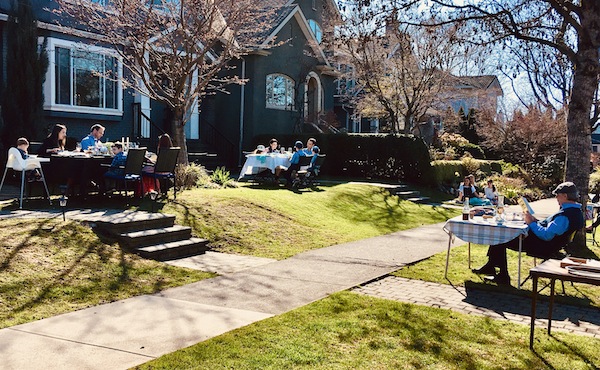
(photo by Avi Dolgin)

Families on 23rd Avenue in Vancouver found an innovative way to celebrate Passover. Each family brought their own meal and, while there was no sharing of dishes, everyone participated in reciting the blessings, reading from the Haggadah and singing together. The gathering was organized by Talia and Josh Bender, top left with their children, and Elana and Brian Jacobson, top right with their children.


Israel’s soldiers not forgotten

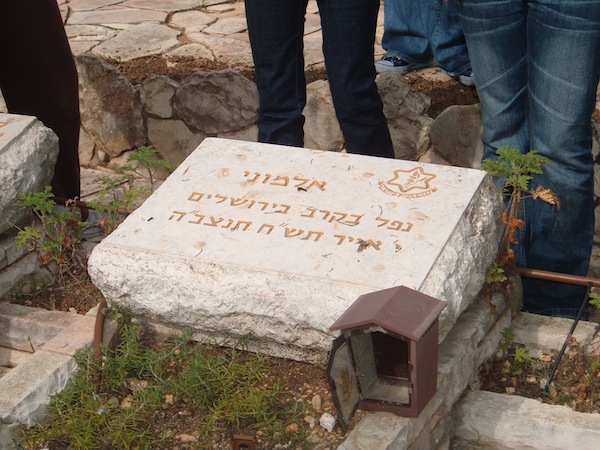
The grave of an unknown soldier on Mt. Herzl in Jerusalem. (photo by Deborah Rubin Fields)

As of Israel Independence Day last year, 23,741 Israeli soldiers had died during their service. The country has come to memorialize its fallen soldiers in one of three ways: 1) most commonly, it provides a grave and a headstone in a military cemetery, with information provided on the soldier, 2) when there is no official grave (that is, when no one really knows where the body of the deceased is), it inscribes the name either on a memorial wall or marker, and 3) it furnishes a grave and a headstone, but little or no information about the deceased is engraved on the stone.

Today, when a soldier dies, the following identification is to be established: the name of the soldier, their army identification number, national civilian identification number, army rank and army unit, as well as their job in the army. When they are buried, the headstone notes the full name of the deceased, their parents’ first names, country of birth (if outside of Israel), date of birth (according to both the Hebrew and Gregorian calendars), aliyah date, date and place of death and age at the time of death. The stone also contains the emblem of the Israel Defence Forces. In a military cemetery, the tombstone’s content reflects a high degree of uniformity. One monument pretty much contains the same details as the next one.

In pre-state Israel and in the War of Independence in 1948, these practices were not yet in place. Young men and women – many of whom had just survived the Holocaust – fought to establish the state. They (and all other soldiers) had little military training. They might not have known Hebrew very well. Not uncommonly, they were the only survivor of their families.

Times were tense, at times verging on the chaotic. The fighting left limited time for socializing, for establishing relationships. So, if a soldier died, it was not surprising to have known them only by their first name. Under the circumstances, most fellow fighters would not have been acquainted with the soldier’s parents, would not have even known their names.

At the end of the War of Independence, about 1,000 of the 4,500 fallen were considered missing. It was the chief rabbi of the IDF, Rabbi Shlomo Goren, who initiated an intensive project of identifying the dead. The establishment of military cemeteries helped the identification process move forward, but, even after that, there remained anonymous soldiers, and headstones with missing information.

Recognizing this situation, Dorit Perry and Uri Sagi started Giving a Face to the Fallen. The organization has been in existence fewer than 10 years. Its team of some 52 volunteer investigators and activists comes from a variety of backgrounds. It includes bereaved family members, friends of fallen soldiers, judges, former career army officers and others. As the organization’s website states, all volunteers believe there is “a duty to remember and, in so doing, to … repay the debt we owe to those who gave their lives for the establishment of the state of Israel.”

All of the volunteers are in a race against time, trying to piece together information on 500 soldiers who fell fighting either in pre-state Israel or in the War of Independence. They ask the following questions: Did you (or maybe your grandfather or an older neighbour) know the fighter we are researching? Maybe you fought with such person either before the creation of the state or in the War of Independence? Maybe you still have pictures of your fighting unit?

The volunteers also try to fill in blanks by asking to see old photos of youth movement activities, aliyah preparation groups (aliyah registration cards have provided investigators with correct birth dates and with the names of relatives, see blog.nli.org.il/en/baumgarten) and family albums. Some soldiers do not even have a photo on file.

Besides trying to find people still alive who were acquainted with these fallen soldiers, volunteers search archives. It is real detective work. When successful, there is the rededication of a tombstone with the added information. To date, out of the more than 800 “untraceable” soldiers, they have pieced together the missing information for 120 of them.

The stories of the fallen soldiers of this period are poignant. Take the example of Tobias Marmolstein, who came from Bitshekov, Czechoslovakia. His father had died in Tobias’s arms at Mauthausen concentration camp. Twenty-year-old Tobias was killed as his Haganah unit fought to open the road to Jerusalem. He had been in Israel for just nine days. He is buried on Mt. Herzl.

Each life story has its twists and turns. For instance, over two decades passed before Shaul Yekutiel Urbach came to be buried in Israel. He arrived in Palestine in 1939 to visit Tel Aviv relatives. When the Second World War broke out, he was unable to return to his large family in Kielce, Poland, so he volunteered to fight for the British. The British sent him to fight in Greece. There, the Germans took him prisoner. The Nazis sent him to do hard labour in Schlesien, Germany. In a revolt against a Nazi camp officer, Shaul was wounded, and he died in a German hospital. After the war, his only surviving brother, Raphael Fishel – the rest of the family had been murdered at Treblinka – tried to have Shaul’s remains brought to Israel. For 22 years, the British stalled in releasing his body from their military cemetery. Finally, in 1967, Shaul was reinterred, on Mt. Herzl.

Uri Sagi has maintained that a blank headstone or one that is missing information makes the soldier invisible. A fallen soldier, Sagi said, should not be invisible.

As time passes, it becomes harder and harder to find acquaintances and family who can fill in the blanks with firsthand testimony. For more information on Giving a Face to the Fallen, visit latetpanim.org.il.

Deborah Rubin Fields is an Israel-based features writer. She is also the author of Take a Peek Inside: A Child’s Guide to Radiology Exams, published in English, Hebrew and Arabic.

About the Passover cover art

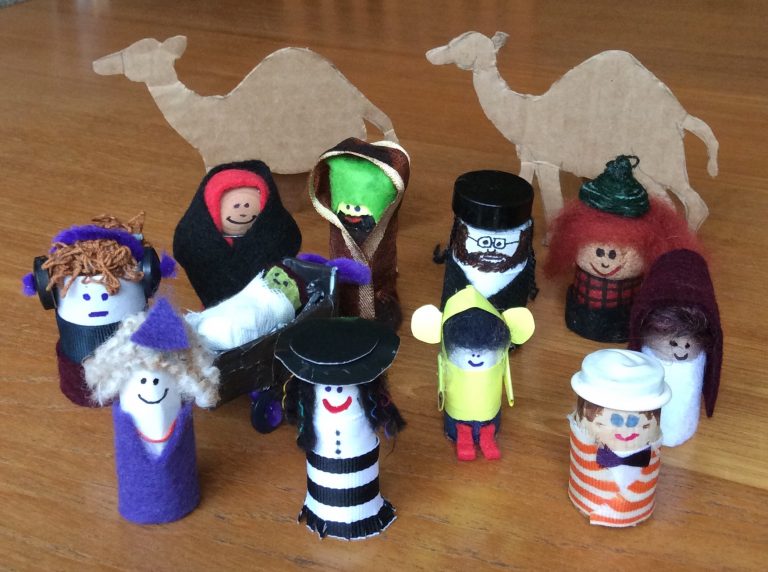
As I always do in anticipation of needing an image for the Jewish Independent’s Passover issue, I started with an internet search. This Passover, I was led to creativejewishmom.com, which features creative projects parents can do with their kids. The Crossing the Red Sea Kid’s Craft captured my imagination. Not one to let the lack of children in my immediate vicinity stop me, I collected the materials necessary and learned to use a glue gun. Through the generosity of a few friends, I didn’t have to buy anything to make the diorama on this issue’s cover.

To capture the notion that, in every generation, we are to regard ourselves as if we personally left Egypt, I created a variety of Israelites, from Moses, Miriam and Aaron leading the group, to a Middle Eastern family from an indeterminate era to a 1920s dandy, a Mary Poppins-inspired woman in a fancy black hat and a Chassid. A teen wears headphones, a toddler wears a mouse-ear raincoat and a girl in a wheelchair negotiates the streambed with the help of a Beatnik.


The project took hours. The logistics of taking a photo that would fit within the parameters of the newspaper’s cover took almost as long to figure out as did the creation of the 29 Israelites, two load-carrying camels, two carts full of supplies, six waves and one streambed “staircase.” The wooden donkey near the back of the image is the only figure I did not make – JI production manager Josie Tonio McCarthy donated it to the effort; she bought the carving on a trip to Israel and we both thought it was appropriate to include, as the travelers’ destination is, of course, the Promised Land.

Wishes for a healthy and meaningful Passover, and a chag sameach.

Just a reminder: The Jewish Independent is now on a publishing hiatus. Our next issue will be April 24 or May 1, depending on the COVID-19 situation. Email editor@jewishindependent.ca with story ideas and sales@jewishindependent.ca for ad bookings.

Post-seder meat dishes

After eating all our wonderful family tradition seder dishes, I find it fun to try out meals that I haven’t before and that are not from my cultural background. Here are some you might want to try.

MATZAH MEAT PIE

(Egyptian-born Claudia Roden is the master of Middle Eastern food and author of 20 cookbooks. Now 84 years old, she lives in London. I met her in the 1970s, when she came to Israel and we had a wonderful visit. This is her recipe from the New York Times Passover Cookbook, adapted from The Book of Jewish Foods, which she wrote. It makes four to six servings.)

1 large chopped onion
3 tbsp vegetable oil
1 1/2 pounds ground lamb or beef
salt and pepper to taste
1 tsp cinnamon
1/2 tsp allspice
2 tbsp raisins
2 tbsp pine nuts or walnuts
1 cup warm beef stock
5-6 matzot
1 small egg, beaten

  1. Preheat oven to 375˚F. Spray a pie plate with vegetable spray.
  2. Heat two tablespoons oil in a frying pan and fry onion over medium heat for 10 minutes, until golden. Add ground meat, salt, pepper, cinnamon and allspice. Cook, stirring until meat has browned but is still moist, about 10 minutes. Add raisins.
  3. In another pan, fry the nuts in one tablespoon oil for one minute, stirring until nuts are lightly coloured. Add to meat mixture and stir.
  4. Place beef stock in a large, shallow rectangular pan. Soak matzot one at a time, pressing them gently to absorb the liquid.
  5. Press two or three softened matzot into a pie plate. Place meat mixture on top of matzot. Cover pie with remaining matzot. Brush top with beaten egg. Bake for 30 minutes or until top is golden.

KABSAH
(This recipe comes from It Tastes Too Good to be Kosher by Peter A. Weissenstein and is a Lebanese dish, good for using up leftover lamb or chicken.)

1 pound ground lamb
1 pound ground chicken
4 minced garlic cloves
salt to taste
2 medium, diced onions
1 finely diced large tomato
2 tsp cumin
4 tbsp minced parsley
oil

  1. In a bowl, combine lamb, chicken, garlic, salt, onions, tomato, cumin and parsley and blend.
  2. Heat oil in a frying pan. Spoon mixture into frying pan and fry until well heated. Serve with Israeli salad.

BRISKET MEATBALLS IN TOMATO PASSATA
(Passata is Italian for “go through,” i.e. the cooked tomato puree goes through a special machine. This Italian-influenced dish was created by Hillary Sterling for Vic’s, her New York City restaurant. It makes four servings.)

Meatballs:
1 1/2 cups crumbled, unsalted matzah
2 1/2 tbsp water
1 1/4 pounds ground brisket
1 large egg
1 tbsp olive oil
salt to taste
1 1/2 tsp ground fennel seeds (optional)
1/2 tsp crushed red pepper
pepper to taste

Passata:
1/4 cup sliced garlic
1 1/2 tbsp olive oil
1 28-ounce can crushed, drained plum tomatoes
1/8 cup fresh marjoram leaves
2 1/2 four-by-one-inch orange peel strips
salt and pepper to taste

  1. Preheat oven to 425˚F. Set a wire rack inside a large baking sheet and spray with vegetable oil.
  2. Combine crumbled matzah and water in a bowl. Add brisket, egg, oil, salt, fennel (if using), red pepper and black pepper. Mix with hands until combined. Shape into eight meatballs. Arrange meatballs on sprayed wire rack. Bake until browned, about 22 minutes.
  3. Meanwhile, in a frying pan, cook garlic and oil for passata, stirring often, a minute and a half. Add crushed tomatoes, marjoram leaves, orange peel strips, salt and red pepper. Bring to a boil then remove from heat.
  4. Transfer meatballs to tomato passata in frying pan. Garnish with crumbled matzot, fresh marjoram leaves and chile oil. Serve warm.

Sybil Kaplan is a journalist, lecturer, book reviewer and food writer in Jerusalem. She created and leads the weekly English-language Shuk Walks in Machane Yehuda, she has compiled and edited nine kosher cookbooks, and is the author of Witness to History: Ten Years as a Woman Journalist in Israel.

Holiday candy, cookies

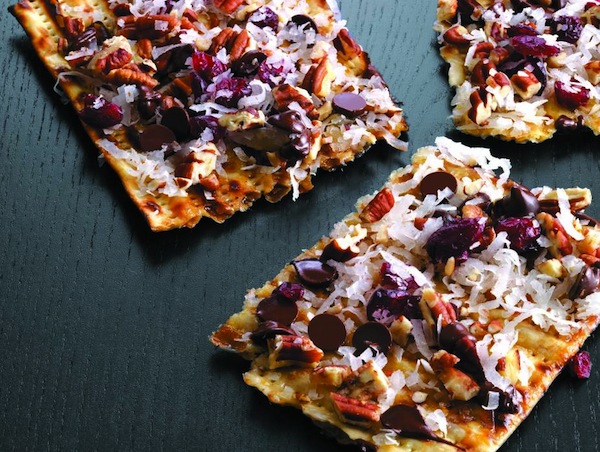
Susie Fishbein’s Butterscotch Matzah Crunch Bars. (photo from kosher.com)

While it is no problem to find candy and cookies that are kosher for Passover, it is also easy to make them yourself. In addition to whatever you may buy at the store, here are some recipes for homemade treats that I enjoy.

MARILYN’S COCONUT MATZAH BALLS
(Marilyn, a former college teacher, now in her 90s, and I were neighbours 40 years ago and are still talk-on-the-phone-daily friends. She came to Israel from Boston in 1949. This recipe makes 20 large balls.)

1/3 cup vegetable oil
1 egg
1/4 cup water or coffee or orange juice
1/2 cup sugar
1/2 cup matzah meal
1/4 cup ground nuts (of your choice)
1/4 cup cocoa
2 tbsp cognac, wine or cherry brandy
1 tbsp coconut

  1. Mix oil, egg, water, coffee or orange juice, sugar, matzah meal, nuts, cocoa and liquor in a bowl. Add more matzah meal if needed to make the dough stick together.
  2. Shape into balls. Place coconut in a bowl and roll each ball in coconut. Refrigerate.

MY FAVOURITE FABULOUS FAUX TOFFEE
(makes three to four dozen two-inch pieces)

6-inch square matzot (enough to cover an 11-by-17-inch cookie sheet)
1 cup butter (I use unsalted pareve margarine)
1 cup brown sugar (I use 2/3 diabetic sugar and 1/3 cup regular)
12 ounces chocolate chips
1 cup chopped nuts

  1. Preheat oven to 350˚F. Generously grease the cookie sheet.
  2. Arrange matzot to cover entire surface.
  3. In a saucepan, combine butter or margarine and brown sugar. Bring to a boil, reduce heat and simmer, stirring continually, for three minutes. Pour over matzot and bake for five minutes.
  4. Remove from oven and cover with chocolate chips, swirling until melted and evenly spread. Sprinkle with nuts. Cool and refrigerate.
  5. Break into pieces when completely cool.

BUTTERSCOTCH CRUNCH BARS
(This is my adaptation from Passover by Design by Susie Fishbein, kosher.com.)

12 tbsp butter or unsalted pareve margarine
1/2 cup brown sugar
4 pieces matzot
1 cup chopped nuts
1 cup shredded coconut
1/2 cup chocolate chips

  1. Preheat oven to 350˚F. Cover a cookie sheet with foil.
  2. Line cookie sheet with matzot, breaking as necessary to fit.
  3. In a saucepan, melt butter or margarine and brown sugar, whisking until the mixture is melted and smooth.
  4. Pour brown sugar mixture over matzot, making sure every surface is covered. Bake for 10 minutes.
  5. In a bowl, toss nuts, coconut and chocolate chips. When matzot are baked enough, remove pan from oven and sprinkle an even layer of coconut mixture on top. Cut into bars while warm.

LIL’S PASSOVER APRICOT SQUARES
(Lil was a friend from our Overland Park, Kan., synagogue. This recipe makes two dozen.)

1 2/3 cups matzah cake meal
1/3 cup sugar
1/3 cup finely ground toasted almonds
1/3 cup oil
2 tbsp lemon juice
1 tbsp grated lemon zest
1 tsp vanilla
2 1/2 to 3 cups apricot preserves

  1. Preheat oven to 350˚F. Grease a rectangular glass baking pan with vegetable cooking spray.
  2. In a mixing bowl, combine matzah cake meal, sugar and almonds and blend.
  3. In another bowl, mix oil, lemon juice, lemon zest and vanilla. Add to dry ingredients and stir with a fork.
  4. Press 2/3 of the mixture on the bottom of the baking pan. Bake for 25 minutes. Remove from oven and cool slightly.
  5. Spread apricot preserves on crust. Sprinkle remaining half of cake meal mixture on top. Return to oven and bake 25 minutes. Cool then cut into squares.

Sybil Kaplan is a journalist, lecturer, book reviewer and food writer in Jerusalem. She created and leads the weekly English-language Shuk Walks in Machane Yehuda, she has compiled and edited nine kosher cookbooks, and is the author of Witness to History: Ten Years as a Woman Journalist in Israel.

Importance of this tradition thing

Passover traditions like the seder connect family and friends, and remind us who we are. (photo from flickr.com)

“I know I read an article somewhere that the greatest number of suicides happen on holidays,” Naomi said to her mother.

Rebecca ignored her. “Just keep lining the shelves.”

“But it makes sense, truly it does. Why are we taking this perfectly clean kitchen apart and practically rebuilding it? Does it say anywhere in the Bible that you go straight to hell if you don’t drop with exhaustion the week before Pesach?”

“This is the way my mother did it, and her mother did it, and one day you’ll do it for your kids, too.”

“You’re kidding yourself. If you think I’d ever inflict all this work on my daughter, you’re crazy. And why doesn’t Joe have to help?”

“He will. He’ll kosher the stove and the sinks.”

“And that’s another thing. Two minutes with a blowtorch and then he’ll pour a kettle of water. Big deal. And Dad doesn’t even do that.”

“He conducts the seder.”

“Another big deal. We take the place apart, vacuum chairs and wash curtains and change over dishes, not to mention 40 kilos of kneidl and all that stuff that gives you indigestion. What am I saying, indigestion? All those eggs – you’re probably giving us a gift of coronary heart disease. Jesus!”

“Naomi, stop it.”

“I’m sick of it. I want to escape like Faye.”

Rebecca’s lips tightened. “Fagie’s coming to the seder, too.”

But Naomi was not to be sidetracked. “Fagie, what a name! No wonder she rebelled. Naomi and Joseph, they’re bad enough. But Fagie, what were you thinking of?”

“It’s a good Jewish name. I was thinking of my grandmother. If you and your sister could have known her, you’d understand. The least I could do was keep her name alive.”

The spotless refrigerator was being polished within an inch of its life. Naomi sat down and watched her mother.

“I thought Passover celebrated freedom from slavery. But every year, you become a slave and you make me one, too. If you think you’re giving me wonderful memories, forget it. As soon as I can leave home, I will. Faye told me the best thing about marriage was being able to run her house like the 20th century. Now we’re in the 21st, for chrissake.”

“I hate it when you talk like that.”

“Like what?”

“So tough. All those profanities. What happened to femininity?” she asked her daughter sadly.

“Feminism came along, only you’ve never heard of it. Dad and Joe get out of everything ’cos they’re men. You’re the biggest chauvinist ever, because you not only condone this status quo, you actually perpetuate it.”

Rebecca sighed. “You don’t understand. Neither does Fagie.”

“You bet we don’t. Here, I’ve lined the last bloody shelf. I’m going out.”

“Where?”

“Out, as in O-U-T.”

“When will you be back?”

“If I had my way, it’d be around May or June – after Pesach.” She slammed the door. Rebecca heard the car start up. Her eyes filled with tears. She was exhausted. “This is gratitude,” she thought bitterly. “Here’s Naomi, barely 18, with her own car. We were married six years before we had one.”

Fagie started her marriage with all the things that she and Sam still don’t have after 27 years. And look how she is bringing up Brendan. Brendan! What sort of name is that? No wonder Fagie and Joel hadn’t wanted to give him a brit. If she and Sam hadn’t insisted, their grandson wouldn’t even have had that. They’d treated his Hebrew name, Baruch, as some sort of joke. Well, maybe in their circles it sounded strange. But at least among the family…. Everything with Fagie was a war. If she bought the child a kippah, Fagie would get upset. If she wouldn’t eat in her daughter’s treif house, it meant another argument. What did you have children for?

She heard loud music from upstairs. The Grateful Dead. No wonder they were grateful – they can’t hear the cacophony, she surmised.

When the key turned in the lock, she didn’t have the strength even to go and say hello to Sam. He wandered into the kitchen. “It looks beautiful,” he said, patting her shoulder and taking in the sparkling clean room.

“To us, maybe.”

“What’s wrong? Fagie been getting to you?”

“Not just her. Naomi’s just as bad now.”

Sam sat down heavily. “I don’t understand it. We sent them to day school – forked out in a year more than our education cost in a lifetime. And what do they give back? Where’s Joe?”

“Can’t you hear? He’s studying. That’s his usual accompaniment.”

“Even so, he’s a good student. He’ll make us proud one day. He’s talking about medicine or law, maybe architecture….”

“We’re kidding ourselves, Sam. Even if we’re proud of him, he’ll be ashamed of us.”

“No, not Joe. Why do you say that?”

“Because we’re fighting a losing battle. The things that are important to us are hateful to them.”

Sam’s shoulders sagged. “Joe’s turning his back on our traditions, too?”

“Not yet. He’s only 14. But he will – give him a few years.”

Wearily, Rebecca made dinner. The three of them ate in near silence. Joe had a book next to his plate and didn’t seem to notice. He had already left for school next morning when Rebecca, Sam and Naomi sat down for breakfast. Naomi avoided her mother’s eyes. “I’m sorry about yesterday.”

“No, you’re not,” Rebecca answered, “you meant it.”

“I just wanted you to understand….”

“Oh, I understand. Your father and I made a decision last night. You tell her Sam.”

He cleared his throat. “Naomi, since Pesach is so distasteful to you, you can go and stay with your sister. Your mother and I are taking Joe and going away for the week. That kosher guest house in the mountains –”

“You mean no seder?”

“What for? For Fagie’s family, who barely tolerate it. For you, who finds it such a chore? You know what it says in the Zohar? It says a little hurt from kin is worse than a big hurt from a stranger. Who needs it?” He pushed his chair back abruptly and, a minute later, they heard the front door close.

Naomi pushed the food around on her plate. “I think you’re overreacting. We always have a seder.”

“We always used to have a seder. We’re not going to do it any more. I didn’t care about the work, the exhaustion, because I thought it meant something. If it doesn’t, there’s no point.”

“It meant something to you and Dad.”

“So, we’ll sit at someone else’s seder. Naomi, go to university. You’ll be late for class.”

An hour later, the telephone rang. “Mum, it’s Fagie.”

“Oh, it’s Fagie today. What happened to Faye?”

“Don’t be sarcastic Mum – it doesn’t suit you. Listen, are you home? Can I come round?”

“What for?”

“I need to talk to you.”

“I’m not babysitting if that’s what you want.”

“Brendan’s at play group. I just want to talk to you.”

“I don’t think there’s anything to talk about. But come if you want.”

Thirty minutes later, Fagie’s car drew up. Rebecca poured her a coffee and pushed it towards her.

“So?”

“It’s about the seder.”

“Naomi didn’t waste much time. What’s wrong? You don’t want your sister’s company for a week?”

“Please listen. It’s not right what you’re doing.”

“Not right? For whom?”

“For anyone. Dad will hate not conducting the seder.”

“He’ll survive.”

Fagie’s voice trembled. “Maybe we won’t.”

“What does that mean?”

“I don’t know how to say this. It’s just….”

Rebecca remained silent, not attempting to help.

“It did mean something to us – me and Naomi – even Joel.”

“What did it mean?”

“It meant we were a family. It kind of bound us together. We need it. Brendan needs it. That once a year at least – to remind us who we are.”

“Who are you exactly? You can go and celebrate Easter. It’s all the same to you.”

Fagie’s voice trembled. “You’re making it hard for me. Mum, it’s true we don’t keep all the things you and Dad do. Most people don’t anymore.”

“And that makes it right?”

“Yes – no – I don’t know. It’s hard for us, to be different from our friends. But we need something. We need to know it’s there for us.”

“Not good enough. What happens when we go?”

“Maybe we’ll take it on then. When there’s no one else.”

“Why would you want to do that, if it’s not meaningful now?”

“For our children. I can’t explain. We can only give up these – traditions – because we know you still keep them. That they’re there for us to come back to. Sure, we ridicule them, but it’s like a family. We insult one another all the time because it’s easier than saying, ‘I love you and I need you.’ Do you understand me?”

Fagie was crying openly now. Rebecca didn’t trust herself to speak.

Three nights later, the candles were lit in the candelabra in Rebecca’s dining room, the flames casting shadows on the snowy white tablecloth. Sam sat at the head of the table and inspected the seder plate with its three matzot, the parsley, saltwater, horseradish, charoset, shank bone and roasted egg. He planned where to hide the afikoman, so that it would not be too hard for Brendan to find. Joe was filling the wine glasses, with the extra big one for the prophet Elijah, while Naomi handed out Haggadot. His grandson sat between Fagie and Joel, his face flushed with excitement. Sam’s eyes met his wife’s, which were moist with unshed tears, as were his.

“Baruch atah,” he began. “Blessed art Thou, O Lord our God, King of the Universe, who created the fruit of the vine.”

Dvora Waysman is a Jerusalem-based author. She has written 14 books, including The Pomegranate Pendant, which was made into a movie, and her latest novella, Searching for Sarah. She can be contacted at dwaysman@gmail.com or through her blog dvorawaysman.com.

Pesach: a tale of two stories

“The Crossing of the Red Sea” by Nicolas Poussin, 1634. (photo from wikimedia)

We are a people with many memories, many stories, and who we are has been shaped by the stories we remember and tell.

More than any other holiday, Pesach is about remembering and passing that memory down to the next generation. Every Jew is commanded to see themselves as if they came out of Egypt, and to tell their Egypt story to their children. The telling of this story is not mediated by teachers or rabbis, nor is it told in a communal framework. The setting of the seder is one of family and immediate friends, and the responsibility is upon every one of us to decide how we convey the story.

What makes this particularly challenging is that, beyond the complicated family dynamics, a Haggadah that is deeply problematic and different sensibilities with regard to what needs to be done, we have inherited two different stories. The challenge is not merely how to tell the story, but which story to tell.

One story, which dominates much of the Haggadah, not to speak of the story as told in the Torah, focuses on Pesach as a story of exodus, of the Jewish people being freed by God from the slavery of Egypt. “I am the Lord. I will free you from the labours of the Egyptians and deliver you from their bondage. I will redeem you with an outstretched arm and through extraordinary chastisements. And I will take you to be my people, and I will be your God.” (Exodus 6:6-7)

More than freedom and salvation, Pesach is a story of the election of the Jewish people, as God pours down God’s wrath on those who enslave the chosen ones and redeems us out of the hands of Egypt to be God’s chosen people. Each plague, told and magnified, is an expression of love, a gift of betrothal of God to us, an offering that bonds us to one another. “I the Lord am your God who brought you out of the land of Egypt, the house of bondage: you shall have no other gods besides me.” (Exodus 20:2-3)

One of the core consequences of this election narrative under Jewish law is the sanctioned discrimination between Jew and non-Jew, between the Children of Israel and the nations of the world. Because God saved us, all of us, from the slavery of Egypt, Jews are all equal, and no Jew can take another Jew as a slave. However, those who are not the recipients of the gift of exodus, the non-Jews, can become our slaves (Leviticus 25). When we go to war, even wars of aggression, the God who took us out of Egypt will always fight on our side, because the moment of election creates an us-them dichotomy in which God is always with us (Deuteronomy 20). Idolatry is neither false nor futile. It is the worship allotted by God to the non-elected. We, the chosen people, are alone commanded to worship God. The God who saved us in Egypt is our God alone (Deuteronomy 4).

This tale of the story of Egypt finds its culmination in our traditional Haggadah, in which one of its concluding prayers is a petition to God to “Pour out your wrath on the nations that do not know you…. Pursue them with anger and destroy them from beneath the heavens of the Lord.”

There is a second story of Pesach, a story in which neither the exodus nor its accompanying plagues takes central stage, but rather the hundreds of years of our subjugation in Egypt. It is to this memory that the core symbols of the holiday – matzah, the poor person’s bread, charoset, the paste that resembles mortar, and maror, the bitter herb, which cause us to relive the experience of pain – all direct us.

It is this memory that shapes the most-repeated commandment in the Torah: “The stranger who resides with you shall be to you as one of your citizens: you shall love him as yourself, for you were strangers in the Land of Egypt.” (Leviticus 19) The story of Egypt is not one of us-them, but of us being them, of us being members of the community of the downtrodden, and the subsequent obligation to treat all who are in need, Jew and non-Jew alike, as equal members of our society.

In an interesting twist on this story, the Ten Commandments obligate us to rest on the Sabbath, “so that your male and female slave may rest as you do. Remember that you were a slave in the Land of Egypt, and the Lord your God freed you from there with a mighty hand and an outstretched arm: therefore, the Lord your God has commanded you to observe the Sabbath day.” (Deuteronomy 5)

It is not merely that because we once were slaves we are bonded to all those in need. The redemption from Egypt is no longer exclusively the moment of election of us, but rather an expression of God’s care and compassion for all who are enslaved. Both our slavery and our salvation unite us with God, in a common mission to bring freedom and equality to our world.

It is with this idea that we begin to tell the story of Egypt in the traditional Haggadah. “This is the bread of affliction that our forefathers ate in the Land of Egypt. All who are hungry let them come and eat.” All, and not merely fellow Jews.

Pesach is a tale of two stories. Each has shaped who we are. As we tell our stories and pass them down to the next generation, it is our obligation to take responsibility for what will define us in the future and what will determine our religious and national identity. The choice is ours. As you tell the stories this year, choose wisely. Our future and the future of Israel depend on it.

Rabbi Dr. Donniel Hartman is president of the Shalom Hartman Institute and author of the 2016 book Putting God Second: How to Save Religion from Itself. Articles by Hartman and other institute scholars can be found at shalomhartman.org.

Symbolic treats for Purim

While hamantashen are one of the most known Ashkenazi treats, many other foods are associated with Purim. (photo by Rebecca Siegel)

In the Book of Esther, all we are told is that letters were sent to the Jews in the provinces, telling them to have days of feasting and gladness. Fourth-century scholar Rava interpreted this to mean a seudat Purim, a meal in the late afternoon, to differentiate Purim from other days.

There are no rituals attached to the seudah, and no special Kiddush is said, though some people make up a Purim Kiddush, which is nonsense or a parody on something in the Torah.

Kalonymos ben Kalonymos, a French writer, philosopher and translator who lived in the 13th and 14th centuries, wrote a parody of a talmudic tractate, called Masekhet Purim, citing 30 different dishes to eat on Purim. He included chestnuts, duck, venison, goose and pigeon.

One custom, particularly of Jews of Middle Eastern backgrounds but also of some Ashkenazim, is to serve dishes with chickpeas on Purim. Why is this done? They say, in order to remind us that, to keep kosher, Esther lived on vegetables, notably beans and peas.

Another custom, according to the late Gil Marks in the Encyclopedia of Jewish Food, is to eat turkey, because Europeans had thought the bird came from India and the Book of Esther says Ahasuerus ruled from India to Kush. The Hebrew word for India, the country, and turkey, the animal, is hodu. Another idea is that the turkey bird is very foolish, and so was Ahasuerus.

Some people also serve kreplach, the triangular-shaped, meat-filled, savoury pastry on Purim. They do so because the meat inside is prepared by chopping, which is a form of “beating,” akin to the stamping of feet on the floor to drown out Haman’s name.

In the 17th century, European Jews made a dish called megillah kroyt, consisting of sauerkraut, raisins and honey. A stringy dish, it symbolized the rope used to hang Haman.

In her book Quiches, Kugels and Couscous, on Jewish cooking in France, Joan Nathan writes that Jews of Alsace made Alsatian Chouroute, sauerkraut with sausage and corned beef, because the sausage hangs in butcher shops and reminds them of Haman. The Alsatians also call the corned beef “the Haman.”

At the actual seudah, Marks says that Ashkenazim often serve koyletsh, or keylitsh in Russian – a long, braided challah symbolizing the rope on which Haman was hanged. Other Ashkenazi dishes include kreplach in chicken soup, knishes, pirogen (filled, boiled, pasta dumplings), stuffed roast chicken or veal breast, stuffed cabbage, and tzimmes.

Some Sephardim serve breads or foulares (pastries filled with long-cooked eggs), sambusak (meat turnovers), stewed chicken, and rice with chickpeas or nuts.

According to Encyclopedia of Jewish Food, because the name of G-d is not mentioned in the Book of Esther, “the sense of the mysterious and hidden extends even to the food.” In other words, we cannot see the fillings inside and that alludes to “the many intrigues, secrets and surprises unfolding in the Purim story.”

The sweets served on Purim symbolize a good “lot” and a sweet future. In fact, Muslims refer to Purim as Id-al-Sukkar, the Sugar Holiday.

The most important aspect of many Purim pastries is their shape. Most Ashkenazi Jews only know of hamantashen, the name for which comes from the German mohn (meaning poppy seeds) and taschen (referring to pockets). Some say the pockets refer to Haman, who stuffed his pockets with bribe money.

The original name was mohntaschen, and the tradition of eating them may date back as far as the 12th century. Shmil Holland, the Israeli historian, caterer and cook, says, when Jews fled Germany for Eastern Europe in the late Middle Ages, they took the poppy seed pastry with them and added the Yiddish prefix “ha,” thus making it hamantash. The Midrash, however, says, while reflecting on his plan to get rid of the Jews, Haman realized the three Patriarchs would intercede. Thus, the pastry is triangular in shape.

Sybil Kaplan is a journalist, lecturer, book reviewer and food writer in Jerusalem. She created and leads the weekly English-language Shuk Walks in Machane Yehuda, she has compiled and edited nine kosher cookbooks, and is the author of Witness to History: Ten Years as a Woman Journalist in Israel.

Why groggers on Purim?

(photo from ajudaica.com)

One of the most popular customs for Purim is to drown out the name of the villain, Haman, with a noisemaker. In Hebrew, it is called a ra’ashan; in Yiddish, it is a grogger, which comes from the Polish word for rattle.

The origin of this custom comes from the Book of Exodus 17:4: “For I will utterly blot out the remembrance of Amalek from under the Heavens.” Haman’s ancestors were Amalekites.

While the custom of using a noisemaker during the reading of the Megillah is more recent among Sephardi Jews, some form of grogger has been used primarily among Ashkenazi Jews since the Middle Ages.

There are records that children in ninth-century France and Germany used groggers on Purim. They took flat stones or wooden paddles on which Haman’s name was inscribed and beat them together when Haman’s name was mentioned in the reading of Megillat Ester. It was also popular to write Haman’s name on the soles of their shoes and then stamp their feet when his name was read, thus erasing his name.

Today, the traditional grogger looks like the Hebrew letter dalet, a horizontal piece made of wood or metal with a rotating cylinder or tongue attached to a vertical handle, which, when turned, makes noise.

One also finds groggers decorated with illustrations from the Book of Esther, plastic groggers with clapping hands, and designs in wood and metal. Schoolchildren often make their own containers of paper or metal and then fill them with beans, so that, when they are shaken, they make noise.

Whatever grogger you use for Purim, just make sure you do it loud and often, for, in each generation, a Haman has arisen to live among us!

Sybil Kaplan is a journalist, lecturer, book reviewer and food writer in Jerusalem. She created and leads the weekly English-language Shuk Walks in Machane Yehuda, she has compiled and edited nine kosher cookbooks, and is the author of Witness to History: Ten Years as a Woman Journalist in Israel.